
Naming What We Know Threshold Concepts of Writing
- Slides: 13
Naming What We Know: Threshold Concepts of Writing Studies Introduction: Coming to Terms by Kathleen Blake Yancey Michael Portnoy ENG 6937
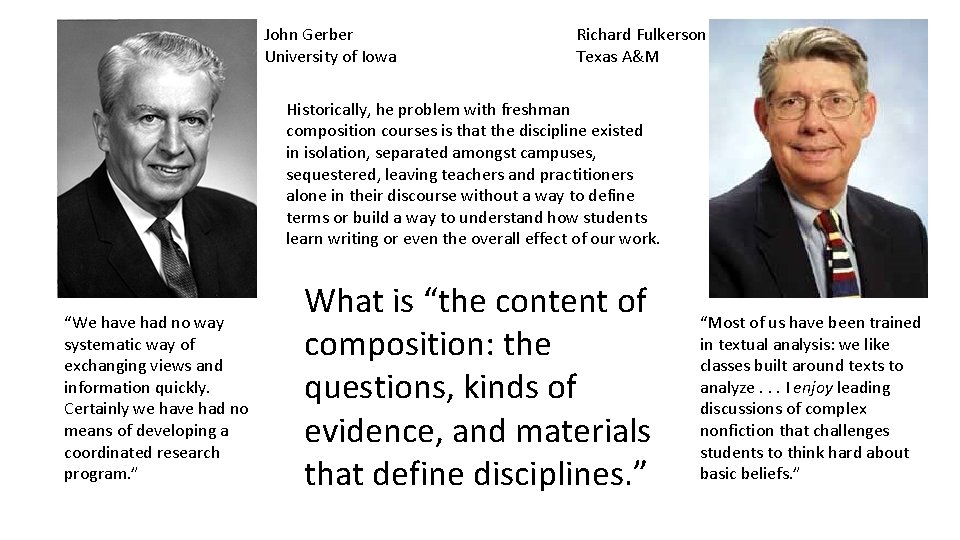
John Gerber University of Iowa Richard Fulkerson Texas A&M Historically, he problem with freshman composition courses is that the discipline existed in isolation, separated amongst campuses, sequestered, leaving teachers and practitioners alone in their discourse without a way to define terms or build a way to understand how students learn writing or even the overall effect of our work. “We have had no way systematic way of exchanging views and information quickly. Certainly we have had no means of developing a coordinated research program. ” What is “the content of composition: the questions, kinds of evidence, and materials that define disciplines. ” “Most of us have been trained in textual analysis: we like classes built around texts to analyze. . . I enjoy leading discussions of complex nonfiction that challenges students to think hard about basic beliefs. ”
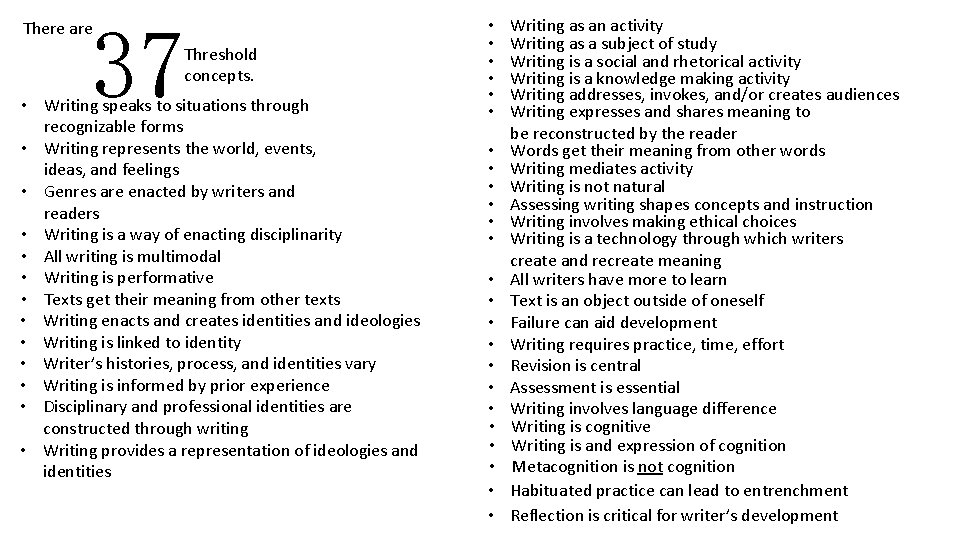
37 There are Threshold concepts. • Writing speaks to situations through recognizable forms • Writing represents the world, events, ideas, and feelings • Genres are enacted by writers and readers • Writing is a way of enacting disciplinarity • All writing is multimodal • Writing is performative • Texts get their meaning from other texts • Writing enacts and creates identities and ideologies • Writing is linked to identity • Writer’s histories, process, and identities vary • Writing is informed by prior experience • Disciplinary and professional identities are constructed through writing • Writing provides a representation of ideologies and identities • • • • • • Writing as an activity Writing as a subject of study Writing is a social and rhetorical activity Writing is a knowledge making activity Writing addresses, invokes, and/or creates audiences Writing expresses and shares meaning to be reconstructed by the reader Words get their meaning from other words Writing mediates activity Writing is not natural Assessing writing shapes concepts and instruction Writing involves making ethical choices Writing is a technology through which writers create and recreate meaning All writers have more to learn Text is an object outside of oneself Failure can aid development Writing requires practice, time, effort Revision is central Assessment is essential Writing involves language difference Writing is cognitive Writing is and expression of cognition Metacognition is not cognition Habituated practice can lead to entrenchment Reflection is critical for writer’s development
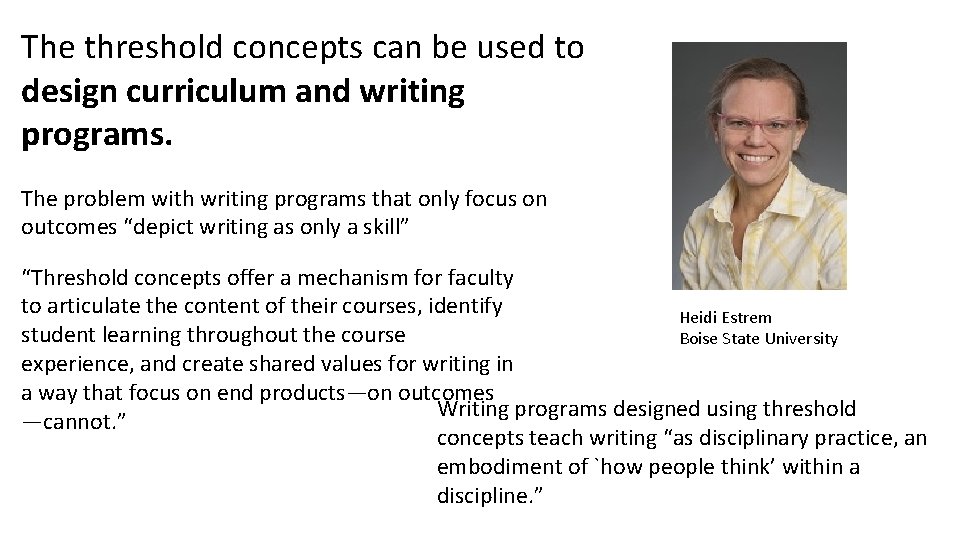
The threshold concepts can be used to design curriculum and writing programs. The problem with writing programs that only focus on outcomes “depict writing as only a skill” “Threshold concepts offer a mechanism for faculty to articulate the content of their courses, identify Heidi Estrem student learning throughout the course Boise State University experience, and create shared values for writing in a way that focus on end products—on outcomes Writing programs designed using threshold —cannot. ” concepts teach writing “as disciplinary practice, an embodiment of `how people think’ within a discipline. ”
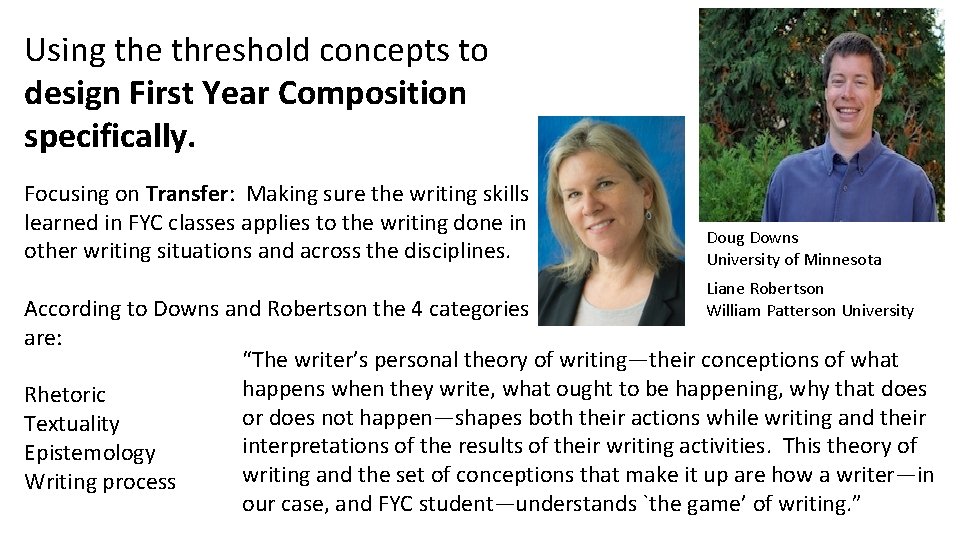
Using the threshold concepts to design First Year Composition specifically. Focusing on Transfer: Making sure the writing skills learned in FYC classes applies to the writing done in other writing situations and across the disciplines. Doug Downs University of Minnesota Liane Robertson William Patterson University According to Downs and Robertson the 4 categories are: “The writer’s personal theory of writing—their conceptions of what happens when they write, what ought to be happening, why that does Rhetoric or does not happen—shapes both their actions while writing and their Textuality interpretations of the results of their writing activities. This theory of Epistemology writing and the set of conceptions that make it up are how a writer—in Writing process our case, and FYC student—understands `the game’ of writing. ”
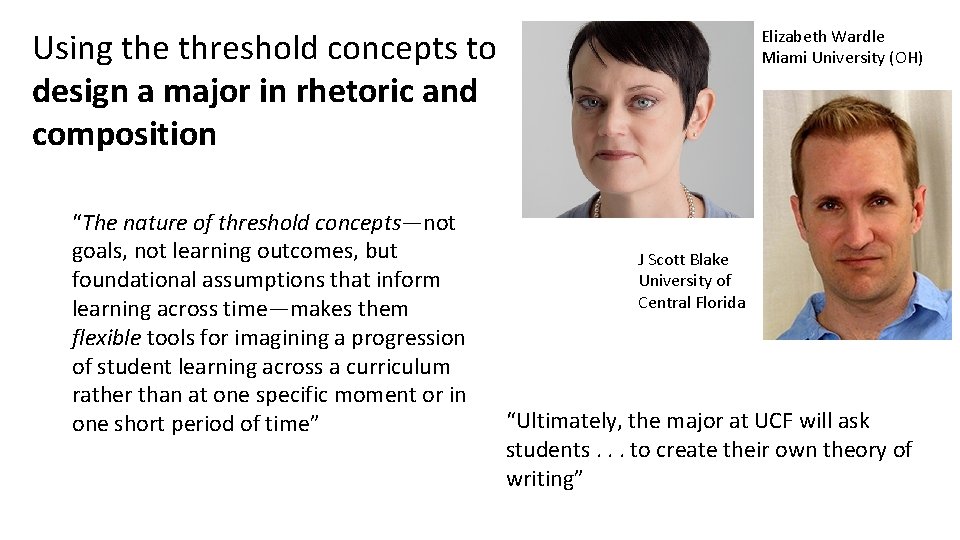
Using the threshold concepts to design a major in rhetoric and composition “The nature of threshold concepts—not goals, not learning outcomes, but foundational assumptions that inform learning across time—makes them flexible tools for imagining a progression of student learning across a curriculum rather than at one specific moment or in one short period of time” Elizabeth Wardle Miami University (OH) J Scott Blake University of Central Florida “Ultimately, the major at UCF will ask students. . . to create their own theory of writing”
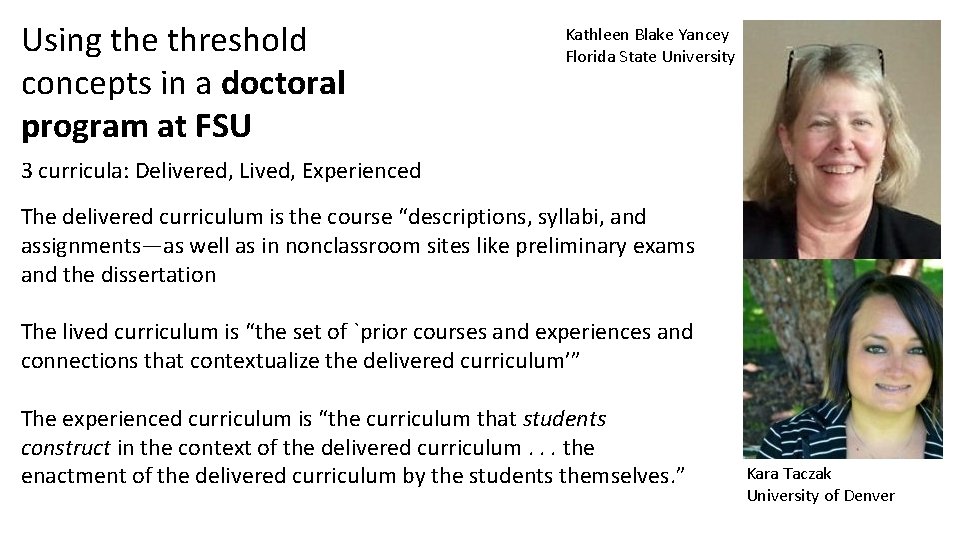
Using the threshold concepts in a doctoral program at FSU Kathleen Blake Yancey Florida State University 3 curricula: Delivered, Lived, Experienced The delivered curriculum is the course “descriptions, syllabi, and assignments—as well as in nonclassroom sites like preliminary exams and the dissertation The lived curriculum is “the set of `prior courses and experiences and connections that contextualize the delivered curriculum’” The experienced curriculum is “the curriculum that students construct in the context of the delivered curriculum. . . the enactment of the delivered curriculum by the students themselves. ” Kara Taczak University of Denver
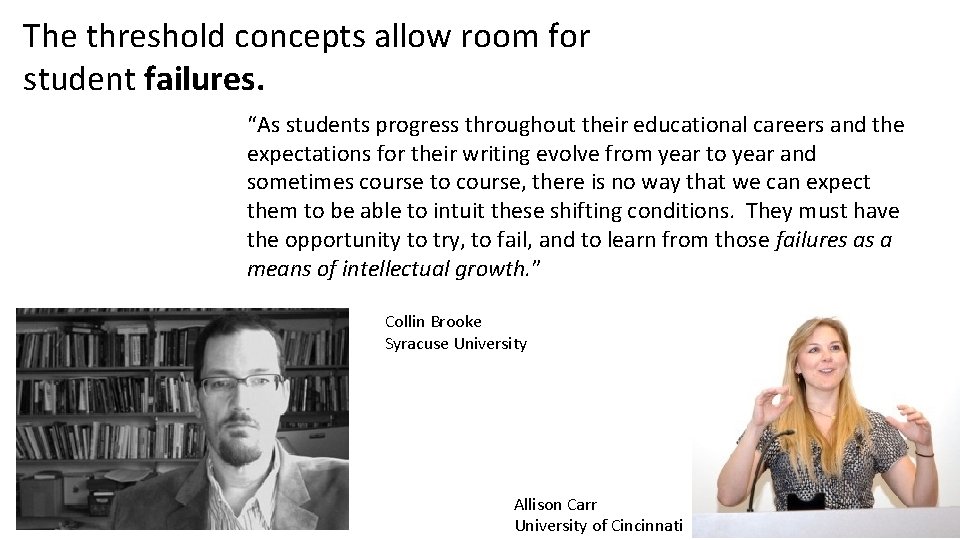
The threshold concepts allow room for student failures. “As students progress throughout their educational careers and the expectations for their writing evolve from year to year and sometimes course to course, there is no way that we can expect them to be able to intuit these shifting conditions. They must have the opportunity to try, to fail, and to learn from those failures as a means of intellectual growth. ” Collin Brooke Syracuse University Allison Carr University of Cincinnati
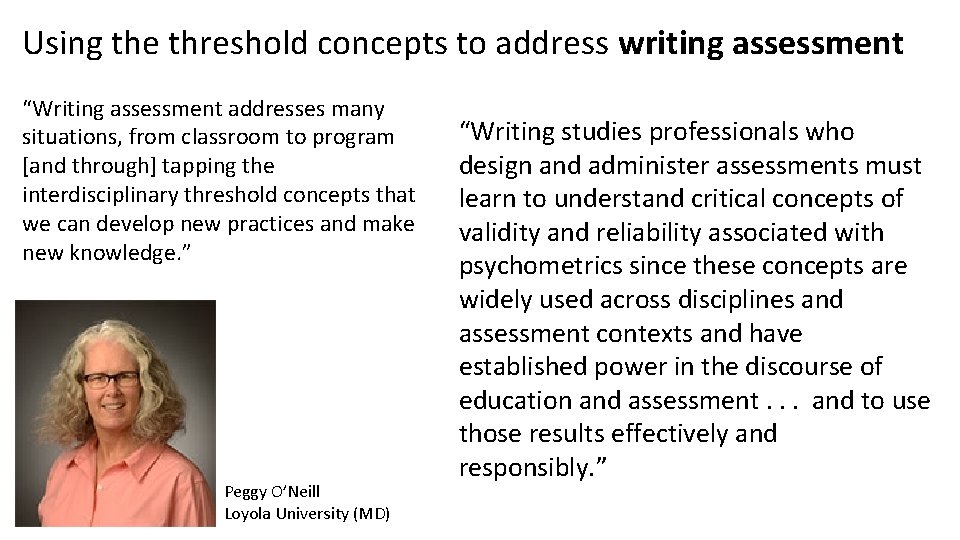
Using the threshold concepts to address writing assessment “Writing assessment addresses many situations, from classroom to program [and through] tapping the interdisciplinary threshold concepts that we can develop new practices and make new knowledge. ” Peggy O’Neill Loyola University (MD) “Writing studies professionals who design and administer assessments must learn to understand critical concepts of validity and reliability associated with psychometrics since these concepts are widely used across disciplines and assessment contexts and have established power in the discourse of education and assessment. . . and to use those results effectively and responsibly. ”
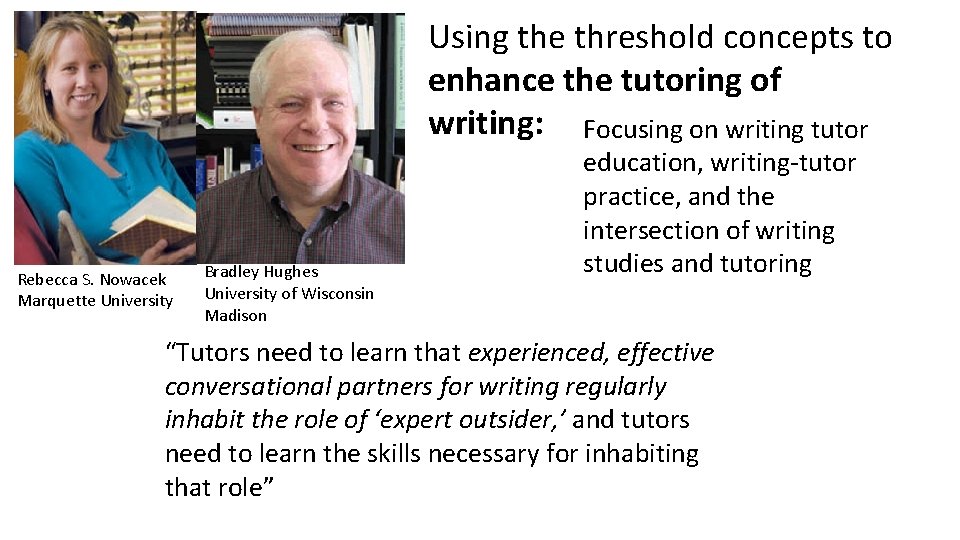
Using the threshold concepts to enhance the tutoring of writing: Focusing on writing tutor Rebecca S. Nowacek Marquette University Bradley Hughes University of Wisconsin Madison education, writing-tutor practice, and the intersection of writing studies and tutoring “Tutors need to learn that experienced, effective conversational partners for writing regularly inhabit the role of ‘expert outsider, ’ and tutors need to learn the skills necessary for inhabiting that role”
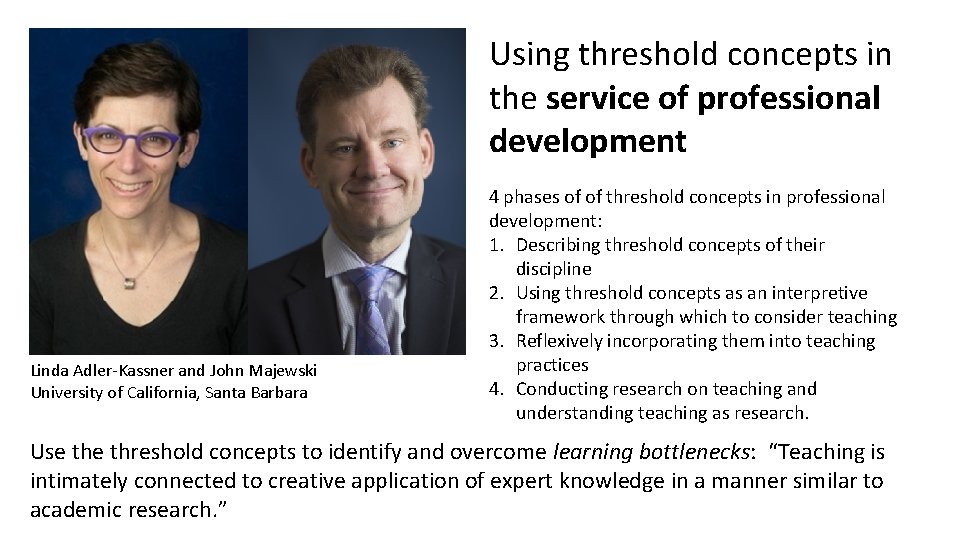
Using threshold concepts in the service of professional development Linda Adler-Kassner and John Majewski University of California, Santa Barbara 4 phases of of threshold concepts in professional development: 1. Describing threshold concepts of their discipline 2. Using threshold concepts as an interpretive framework through which to consider teaching 3. Reflexively incorporating them into teaching practices 4. Conducting research on teaching and understanding teaching as research. Use threshold concepts to identify and overcome learning bottlenecks: “Teaching is intimately connected to creative application of expert knowledge in a manner similar to academic research. ”
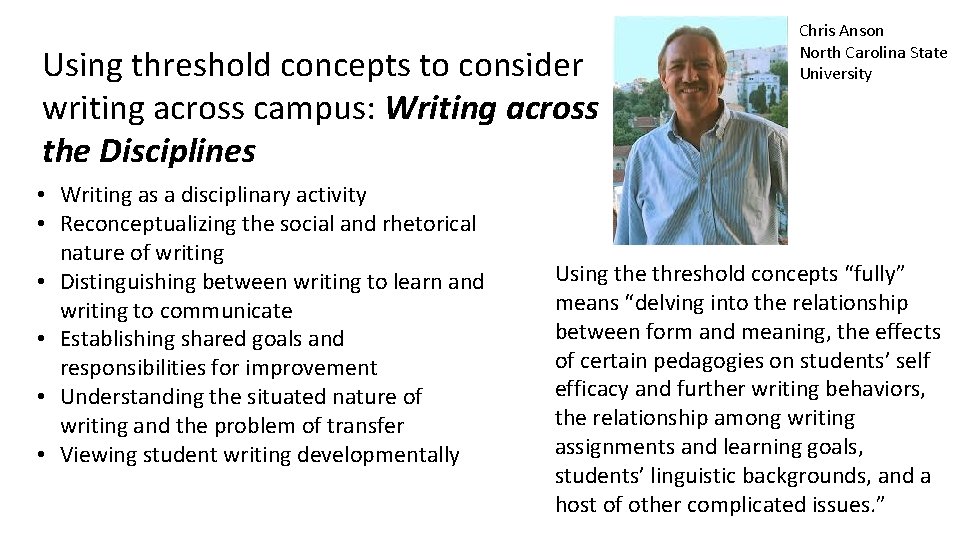
Using threshold concepts to consider writing across campus: Writing across the Disciplines • Writing as a disciplinary activity • Reconceptualizing the social and rhetorical nature of writing • Distinguishing between writing to learn and writing to communicate • Establishing shared goals and responsibilities for improvement • Understanding the situated nature of writing and the problem of transfer • Viewing student writing developmentally Chris Anson North Carolina State University Using the threshold concepts “fully” means “delving into the relationship between form and meaning, the effects of certain pedagogies on students’ self efficacy and further writing behaviors, the relationship among writing assignments and learning goals, students’ linguistic backgrounds, and a host of other complicated issues. ”
thank you.