
NAMING THE MUSCLES Origin and Insertion Origin the
- Slides: 24
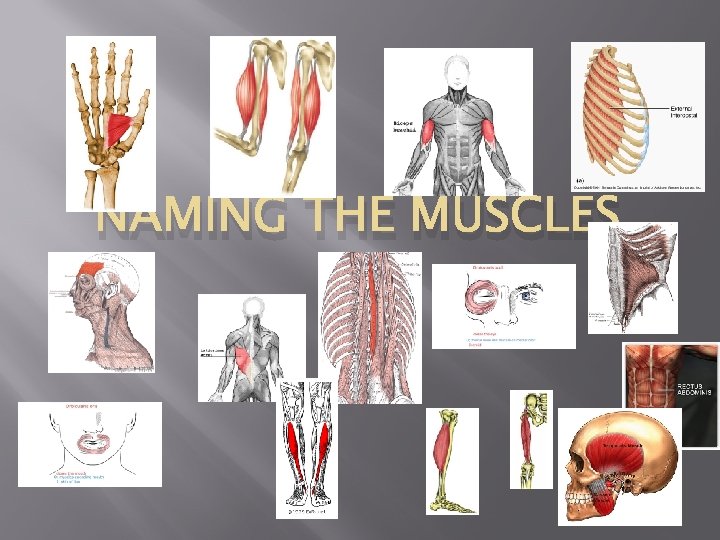
NAMING THE MUSCLES
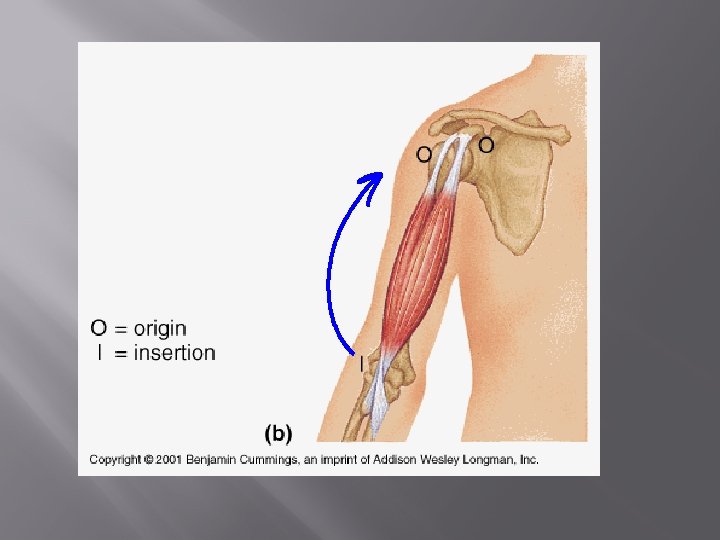
Origin and Insertion � � � Origin: the immovable end of the muscle; attached to a relatively immovable bone Insertion: the end of the muscle attached to a movable bone **When a muscle contracts, its insertion is pulled toward its origin.
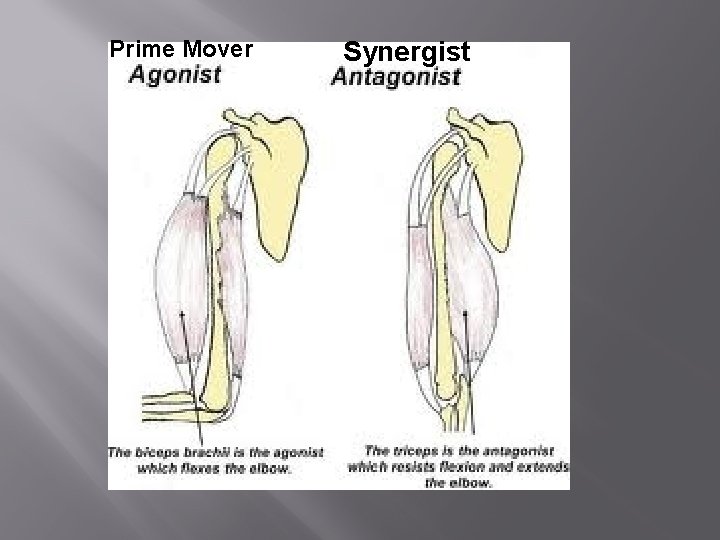
Interaction of Skeletal Muscles � � Prime mover (agonist): the muscle that provides most of the movement in an action Synergists (antagonists): the muscles around the prime mover that assist it in an action
Prime Mover Synergist
How Muscles are Named � � � � Latin and Greek roots Characteristics Used to Name Muscles 1) direction of their fibers 2) size 3) location 4) which bones they attach to 5) function **The names of muscles often contain combinations of each of the above.
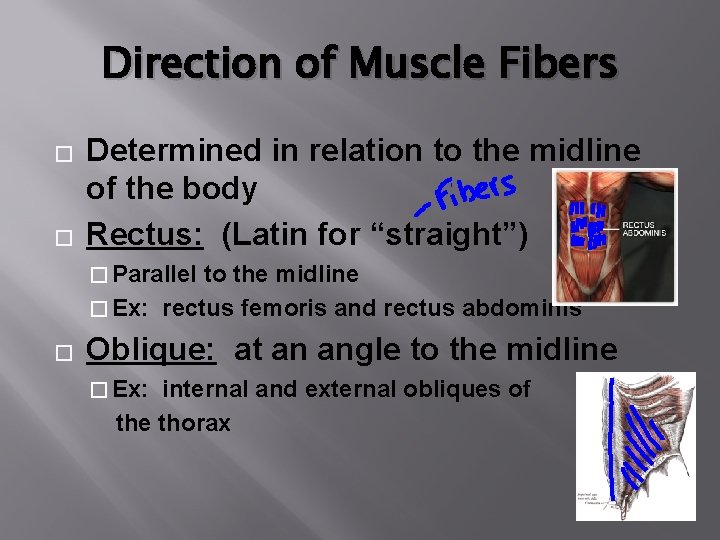
Direction of Muscle Fibers � � Determined in relation to the midline of the body Rectus: (Latin for “straight”) � Parallel to the midline � Ex: rectus femoris and rectus abdominis � Oblique: at an angle to the midline � Ex: internal and external obliques of the thorax
Muscle Size � Longus: long � Brevis: short � Maximus: largest or greatest � Major: larger � Vastus: huge � Minimus: least or smallest � Minor: smaller
Location in the Body � � � � Oris: mouth Digitorum: finger or toe Oculi: eye Pollicis: thumb Palmaris: palm of the hand Costals: rib Abdominus: abdomen Brachii: arm Hallicus: great toe Femoris: thigh Carpi: wrist Tibialis: shin bone Spinalis: spine Peroneus: fibula Scapularis: shoulder blade
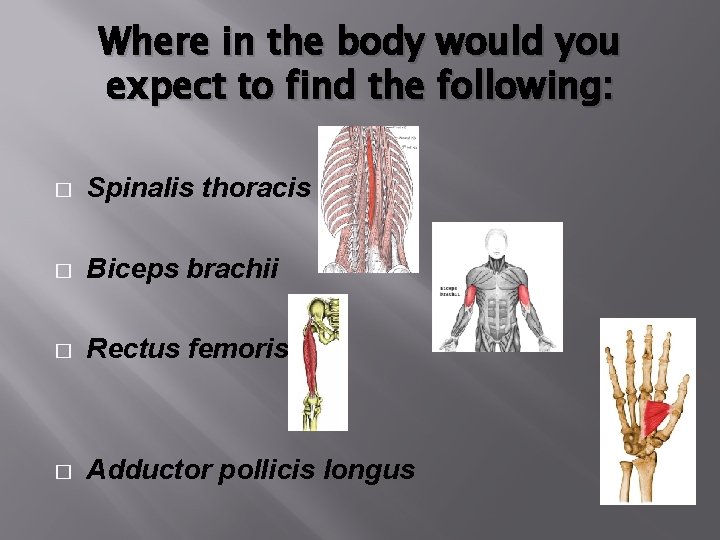
Where in the body would you expect to find the following: � Spinalis thoracis � Biceps brachii � Rectus femoris � Adductor pollicis longus
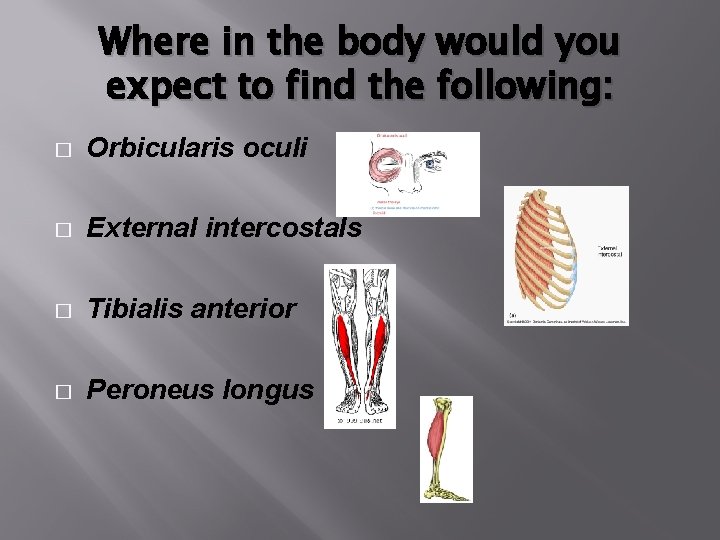
Where in the body would you expect to find the following: � Orbicularis oculi � External intercostals � Tibialis anterior � Peroneus longus
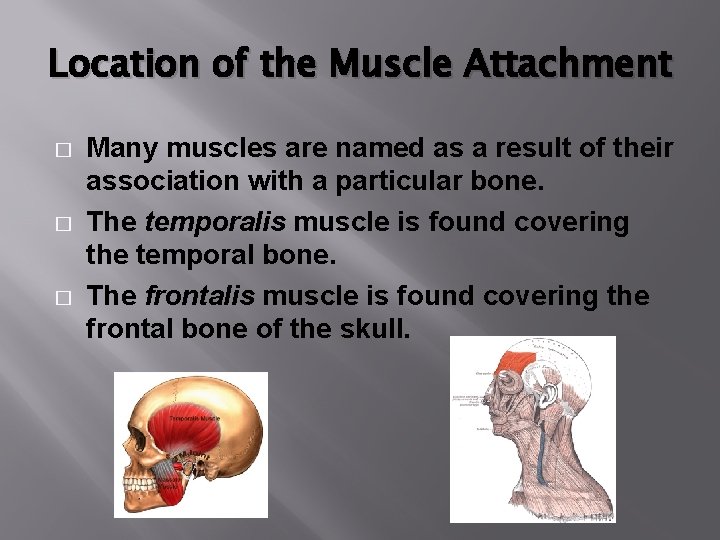
Location of the Muscle Attachment � � � Many muscles are named as a result of their association with a particular bone. The temporalis muscle is found covering the temporal bone. The frontalis muscle is found covering the frontal bone of the skull.
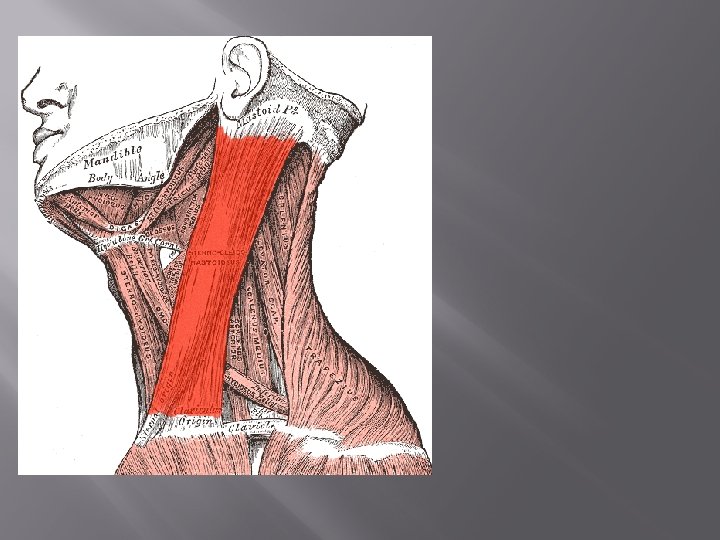
Location of Muscle’s Origin & Insertion � � � Some muscles are named for their origin and insertion. The first part of the muscle name indicates the origin, while the second part of the name indicates the insertion. Ex: sternocleidomastoid = sterno (breastbone) and cleido (clavicle) insertion; mastoid (breast shaped) process on the skull
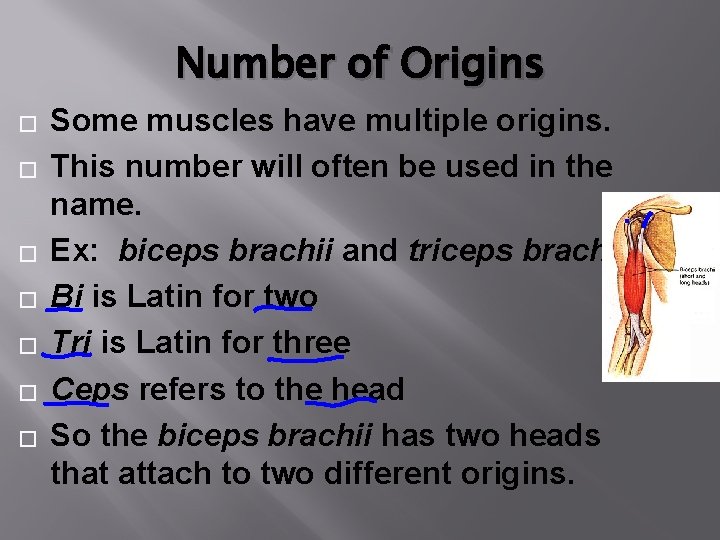
Number of Origins � � � � Some muscles have multiple origins. This number will often be used in the name. Ex: biceps brachii and triceps brachii Bi is Latin for two Tri is Latin for three Ceps refers to the head So the biceps brachii has two heads that attach to two different origins.
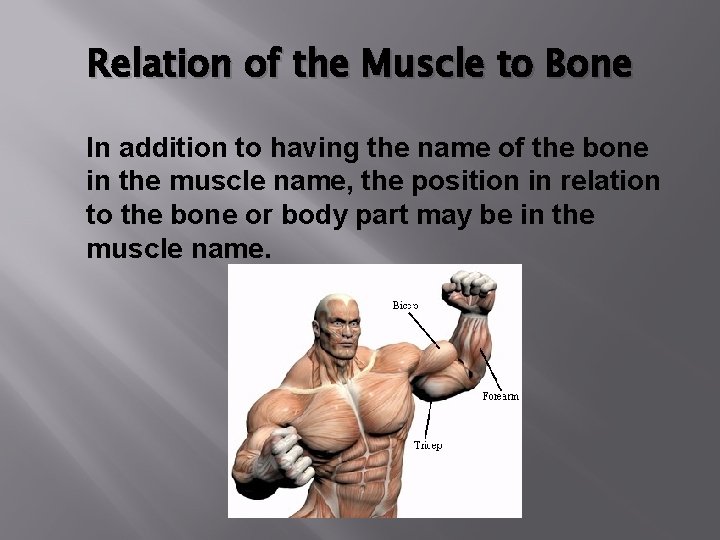
Relation of the Muscle to Bone In addition to having the name of the bone in the muscle name, the position in relation to the bone or body part may be in the muscle name.
Relation of the Muscle to Bone � � � � Supra: above or over Infra: below or beneath Sub: below or under Lateralis: the side Medialis: the middle Inter: between or among External: outer Internal: inner
Relation of the Muscle to Bone � Superior: above or over � Inferior: underneath � Dorsi: the back � Anterior: in front of � Ex: supraspinatus, infraspinatus, subscapularis, vastus lateralis, vastus medialis, intercostals, external internal obliques, superior and inferior rectus of the eye
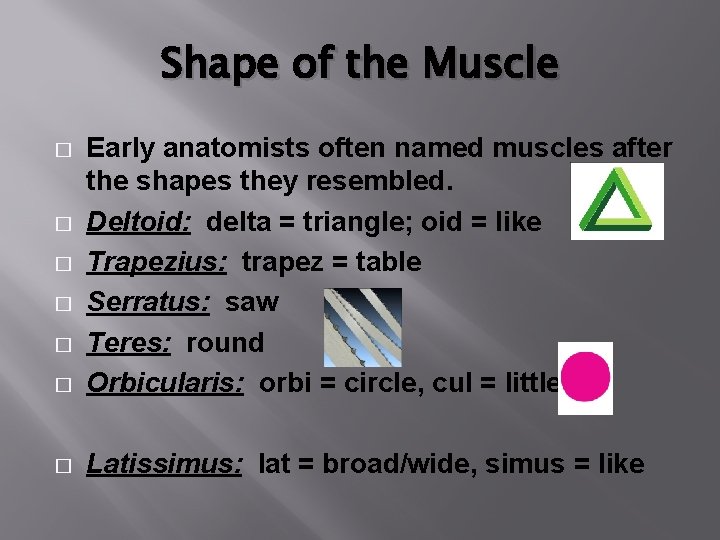
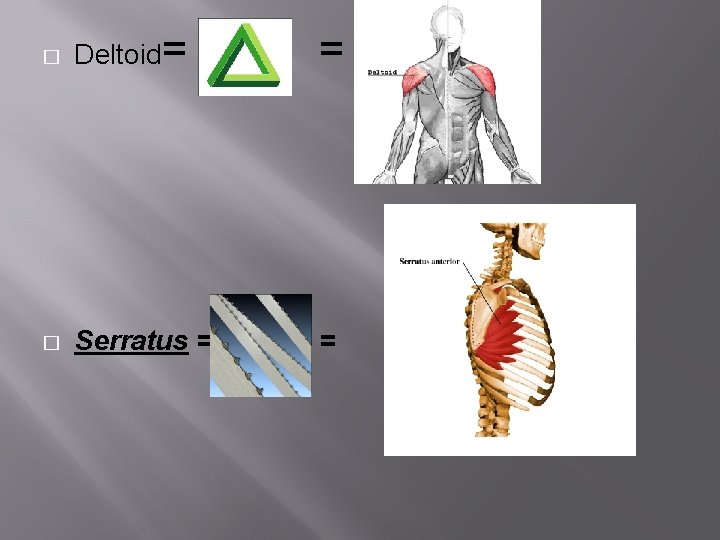
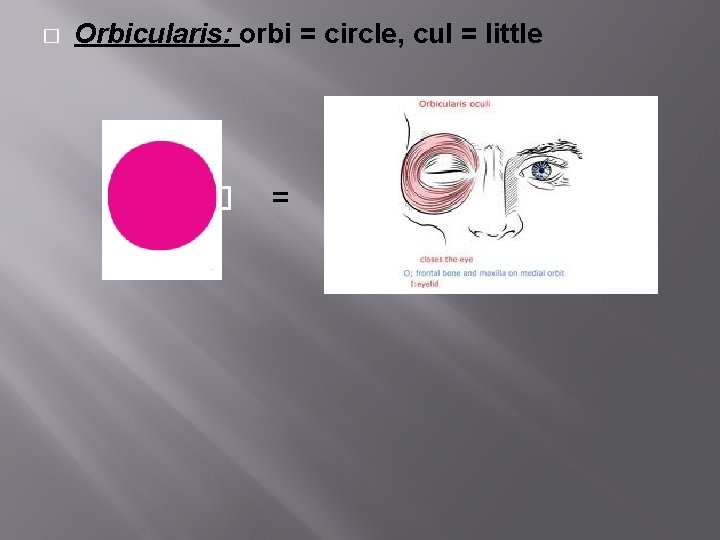
Shape of the Muscle � Early anatomists often named muscles after the shapes they resembled. Deltoid: delta = triangle; oid = like Trapezius: trapez = table Serratus: saw Teres: round Orbicularis: orbi = circle, cul = little � Latissimus: lat = broad/wide, simus = like � � �
� Deltoid= = � Serratus = =
� Orbicularis: orbi = circle, cul = little � =
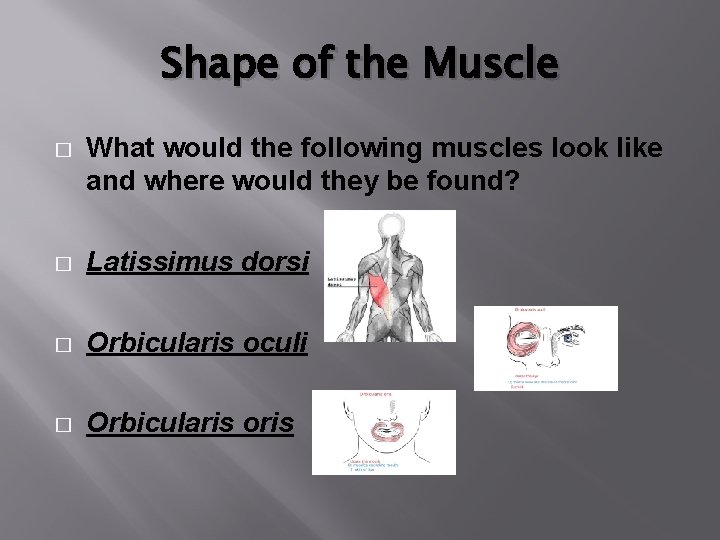
Shape of the Muscle � What would the following muscles look like and where would they be found? � Latissimus dorsi � Orbicularis oculi � Orbicularis oris
Type of Action Produced by the Muscle � flexion : flex = bend (decreases the angle at a joint) extension: ex = out; ten = stretch (increases the angle at a joint) adduction: ad = toward; duct = lead (pulls the limb toward the midline) abduction : ab = away from; duct = lead (pulls the limb away from the midline) pronation: pron = bent forward (turning the palm downward) supination: supin = lying on the back (turning the palm upward)
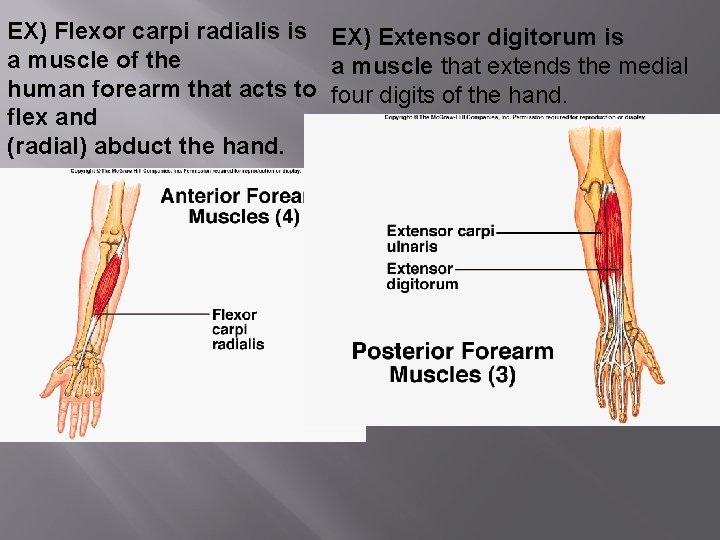
EX) Flexor carpi radialis is EX) Extensor digitorum is a muscle of the a muscle that extends the medial human forearm that acts to four digits of the hand. flex and (radial) abduct the hand.