
Naming Skeletal Muscles Claudio Hernandez P 3 Overview
- Slides: 13
Naming Skeletal Muscles Claudio Hernandez P. 3
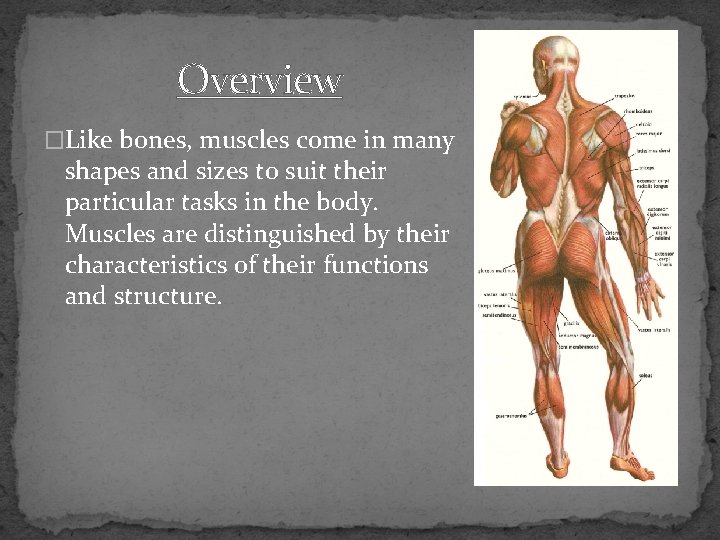
Overview �Like bones, muscles come in many shapes and sizes to suit their particular tasks in the body. Muscles are distinguished by their characteristics of their functions and structure.
Functions of Skeletal Muscles �Skeletal muscle moves the skeleton and is responsible for all our voluntary movements, as well as for the automatic movements required. �For example, to stand, to hold up our head, and to breathe. � (Other involuntary functions involve smooth muscle and cardiac muscle. )
Direction of the muscle fibers � Some muscles are named in reference to some imaginary line, usually the midline of the body or the long axis of a limb bone. When a muscle’s name includes the term rectus (straight), its fibers run parallel to that imaginary line. �For example, the rectus femoris is the straight muscle of the thigh, or femur. � Similarly, the term oblique as part of a muscle’s name tells you that the muscle fibers run obliquely (at a slant) to the imaginary line.
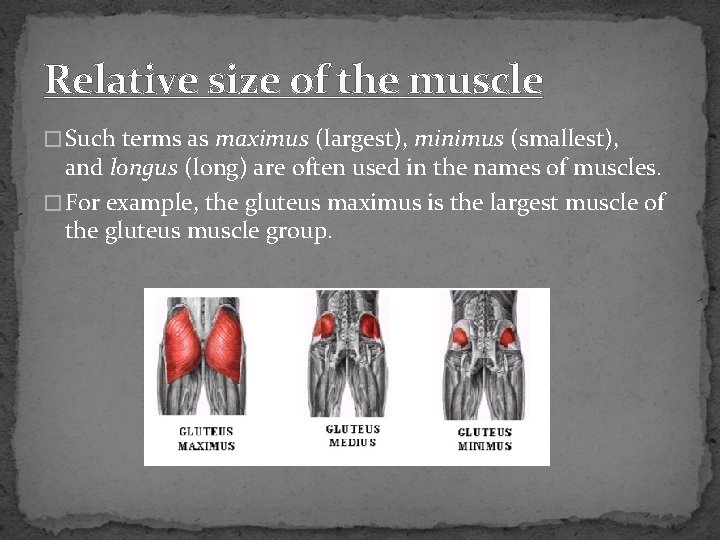
Relative size of the muscle � Such terms as maximus (largest), minimus (smallest), and longus (long) are often used in the names of muscles. � For example, the gluteus maximus is the largest muscle of the gluteus muscle group.
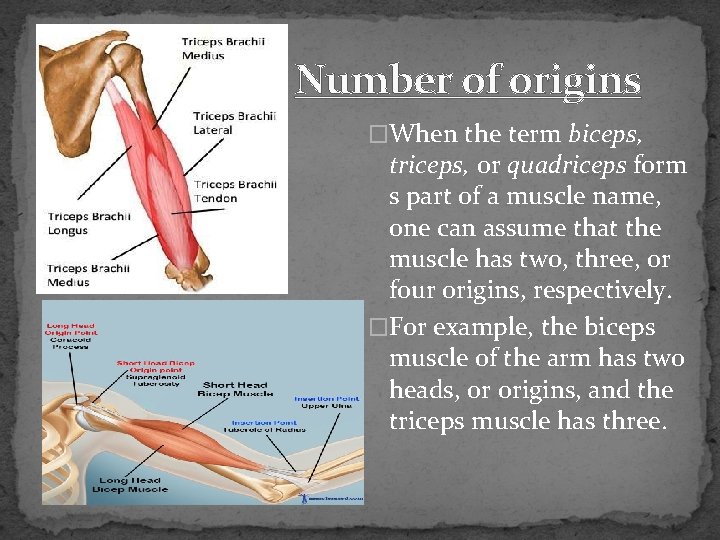
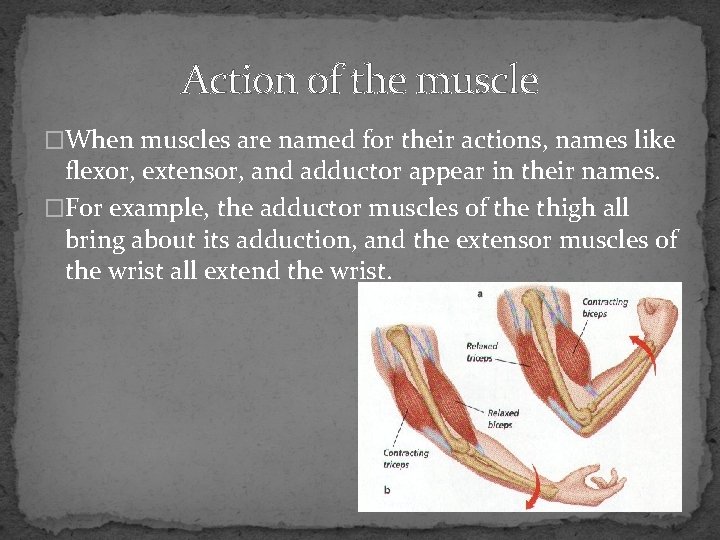
Number of origins �When the term biceps, triceps, or quadriceps form s part of a muscle name, one can assume that the muscle has two, three, or four origins, respectively. �For example, the biceps muscle of the arm has two heads, or origins, and the triceps muscle has three.
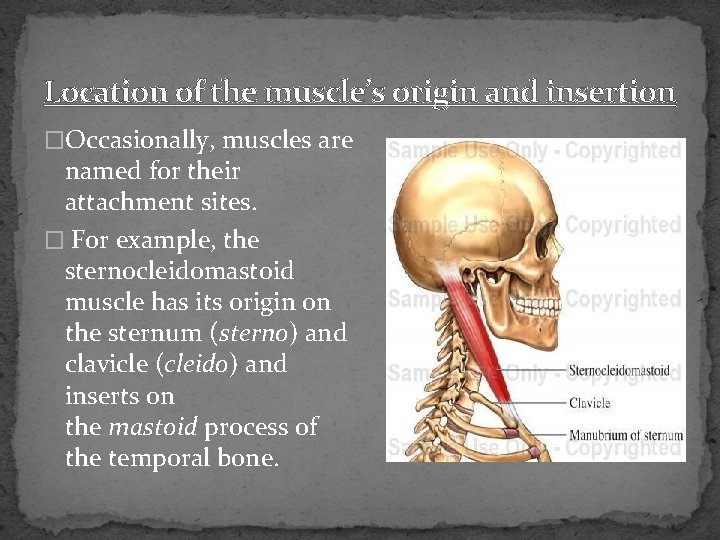
Location of the muscle’s origin and insertion �Occasionally, muscles are named for their attachment sites. � For example, the sternocleidomastoid muscle has its origin on the sternum (sterno) and clavicle (cleido) and inserts on the mastoid process of the temporal bone.
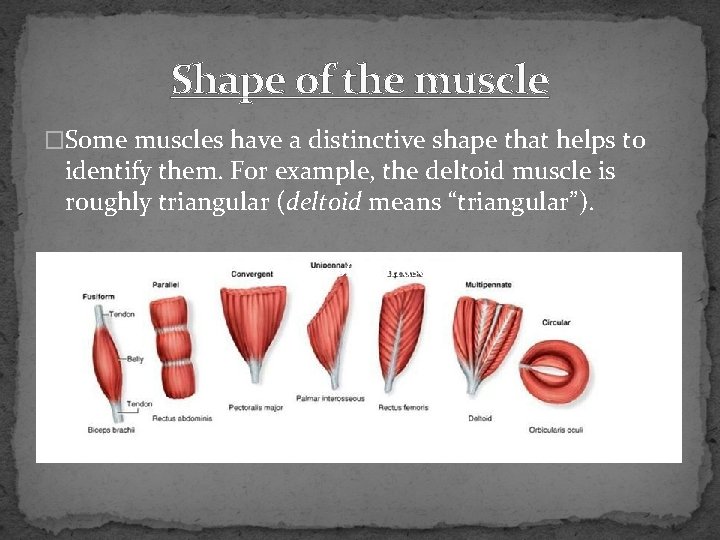
Shape of the muscle �Some muscles have a distinctive shape that helps to identify them. For example, the deltoid muscle is roughly triangular (deltoid means “triangular”). Action of the muscle
Action of the muscle �When muscles are named for their actions, names like flexor, extensor, and adductor appear in their names. �For example, the adductor muscles of the thigh all bring about its adduction, and the extensor muscles of the wrist all extend the wrist.
Major Skeletal Muscles (1) Head and Neck �Frontalis �Orbicularis oris �Orbicularis oculi �Occipitofrontalis �Zygomaticus major �Masseter �Sternocleidomastoid �Trapezius �Buccinator Muscles of the Trunk • External Intercostals • Internal Intercostals • Transverse abdominis • Infraspinatus • Rectus abdominis • Serratus anterior • Diaphragm
Major Skeletal Muscles (2) Move Upper Extremities � Pectoralis major � Latissimus dorsi � Deltoid � Teres major � Biceps brachii � Triceps brachii � Brachialis � Brachioradialis � Palmaris longus � Flexor carpi radialis. � Flexor digitorum superficialis � Extensor carpi radialis � Extensor digitorum � Extensor digiti minimi � Extensor carpi ulnaris Move the Lower Extremities • Iliopsoas • Sartorius • Gluteus maximus • Gluteus medius • Tensor fasciae latae • Adductor longus • Gracilis • Semimembranosus • Semitendinosus • Biceps femoris • Rectus femoris • Vastus lateralis • Vastus intermedium • Vastus medialis • Tibialis anterior • Gastrocnemius • Soleus • Peroneus longus • Peroneus brevis
Questions �Are Skeletal muscles voluntary or involuntary? Why? �What causes the striations of a skeletal muscle cell? �What’s your favorite muscle? Why?
Bibliography �Kopach, Jennifer. 2016 Major Skeletal Muscle List (n. d. ): n. pag. List of 50 Major Skeletal Muscles for 2016. Jennifer Kopach, 1 Jan. 2016. Web. 14 Dec. 2016. �University, Oxford. "Skeletal Muscle. " The Oxford Companion to the Body. Encyclopedia. com, 1 Jan. 2001. Web. 14 Dec. 2016. �Marieb, Elaine N. "Essentials of Human Anatomy & Physiology, 9 th Edition. " Essentials of Human Anatomy & Physiology, 9 th Edition. Elaine N Marieb, 24 Aug. 2016. Web. 14 Dec. 2016.