
Naming Hydrocarbons nomenclature Handout Hydrocarbons IUPAC names Formulas
Naming Hydrocarbons (nomenclature) Handout: Hydrocarbons: IUPAC names
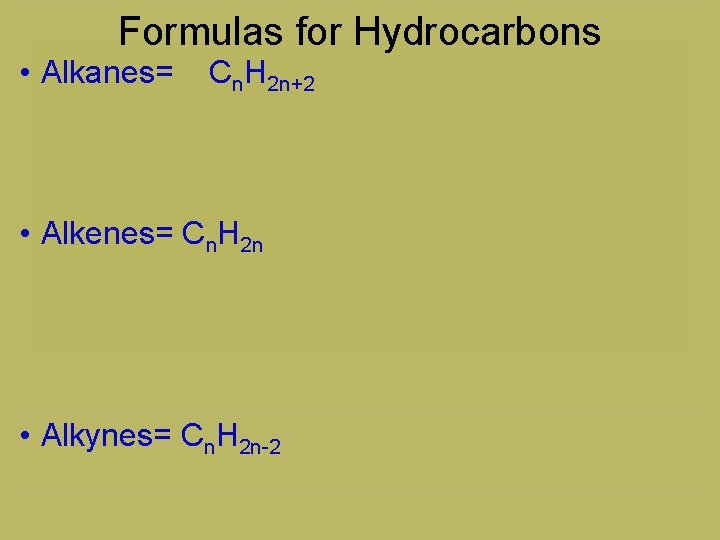
Formulas for Hydrocarbons • Alkanes= Cn. H 2 n+2 • Alkenes= Cn. H 2 n • Alkynes= Cn. H 2 n-2

Mnemonic for first four prefixes First four prefixes • • Meth. Eth. Prop. But- Monkeys Eat Peeled Bananas
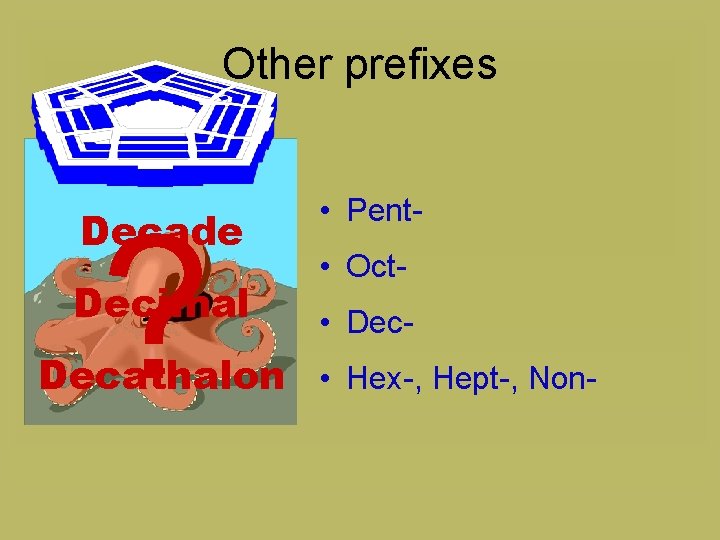
Other prefixes ? Decade Decimal • Pent • Oct • Dec- Decathalon • Hex-, Hept-, Non-
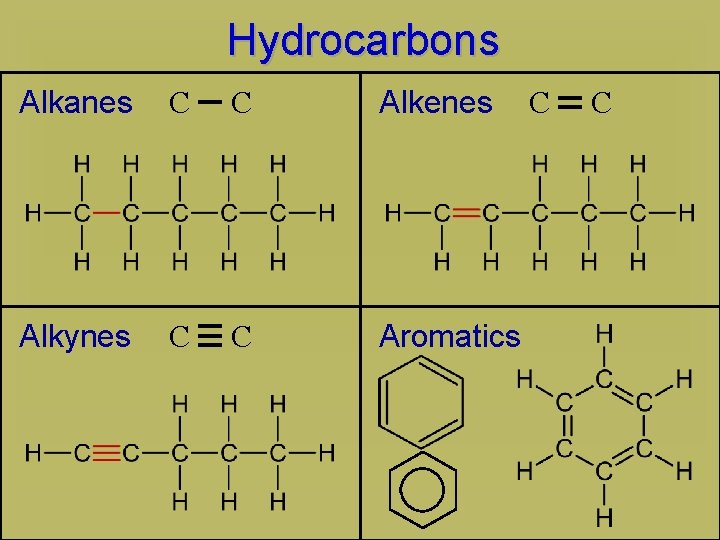
Hydrocarbons Alkanes C C Alkenes Alkynes C C Aromatics C C
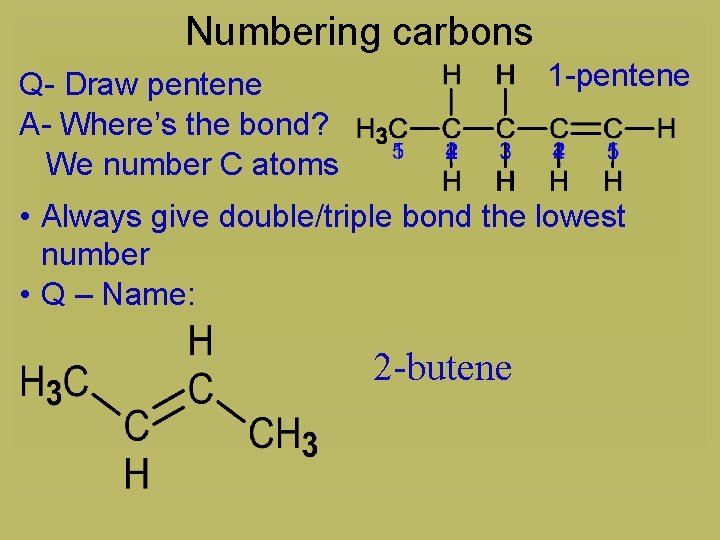
Numbering carbons 1 -pentene Q- Draw pentene A- Where’s the bond? We number C atoms • Always give double/triple bond the lowest number • Q – Name: 2 -butene
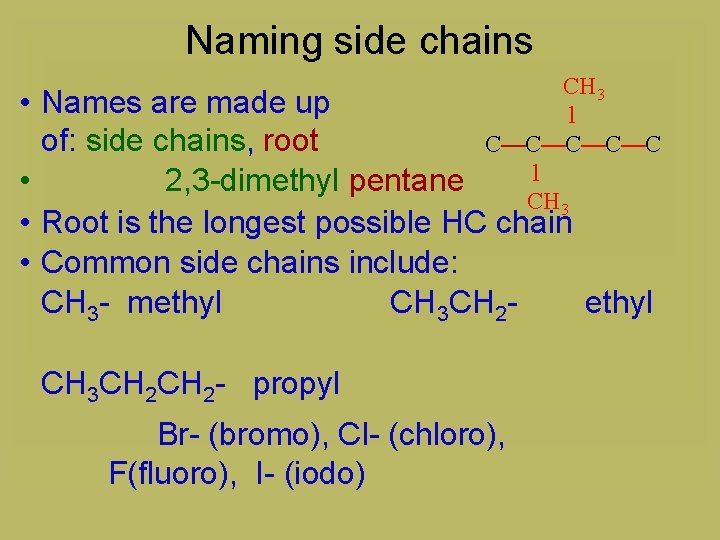
Naming side chains CH 3 l C—C—C l CH 3 • Names are made up of: side chains, root • 2, 3 -dimethyl pentane • Root is the longest possible HC chain • Common side chains include: CH 3 - methyl CH 3 CH 2 CH 2 - propyl Br- (bromo), Cl- (chloro), F(fluoro), I- (iodo)
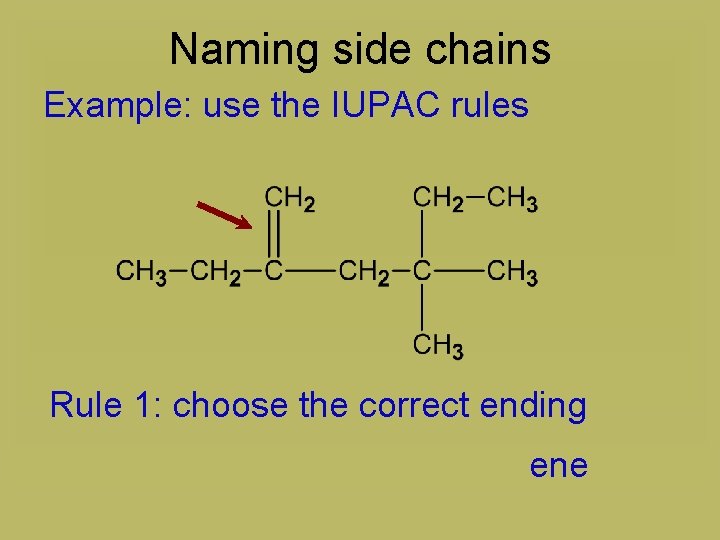
Naming side chains Example: use the IUPAC rules Rule 1: choose the correct ending ene
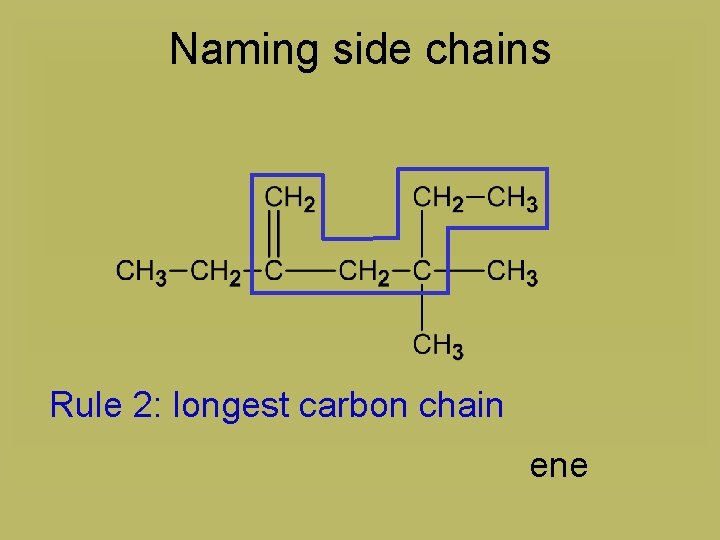
Naming side chains Rule 2: longest carbon chain ene
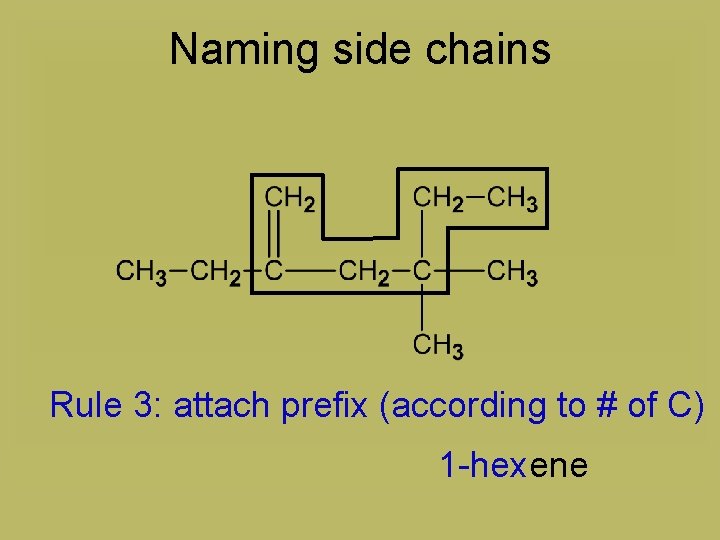
Naming side chains Rule 3: attach prefix (according to # of C) 1 -hexene
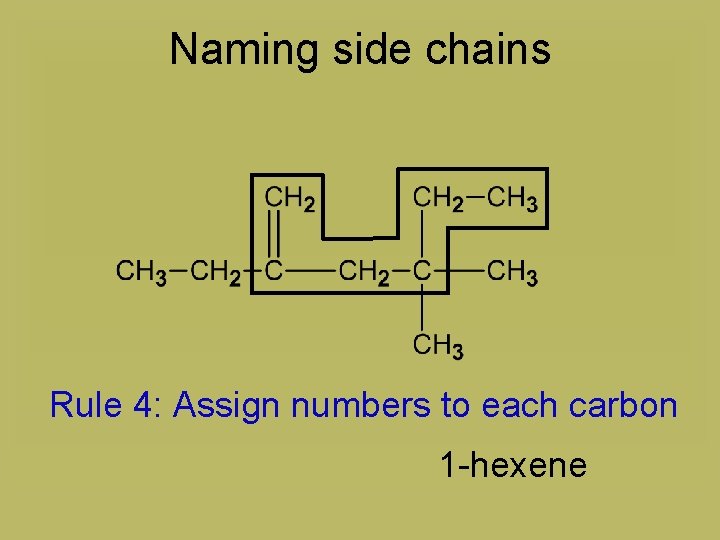
Naming side chains Rule 4: Assign numbers to each carbon 1 -hexene
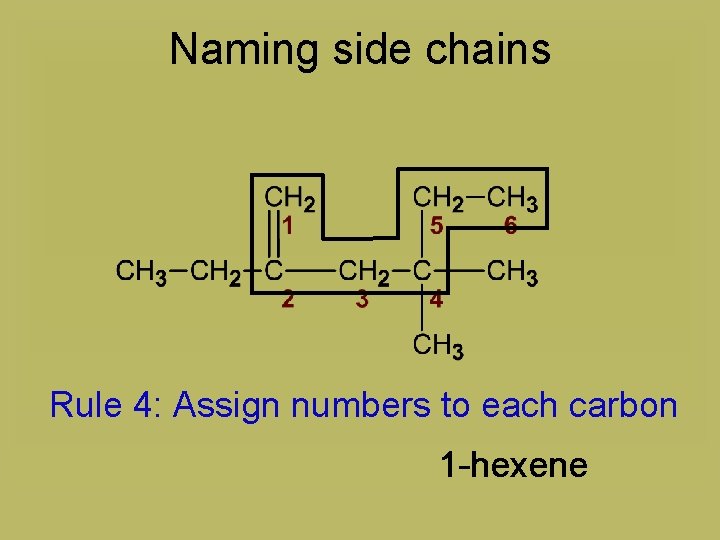
Naming side chains Rule 4: Assign numbers to each carbon 1 -hexene
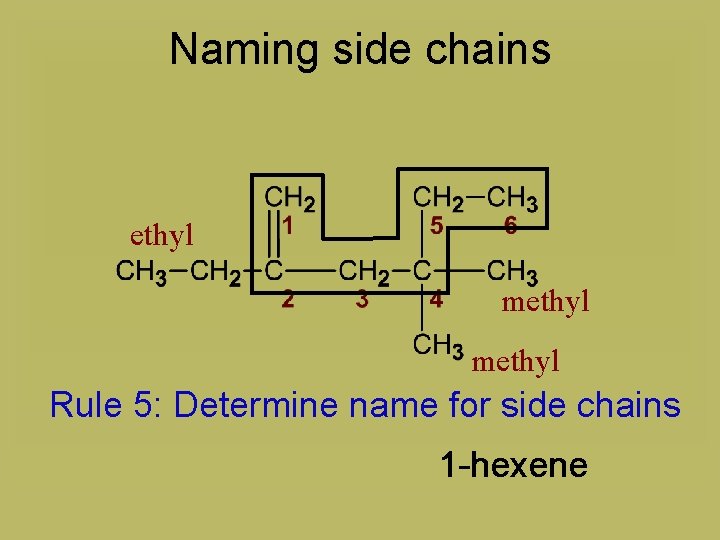
Naming side chains ethyl methyl Rule 5: Determine name for side chains 1 -hexene
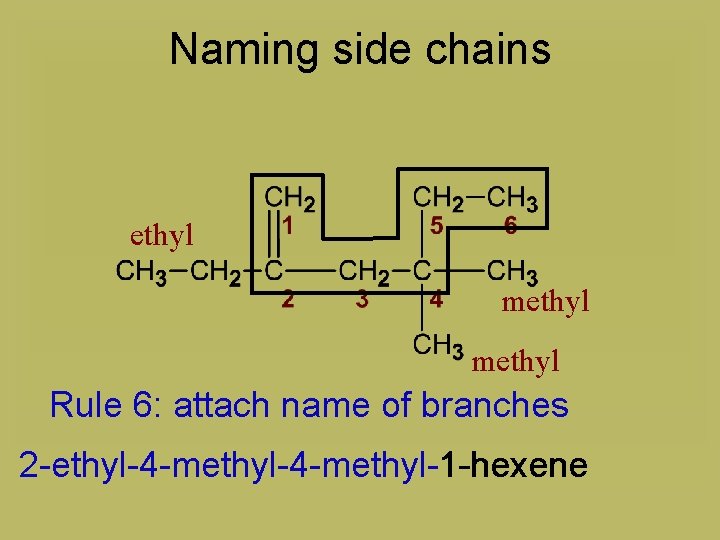
Naming side chains ethyl methyl Rule 6: attach name of branches 2 -ethyl-4 -methyl-1 -hexene
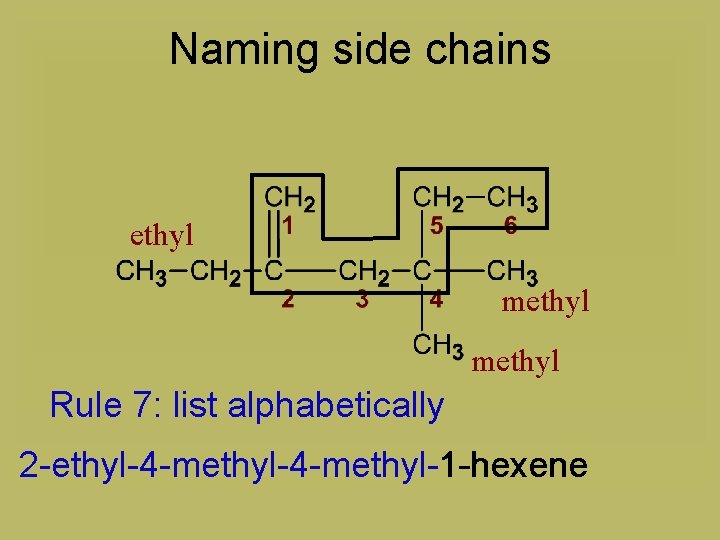
Naming side chains ethyl methyl Rule 7: list alphabetically 2 -ethyl-4 -methyl-1 -hexene
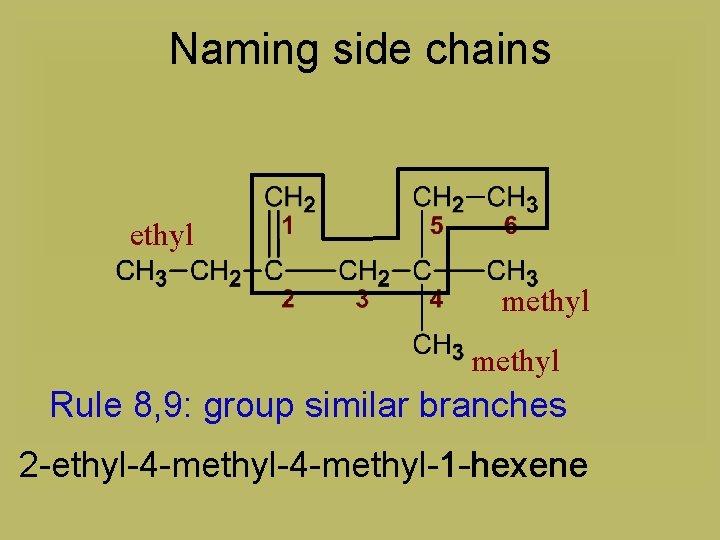
Naming side chains ethyl methyl Rule 8, 9: group similar branches 2 -ethyl-4 -methyl-1 -hexene
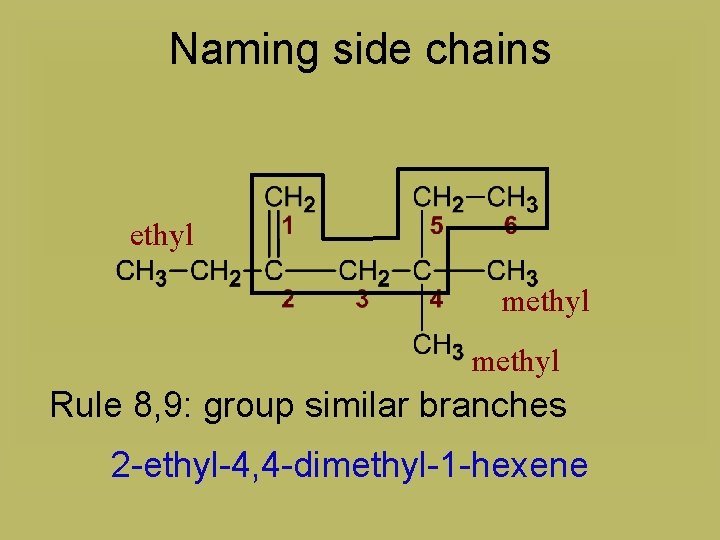
Naming side chains ethyl methyl Rule 8, 9: group similar branches 2 -ethyl-4, 4 -dimethyl-1 -hexene
More practice • Build a molecule that can be named according to the rules that we have talked about. Make it challenging. • Place your model at a vacant lab station. • On a scrap piece of paper write the following: 1) your station number, 2) the structure of your molecule, 3) the name of the structure. Give this to your teacher. • Rotate through the stations, drawing the structures and determining their names. At the end of the class students will reveal the answer with an explanation. For more lessons, visit www. chalkbored. com
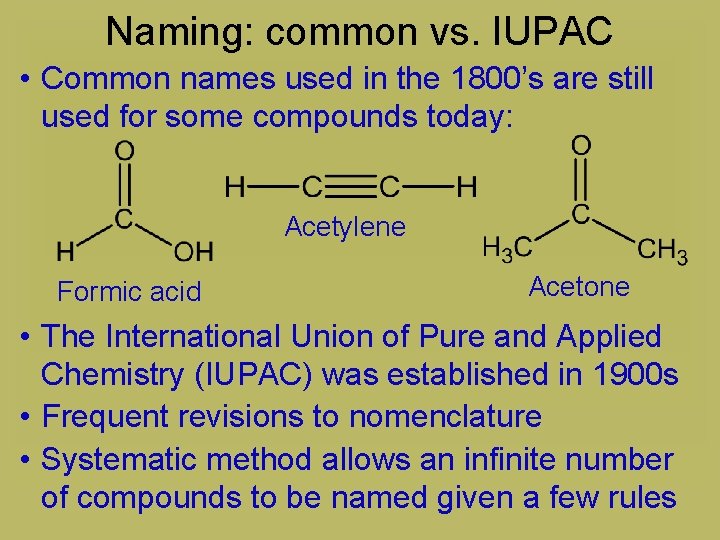
Naming: common vs. IUPAC • Common names used in the 1800’s are still used for some compounds today: Acetylene Formic acid Acetone • The International Union of Pure and Applied Chemistry (IUPAC) was established in 1900 s • Frequent revisions to nomenclature • Systematic method allows an infinite number of compounds to be named given a few rules
Basic names of hydrocarbons • Hydrocarbon names are based on: 1) class 2) # of C, 3) side chain type and 4) position • 1) name will end in -ane, -ene, or -yne • 2) the number of carbons is given by a “Prefix” 1 meth- 2 eth- 3 prop- 4 but- 5 pent 6 hex- 7 hept- 8 oct- 9 non- 10 dec • Actually, all end in a, but a is dropped when next to a vowel. E. g. a 6 C alkene is hexene Q - What names would be given to these: 7 C, 9 C alkane heptane, nonane 2 C, 4 C alkyne ethyne, butyne 1 C, 3 C alkene does not exist, propene
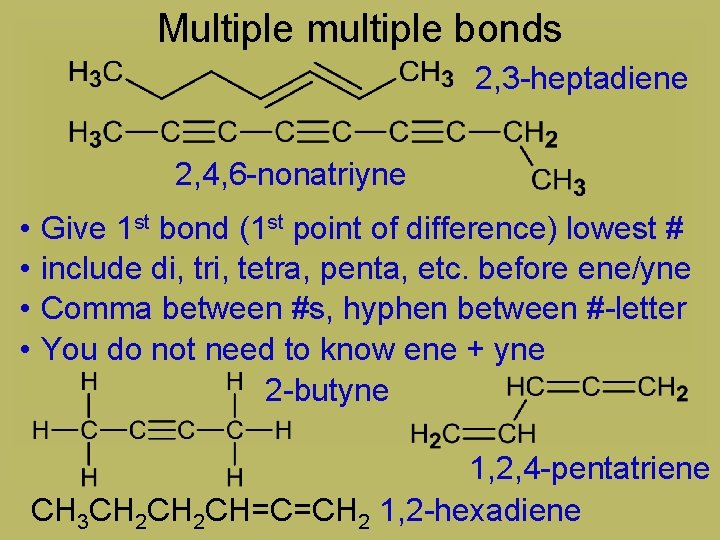
Multiple multiple bonds 2, 3 -heptadiene 2, 4, 6 -nonatriyne • • Give 1 st bond (1 st point of difference) lowest # include di, tri, tetra, penta, etc. before ene/yne Comma between #s, hyphen between #-letter You do not need to know ene + yne 2 -butyne 1, 2, 4 -pentatriene CH 3 CH 2 CH=C=CH 2 1, 2 -hexadiene
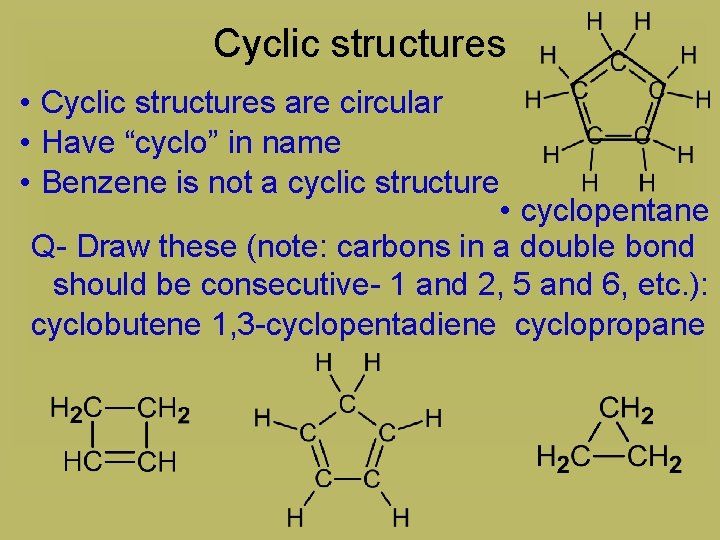
Cyclic structures • Cyclic structures are circular • Have “cyclo” in name • Benzene is not a cyclic structure • cyclopentane Q- Draw these (note: carbons in a double bond should be consecutive- 1 and 2, 5 and 6, etc. ): cyclobutene 1, 3 -cyclopentadiene cyclopropane
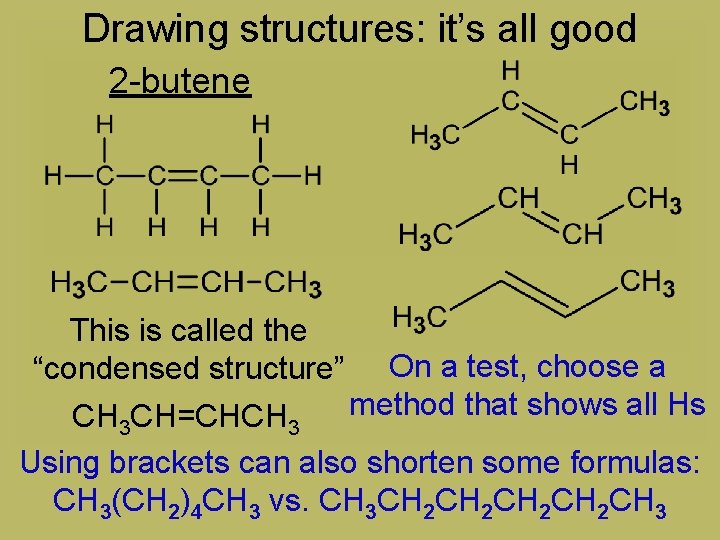
Drawing structures: it’s all good 2 -butene This is called the “condensed structure” On a test, choose a method that shows all Hs CH 3 CH=CHCH 3 Using brackets can also shorten some formulas: CH 3(CH 2)4 CH 3 vs. CH 3 CH 2 CH 2 CH 3

Naming side chains 3 -methylhexane 4 -ethyl-2, 3 -dimethylheptane 5 -ethyl-2, 4, 6 -trimethyloctane
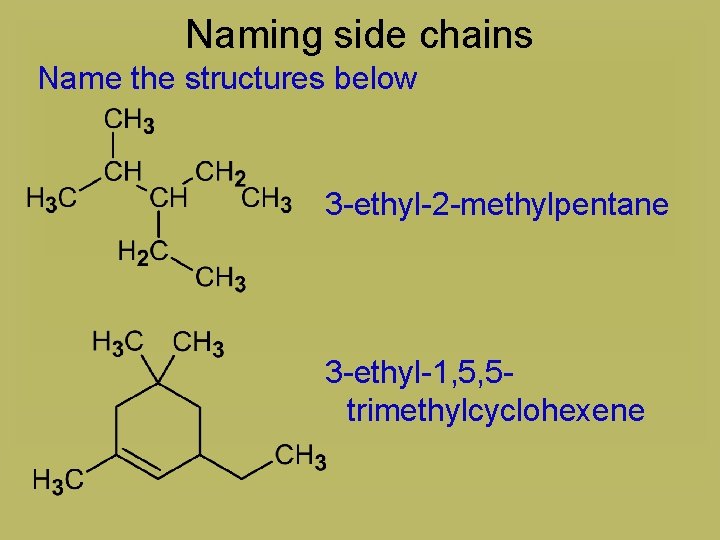
Naming side chains Name the structures below 3 -ethyl-2 -methylpentane 3 -ethyl-1, 5, 5 trimethylcyclohexene
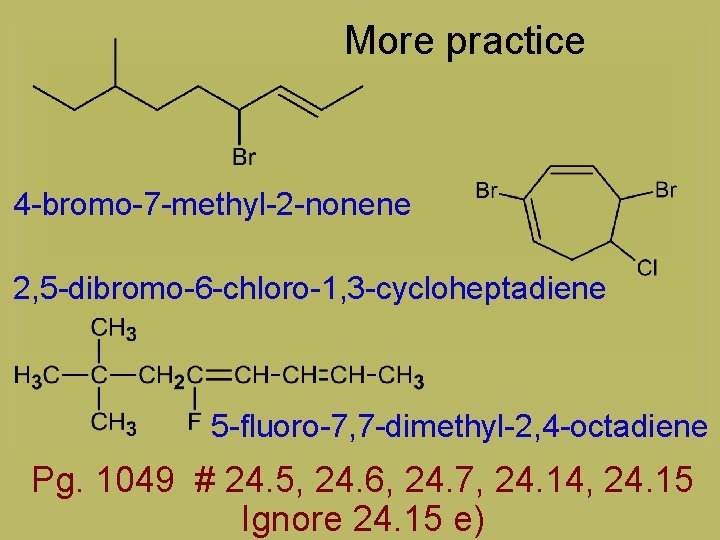
More practice 4 -bromo-7 -methyl-2 -nonene 2, 5 -dibromo-6 -chloro-1, 3 -cycloheptadiene 5 -fluoro-7, 7 -dimethyl-2, 4 -octadiene Pg. 1049 # 24. 5, 24. 6, 24. 7, 24. 14, 24. 15 Ignore 24. 15 e)
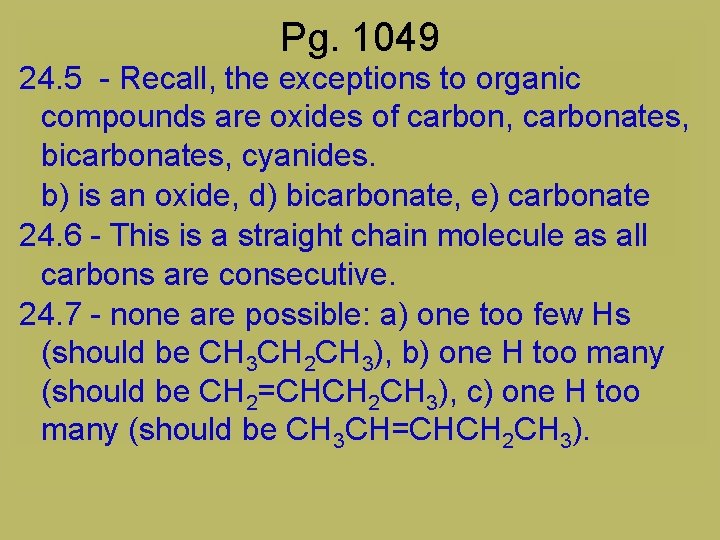
Pg. 1049 24. 5 - Recall, the exceptions to organic compounds are oxides of carbon, carbonates, bicarbonates, cyanides. b) is an oxide, d) bicarbonate, e) carbonate 24. 6 - This is a straight chain molecule as all carbons are consecutive. 24. 7 - none are possible: a) one too few Hs (should be CH 3 CH 2 CH 3), b) one H too many (should be CH 2=CHCH 2 CH 3), c) one H too many (should be CH 3 CH=CHCH 2 CH 3).
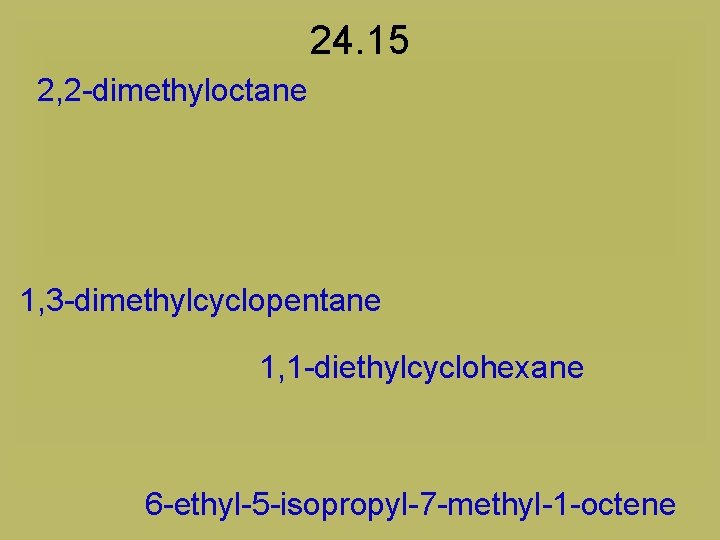
24. 15 2, 2 -dimethyloctane 1, 3 -dimethylcyclopentane 1, 1 -diethylcyclohexane 6 -ethyl-5 -isopropyl-7 -methyl-1 -octene
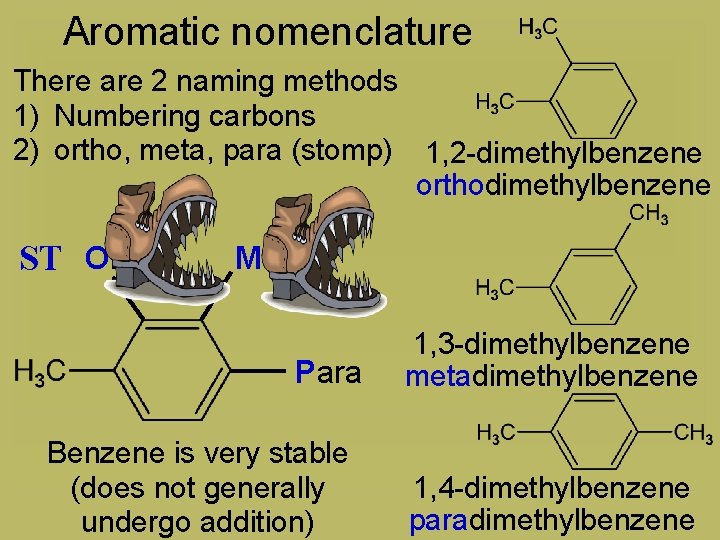
Aromatic nomenclature There are 2 naming methods 1) Numbering carbons 2) ortho, meta, para (stomp) 1, 2 -dimethylbenzene orthodimethylbenzene ST Ortho Meta Para Benzene is very stable (does not generally undergo addition) 1, 3 -dimethylbenzene metadimethylbenzene 1, 4 -dimethylbenzene paradimethylbenzene
- Slides: 29