
Naming Conventions in SDOHCC IG Gravity Project January
- Slides: 7
Naming Conventions in SDOH-CC IG Gravity Project January 29, 2020
What types of FHIR IG artifacts have names? • When it comes to an FHIR IG Profile artifact or Terminological artifact, what is its name? • An artifact name is a unique way of identifying an artifact. Because the terms “identifier” and “id” are overused and have very specific meanings in FHIR, we will not call an artifact’s name an identifier. We will simply call an artifact’s name a “name”. • See the slide titled, “identifiers” for the one way we will use the term “identifier” in our naming convention documentation. • These FHIR IG artifacts have names: • Profiles have names • Value Sets have names • Codes Systems have names • Value Sets and Code Systems are also known by a uri which also is a unique name for the artifact • The uri can be an OID or a urn or url. • Codes have a concept and a defined code to represent that concept • Identifiers have a system attribute the tells what the value attribute means (the namespace of its origin)
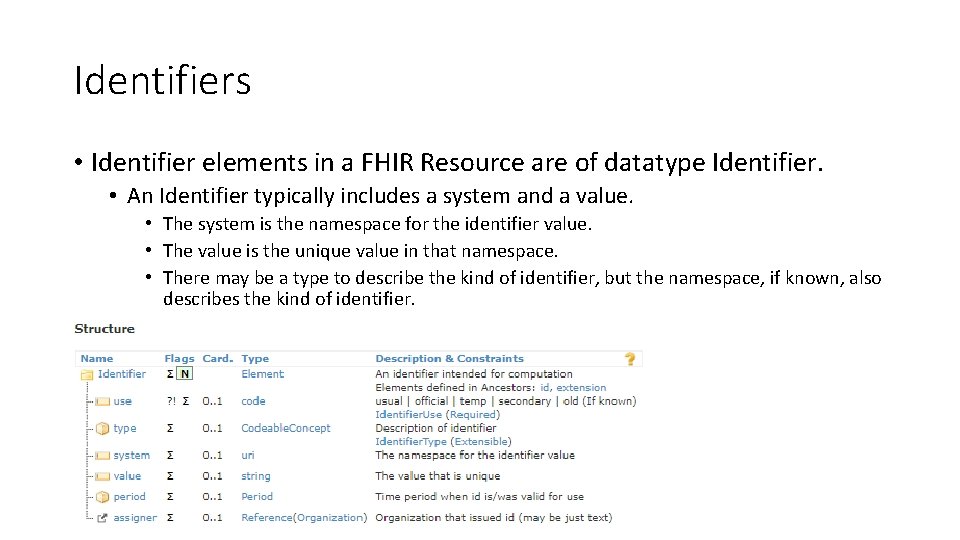
Identifiers • Identifier elements in a FHIR Resource are of datatype Identifier. • An Identifier typically includes a system and a value. • The system is the namespace for the identifier value. • The value is the unique value in that namespace. • There may be a type to describe the kind of identifier, but the namespace, if known, also describes the kind of identifier.
Naming Conventions for Profiles • Profiles named and defined in the IG are “permanent names”. • The naming convention is applied to establish the Profile’s name and that name persists throughout the ballot and publication process. • Naming conventions for Profiles are: • [add how-to rules here. ]
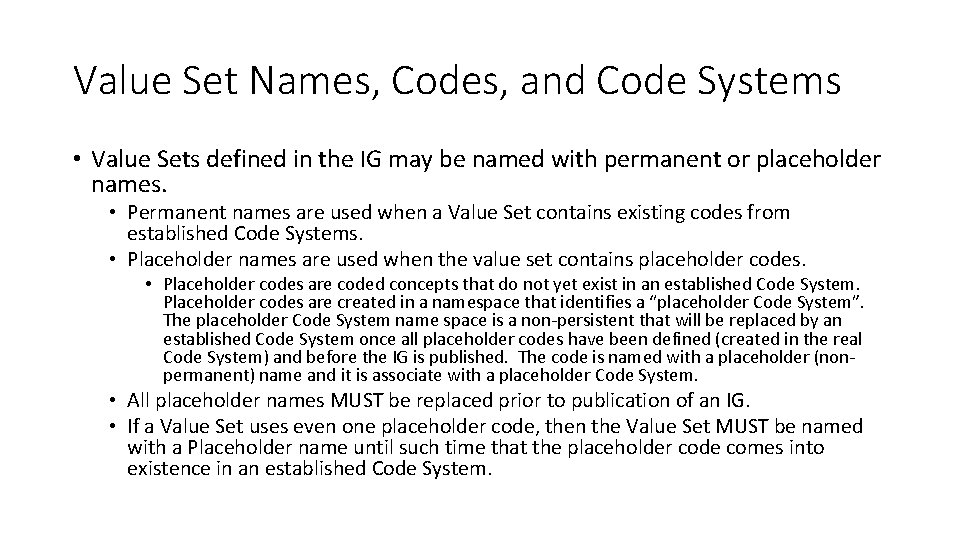
Value Set Names, Codes, and Code Systems • Value Sets defined in the IG may be named with permanent or placeholder names. • Permanent names are used when a Value Set contains existing codes from established Code Systems. • Placeholder names are used when the value set contains placeholder codes. • Placeholder codes are coded concepts that do not yet exist in an established Code System. Placeholder codes are created in a namespace that identifies a “placeholder Code System”. The placeholder Code System name space is a non-persistent that will be replaced by an established Code System once all placeholder codes have been defined (created in the real Code System) and before the IG is published. The code is named with a placeholder (nonpermanent) name and it is associate with a placeholder Code System. • All placeholder names MUST be replaced prior to publication of an IG. • If a Value Set uses even one placeholder code, then the Value Set MUST be named with a Placeholder name until such time that the placeholder code comes into existence in an established Code System.
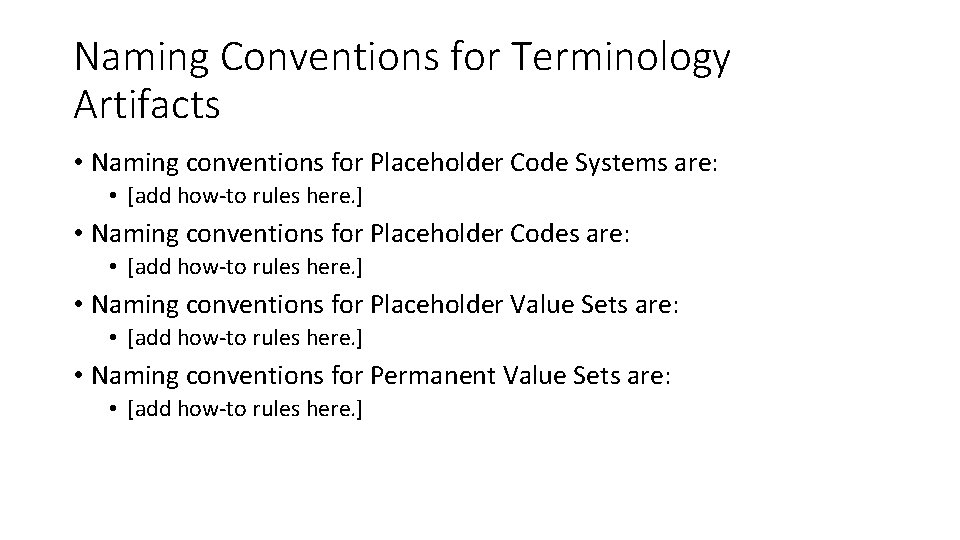
Naming Conventions for Terminology Artifacts • Naming conventions for Placeholder Code Systems are: • [add how-to rules here. ] • Naming conventions for Placeholder Codes are: • [add how-to rules here. ] • Naming conventions for Placeholder Value Sets are: • [add how-to rules here. ] • Naming conventions for Permanent Value Sets are: • [add how-to rules here. ]
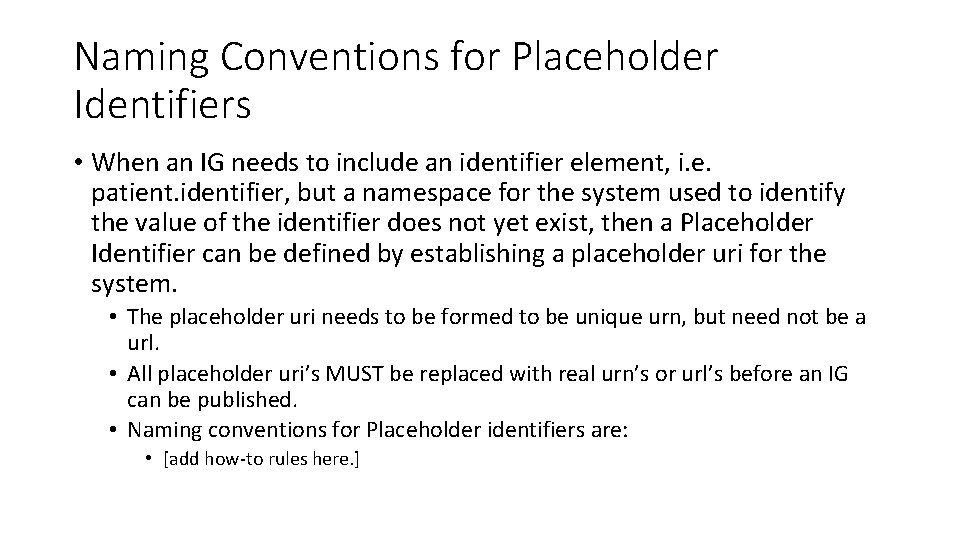
Naming Conventions for Placeholder Identifiers • When an IG needs to include an identifier element, i. e. patient. identifier, but a namespace for the system used to identify the value of the identifier does not yet exist, then a Placeholder Identifier can be defined by establishing a placeholder uri for the system. • The placeholder uri needs to be formed to be unique urn, but need not be a url. • All placeholder uri’s MUST be replaced with real urn’s or url’s before an IG can be published. • Naming conventions for Placeholder identifiers are: • [add how-to rules here. ]