
Naming Binary Covalent Compounds So why do atoms
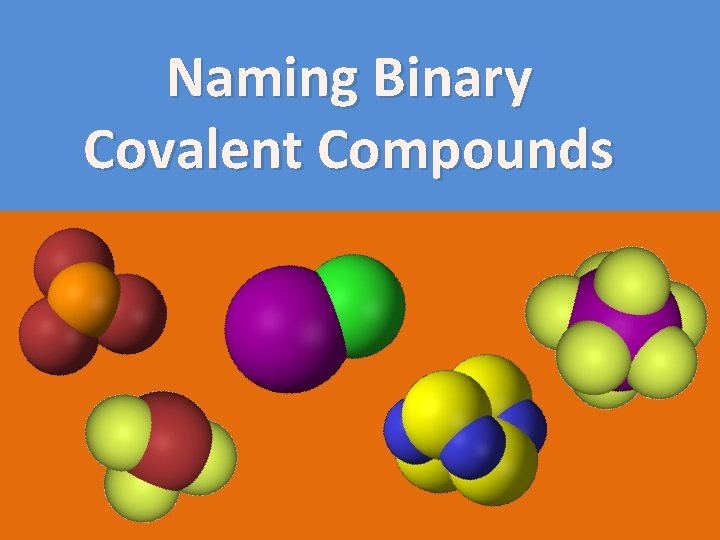
Naming Binary Covalent Compounds
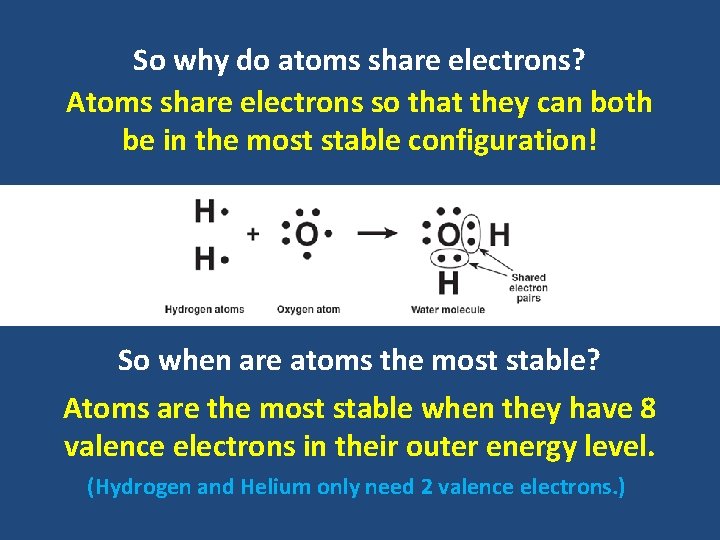
So why do atoms share electrons? Atoms share electrons so that they can both be in the most stable configuration! So when are atoms the most stable? Atoms are the most stable when they have 8 valence electrons in their outer energy level. (Hydrogen and Helium only need 2 valence electrons. )
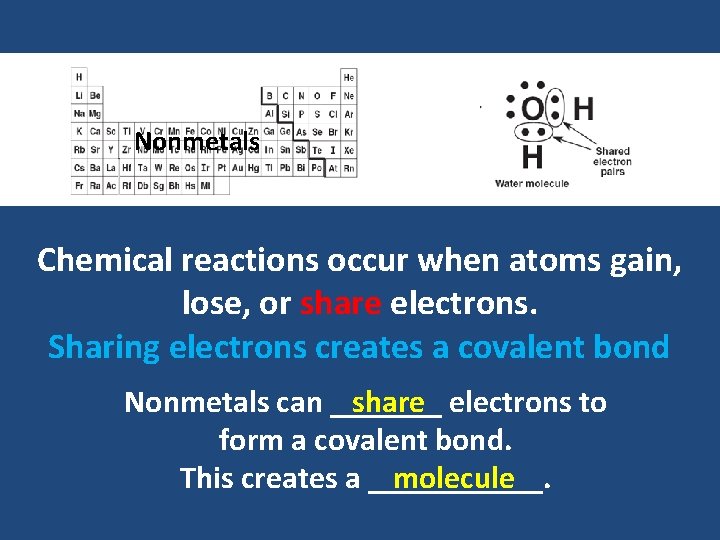
Nonmetals Chemical reactions occur when atoms gain, lose, or share electrons. Sharing electrons creates a covalent bond Nonmetals can _______ share electrons to form a covalent bond. molecule This creates a ______.
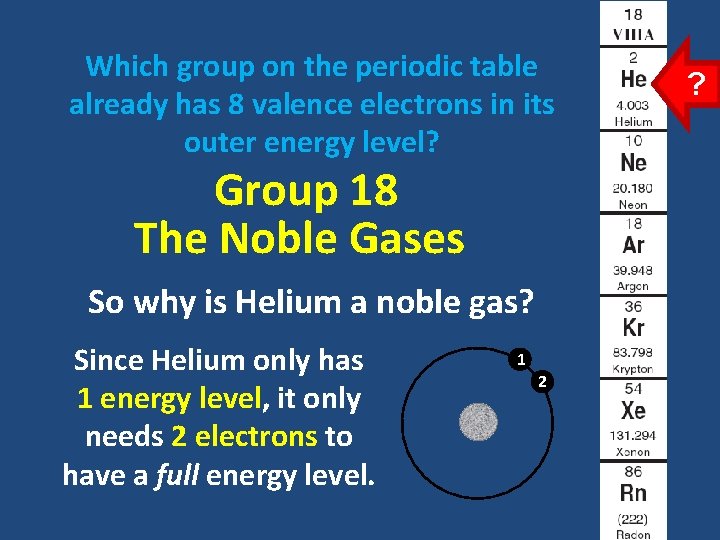
Which group on the periodic table already has 8 valence electrons in its outer energy level? Group 18 The Noble Gases So why is Helium a noble gas? Since Helium only has 1 energy level, it only needs 2 electrons to have a full energy level. 1 2 ?
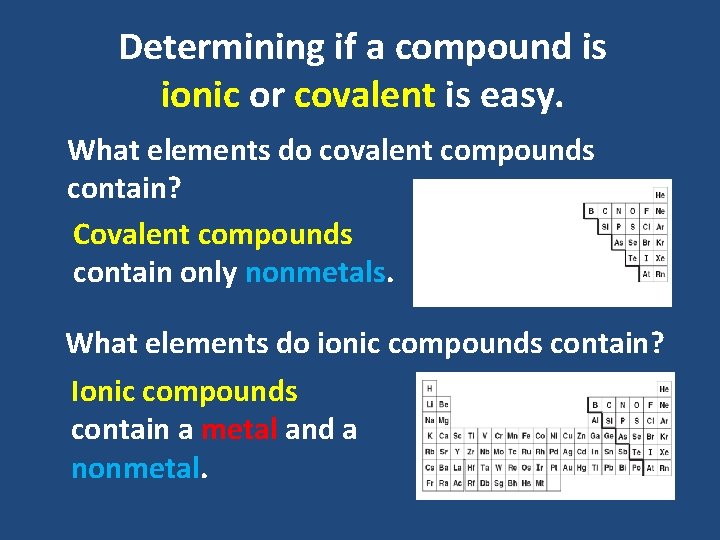
Determining if a compound is ionic or covalent is easy. What elements do covalent compounds contain? Covalent compounds contain only nonmetals. What elements do ionic compounds contain? Ionic compounds contain a metal and a nonmetal.
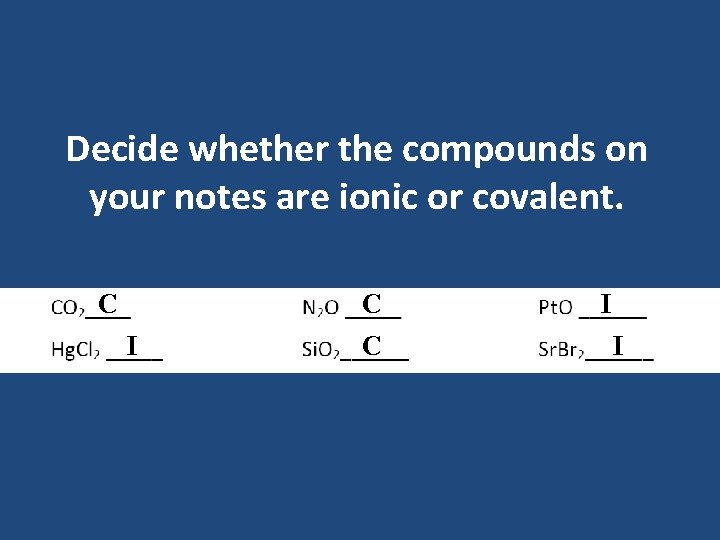
Decide whether the compounds on your notes are ionic or covalent. C I C C I I
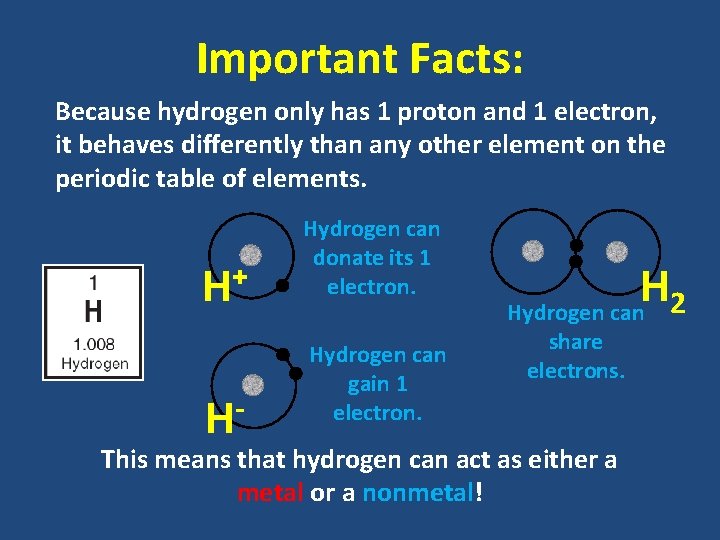
Important Facts: Because hydrogen only has 1 proton and 1 electron, it behaves differently than any other element on the periodic table of elements. + H H Hydrogen can donate its 1 electron. Hydrogen can gain 1 electron. H Hydrogen can 2 share electrons. This means that hydrogen can act as either a metal or a nonmetal!
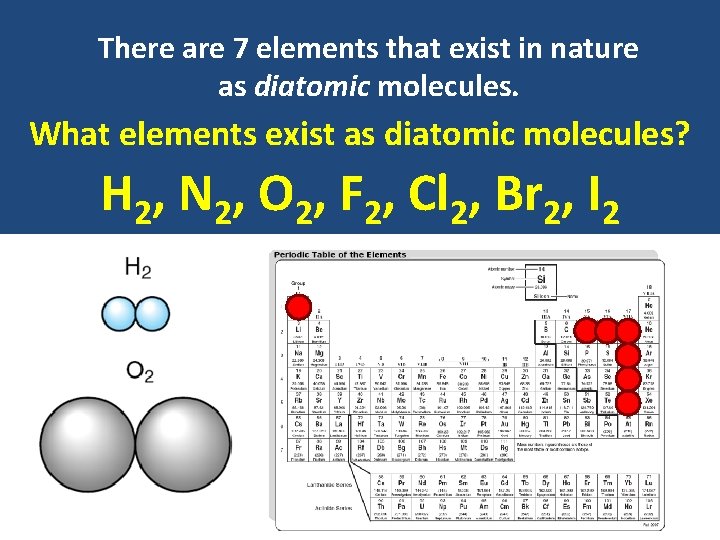
There are 7 elements that exist in nature as diatomic molecules. What elements exist as diatomic molecules? H 2, N 2, O 2, F 2, Cl 2, Br 2, I 2
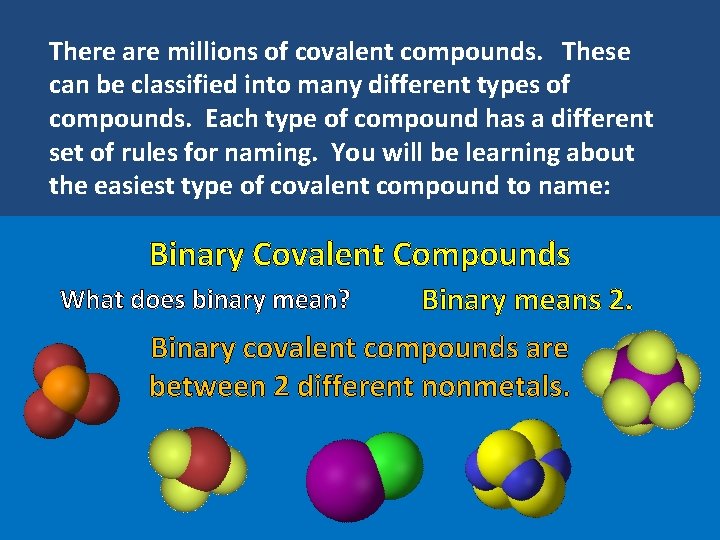
There are millions of covalent compounds. These can be classified into many different types of compounds. Each type of compound has a different set of rules for naming. You will be learning about the easiest type of covalent compound to name: Binary Covalent Compounds Binary means 2. Binary covalent compounds are between 2 different nonmetals. What does binary mean?
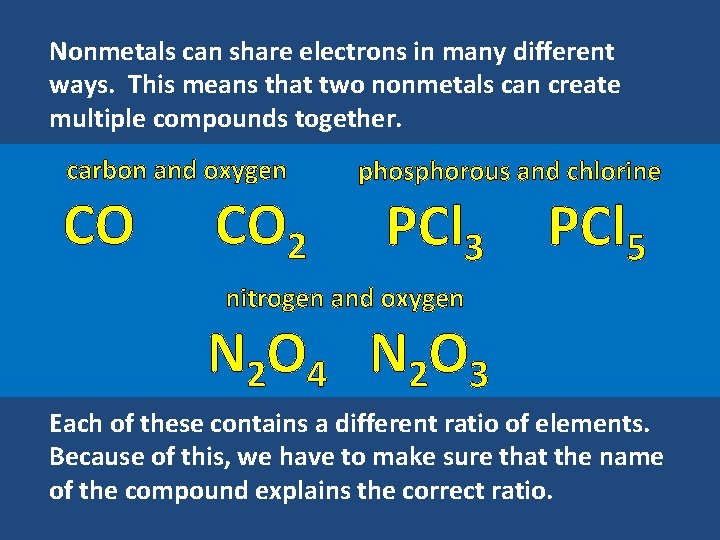
Nonmetals can share electrons in many different ways. This means that two nonmetals can create multiple compounds together. carbon and oxygen CO CO 2 phosphorous and chlorine PCl 3 PCl 5 nitrogen and oxygen N 2 O 4 N 2 O 3 Each of these contains a different ratio of elements. Because of this, we have to make sure that the name of the compound explains the correct ratio.
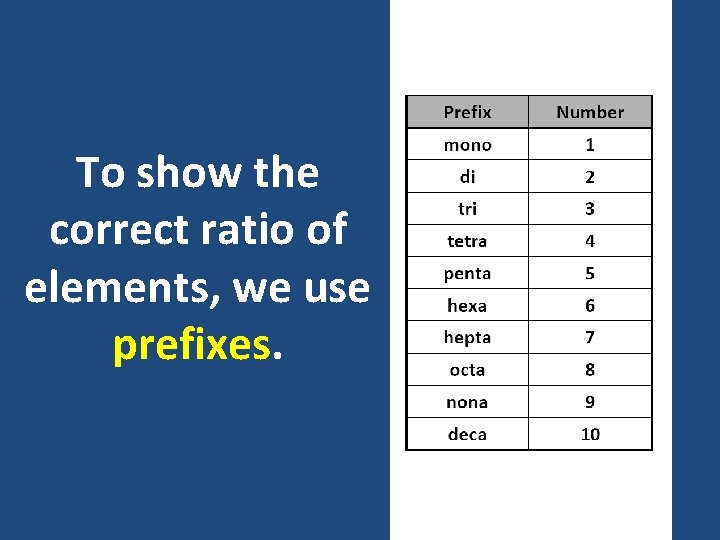
To show the correct ratio of elements, we use prefixes.
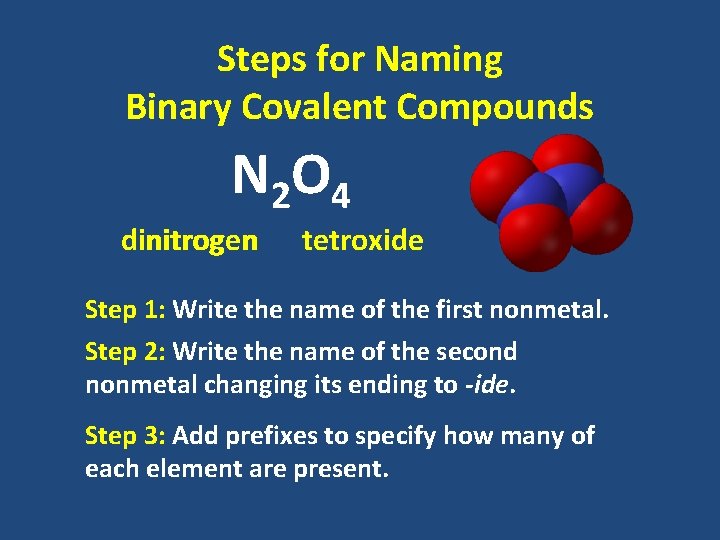
Steps for Naming Binary Covalent Compounds N 2 O 4 dinitrogen tetroxide Step 1: Write the name of the first nonmetal. Step 2: Write the name of the second nonmetal changing its ending to -ide. Step 3: Add prefixes to specify how many of each element are present.
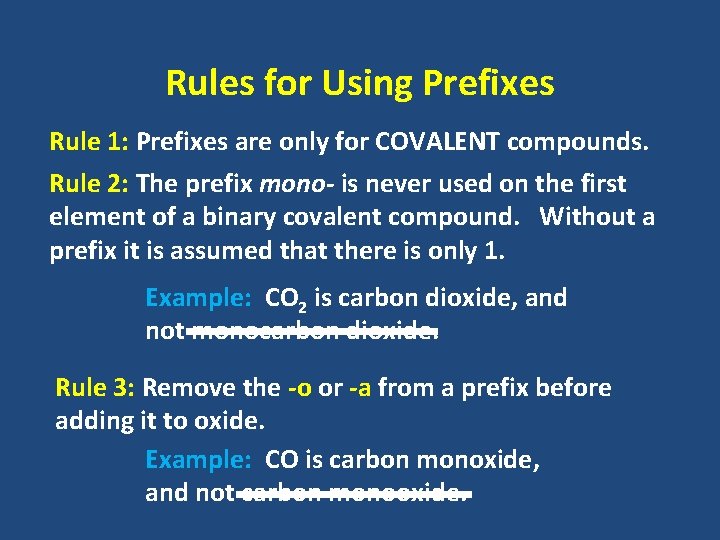
Rules for Using Prefixes Rule 1: Prefixes are only for COVALENT compounds. Rule 2: The prefix mono- is never used on the first element of a binary covalent compound. Without a prefix it is assumed that there is only 1. Example: CO 2 is carbon dioxide, and not monocarbon dioxide. Rule 3: Remove the -o or -a from a prefix before adding it to oxide. Example: CO is carbon monoxide, and not carbon monooxide.
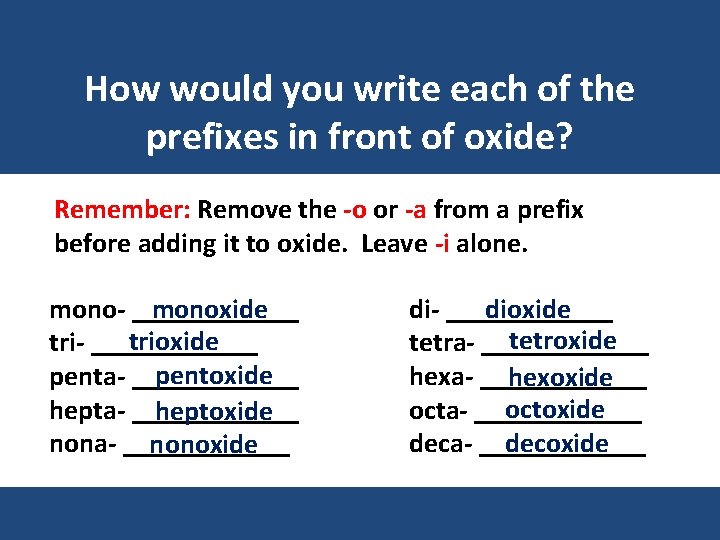
How would you write each of the prefixes in front of oxide? Remember: Remove the -o or -a from a prefix before adding it to oxide. Leave -i alone. mono- ______ monoxide tri- ______ pentoxide penta- ____________ heptoxide nona- ______ nonoxide di- ______ dioxide tetra- ____________ hexoxide octa- ____________ decoxide
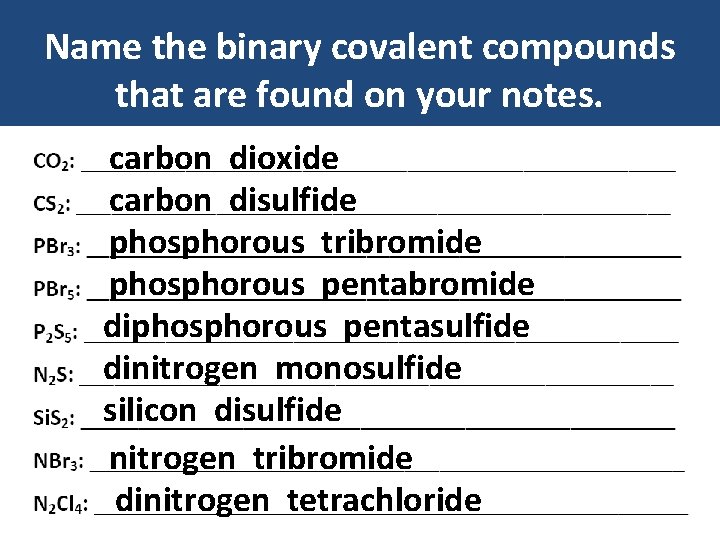
Name the binary covalent compounds that are found on your notes. carbon dioxide carbon disulfide phosphorous tribromide phosphorous pentabromide diphosphorous pentasulfide dinitrogen monosulfide silicon disulfide nitrogen tribromide dinitrogen tetrachloride
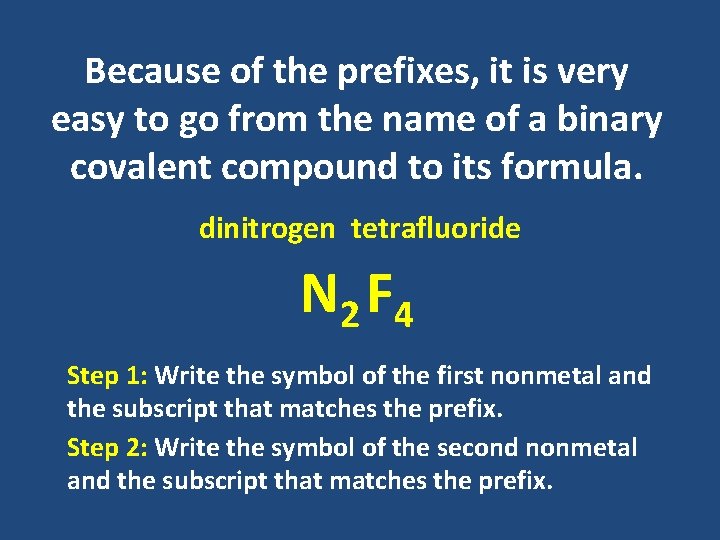
Because of the prefixes, it is very easy to go from the name of a binary covalent compound to its formula. dinitrogen tetrafluoride N 2 F 4 Step 1: Write the symbol of the first nonmetal and the subscript that matches the prefix. Step 2: Write the symbol of the second nonmetal and the subscript that matches the prefix.
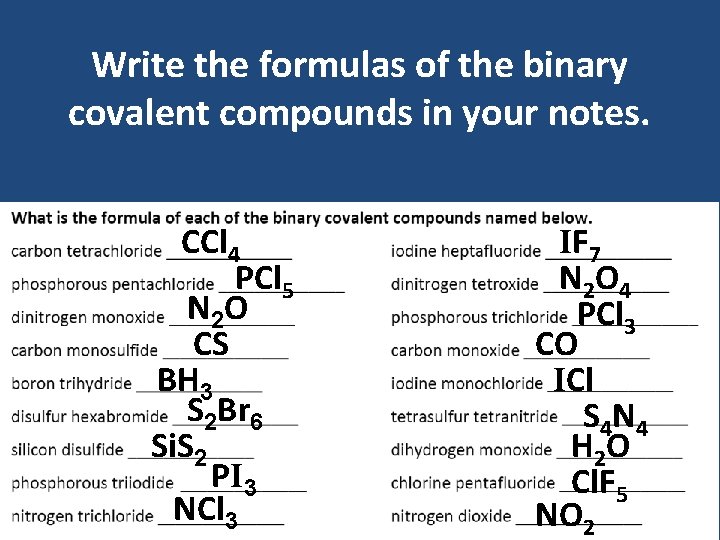
Write the formulas of the binary covalent compounds in your notes. CCl 4 PCl 5 N 2 O CS BH 3 S 2 Br 6 Si. S 2 P I 3 NCl 3 IF 7 N 2 O 4 PCl 3 CO ICl S 4 N 4 H 2 O Cl. F 5 NO 2
- Slides: 17