
Naming and Writing Formulas Classifying Compounds The system

- Slides: 35
Naming and Writing Formulas
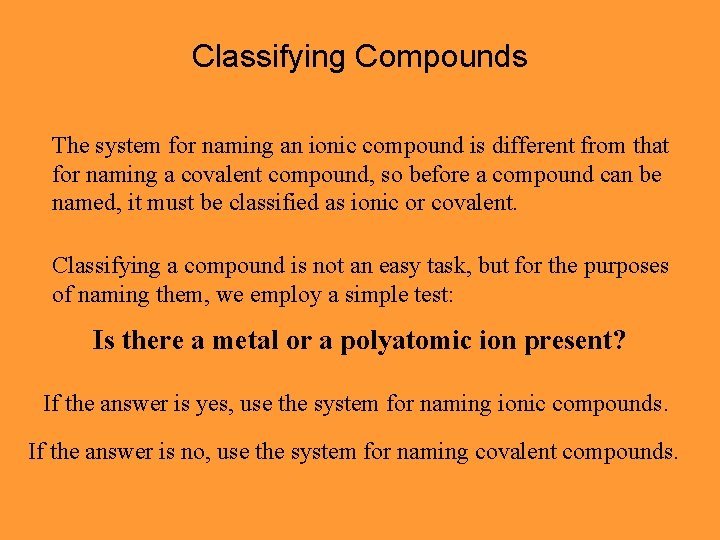
Classifying Compounds The system for naming an ionic compound is different from that for naming a covalent compound, so before a compound can be named, it must be classified as ionic or covalent. Classifying a compound is not an easy task, but for the purposes of naming them, we employ a simple test: Is there a metal or a polyatomic ion present? If the answer is yes, use the system for naming ionic compounds. If the answer is no, use the system for naming covalent compounds.
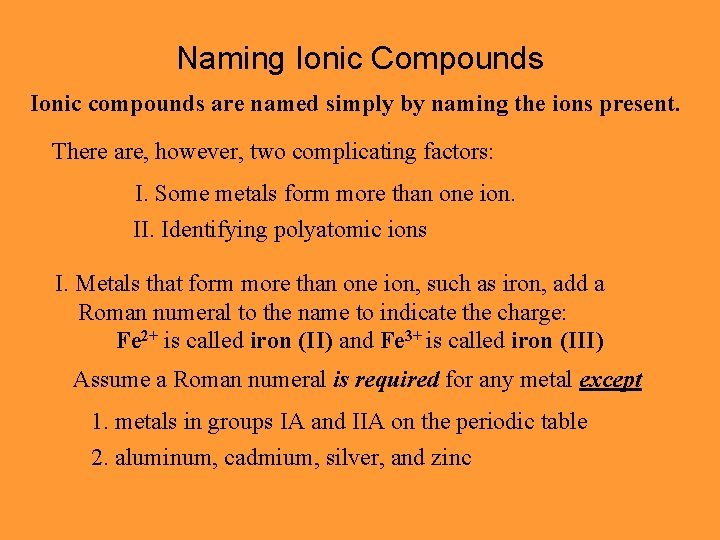
Naming Ionic Compounds Ionic compounds are named simply by naming the ions present. There are, however, two complicating factors: I. Some metals form more than one ion. II. Identifying polyatomic ions I. Metals that form more than one ion, such as iron, add a Roman numeral to the name to indicate the charge: Fe 2+ is called iron (II) and Fe 3+ is called iron (III) Assume a Roman numeral is required for any metal except 1. metals in groups IA and IIA on the periodic table 2. aluminum, cadmium, silver, and zinc
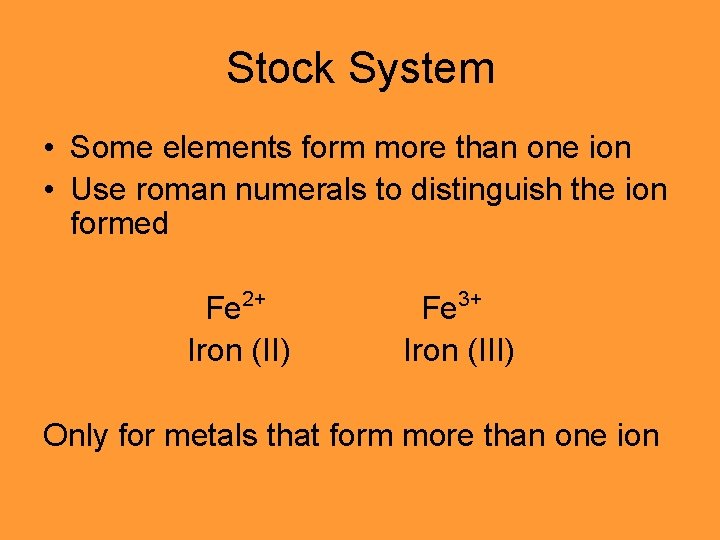
Stock System • Some elements form more than one ion • Use roman numerals to distinguish the ion formed Fe 2+ Iron (II) Fe 3+ Iron (III) Only for metals that form more than one ion
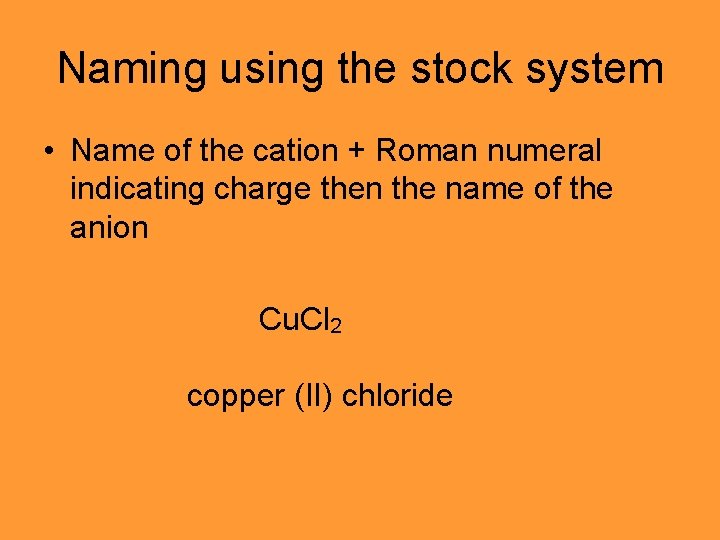
Naming using the stock system • Name of the cation + Roman numeral indicating charge then the name of the anion Cu. Cl 2 copper (II) chloride
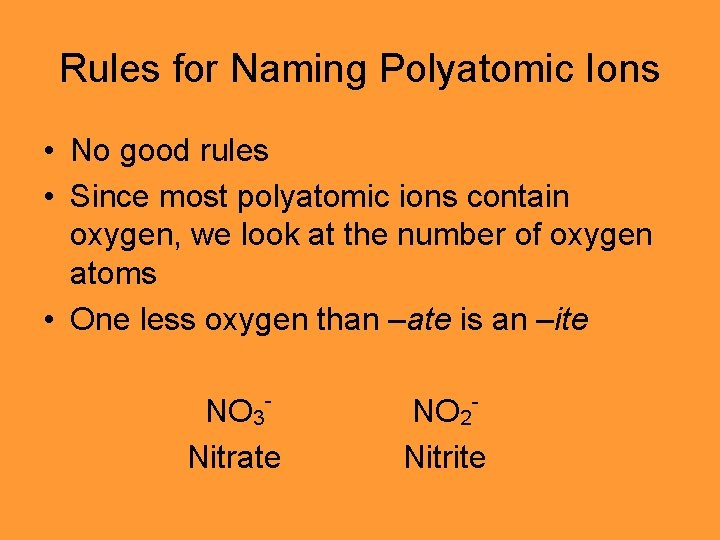
Rules for Naming Polyatomic Ions • No good rules • Since most polyatomic ions contain oxygen, we look at the number of oxygen atoms • One less oxygen than –ate is an –ite NO 3 Nitrate NO 2 Nitrite
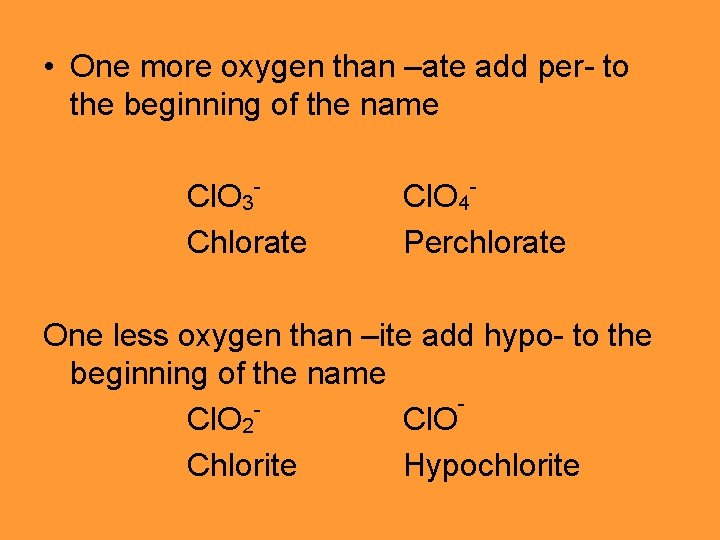
• One more oxygen than –ate add per- to the beginning of the name Cl. O 3 Chlorate Cl. O 4 Perchlorate One less oxygen than –ite add hypo- to the beginning of the name Cl. O 2 Cl. O Chlorite Hypochlorite
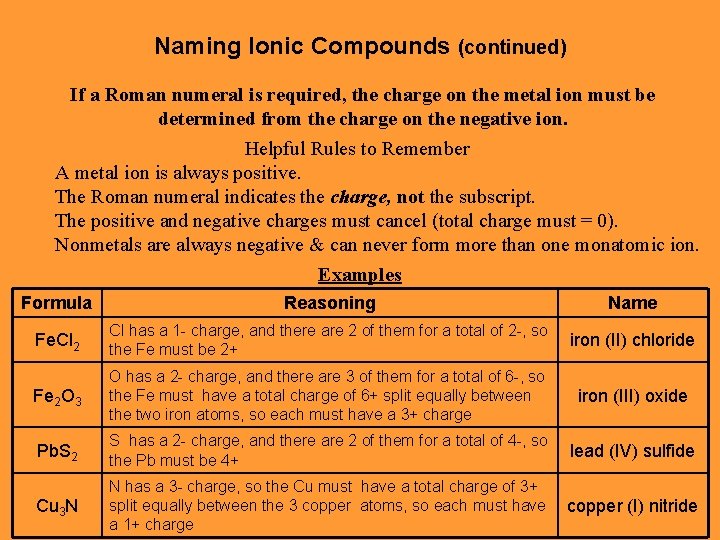
Naming Ionic Compounds (continued) If a Roman numeral is required, the charge on the metal ion must be determined from the charge on the negative ion. Helpful Rules to Remember A metal ion is always positive. The Roman numeral indicates the charge, not the subscript. The positive and negative charges must cancel (total charge must = 0). Nonmetals are always negative & can never form more than one monatomic ion. Examples Formula Reasoning Name Fe. Cl 2 Cl has a 1 - charge, and there are 2 of them for a total of 2 -, so the Fe must be 2+ iron (II) chloride Fe 2 O 3 O has a 2 - charge, and there are 3 of them for a total of 6 -, so the Fe must have a total charge of 6+ split equally between the two iron atoms, so each must have a 3+ charge iron (III) oxide Pb. S 2 S has a 2 - charge, and there are 2 of them for a total of 4 -, so the Pb must be 4+ lead (IV) sulfide Cu 3 N N has a 3 - charge, so the Cu must have a total charge of 3+ split equally between the 3 copper atoms, so each must have a 1+ charge copper (I) nitride
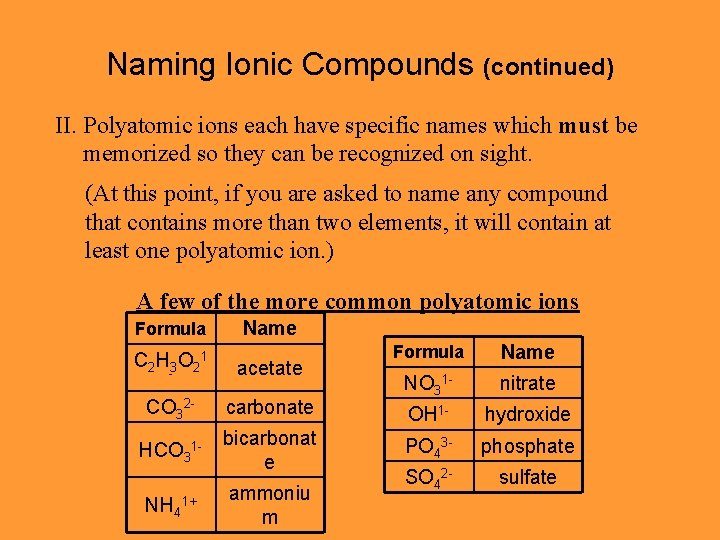
Naming Ionic Compounds (continued) II. Polyatomic ions each have specific names which must be memorized so they can be recognized on sight. (At this point, if you are asked to name any compound that contains more than two elements, it will contain at least one polyatomic ion. ) A few of the more common polyatomic ions Formula Name C 2 H 3 O 2 1 - acetate CO 32 - carbonate HCO 31 - bicarbonat e NH 41+ ammoniu m Formula Name NO 31 - nitrate OH 1 - hydroxide PO 43 - phosphate SO 42 - sulfate
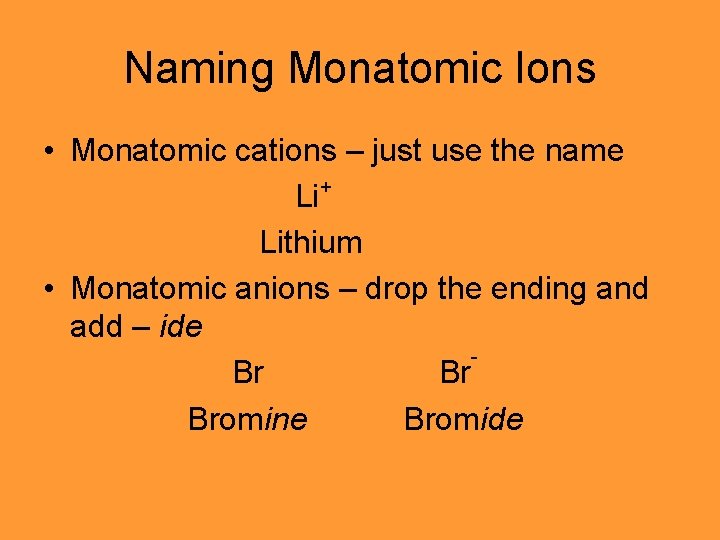
Naming Monatomic Ions • Monatomic cations – just use the name Li+ Lithium • Monatomic anions – drop the ending and add – ide Br Br Bromine Bromide
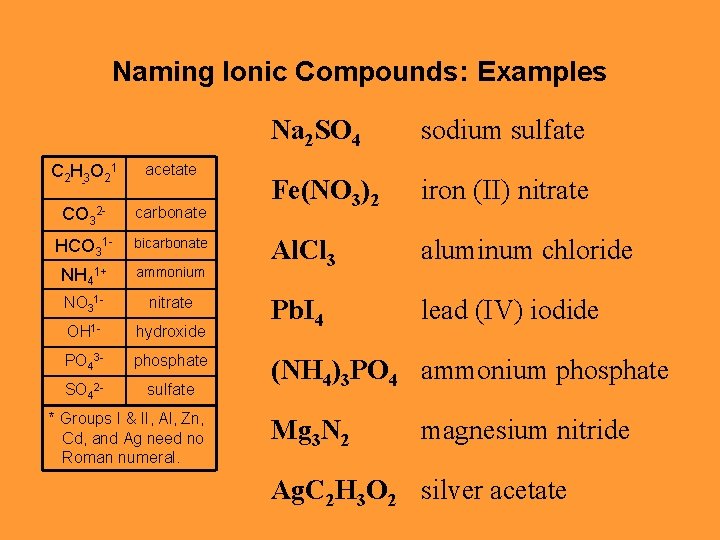
Naming Ionic Compounds: Examples C 2 H 3 O 2 1 acetate CO 32 - carbonate HCO 31 - bicarbonate NH 41+ ammonium NO 31 - nitrate OH 1 - hydroxide PO 43 - phosphate SO 4 sulfate - 2 - * Groups I & II, Al, Zn, Cd, and Ag need no Roman numeral. Na 2 SO 4 sodium sulfate Fe(NO 3)2 iron (II) nitrate Al. Cl 3 aluminum chloride Pb. I 4 lead (IV) iodide (NH 4)3 PO 4 ammonium phosphate Mg 3 N 2 magnesium nitride Ag. C 2 H 3 O 2 silver acetate
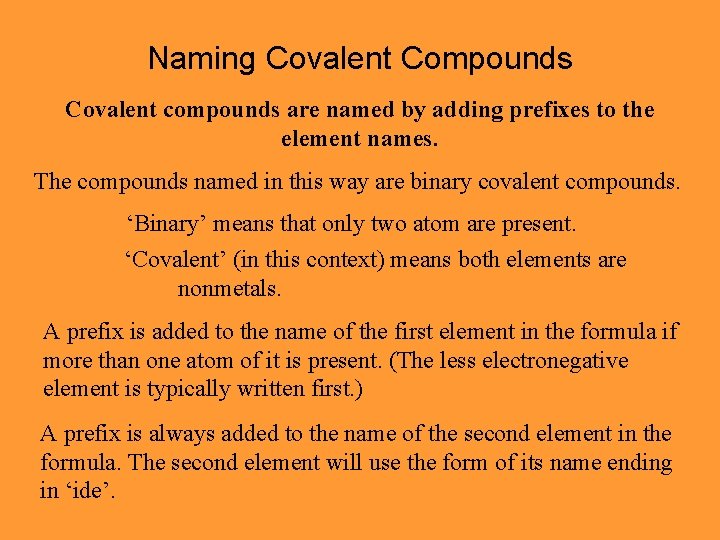
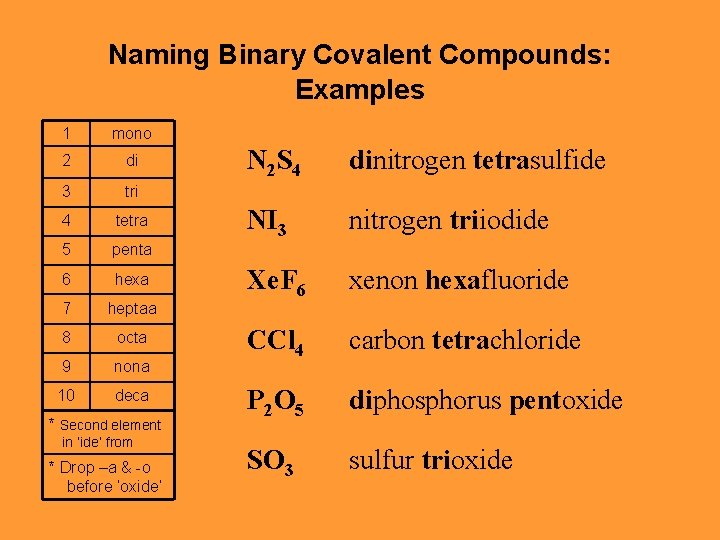
Naming Covalent Compounds Covalent compounds are named by adding prefixes to the element names. The compounds named in this way are binary covalent compounds. ‘Binary’ means that only two atom are present. ‘Covalent’ (in this context) means both elements are nonmetals. A prefix is added to the name of the first element in the formula if more than one atom of it is present. (The less electronegative element is typically written first. ) A prefix is always added to the name of the second element in the formula. The second element will use the form of its name ending in ‘ide’.
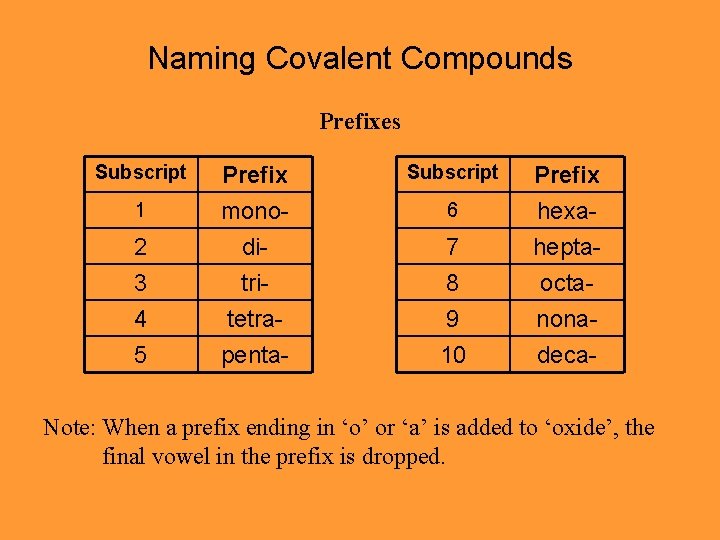
Naming Covalent Compounds Prefixes Subscript 2 3 Prefix monoditri- 7 8 Prefix hexaheptaocta- 4 5 tetrapenta- 9 10 nonadeca- 1 6 Note: When a prefix ending in ‘o’ or ‘a’ is added to ‘oxide’, the final vowel in the prefix is dropped.
Naming Binary Covalent Compounds: Examples 1 mono 2 di 3 tri 4 tetra 5 penta 6 hexa 7 heptaa 8 octa 9 nona 10 deca * Second element in ‘ide’ from * Drop –a & -o before ‘oxide’ N 2 S 4 dinitrogen tetrasulfide NI 3 nitrogen triiodide Xe. F 6 xenon hexafluoride CCl 4 carbon tetrachloride P 2 O 5 diphosphorus pentoxide SO 3 sulfur trioxide
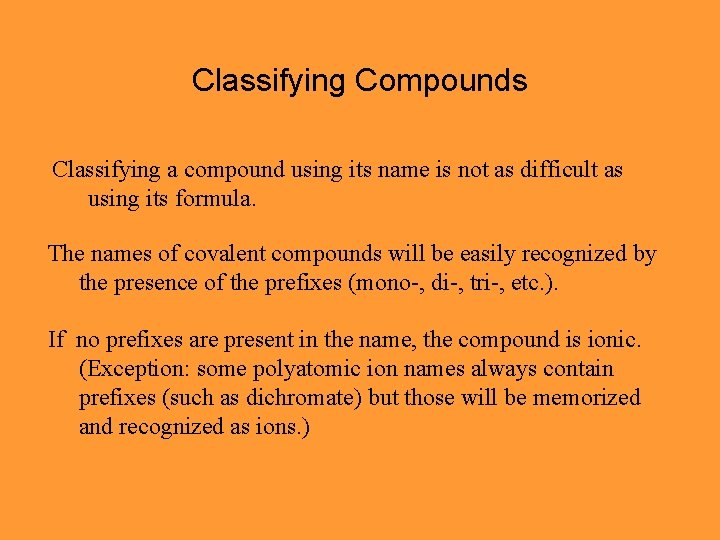
Classifying Compounds Classifying a compound using its name is not as difficult as using its formula. The names of covalent compounds will be easily recognized by the presence of the prefixes (mono-, di-, tri-, etc. ). If no prefixes are present in the name, the compound is ionic. (Exception: some polyatomic ion names always contain prefixes (such as dichromate) but those will be memorized and recognized as ions. )
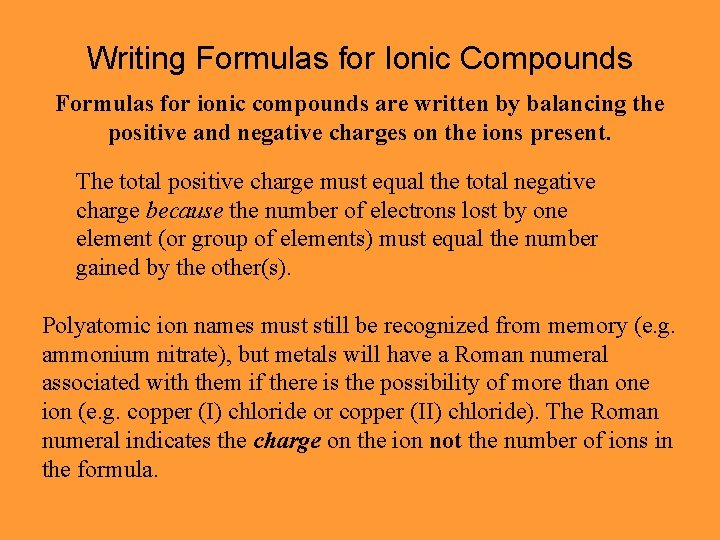
Writing Formulas for Ionic Compounds Formulas for ionic compounds are written by balancing the positive and negative charges on the ions present. The total positive charge must equal the total negative charge because the number of electrons lost by one element (or group of elements) must equal the number gained by the other(s). Polyatomic ion names must still be recognized from memory (e. g. ammonium nitrate), but metals will have a Roman numeral associated with them if there is the possibility of more than one ion (e. g. copper (I) chloride or copper (II) chloride). The Roman numeral indicates the charge on the ion not the number of ions in the formula.
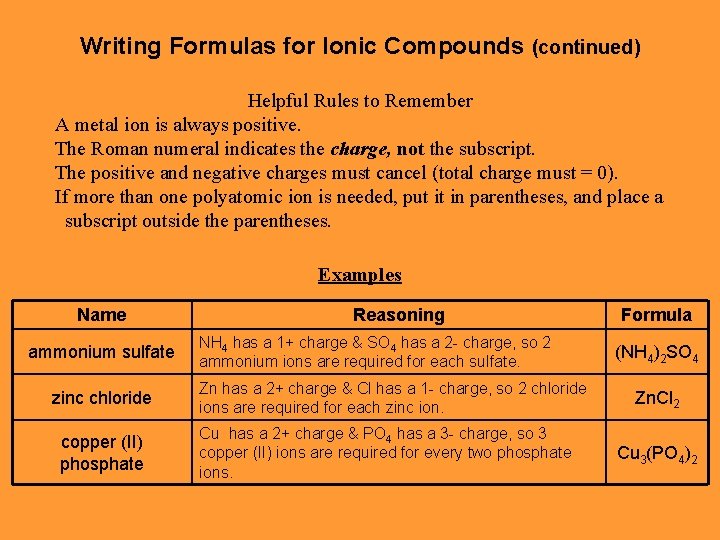
Writing Formulas for Ionic Compounds (continued) Helpful Rules to Remember A metal ion is always positive. The Roman numeral indicates the charge, not the subscript. The positive and negative charges must cancel (total charge must = 0). If more than one polyatomic ion is needed, put it in parentheses, and place a subscript outside the parentheses. Examples Name ammonium sulfate zinc chloride copper (II) phosphate Reasoning NH 4 has a 1+ charge & SO 4 has a 2 - charge, so 2 ammonium ions are required for each sulfate. Zn has a 2+ charge & Cl has a 1 - charge, so 2 chloride ions are required for each zinc ion. Cu has a 2+ charge & PO 4 has a 3 - charge, so 3 copper (II) ions are required for every two phosphate ions. Formula (NH 4)2 SO 4 Zn. Cl 2 Cu 3(PO 4)2
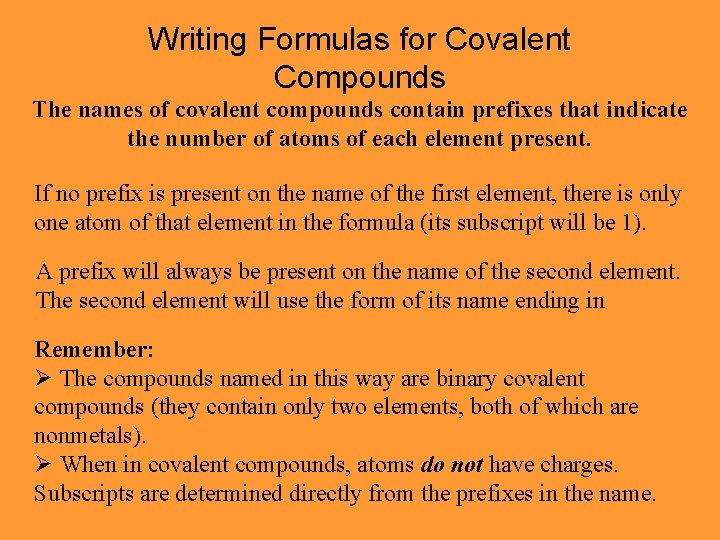
Writing Formulas for Covalent Compounds The names of covalent compounds contain prefixes that indicate the number of atoms of each element present. If no prefix is present on the name of the first element, there is only one atom of that element in the formula (its subscript will be 1). A prefix will always be present on the name of the second element. The second element will use the form of its name ending in Remember: Ø The compounds named in this way are binary covalent compounds (they contain only two elements, both of which are nonmetals). Ø When in covalent compounds, atoms do not have charges. Subscripts are determined directly from the prefixes in the name.
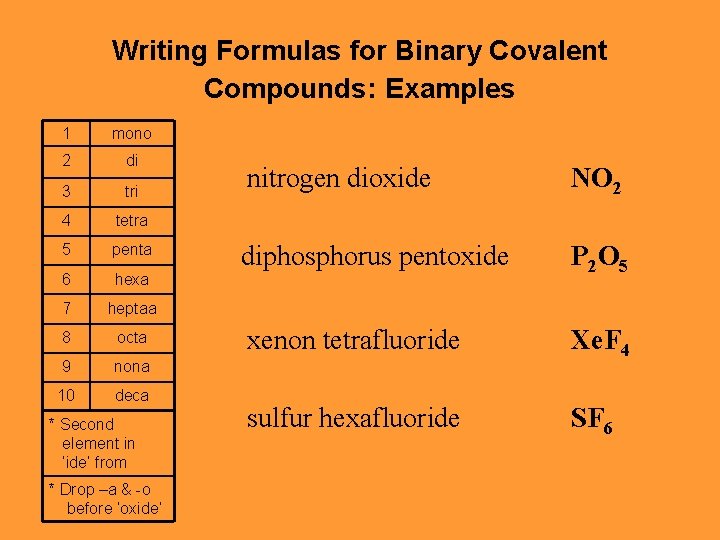
Writing Formulas for Binary Covalent Compounds: Examples 1 mono 2 di 3 tri 4 tetra 5 penta 6 hexa 7 heptaa 8 octa 9 nona 10 deca * Second element in ‘ide’ from * Drop –a & -o before ‘oxide’ nitrogen dioxide NO 2 diphosphorus pentoxide P 2 O 5 xenon tetrafluoride Xe. F 4 sulfur hexafluoride SF 6
Acids • An acid is a substance that produces positive hydrogen ions when placed in water. (H+) • The strength of an acid depends on how completely the substance ionizes. Strong acids completely ionize in water. Weak acids ionize only slightly.
Base • A base is a substance that produces negative hydroxide ions when placed in water. (OH-) • The strength of a base depends on how completely the substance dissociates into metal ions and hydroxide ions in water. Strong bases dissociate completely. Weak bases do not.
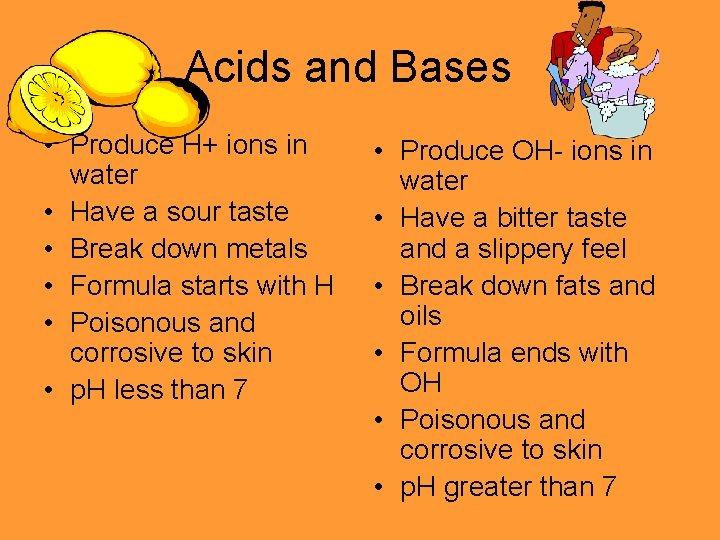
Acids and Bases • Produce H+ ions in water • Have a sour taste • Break down metals • Formula starts with H • Poisonous and corrosive to skin • p. H less than 7 • Produce OH- ions in water • Have a bitter taste and a slippery feel • Break down fats and oils • Formula ends with OH • Poisonous and corrosive to skin • p. H greater than 7
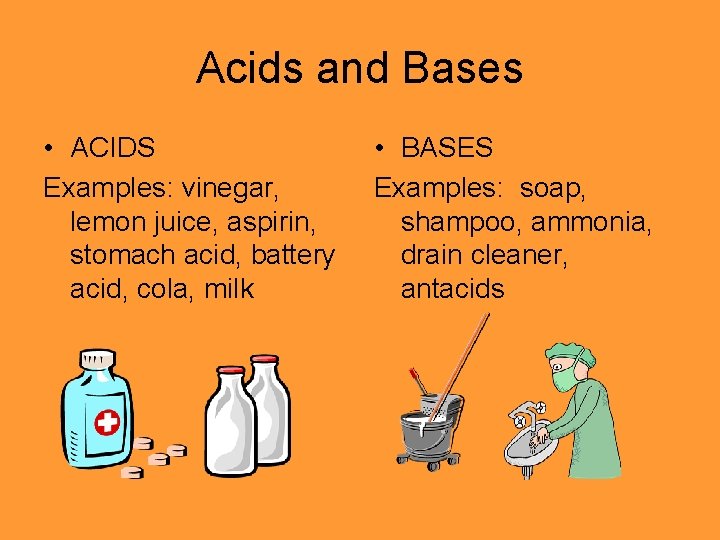
Acids and Bases • ACIDS Examples: vinegar, lemon juice, aspirin, stomach acid, battery acid, cola, milk • BASES Examples: soap, shampoo, ammonia, drain cleaner, antacids
Neutral Substances • p. H = 7 • Safe to ingest and leave on skin • Concentrations of H+ ions and OH- ions are equal Examples: d. H 2 O, salts, most cosmetics, lotions, eye drops, etc.
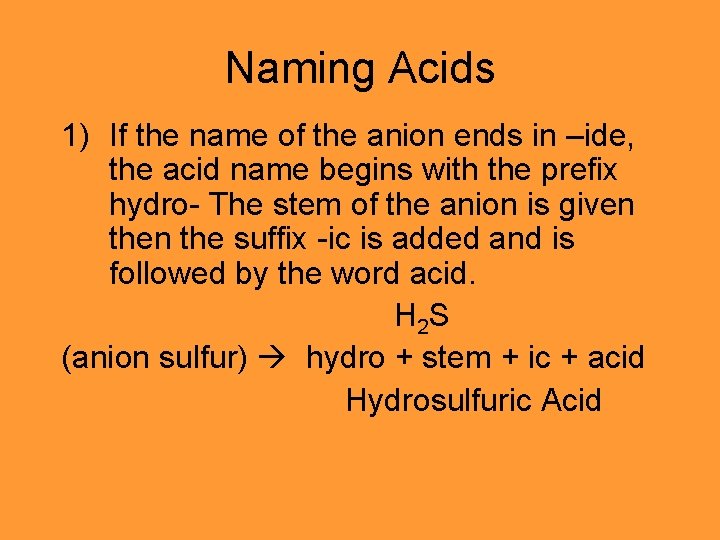
Naming Acids 1) If the name of the anion ends in –ide, the acid name begins with the prefix hydro- The stem of the anion is given the suffix -ic is added and is followed by the word acid. H 2 S (anion sulfur) hydro + stem + ic + acid Hydrosulfuric Acid
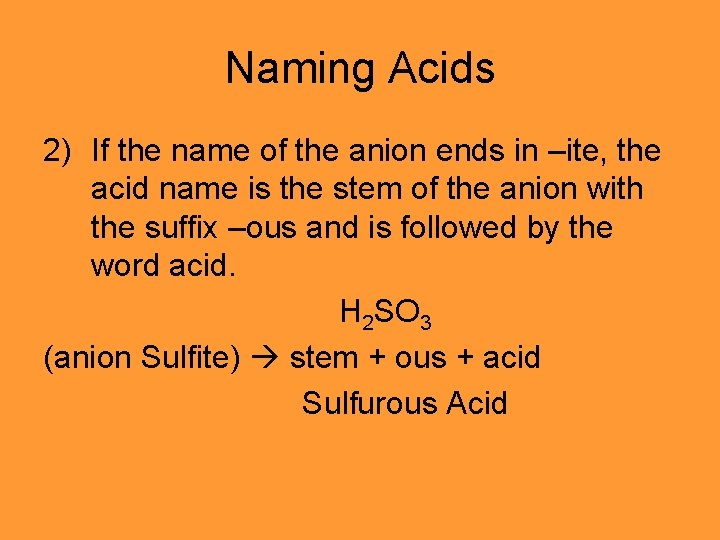
Naming Acids 2) If the name of the anion ends in –ite, the acid name is the stem of the anion with the suffix –ous and is followed by the word acid. H 2 SO 3 (anion Sulfite) stem + ous + acid Sulfurous Acid
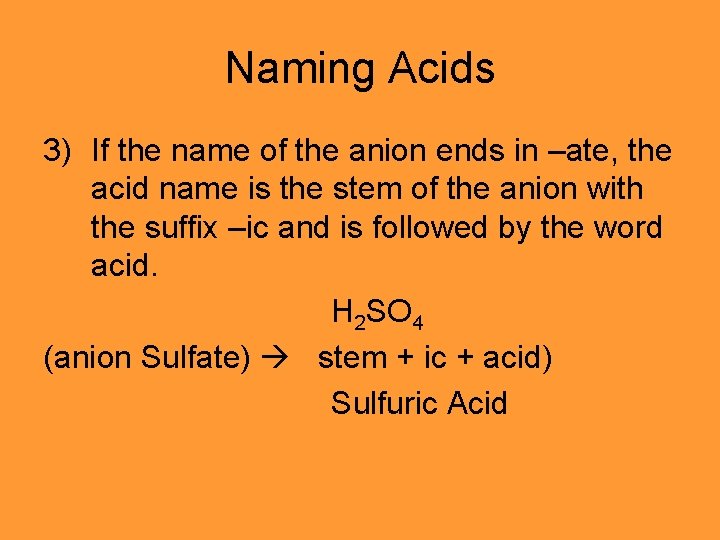
Naming Acids 3) If the name of the anion ends in –ate, the acid name is the stem of the anion with the suffix –ic and is followed by the word acid. H 2 SO 4 (anion Sulfate) stem + ic + acid) Sulfuric Acid
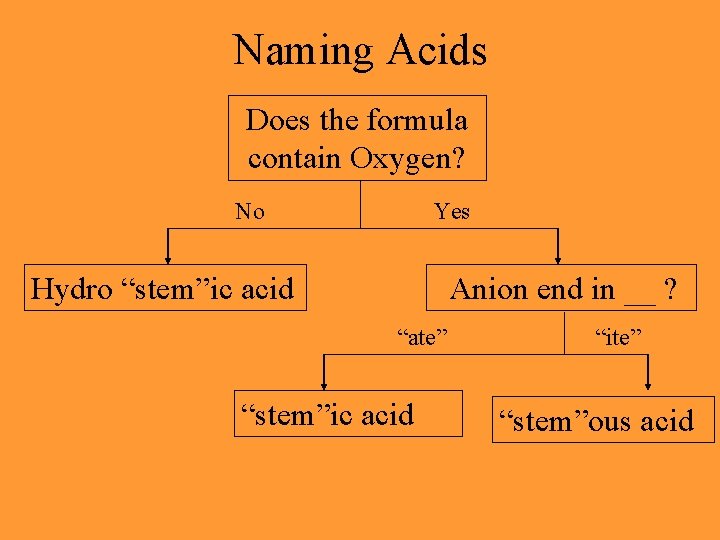
Naming Acids Does the formula contain Oxygen? No Yes Hydro “stem”ic acid Anion end in __ ? “ate” “stem”ic acid “ite” “stem”ous acid
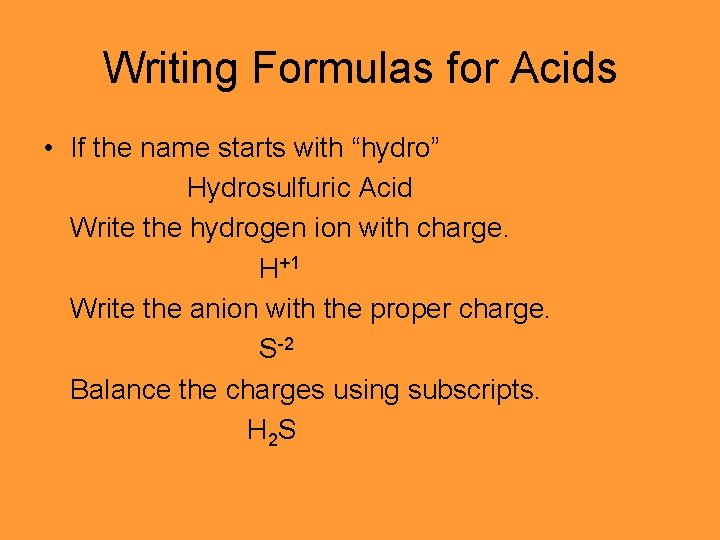
Writing Formulas for Acids • If the name starts with “hydro” Hydrosulfuric Acid Write the hydrogen ion with charge. H+1 Write the anion with the proper charge. S-2 Balance the charges using subscripts. H 2 S
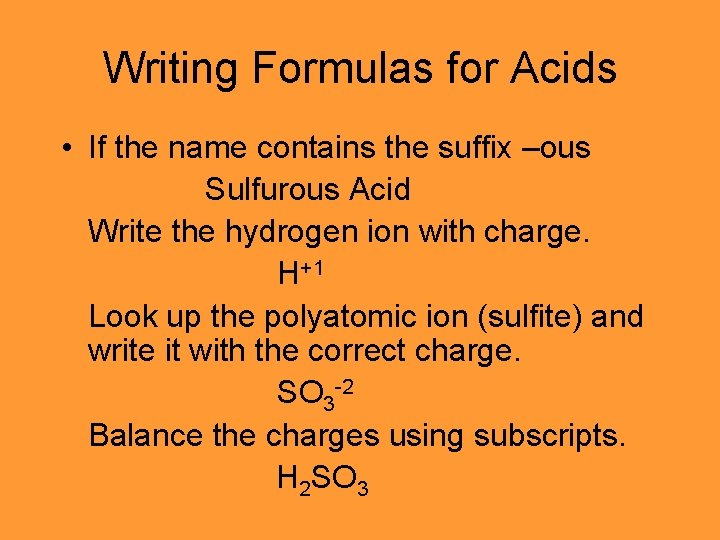
Writing Formulas for Acids • If the name contains the suffix –ous Sulfurous Acid Write the hydrogen ion with charge. H+1 Look up the polyatomic ion (sulfite) and write it with the correct charge. SO 3 -2 Balance the charges using subscripts. H 2 SO 3
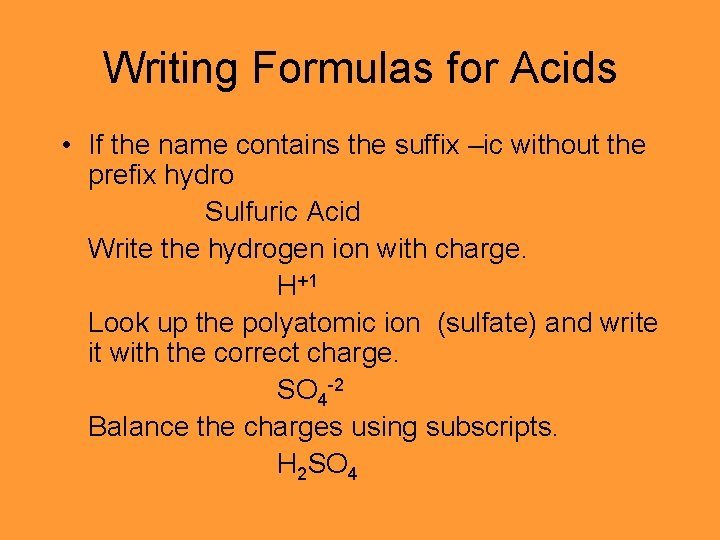
Writing Formulas for Acids • If the name contains the suffix –ic without the prefix hydro Sulfuric Acid Write the hydrogen ion with charge. H+1 Look up the polyatomic ion (sulfate) and write it with the correct charge. SO 4 -2 Balance the charges using subscripts. H 2 SO 4
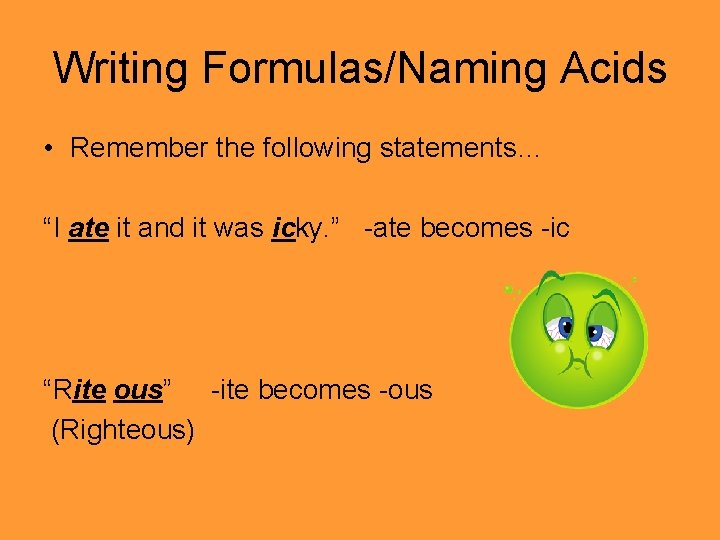
Writing Formulas/Naming Acids • Remember the following statements… “I ate it and it was icky. ” -ate becomes -ic “Rite ous” -ite becomes -ous (Righteous)
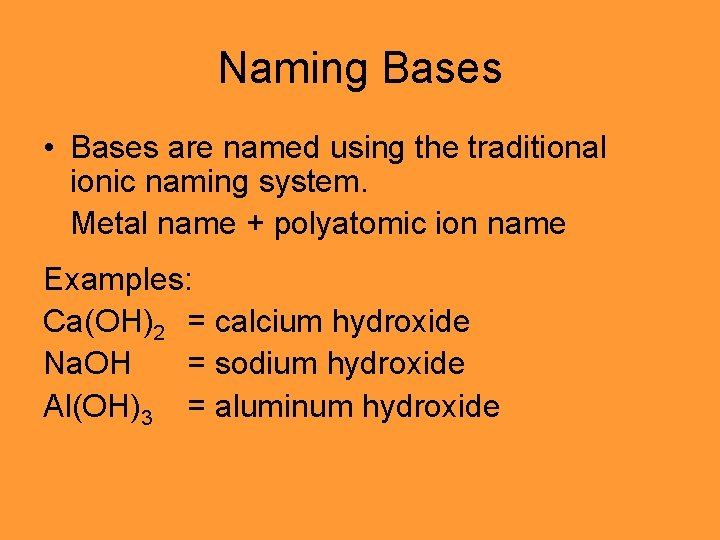
Naming Bases • Bases are named using the traditional ionic naming system. Metal name + polyatomic ion name Examples: Ca(OH)2 = calcium hydroxide Na. OH = sodium hydroxide Al(OH)3 = aluminum hydroxide
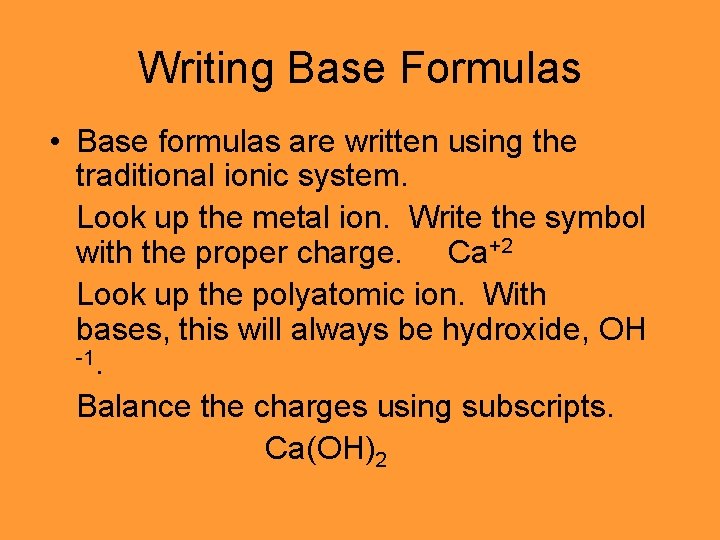
Writing Base Formulas • Base formulas are written using the traditional ionic system. Look up the metal ion. Write the symbol with the proper charge. Ca+2 Look up the polyatomic ion. With bases, this will always be hydroxide, OH -1. Balance the charges using subscripts. Ca(OH)2
The rules for naming and writing formulas for compounds are possible because of 2 laws: – 1. The Law of Definite Proportions: samples of any chemical compound, the masses of the elements are always in the same proportions. – 2. The Law of Multiple Proportions: Whenever the same two elements form more than one compound, the different masses of one element that combine with the same mass of the other element are in the ratio of small whole numbers.