
Namibia The Oil and Gas Activities and Hydrocarbon
Namibia: The Oil and Gas Activities and Hydrocarbon Potential Obeth Mbui Kandjoze Manager New Ventures & Promotion NAMCOR AAPG International Conference & Exhibition November 5 -8, 2006 Perth Convention & Exhibition Centre • Perth, Australia
Talk Outline Location Onshore & Offshore Basins Fiscal & Legal Regime Database Tectono-stratigraphic Development Source rock development and maturity Kudu Development Licensing Status

Location Windhoek Perth

Onshore & Offshore Basins
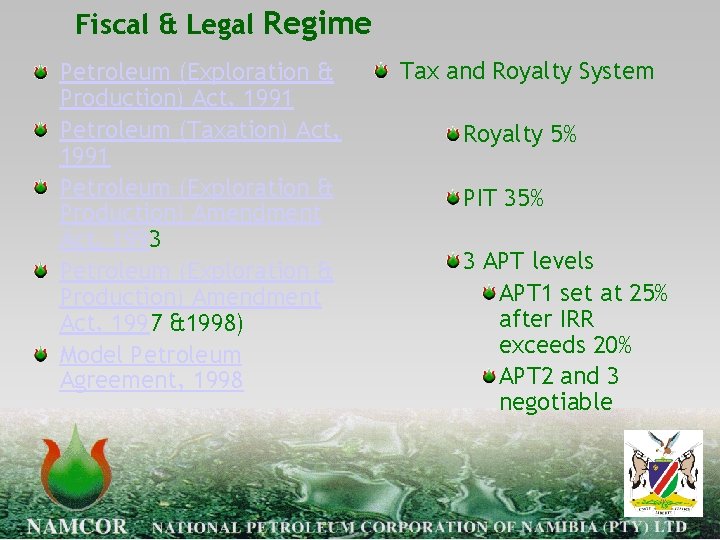
Fiscal & Legal Regime Petroleum (Exploration & Production) Act, 1991 Petroleum (Taxation) Act, 1991 Petroleum (Exploration & Production) Amendment Act, 1993 Petroleum (Exploration & Production) Amendment Act, 1997 &1998) Model Petroleum Agreement, 1998 Tax and Royalty System Royalty 5% PIT 35% 3 APT levels APT 1 set at 25% after IRR exceeds 20% APT 2 and 3 negotiable
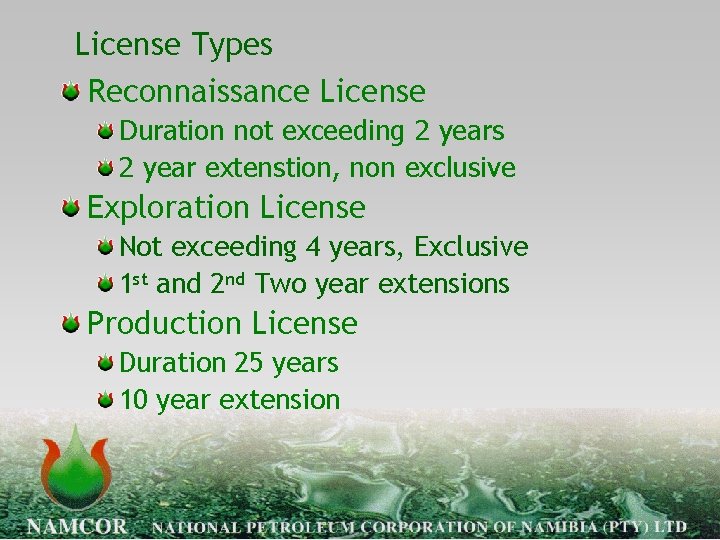
License Types Reconnaissance License Duration not exceeding 2 years 2 year extenstion, non exclusive Exploration License Not exceeding 4 years, Exclusive 1 st and 2 nd Two year extensions Production License Duration 25 years 10 year extension
Database Exploration started off 1970’s 33, 000 km seismic acquired Single well drilled 1974 Discovery of Kudu gas field in 1974 1980’s NAMCOR acquired seismic over Kudu 1987 -1988 Kudu 2 and 3 drilled Kudu 3 tested; 38 MMscf/day
ECL 1989 –NAMCOR & Halliburton, a 10, 600 km 2 D seismic offshore plus 3, 770 km over Kudu remains the core of data Held 3 Lic. Rounds post 90’s Now Open Lic. System To date 14 wells drilled offshore Now Seismic Database 2 D Data 35000 km non-exclusive seismic 45000 km proprietary data 3 D Data 1345 sq km proprietary Aeromagnetic Data Satellite Gravity Surface Geochemical

1911/10 -1 1911/15 -1 Seismic & Well Database 2012/13 -1 • 14 wells drilled offshore Namibia • 7 of these on or around Kudu • 10 ODP/DSDP holes, mostly Neogene TD 2815/15 -1
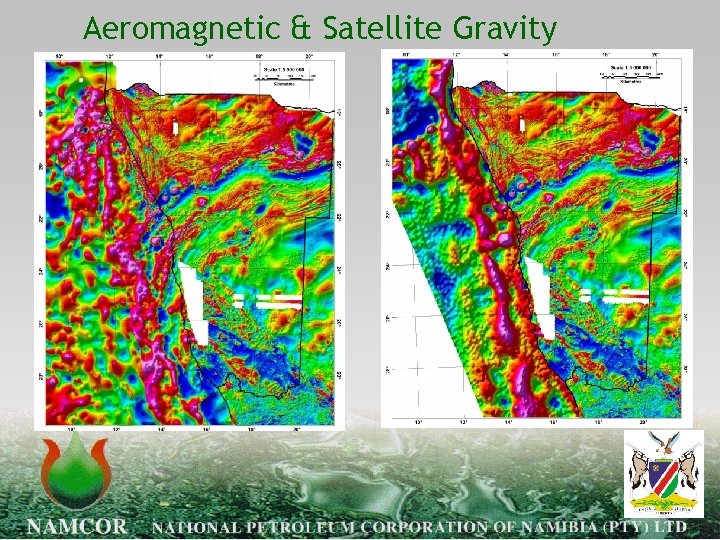
Aeromagnetic & Satellite Gravity
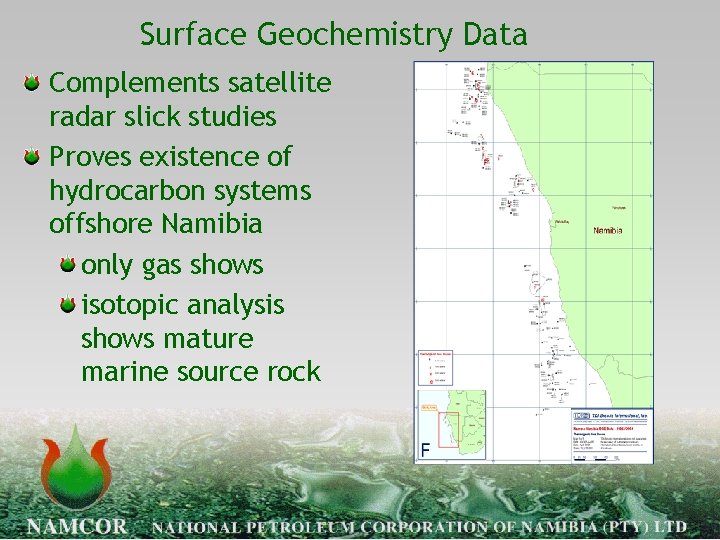
Surface Geochemistry Data Complements satellite radar slick studies Proves existence of hydrocarbon systems offshore Namibia only gas shows isotopic analysis shows mature marine source rock
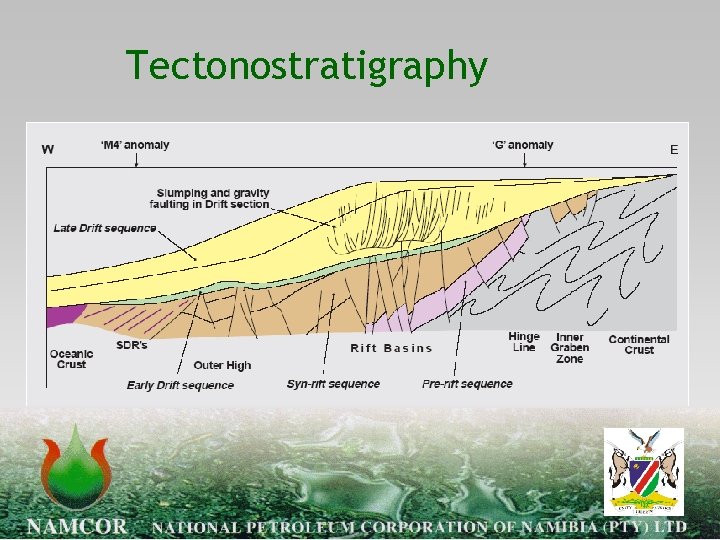
Tectonostratigraphy
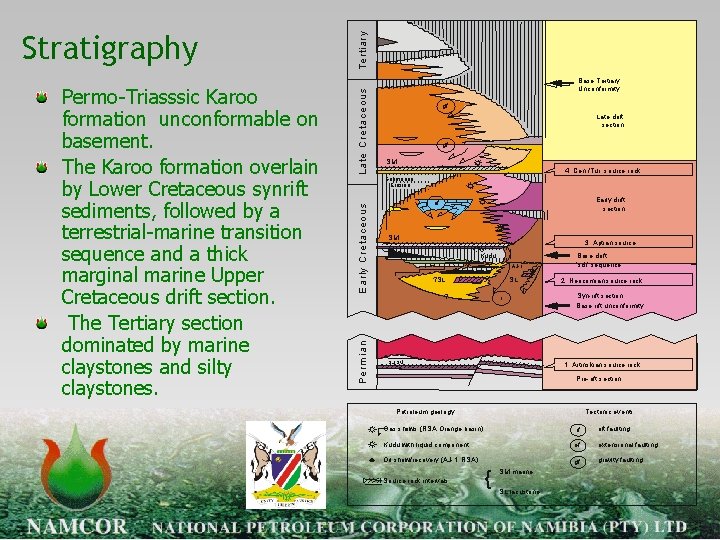
Ter tia ry L a te C r e ta ce o u s E a rly C re ta c e o u s Permo-Triasssic Karoo formation unconformable on basement. The Karoo formation overlain by Lower Cretaceous synrift sediments, followed by a terrestrial-marine transition sequence and a thick marginal marine Upper Cretaceous drift section. The Tertiary section dominated by marine claystones and silty claystones. P erm ia n Stratigraphy Base Tertiary Unconformity gf Late drift section gf SM 4. Cen. /Tur. source rock Submarine Erosion Early drift section ef SM 3. Aptian source Kudu AJ-1 ? SL SL ? r SL/SM Base drift 'sdr' sequence 2. Neocomian source rock Syn-rift section Base rift unconformity 1. Artinskian source rock Pre-rift section Petroleum geology Tectonic events Gas shows (RSA Orange basin) rf rift faulting Kudu with liquid component ef extensional faulting gf gravity faulting Oil show/recovery (AJ-1, RSA) Source rock intervals { SM marine SL lacustrine
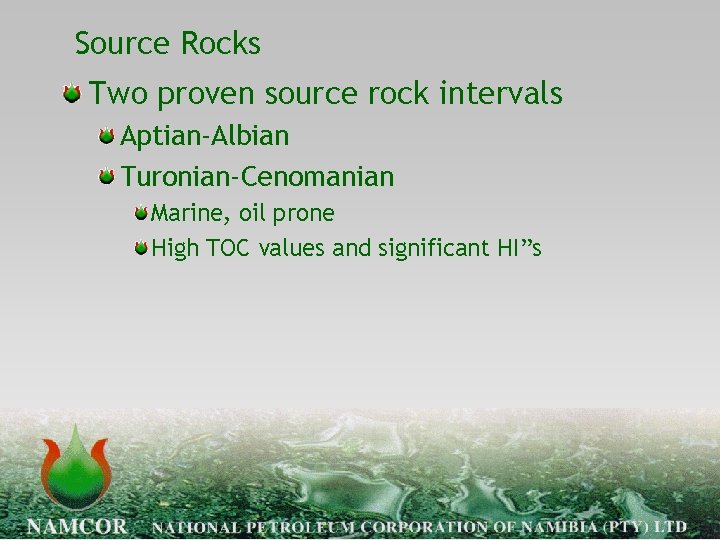
Source Rocks Two proven source rock intervals Aptian-Albian Turonian-Cenomanian Marine, oil prone High TOC values and significant HI”s
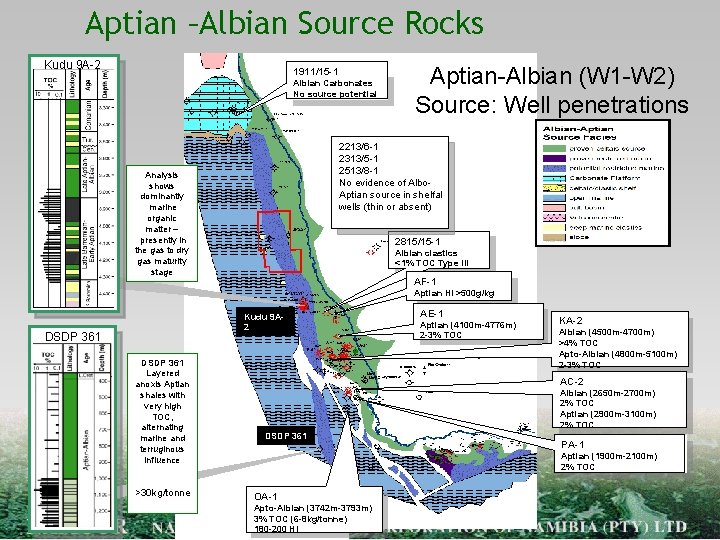
Aptian –Albian Source Rocks Kudu 9 A-2 1911/15 -1 Albian Carbonates No source potential Aptian-Albian (W 1 -W 2) Source: Well penetrations 2213/6 -1 2313/5 -1 2513/8 -1 No evidence of Albo. Aptian source in shelfal wells (thin or absent) Analysis shows dominantly marine organic matter – presently in the gas to dry gas maturity stage 2815/15 -1 Albian clastics <1% TOC Type III AF-1 Aptian HI >500 g/kg Kudu 9 A 2 DSDP 361 Layered anoxis Aptian shales with very high TOC, alternating marine and terruginous influence >30 kg/tonne AE-1 Aptian (4100 m-4776 m) 2 -3% TOC KA-2 Albian (4500 m-4700 m) >4% TOC Apto-Albian (4800 m-5100 m) 2 -3% TOC AC-2 Albian (2650 m-2700 m) 2% TOC Aptian (2900 m-3100 m) 2% TOC DSDP 361 PA-1 Aptian (1900 m-2100 m) 2% TOC OA-1 Apto-Albian (3742 m-3793 m) 3% TOC (6 -8 kg/tonne) 180 -200 HI
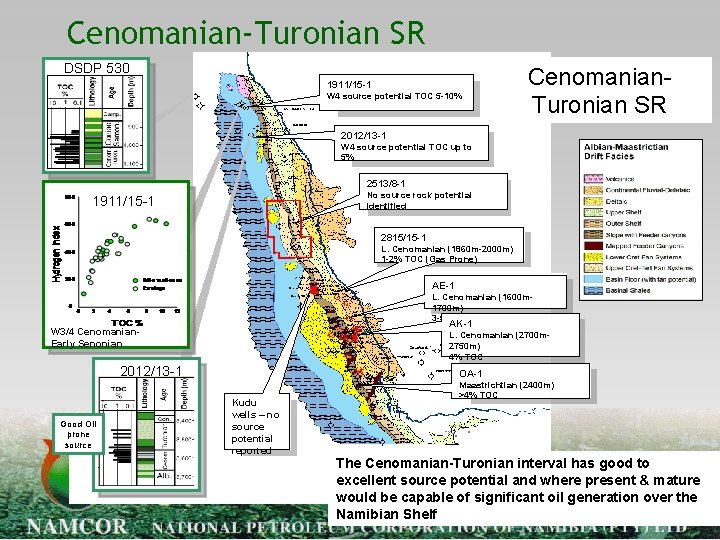
Cenomanian-Turonian SR DSDP 530 1911/15 -1 W 4 source potential TOC 5 -10% Cenomanian. Turonian SR 2012/13 -1 W 4 source potential TOC up to 5% 2513/8 -1 No source rock potential identified 1911/15 -1 2815/15 -1 L. Cenomanian (1860 m-2000 m) 1 -2% TOC (Gas Prone) AE-1 L. Cenomanian (1600 m 1700 m) 3 -5% TOC AK-1 W 3/4 Cenomanian. Early Senonian L. Cenomanian (2700 m 2750 m) 4% TOC 2012/13 -1 Good Oil prone source OA-1 Kudu wells – no source potential reported Maastrichtian (2400 m) >4% TOC The Cenomanian-Turonian interval has good to excellent source potential and where present & mature would be capable of significant oil generation over the Namibian Shelf
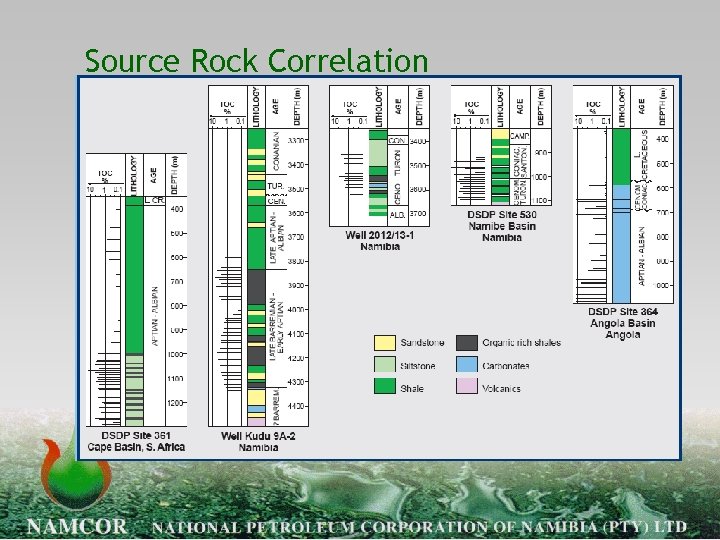
Source Rock Correlation
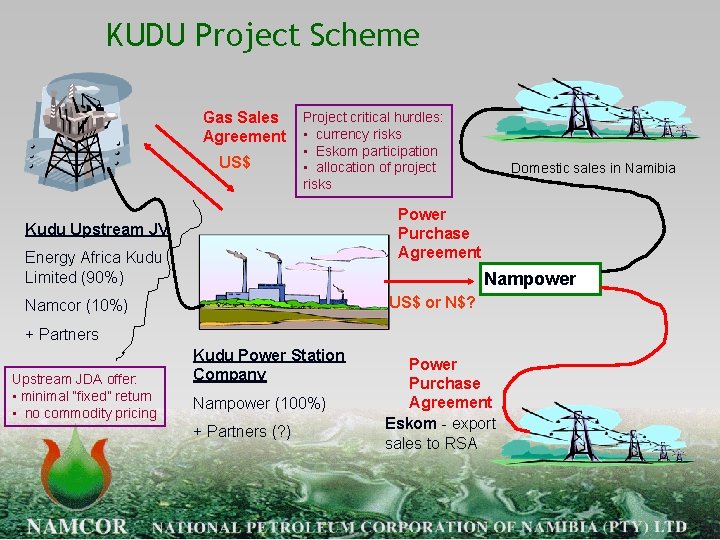
KUDU Project Scheme Gas Sales Agreement US$ Project critical hurdles: • currency risks • Eskom participation • allocation of project risks Domestic sales in Namibia Power Purchase Agreement Kudu Upstream JV Energy Africa Kudu Limited (90%) Nampower US$ or N$? Namcor (10%) + Partners Upstream JDA offer: • minimal “fixed” return • no commodity pricing Kudu Power Station Company Nampower (100%) + Partners (? ) Power Purchase Agreement Eskom - export sales to RSA

LICENSE BLOCKS
thank you ! National Petroleum Corporation of Namibia www. namcor. com. na
- Slides: 20