
NAMIBIA AFRICA Location Southern Africa bordering S Atlantic
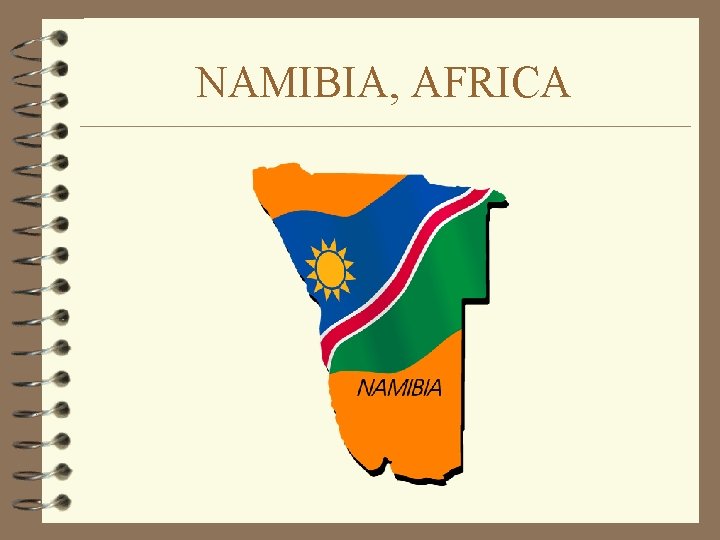
NAMIBIA, AFRICA
Location: Southern Africa, bordering S. Atlantic Ocean, between Angola and South Africa Total Area: 825, 318 sq. km. Borders: Angola, Botswana, South Africa, and Zambia Climate: Desert—hot, dry, with sparse rainfall Water: 0 sq. km Terrain: Mostly high plateau, Namib desert along coast and Kalahari Desert in east Land Use: Arable land: 99%, Permanent crops: 0%, Other: 99. 01% Natural Resources: Diamonds, copper, uranium, gold, lead, tin, lithium, cadmium, zinc, salt, vanadium, natural gas, hydropower, fish Irrigated Land: 60 sq. km. Environmental Issues: Limited natural freshwater resources, desertification, wildlife poaching
Population: 1, 954, 033 Age Structure: 0 -14 years: 42. 4%, 15 -64 years: 54%, 65 years and older: 3. 5% Life Expectancy: 42. 36 years Birth Rate: 33. 51 births/1, 000 Fertility Rate: 4. 65 children/woman Infant Mortality: 72 per 1, 000 births Ethnic Groups: Black: 87. 5%, white: 6%, mixed: 6. 5% Languages: Afrikaans: 60%, German: 32%, English: 7% Indigenous Languages: Oshivambo, Herero, Nama Religions: Christianity: 80 -90% (at least 50% Lutheran); indigenous beliefs: 10 -20% HIV/AIDS (adult rate): 1 in 5 People Living With AIDS: 210, 000
• Heavily dependent on the extraction and processing of minerals for export • Half of the population depends on subsistence agriculture • Industries: Meatpacking, fish processing, dairy, mining • Mining: Diamond, lead, zinc, tin, silver, uranium, copper • Agriculture: Millet, sorghum, peanuts, livestock, fish • Import about 50% of grain/cereal requirement • Labor force by occupation: agriculture: 47%, services: 33%, industry: 20% • Unemployment: 35% • 50% of the population is below poverty, with incomes of less than $1, 400 per year
HISTORY • During its first years of occupation, Namibia was a • • German colony known as South-West Africa. During WWI, the country was occupied by South Africa and then was taken over by South Africa after WWII. In 1966, a guerilla group started a war for independence and renamed the area Namibia. In 1988, South Africa ended its involvement in Namibia. Independence followed in 1990 with multiparty elections and the establishment of a constitution.
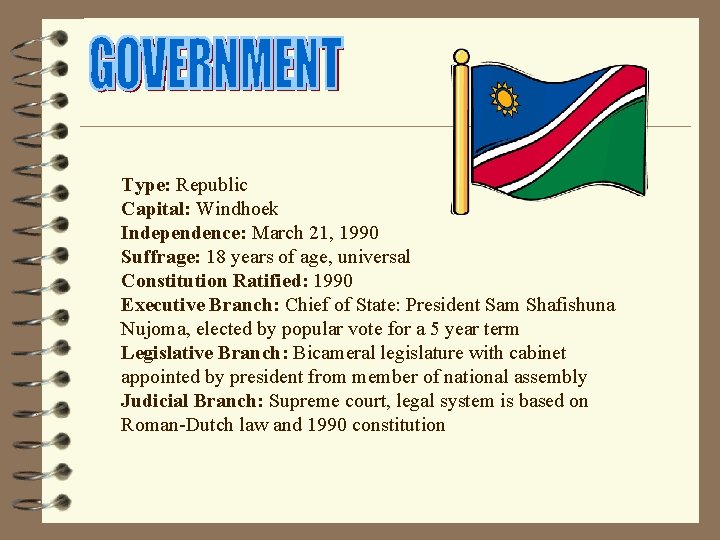
Type: Republic Capital: Windhoek Independence: March 21, 1990 Suffrage: 18 years of age, universal Constitution Ratified: 1990 Executive Branch: Chief of State: President Sam Shafishuna Nujoma, elected by popular vote for a 5 year term Legislative Branch: Bicameral legislature with cabinet appointed by president from member of national assembly Judicial Branch: Supreme court, legal system is based on Roman-Dutch law and 1990 constitution
Illiteracy: • 62% of adult population (over age 15) • 55% of males • 69% of females • Namibia’s people are striving for a higher literacy rate. • Illiteracy often affects women and poor rural people the most.
Ideas for solution: • Establish adult-literacy tutoring program targeting women • Train adult-literacy leaders • Develop literacy curriculum • Create a Web site to solicit donations for a library
• An Introduction to Namibia (www. geographia. com/namibia) • CIA World Fact Book: Namibia (www. odci. gov/cia/publications/factbook/geos/wa. html) • Namibia in a Nutshell (www. grnnet. gov. na/Nam_Nutshell/History. htm) • Namibia World Desk Reference (www. travel. dk. com/wdr/NA/m. NA_Intr. htm) • Peace Corps Countries: Namibia (www. peacecorps. gov/countries/namibia/index. cfm)
- Slides: 10