
Names and Bindings Name is Symbolic identifier used
Names and Bindings Name is Symbolic identifier used to refer to variable, constant, operation, type etc. , instead of referring to low-level concepts like address or fragment of code Binding is An association between a name and the thing it names Binding time is Time at which an association is created (or time at which any implementation decision is made) • Static binding = Things are bound before run time (early binding) Associated with greater efficiency, e. g. compiler decides on layout of variables in memory and generates efficient code to access them. Compiled languages tend to have early binding times. • Dynamic binding = Things are bound at run time (late binding) Associated with greater flexibility, e. g. decision on which data value of which type is bound to a variable name may be made at run time Interpreted languages tend to have later binding times. We will talk about binding of the identifiers to the variables they name.
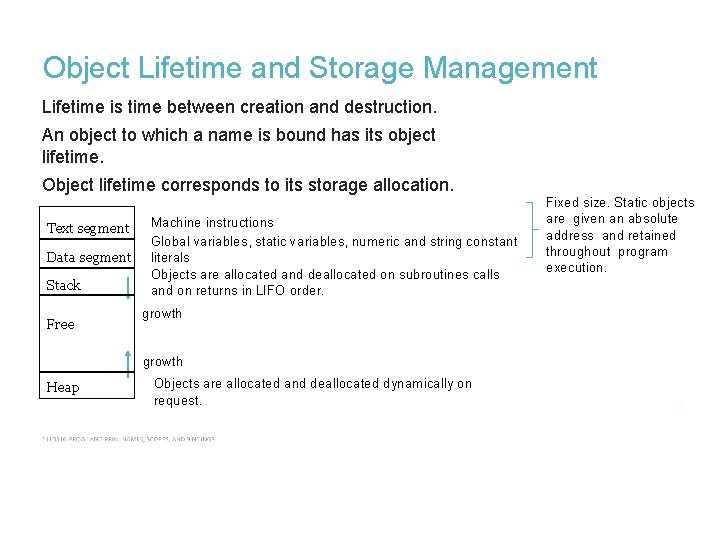
Object Lifetime and Storage Management Lifetime is time between creation and destruction. An object to which a name is bound has its object lifetime. Object lifetime corresponds to its storage allocation. Text segment Data segment Stack Free Machine instructions Global variables, static variables, numeric and string constant literals Objects are allocated and deallocated on subroutines calls and on returns in LIFO order. growth Heap Objects are allocated and deallocated dynamically on request. Fixed size. Static objects are given an absolute address and retained throughout program execution.
Stack-Based Allocation Each instance of a called subroutine at run time has its own frame (or activation record) on stack which contains • Arguments (if any) • Return address • Bookkeeping : Saved values of registers, reference to other frame (see later) etc. • Local variables (if any) • Temporaries : Intermediate values produced in complex calculations Stack pointer (sp) is a register for the address of the top of stack. Compiler cannot tell the location of a frame but the offsets of objects in a frame. • Frame pointer (fp) is a register that points to a known (reference) location within a frame of the current subroutine. • Code to access data within a frame adds a predetermined negative or positive offset to the value in fp.
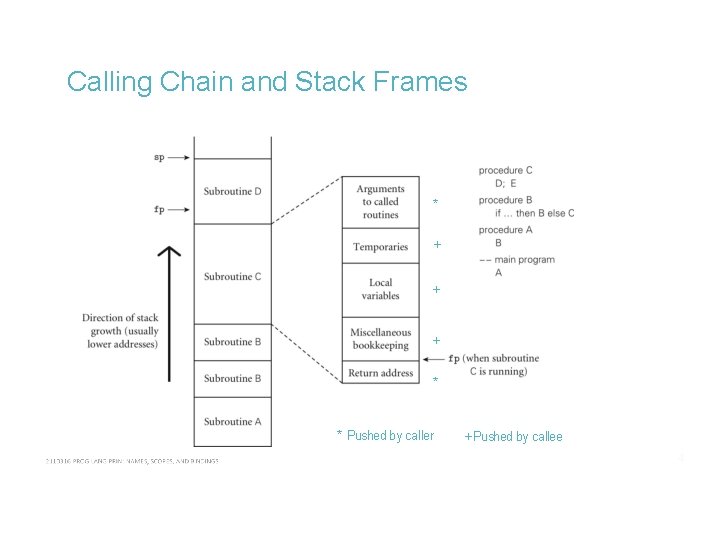
Calling Chain and Stack Frames * + + + * * Pushed by caller + Pushed by callee
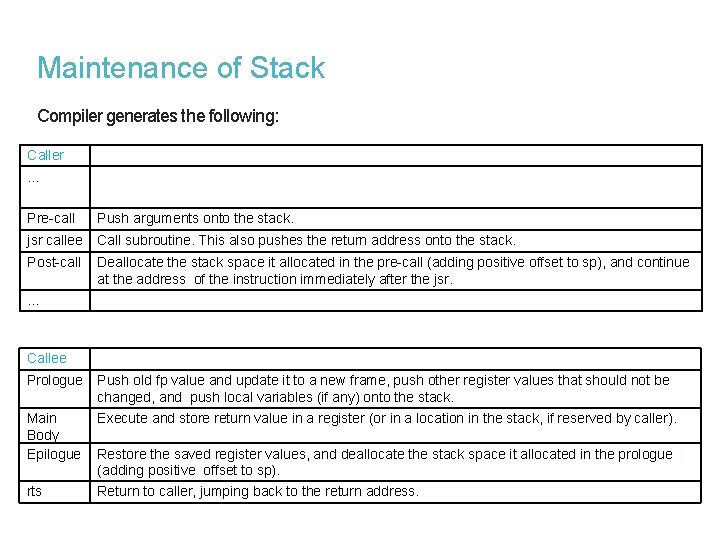
Maintenance of Stack Compiler generates the following: Caller … Pre-call Push arguments onto the stack. jsr callee Call subroutine. This also pushes the return address onto the stack. Post-call Deallocate the stack space it allocated in the pre-call (adding positive offset to sp), and continue at the address of the instruction immediately after the jsr. … Callee Prologue Main Body Epilogue rts Push old fp value and update it to a new frame, push other register values that should not be changed, and push local variables (if any) onto the stack. Execute and store return value in a register (or in a location in the stack, if reserved by caller). Restore the saved register values, and deallocate the stack space it allocated in the prologue (adding positive offset to sp). Return to caller, jumping back to the return address.
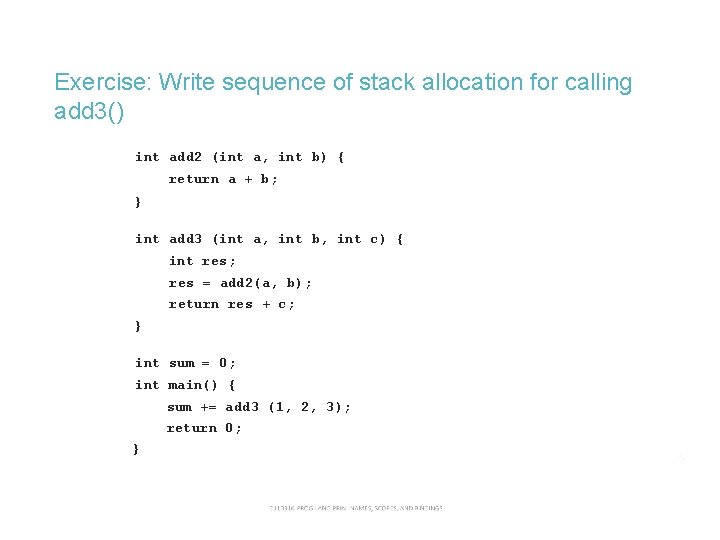
Exercise: Write sequence of stack allocation for calling add 3() int add 2 (int a, int b) { return a + b; } int add 3 (int a, int b, int c) { int res; res = add 2(a, b); return res + c; } int sum = 0; int main() { sum += add 3 (1, 2, 3); return 0; }
Heap-Based Allocation Heap is storage in which subblocks can be allocated and deallocated at arbitrary times. Heaps are required for dynamically allocated pieces of linked data structures or objects whose size may change (e. g. string, list, set). Allocation is by some operation in a program, e. g. malloc() in C, new in Java, C++. Deallocation is by garbage collection or some operation in a program, e. g. free() in C, delete in C++
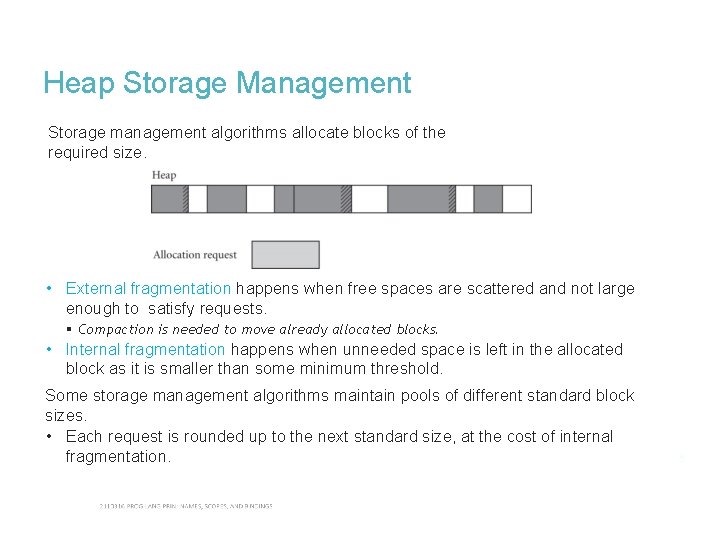
Heap Storage Management Storage management algorithms allocate blocks of the required size. • External fragmentation happens when free spaces are scattered and not large enough to satisfy requests. Compaction is needed to move already allocated blocks. • Internal fragmentation happens when unneeded space is left in the allocated block as it is smaller than some minimum threshold. Some storage management algorithms maintain pools of different standard block sizes. • Each request is rounded up to the next standard size, at the cost of internal fragmentation.
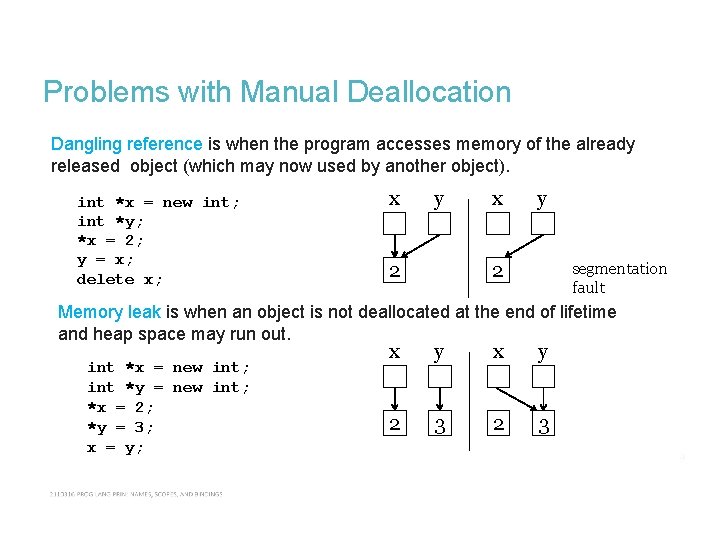
Problems with Manual Deallocation Dangling reference is when the program accesses memory of the already released object (which may now used by another object). int *x = new int; int *y; *x = 2; y = x; delete x; x y 2 segmentation fault Memory leak is when an object is not deallocated at the end of lifetime and heap space may run out. int *x = new int; int *y = new int; *x = 2; *y = 3; x = y; x y 2 3
Exercise: Heap-Based Objects and Binding Since lifetime means the time between creation and destruction, Binding lifetime is …………………………… Object lifetime is …………………………… If object lifetime is longer than binding lifetime, we have………………… If binding lifetime is longer than object lifetime, we have ………………
Garbage Collection Garbage occurs when objects are no longer reachable from any program variables. Instead of explicit deallocation of heap-based objects, some languages provide run time library with garbage collection mechanism to implicitly identify and reclaim unreachable objects. • More recent imperative languages, e. g. Java, C# • Most functional and scripting languages Benefit • Reducing programming errors Drawback • Execution speed and complexity in language implementation With language implementation becoming more complex, marginal complexity of garbage collection is reduced. It is now an essential language feature with improved algorithms.
Scopes Scope of binding is a textual region of the program in which a name-to-object binding is active. Scope is a program region of maximal size in which no bindings change, e. g. the body of a class, subroutine, structured control-flow statement, or a block delimited with { }. Referencing environment is a set of active bindings at any given point in a program’s execution.
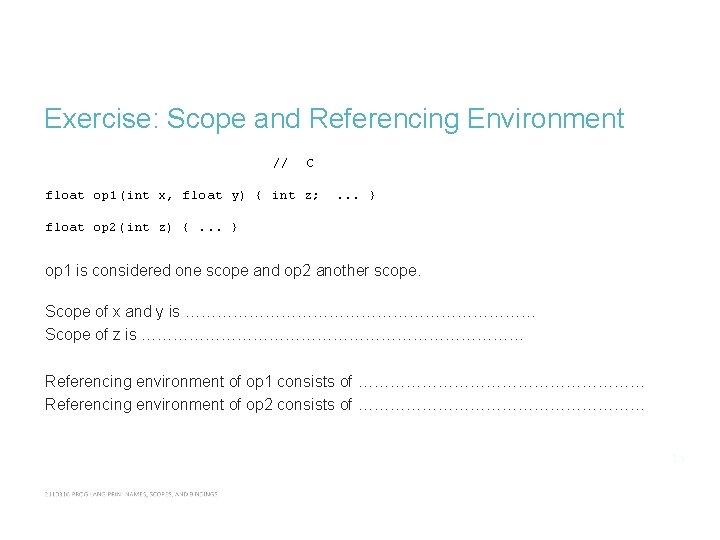
Exercise: Scope and Referencing Environment // C float op 1(int x, float y) { int z; . . . } float op 2(int z) {. . . } op 1 is considered one scope and op 2 another scope. Scope of x and y is …………………………… Scope of z is ……………………………… Referencing environment of op 1 consists of ……………………… Referencing environment of op 2 consists of ………………………
Static Scoping (or Lexical Scoping) Bindings between names and objects can be determined at compile time by examining the text of the program, without consideration of the flow of control at run time. In most modern languages, scope of a binding is determined statically at compile time. We can look at a C program, for example, and know which names refer to which objects at which points in the program based on purely textual rules. Then C is statically scoped. Generally, scope of a local variable is limited to the subroutine in which it appears.
Classic Example: Nested Scope in Nested Subroutines A feature in many languages (e. g. Pascal, Ada, Python) is nested subroutines. In nested subroutines, bindings of names to objects are resolved by closest nested scope rule. • A name is known (or visible) in the scope in which it is declared, and in each internally nested scope. • But a name can be hidden by another declaration of the same name in one or more nested scopes. • To find the object that is bound to a given use of name We look for its declaration in the current innermost scope. If there is one, it defines the active binding for the name. Otherwise we continue outward, examining successively surrounding scopes.
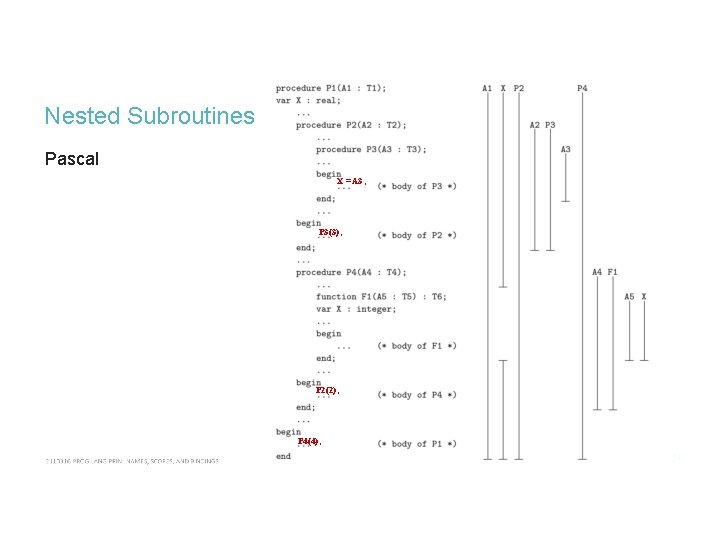
Nested Subroutines Pascal X = A 3; P 3(3); P 2(2); P 4(4);
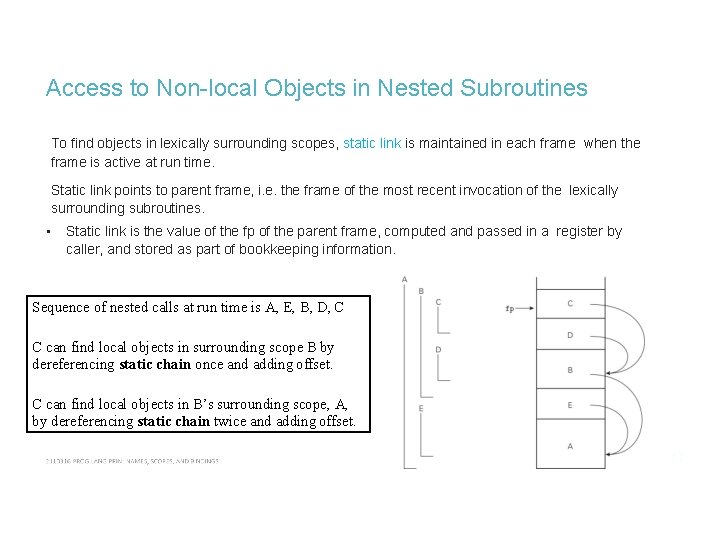
Access to Non-local Objects in Nested Subroutines To find objects in lexically surrounding scopes, static link is maintained in each frame when the frame is active at run time. Static link points to parent frame, i. e. the frame of the most recent invocation of the lexically surrounding subroutines. • Static link is the value of the fp of the parent frame, computed and passed in a register by caller, and stored as part of bookkeeping information. Sequence of nested calls at run time is A, E, B, D, C C can find local objects in surrounding scope B by dereferencing static chain once and adding offset. C can find local objects in B’s surrounding scope, A, by dereferencing static chain twice and adding offset.
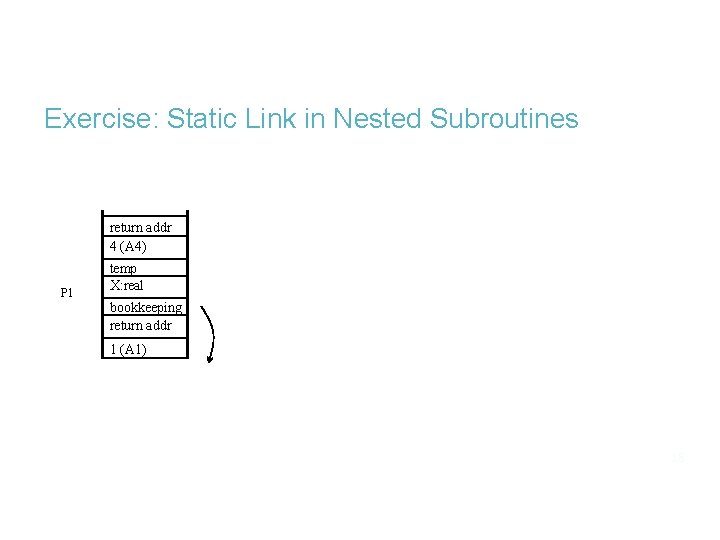
Exercise: Static Link in Nested Subroutines return addr 4 (A 4) P 1 temp X: real bookkeeping return addr 1 (A 1)
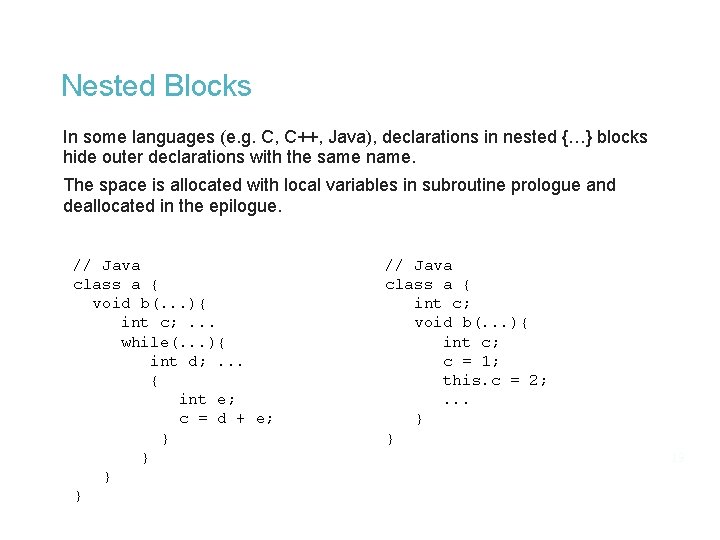
Nested Blocks In some languages (e. g. C, C++, Java), declarations in nested {…} blocks hide outer declarations with the same name. The space is allocated with local variables in subroutine prologue and deallocated in the epilogue. // Java class a { void b(. . . ){ int c; . . . while(. . . ){ int d; . . . { int e; c = d + e; } } // Java class a { int c; void b(. . . ){ int c; c = 1; this. c = 2; . . . } }
Dynamic Scoping Bindings between names and objects depend on the flow of control, and on the order in which subroutines are called. The current binding for a given name is the one encountered most recently during execution, and not yet destroyed by returning from its scope. Type checking in expressions and argument checking in subroutine calls must be deferred until runtime. Languages with dynamic scoping tend to be interpreted, rather than compiled, e. g. Lisp, Perl.
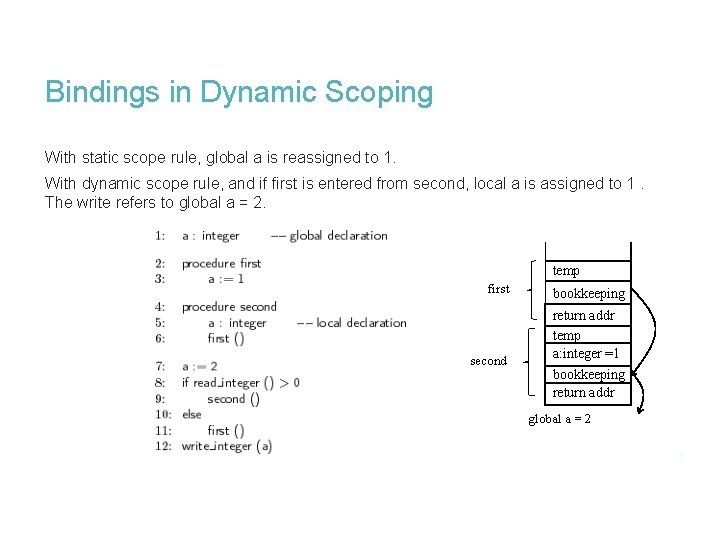
Bindings in Dynamic Scoping With static scope rule, global a is reassigned to 1. With dynamic scope rule, and if first is entered from second, local a is assigned to 1. The write refers to global a = 2. temp first second bookkeeping return addr temp a: integer =1 bookkeeping return addr global a = 2
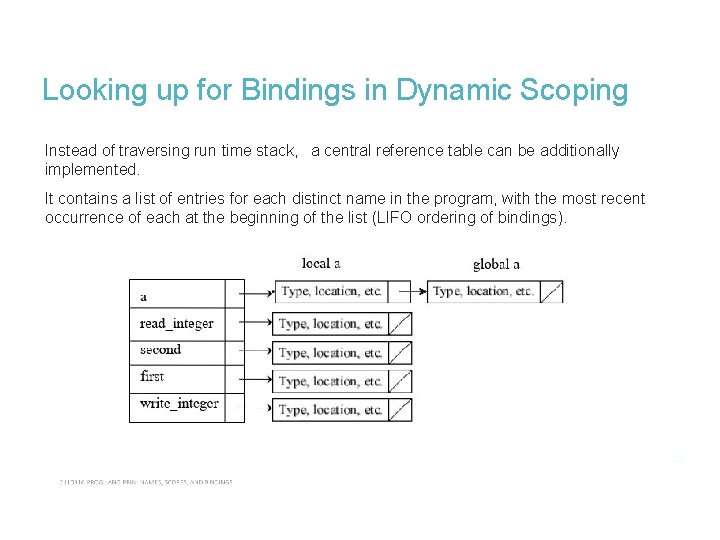
Looking up for Bindings in Dynamic Scoping Instead of traversing run time stack, a central reference table can be additionally implemented. It contains a list of entries for each distinct name in the program, with the most recent occurrence of each at the beginning of the list (LIFO ordering of bindings).
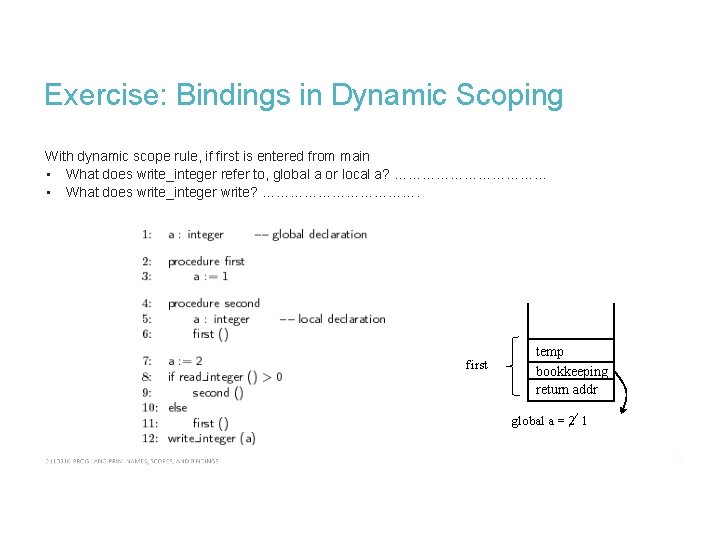
Exercise: Bindings in Dynamic Scoping With dynamic scope rule, if first is entered from main • What does write_integer refer to, global a or local a? ……………… • What does write_integer write? ………………. first temp bookkeeping return addr global a = 2 1
- Slides: 23