
Name the Battle I died in Hell my
Name the Battle… I died in Hell; my wound was slight And I was hobbling back’ and then a shell Burst slick upon the duckboards; so I fell Into the bottomless mud, and lost the light Siegfried Sassoon
CLUE: Iron Maiden Song… In a foreign field he lay lonely soldier unknown grave on his dying words he prays tell the WORLD of Paschendale Relive all that he's been through last communion of his soul rust your bullets with his tears let me tell you 'bout his years Laying low in a blood filled trench killing time 'til my very own death on my face I can feel the falling rain never see my friends again in the smoke, in the mud and lead smell of fear and feeling of dread soon be time to go over the wall rapid fire and the end of us all Whistles, shouts and more gun fire lifeless bodies hang on barbed wire battlefield nothing but a bloody tomb be reunited with my dead friends soon many soldiers eighteen years drown in mud, no more tears surely a war no one can win killing time about to begin Home, far away. From the war, a chance to live again Home, far away. But the war, no chance to live again The bodies of ours and our foes the sea of death it overflows in no man's land God only knows into jaws of death we go. . . Crucified as if on a cross allied troops, they mourn their loss German war propaganda machine such before has never been swear I heard the angels cry pray to God no more may die so that people know the truth tell the tale of Paschendale Cruelty has a human heart everyman does play his part terror of the men we kill the human heart is hungry still I stand my ground for the very last time gun is ready as I stand in line nervous wait for the whistle to blow rush of blood and over we go. . . Blood is falling like the rain its crimson cloak unveils again the sound of guns can't hide their shame and so we die in Paschendale Dodging shrapnel and barbed wire running straight at cannon fire running blind as I hold my breath say a prayer symphony of death as we charge the enemy lines a burst of fire and we go down I choke a cry but no one hears feel the blood go down my throat Home, far away. From the war, a chance to live again Home, far away. But the war, no chance to live again See my spirit on the wind across the lines beyond the hill friend and foe will meet again those who died at Paschendale http: //www. youtube. com/watch? v=m. ML 4 xir. KTu 8
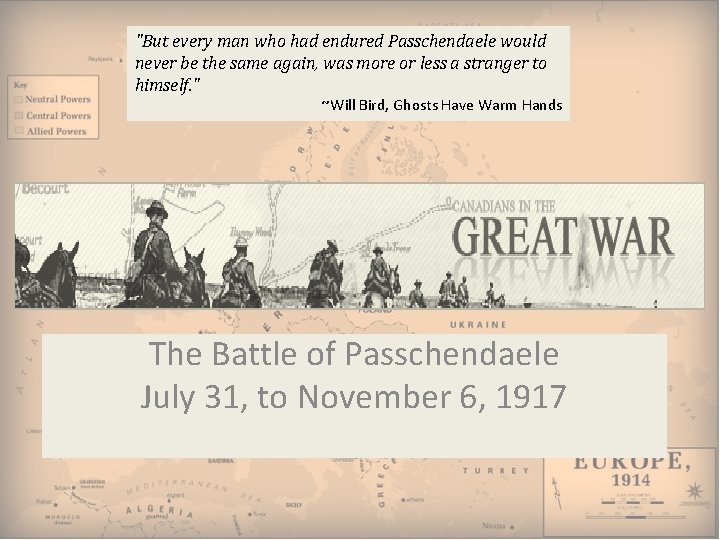
"But every man who had endured Passchendaele would never be the same again, was more or less a stranger to himself. " ~Will Bird, Ghosts Have Warm Hands The Battle of Passchendaele July 31, to November 6, 1917
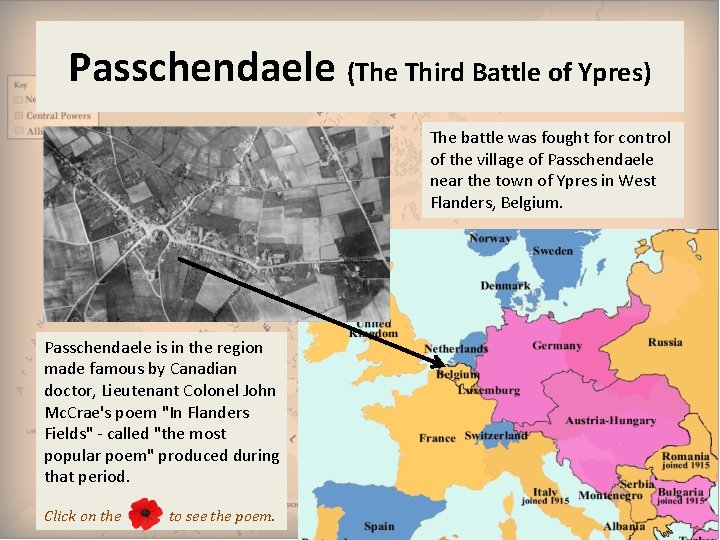
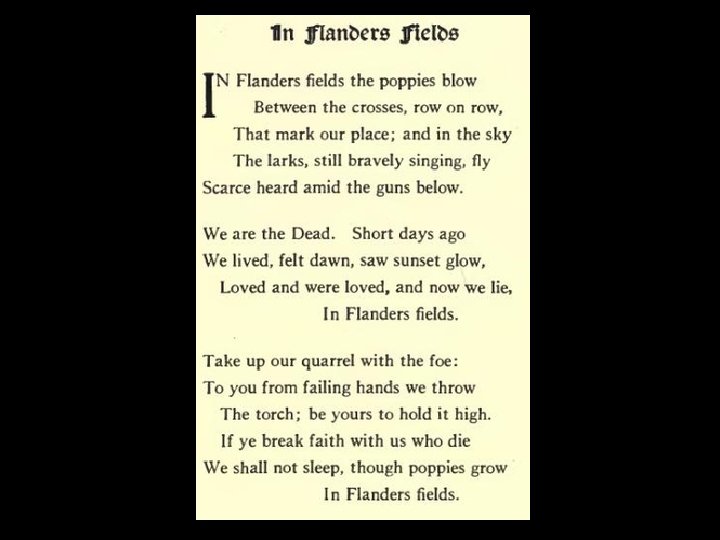
Passchendaele (The Third Battle of Ypres) The battle was fought for control of the village of Passchendaele near the town of Ypres in West Flanders, Belgium. Passchendaele is in the region made famous by Canadian doctor, Lieutenant Colonel John Mc. Crae's poem "In Flanders Fields" - called "the most popular poem" produced during that period. Click on the poppy to see the poem.
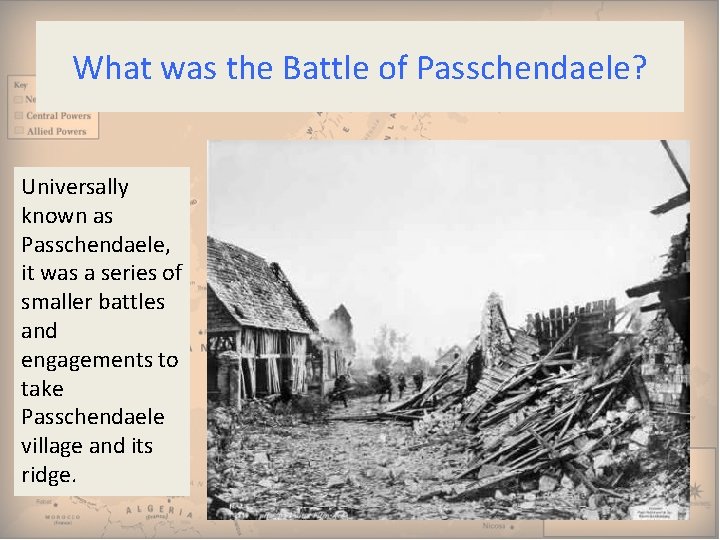
What was the Battle of Passchendaele? Universally known as Passchendaele, it was a series of smaller battles and engagements to take Passchendaele village and its ridge.
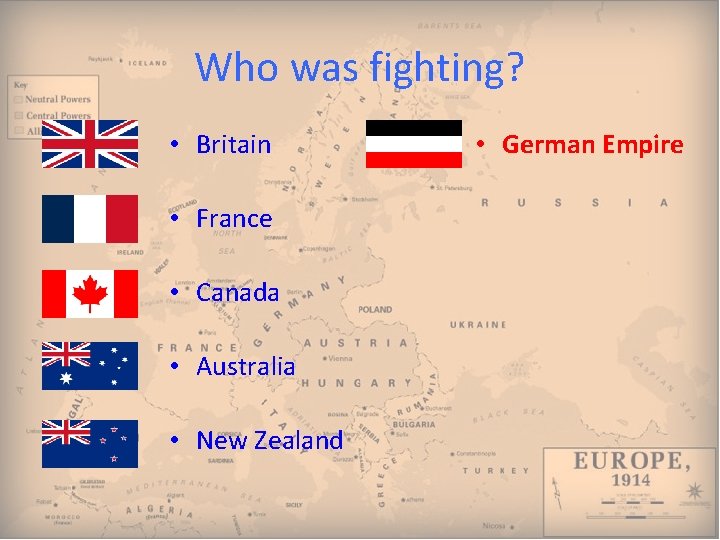
Who was fighting? • Britain • France • Canada • Australia • New Zealand • German Empire
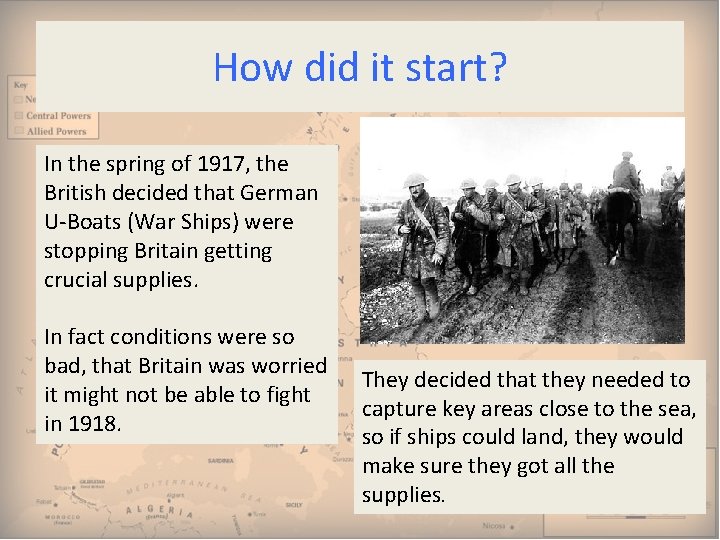
How did it start? In the spring of 1917, the British decided that German U-Boats (War Ships) were stopping Britain getting crucial supplies. In fact conditions were so bad, that Britain was worried it might not be able to fight in 1918. They decided that they needed to capture key areas close to the sea, so if ships could land, they would make sure they got all the supplies.
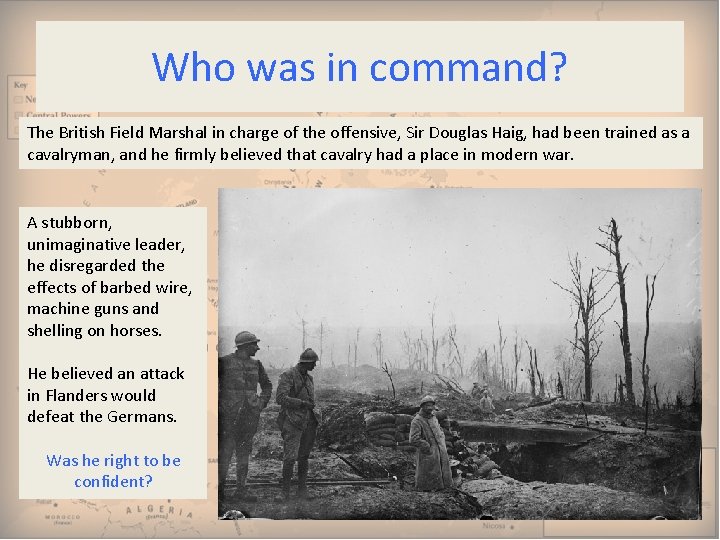
Who was in command? The British Field Marshal in charge of the offensive, Sir Douglas Haig, had been trained as a cavalryman, and he firmly believed that cavalry had a place in modern war. A stubborn, unimaginative leader, he disregarded the effects of barbed wire, machine guns and shelling on horses. He believed an attack in Flanders would defeat the Germans. Was he right to be confident?
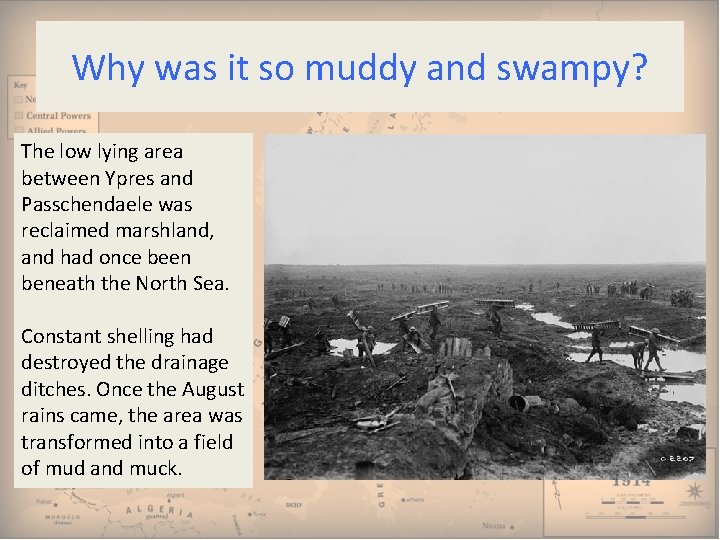
Why was it so muddy and swampy? The low lying area between Ypres and Passchendaele was reclaimed marshland, and had once been beneath the North Sea. Constant shelling had destroyed the drainage ditches. Once the August rains came, the area was transformed into a field of mud and muck.
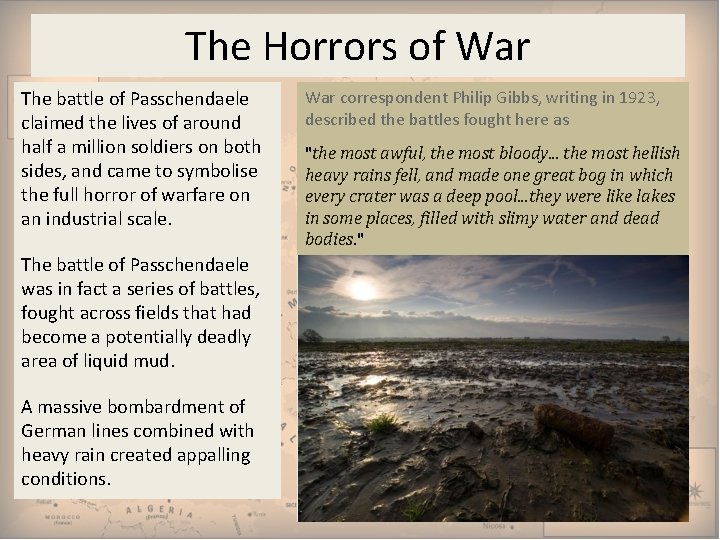
The Horrors of War The battle of Passchendaele claimed the lives of around half a million soldiers on both sides, and came to symbolise the full horror of warfare on an industrial scale. The battle of Passchendaele was in fact a series of battles, fought across fields that had become a potentially deadly area of liquid mud. A massive bombardment of German lines combined with heavy rain created appalling conditions. War correspondent Philip Gibbs, writing in 1923, described the battles fought here as "the most awful, the most bloody. . . the most hellish heavy rains fell, and made one great bog in which every crater was a deep pool. . . they were like lakes in some places, filled with slimy water and dead bodies. "
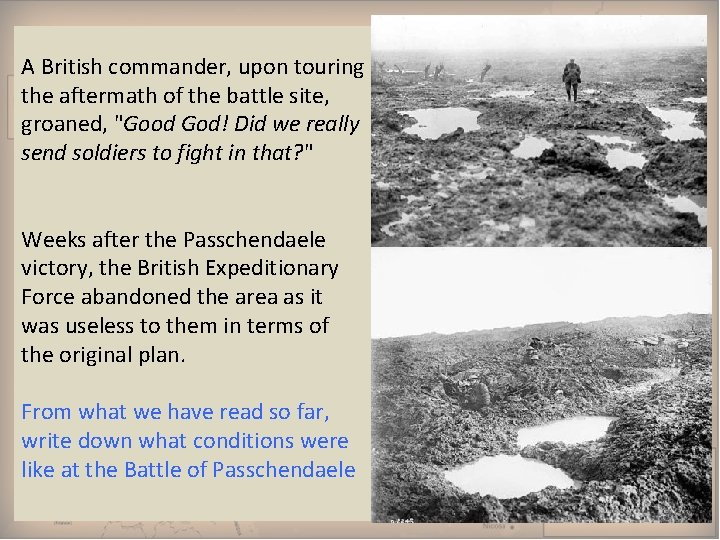
A British commander, upon touring the aftermath of the battle site, groaned, "Good God! Did we really send soldiers to fight in that? " Weeks after the Passchendaele victory, the British Expeditionary Force abandoned the area as it was useless to them in terms of the original plan. From what we have read so far, write down what conditions were like at the Battle of Passchendaele
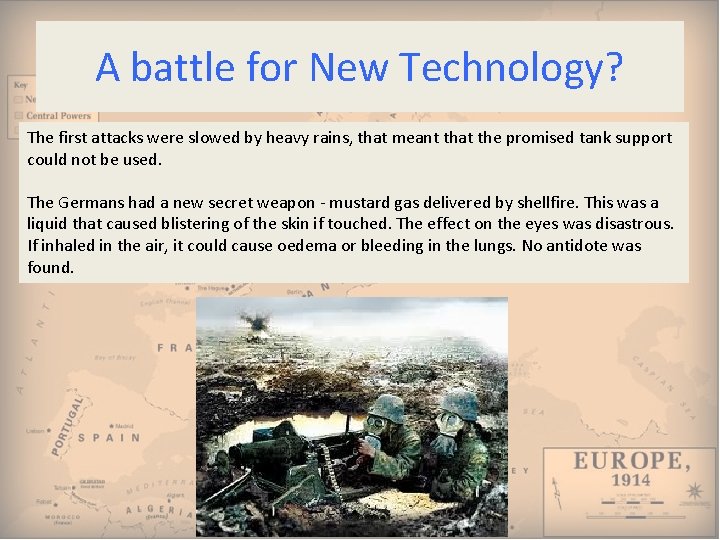
A battle for New Technology? The first attacks were slowed by heavy rains, that meant that the promised tank support could not be used. The Germans had a new secret weapon - mustard gas delivered by shellfire. This was a liquid that caused blistering of the skin if touched. The effect on the eyes was disastrous. If inhaled in the air, it could cause oedema or bleeding in the lungs. No antidote was found.
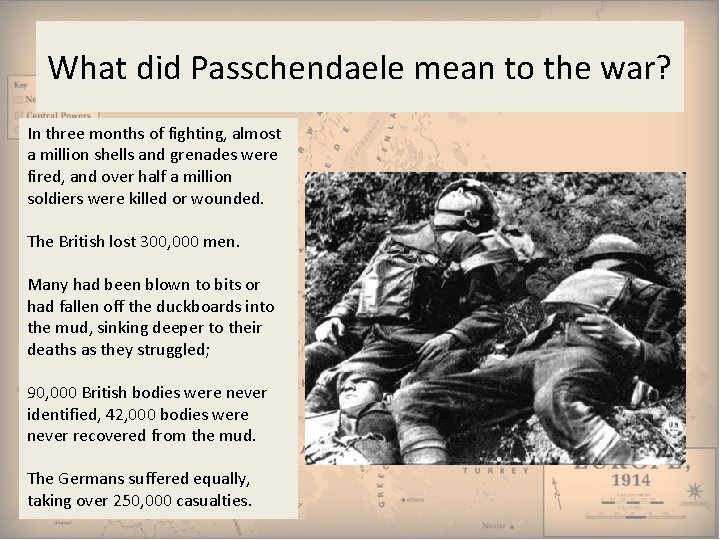
What did Passchendaele mean to the war? In three months of fighting, almost a million shells and grenades were fired, and over half a million soldiers were killed or wounded. The British lost 300, 000 men. Many had been blown to bits or had fallen off the duckboards into the mud, sinking deeper to their deaths as they struggled; 90, 000 British bodies were never identified, 42, 000 bodies were never recovered from the mud. The Germans suffered equally, taking over 250, 000 casualties.
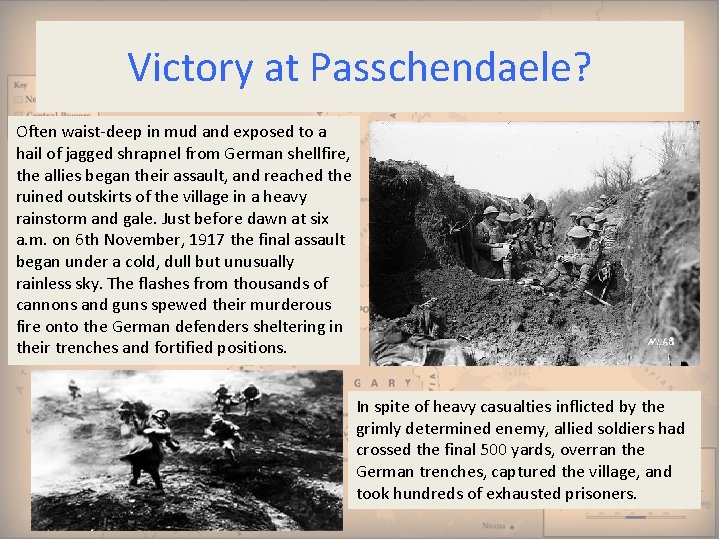
Victory at Passchendaele? Often waist-deep in mud and exposed to a hail of jagged shrapnel from German shellfire, the allies began their assault, and reached the ruined outskirts of the village in a heavy rainstorm and gale. Just before dawn at six a. m. on 6 th November, 1917 the final assault began under a cold, dull but unusually rainless sky. The flashes from thousands of cannons and guns spewed their murderous fire onto the German defenders sheltering in their trenches and fortified positions. In spite of heavy casualties inflicted by the grimly determined enemy, allied soldiers had crossed the final 500 yards, overran the German trenches, captured the village, and took hundreds of exhausted prisoners.
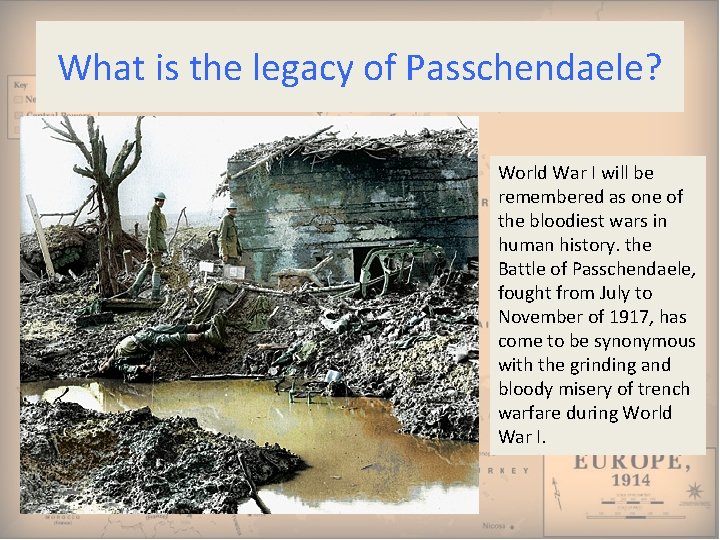
What is the legacy of Passchendaele? World War I will be remembered as one of the bloodiest wars in human history. the Battle of Passchendaele, fought from July to November of 1917, has come to be synonymous with the grinding and bloody misery of trench warfare during World War I.
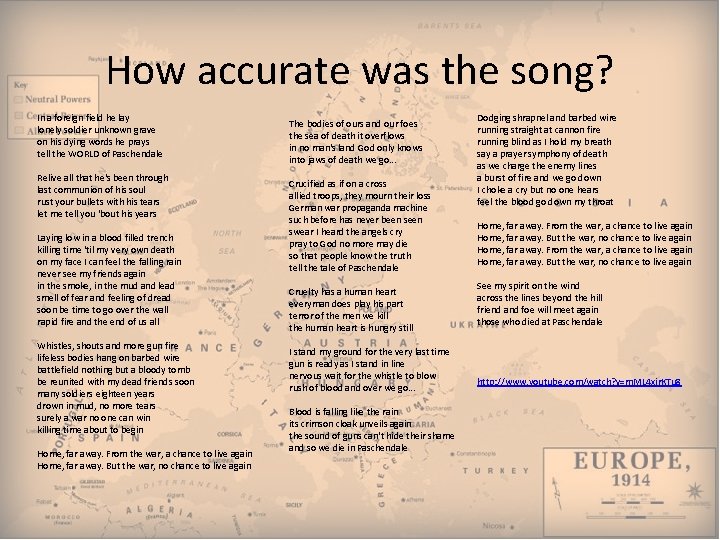
How accurate was the song? In a foreign field he lay lonely soldier unknown grave on his dying words he prays tell the WORLD of Paschendale Relive all that he's been through last communion of his soul rust your bullets with his tears let me tell you 'bout his years Laying low in a blood filled trench killing time 'til my very own death on my face I can feel the falling rain never see my friends again in the smoke, in the mud and lead smell of fear and feeling of dread soon be time to go over the wall rapid fire and the end of us all Whistles, shouts and more gun fire lifeless bodies hang on barbed wire battlefield nothing but a bloody tomb be reunited with my dead friends soon many soldiers eighteen years drown in mud, no more tears surely a war no one can win killing time about to begin Home, far away. From the war, a chance to live again Home, far away. But the war, no chance to live again The bodies of ours and our foes the sea of death it overflows in no man's land God only knows into jaws of death we go. . . Crucified as if on a cross allied troops, they mourn their loss German war propaganda machine such before has never been swear I heard the angels cry pray to God no more may die so that people know the truth tell the tale of Paschendale Cruelty has a human heart everyman does play his part terror of the men we kill the human heart is hungry still I stand my ground for the very last time gun is ready as I stand in line nervous wait for the whistle to blow rush of blood and over we go. . . Blood is falling like the rain its crimson cloak unveils again the sound of guns can't hide their shame and so we die in Paschendale Dodging shrapnel and barbed wire running straight at cannon fire running blind as I hold my breath say a prayer symphony of death as we charge the enemy lines a burst of fire and we go down I choke a cry but no one hears feel the blood go down my throat Home, far away. From the war, a chance to live again Home, far away. But the war, no chance to live again See my spirit on the wind across the lines beyond the hill friend and foe will meet again those who died at Paschendale http: //www. youtube. com/watch? v=m. ML 4 xir. KTu 8
- Slides: 17