
Name Rotation Slide 2 Seasons Date Turning or
- Slides: 2
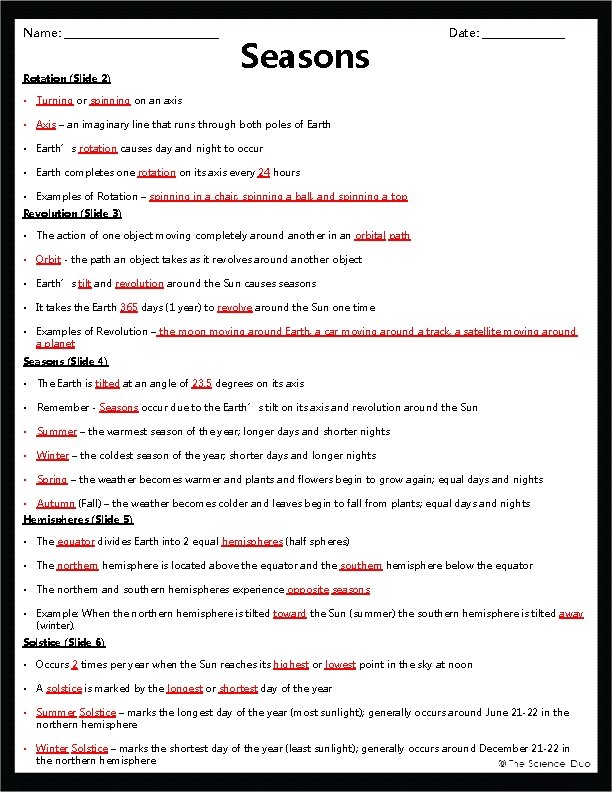
Name: _____________ Rotation (Slide 2) Seasons Date: _______ • Turning or spinning on an axis • Axis – an imaginary line that runs through both poles of Earth • Earth’s rotation causes day and night to occur • Earth completes one rotation on its axis every 24 hours • Examples of Rotation – spinning in a chair, spinning a ball, and spinning a top Revolution (Slide 3) • The action of one object moving completely around another in an orbital path • Orbit - the path an object takes as it revolves around another object • Earth’s tilt and revolution around the Sun causes seasons • It takes the Earth 365 days (1 year) to revolve around the Sun one time • Examples of Revolution – the moon moving around Earth, a car moving around a track, a satellite moving around a planet Seasons (Slide 4) • The Earth is tilted at an angle of 23. 5 degrees on its axis • Remember - Seasons occur due to the Earth’s tilt on its axis and revolution around the Sun • Summer – the warmest season of the year; longer days and shorter nights • Winter – the coldest season of the year; shorter days and longer nights • Spring – the weather becomes warmer and plants and flowers begin to grow again; equal days and nights • Autumn (Fall) – the weather becomes colder and leaves begin to fall from plants; equal days and nights Hemispheres (Slide 5) • The equator divides Earth into 2 equal hemispheres (half spheres) • The northern hemisphere is located above the equator and the southern hemisphere below the equator • The northern and southern hemispheres experience opposite seasons • Example: When the northern hemisphere is tilted toward the Sun (summer) the southern hemisphere is tilted away (winter). Solstice (Slide 6) • Occurs 2 times per year when the Sun reaches its highest or lowest point in the sky at noon • A solstice is marked by the longest or shortest day of the year • Summer Solstice – marks the longest day of the year (most sunlight); generally occurs around June 21 -22 in the northern hemisphere • Winter Solstice – marks the shortest day of the year (least sunlight); generally occurs around December 21 -22 in the northern hemisphere
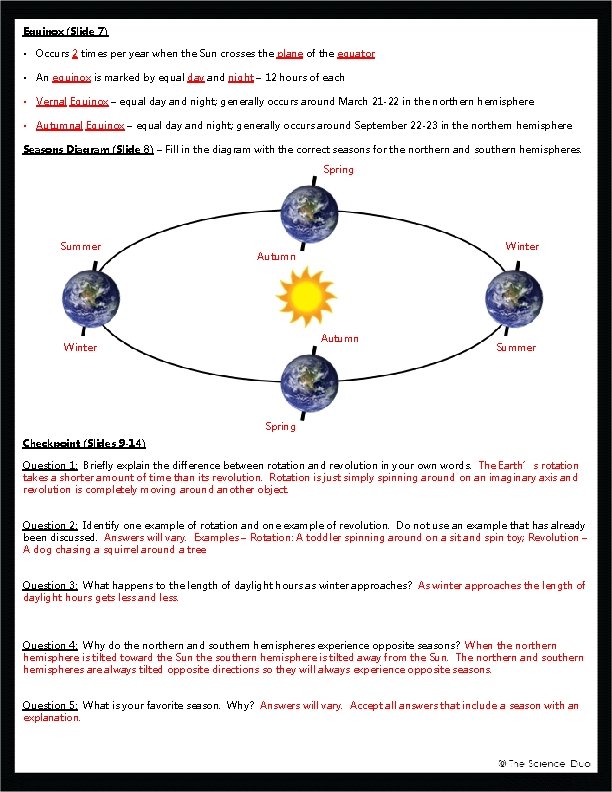
Equinox (Slide 7) • Occurs 2 times per year when the Sun crosses the plane of the equator • An equinox is marked by equal day and night – 12 hours of each • Vernal Equinox – equal day and night; generally occurs around March 21 -22 in the northern hemisphere • Autumnal Equinox – equal day and night; generally occurs around September 22 -23 in the northern hemisphere Seasons Diagram (Slide 8) – Fill in the diagram with the correct seasons for the northern and southern hemispheres. Spring Summer Winter Autumn Winter Summer Spring Checkpoint (Slides 9 -14) Question 1: Briefly explain the difference between rotation and revolution in your own words. The Earth’s rotation takes a shorter amount of time than its revolution. Rotation is just simply spinning around on an imaginary axis and revolution is completely moving around another object. Question 2: Identify one example of rotation and one example of revolution. Do not use an example that has already been discussed. Answers will vary. Examples – Rotation: A toddler spinning around on a sit and spin toy; Revolution – A dog chasing a squirrel around a tree Question 3: What happens to the length of daylight hours as winter approaches? As winter approaches the length of daylight hours gets less and less. Question 4: Why do the northern and southern hemispheres experience opposite seasons? When the northern hemisphere is tilted toward the Sun the southern hemisphere is tilted away from the Sun. The northern and southern hemispheres are always tilted opposite directions so they will always experience opposite seasons. Question 5: What is your favorite season. Why? Answers will vary. Accept all answers that include a season with an explanation.