
Name Of Eicosanoids Eicosanoids is a Generic term


























- Slides: 168
Name Of Eicosanoids
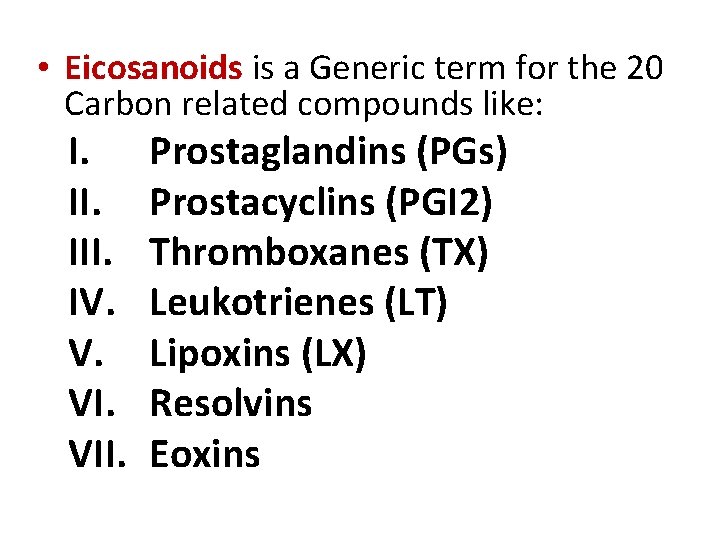
• Eicosanoids is a Generic term for the 20 Carbon related compounds like: I. III. IV. V. VII. Prostaglandins (PGs) Prostacyclins (PGI 2) Thromboxanes (TX) Leukotrienes (LT) Lipoxins (LX) Resolvins Eoxins
Biosynthesis Of Eicosanoids
• Eicosanoids are derivatives of Nutritional Essential Fatty acid/PUFAs.
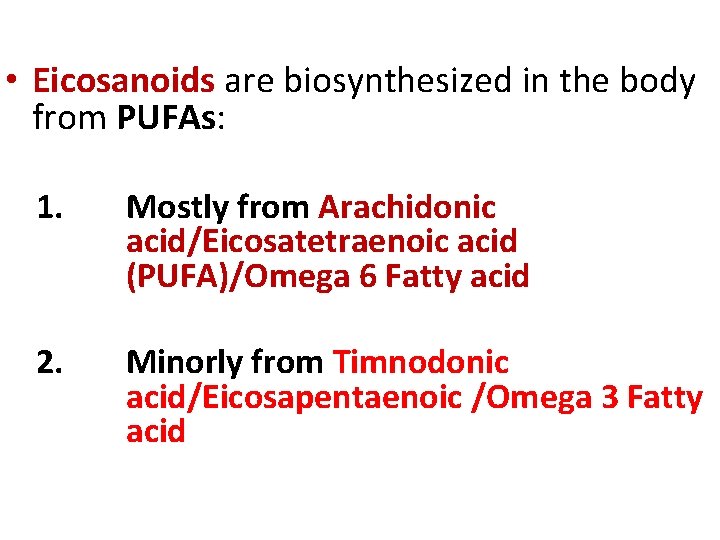
• Eicosanoids are biosynthesized in the body from PUFAs: 1. Mostly from Arachidonic acid/Eicosatetraenoic acid (PUFA)/Omega 6 Fatty acid 2. Minorly from Timnodonic acid/Eicosapentaenoic /Omega 3 Fatty acid
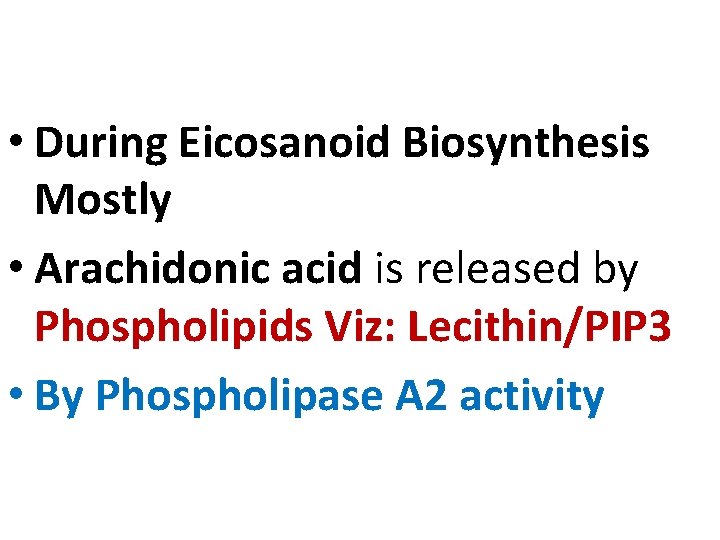
• During Eicosanoid Biosynthesis Mostly • Arachidonic acid is released by Phospholipids Viz: Lecithin/PIP 3 • By Phospholipase A 2 activity
• Eicosanoids has very short half life • From seconds to few minutes
Classification Of Eicosanoids
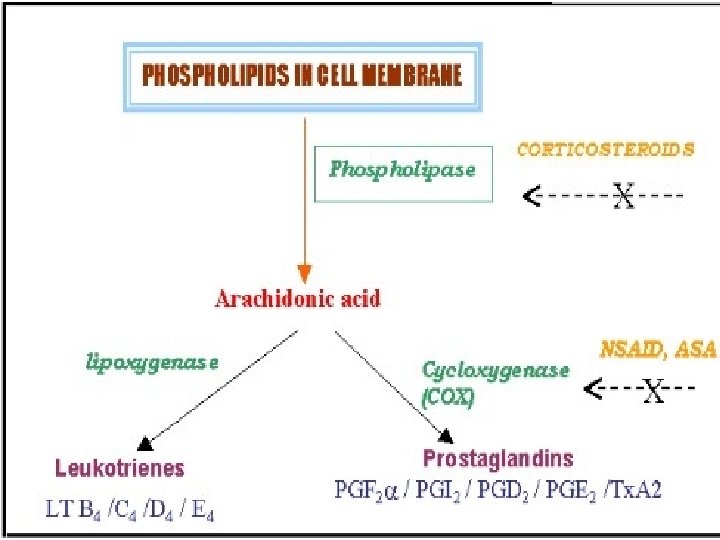
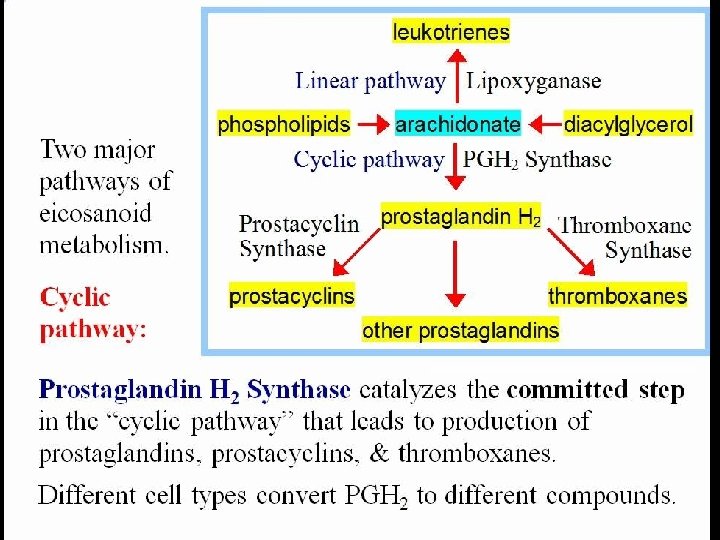
• Prostanoids : Obtained by Cycloxygenase System : • Prostaglandin • Prostacyclins • Thromboxanes • Leukotrienes and Lipoxins are obtained by Lipoxygenase System
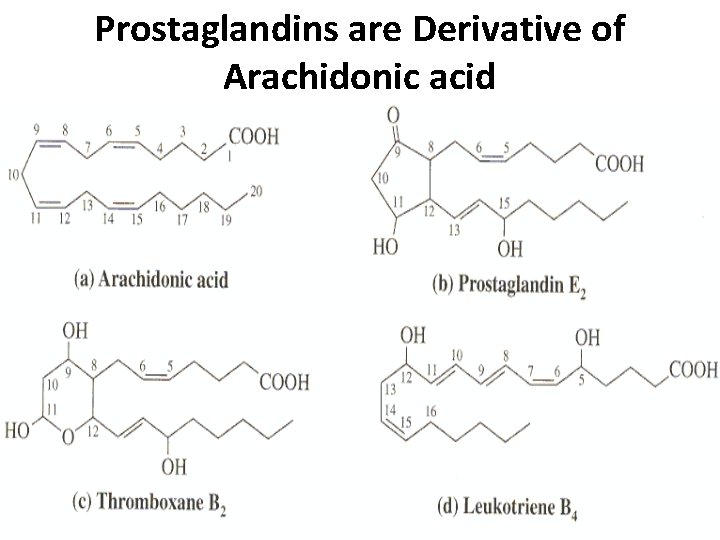
Prostaglandins are Derivative of Arachidonic acid
1. Prostaglandins (PGs)
• Prostaglandins are type of Eicosanoids. • PGs also termed as Prostanoids • Since they are obtained from parent compound Prostanoic acid
Biosynthesis Of Prostaglandins
• Per day 1 mg of Prostaglandins are biosynthesized in human body.
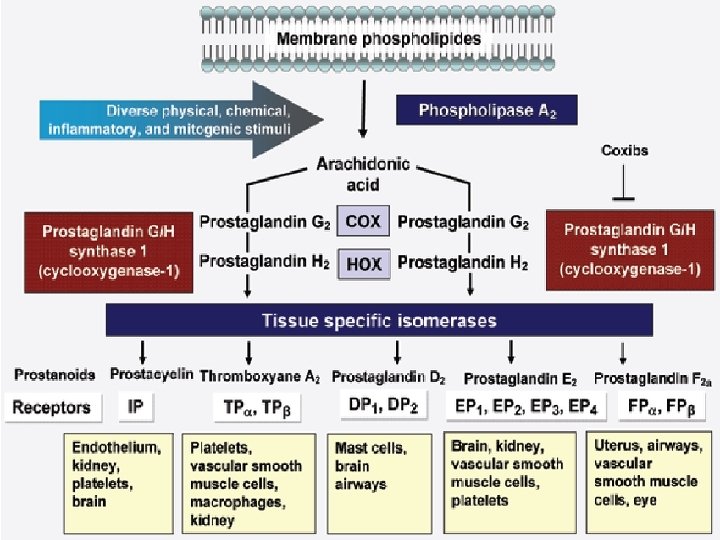
• Prostaglandins are derived from Arachidonic acid by Cycloxygenase system.
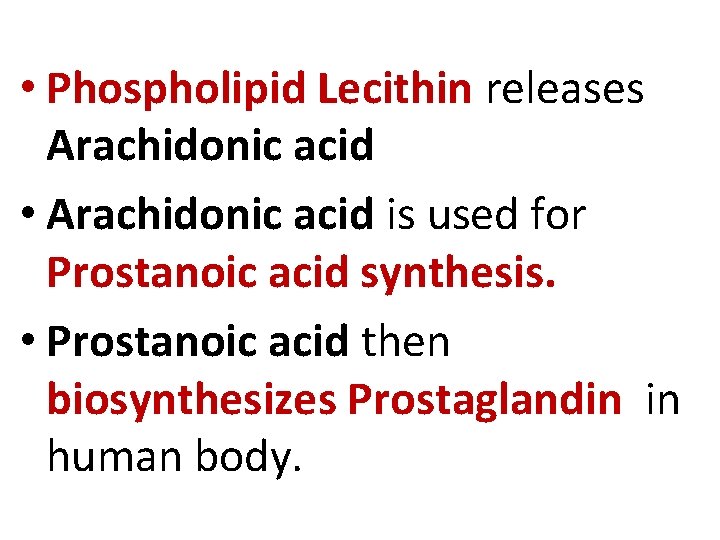
• Phospholipid Lecithin releases Arachidonic acid • Arachidonic acid is used for Prostanoic acid synthesis. • Prostanoic acid then biosynthesizes Prostaglandin in human body.
Structure and Types Of PGs
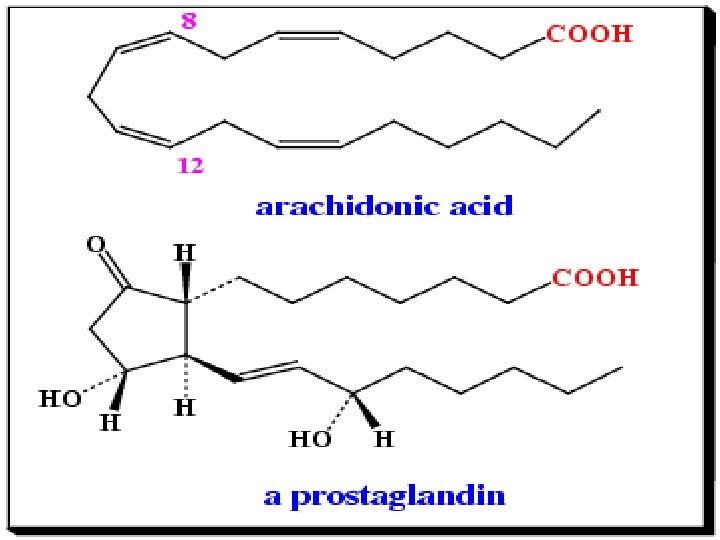
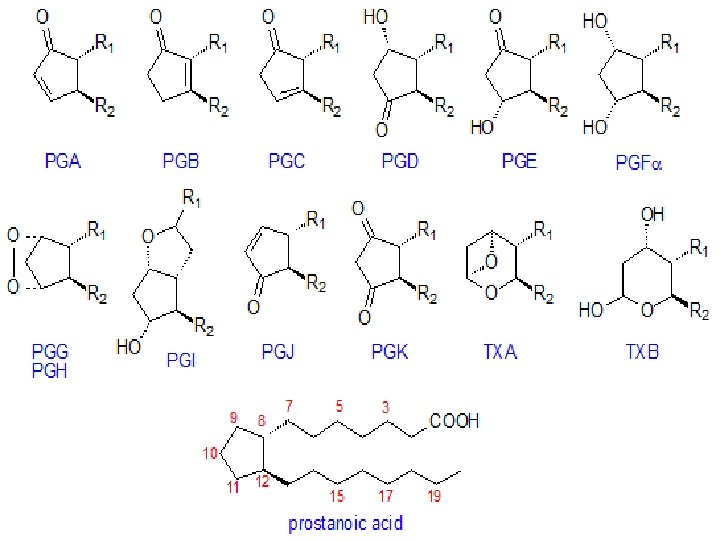
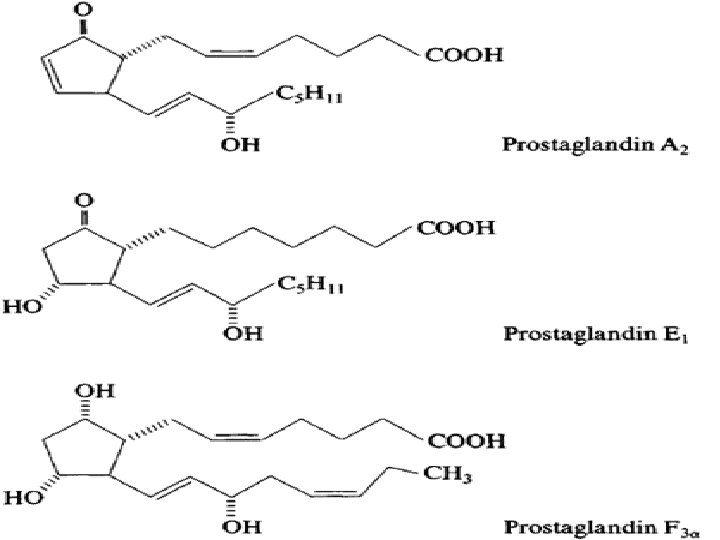
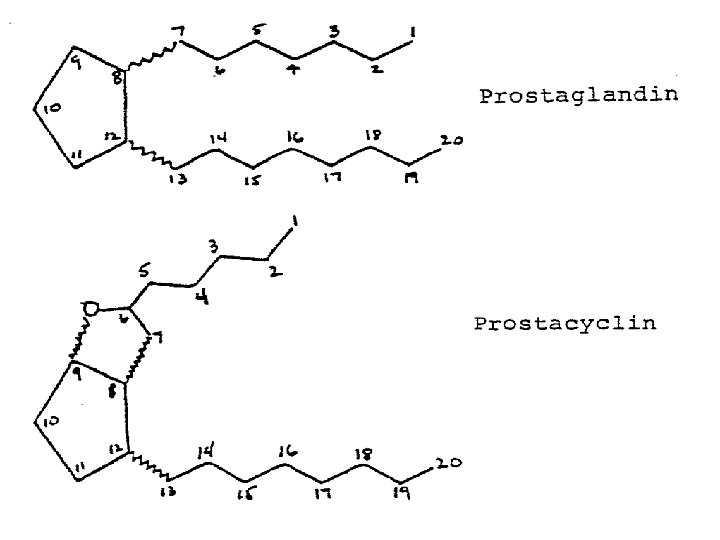
• Prostaglandin structure is complex and possess: –Cyclopentane ring –Double bond –Carboxylic and Hydroxyl groups
• Prostaglandins contains a • Cyclopentane ring with Hydroxyl groups at C 11 and C 15
• Prostaglandins (PG) are of following Types: –PG A –PG B –PG C –PG D –PG E –PG F –PG G –PG H
Occurrence/Distribution Of PGs
Occurrence Of PGs • Prostaglandin was first seen in Prostatic secretion and Semen. • Later it was found that Prostaglandins are ubiquitous • Present all over in human body tissues.
Functions OF Prostaglandins
• Prostaglandins serve as Cell Signaling Agents/Local Hormones with. –Paracrine in action (act on sites closely where they are produced/ neighboring cells). –Autocrine in action that the sites where they are produced.
• PGs exert their function through G-Protein linked membrane receptors.
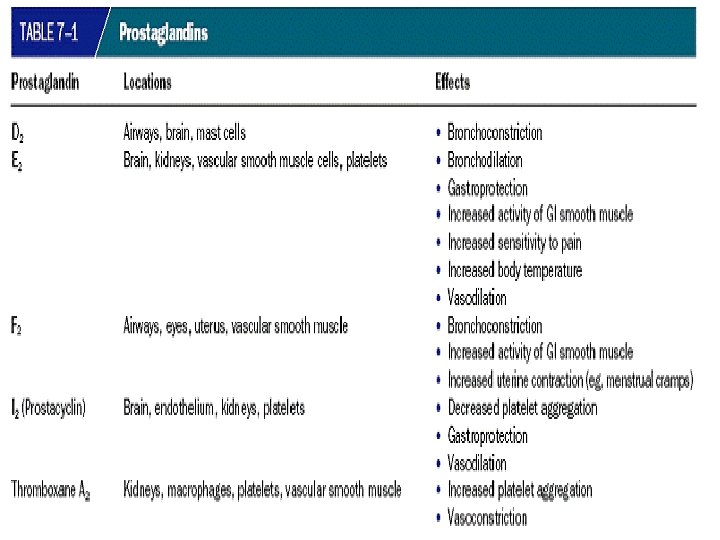
Prostaglandins have diverse functions on many tissues
• Action of one PG is different in different tissues. • Sometimes PGs bring out opposing action in same tissue.
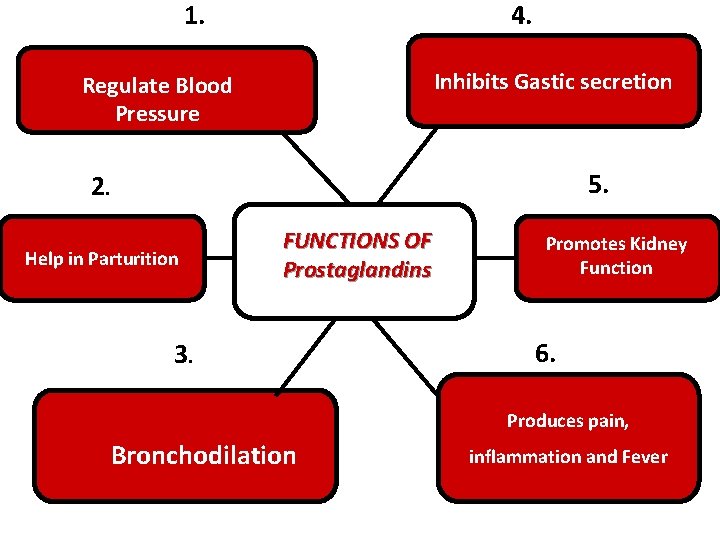
1. 4. Inhibits Gastic secretion Regulate Blood Pressure 5. 2. Help in Parturition FUNCTIONS OF Prostaglandins 3. Promotes Kidney Function 6. Produces pain, Bronchodilation inflammation and Fever
1. Role Of PGs In Blood Vessels
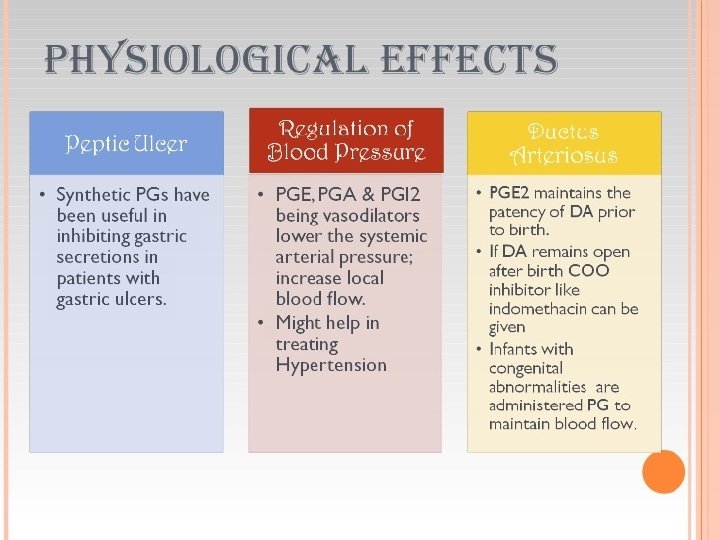
PGs Regulate Blood Pressure • PG A and PG E are Vasodilators. • PGs lowers the blood pressure by: –Increasing blood flow and –Decreasing vascular resistance in blood vessels.
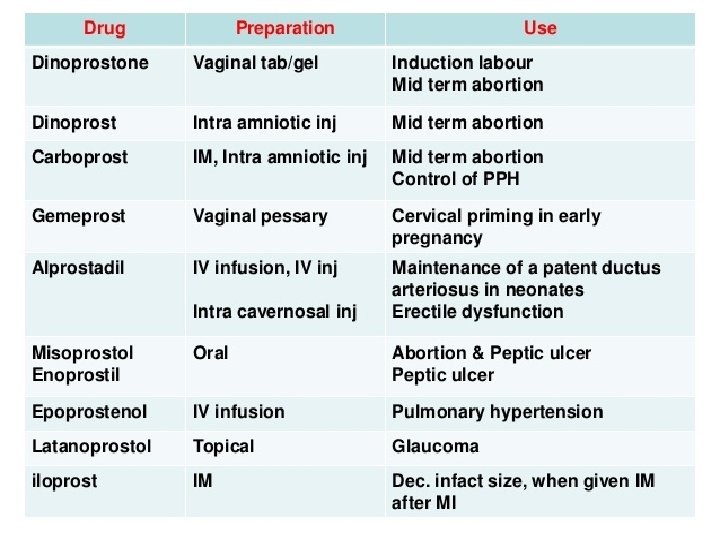
• PGs are used Therapeutically in treating Hypertension.
Prostaglandin occur at Platelets Inhibits Platelet Aggregation and Thrombus formation
2. PGs Has Role in Uterus At The Time Of Parturition
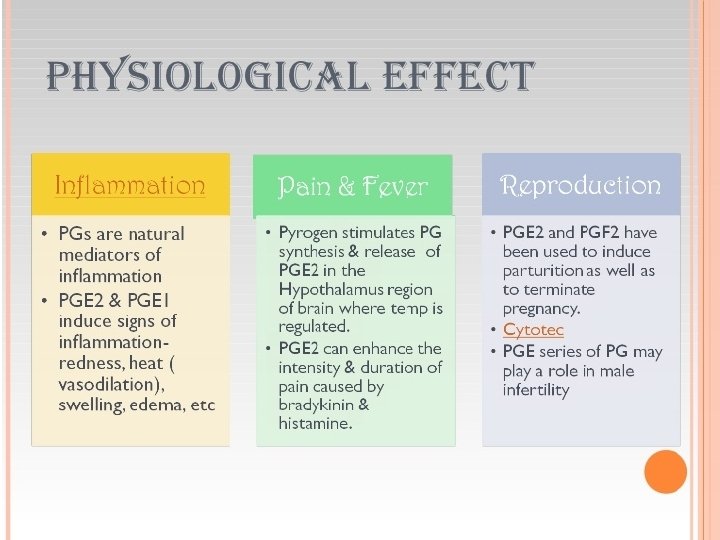
• PG naturally increases uterine contraction of smooth muscles which induces the delivery of baby.
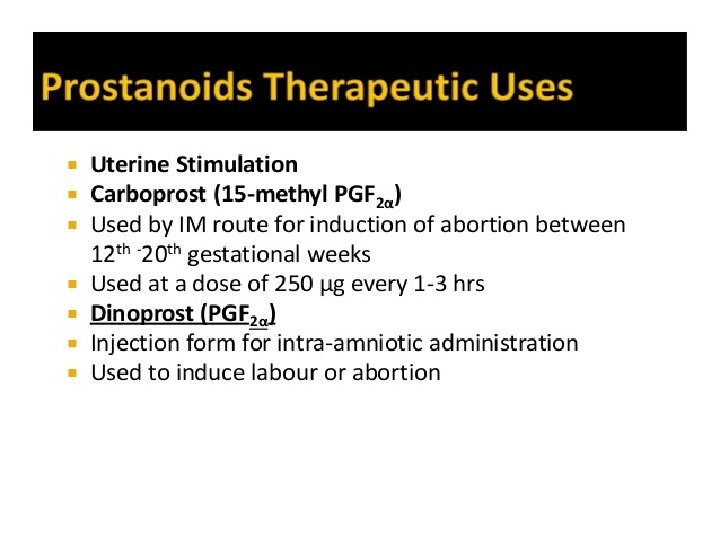
• PGs can be therapeutically used as Abortificients during Medical Termination of Pregnancies (MTPs) • PGs also arrests postpartum hemorrhage.
3. Role Of Prostaglandins In Lungs
• PGs in Lungs serve as Bronchodilators and Bronchoconstrictor of Lungs. –PG E-Bronchodilator –PG F- Bronchoconstrictor
• PG E is used in treatment of Bronchial Asthma.
4. Role Of Prostaglandin In GIT
• Prostaglandin in stomach increases its motility and inhibits gastric secretion of HCL. • PG is used in treatment of gastric ulcers.
5. Role Of Prostaglandins in Kidneys
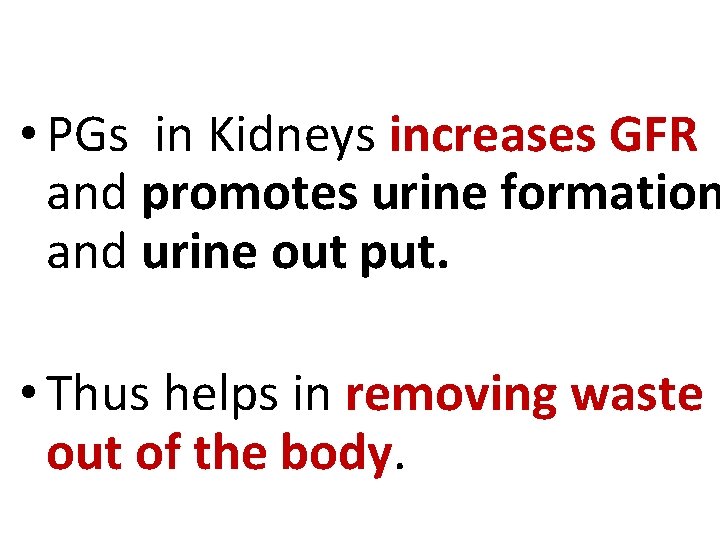
• PGs in Kidneys increases GFR and promotes urine formation and urine out put. • Thus helps in removing waste out of the body.
PGs Regulate Sleep and Wake Process • Use of PG D 2 promotes Sleep
6. Effect Of PGs on Metabolism
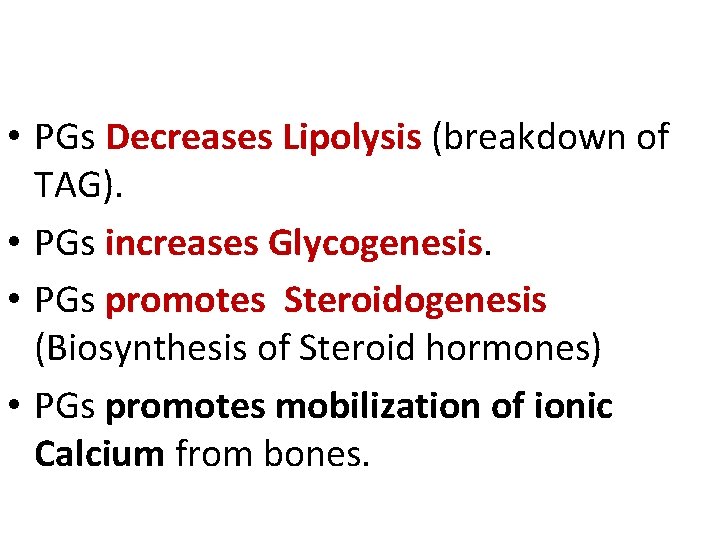
• PGs Decreases Lipolysis (breakdown of TAG). • PGs increases Glycogenesis. • PGs promotes Steroidogenesis (Biosynthesis of Steroid hormones) • PGs promotes mobilization of ionic Calcium from bones.
Production of PGs Promote Fever , Pain , Nausea Vomiting and Inflammation
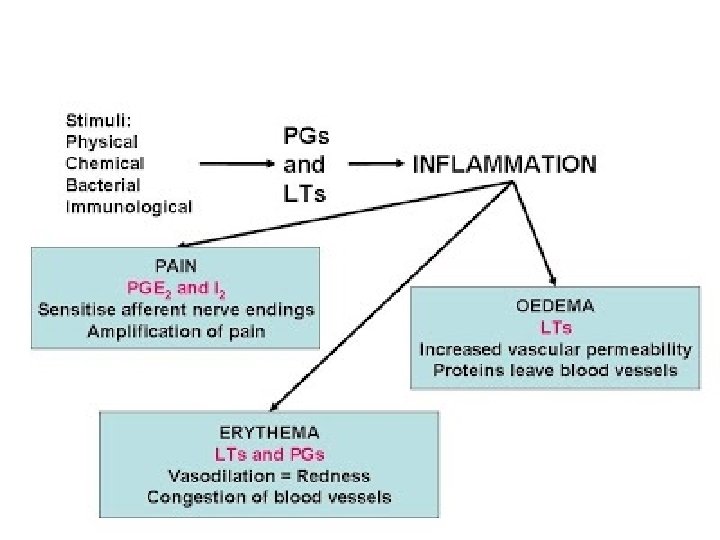
Role Of PGs In Immunity And Inflammation • Prostaglandins are produced in more amounts at the time of : –Fever –Pain –Nausea and Vomiting –Inflammation • Provide non specific immunity to body
• PGs are more produced in inflammatory disorders like Rheumatoid Arthritis
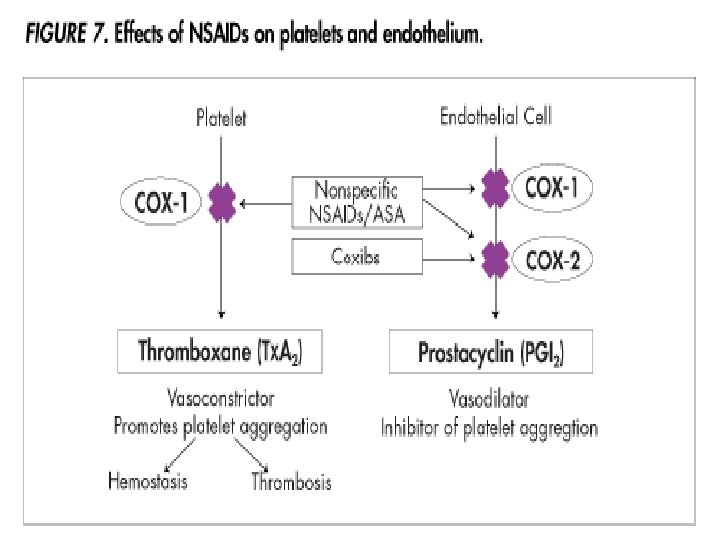
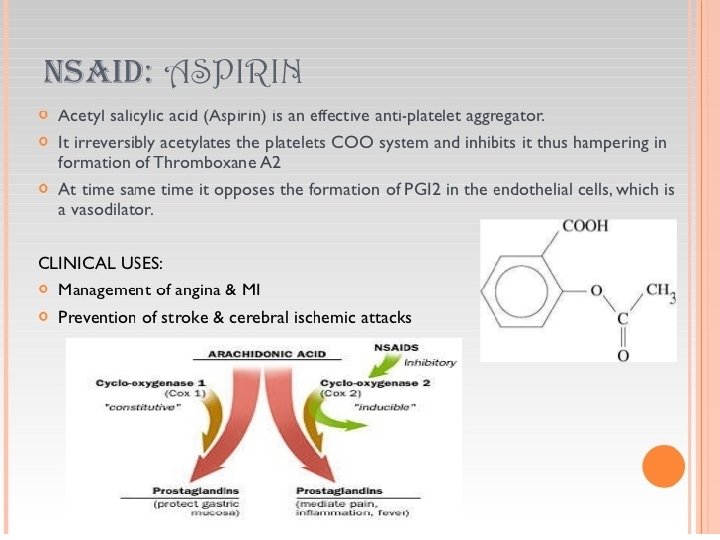
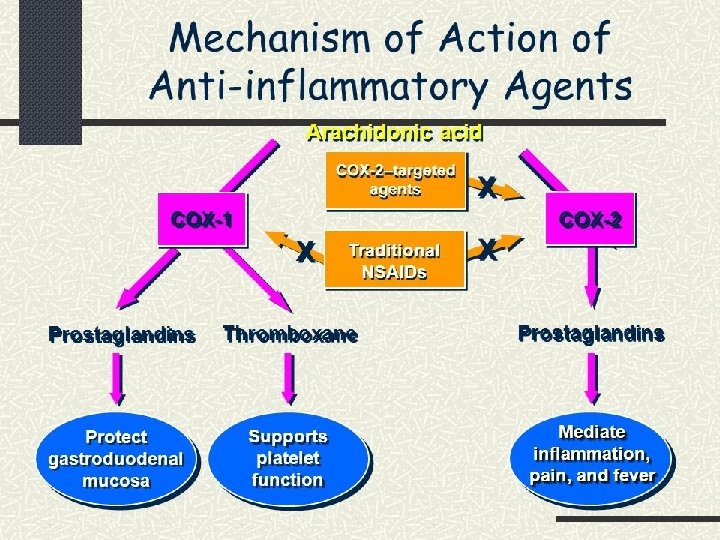
• Drugs like NSAIDs Aspirin used in treating inflammatory disorders. • Inhibits the Enzyme of Cycloxygenase system • Which in turn inhibits the biosynthesis of Prostaglandins.
2. Prostacyclins (PGI 2)
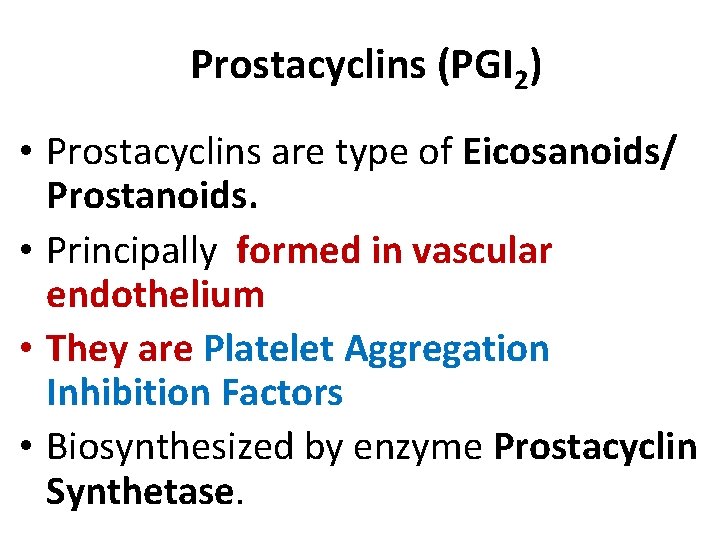
Prostacyclins (PGI 2) • Prostacyclins are type of Eicosanoids/ Prostanoids. • Principally formed in vascular endothelium • They are Platelet Aggregation Inhibition Factors • Biosynthesized by enzyme Prostacyclin Synthetase.
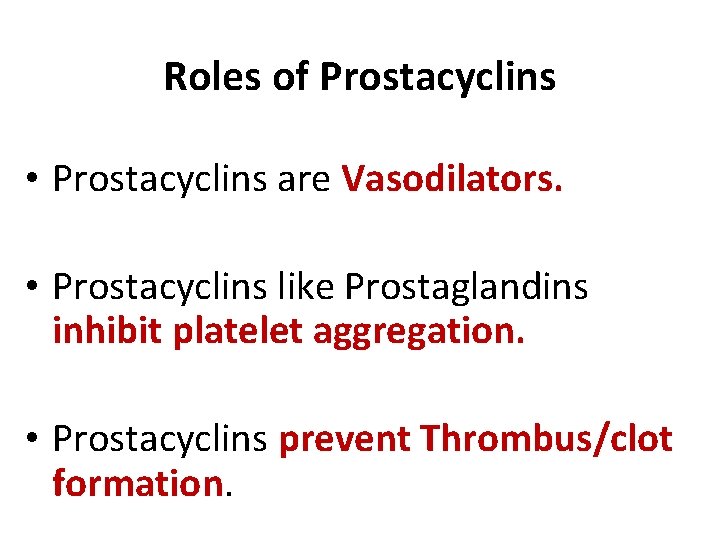
Roles of Prostacyclins • Prostacyclins are Vasodilators. • Prostacyclins like Prostaglandins inhibit platelet aggregation. • Prostacyclins prevent Thrombus/clot formation.
3. Thromboxanes (TX)
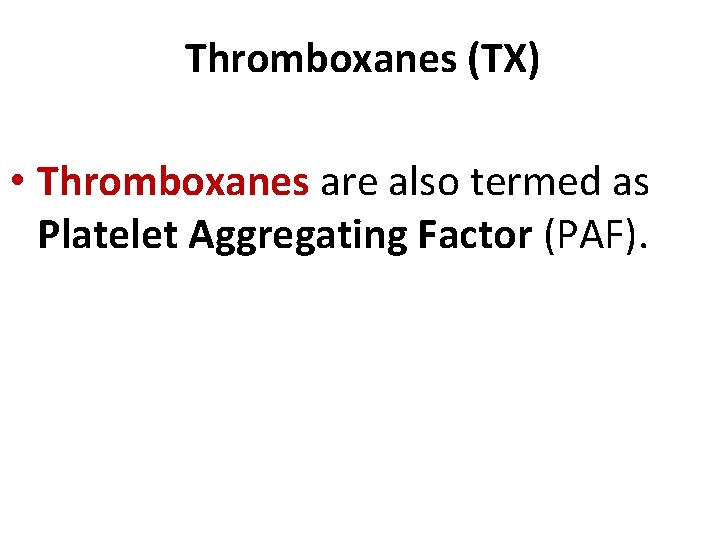
Thromboxanes (TX) • Thromboxanes are also termed as Platelet Aggregating Factor (PAF).
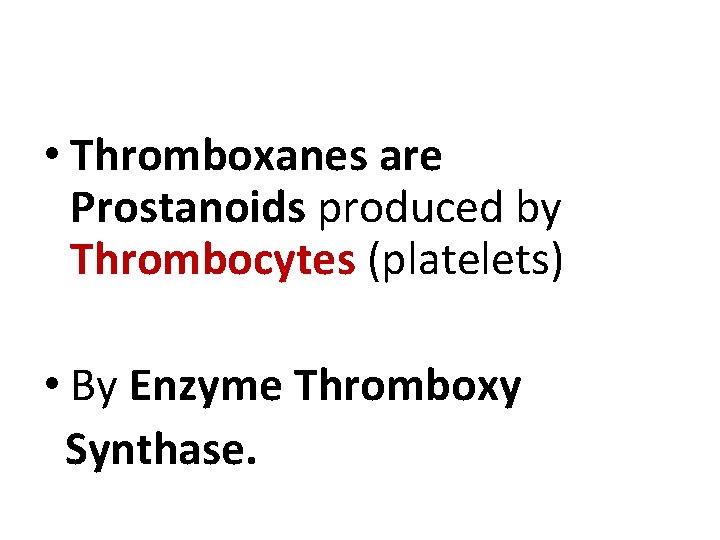
• Thromboxanes are Prostanoids produced by Thrombocytes (platelets) • By Enzyme Thromboxy Synthase.
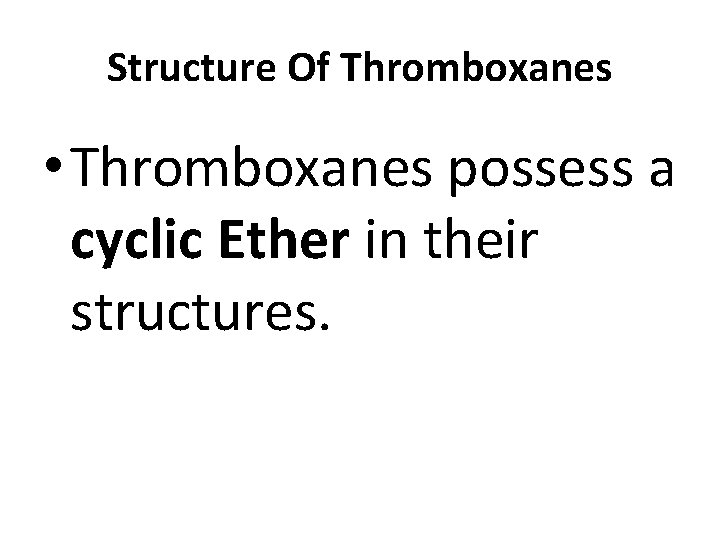
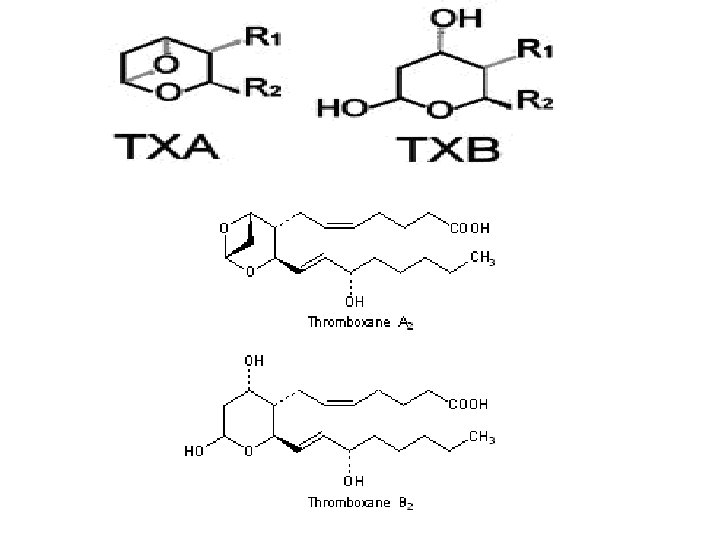
Structure Of Thromboxanes • Thromboxanes possess a cyclic Ether in their structures.
Types Of Thromboxanes • TX A and TX B are types of Thromboxanes. • TXA 2 is more prominent in human body.
Functions Of Thromboxanes • Thromboxanes are vasoconstrictors. • Thromboxanes enhances platelet aggregation. • Thromboxanes favors blood clot formation during blood coagulation.
• Thromboxanes and Prostacyclins are antagonistic to each other balancing their activities. • Increased Thromboxane activity results in Thrombosis.
4. Leukotrienes
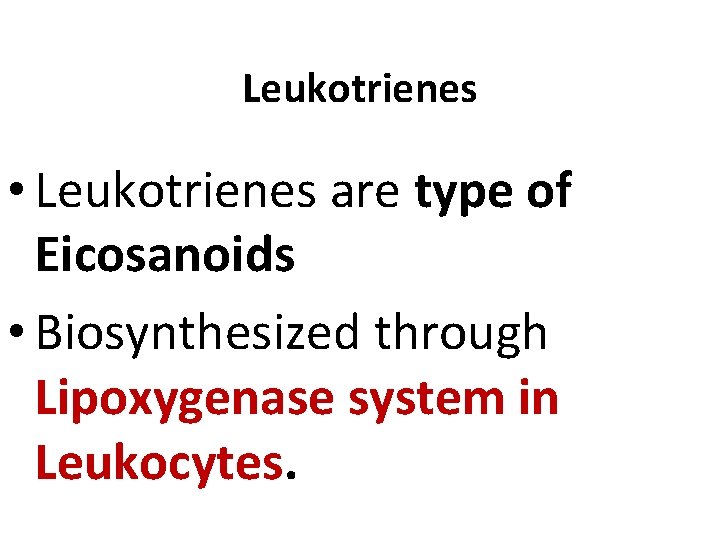
Leukotrienes • Leukotrienes are type of Eicosanoids • Biosynthesized through Lipoxygenase system in Leukocytes.
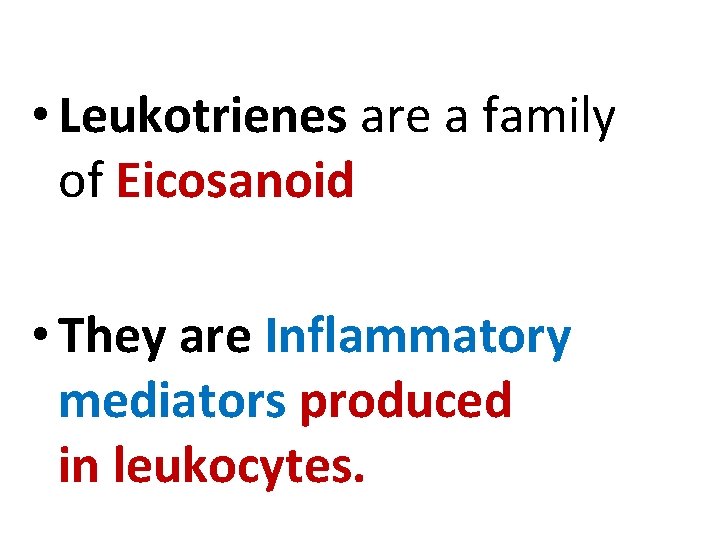
• Leukotrienes are a family of Eicosanoid • They are Inflammatory mediators produced in leukocytes.
Structure And Types Of Leukotrienes
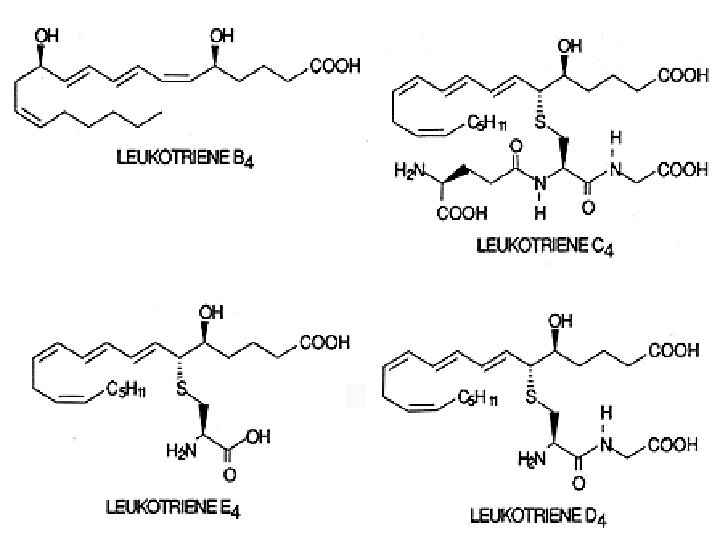
Leukotrienes Structure and Types • Leukotrines are Hydroxy derivatives possessing conjugated Trienes. • Types of Leukotrienes: • LTB 4, LTC 4, LTD 4 and LTE 4
Occurrence Of Leukotrienes
• Early discovery of Leukotrienes was in Leukocytes.
• Leukotrienes are also produced and present in. –Mast cells –Lung –Heart –Spleen
Effect Of Leukotrienes • Leukotrienes are biologically active components of Slow Reacting Substances (SRS-A). • SRS-A are released during Allergic reactions/Anaphylaxis.
• Leukotrienes are 1001000 times more potent than Histamine during allergic reactions.
• LTB 4 is a potent chemotactic agent. (chemical substance which mediates movement of cells).
• Leukotrienes by action are: –Bronchoconstrictors –Vasoconstrictors
• LTC 4, LTD 4 and LTE 4 are Slow - Releasing Substance of anaphylaxis ( SRS - A ) , • SRS-A causes fluid leakage from blood vessels to an inflamed area.
Levels Of Leukotrienes Increased In • Allergies • Allergic rhinitis • Asthma ( Tightening of airways, difficult to breathe)
• Overproduction of Leukotrienes causes Anaphylactic shocks.
• An Antiasthmatic drug Prednisone inhibits Leukotriene biosynthesis.
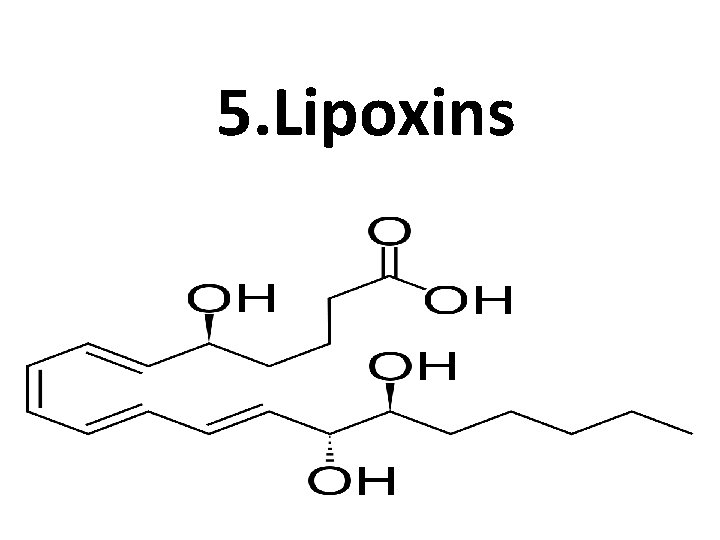
5. Lipoxins
Lipoxins • Lipoxins are Eicosanoids produced in Leukocytes of human body.
Roles Of Lipoxins are essential in maintaining tissue homeostasis and resolve inflammation. • Lipoxins are: – Vasoactive/Vasodilators – Anti-inflammatory – Anti-proliferative – Pro-resolving – Immunoregulatory – Chemotactic substances
Omega 6 and Omega 3 Derived Eicosanoids Are Opposite in Action
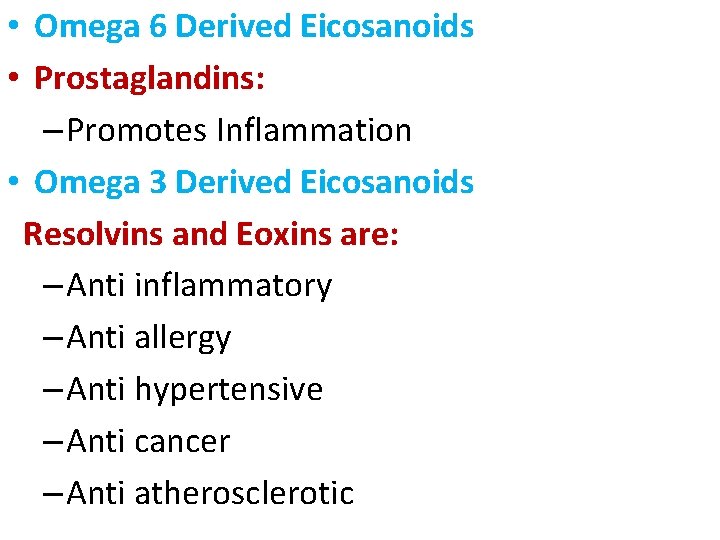
• Omega 6 Derived Eicosanoids • Prostaglandins: – Promotes Inflammation • Omega 3 Derived Eicosanoids Resolvins and Eoxins are: – Anti inflammatory – Anti allergy – Anti hypertensive – Anti cancer – Anti atherosclerotic
Effects of Eicosanoids
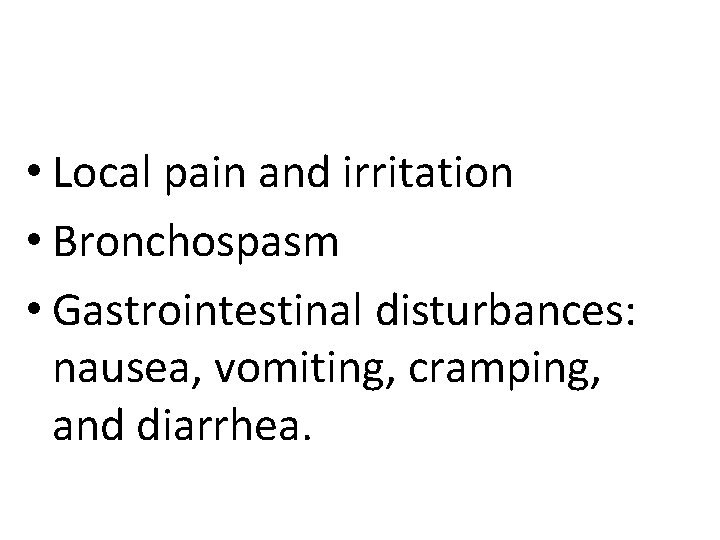
• Local pain and irritation • Bronchospasm • Gastrointestinal disturbances: nausea, vomiting, cramping, and diarrhea.
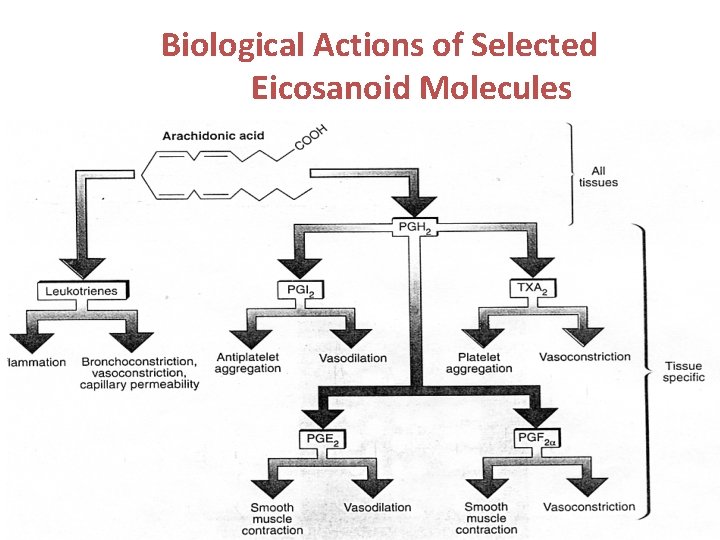
Biological Actions of Selected Eicosanoid Molecules
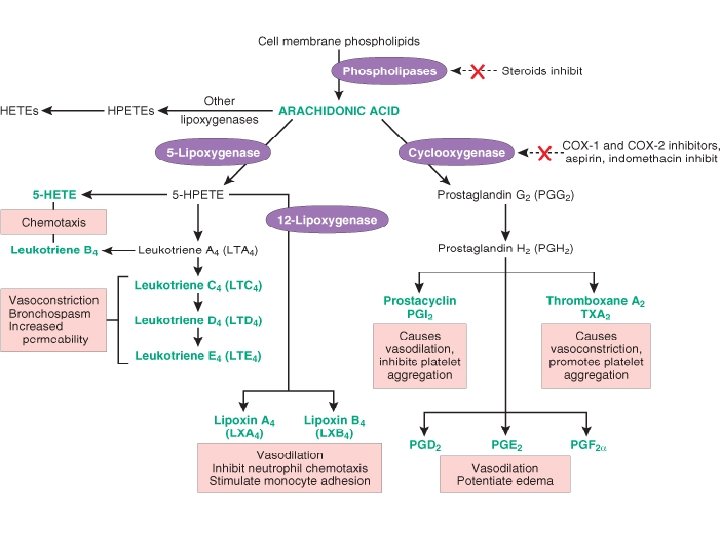
Generation of arachidonic acid metabolites and their roles in inflammation. The molecular targets of some anti-inflammatory drugs are indicated by a red X. COX, cyclooxygenase; HETE, hydroxyeicosatetraenoic acid; HPETE, hydroperoxyeicosatetraenoic acid.
Amphipathic Lipids
Examples Of Amphipathic Body Lipids • Phospholipids • Glycolipids • Free Fatty acids • Free Cholesterol
Features Of Amphipathic Lipids • Structure has both polar and non polar groups • Partially soluble • Orientation of groups: –Polar group directed towards water phase –Non polar group directed in oil phase/away from water.
Role Of Amphipathic Lipids
• Amphipathic Lipids have following biological Significances in forming: – Biomembranes: (Phospholipid bilayer, Glycolipids and Cholesterol) – Emulsions: – In intestine PL help in Lipids Digestion – Micelles: – In intestine help in Lipids Absorption – Lipoproteins: – For transport of nonpolar/neutral Lipids – Liposomes: – Agents for Drug /Gene carrier
Emulsions
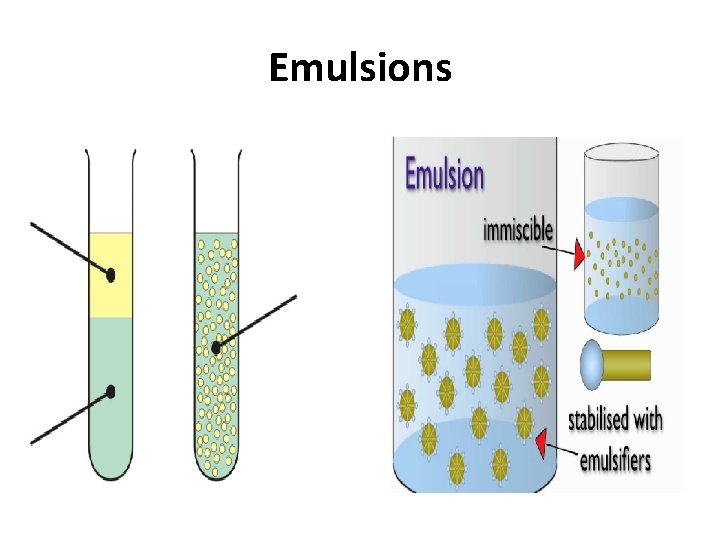
Emulsions • Emulsions are small droplets of oils miscible in aqueous phase. • Emulsions are usually formed by Nonpolar and Amphipathic Lipids along with Bile Salts in aqueous phase.
In Human GIT • Emulsions are formed as small, miscible dietary Lipid droplets in aqueous phase of intestinal juice in intestinal lumen.
• Emulsions are formed during the process of Emulsification in GIT.
Requirements For Emulsification • Emulsifying agents : –Bile salts (Major) –Amphipathic Lipids (Minor) • Mechanical force aids emulsification.
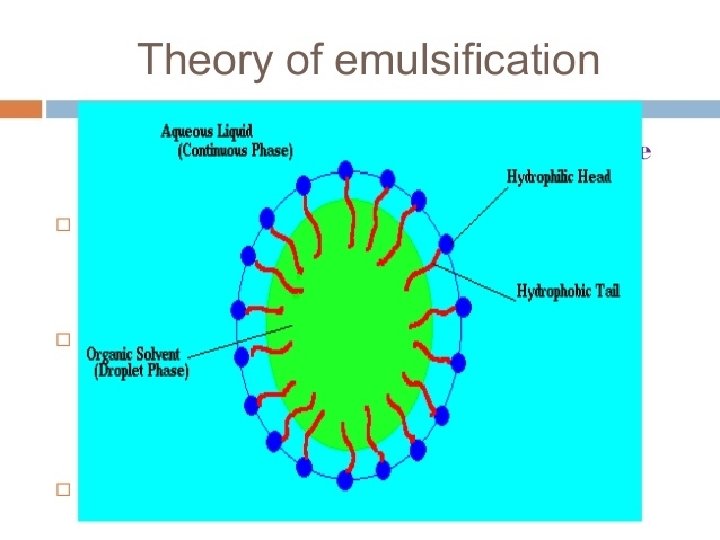
• Emulsifying agents reduces surface tension. • Emulsifying agents form a surface layer of separating main bulk of nonpolar Lipids from aqueous phase.
• Emulsions are stabilized by detergent action of emulsifying agents.
Emulsification Process • Emulsification process takes place in an aqueous phase of intestinal juice in intestinal lumen and forms Emulsions. • During Emulsification Hydrophobic or nonpolar dietary Lipids (TAG) are mixed with an emulsifying agents: – Bile salts – Lecithin( Amphipathic Lipids)
• Mechanical force(provided by intestinal peristaltic movement) facilitates the process of Emulsification.
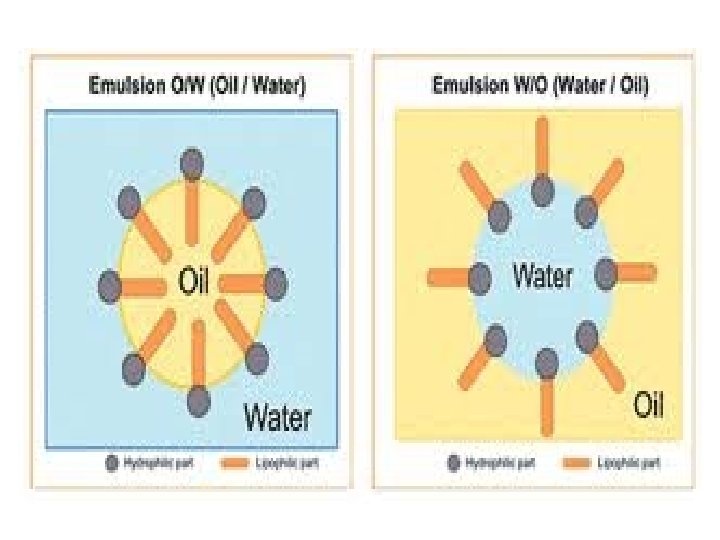
Types Of Emulsions I. Oil In Water II. Water In Oil
Significance Of Emulsions • Emulsions formed in the intestinal lumen help in the digestion of dietary Lipids. • The dietary large droplets of Fat/Oil are transformed to small , miscible droplets as Emulsions.
• Emulsions bring the dietary Lipids in contact with Lipid digesting Enzymes present in aqueous phase of intestinal juice.
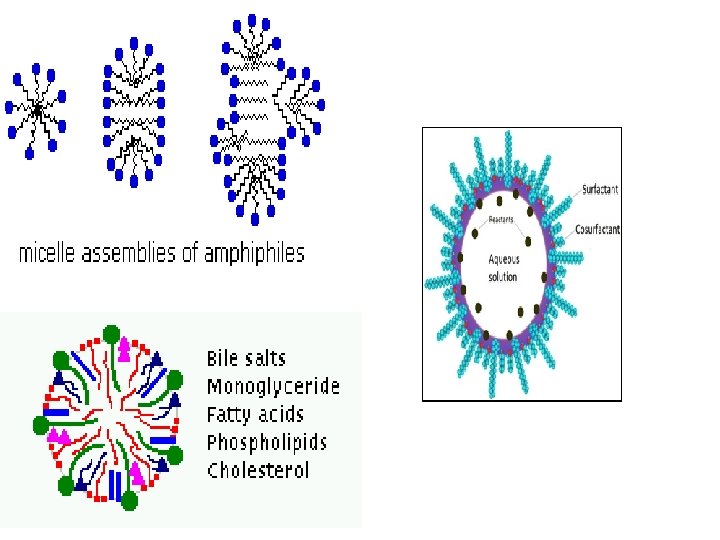
Micelles • Micelles have a disc like shape. • Critical concentration of Amphipathic Lipids in aqueous medium form Micelles(˜ 200 nm). • Bile salts help in forming Mixed Micelles.
• Mixed Micelles are formed in Intestine after digestion of Lipids. • By an aggregation of various forms of dietary digested Lipids with Bile salts.
• Aggregation of various digestive end products of dietary Lipids covered with a peripheral layer of Bile salts form Mixed Micelles in intestinal lumen.
• Mixed Micelles contain the non polar Lipids in the interior portions and polar Bile salts on the exterior.
Significance Of Mixed Micelles • Mixed Micelles helps in absorption of dietary Lipids • From intestinal lumen into intestinal mucosal cells.
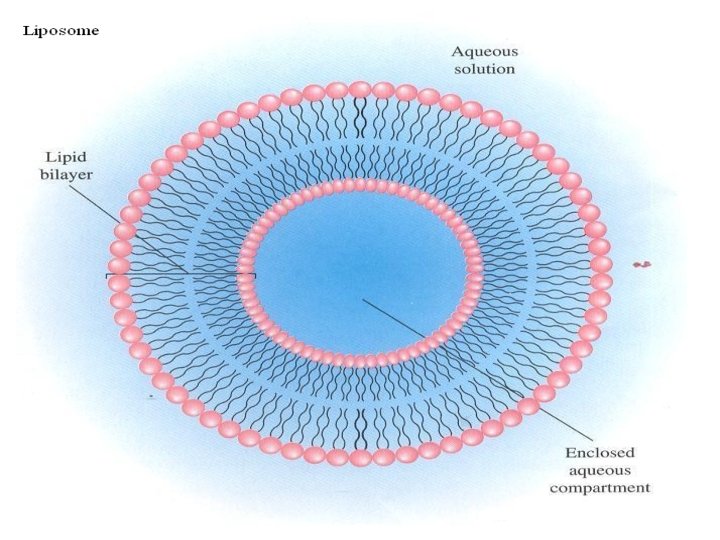
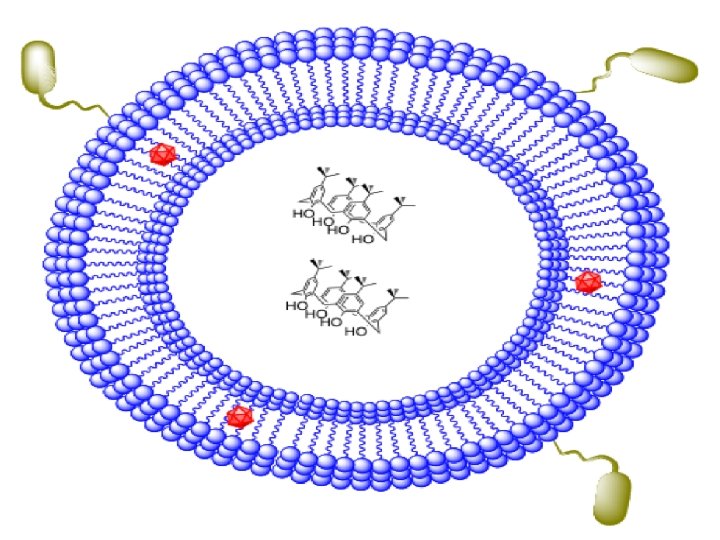
Liposomes • Amphipathic Lipids when exposed to high frequency sound waves (Ultra Sonication) in aqueous medium to agitate particles and form Liposomes. • Liposomes can be prepared by disrupting biological membranes by ultra sonication(>20 KHz )
Structures Of Liposomes • Liposomes are composite structures made of largely phospholipids and small amounts of other molecules • Liposomes has spheres of one/ many Lipid bilayers. • Liposomes contain aqueous regions(polar phase) and intermittently lipid bilayer (non polar phase).
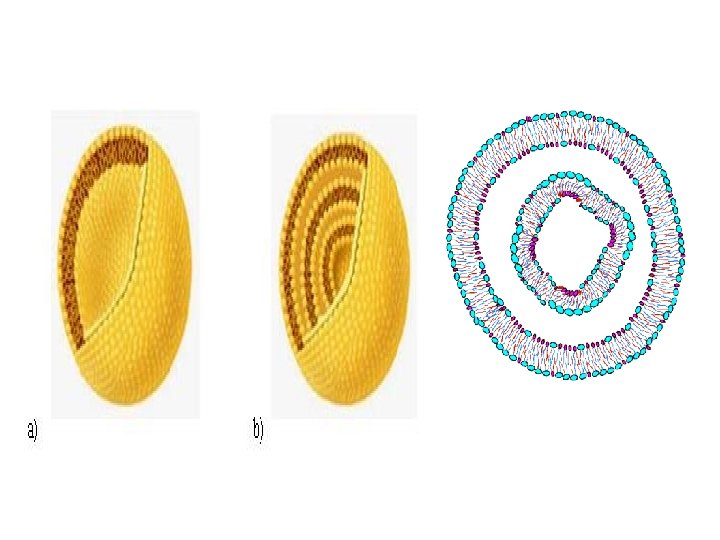
Types Of Liposomes • Unilamellar Liposome • Multilamellar Liposome
Applications Of Liposomes • Liposomes are vehicles for administration of drug through blood, targeted to specific organs. • Topical transdermal delivery of drugs. • Transfer of Gene into vascular cells
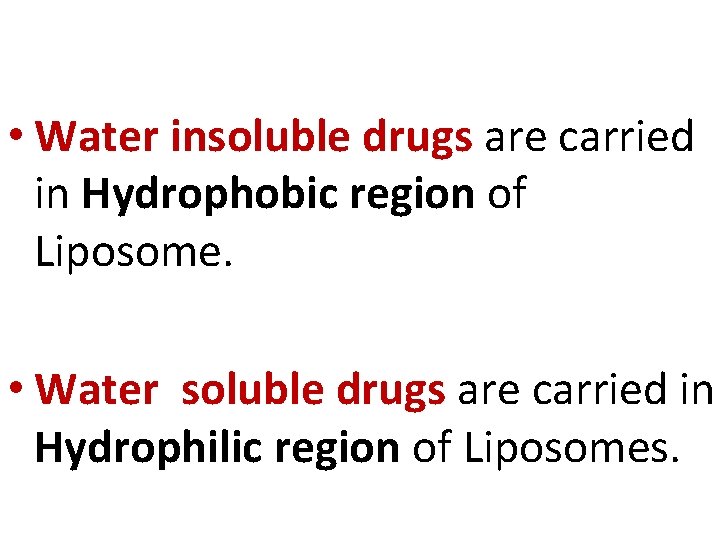
• Water insoluble drugs are carried in Hydrophobic region of Liposome. • Water soluble drugs are carried in Hydrophilic region of Liposomes.
Biomedical Importances Of Body Lipids
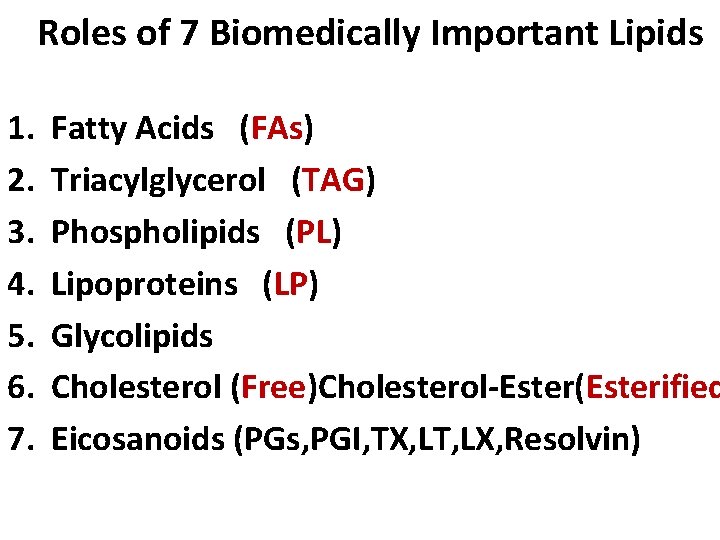
Roles of 7 Biomedically Important Lipids 1. 2. 3. 4. 5. 6. 7. Fatty Acids (FAs) Triacylglycerol (TAG) Phospholipids (PL) Lipoproteins (LP) Glycolipids Cholesterol (Free)Cholesterol-Ester(Esterified Eicosanoids (PGs, PGI, TX, LT, LX, Resolvin)
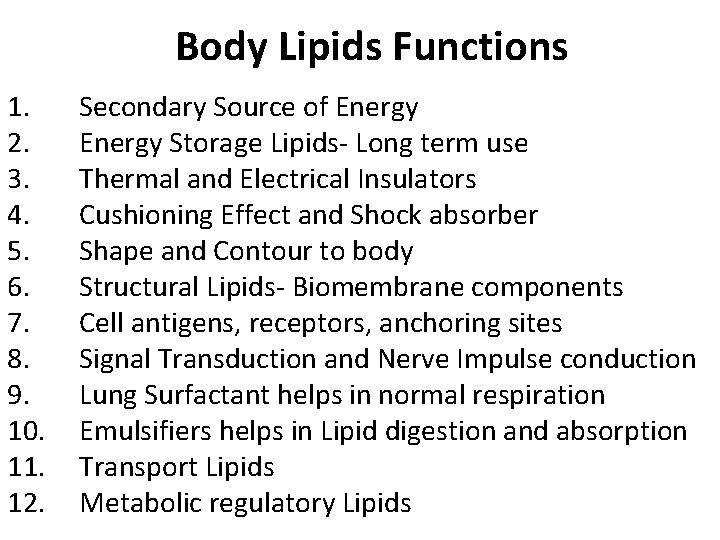
Body Lipids Functions 1. 2. 3. 4. 5. 6. 7. 8. 9. 10. 11. 12. Secondary Source of Energy Storage Lipids- Long term use Thermal and Electrical Insulators Cushioning Effect and Shock absorber Shape and Contour to body Structural Lipids- Biomembrane components Cell antigens, receptors, anchoring sites Signal Transduction and Nerve Impulse conduction Lung Surfactant helps in normal respiration Emulsifiers helps in Lipid digestion and absorption Transport Lipids Metabolic regulatory Lipids
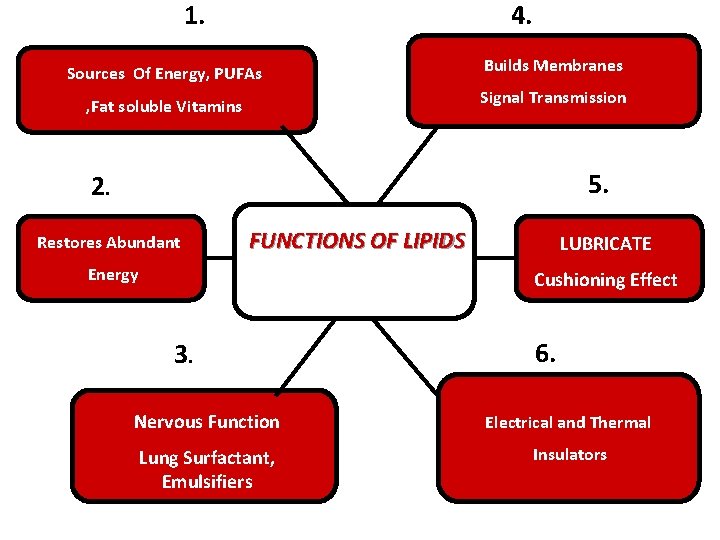
1. 4. Sources Of Energy, PUFAs Builds Membranes , Fat soluble Vitamins Signal Transmission 5. 2. Restores Abundant FUNCTIONS OF LIPIDS Energy LUBRICATE Cushioning Effect 3. 6. Nervous Function Electrical and Thermal Lung Surfactant, Emulsifiers Insulators
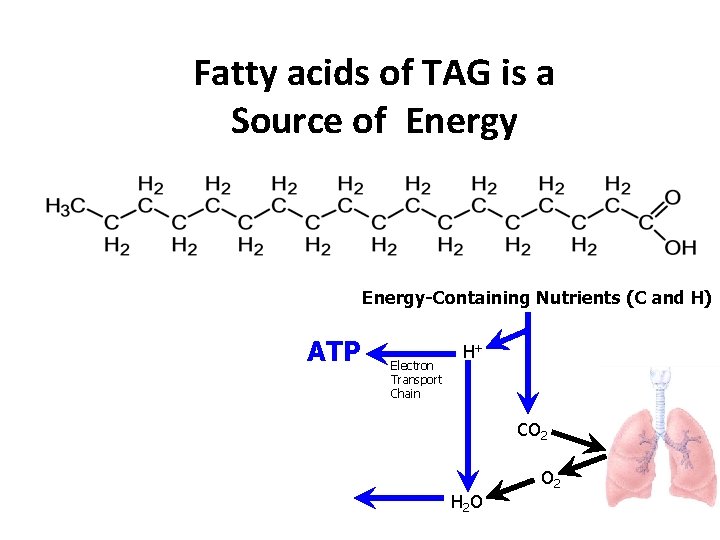
Fatty acids of TAG is a Source of Energy-Containing Nutrients (C and H) ATP Electron Transport Chain H+ CO 2 H 2 O O 2
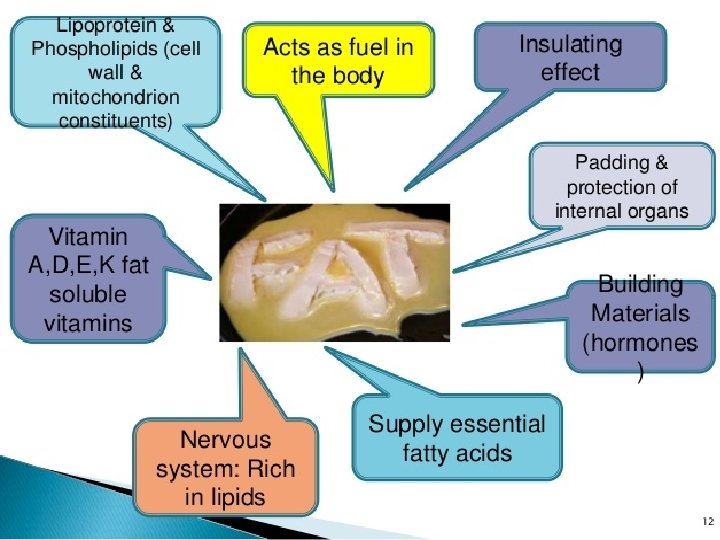
Good About Body Lipids • Liberate 9 kcal per gram of TAG. • Major fuel at rest • Endurance Exercise • Source of : – Essential fatty acids – Fat-soluble vitamins • Regulates cell function • Maintains membrane structure • Improve nerve function • Provides flavors and textures of foods • Gives satiety value
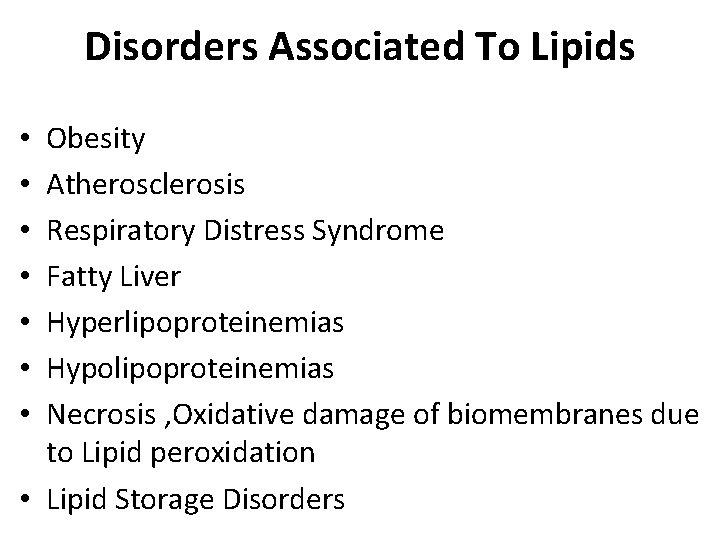
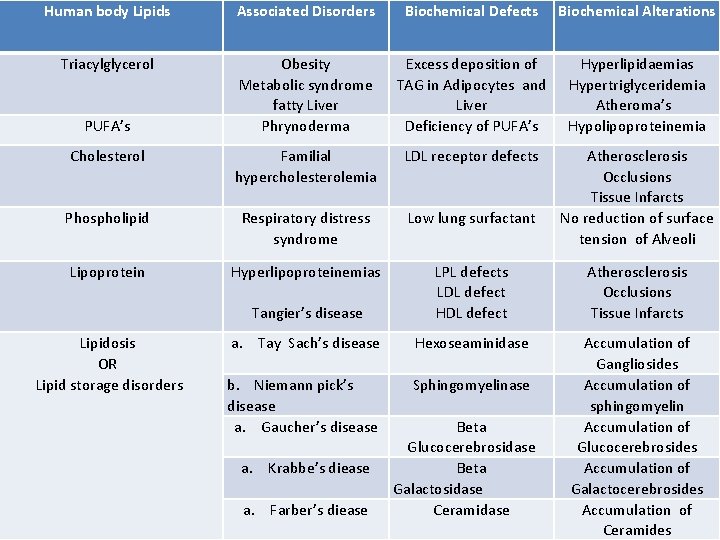
Disorders Associated To Lipids Obesity Atherosclerosis Respiratory Distress Syndrome Fatty Liver Hyperlipoproteinemias Hypolipoproteinemias Necrosis , Oxidative damage of biomembranes due to Lipid peroxidation • Lipid Storage Disorders • •
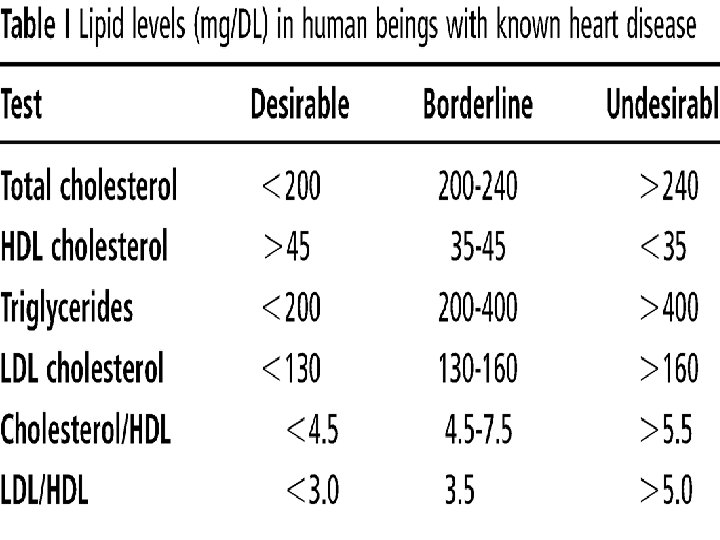
Common Lipids Associated Disorders • Obesity • Metabolic Syndrome –Atherosclerosis –Coronary Heart Disease –Hypertension –Diabetes Mellitus
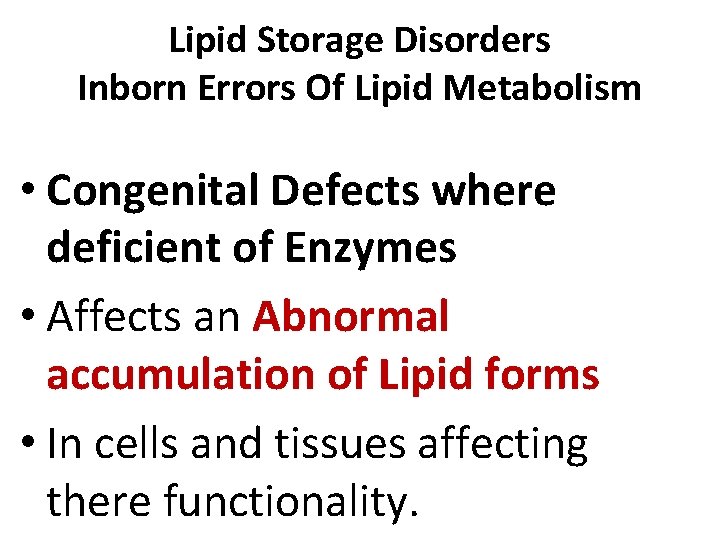
Lipid Storage Disorders Inborn Errors Of Lipid Metabolism • Congenital Defects where deficient of Enzymes • Affects an Abnormal accumulation of Lipid forms • In cells and tissues affecting there functionality.
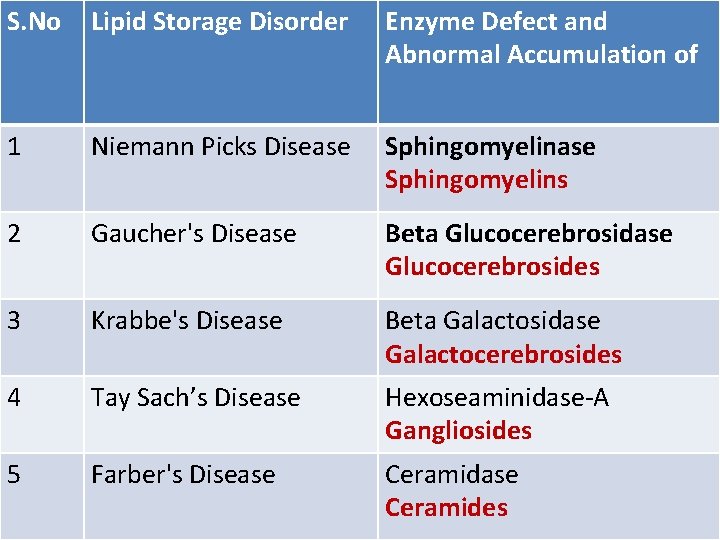
S. No Lipid Storage Disorder Enzyme Defect and Abnormal Accumulation of 1 Niemann Picks Disease Sphingomyelins 2 Gaucher's Disease Beta Glucocerebrosidase Glucocerebrosides 3 Krabbe's Disease Beta Galactosidase Galactocerebrosides 4 Tay Sach’s Disease Hexoseaminidase-A Gangliosides 5 Farber's Disease Ceramides
Human body Lipids Associated Disorders Biochemical Defects Biochemical Alterations Triacylglycerol Obesity Metabolic syndrome fatty Liver Phrynoderma Excess deposition of TAG in Adipocytes and Liver Deficiency of PUFA’s Hyperlipidaemias Hypertriglyceridemia Atheroma’s Hypolipoproteinemia Cholesterol Familial hypercholesterolemia LDL receptor defects Phospholipid Respiratory distress syndrome Low lung surfactant Atherosclerosis Occlusions Tissue Infarcts No reduction of surface tension of Alveoli Lipoprotein Hyperlipoproteinemias Tangier’s disease LPL defects LDL defect HDL defect Atherosclerosis Occlusions Tissue Infarcts Lipidosis OR Lipid storage disorders a. Tay Sach’s disease Hexoseaminidase b. Niemann pick’s disease a. Gaucher’s disease Sphingomyelinase Accumulation of Gangliosides Accumulation of sphingomyelin Accumulation of Glucocerebrosides Accumulation of Galactocerebrosides Accumulation of Ceramides PUFA’s Beta Glucocerebrosidase a. Krabbe’s diease Beta Galactosidase a. Farber’s diease Ceramidase
Questions
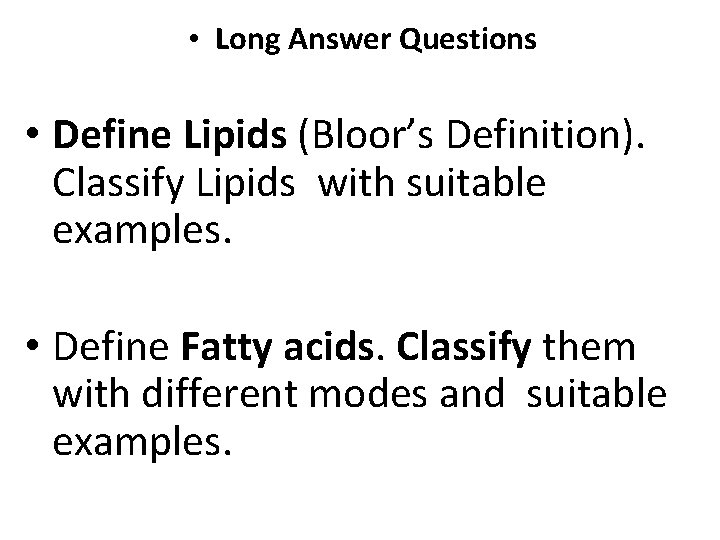
• Long Answer Questions • Define Lipids (Bloor’s Definition). Classify Lipids with suitable examples. • Define Fatty acids. Classify them with different modes and suitable examples.
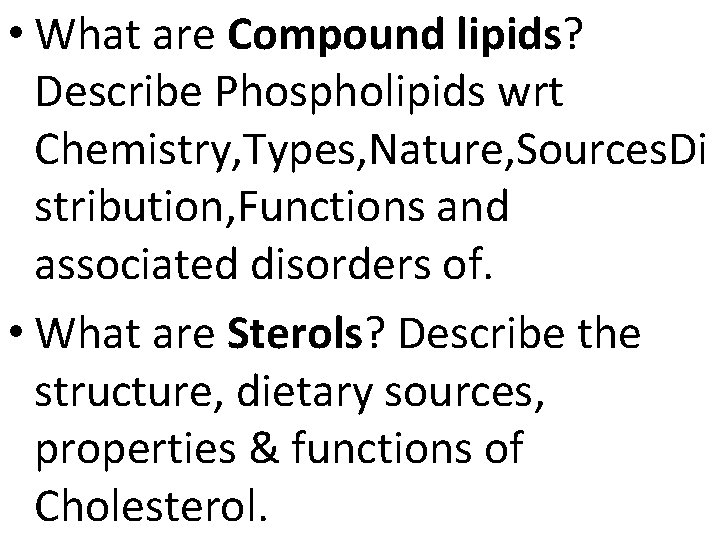
• What are Compound lipids? Describe Phospholipids wrt Chemistry, Types, Nature, Sources. Di stribution, Functions and associated disorders of. • What are Sterols? Describe the structure, dietary sources, properties & functions of Cholesterol.
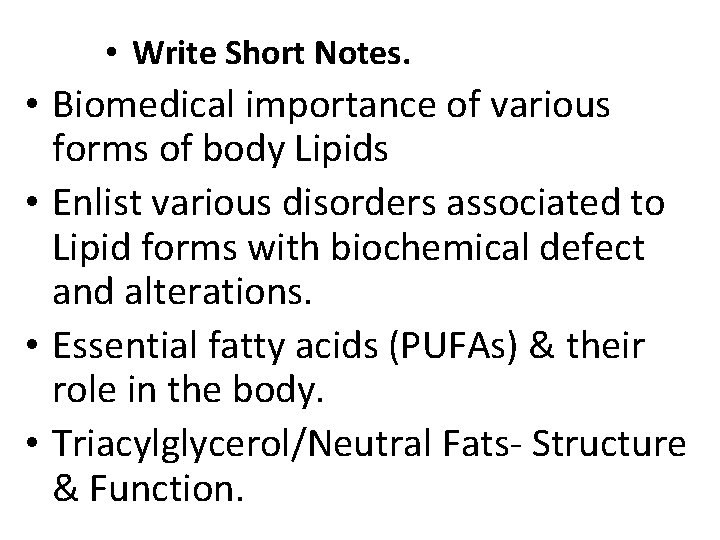
• Write Short Notes. • Biomedical importance of various forms of body Lipids • Enlist various disorders associated to Lipid forms with biochemical defect and alterations. • Essential fatty acids (PUFAs) & their role in the body. • Triacylglycerol/Neutral Fats- Structure & Function.
• Rancidity- Causes & Prevention. • Gycolipids/Cerebrosides/Gangliosides • Lipoproteins- Chemistry, types & functions • Eicosanoids/Prostaglandins
Therapeutic uses of Prostaglandins Distinguish between Fats & Waxes Nomenclature & Isomerism of fatty acids Omega 3 fatty acids and their importance Amphipathic nature of lipids and their roles Distinguish between Fats & Oils Enumerate biomedical important lipids with their classes • Properties of Fatty acids. • •
• Simple Lipids with their examples • Enumerate Compound Lipids & one function of each • Name Derived lipids & their functions • Trans Fats and their harmful effects • Tests to check the purity of fats & oils/Characteristic number of Fats
Revision Questions
• • Define Lipids Number and Names of Lipid Classes Define Derived Lipids Examples of Derived Lipids Define Fatty acids What is Delta and Omega end of FAs What is Beta Carbon of a Fatty acid 6 Modes of Classification of Fatty acids
• Fatty acids with one double bond is: ------- • Name most predominant Fatty acid of human body---- • Most easily metabolized fatty acids are : ------, ______- and _______ • Fatty acid with odd and even number carbon atoms are: • PUFAs are Fatty acids with---------- • Name PUFAs of Omega 3 and 6 types • Enumerate Lipidosis with enzyme defects
• Are Nutritionally Essential Fatty acids and PUFAs same • Name branched Chain and Odd Number Fatty acids • Name Cyclic and Hydroxy Fatty acids • What are Cis and Trans Fatty acids • Enlist Omega 3 Fatty acids and 3 Main Roles
• Criteria for Sub classification of Simple Lipids • Define Simple lipids • Examples/Subtypes of Simple Lipids • What is a Class of Fat/Oil and its chemical name • Define Waxes • Name human body Wax
• Differences of Fats and Oils • Differentiate between Cerebrosides and Gangliosides • Occurrence and Role of TAG • Definition of Compound Lipids • Types of Compound lipids • Sphingophospholipid Example
• Number and Names Of Glycerophospholipids • Hormonal role of Phospholipds • Chemical composition of Lung Surfactant • Which Compound Lipid is classified under classes of Lipid and Protein?
• Enzyme defect in Niemann Picks Disease • Red Spot Macula is noted in which all conditions • In which disorder Ceramides get accumulated in joints • Emulsions and Liposomes results due to which Lipid forms. • On what criteria's TAG is selected as reservoir of energy for long term use • Enumerate various Lipid Storage disorders with biochemical defect and abnormal accumulated Lipid form
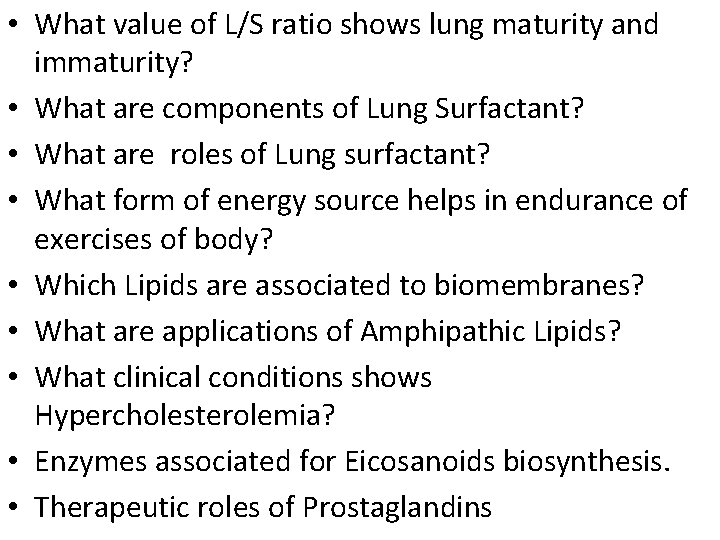
• What value of L/S ratio shows lung maturity and immaturity? • What are components of Lung Surfactant? • What are roles of Lung surfactant? • What form of energy source helps in endurance of exercises of body? • Which Lipids are associated to biomembranes? • What are applications of Amphipathic Lipids? • What clinical conditions shows Hypercholesterolemia? • Enzymes associated for Eicosanoids biosynthesis. • Therapeutic roles of Prostaglandins
Dr Anissa Atif Mirza Biochemistry Department