
NAME OF COURSE OUR SESSION WILL BEGIN SHORTLY
NAME OF COURSE OUR SESSION WILL BEGIN SHORTLY While we wait for everyone to join, think about the scenario below: Think of a recent situation where you felt anxious, frustrated, disappointed, or any other unpleasant emotion. How did you address it? (Do not share your answers!) BECAME ANGRY BECAME STRESSED OUT FOCUSED ON SOMETHING ELSE REDIRECED THOUGHTS / ACTIONS FELT OR GOT SICK IGNORED IT ISD to Update www. 327 solutions. com
Name of course Update Image Script complete. Do not alter. www. 327 solutions. com
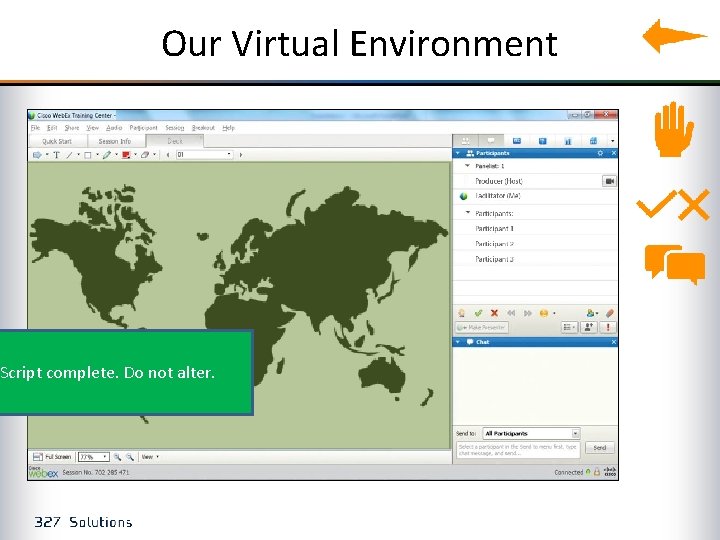
Our Virtual Environment Script complete. Do not alter.
Setting the Stage 1. Why is leadership and influence ISD to Update interesting or important for you? 2. What are your learning expectations for the course today?
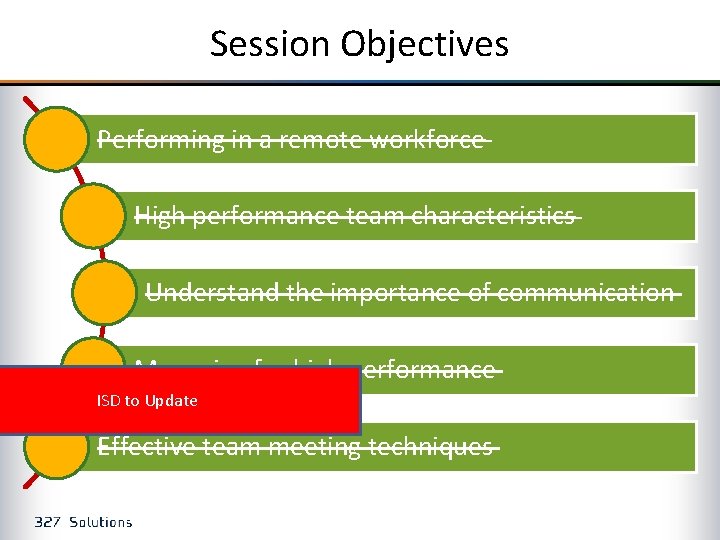
Session Objectives Performing in a remote workforce High performance team characteristics Understand the importance of communication Managing for high performance ISD to Update Effective team meeting techniques
Section 1 xxxxxxxxxxxxxxxxxxxxxx
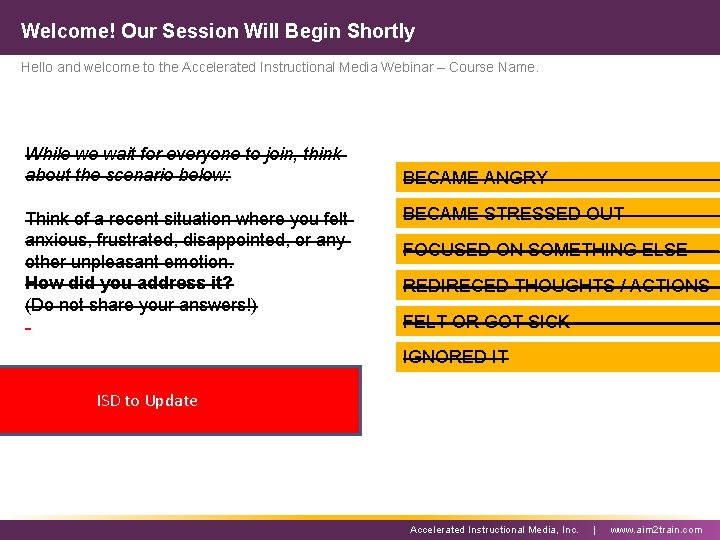
Welcome! Our Session Will Begin Shortly Hello and welcome to the Accelerated Instructional Media Webinar – Course Name. While we wait for everyone to join, think about the scenario below: Think of a recent situation where you felt anxious, frustrated, disappointed, or any other unpleasant emotion. How did you address it? (Do not share your answers!) BECAME ANGRY BECAME STRESSED OUT FOCUSED ON SOMETHING ELSE REDIRECED THOUGHTS / ACTIONS FELT OR GOT SICK IGNORED IT ISD to Update Accelerated Instructional Media, Inc. | www. aim 2 train. com
Business Acumen complete. Do not alter. Accelerated Instructional Media, Inc. | www. aim 2 train. com
Today’s Path Session Objectives • Discuss the Benefits and Challenges of Working Remotely Develop a Practice risk Describe characteristics that drive high performance in financial a Remote Environment Ke management literacy Recognize how and when to transform challenges into success factors strategy • Understand the elements of successful team dynamics • • ISD to Update Accelerated Instructional Media, Inc.

Accelerated Instructional Media, Inc.

Accelerated Instructional Media, Inc.
Module One: Getting Started Don’t be afraid to get creative and experiment with your marketing. Mike Volpe Accelerated Instructional Media, Inc.

Module Two: Seeing the Big Picture Details create the big picture. Sanford I. Weill Accelerated Instructional Media, Inc.
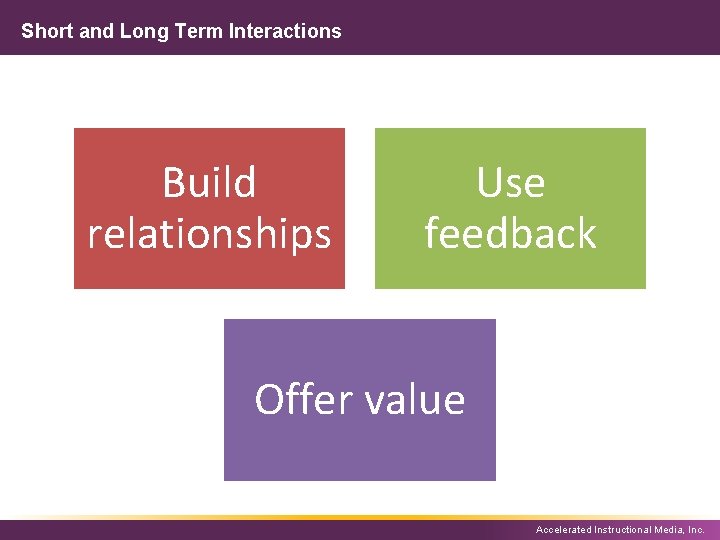
Short and Long Term Interactions Build relationships Use feedback Offer value Accelerated Instructional Media, Inc.
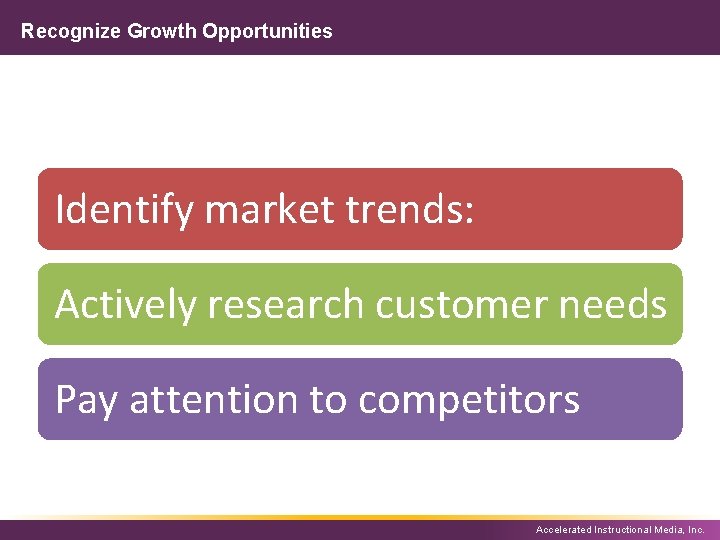
Recognize Growth Opportunities Identify market trends: Actively research customer needs Pay attention to competitors Accelerated Instructional Media, Inc.
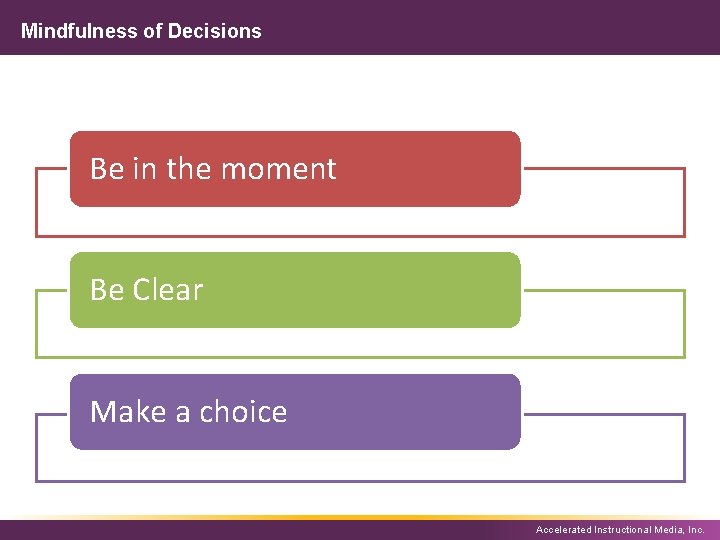
Mindfulness of Decisions Be in the moment Be Clear Make a choice Accelerated Instructional Media, Inc.
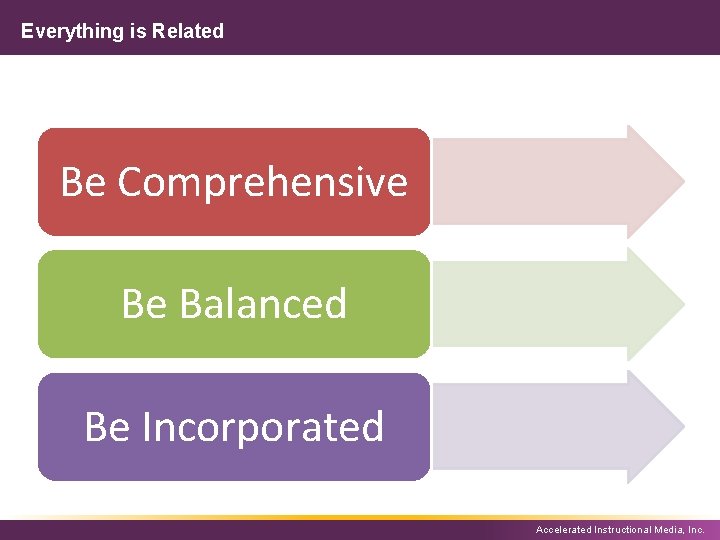
Everything is Related Be Comprehensive Be Balanced Be Incorporated Accelerated Instructional Media, Inc.
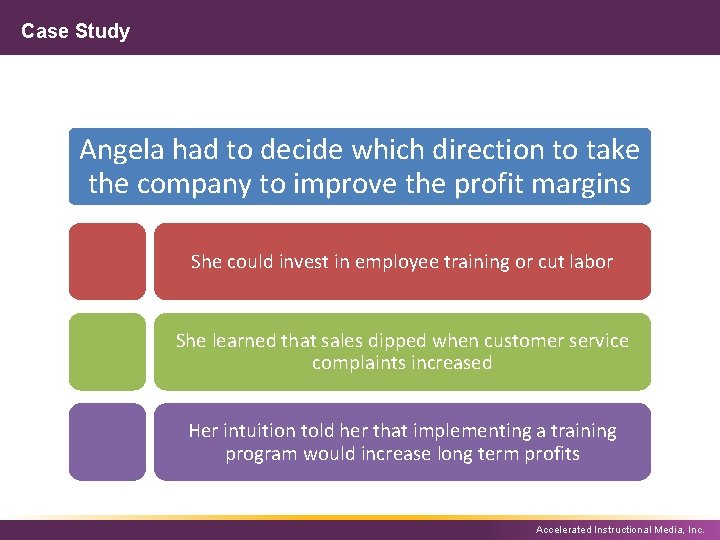
Case Study Angela had to decide which direction to take the company to improve the profit margins She could invest in employee training or cut labor She learned that sales dipped when customer service complaints increased Her intuition told her that implementing a training program would increase long term profits Accelerated Instructional Media, Inc.
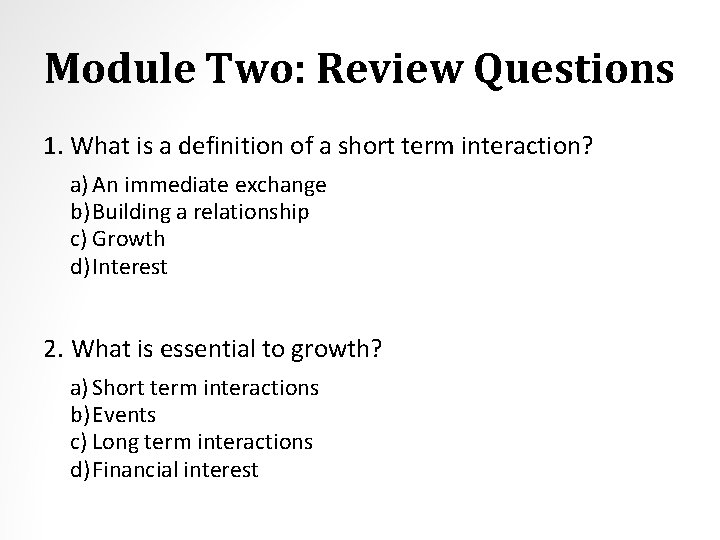
Module Two: Review Questions 1. What is a definition of a short term interaction? a) An immediate exchange b) Building a relationship c) Growth d) Interest 2. What is essential to growth? a) Short term interactions b) Events c) Long term interactions d) Financial interest
Module Two: Review Questions 3. What happens when you do not see the big picture? a) Opportunities are focused b) Opportunities are overlooked c) Nothing d) Growth is enhanced 4. What will market research provide? a) Investment opportunities b) Long term interactions c) Short term interactions d) Information on customer needs
Module Two: Review Questions 5. What do experts in mindful decision making recommend? a) Meditation b) Exercise c) Opportunity d) Attending events 6. Which of the following should not induce stress? a) Operational decision b) Neutral decision c) Important decision d) Strategic decision
Module Two: Review Questions 7. What do most people focus their energy on at work? a) Big picture b) Interests c) Specific roles d) Company roles 8. What is necessary for being comprehensive? a) Make adjustments b) Job descriptions. c) Training programs. d) Monitor every aspect
Module Two: Review Questions 9. What happened when Angela thought about cutting labor? a) Nothing b) She became nauseated c) She was comfortable with the idea d) She knew it was the right decision 10. What feedback did Angela receive from employees? a) They were not interested in training b) The employees were c) They were interested in training d) There was none
Module Two: Review Questions 1. What is a definition of a short term interaction? a) b) c) d) An immediate exchange Building a relationship Growth Interest Short term interactions are immediate exchanges. They are singular events. 2. What is essential to growth? a) b) c) d) Short term interactions Events Long term interactions Financial interest Long term interactions are relationships. These are essential to the growth of a company.
Module Two: Review Questions 3. What happens when you do not see the big picture? a) b) c) d) Opportunities are focused Opportunities are overlooked Nothing Growth is enhanced Growth requires recognizing opportunities. Not seeing the big picture will result in overlooked opportunities. 4. What will market research provide? a) b) c) d) Investment opportunities Long term interactions Short term interactions Information on customer needs Recognizing opportunities for growth requires monitoring customer needs. Market research will help provide this information.
Module Two: Review Questions 5. What do experts in mindful decision making recommend? a) b) c) d) Meditation Exercise Opportunity Attending events Mindful decision making requires connecting with intuition. Experts recommend taking up meditation to improve mindful decision making. 6. Which of the following should not induce stress? a) b) c) d) Operational decision Neutral decision Important decision Strategic decision It is important to identify the types of decisions that you have to make. A neutral decision should not be stressful.
Module Two: Review Questions 7. What do most people focus their energy on at work? a) b) c) d) Big picture Interests Specific roles Company roles Most people only focus on their specific roles, without considering how they affect the other departments. This can distract from the big picture. 8. What is necessary for being comprehensive? a) b) c) d) Make adjustments Job descriptions. Training programs. Monitor every aspect It is necessary to be comprehensive when examining how the aspects of the business are related. This requires monitoring every aspect of the business.
Module Two: Review Questions 9. What happened when Angela thought about cutting labor? a) b) c) d) Nothing She became nauseated She was comfortable with the idea She knew it was the right decision Angela physically reacted to the decision. She became nauseated with the idea of cutting labor. 10. What feedback did Angela receive from employees? a) b) c) d) They were not interested in training The employees were They were interested in training There was none Angela gathered information to make her decision. She learned that the employees were interested in training.
Module Three: KPIs (Key Performance Indicators) The price of light is less than the cost of darkness. Arthur C. Nielson Accelerated Instructional Media, Inc.
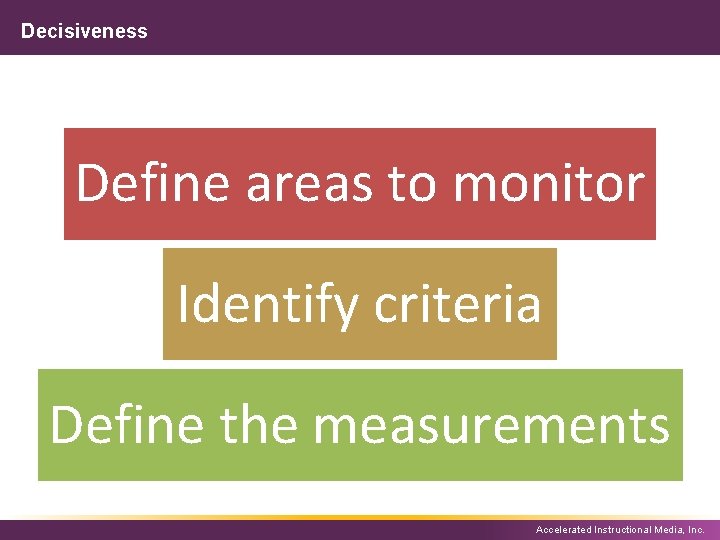
Decisiveness Define areas to monitor Identify criteria Define the measurements Accelerated Instructional Media, Inc.
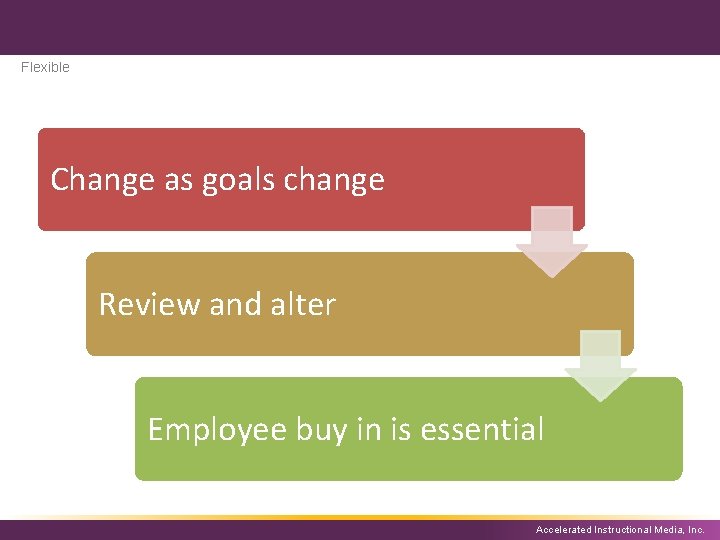
Flexible Change as goals change Review and alter Employee buy in is essential Accelerated Instructional Media, Inc.
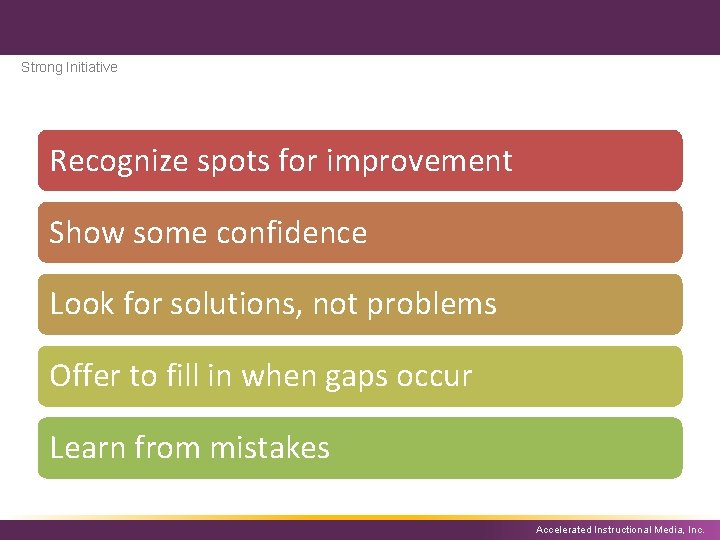
Strong Initiative Recognize spots for improvement Show some confidence Look for solutions, not problems Offer to fill in when gaps occur Learn from mistakes Accelerated Instructional Media, Inc.
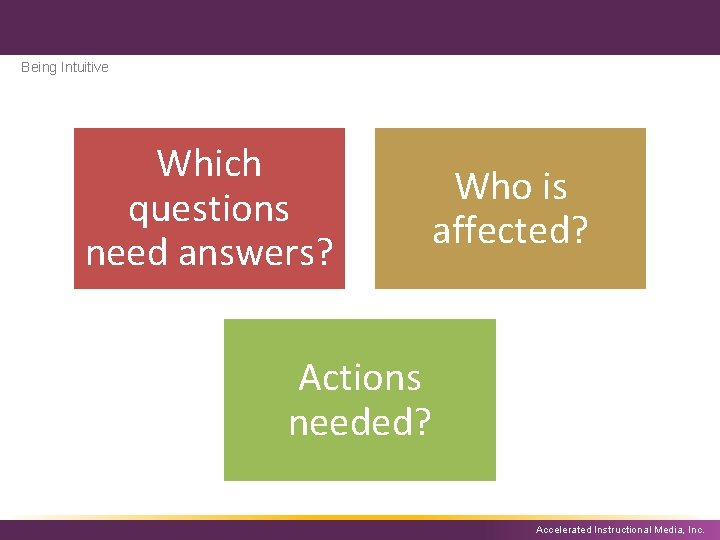
Being Intuitive Which questions need answers? Who is affected? Actions needed? Accelerated Instructional Media, Inc.
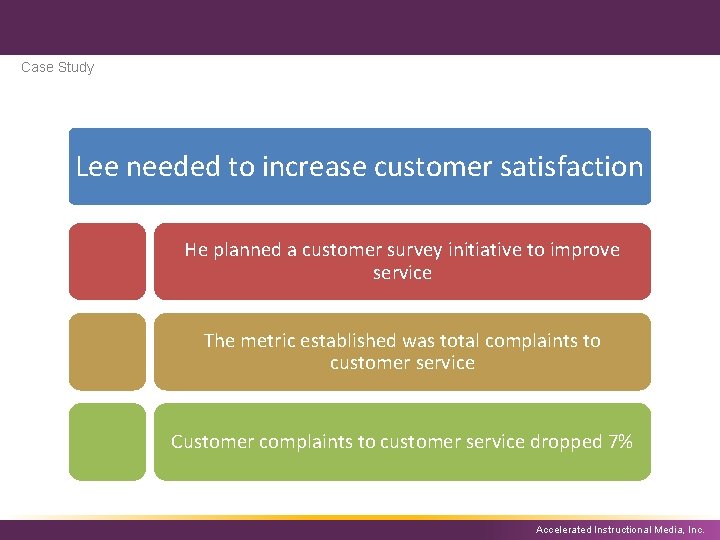
Case Study Lee needed to increase customer satisfaction He planned a customer survey initiative to improve service The metric established was total complaints to customer service Customer complaints to customer service dropped 7% Accelerated Instructional Media, Inc.
Module Three: Review Questions 1. What type of goals need to be established? a) Reasonable b) SMART c) New d) Established 2. Which areas of business need to be monitored? a) Successful b) Unsuccessful c) Successful and unsuccessful d) None
Module Three: Review Questions 3. Why needs to change with goals? a) Nothing b) Intuition c) KPIs d) Interest 4. How should implementation of KPIs be determined? a) By department b) As a whole c) Singularly d) It does not matter
Module Three: Review Questions 5. What do KPIs determine about initiatives? a) They come to work even if they are sick b) They take a lot of vacation time c) They are liked by everyone d) Their success 6. What is an acceptable target based on? a) Research b) Goals c) Objectives d) Interest
Module Three: Review Questions 7. How are KPIs created for dashboard? a) Easily b) Top down c) With difficulty d) Bottom up 8. Who needs to be involved in establishing dashboard KPIs? a) Management b) Employees c) All users d) Customers
Module Three: Review Questions 9. What was the initial target? a) 7% b) 10% c) 3% d) 17% 10. How long did Lee time his objective? a) One year b) 6 months c) 3 months d) One month
Module Three: Review Questions 1. What type of goals need to be established? a) b) c) d) Reasonable SMART New Established When establishing KPIs, you need clear goals and objectives. The goals need to be SMART. 2. Which areas of business need to be monitored? a) b) c) d) Successful Unsuccessful Successful and unsuccessful None The first step of creating KPIs is determining the areas of business that need to be monitored. This requires identifying successful and unsuccessful areas that require monitoring.
Module Three: Review Questions 3. Why needs to change with goals? a) b) c) d) Nothing Intuition KPIs Interest KPIs need to be flexible and change when necessary. They should change when the goals change. 4. How should implementation of KPIs be determined? a) b) c) d) By department As a whole Singularly It does not matter Flexibility should be given when implementing KPIs. The timing should be left to each department based on specific needs.
Module Three: Review Questions 5. What do KPIs determine about initiatives? a) b) c) d) They come to work even if they are sick They take a lot of vacation time They are liked by everyone Their success KPIs are used to measure results. These help determine the success of an initiative. 6. What is an acceptable target based on? a) b) c) d) Research Goals Objectives Interest Targets are necessary for creating KPIs. These targets need to be based on research.
Module Three: Review Questions 7. How are KPIs created for dashboard? a) b) c) d) Easily Top down With difficulty Bottom up KPIs are created from the top down or the bottom up. When using a dashboard, KPIs are created from the top down. 8. Who needs to be involved in establishing dashboard KPIs? a) b) c) d) Management Employees All users Customers Dashboard KPIs are focused on operational goals. This requires interviewing the users.
Module Three: Review Questions 9. What was the initial target? a) b) c) d) 7% 10% 3% 17% Lee created an initial target to improve customer service. The initial target Lee set was 10%. 10. How long did Lee time his objective? a) b) c) d) One year 6 months 3 months One month Lee timed the objective for one month. It was not based on any reliable data.
Module Four: Risk Management Strategies The first step in the risk management process is to acknowledge the reality of the risk. Charles Tremper Accelerated Instructional Media, Inc.
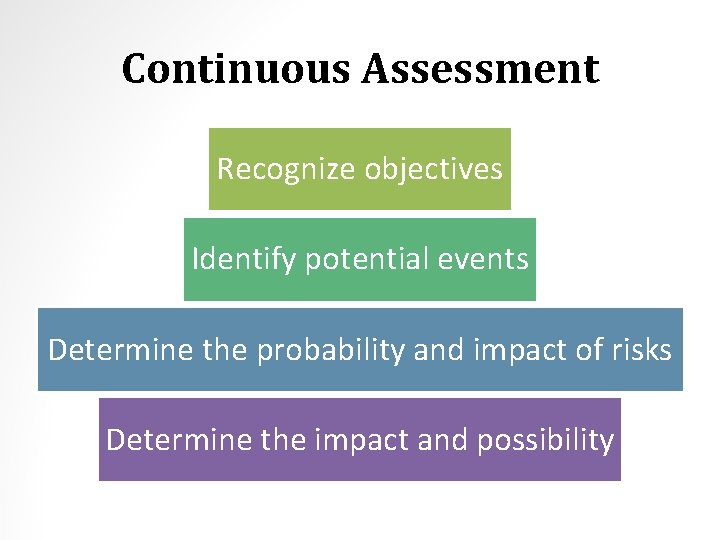
Continuous Assessment Recognize objectives Identify potential events Determine the probability and impact of risks Determine the impact and possibility
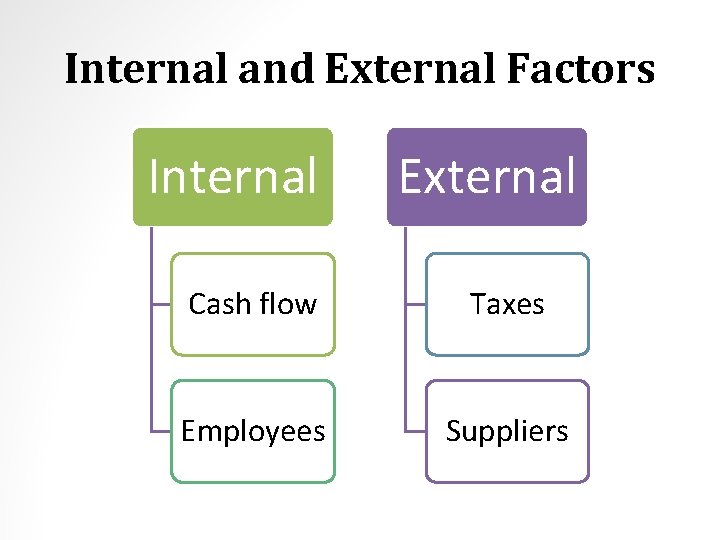
Internal and External Factors Internal External Cash flow Taxes Employees Suppliers
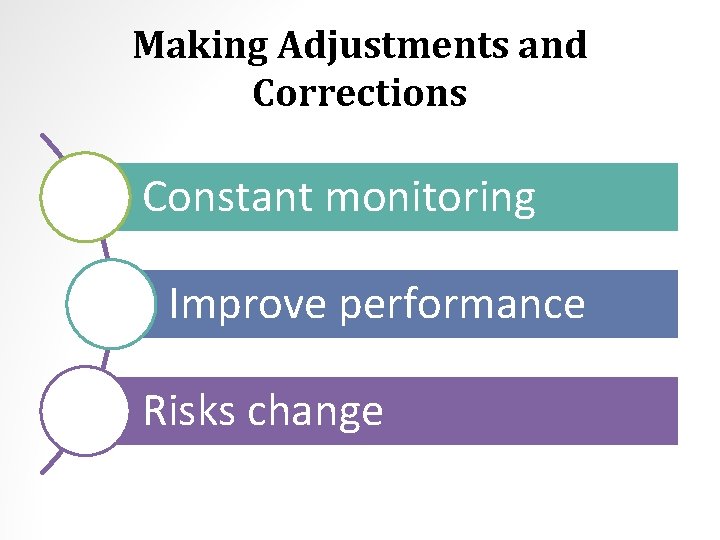
Making Adjustments and Corrections Constant monitoring Improve performance Risks change
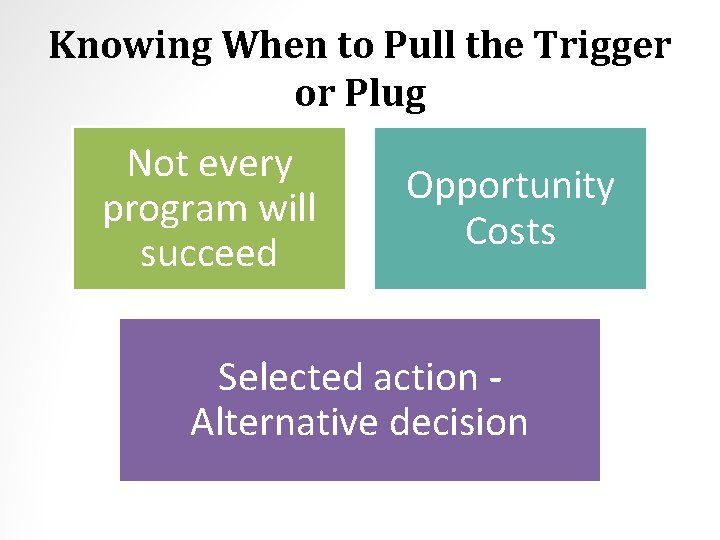
Knowing When to Pull the Trigger or Plug Not every program will succeed Opportunity Costs Selected action Alternative decision
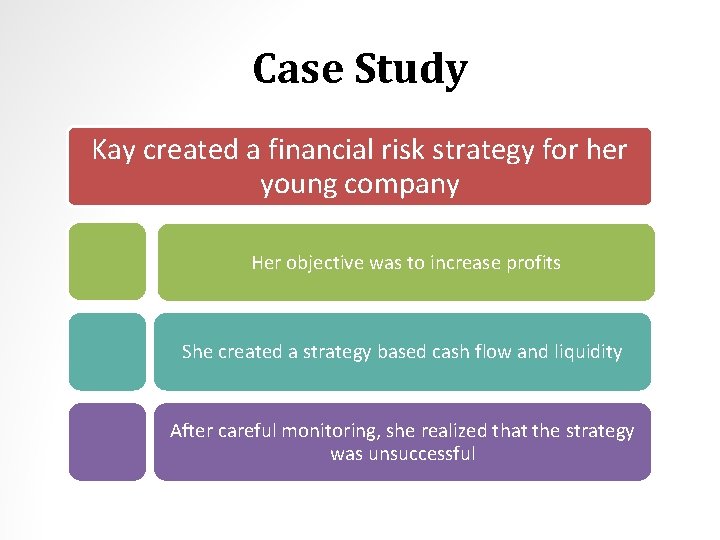
Case Study Kay created a financial risk strategy for her young company Her objective was to increase profits She created a strategy based cash flow and liquidity After careful monitoring, she realized that the strategy was unsuccessful
Module Four: Review Questions 1. What determines the type of risk assessment besides the business need? a) Risk b) Objective c) Opportunity d) Strength 2. What do risk assessments identify besides risks? a) Objectives b) Interest c) Opportunity d) Nothing
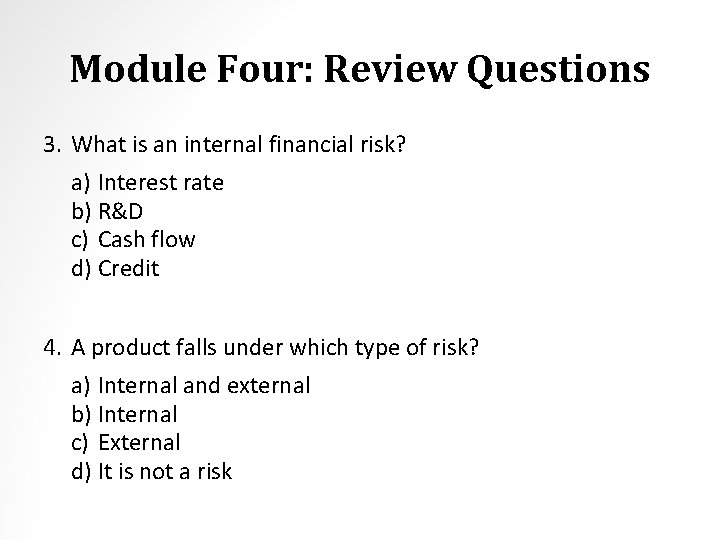
Module Four: Review Questions 3. What is an internal financial risk? a) Interest rate b) R&D c) Cash flow d) Credit 4. A product falls under which type of risk? a) Internal and external b) Internal c) External d) It is not a risk
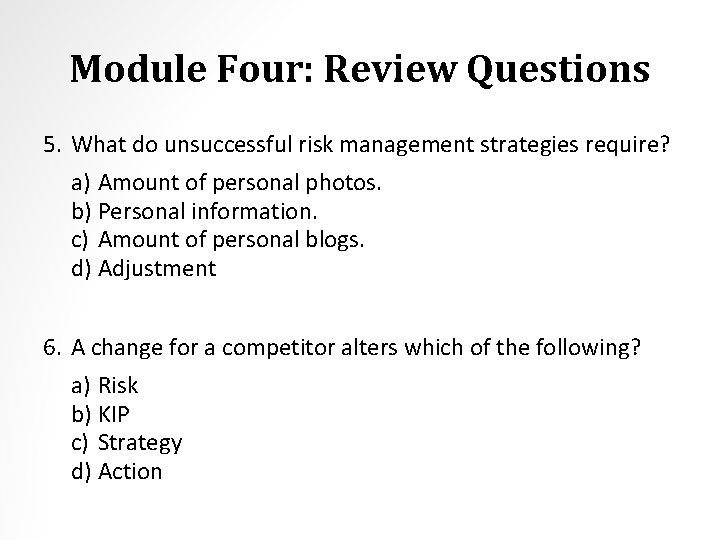
Module Four: Review Questions 5. What do unsuccessful risk management strategies require? a) Amount of personal photos. b) Personal information. c) Amount of personal blogs. d) Adjustment 6. A change for a competitor alters which of the following? a) Risk b) KIP c) Strategy d) Action
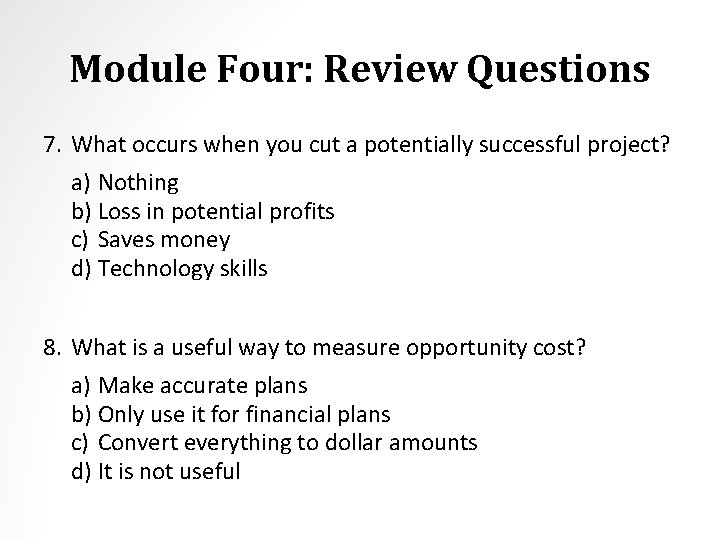
Module Four: Review Questions 7. What occurs when you cut a potentially successful project? a) Nothing b) Loss in potential profits c) Saves money d) Technology skills 8. What is a useful way to measure opportunity cost? a) Make accurate plans b) Only use it for financial plans c) Convert everything to dollar amounts d) It is not useful
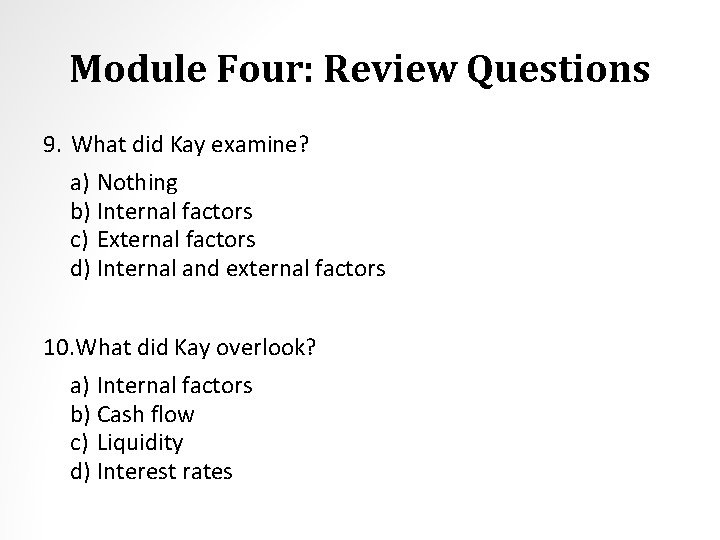
Module Four: Review Questions 9. What did Kay examine? a) Nothing b) Internal factors c) External factors d) Internal and external factors 10. What did Kay overlook? a) Internal factors b) Cash flow c) Liquidity d) Interest rates
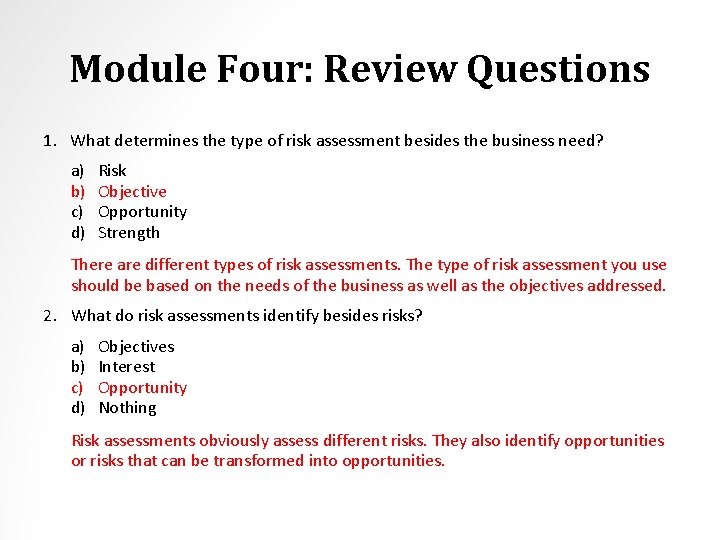
Module Four: Review Questions 1. What determines the type of risk assessment besides the business need? a) b) c) d) Risk Objective Opportunity Strength There are different types of risk assessments. The type of risk assessment you use should be based on the needs of the business as well as the objectives addressed. 2. What do risk assessments identify besides risks? a) b) c) d) Objectives Interest Opportunity Nothing Risk assessments obviously assess different risks. They also identify opportunities or risks that can be transformed into opportunities.
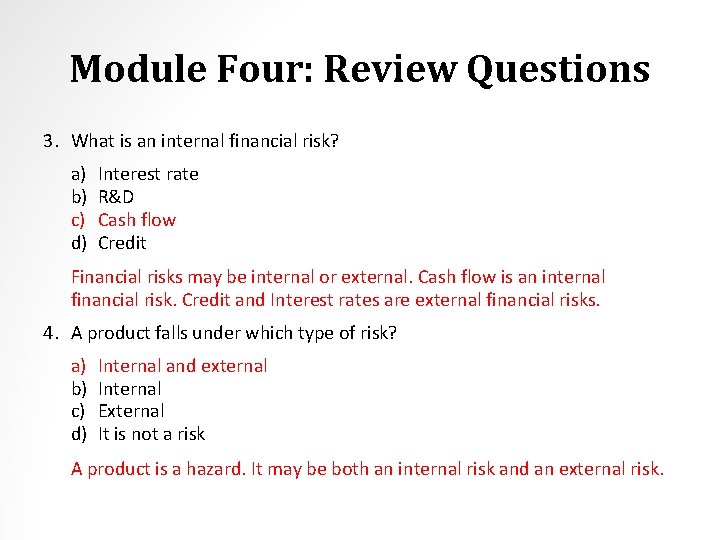
Module Four: Review Questions 3. What is an internal financial risk? a) b) c) d) Interest rate R&D Cash flow Credit Financial risks may be internal or external. Cash flow is an internal financial risk. Credit and Interest rates are external financial risks. 4. A product falls under which type of risk? a) b) c) d) Internal and external Internal External It is not a risk A product is a hazard. It may be both an internal risk and an external risk.
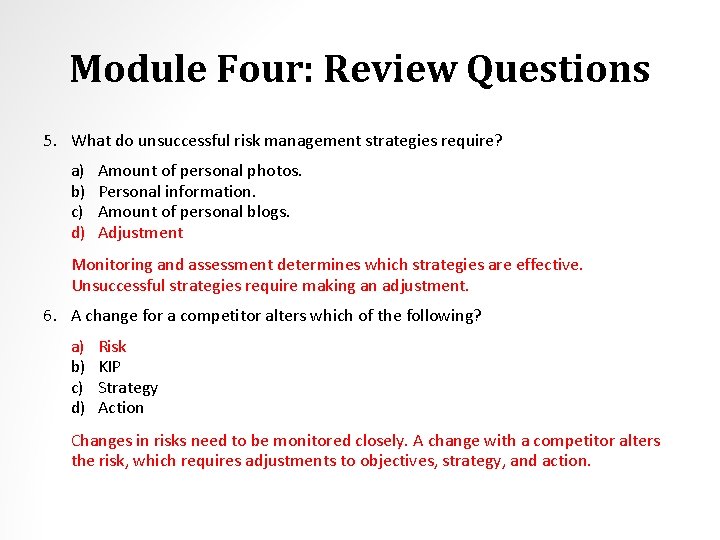
Module Four: Review Questions 5. What do unsuccessful risk management strategies require? a) b) c) d) Amount of personal photos. Personal information. Amount of personal blogs. Adjustment Monitoring and assessment determines which strategies are effective. Unsuccessful strategies require making an adjustment. 6. A change for a competitor alters which of the following? a) b) c) d) Risk KIP Strategy Action Changes in risks need to be monitored closely. A change with a competitor alters the risk, which requires adjustments to objectives, strategy, and action.
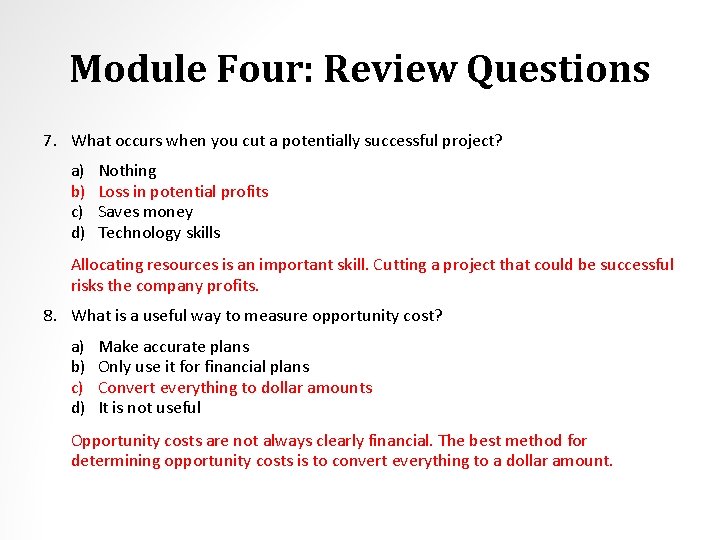
Module Four: Review Questions 7. What occurs when you cut a potentially successful project? a) b) c) d) Nothing Loss in potential profits Saves money Technology skills Allocating resources is an important skill. Cutting a project that could be successful risks the company profits. 8. What is a useful way to measure opportunity cost? a) b) c) d) Make accurate plans Only use it for financial plans Convert everything to dollar amounts It is not useful Opportunity costs are not always clearly financial. The best method for determining opportunity costs is to convert everything to a dollar amount.
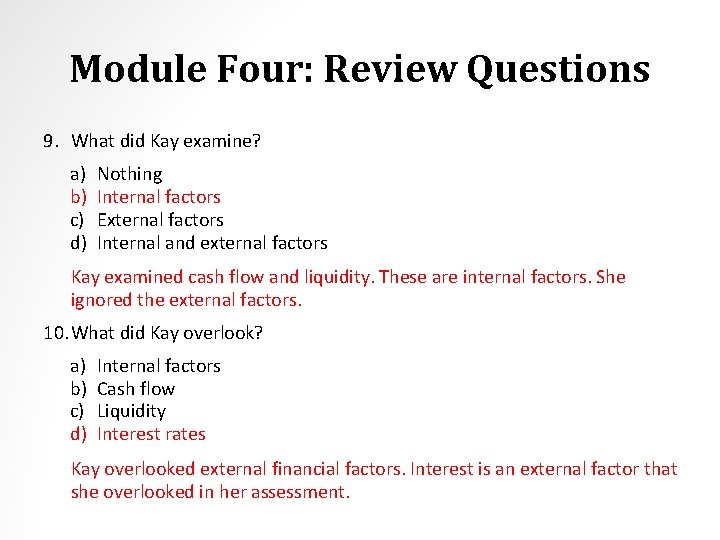
Module Four: Review Questions 9. What did Kay examine? a) b) c) d) Nothing Internal factors External factors Internal and external factors Kay examined cash flow and liquidity. These are internal factors. She ignored the external factors. 10. What did Kay overlook? a) b) c) d) Internal factors Cash flow Liquidity Interest rates Kay overlooked external financial factors. Interest is an external factor that she overlooked in her assessment.
Module Five: Recognizing Learning Events Live as if you were to die tomorrow. Learn as if you were to live forever. Ev so ac ev op alw kn fro de Mahatma Gandhi Accelerated Instructional Media, Inc.
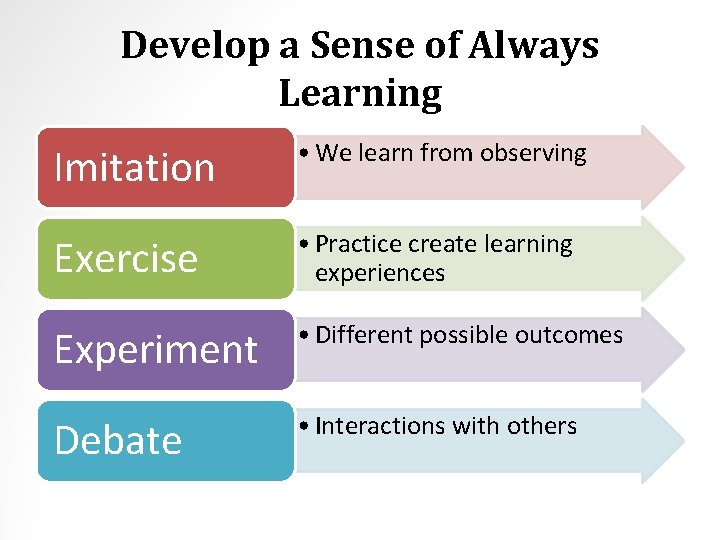
Develop a Sense of Always Learning Imitation • We learn from observing Exercise • Practice create learning experiences Experiment • Different possible outcomes Debate • Interactions with others
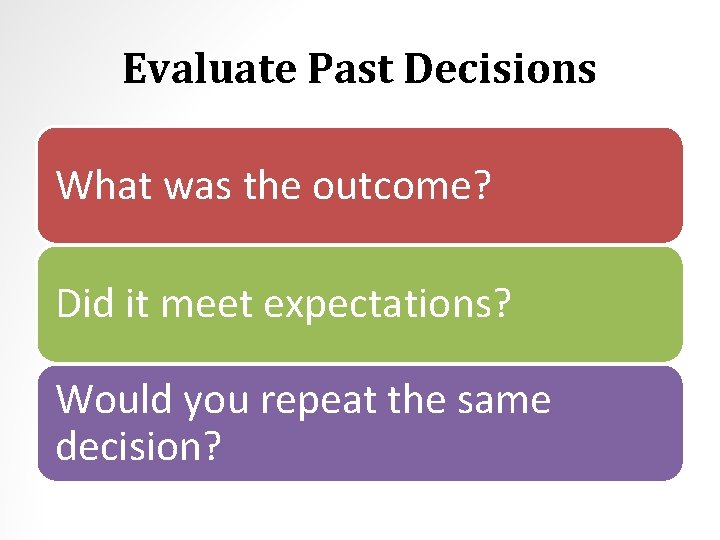
Evaluate Past Decisions What was the outcome? Did it meet expectations? Would you repeat the same decision?
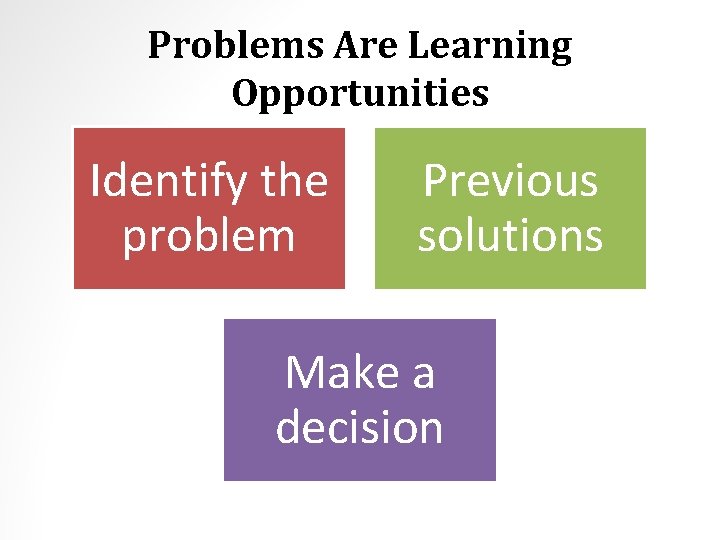
Problems Are Learning Opportunities Identify the problem Previous solutions Make a decision
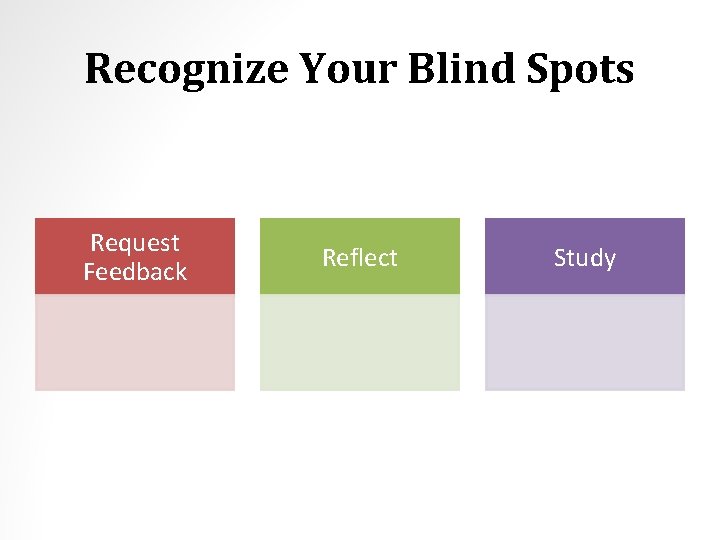
Recognize Your Blind Spots Request Feedback Reflect Study
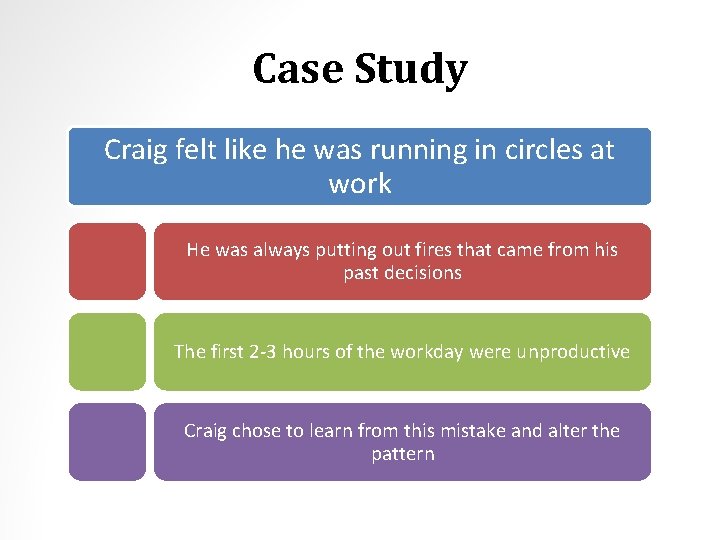
Case Study Craig felt like he was running in circles at work He was always putting out fires that came from his past decisions The first 2 -3 hours of the workday were unproductive Craig chose to learn from this mistake and alter the pattern
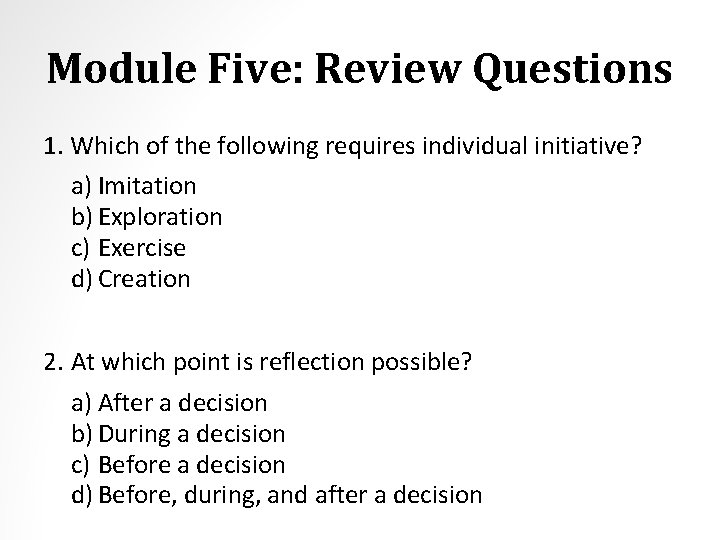
Module Five: Review Questions 1. Which of the following requires individual initiative? a) Imitation b) Exploration c) Exercise d) Creation 2. At which point is reflection possible? a) After a decision b) During a decision c) Before a decision d) Before, during, and after a decision
Module Five: Review Questions 3. What should you do after each decision? a) Crunch numbers b) Determine if it is successful c) Ask questions d) Brainstorm 4. Which decisions do you need to evaluate? a) Successful and unsuccessful b) Successful c) Unsuccessful d) None
Module Five: Review Questions 5. What must you do to identify opportunities and solutions? a) Solve the problem b) Embrace mistakes c) Consider options d) Identify problem 6. What occurs when you make a mistake addressing a problem? a) You learn what to avoid b) You learn what is successful c) You create a new problem d) Nothing
Module Five: Review Questions 7. What is necessary for recognizing blind spots? a) Data b) Honesty c) Creativity d) Learning 8. What is not an example of a blind spot? a) Fears b) Annoying habits c) Persistence d) Judgmental attitudes
Module Five: Review Questions 9. How many hours a day did Craig spend putting out fires? a) 1 -2 b) 2 -3 c) 3 -4 d) 2 -4 10. What mistake did Craig keep making? a) Lack of interest b) Lack of funding c) Over confidence d) Lack of communication
Module Five: Review Questions 1. Which of the following requires individual initiative? a) b) c) d) Imitation Exploration Exercise Creation All of the answers are different ways that we learn. Exploration is discovery. It requires individual initiative. 2. At which point is reflection possible? a) b) c) d) After a decision During a decision Before, during, and after a decision Reflection is an opportunity for learning. It can take place, before during, and after a decision or action.
Module Five: Review Questions 3. What should you do after each decision? a) b) c) d) Crunch numbers Determine if it is successful Ask questions Brainstorm You need to evaluate each decision. This requires you to ask a few questions about the decision. 4. Which decisions do you need to evaluate? a) b) c) d) Successful and unsuccessful Successful Unsuccessful None All decisions provide learning opportunities. You need to evaluate your successful decisions as well as your unsuccessful decisions, which allow you to learn from your mistakes and victories.
Module Five: Review Questions 5. What must you do to identify opportunities and solutions? a) b) c) d) Solve the problem Embrace mistakes Consider options Identify problem You need to identify learning opportunities and solutions. However, this first requires identifying the problem. 6. What occurs when you make a mistake addressing a problem? a) b) c) d) You learn what to avoid You learn what is successful You create a new problem Nothing Mistakes will be made when addressing problems. These mistakes, however, teach you what actions to avoid in the future.
Module Five: Review Questions 7. What is necessary for recognizing blind spots? a) b) c) d) Data Honesty Creativity Learning Blind spots are hidden from us. In order to identify them, we need to be honest with ourselves and accept honesty from others. 8. What is not an example of a blind spot? a) b) c) d) Fears Annoying habits Persistence Judgmental attitudes Blind spots are hidden aspects of personality that can have negative consequences. Persistence is not a blind spot, but the other answers are.
Module Five: Review Questions 9. How many hours a day did Craig spend putting out fires? a) b) c) d) 1 -2 2 -3 3 -4 2 -4 Craig spent the first few hours of each day handling problems. They averaged to 2 -3 hours each morning. 10. What mistake did Craig keep making? a) b) c) d) Lack of interest Lack of funding Over confidence Lack of communication Craig finally examined his past decisions and actions. He discovered a lack of communication lead to repeated mistakes.
Module Six: You Need to Know These Answers and More Running a business is a complex enterprise. In order to look at the big picture in your business, you need to know the answers to some basic financial questions. It is not enough for your accountant to know this information. Business acumen requires you to be aware of these answers so that you will be able to guide your company to success. Without knowledge action is useless and knowledge without action is futile. Abu Bakr
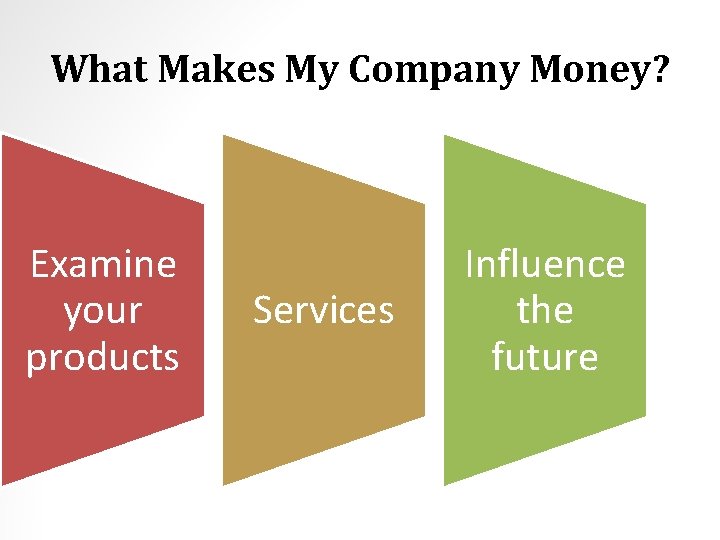
What Makes My Company Money? Examine your products Services Influence the future
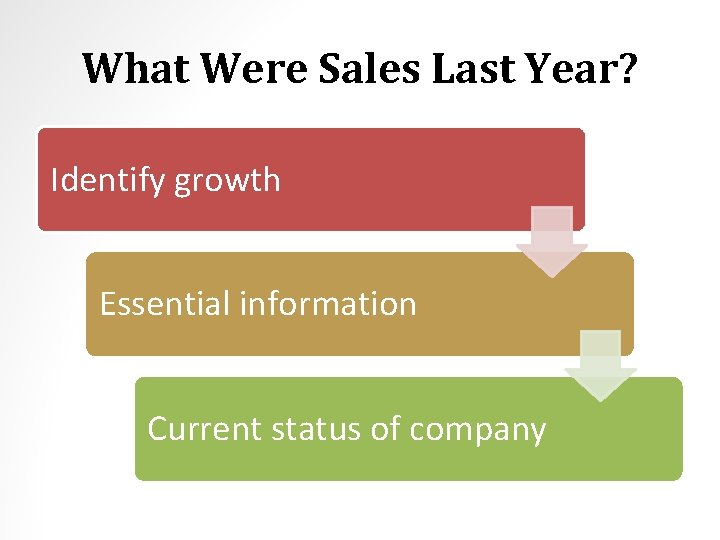
What Were Sales Last Year? Identify growth Essential information Current status of company
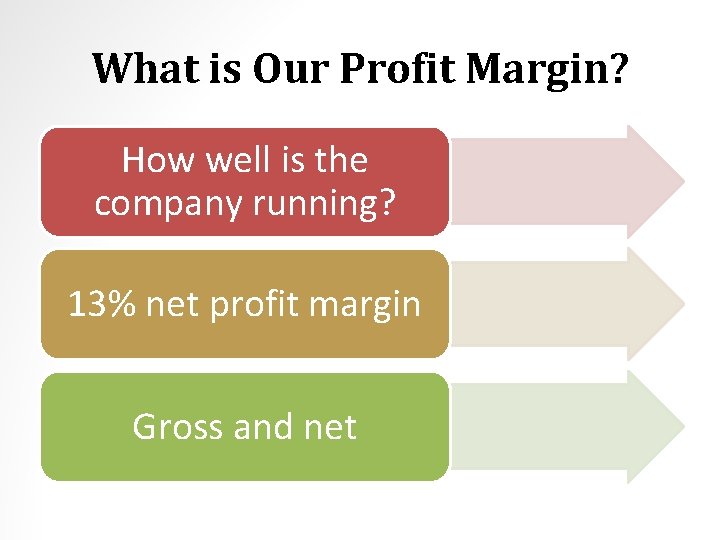
What is Our Profit Margin? How well is the company running? 13% net profit margin Gross and net
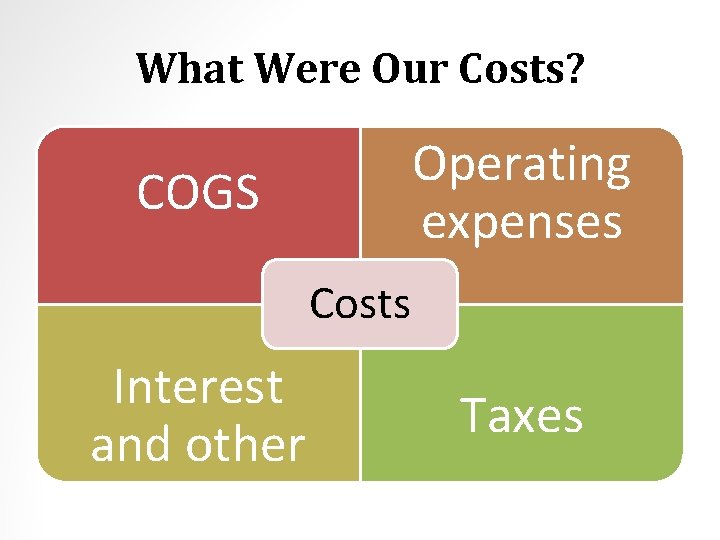
What Were Our Costs? Operating expenses COGS Costs Interest and other Taxes
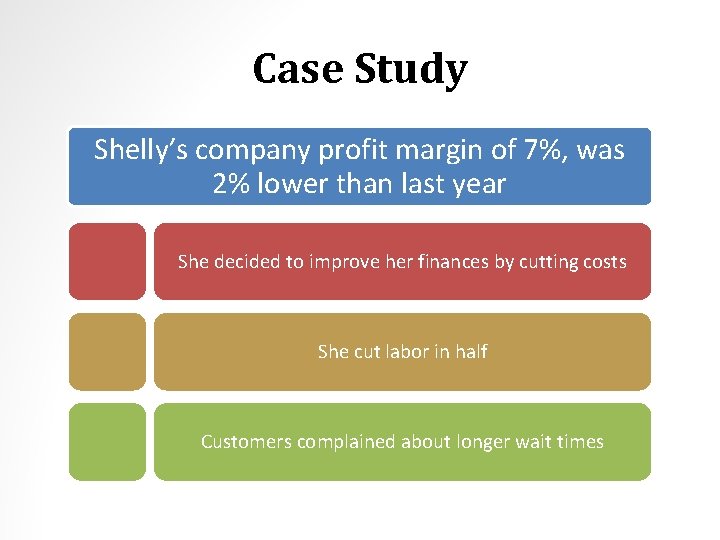
Case Study Shelly’s company profit margin of 7%, was 2% lower than last year She decided to improve her finances by cutting costs She cut labor in half Customers complained about longer wait times
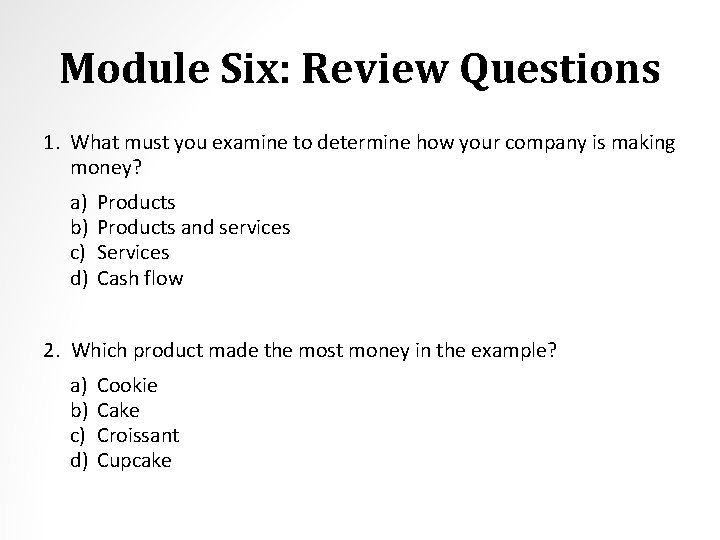
Module Six: Review Questions 1. What must you examine to determine how your company is making money? a) b) c) d) Products and services Services Cash flow 2. Which product made the most money in the example? a) b) c) d) Cookie Cake Croissant Cupcake
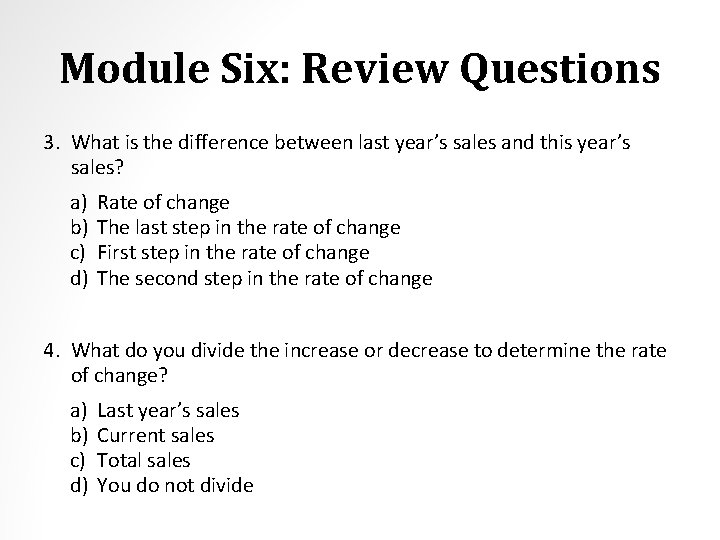
Module Six: Review Questions 3. What is the difference between last year’s sales and this year’s sales? a) b) c) d) Rate of change The last step in the rate of change First step in the rate of change The second step in the rate of change 4. What do you divide the increase or decrease to determine the rate of change? a) b) c) d) Last year’s sales Current sales Total sales You do not divide
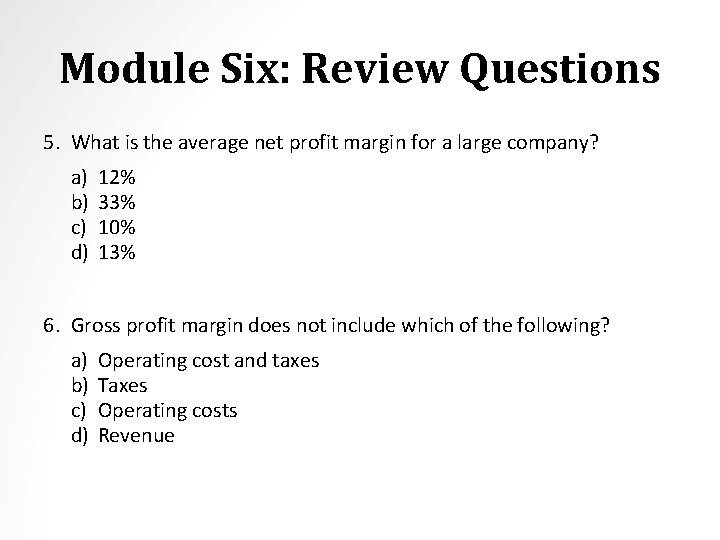
Module Six: Review Questions 5. What is the average net profit margin for a large company? a) b) c) d) 12% 33% 10% 13% 6. Gross profit margin does not include which of the following? a) b) c) d) Operating cost and taxes Taxes Operating costs Revenue
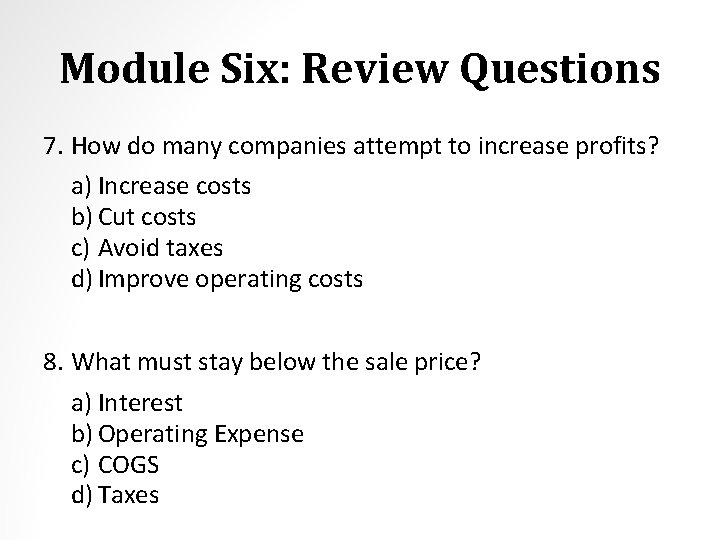
Module Six: Review Questions 7. How do many companies attempt to increase profits? a) Increase costs b) Cut costs c) Avoid taxes d) Improve operating costs 8. What must stay below the sale price? a) Interest b) Operating Expense c) COGS d) Taxes
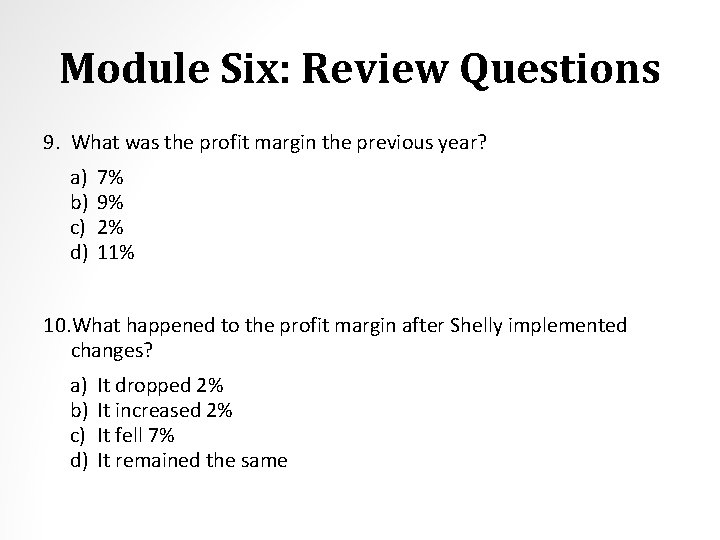
Module Six: Review Questions 9. What was the profit margin the previous year? a) b) c) d) 7% 9% 2% 11% 10. What happened to the profit margin after Shelly implemented changes? a) b) c) d) It dropped 2% It increased 2% It fell 7% It remained the same
Module Six: Review Questions 1. What must you examine to determine how your company is making money? a) b) c) d) Products and services Services Cash flow You make money by selling your products and services. They need to be examined to determine which ones are making money. 2. Which product made the most money in the example? a) b) c) d) Cookie Cake Croissant Cupcake The croissants make up 80% of the bakery’s sales. This product makes the company the most money.
Module Six: Review Questions 3. What is the difference between last year’s sales and this year’s sales? a) b) c) d) Rate of change The last step in the rate of change First step in the rate of change The second step in the rate of change You need to compare sales for two years in the rate of change. The first step is to determine the difference between the sales. 4. What do you divide the increase or decrease to determine the rate of change? a) b) c) d) Last year’s sales Current sales Total sales You do not divide The rate is determined using last year’s sales. This is what you divide into the increase or decrease.
Module Six: Review Questions 5. What is the average net profit margin for a large company? a) b) c) d) 12% 33% 10% 13% Profit margin shows you how well the business is running. The average net profit margin for a large organization is 13%. 6. Gross profit margin does not include which of the following? a) b) c) d) Operating cost and taxes Taxes Operating costs Revenue You can determine gross and net profit margins. Gross profit margins to not include operating costs and taxes when establishing the amount of profit.
Module Six: Review Questions 7. How do many companies attempt to increase profits? a) b) c) d) Increase costs Cut costs Avoid taxes Improve operating costs Many companies cut costs to improve profits. This strategy, however, will backfire when customers are affected by the cuts. 8. What must stay below the sale price? a) b) c) d) Interest Operating Expense COGS Taxes Costs of goods sold must stay below the sale price. Going above the sale price will affect profits.
Module Six: Review Questions 9. What was the profit margin the previous year? a) b) c) d) 7% 9% 2% 11% The profit margin was down 2%. It is 7%, making the previous profit margin 7%. 10. What happened to the profit margin after Shelly implemented changes? a) b) c) d) It dropped 2% It increased 2% It fell 7% It remained the same Shelly’s decision decreased vendor costs, but increased hiring costs. The profit margin remained unchanged.
Module Seven: Financial Literacy (I) Financial literacy is essential to business acumen. In order to see the big picture, you have to understand every aspect of the company’s finances. Fortunately, anyone can improve financial literacy with some basic instruction and practice. This module and the next will provide you with information to improve your understanding of financial literacy. To succeed, you will soon learn, as I did, the importance of a solid foundation in the basics of education – literacy both verbal and numerical, and communication skills. Alan Greenspan
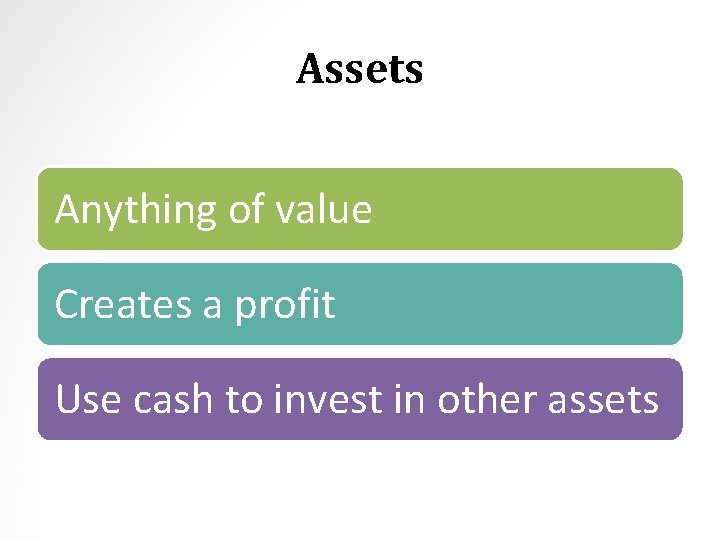
Assets Anything of value Creates a profit Use cash to invest in other assets
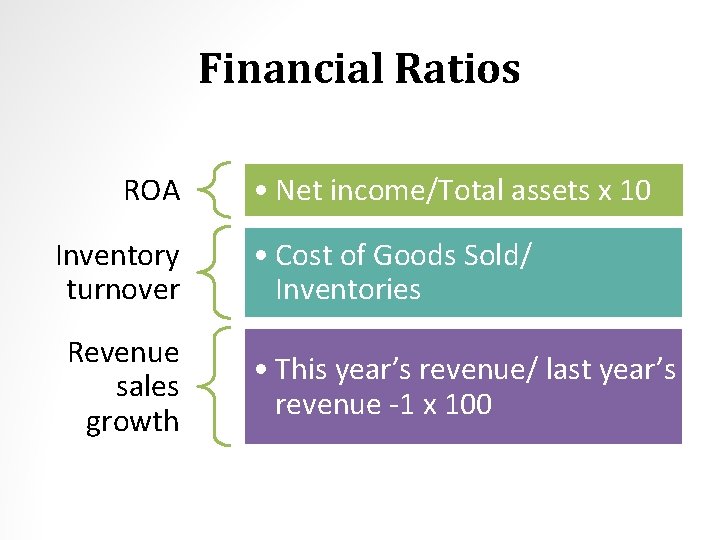
Financial Ratios ROA Inventory turnover Revenue sales growth • Net income/Total assets x 10 • Cost of Goods Sold/ Inventories • This year’s revenue/ last year’s revenue -1 x 100
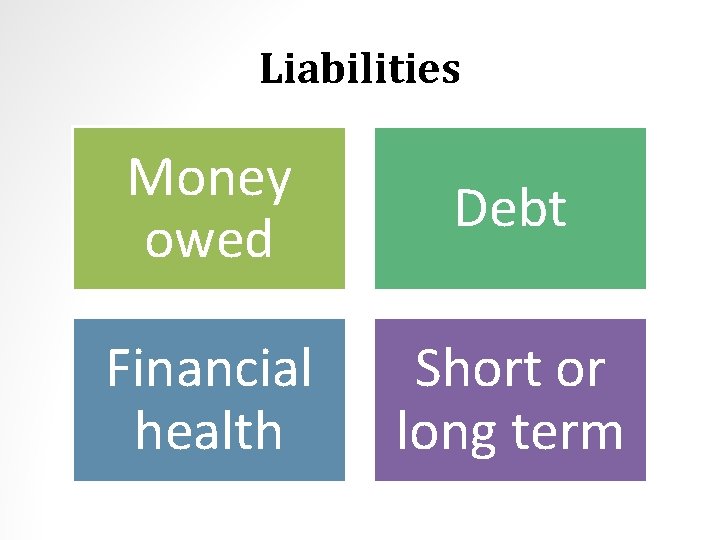
Liabilities Money owed Debt Financial health Short or long term
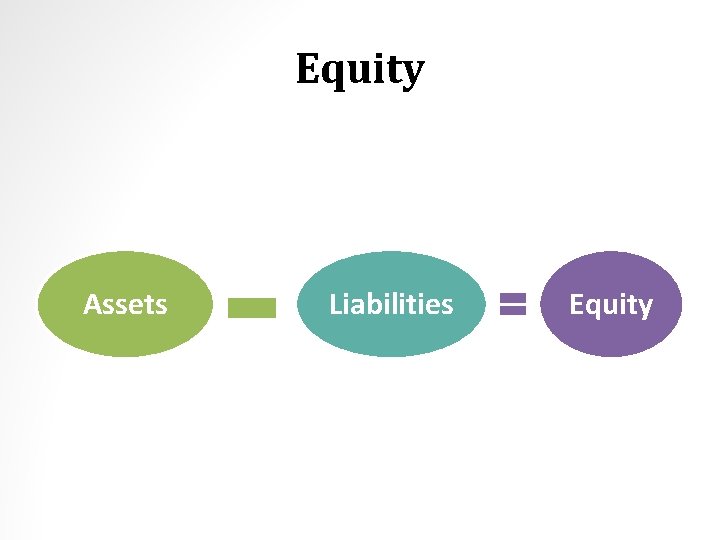
Equity Assets Liabilities Equity
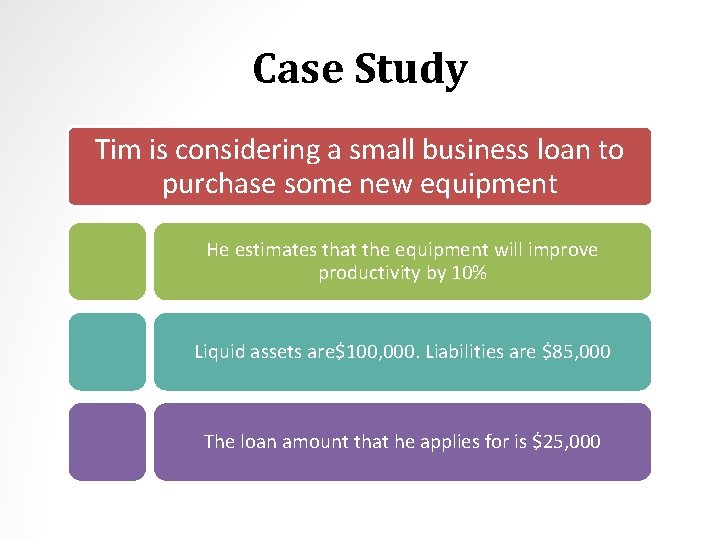
Case Study Tim is considering a small business loan to purchase some new equipment He estimates that the equipment will improve productivity by 10% Liquid assets are$100, 000. Liabilities are $85, 000 The loan amount that he applies for is $25, 000
Module Seven: Review Questions 1. What do assets determine? a) b) c) d) Profits Company strength Interest Cash flow 2. What is the most important asset a company has besides customers? a) b) c) d) Cash Buildings Employees Machinery
Module Seven: Review Questions 3. Where do you find the information to create financial ratios? a) b) c) d) Balance statement Interest earnings Financial statement Income statement 4. Besides the inventory, what is necessary for an inventory ratio? a) b) c) d) Cost of goods sold Total revenue Net income Total assets
Module Seven: Review Questions 5. What indicates that the company is in trouble? a) Nothing b) Assets are greater than liabilities c) There are no liabilities. d) Liabilities are greater than assets 6. What will be paid within a year? a) Short term liabilities b) Assets c) Long term liabilities d) Equity
Module Seven: Review Questions 7. Which action will increase equity? a) Remove stock options b) Issue stock c) Increase inventory d) Stop marketing 8. What is used to determine equity besides liabilities? a) Ratios b) Liquidity c) Assets d) Income
Module Seven: Review Questions 9. What are Tim’s assets? a) $25, 000 b) $100, 000 c) $85, 000 d) $15, 000 10. What is Tim’s equity? a) $25, 000 b) $100, 000 c) $85, 000 d) $15, 000
Module Seven: Review Questions 1. What do assets determine? a) b) c) d) Profits Company strength Interest Cash flow Company strength is determined by its assets. Liquid assets prepare the company for times of trouble. Utilized assets increase productivity. 2. What is the most important asset a company has besides customers? a) b) c) d) Cash Buildings Employees Machinery Not every asset appears on the balance sheet. Employees and customers are considered to be the greatest assets a company can have.
Module Seven: Review Questions 3. Where do you find the information to create financial ratios? a) b) c) d) Balance statement Interest earnings Financial statement Income statement Financial statements include the different elements of finance. The information on a financial statement is used to create financial ratios. 4. Besides the inventory, what is necessary for an inventory ratio? a) b) c) d) Cost of goods sold Total revenue Net income Total assets All of the answers are found on the financial statement. The cost of goods sold is necessary for an inventory ratio.
Module Seven: Review Questions 5. What indicates that the company is in trouble? a) b) c) d) Nothing Assets are greater than liabilities There are no liabilities. Liabilities are greater than assets Liabilities and assets work together to determine the health of an organization. When liabilities are greater, the company has too much debt. 6. What will be paid within a year? a) b) c) d) Short term liabilities Assets Long term liabilities Equity Liabilities are financial debts. Short term liabilities are typically paid within a year.
Module Seven: Review Questions 7. Which action will increase equity? a) b) c) d) Remove stock options Issue stock Increase inventory Stop marketing Stocks and equity are tied together. Issuing stocks will actually increase equity in the company. 8. What is used to determine equity besides liabilities? a) b) c) d) Ratios Liquidity Assets Income Assets and liabilities are used to determine equity. Equity = Assets – liabilities.
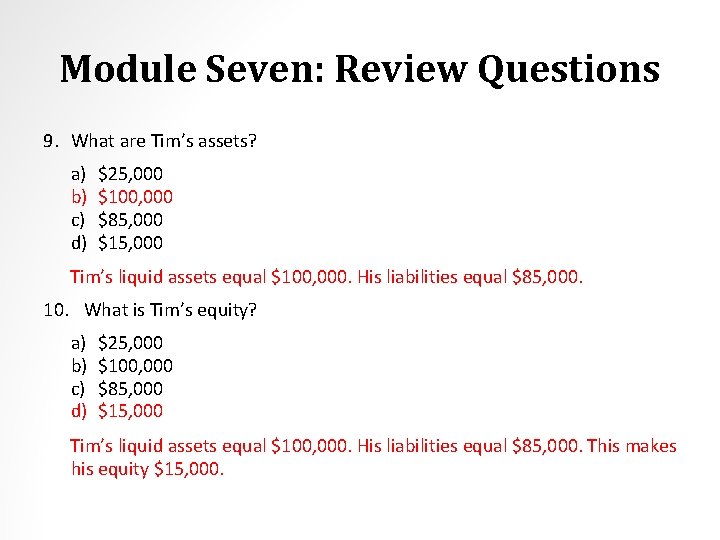
Module Seven: Review Questions 9. What are Tim’s assets? a) b) c) d) $25, 000 $100, 000 $85, 000 $15, 000 Tim’s liquid assets equal $100, 000. His liabilities equal $85, 000. 10. What is Tim’s equity? a) b) c) d) $25, 000 $100, 000 $85, 000 $15, 000 Tim’s liquid assets equal $100, 000. His liabilities equal $85, 000. This makes his equity $15, 000.
Module Eight: Financial Literacy (II) Financial literacy requires you to read and understand different reports such as the income statement, balance sheet, and cash flow statement. These internal reports along with external information that you gather, will help you lead a financially stable business. Knowledge is the fundamental factor – the major enabler – of enterprise performance. Karl M. Wiig
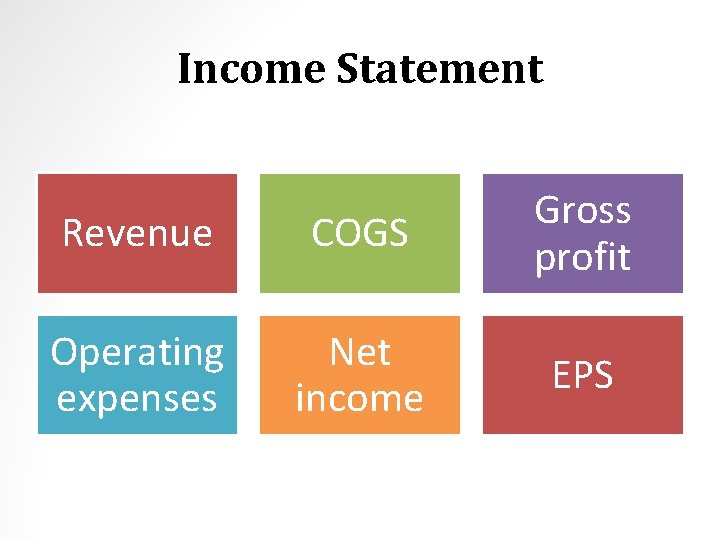
Income Statement Revenue COGS Gross profit Operating expenses Net income EPS
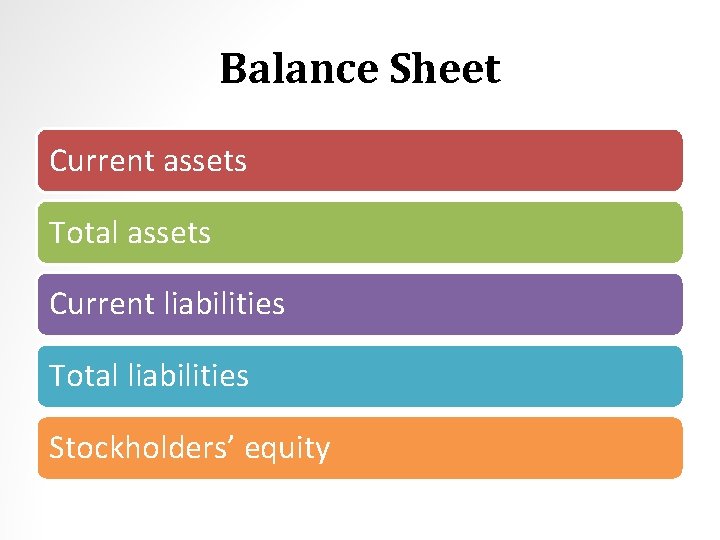
Balance Sheet Current assets Total assets Current liabilities Total liabilities Stockholders’ equity
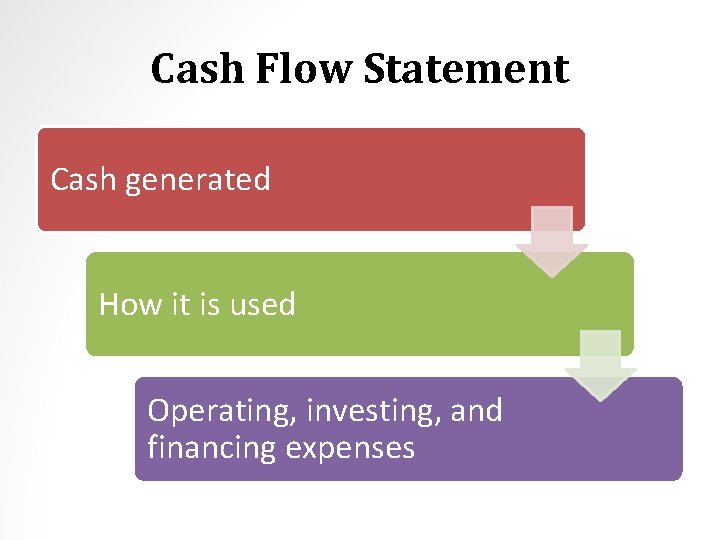
Cash Flow Statement Cash generated How it is used Operating, investing, and financing expenses
Read, and Read Periodicals Trade publications Blogs
Case Study Brie prepared her balance sheet at the end of the quarter She had $10, 000 in equity and considered it healthy She did not compare it to previous statements Brie realized that her equity had been falling. It was currently $8, 500.
Module Eight: Review Questions 1. What is another name for an income statement? a) Balance sheet b) Profit and loss statement c) Cash flow statement d) There is no other name 2. How often do you typically update an income statement? a) Monthly b) Semi-annually c) Quarterly d) Weekly
Module Eight: Review Questions 3. What does a balance sheet determine? a) b) c) d) Profits Cash flow Financial health Loss 4. How many past balance sheet statements should be in a report? a) b) c) d) 2 0 1 3
Module Eight: Review Questions 5. How many past cash flow statements should appear with the current statement? a) b) c) d) 2 0 1 3 6. What begins the cash flow statement? a) b) c) d) Net income Gross income Cash equivalent Balance sheet
Module Eight: Review Questions 7. What is the benefit of trade publications? a) They are timeless b) They are current c) They are frequent d) They entertaining 8. What is the purpose of studying financial literacy? a) Understand income b) Determine profits and loss c) Integrate it into the financial strategy d) Understand cash flow
Module Eight: Review Questions 9. What was Brie’s equity at first? a) $2, 500 b) $10, 000 c) $1, 500 d) $8, 500 10. How many balance sheets showed a trend? a) 1 b) 4 c) 2 d) 3
Module Eight: Review Questions 1. What is another name for an income statement? a) b) c) d) Balance sheet Profit and loss statement Cash flow statement There is no other name Income statements show income over a time period. It is also referred to as a profit and loss statement. 2. How often do you typically update an income statement? a) b) c) d) Monthly Semi-annually Quarterly Weekly Income statements are typically updated quarterly. They may be updated yearly for smaller organizations.
Module Eight: Review Questions 3. What does a balance sheet determine? a) b) c) d) Profits Cash flow Financial health Loss A balance sheet shows the financial health of an organization. It includes the assets, liabilities, and equity. 4. How many past balance sheet statements should be in a report? a) b) c) d) 2 0 1 3 A balance sheet needs to include to past statements. This will show the progression of the company.
Module Eight: Review Questions 5. How many past cash flow statements should appear with the current statement? a) b) c) d) 2 0 1 3 Cash flow statements should include past statements. They need to require 3 past statements. 6. What begins the cash flow statement? a) b) c) d) Net income Gross income Cash equivalent Balance sheet Cash flow statements begin with the net income from an income statement. They end with the cash equivalent.
Module Eight: Review Questions 7. What is the benefit of trade publications? a) b) c) d) They are timeless They are current They are frequent They entertaining Periodicals and trade publications are useful sources of information. They are typically current. 8. What is the purpose of studying financial literacy? a) b) c) d) Understand income Determine profits and loss Integrate it into the financial strategy Understand cash flow Financial literacy finds information. This is incorporated into the financial strategy.
Module Eight: Review Questions 9. What was Brie’s equity at first? a) b) c) d) $2, 500 $10, 000 $1, 500 $8, 500 When Brie prepared her balance sheet, she had equity of $10, 000. She believed it was healthy. 10. How many balance sheets showed a trend? a) b) c) d) 1 4 2 3 The accountant showed the current balance sheet along with the two previous. This is a total of three different statements.
Module Nine: Business Acumen in Management Business acumen requires careful cultivation of resources, specifically one of the most important resources, employees. Managing people is a complex process, but developing your management skills will help you become an effective manager who achieves significant results. Good managing consists of showing average people how to do the work of superior people. John D. Rockefeller
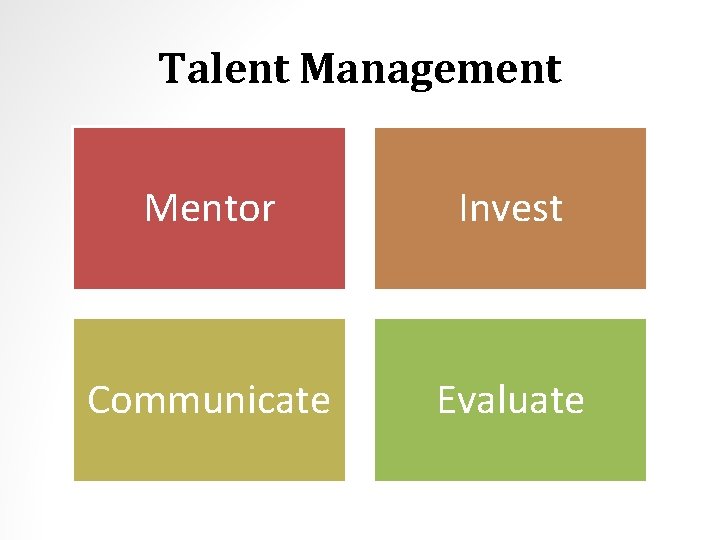
Talent Management Mentor Invest Communicate Evaluate
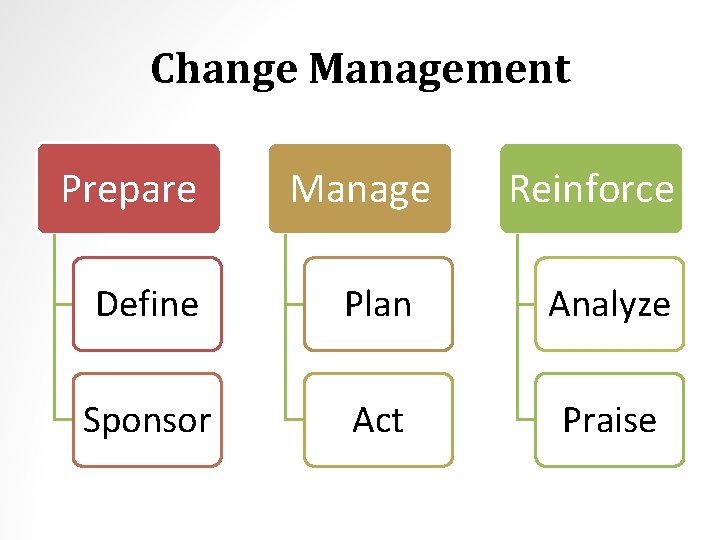
Change Management Prepare Manage Reinforce Define Plan Analyze Sponsor Act Praise
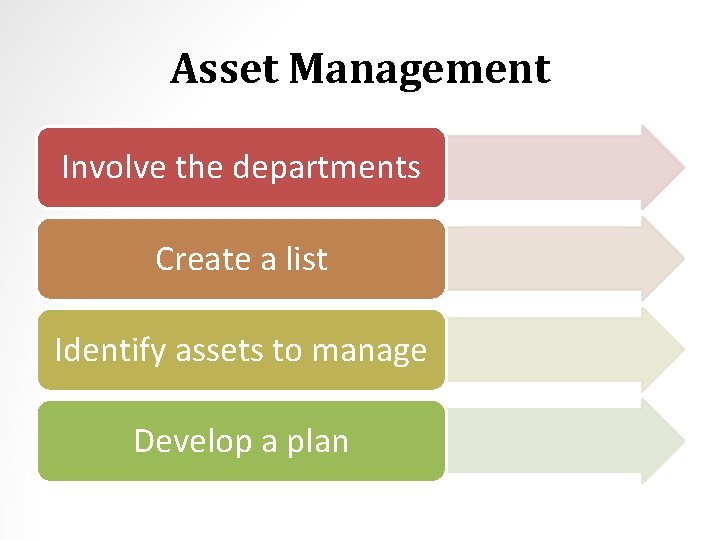
Asset Management Involve the departments Create a list Identify assets to manage Develop a plan
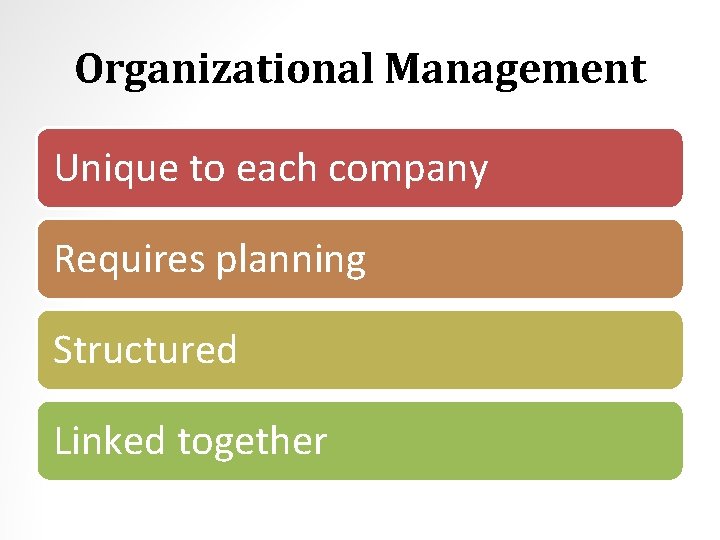
Organizational Management Unique to each company Requires planning Structured Linked together
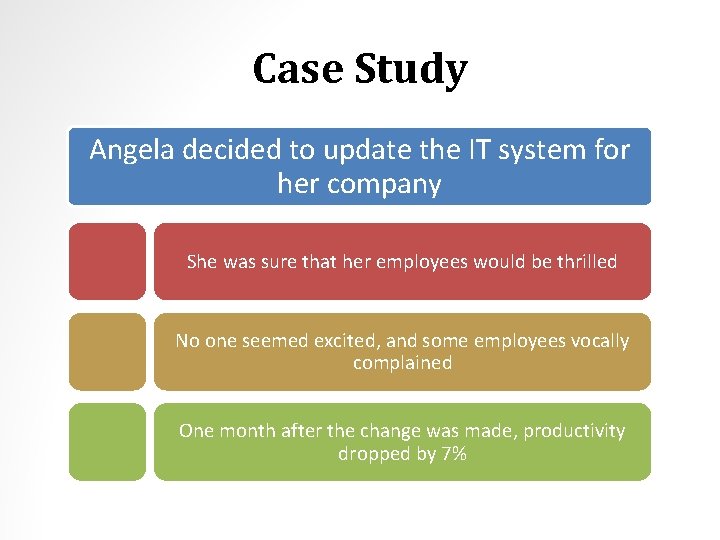
Case Study Angela decided to update the IT system for her company She was sure that her employees would be thrilled No one seemed excited, and some employees vocally complained One month after the change was made, productivity dropped by 7%
Module Nine: Review Questions 1. What does investing in employees accomplish? a) b) c) d) Nothing They feel valued They feel undervalued They leave quickly 2. What is the product of a successful talent management program? a) b) c) d) Improved culture Decreased productivity Increased hiring
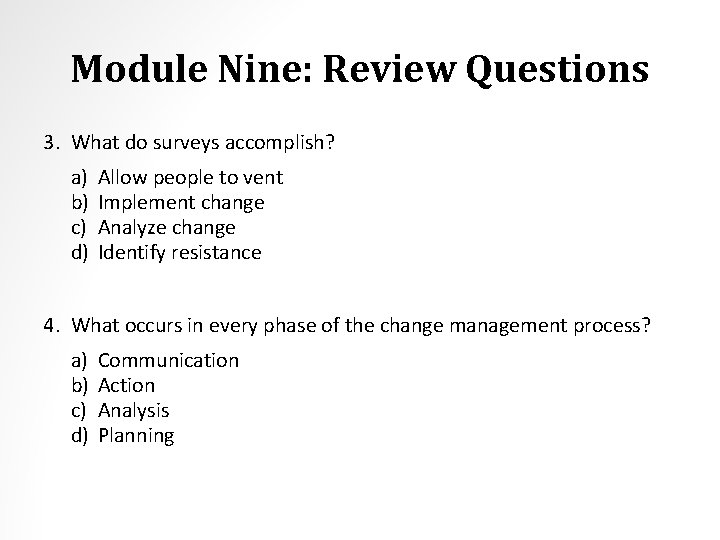
Module Nine: Review Questions 3. What do surveys accomplish? a) b) c) d) Allow people to vent Implement change Analyze change Identify resistance 4. What occurs in every phase of the change management process? a) b) c) d) Communication Action Analysis Planning
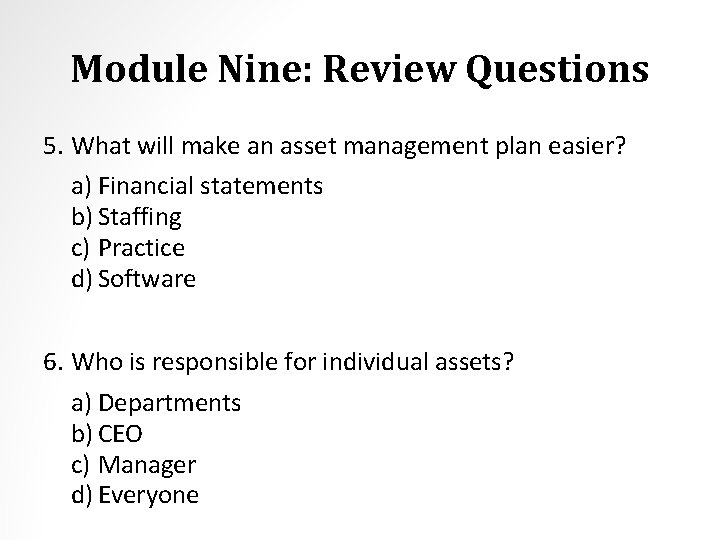
Module Nine: Review Questions 5. What will make an asset management plan easier? a) Financial statements b) Staffing c) Practice d) Software 6. Who is responsible for individual assets? a) Departments b) CEO c) Manager d) Everyone
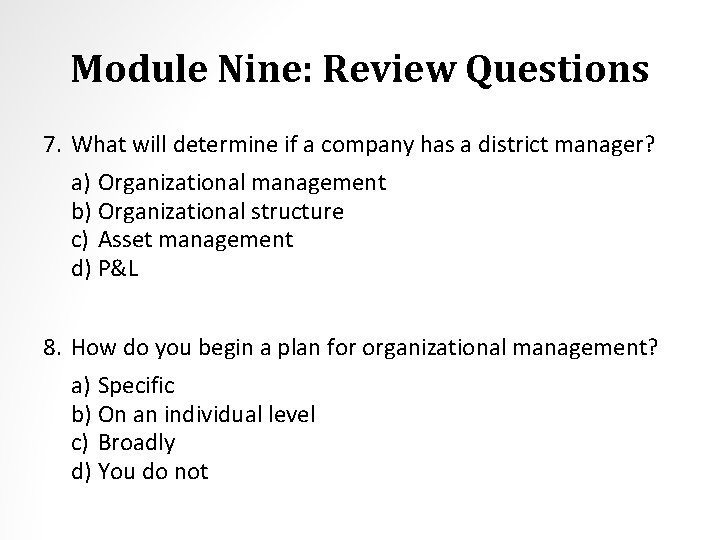
Module Nine: Review Questions 7. What will determine if a company has a district manager? a) Organizational management b) Organizational structure c) Asset management d) P&L 8. How do you begin a plan for organizational management? a) Specific b) On an individual level c) Broadly d) You do not
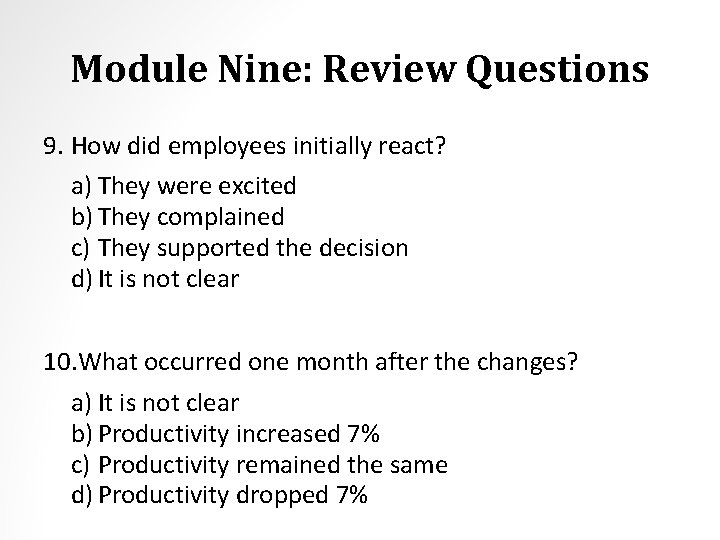
Module Nine: Review Questions 9. How did employees initially react? a) They were excited b) They complained c) They supported the decision d) It is not clear 10. What occurred one month after the changes? a) It is not clear b) Productivity increased 7% c) Productivity remained the same d) Productivity dropped 7%
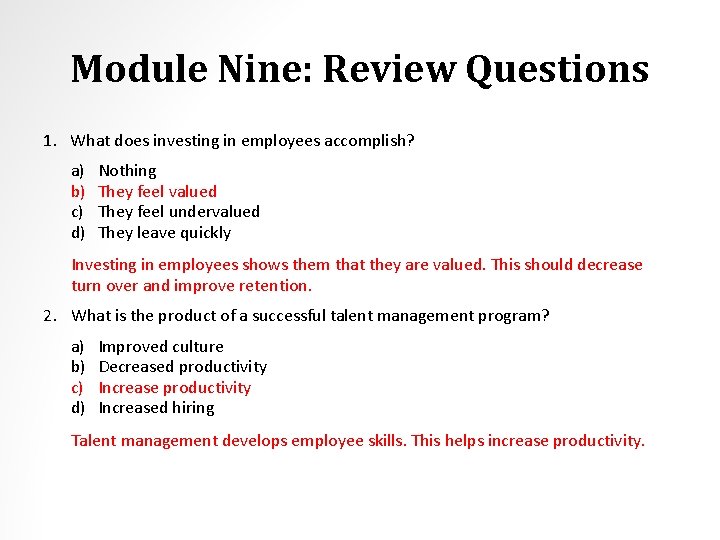
Module Nine: Review Questions 1. What does investing in employees accomplish? a) b) c) d) Nothing They feel valued They feel undervalued They leave quickly Investing in employees shows them that they are valued. This should decrease turn over and improve retention. 2. What is the product of a successful talent management program? a) b) c) d) Improved culture Decreased productivity Increased hiring Talent management develops employee skills. This helps increase productivity.
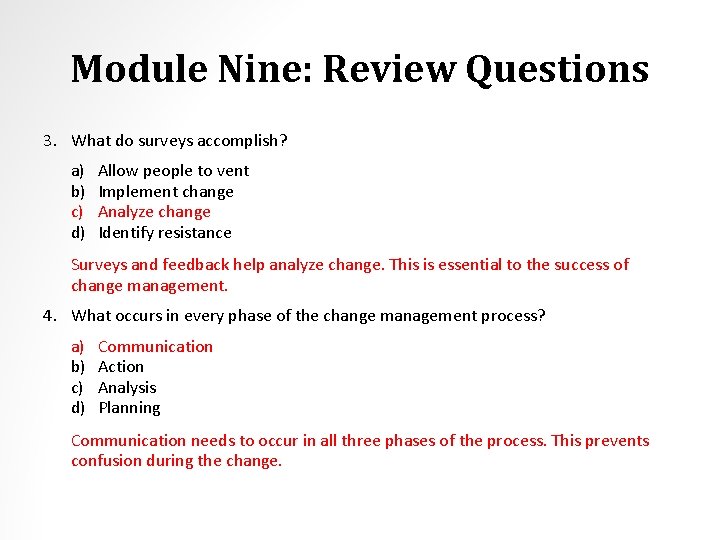
Module Nine: Review Questions 3. What do surveys accomplish? a) b) c) d) Allow people to vent Implement change Analyze change Identify resistance Surveys and feedback help analyze change. This is essential to the success of change management. 4. What occurs in every phase of the change management process? a) b) c) d) Communication Action Analysis Planning Communication needs to occur in all three phases of the process. This prevents confusion during the change.
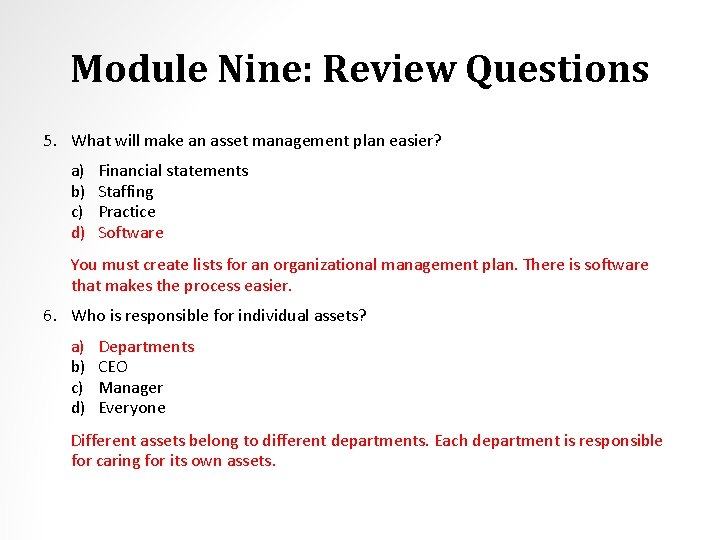
Module Nine: Review Questions 5. What will make an asset management plan easier? a) b) c) d) Financial statements Staffing Practice Software You must create lists for an organizational management plan. There is software that makes the process easier. 6. Who is responsible for individual assets? a) b) c) d) Departments CEO Manager Everyone Different assets belong to different departments. Each department is responsible for caring for its own assets.
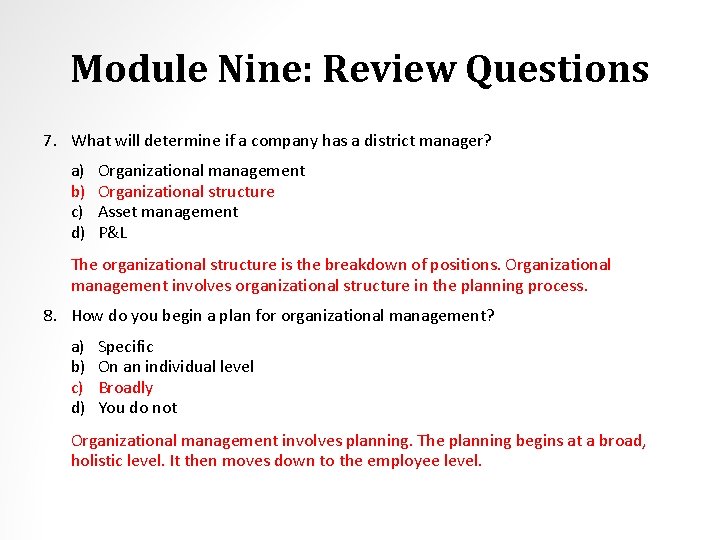
Module Nine: Review Questions 7. What will determine if a company has a district manager? a) b) c) d) Organizational management Organizational structure Asset management P&L The organizational structure is the breakdown of positions. Organizational management involves organizational structure in the planning process. 8. How do you begin a plan for organizational management? a) b) c) d) Specific On an individual level Broadly You do not Organizational management involves planning. The planning begins at a broad, holistic level. It then moves down to the employee level.
Module Nine: Review Questions 9. How did employees initially react? a) b) c) d) They were excited They complained They supported the decision It is not clear The employees did not react to the news well. The vocal employees complained about the change being implemented. 10. What occurred one month after the changes? a) b) c) d) It is not clear Productivity increased 7% Productivity remained the same Productivity dropped 7% Angela hoped the changes would increase productivity. A month after the change, productivity decreased by 7%.
Module Ten: Critical Thinking in Business In business, you are constantly bombarded with information. You rely on this information to make important decisions. Business acumen requires that you do more than absorb information. You need to think critically to about information and make your decisions accordingly. The essence of the independent mind lies not in what it thinks but how it thinks. Christopher Hitchens
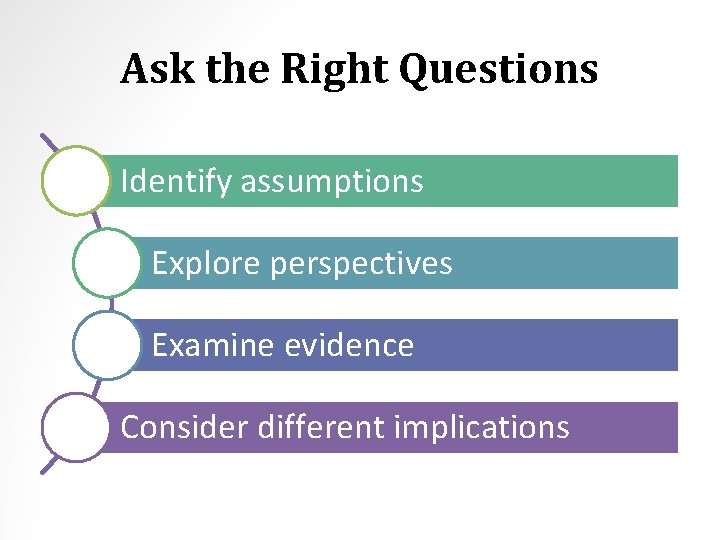
Ask the Right Questions Identify assumptions Explore perspectives Examine evidence Consider different implications
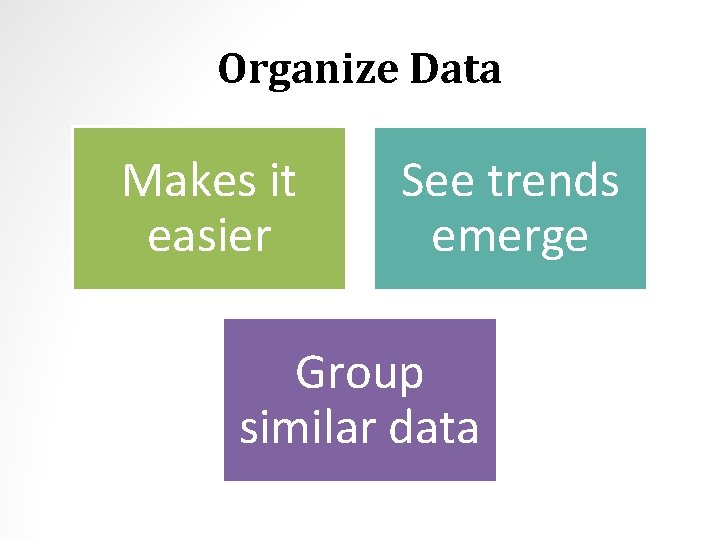
Organize Data Makes it easier See trends emerge Group similar data
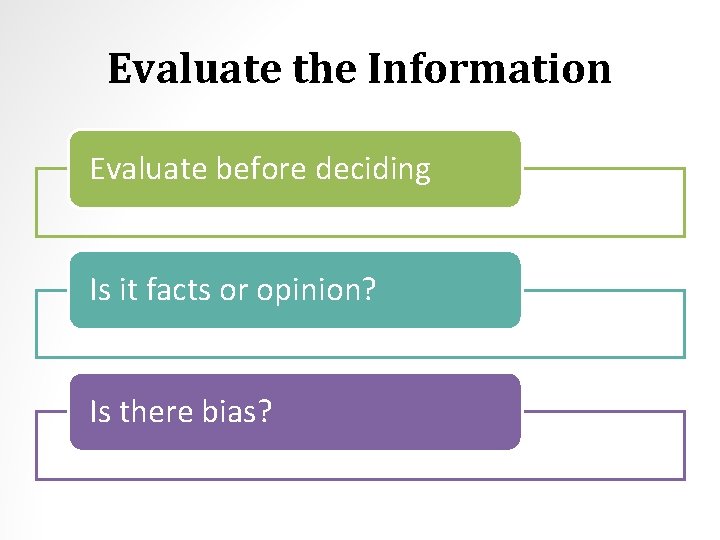
Evaluate the Information Evaluate before deciding Is it facts or opinion? Is there bias?
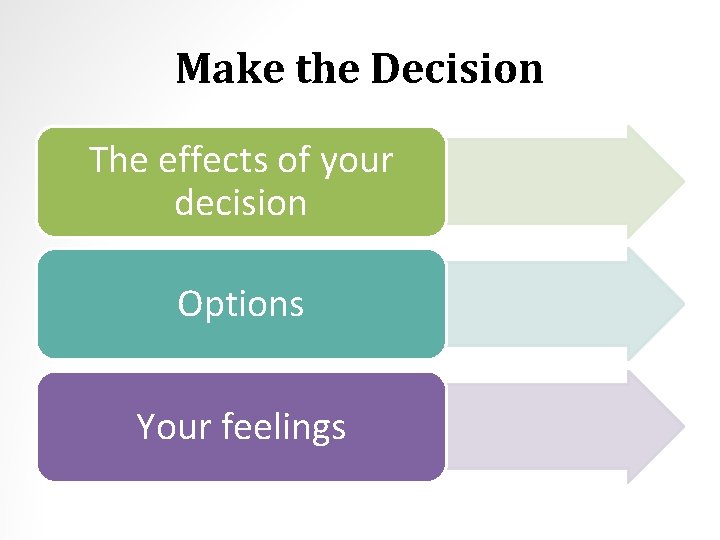
Make the Decision The effects of your decision Options Your feelings
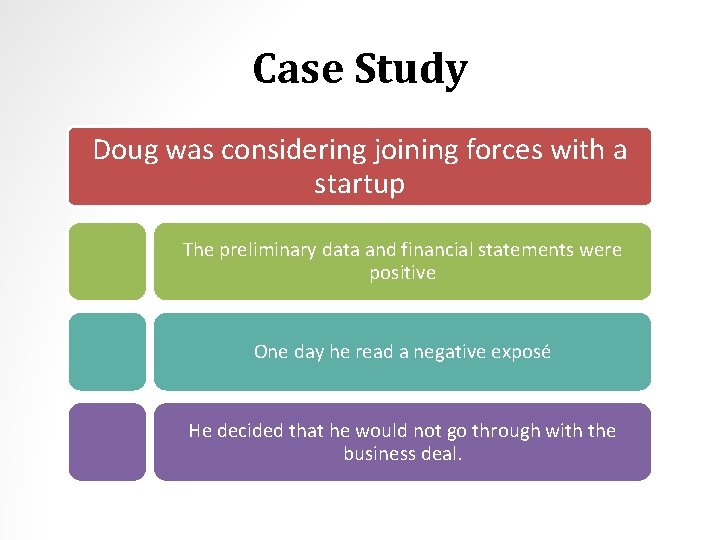
Case Study Doug was considering joining forces with a startup The preliminary data and financial statements were positive One day he read a negative exposé He decided that he would not go through with the business deal.
Module Ten: Review Questions 1. How often should you question information? a) Once b) Continually c) Daily d) Weekly 2. Why ask questions? a) Learn more information b) To be annoying c) Identify useful information d) Find new ideas
Module Ten: Review Questions 3. What will organizing data help you find? a) Information b) Decisions c) Trends d) Groups 4. What makes data analysis easier? a) Conclusion b) Data c) Trends d) Organization
Module Ten: Review Questions 5. What will the right questions identify? a) Interest b) Decisions c) Timing d) Opinions 6. You need to evaluate the information for signs of _______. a) Bias b) Opinion c) Interest d) Conclusions
Module Ten: Review Questions 7. What do you Not need to think about when considering the effect of your decision? a) b) c) d) Yourself Other companies Company Others 8. What do you need to consider after making a complete evaluation? a) b) c) d) Wait Reevaluate Act Nothing
Module Ten: Review Questions 9. Who is the source of the negative information? a) Doug b) Competitor c) Business partner d) Uncertain 10. What is a source or positive information? a) Business partner b) Competition c) Agreement d) Financial statement
Module Ten: Review Questions 1. How often should you question information? a) b) c) d) Once Continually Daily Weekly It is important to question all information. You must do so continually to think critically. 2. Why ask questions? a) b) c) d) Learn more information To be annoying Identify useful information Find new ideas Questions weed through information. They identify useful information from useless information.
Module Ten: Review Questions 3. What will organizing data help you find? a) b) c) d) Information Decisions Trends Groups Organization is part of data analysis. When data is organized, you identify trends, which help you reach conclusions. 4. What makes data analysis easier? a) b) c) d) Conclusion Data Trends Organization groups data together. This makes data analysis easier because trends are apparent.
Module Ten: Review Questions 5. What will the right questions identify? a) b) c) d) Interest Decisions Timing Opinions When evaluating information, you need to separate fact from opinion. The right questions will help identify opinions. 6. You need to evaluate the information for signs of _______. a) b) c) d) Bias Opinion Interest Conclusions Information and conclusions are at risk of bias. It is important to evaluate the information and conclusions for signs of bias.
Module Ten: Review Questions 7. What do you Not need to think about when considering the effect of your decision? a) b) c) d) Yourself Other companies Company Others You need to consider the effects of your decision. Consider how it will affect you, the company, and others. 8. What do you need to consider after making a complete evaluation? a) b) c) d) Wait Reevaluate Act Nothing Once you have evaluated everything necessary to make your decision, you need to act. You have already considered all the options; so do not wait.
Module Ten: Review Questions 9. Who is the source of the negative information? a) b) c) d) Doug Competitor Business partner Uncertain The negative information came from a competitor. Doug did not evaluate it. 10. What is a source or positive information? a) b) c) d) Business partner Competition Agreement Financial statement The financial statement encouraged Doug. It is not clear if he evaluated the statement.
Module Eleven: Key Financial Levers There are key financial levers that drive any business. These financial levers may be overlooked, but you do so to the detriment of the business. Identifying the levers is the first step to addressing them correctly. Once you understand these key levers, you will increase your business acumen. Many small businesses would rather face an angry barbarian horde than tackle their cash flow statement or price a new product. Nicole Fende
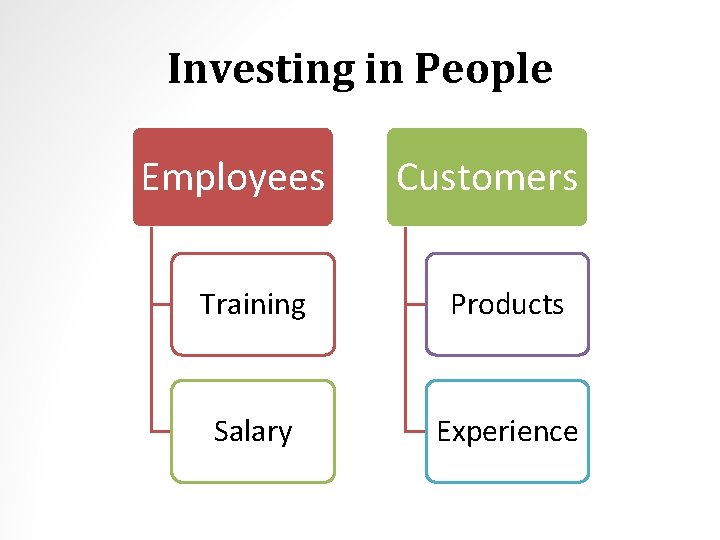
Investing in People Employees Customers Training Products Salary Experience
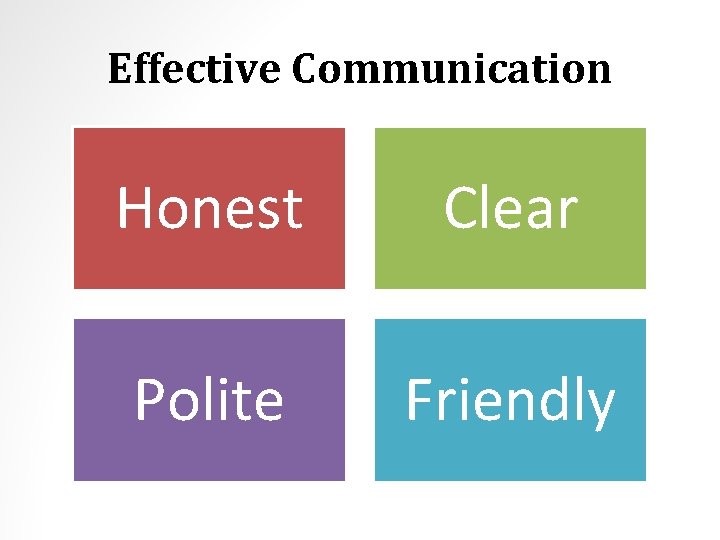
Effective Communication Honest Clear Polite Friendly
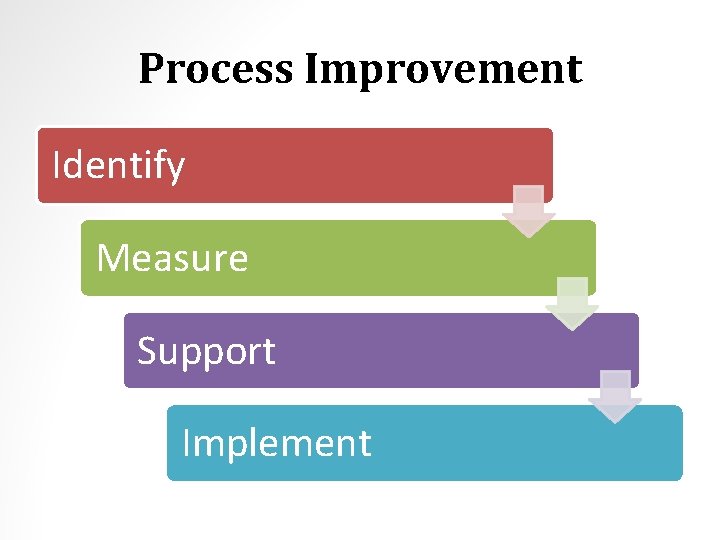
Process Improvement Identify Measure Support Implement
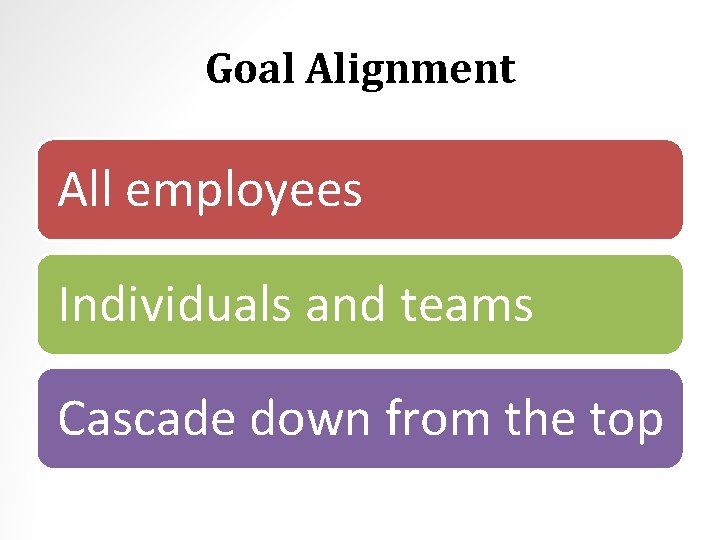
Goal Alignment All employees Individuals and teams Cascade down from the top
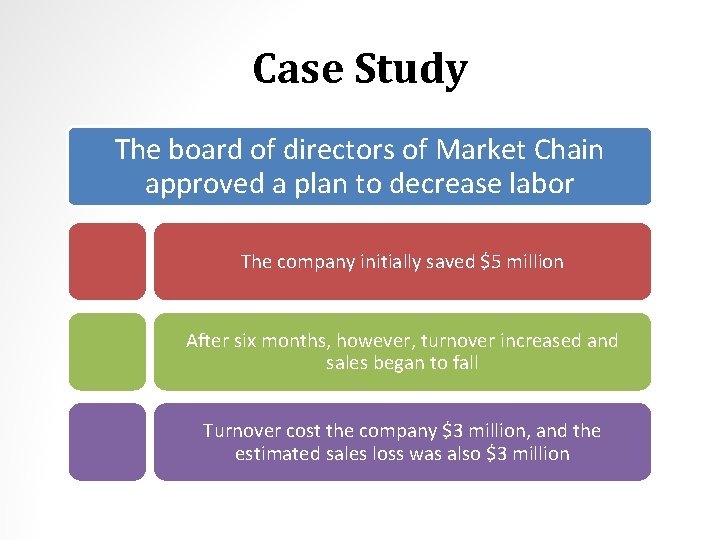
Case Study The board of directors of Market Chain approved a plan to decrease labor The company initially saved $5 million After six months, however, turnover increased and sales began to fall Turnover cost the company $3 million, and the estimated sales loss was also $3 million
Module Eleven: Review Questions 1. What is your greatest asset? a) Cash b) People c) Property d) Stock 2. What do you risk by not investing in employees? a) Decreased productivity b) Increased productivity c) Loss of employee d) Retained employees
Module Eleven: Review Questions 3. How do you begin effective communication? a) Questions b) Answers c) Listening d) Tone 4. Communication should always be clear and ______. a) Concise b) Rambling c) Dull d) Fun
Module Eleven: Review Questions 5. What is the last step of process improvement? a) Implement b) Revise c) Identify d) Evaluate 6. What is the first step of process improvement? a) Identify b) Evaluate c) Implement d) Revise
Module Eleven: Review Questions 7. Which goals begin at the top and work their way down? a) Aligned b) Cascading c) SMART d) None 8. What is not included in a SMART goal? a) Measurable b) Specific c) Attitude d) Timely
Module Eleven: Review Questions 9. How much did the company save? a) $2 million b) $5 million c) $3 million d) $6 million 10. How much did the company lose over 6 months? a) $2 million b) $5 million c) $3 million d) $6 million
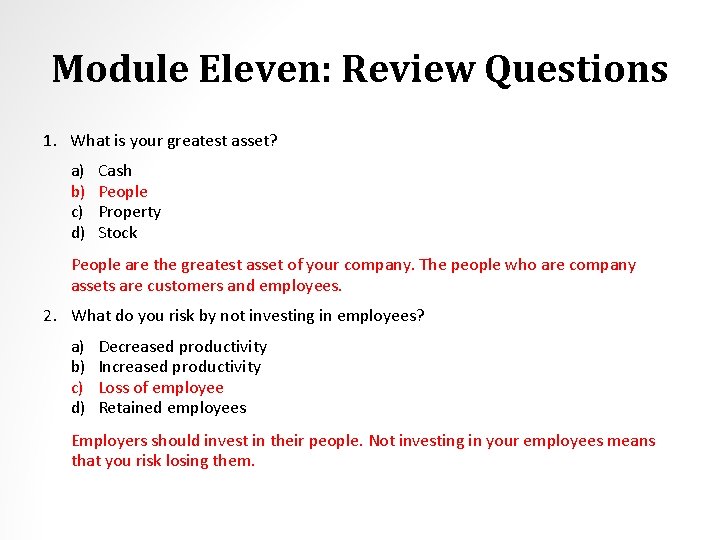
Module Eleven: Review Questions 1. What is your greatest asset? a) b) c) d) Cash People Property Stock People are the greatest asset of your company. The people who are company assets are customers and employees. 2. What do you risk by not investing in employees? a) b) c) d) Decreased productivity Increased productivity Loss of employee Retained employees Employers should invest in their people. Not investing in your employees means that you risk losing them.
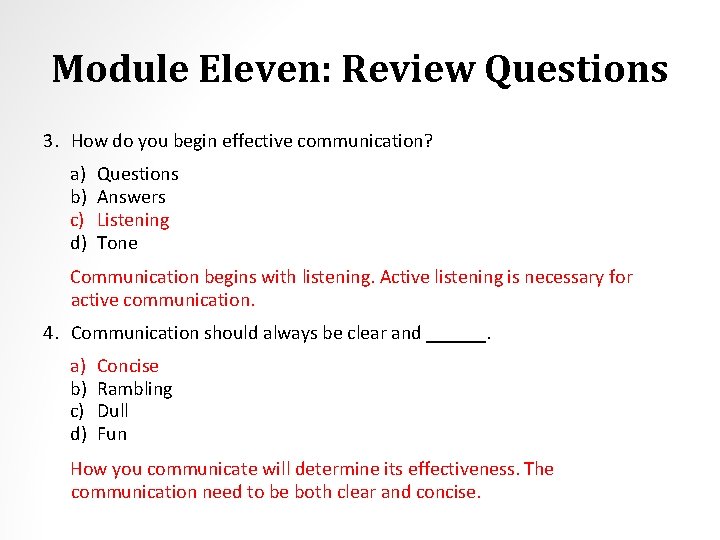
Module Eleven: Review Questions 3. How do you begin effective communication? a) b) c) d) Questions Answers Listening Tone Communication begins with listening. Active listening is necessary for active communication. 4. Communication should always be clear and ______. a) b) c) d) Concise Rambling Dull Fun How you communicate will determine its effectiveness. The communication need to be both clear and concise.
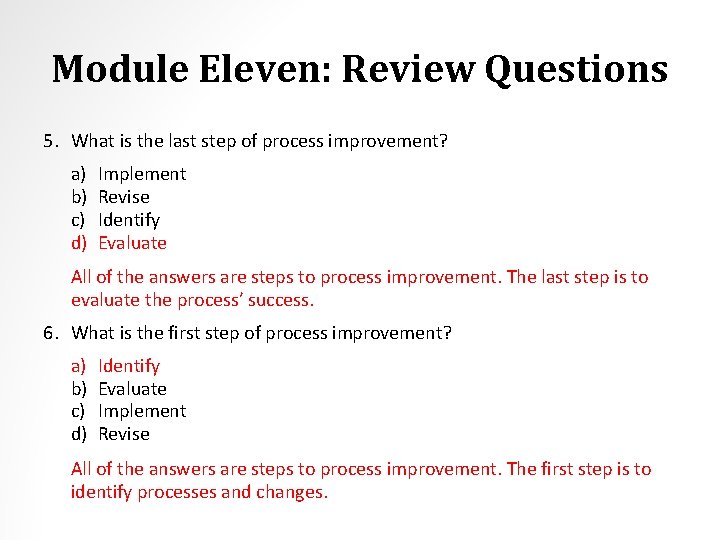
Module Eleven: Review Questions 5. What is the last step of process improvement? a) b) c) d) Implement Revise Identify Evaluate All of the answers are steps to process improvement. The last step is to evaluate the process’ success. 6. What is the first step of process improvement? a) b) c) d) Identify Evaluate Implement Revise All of the answers are steps to process improvement. The first step is to identify processes and changes.
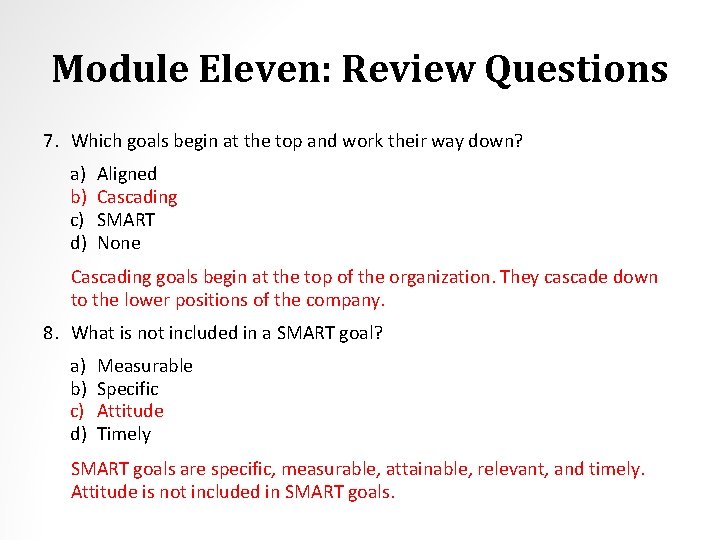
Module Eleven: Review Questions 7. Which goals begin at the top and work their way down? a) b) c) d) Aligned Cascading SMART None Cascading goals begin at the top of the organization. They cascade down to the lower positions of the company. 8. What is not included in a SMART goal? a) b) c) d) Measurable Specific Attitude Timely SMART goals are specific, measurable, attainable, relevant, and timely. Attitude is not included in SMART goals.
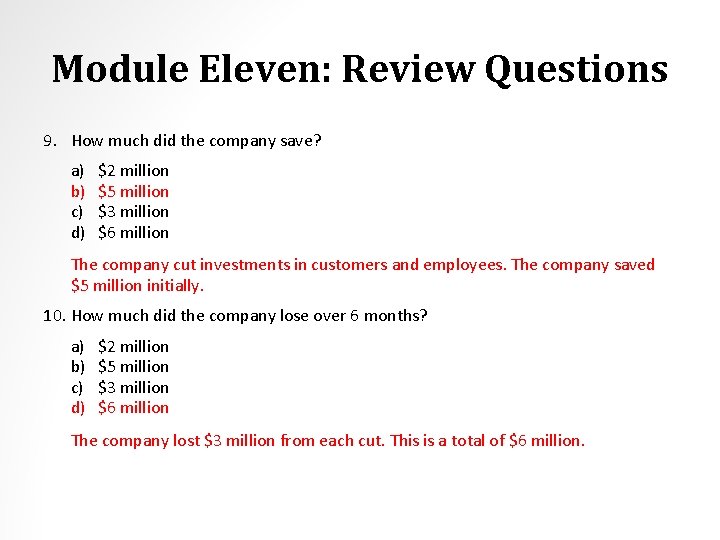
Module Eleven: Review Questions 9. How much did the company save? a) b) c) d) $2 million $5 million $3 million $6 million The company cut investments in customers and employees. The company saved $5 million initially. 10. How much did the company lose over 6 months? a) b) c) d) $2 million $5 million $3 million $6 million The company lost $3 million from each cut. This is a total of $6 million.
Module Twelve: Wrapping Up Although this workshop is coming to a close, we hope that your journey to improve your Business Acumen skills is just beginning. Please take a moment to review and update your action plan. This will be a key tool to guide your progress in the days, weeks, months, and years to come. We wish you the best of luck on the rest of your travels! There’s no such thing as knowledge management; there are only knowledgeable people. Peter Drucker
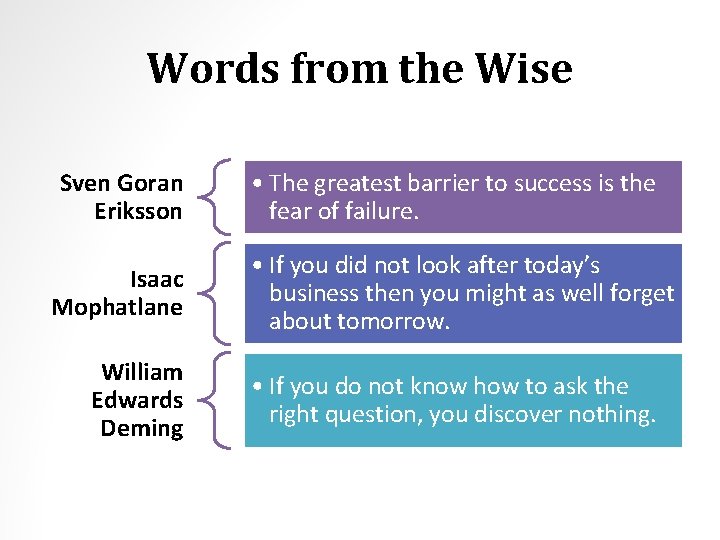
Words from the Wise Sven Goran Eriksson Isaac Mophatlane William Edwards Deming • The greatest barrier to success is the fear of failure. • If you did not look after today’s business then you might as well forget about tomorrow. • If you do not know how to ask the right question, you discover nothing.
ISD to Update Conclusion Recap and Reflection Wrap-up Accelerated Instructional Media, Inc.
Revisiting Your Responses What of your original response would have changed if you knew the insights provided today? Next Steps in Success Apply What You’ve Learned Your next step is to complete the On -the-Job section of the XXXX Caree Development topic. ISD to Update Accelerated Instructional Media, Inc. | www. aim 2 train. com
Thank you! Survey ISD to Update Which today Accelerated Instructional Media, Inc. | www. aim 2 train. com
Recap and Reflect ISD to Update
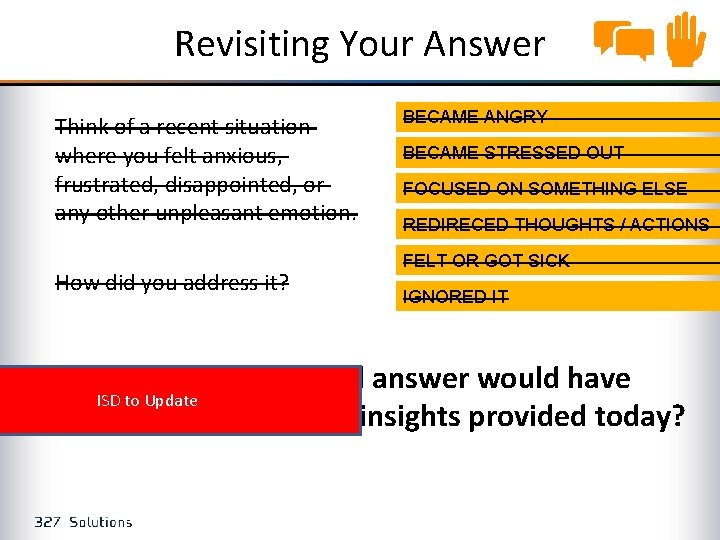
Revisiting Your Answer Think of a recent situation where you felt anxious, frustrated, disappointed, or any other unpleasant emotion. How did you address it? BECAME ANGRY BECAME STRESSED OUT FOCUSED ON SOMETHING ELSE REDIRECED THOUGHTS / ACTIONS FELT OR GOT SICK IGNORED IT What of your original answer would have ISD to Update changed if you knew the insights provided today?
LEARN – APPLY – PRACTICE – EVALUATE Update Image Which insights of leadership and influence from today’s session will you apply immediately? ISD to Update www. 327 solutions. com
- Slides: 180