
NAME OF COURSE OUR SESSION WILL BEGIN SHORTLY
NAME OF COURSE OUR SESSION WILL BEGIN SHORTLY While we wait for everyone to join, think about the scenario below: Think of a recent situation where you felt anxious, frustrated, disappointed, or any other unpleasant emotion. How did you address it? (Do not share your answers!) BECAME ANGRY BECAME STRESSED OUT FOCUSED ON SOMETHING ELSE REDIRECED THOUGHTS / ACTIONS FELT OR GOT SICK IGNORED IT ISD to Update www. 327 solutions. com
Name of course Update Image Script complete. Do not alter. www. 327 solutions. com
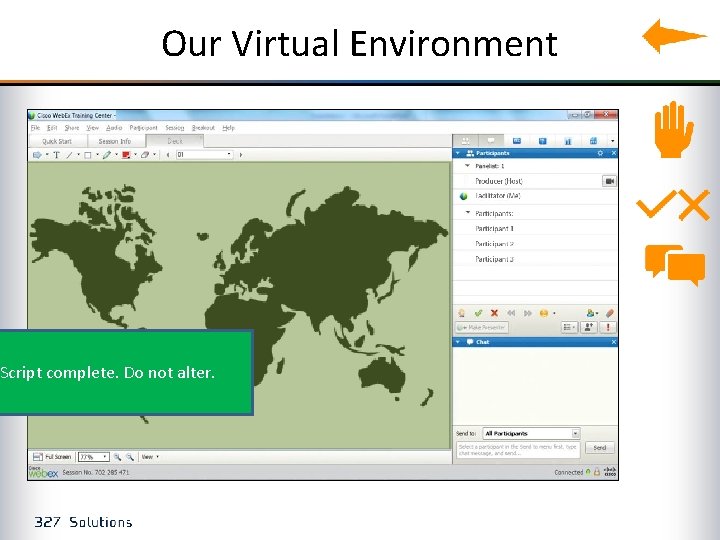
Our Virtual Environment Script complete. Do not alter.
Setting the Stage 1. Why is leadership and influence ISD to Update interesting or important for you? 2. What are your learning expectations for the course today?
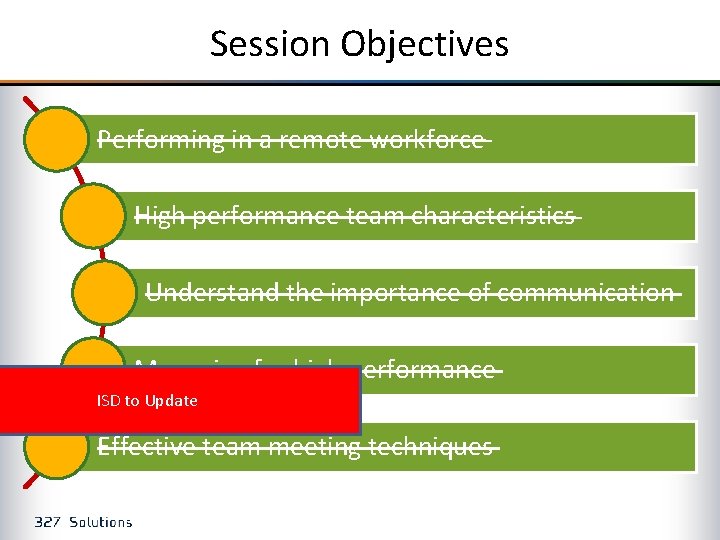
Session Objectives Performing in a remote workforce High performance team characteristics Understand the importance of communication Managing for high performance ISD to Update Effective team meeting techniques

Section 1 xxxxxxxxxxxxxxxxxxxxxx
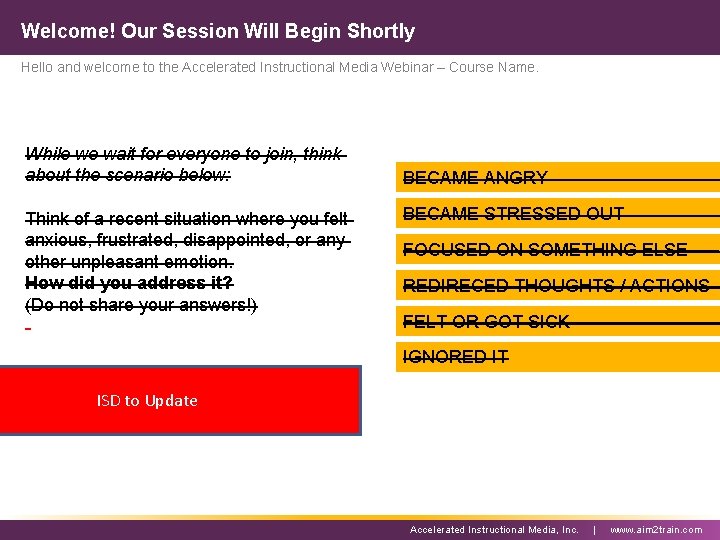
Welcome! Our Session Will Begin Shortly Hello and welcome to the Accelerated Instructional Media Webinar – Course Name. While we wait for everyone to join, think about the scenario below: Think of a recent situation where you felt anxious, frustrated, disappointed, or any other unpleasant emotion. How did you address it? (Do not share your answers!) BECAME ANGRY BECAME STRESSED OUT FOCUSED ON SOMETHING ELSE REDIRECED THOUGHTS / ACTIONS FELT OR GOT SICK IGNORED IT ISD to Update Accelerated Instructional Media, Inc. | www. aim 2 train. com

complete. Do not alter. Accelerated Instructional Media, Inc. | www. aim 2 train. com
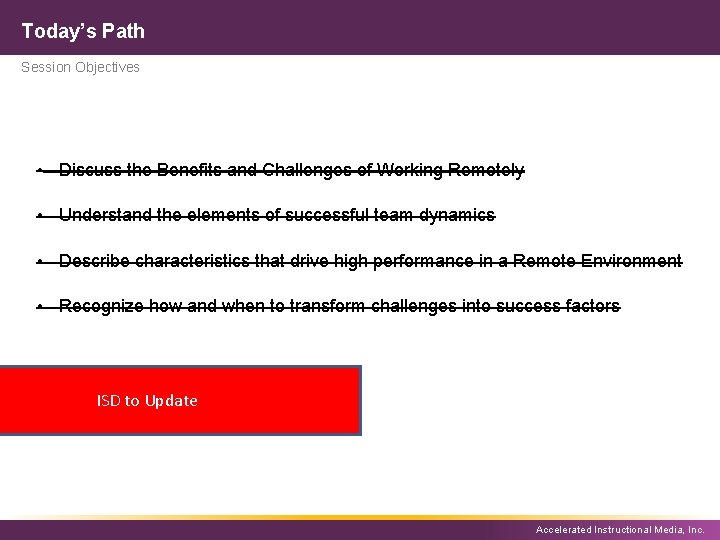
Today’s Path Session Objectives • Discuss the Benefits and Challenges of Working Remotely • Understand the elements of successful team dynamics • Describe characteristics that drive high performance in a Remote Environment • Recognize how and when to transform challenges into success factors ISD to Update Accelerated Instructional Media, Inc.

Accelerated Instructional Media, Inc.

Accelerated Instructional Media, Inc.
Life Coaching Essentials complete. Do not alter. Accelerated Instructional Media, Inc. | www. aim 2 train. com
Module One: Getting Started Coaching is about human interaction and getting to know your players. Bill Parcells Accelerated Instructional Media, Inc.
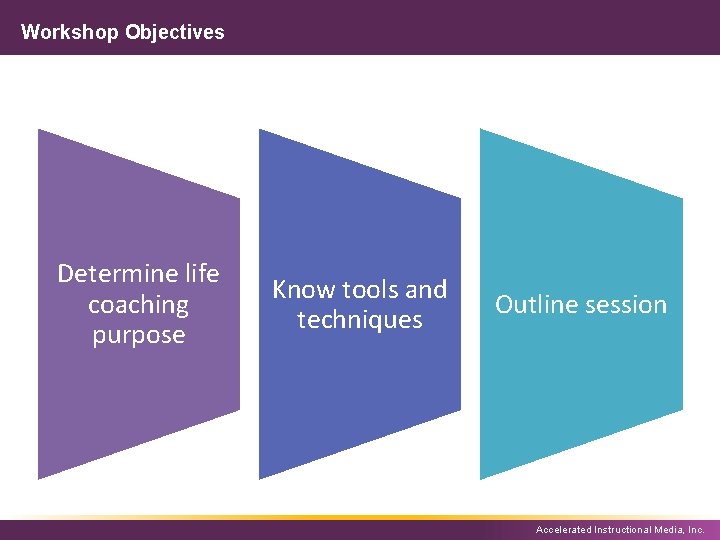
Workshop Objectives Determine life coaching purpose Know tools and techniques Outline session Accelerated Instructional Media, Inc.
Module Two: Why You Need a Life Coach? A man’s pride can be his downfall. He needs to learn when to turn to others for support and guidance. Bear Grylls Accelerated Instructional Media, Inc.
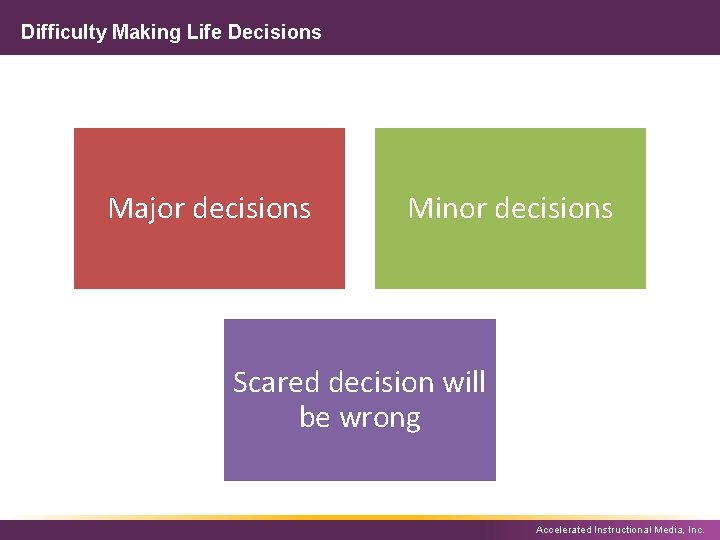
Difficulty Making Life Decisions Major decisions Minor decisions Scared decision will be wrong Accelerated Instructional Media, Inc.
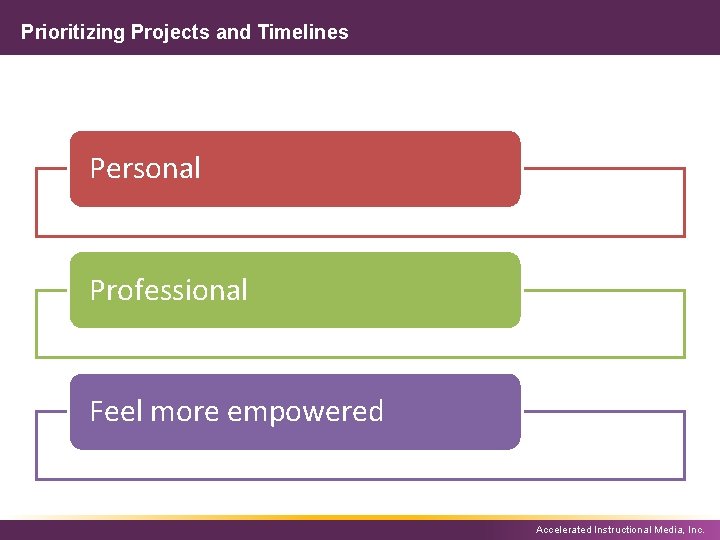
Prioritizing Projects and Timelines Personal Professional Feel more empowered Accelerated Instructional Media, Inc.
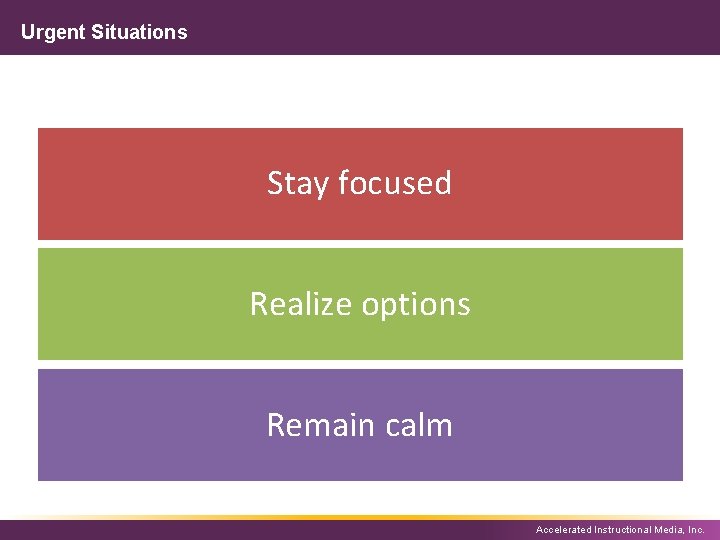
Urgent Situations Stay focused Realize options Remain calm Accelerated Instructional Media, Inc.
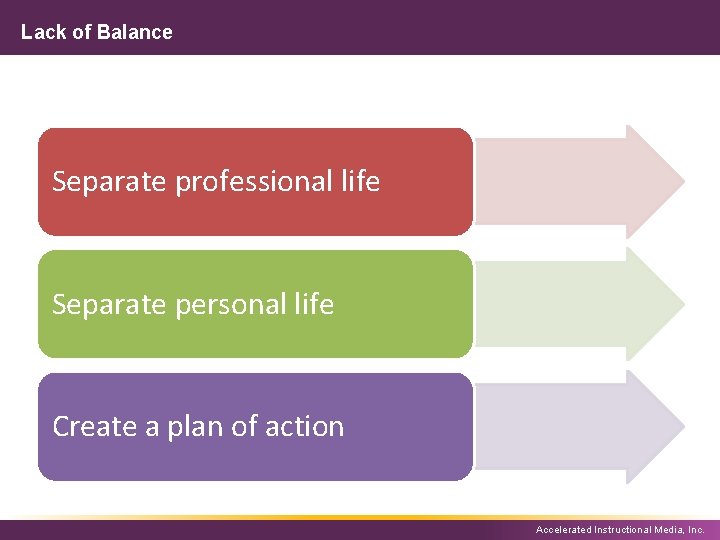
Lack of Balance Separate professional life Separate personal life Create a plan of action Accelerated Instructional Media, Inc.
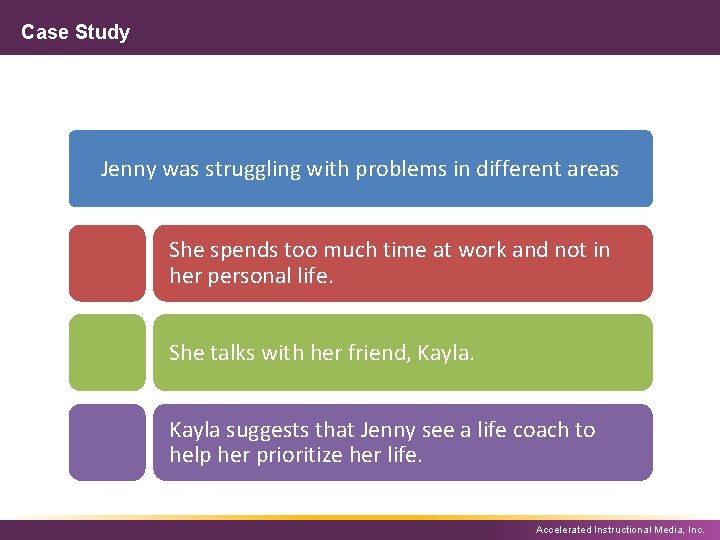
Case Study Jenny was struggling with problems in different areas She spends too much time at work and not in her personal life. She talks with her friend, Kayla suggests that Jenny see a life coach to help her prioritize her life. Accelerated Instructional Media, Inc.
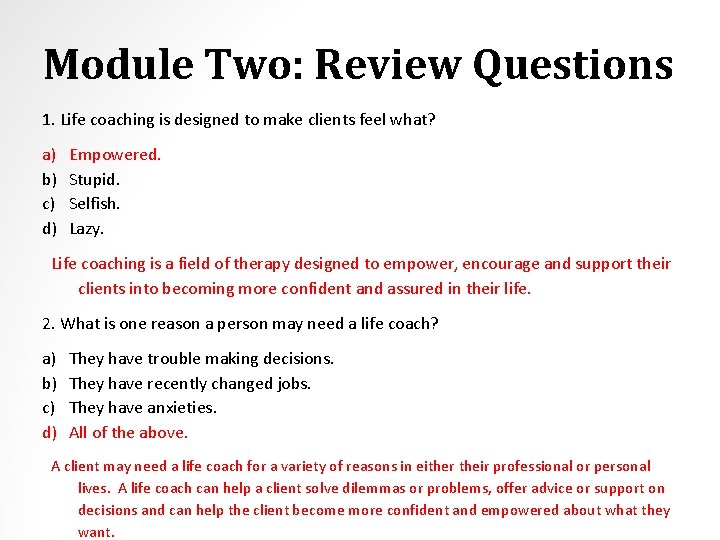
Module Two: Review Questions 1. Life coaching is designed to make clients feel what? a) b) c) d) Empowered. Stupid. Selfish. Lazy. Life coaching is a field of therapy designed to empower, encourage and support their clients into becoming more confident and assured in their life. 2. What is one reason a person may need a life coach? a) b) c) d) They have trouble making decisions. They have recently changed jobs. They have anxieties. All of the above. A client may need a life coach for a variety of reasons in either their professional or personal lives. A life coach can help a client solve dilemmas or problems, offer advice or support on decisions and can help the client become more confident and empowered about what they want.
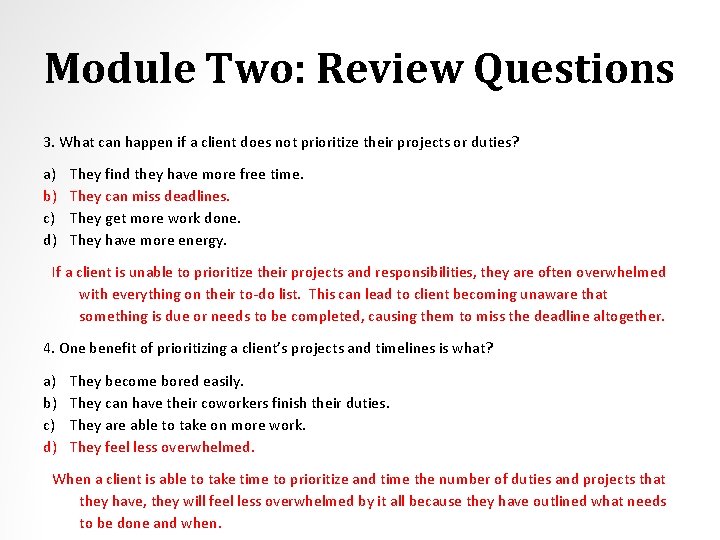
Module Two: Review Questions 3. What can happen if a client does not prioritize their projects or duties? a) b) c) d) They find they have more free time. They can miss deadlines. They get more work done. They have more energy. If a client is unable to prioritize their projects and responsibilities, they are often overwhelmed with everything on their to-do list. This can lead to client becoming unaware that something is due or needs to be completed, causing them to miss the deadline altogether. 4. One benefit of prioritizing a client’s projects and timelines is what? a) b) c) d) They become bored easily. They can have their coworkers finish their duties. They are able to take on more work. They feel less overwhelmed. When a client is able to take time to prioritize and time the number of duties and projects that they have, they will feel less overwhelmed by it all because they have outlined what needs to be done and when.
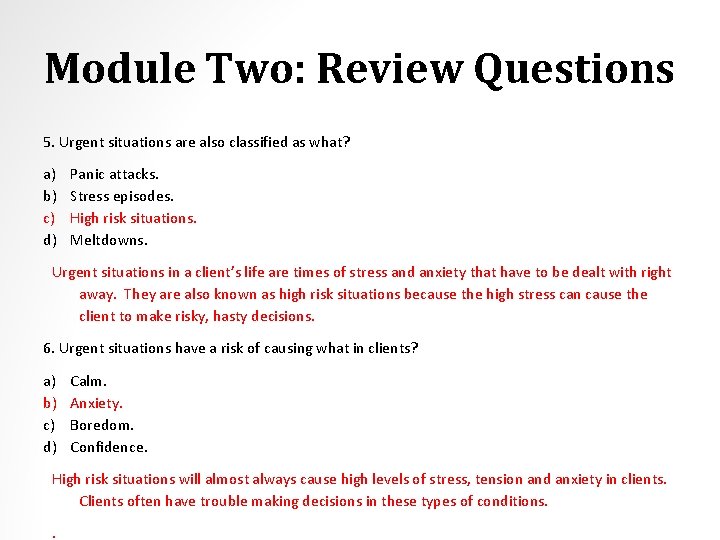
Module Two: Review Questions 5. Urgent situations are also classified as what? a) b) c) d) Panic attacks. Stress episodes. High risk situations. Meltdowns. Urgent situations in a client’s life are times of stress and anxiety that have to be dealt with right away. They are also known as high risk situations because the high stress can cause the client to make risky, hasty decisions. 6. Urgent situations have a risk of causing what in clients? a) b) c) d) Calm. Anxiety. Boredom. Confidence. High risk situations will almost always cause high levels of stress, tension and anxiety in clients. Clients often have trouble making decisions in these types of conditions. .
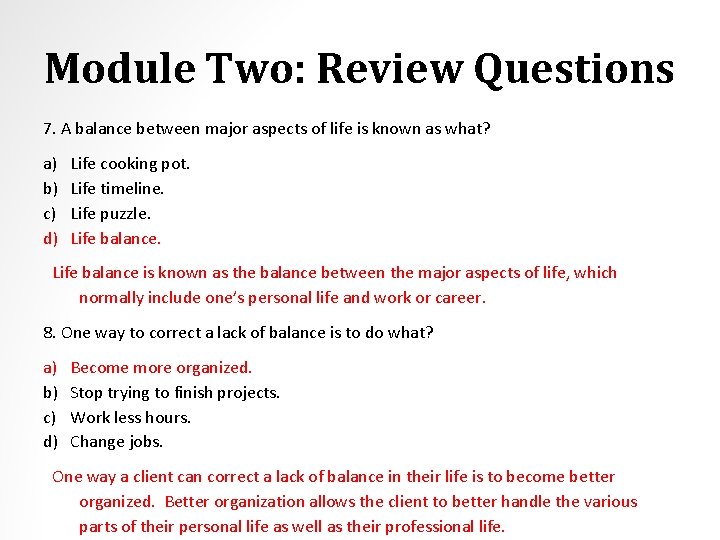
Module Two: Review Questions 7. A balance between major aspects of life is known as what? a) b) c) d) Life cooking pot. Life timeline. Life puzzle. Life balance is known as the balance between the major aspects of life, which normally include one’s personal life and work or career. 8. One way to correct a lack of balance is to do what? a) b) c) d) Become more organized. Stop trying to finish projects. Work less hours. Change jobs. One way a client can correct a lack of balance in their life is to become better organized. Better organization allows the client to better handle the various parts of their personal life as well as their professional life.
Module Two: Review Questions 9. What is one problem Jenny was struggling with? a) b) c) d) She was fighting with her husband. A lack of work ethic. A lack of life balance. She wanted to retire. Jenny admits that she spends too much time at work and not enough time on her personal life, which is causing her to have a lack of life balance. 10. What is one method Kayla suggested Jenny use to solve her problem? a) b) c) d) Change jobs. Hire a life coach. Talk to their manager. Get divorced. After listening to Jenny’s problems, Kayla suggested that she hire a life coach. Kayla said the life coach would be able to help Jenny create a better life-work balance and prioritize the different areas of her life.
Module Three: The Benefits of Life Coaching You have to have the guidance to lead you in the direction until you can do it yourself. Tina Yothers Accelerated Instructional Media, Inc.
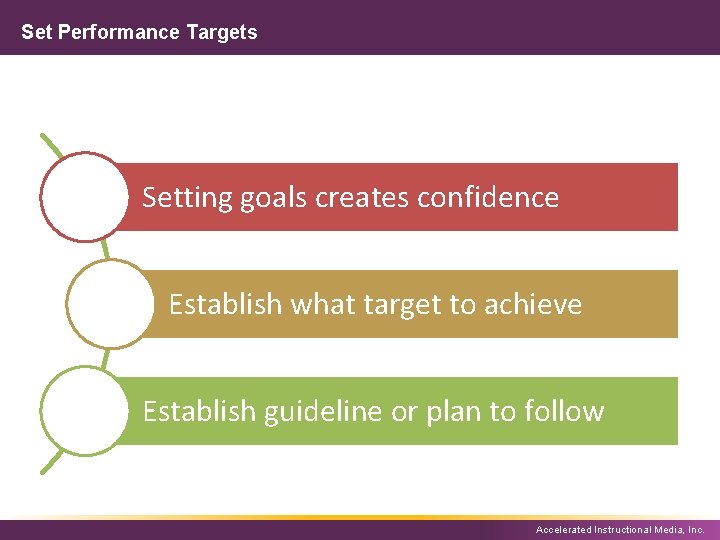
Set Performance Targets Setting goals creates confidence Establish what target to achieve Establish guideline or plan to follow Accelerated Instructional Media, Inc.
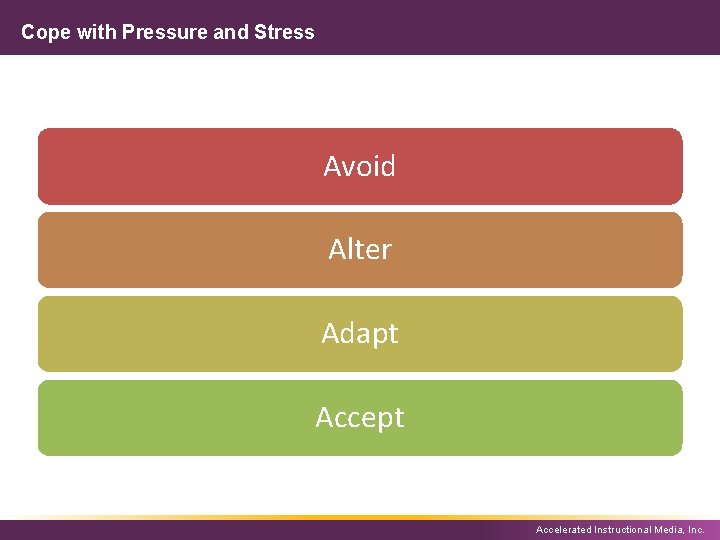
Cope with Pressure and Stress Avoid Alter Adapt Accelerated Instructional Media, Inc.
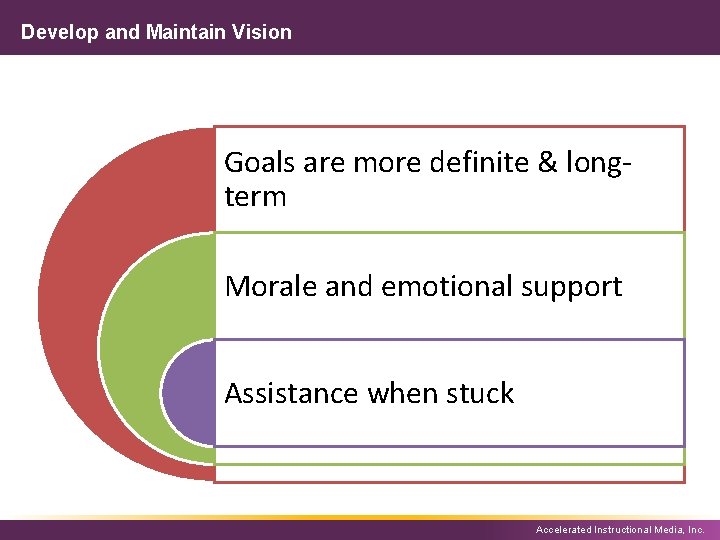
Develop and Maintain Vision Goals are more definite & longterm Morale and emotional support Assistance when stuck Accelerated Instructional Media, Inc.
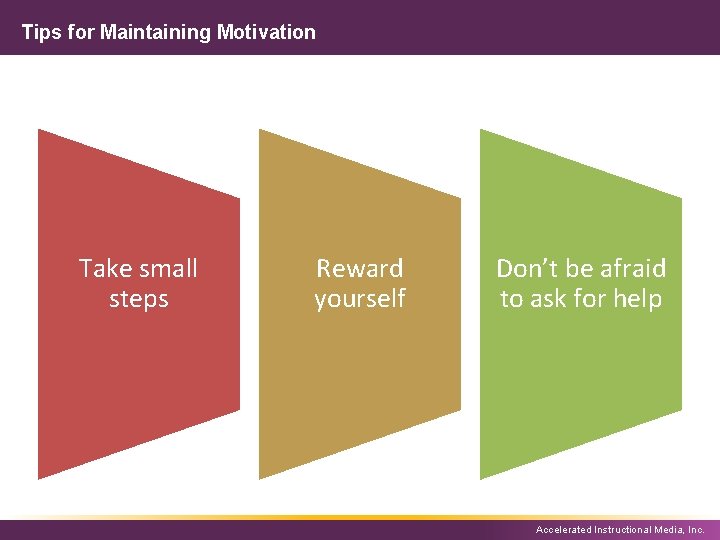
Tips for Maintaining Motivation Take small steps Reward yourself Don’t be afraid to ask for help Accelerated Instructional Media, Inc.
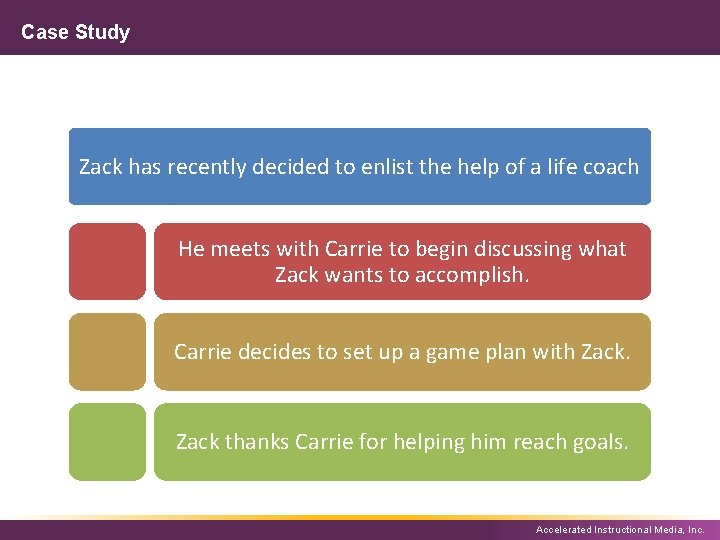
Case Study Zack has recently decided to enlist the help of a life coach He meets with Carrie to begin discussing what Zack wants to accomplish. Carrie decides to set up a game plan with Zack thanks Carrie for helping him reach goals. Accelerated Instructional Media, Inc.
Module Three: Review Questions 1. A performance target is also known as what? a) b) c) d) A pain. A goal. A dilemma. A chore. A performance target is another term for a goal, ambition or desire. Life coaches use these terms to help clients define and determine what they want to achieve. 2. One of the first steps to establish a performance target is to what? a) b) c) d) Determine the steps to reach it. Outline an action plan. Determine what the client wants. Create milestones. When establishing a performance target, the client is essentially establishing the end result of what they are aiming for. So, the client must first determine what they want or want to achieve.
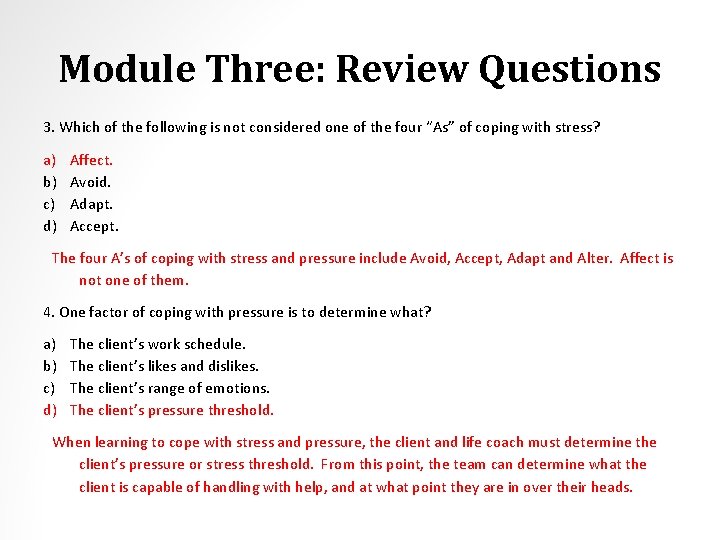
Module Three: Review Questions 3. Which of the following is not considered one of the four “As” of coping with stress? a) b) c) d) Affect. Avoid. Adapt. Accept. The four A’s of coping with stress and pressure include Avoid, Accept, Adapt and Alter. Affect is not one of them. 4. One factor of coping with pressure is to determine what? a) b) c) d) The client’s work schedule. The client’s likes and dislikes. The client’s range of emotions. The client’s pressure threshold. When learning to cope with stress and pressure, the client and life coach must determine the client’s pressure or stress threshold. From this point, the team can determine what the client is capable of handling with help, and at what point they are in over their heads.
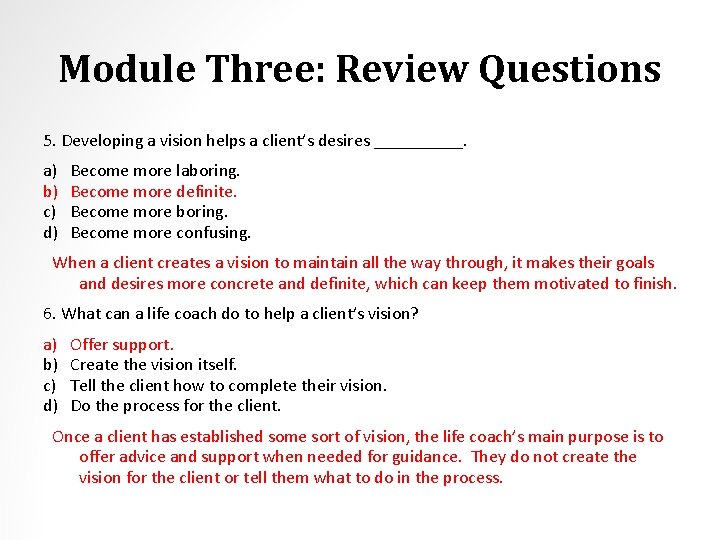
Module Three: Review Questions 5. Developing a vision helps a client’s desires _____. a) b) c) d) Become more laboring. Become more definite. Become more boring. Become more confusing. When a client creates a vision to maintain all the way through, it makes their goals and desires more concrete and definite, which can keep them motivated to finish. 6. What can a life coach do to help a client’s vision? a) b) c) d) Offer support. Create the vision itself. Tell the client how to complete their vision. Do the process for the client. Once a client has established some sort of vision, the life coach’s main purpose is to offer advice and support when needed for guidance. They do not create the vision for the client or tell them what to do in the process.
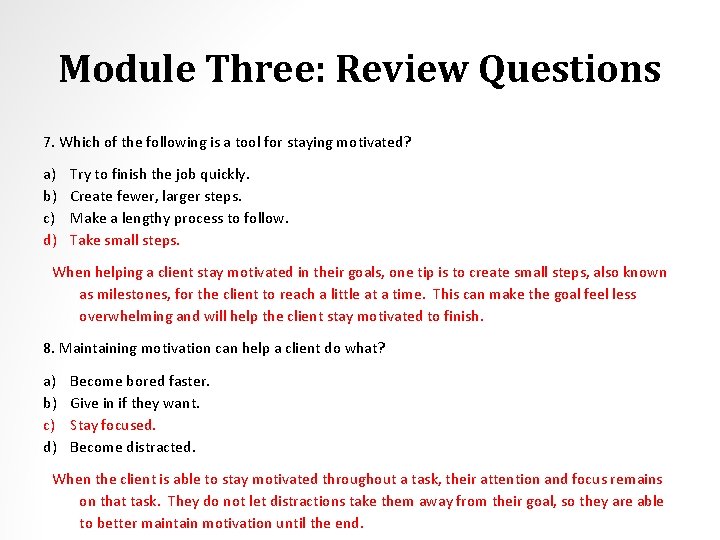
Module Three: Review Questions 7. Which of the following is a tool for staying motivated? a) b) c) d) Try to finish the job quickly. Create fewer, larger steps. Make a lengthy process to follow. Take small steps. When helping a client stay motivated in their goals, one tip is to create small steps, also known as milestones, for the client to reach a little at a time. This can make the goal feel less overwhelming and will help the client stay motivated to finish. 8. Maintaining motivation can help a client do what? a) b) c) d) Become bored faster. Give in if they want. Stay focused. Become distracted. When the client is able to stay motivated throughout a task, their attention and focus remains on that task. They do not let distractions take them away from their goal, so they are able to better maintain motivation until the end.
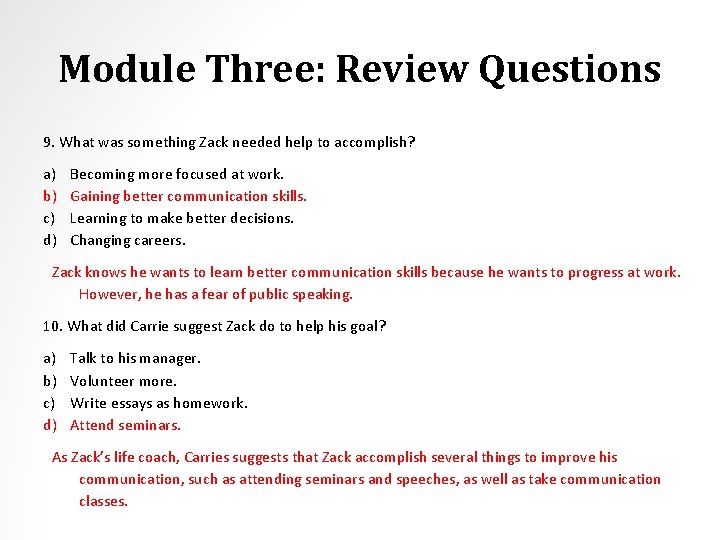
Module Three: Review Questions 9. What was something Zack needed help to accomplish? a) b) c) d) Becoming more focused at work. Gaining better communication skills. Learning to make better decisions. Changing careers. Zack knows he wants to learn better communication skills because he wants to progress at work. However, he has a fear of public speaking. 10. What did Carrie suggest Zack do to help his goal? a) b) c) d) Talk to his manager. Volunteer more. Write essays as homework. Attend seminars. As Zack’s life coach, Carries suggests that Zack accomplish several things to improve his communication, such as attending seminars and speeches, as well as take communication classes.
Module Four: Life Coaching Challenges Everything negative – the pressure, the challenges – is just an opportunity to rise. Kobe Bryant Accelerated Instructional Media, Inc.
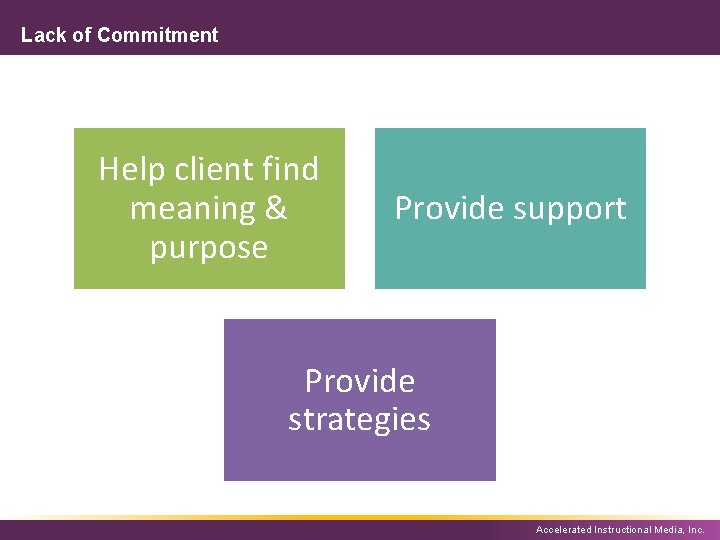
Lack of Commitment Help client find meaning & purpose Provide support Provide strategies Accelerated Instructional Media, Inc.
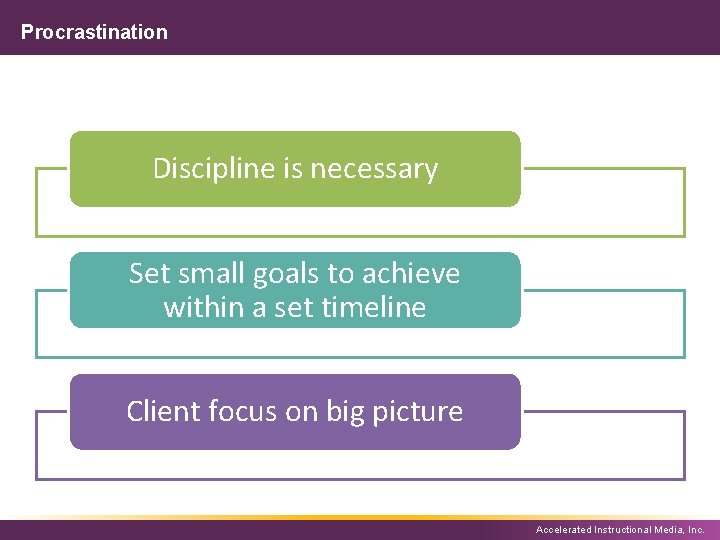
Procrastination Discipline is necessary Set small goals to achieve within a set timeline Client focus on big picture Accelerated Instructional Media, Inc.
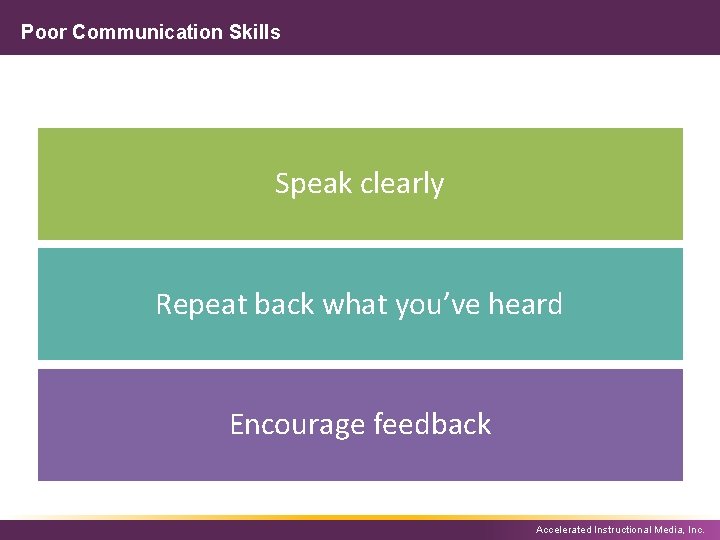
Poor Communication Skills Speak clearly Repeat back what you’ve heard Encourage feedback Accelerated Instructional Media, Inc.
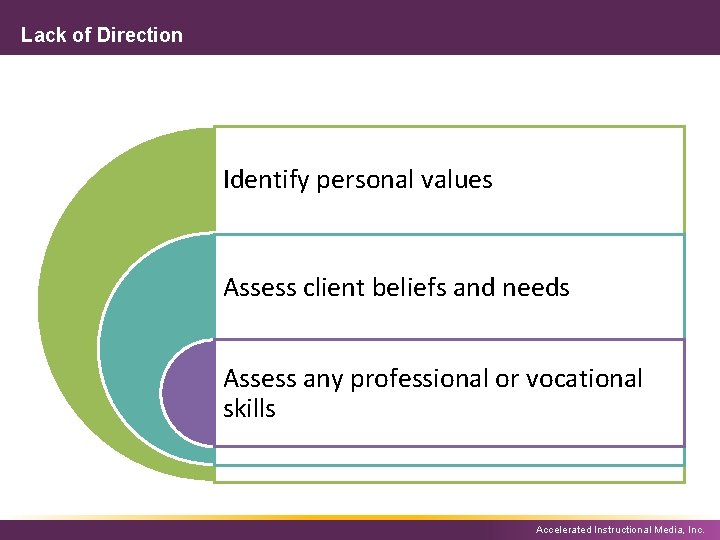
Lack of Direction Identify personal values Assess client beliefs and needs Assess any professional or vocational skills Accelerated Instructional Media, Inc.
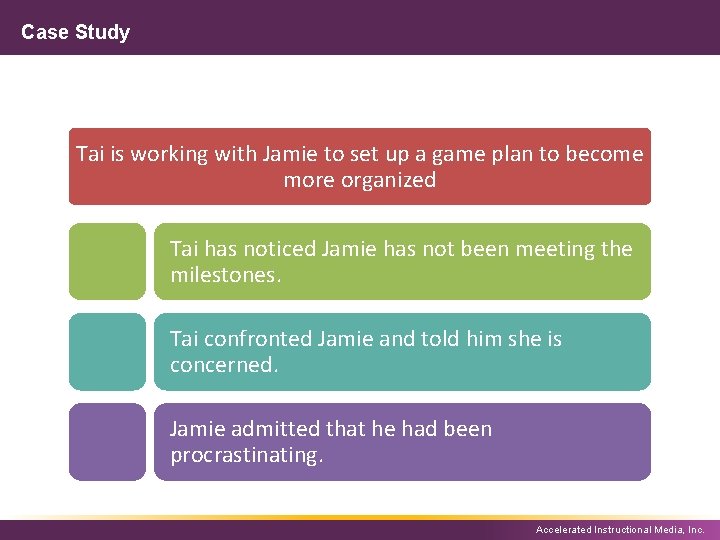
Case Study Tai is working with Jamie to set up a game plan to become more organized Tai has noticed Jamie has not been meeting the milestones. Tai confronted Jamie and told him she is concerned. Jamie admitted that he had been procrastinating. Accelerated Instructional Media, Inc.
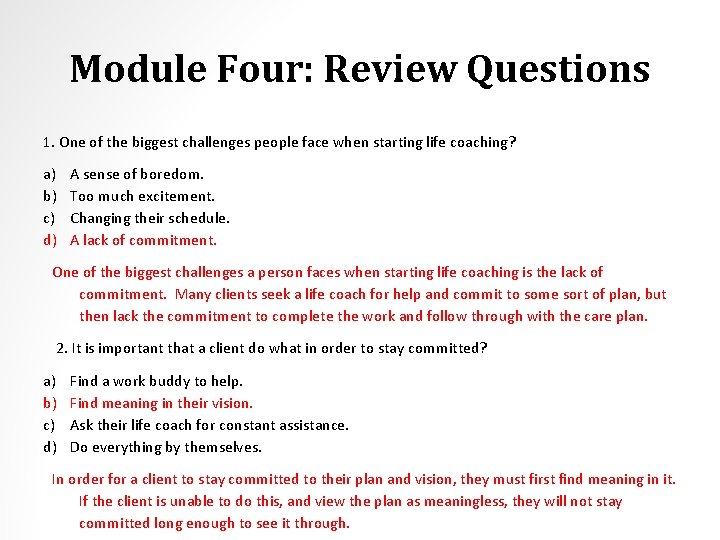
Module Four: Review Questions 1. One of the biggest challenges people face when starting life coaching? a) b) c) d) A sense of boredom. Too much excitement. Changing their schedule. A lack of commitment. One of the biggest challenges a person faces when starting life coaching is the lack of commitment. Many clients seek a life coach for help and commit to some sort of plan, but then lack the commitment to complete the work and follow through with the care plan. 2. It is important that a client do what in order to stay committed? a) b) c) d) Find a work buddy to help. Find meaning in their vision. Ask their life coach for constant assistance. Do everything by themselves. In order for a client to stay committed to their plan and vision, they must first find meaning in it. If the client is unable to do this, and view the plan as meaningless, they will not stay committed long enough to see it through.
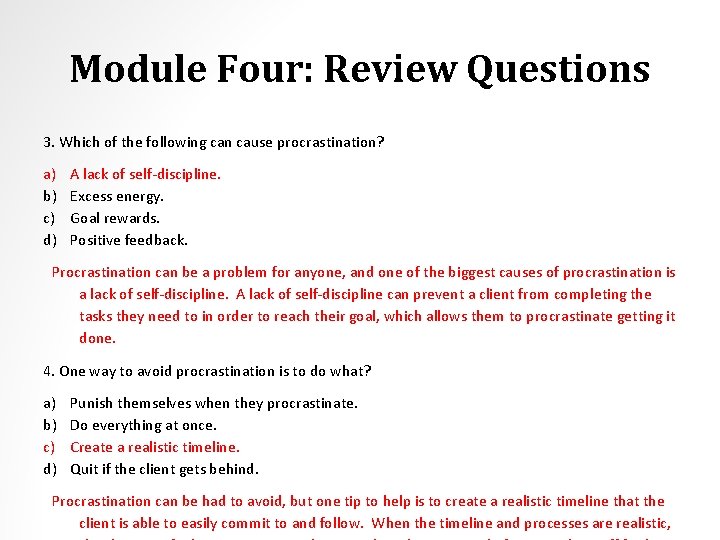
Module Four: Review Questions 3. Which of the following can cause procrastination? a) b) c) d) A lack of self-discipline. Excess energy. Goal rewards. Positive feedback. Procrastination can be a problem for anyone, and one of the biggest causes of procrastination is a lack of self-discipline. A lack of self-discipline can prevent a client from completing the tasks they need to in order to reach their goal, which allows them to procrastinate getting it done. 4. One way to avoid procrastination is to do what? a) b) c) d) Punish themselves when they procrastinate. Do everything at once. Create a realistic timeline. Quit if the client gets behind. Procrastination can be had to avoid, but one tip to help is to create a realistic timeline that the client is able to easily commit to and follow. When the timeline and processes are realistic,
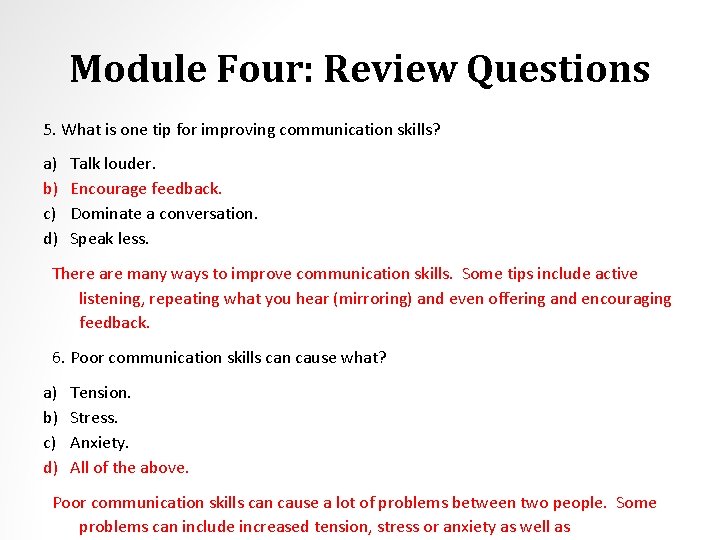
Module Four: Review Questions 5. What is one tip for improving communication skills? a) b) c) d) Talk louder. Encourage feedback. Dominate a conversation. Speak less. There are many ways to improve communication skills. Some tips include active listening, repeating what you hear (mirroring) and even offering and encouraging feedback. 6. Poor communication skills can cause what? a) b) c) d) Tension. Stress. Anxiety. All of the above. Poor communication skills can cause a lot of problems between two people. Some problems can include increased tension, stress or anxiety as well as
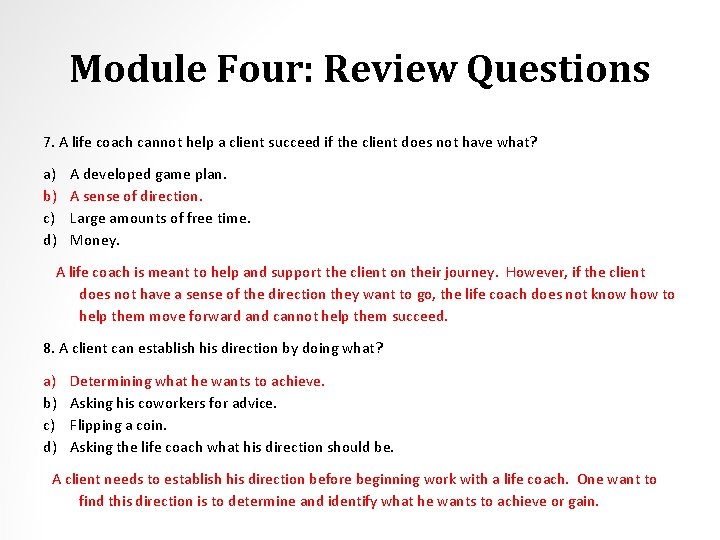
Module Four: Review Questions 7. A life coach cannot help a client succeed if the client does not have what? a) b) c) d) A developed game plan. A sense of direction. Large amounts of free time. Money. A life coach is meant to help and support the client on their journey. However, if the client does not have a sense of the direction they want to go, the life coach does not know how to help them move forward and cannot help them succeed. 8. A client can establish his direction by doing what? a) b) c) d) Determining what he wants to achieve. Asking his coworkers for advice. Flipping a coin. Asking the life coach what his direction should be. A client needs to establish his direction before beginning work with a life coach. One want to find this direction is to determine and identify what he wants to achieve or gain.
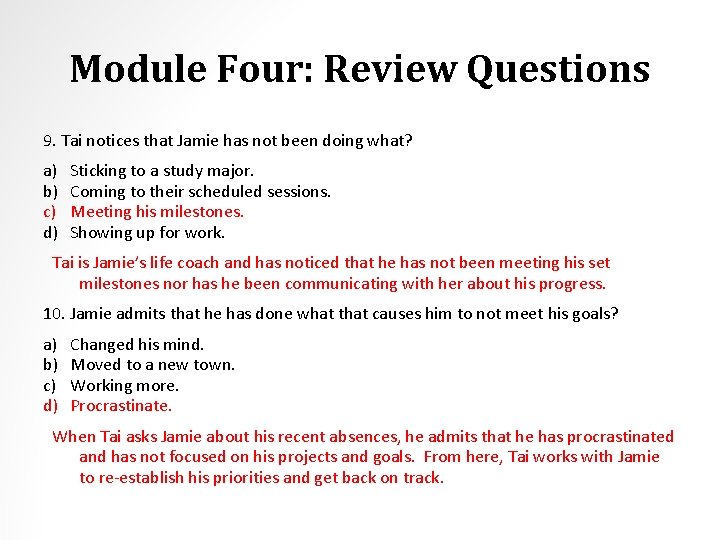
Module Four: Review Questions 9. Tai notices that Jamie has not been doing what? a) b) c) d) Sticking to a study major. Coming to their scheduled sessions. Meeting his milestones. Showing up for work. Tai is Jamie’s life coach and has noticed that he has not been meeting his set milestones nor has he been communicating with her about his progress. 10. Jamie admits that he has done what that causes him to not meet his goals? a) b) c) d) Changed his mind. Moved to a new town. Working more. Procrastinate. When Tai asks Jamie about his recent absences, he admits that he has procrastinated and has not focused on his projects and goals. From here, Tai works with Jamie to re-establish his priorities and get back on track.
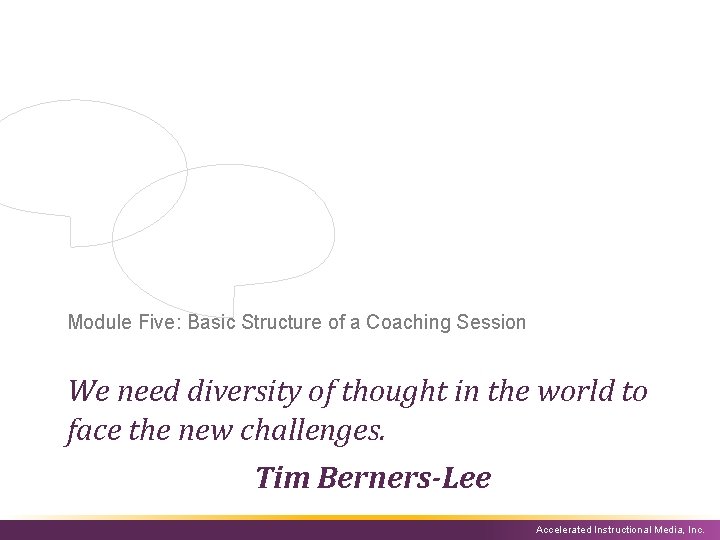
Module Five: Basic Structure of a Coaching Session We need diversity of thought in the world to face the new challenges. Tim Berners-Lee Accelerated Instructional Media, Inc.
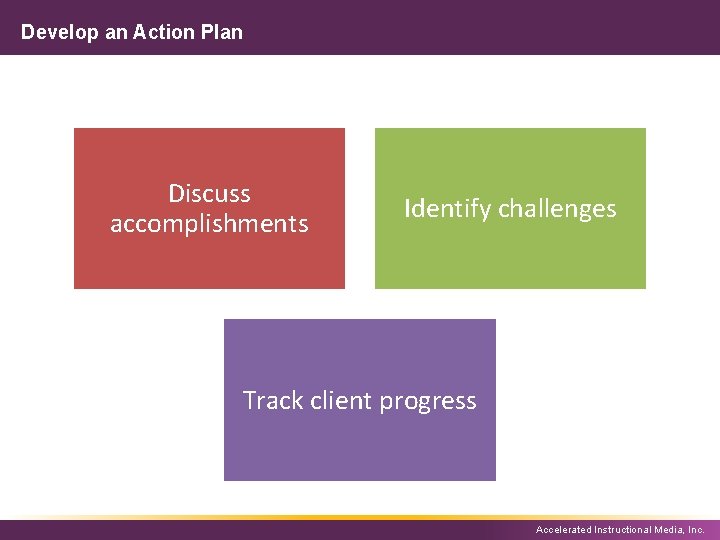
Develop an Action Plan Discuss accomplishments Identify challenges Track client progress Accelerated Instructional Media, Inc.
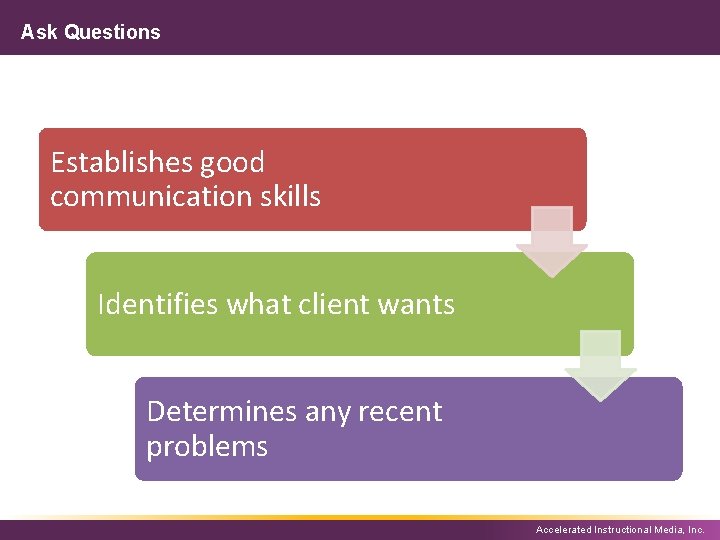
Ask Questions Establishes good communication skills Identifies what client wants Determines any recent problems Accelerated Instructional Media, Inc.
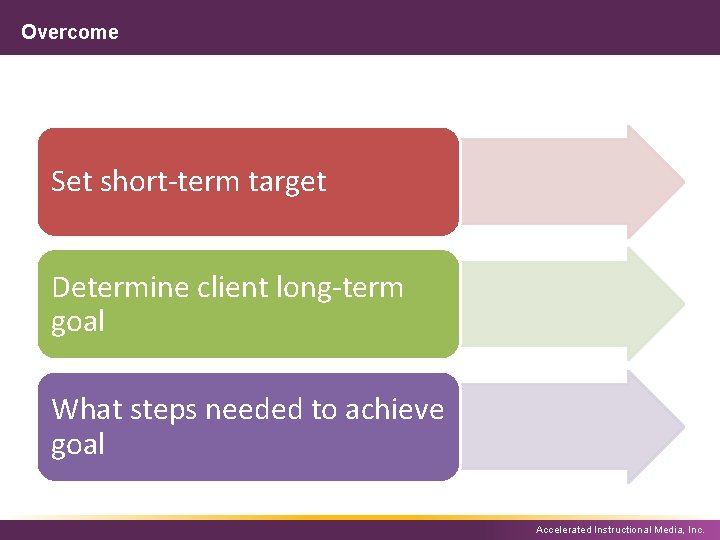
Overcome Set short-term target Determine client long-term goal What steps needed to achieve goal Accelerated Instructional Media, Inc.
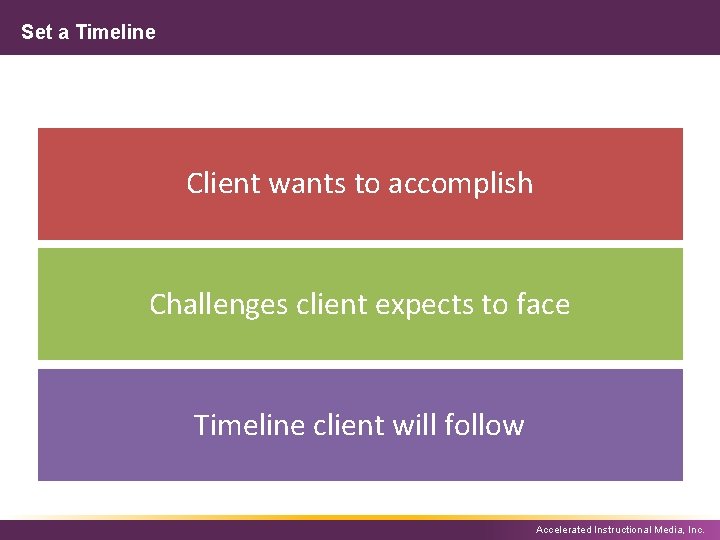
Set a Timeline Client wants to accomplish Challenges client expects to face Timeline client will follow Accelerated Instructional Media, Inc.
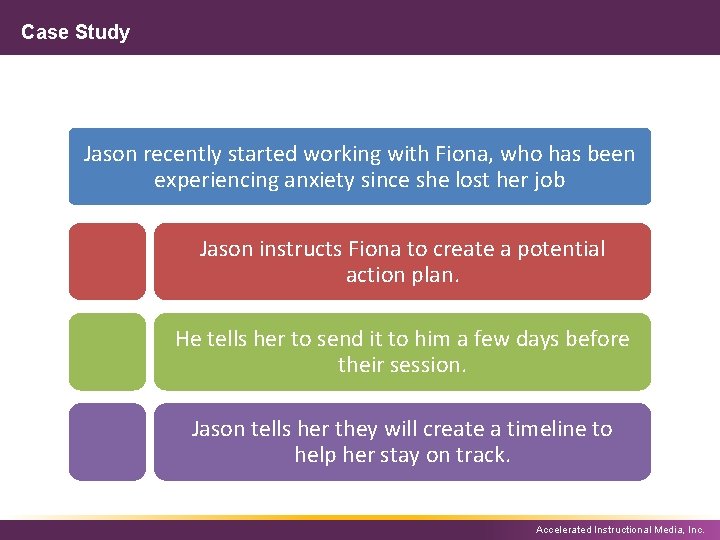
Case Study Jason recently started working with Fiona, who has been experiencing anxiety since she lost her job Jason instructs Fiona to create a potential action plan. He tells her to send it to him a few days before their session. Jason tells her they will create a timeline to help her stay on track. Accelerated Instructional Media, Inc.
Module Five: Review Questions 1. An action plan is formed at what point? a) b) c) d) At any time. During the coaching session. After the session ends. Before the session takes place. An action plan for a coaching session is designed to act as a road map for the session and includes information to be discussed and planned on. 2. The action plan should include what? a) b) c) d) Recent achievements. Forms of progress. Any recent problems. All of the above. An action plan for a coaching session acts as a guide or outline for the session. It should include topics such as the client’s recent achievements, any recent challenges or problems they’ve faced, any form of progress made and what they hope to achieve in the near future.
Module Five: Review Questions 3. What type of questions should be used in coaching sessions? a) b) c) d) Rhetorical questions. Simple questions. Open-ended questions. Essay questions. Open-ended questions are the best type of questions to use in a coaching session because they require more than simple word answers and require the client to think about their response before saying anything. 4. The client can ask questions in order to obtain what? a) b) c) d) Biased advice. A different point of view. Free therapy time. Names of good books to read. When a client is able to ask various questions in a coaching session they are not only able to gain different points of view on a subject, but they can also gain perspective, support and advice from an unbiased source.
Module Five: Review Questions 5. The “overcome” segment of the session is designed to do what? a) b) c) d) Determine when the client will start coaching. Determine appointment times for sessions. Determine how the life coach will create the client’s goal outline. Determine what the client wants to achieve. The “overcome” segment of a coaching session is designed to address what the client wants to achieve and how they will find a way to get there, or overcome. 6. When creating future goals, it is important that they are what? a) b) c) d) Challenging. Lengthy. Realistic. Easy. When a client and life coaches are creating goals in their session, it is important the goals are realistic and achievable. If they are not, the client will not have faith that they can complete them and will give up.
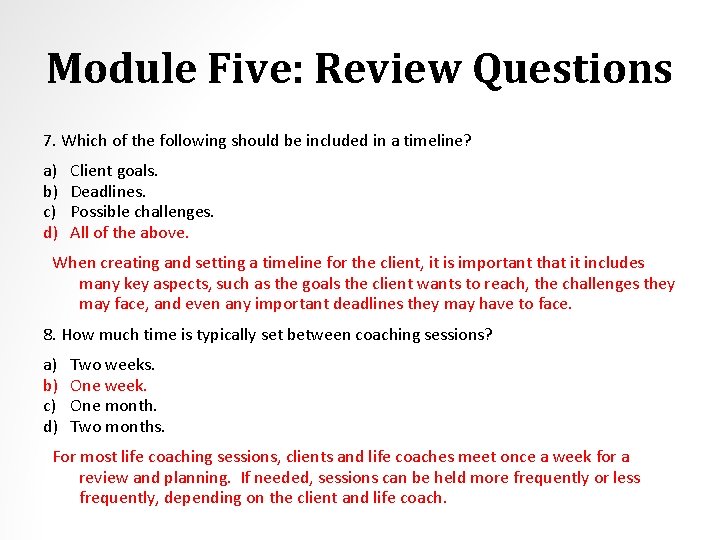
Module Five: Review Questions 7. Which of the following should be included in a timeline? a) b) c) d) Client goals. Deadlines. Possible challenges. All of the above. When creating and setting a timeline for the client, it is important that it includes many key aspects, such as the goals the client wants to reach, the challenges they may face, and even any important deadlines they may have to face. 8. How much time is typically set between coaching sessions? a) b) c) d) Two weeks. One week. One month. Two months. For most life coaching sessions, clients and life coaches meet once a week for a review and planning. If needed, sessions can be held more frequently or less frequently, depending on the client and life coach.
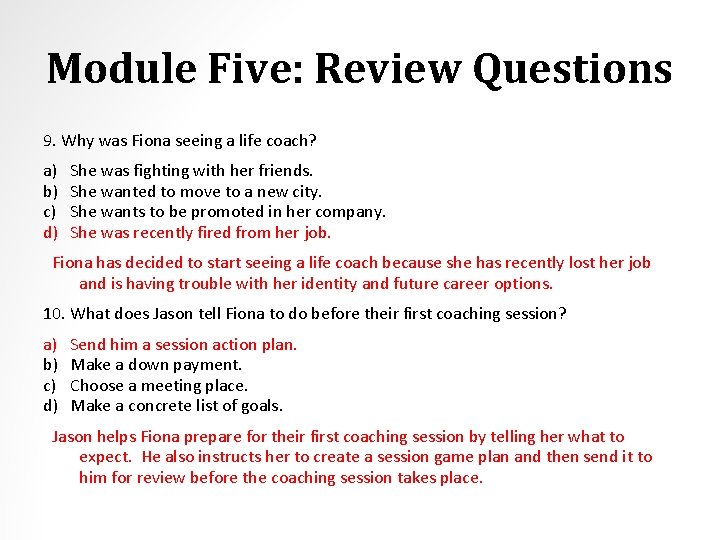
Module Five: Review Questions 9. Why was Fiona seeing a life coach? a) b) c) d) She was fighting with her friends. She wanted to move to a new city. She wants to be promoted in her company. She was recently fired from her job. Fiona has decided to start seeing a life coach because she has recently lost her job and is having trouble with her identity and future career options. 10. What does Jason tell Fiona to do before their first coaching session? a) b) c) d) Send him a session action plan. Make a down payment. Choose a meeting place. Make a concrete list of goals. Jason helps Fiona prepare for their first coaching session by telling her what to expect. He also instructs her to create a session game plan and then send it to him for review before the coaching session takes place.
Module Six: Essential Skills for Successful Coaching Success consists of going from failure to failure without a loss of enthusiasm. Winston Churchill Accelerated Instructional Media, Inc.
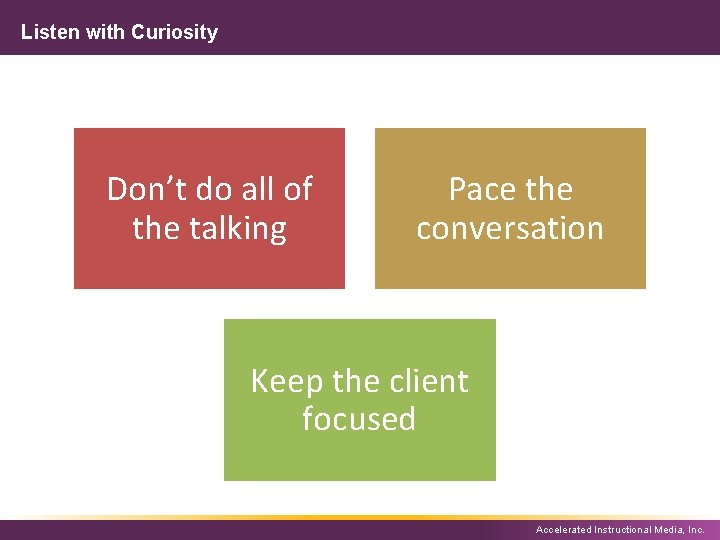
Listen with Curiosity Don’t do all of the talking Pace the conversation Keep the client focused Accelerated Instructional Media, Inc.
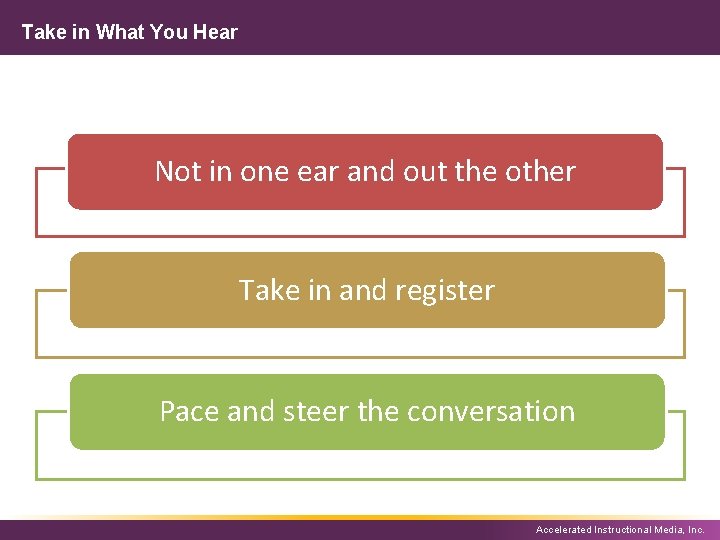
Take in What You Hear Not in one ear and out the other Take in and register Pace and steer the conversation Accelerated Instructional Media, Inc.
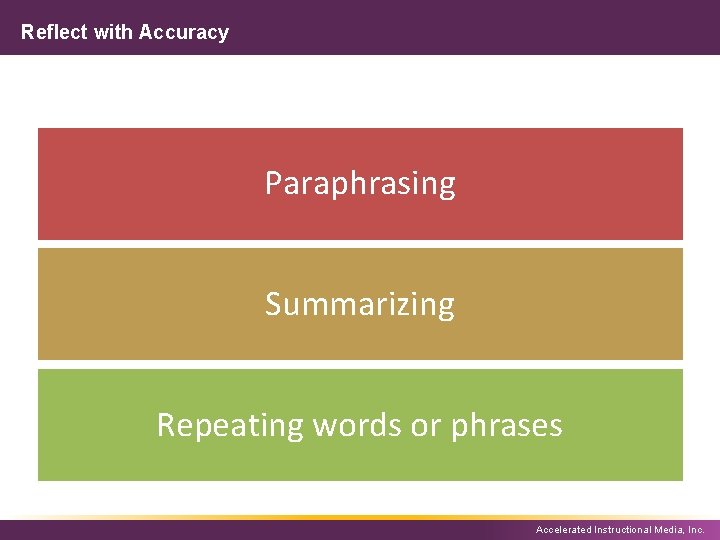
Reflect with Accuracy Paraphrasing Summarizing Repeating words or phrases Accelerated Instructional Media, Inc.
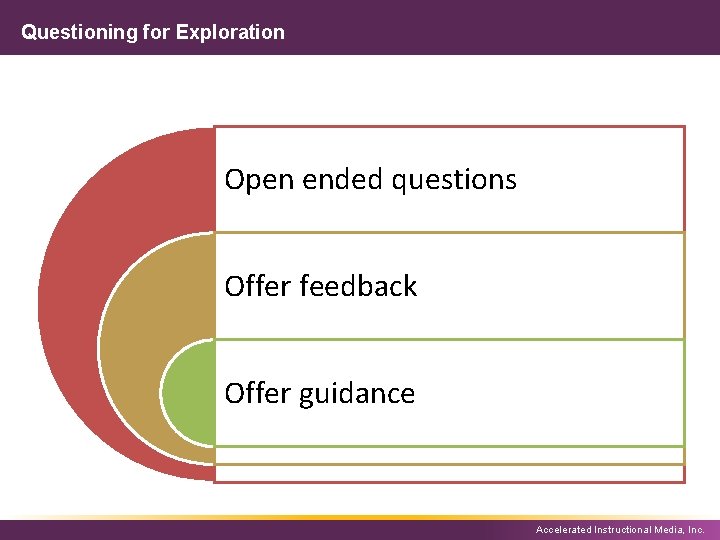
Questioning for Exploration Open ended questions Offer feedback Offer guidance Accelerated Instructional Media, Inc.
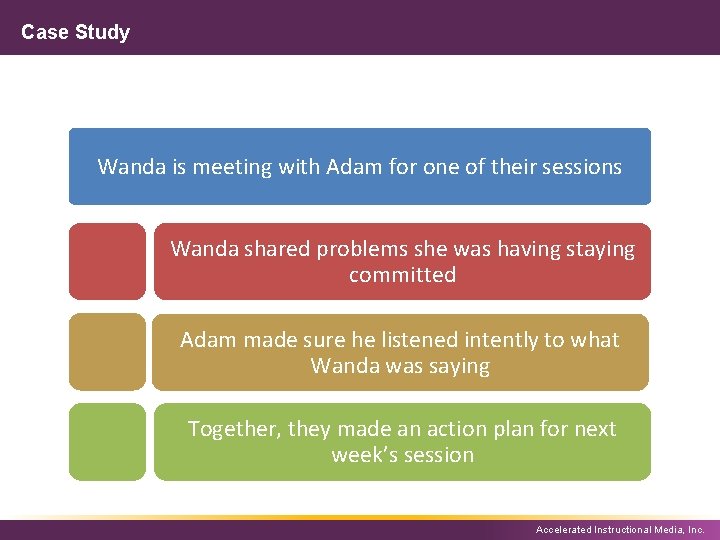
Case Study Wanda is meeting with Adam for one of their sessions Wanda shared problems she was having staying committed Adam made sure he listened intently to what Wanda was saying Together, they made an action plan for next week’s session Accelerated Instructional Media, Inc.
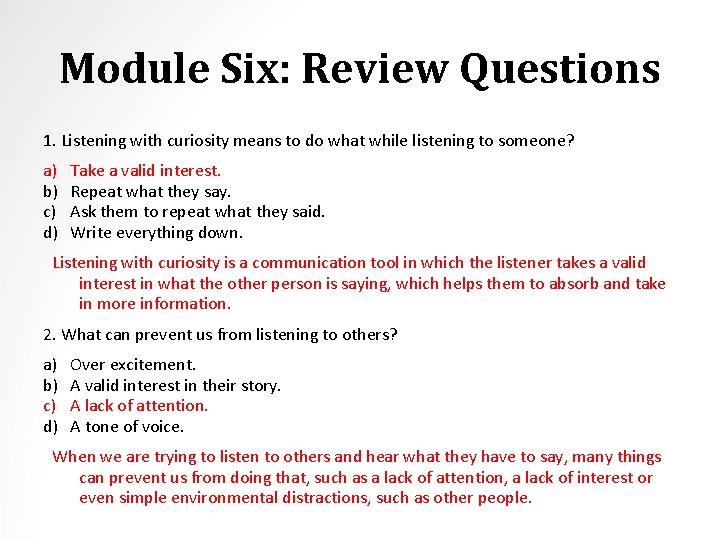
Module Six: Review Questions 1. Listening with curiosity means to do what while listening to someone? a) b) c) d) Take a valid interest. Repeat what they say. Ask them to repeat what they said. Write everything down. Listening with curiosity is a communication tool in which the listener takes a valid interest in what the other person is saying, which helps them to absorb and take in more information. 2. What can prevent us from listening to others? a) b) c) d) Over excitement. A valid interest in their story. A lack of attention. A tone of voice. When we are trying to listen to others and hear what they have to say, many things can prevent us from doing that, such as a lack of attention, a lack of interest or even simple environmental distractions, such as other people.
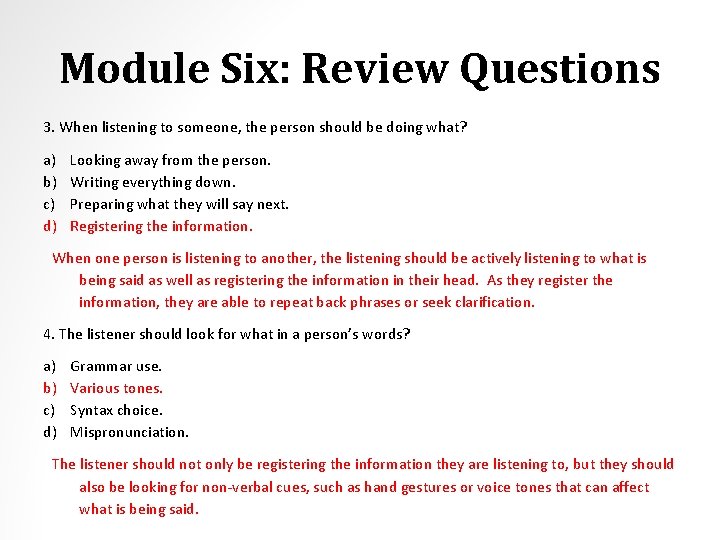
Module Six: Review Questions 3. When listening to someone, the person should be doing what? a) b) c) d) Looking away from the person. Writing everything down. Preparing what they will say next. Registering the information. When one person is listening to another, the listening should be actively listening to what is being said as well as registering the information in their head. As they register the information, they are able to repeat back phrases or seek clarification. 4. The listener should look for what in a person’s words? a) b) c) d) Grammar use. Various tones. Syntax choice. Mispronunciation. The listener should not only be registering the information they are listening to, but they should also be looking for non-verbal cues, such as hand gestures or voice tones that can affect what is being said.
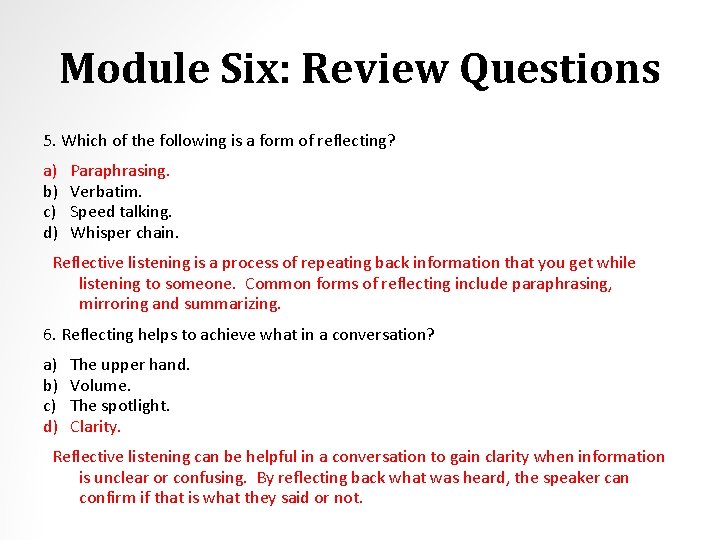
Module Six: Review Questions 5. Which of the following is a form of reflecting? a) b) c) d) Paraphrasing. Verbatim. Speed talking. Whisper chain. Reflective listening is a process of repeating back information that you get while listening to someone. Common forms of reflecting include paraphrasing, mirroring and summarizing. 6. Reflecting helps to achieve what in a conversation? a) b) c) d) The upper hand. Volume. The spotlight. Clarity. Reflective listening can be helpful in a conversation to gain clarity when information is unclear or confusing. By reflecting back what was heard, the speaker can confirm if that is what they said or not.
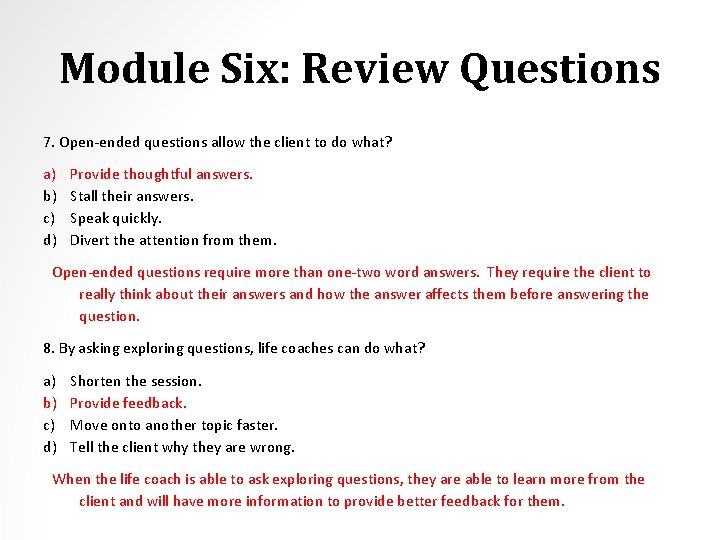
Module Six: Review Questions 7. Open-ended questions allow the client to do what? a) b) c) d) Provide thoughtful answers. Stall their answers. Speak quickly. Divert the attention from them. Open-ended questions require more than one-two word answers. They require the client to really think about their answers and how the answer affects them before answering the question. 8. By asking exploring questions, life coaches can do what? a) b) c) d) Shorten the session. Provide feedback. Move onto another topic faster. Tell the client why they are wrong. When the life coach is able to ask exploring questions, they are able to learn more from the client and will have more information to provide better feedback for them.
Module Six: Review Questions 9. What was something Wanda was having trouble with? a) b) c) d) Her spouse. He coworkers. Her business classes. Her manager. Wanda was speaking with her life coach bout some of the problems she was experiencing, such as troubles wither business class and her desire to quite her degree plan. 10. Adam told Wanda to do what before ending their coaching session? a) b) c) d) Create an action plan for their next session. Pay her overdue balance. Talk to her manager. Work less hours. After meeting with Wanda today and discussing some of her current issues, Adam told Wanda to create an action plan for their next session, which allows her to plan what she’ll want to discuss at that time.
Module Seven: Life Coaching Tools and Techniques Action is the foundational key to all success. Pablo Picasso Accelerated Instructional Media, Inc.
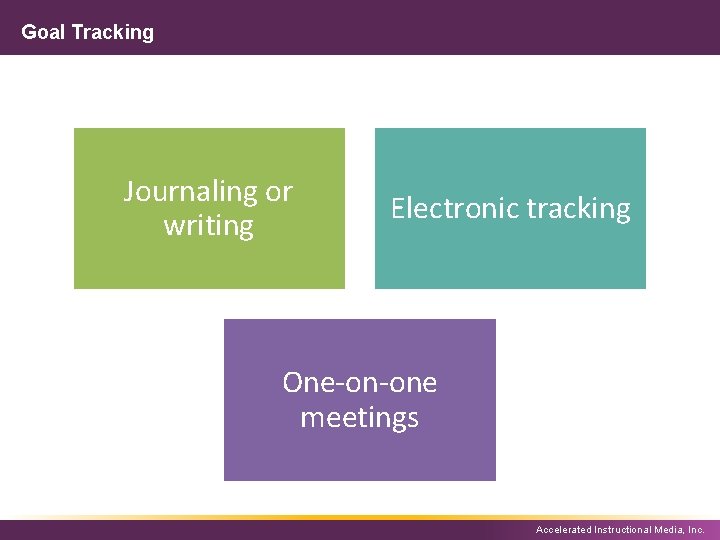
Goal Tracking Journaling or writing Electronic tracking One-on-one meetings Accelerated Instructional Media, Inc.
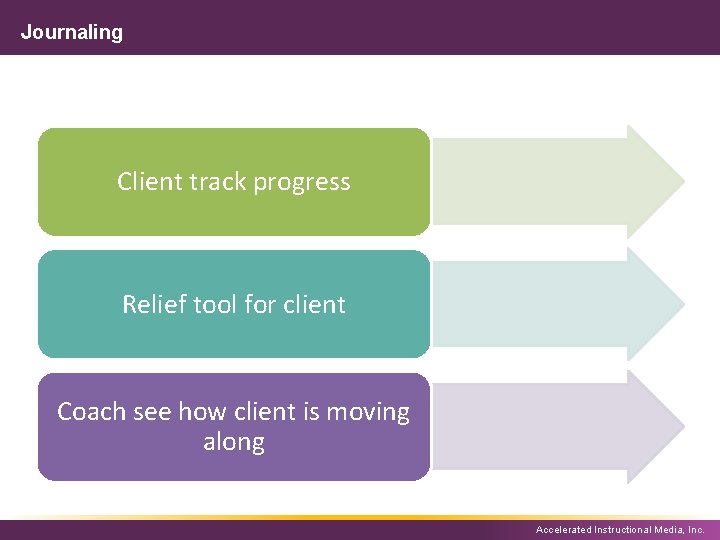
Journaling Client track progress Relief tool for client Coach see how client is moving along Accelerated Instructional Media, Inc.
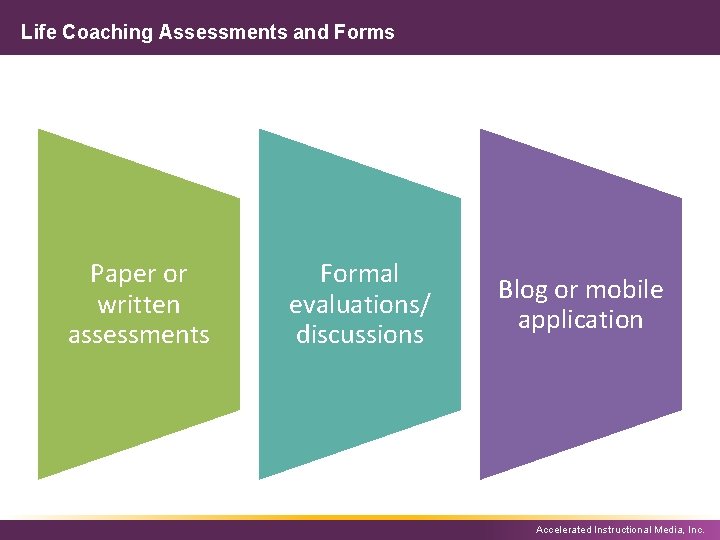
Life Coaching Assessments and Forms Paper or written assessments Formal evaluations/ discussions Blog or mobile application Accelerated Instructional Media, Inc.
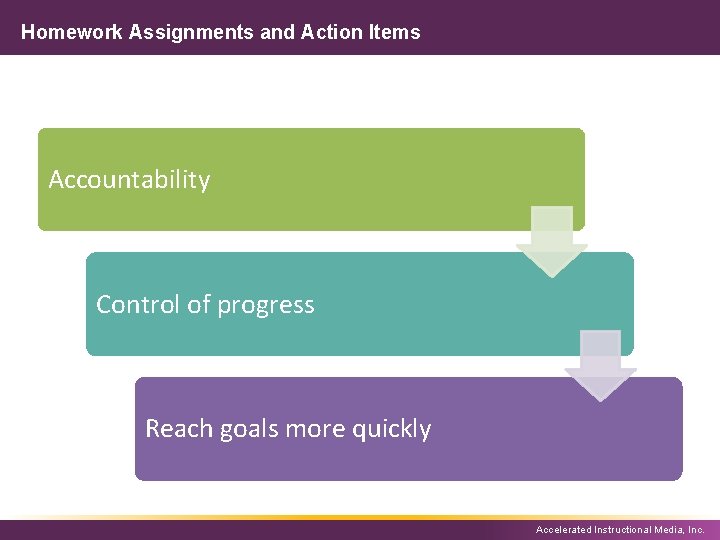
Homework Assignments and Action Items Accountability Control of progress Reach goals more quickly Accelerated Instructional Media, Inc.
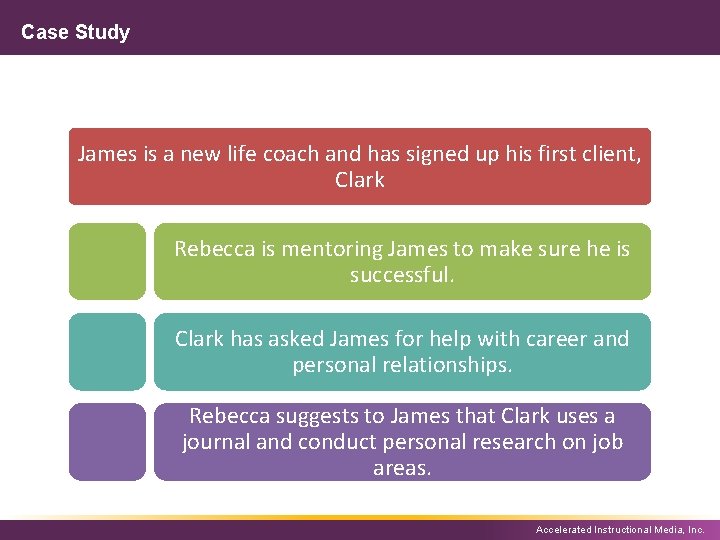
Case Study James is a new life coach and has signed up his first client, Clark Rebecca is mentoring James to make sure he is successful. Clark has asked James for help with career and personal relationships. Rebecca suggests to James that Clark uses a journal and conduct personal research on job areas. Accelerated Instructional Media, Inc.
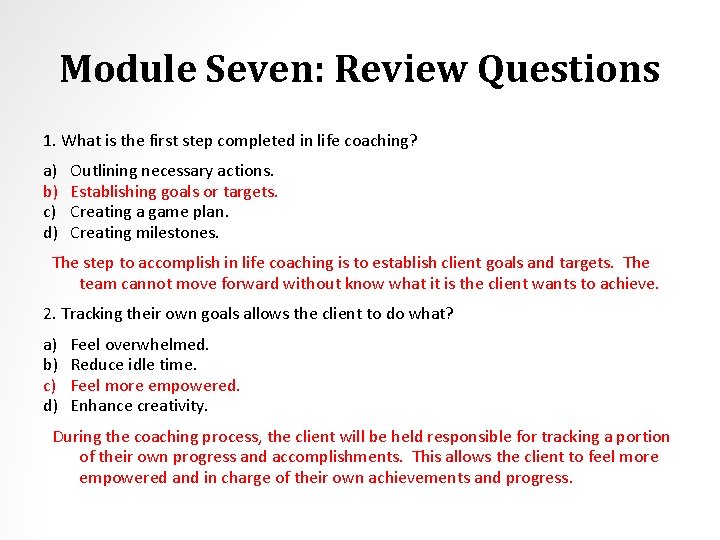
Module Seven: Review Questions 1. What is the first step completed in life coaching? a) b) c) d) Outlining necessary actions. Establishing goals or targets. Creating a game plan. Creating milestones. The step to accomplish in life coaching is to establish client goals and targets. The team cannot move forward without know what it is the client wants to achieve. 2. Tracking their own goals allows the client to do what? a) b) c) d) Feel overwhelmed. Reduce idle time. Feel more empowered. Enhance creativity. During the coaching process, the client will be held responsible for tracking a portion of their own progress and accomplishments. This allows the client to feel more empowered and in charge of their own achievements and progress.
Module Seven: Review Questions 3. Journaling is a tool commonly used for what? a) b) c) d) Therapeutic relief. Client evaluations. Tracking devices. Event recordings. In many fields, journaling has always been a tool for therapeutic relief by allowing the user to freely record any form of emotions, ideas, opinions, anxieties or current situations on their own time and at their own pace. 4. Journaling allows the client to freely record what? a) b) c) d) Emotions. Stress or anxieties. Thoughts and ideas. All of the above. When a client utilizes a journal, they are free to record anything they want, including any current events or situations, emotions or feelings, problems, stresses, anxieties or fears.
Module Seven: Review Questions 5. Assessments allow life coaches to do what? a) b) c) d) Apply a grade to the client’s work. Track client progress. Increase their rates. Test the client’s intelligence. A life coach can use a variety of assessments that can allow them to track a client’s process. Based on the assessment results, the life coach can determine what they need to work on with the client and if they need to recover any information. 6. What is one form of a client assessment? a) b) c) d) An open discussion. Homework assignment. Suggested reading lists. Action plans. There are many forms of assessments a life coach can use with clients. Common assessments include quizzes, evaluations, surveys, and even simple discussions between the life coach and the client.
Module Seven: Review Questions 7. Which of the following is a form of a homework assignment? a) b) c) d) Calling the life coach at home. Skipping a coaching session. Client journaling. Taking a vacation. Homework assignments are tools used by the life coaches for the client to complete between sessions. Common homework tools include journaling, essays or articles, conducting research and even assigned reading or watching videos. 8. Action items allow the client to do what? a) b) c) d) Become overwhelmed. Procrastinate. Find something to do. Be accountable. When a life coach assigns action items for a client to complete, the life coach is giving a chance for the client to be accountable for their own learning. These action items will take selfdiscipline and self-awareness for the client to complete on their own.
Module Seven: Review Questions 9. James is helping Clark with what type of problem? a) b) c) d) Personal relationship problems. Problems with his children. Problems with a coworker. Personal problems within himself. Clark has come to James seeking helps with not only his current and future career paths, but also problems with his current personal relationship problems. 10. Rebecca suggests using what type of coaching tool? a) b) c) d) Go on job interviews. Conduct personal research. Attend seminars. Create a timeline. Rebecca is working with James and his life coach client, Clark. She suggests for James to help Clark with his career problems by instructing him to keep a journal and conduct personal research in the career field he would be interested in, as well as
Module Eight: Life Coaching Specialized Areas (I) Our ability to handle life’s challenges is a measure of our strength of character. Les Brown Accelerated Instructional Media, Inc.
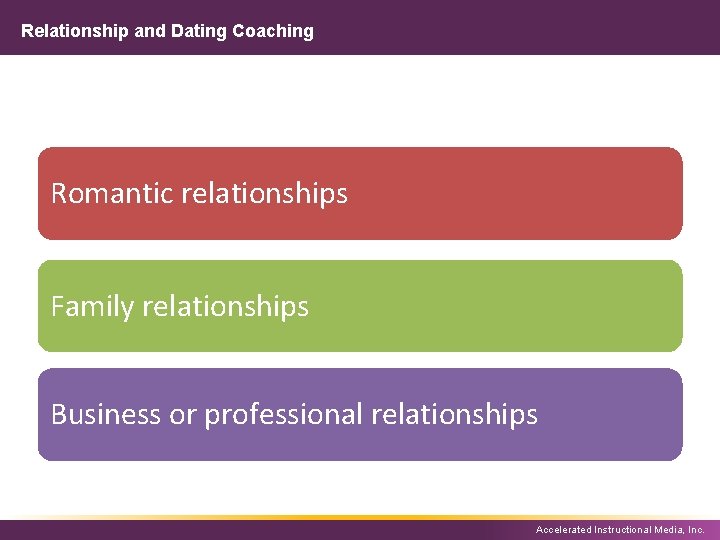
Relationship and Dating Coaching Romantic relationships Family relationships Business or professional relationships Accelerated Instructional Media, Inc.
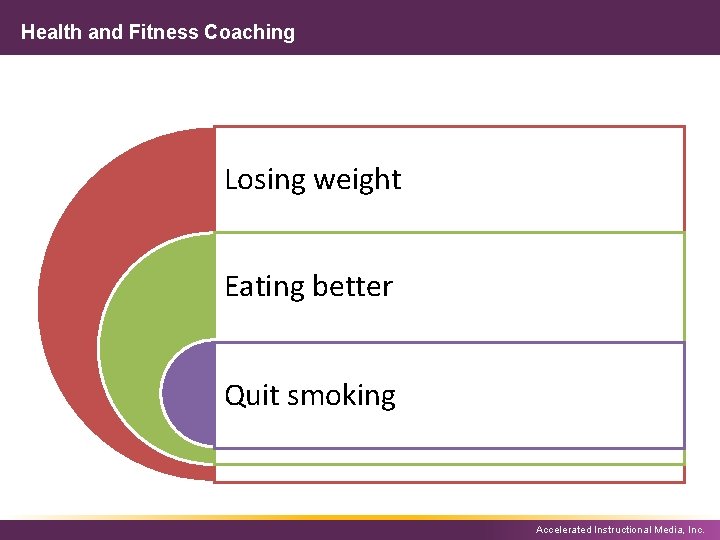
Health and Fitness Coaching Losing weight Eating better Quit smoking Accelerated Instructional Media, Inc.
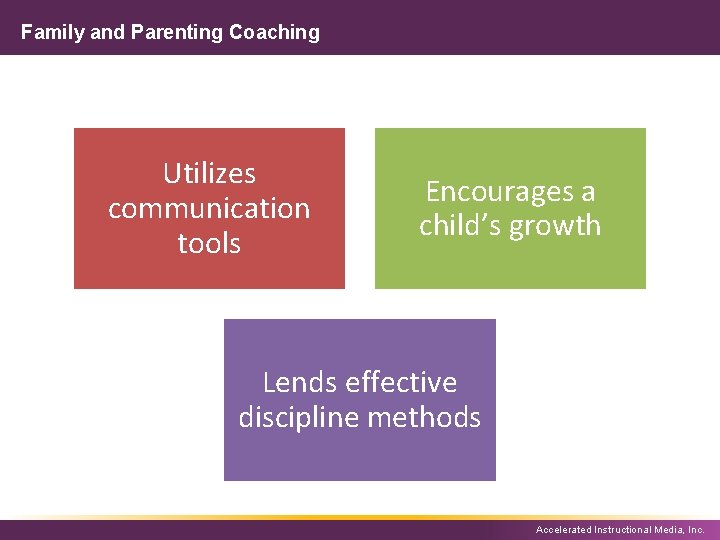
Family and Parenting Coaching Utilizes communication tools Encourages a child’s growth Lends effective discipline methods Accelerated Instructional Media, Inc.
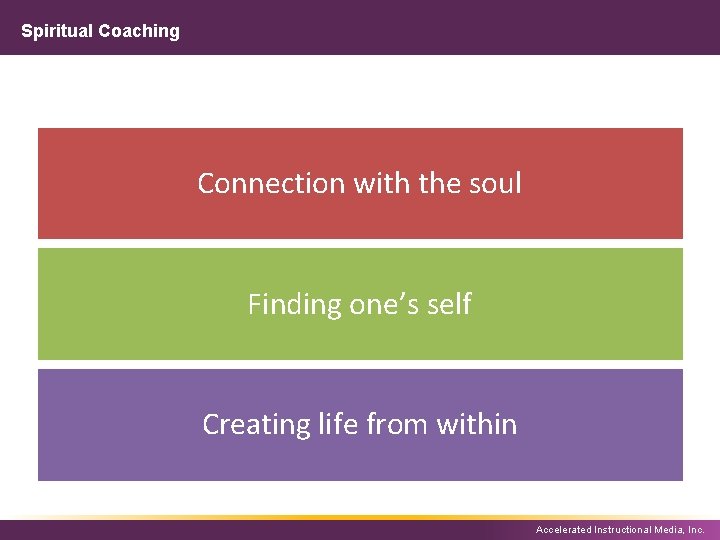
Spiritual Coaching Connection with the soul Finding one’s self Creating life from within Accelerated Instructional Media, Inc.
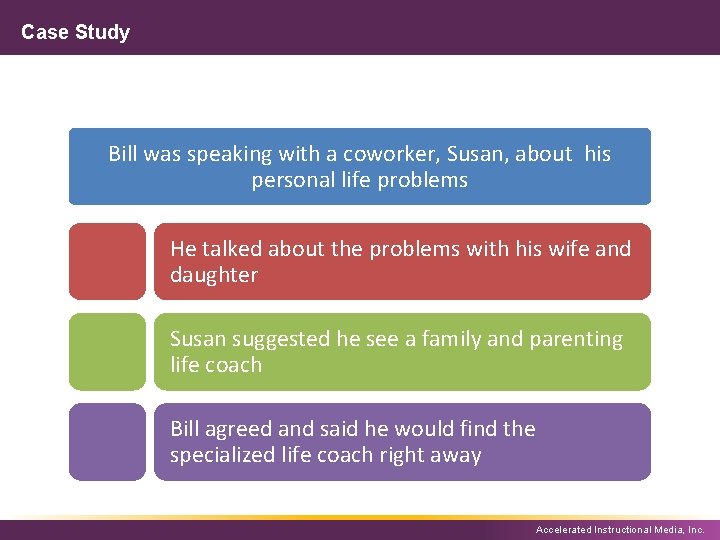
Case Study Bill was speaking with a coworker, Susan, about his personal life problems He talked about the problems with his wife and daughter Susan suggested he see a family and parenting life coach Bill agreed and said he would find the specialized life coach right away Accelerated Instructional Media, Inc.
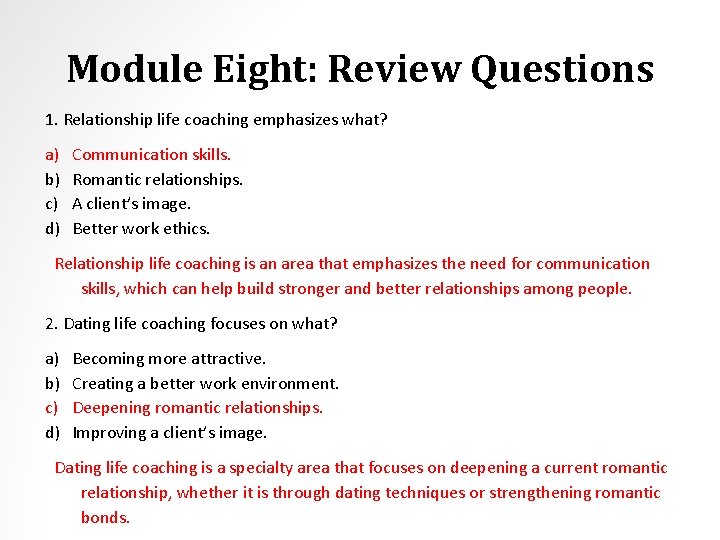
Module Eight: Review Questions 1. Relationship life coaching emphasizes what? a) b) c) d) Communication skills. Romantic relationships. A client’s image. Better work ethics. Relationship life coaching is an area that emphasizes the need for communication skills, which can help build stronger and better relationships among people. 2. Dating life coaching focuses on what? a) b) c) d) Becoming more attractive. Creating a better work environment. Deepening romantic relationships. Improving a client’s image. Dating life coaching is a specialty area that focuses on deepening a current romantic relationship, whether it is through dating techniques or strengthening romantic bonds.
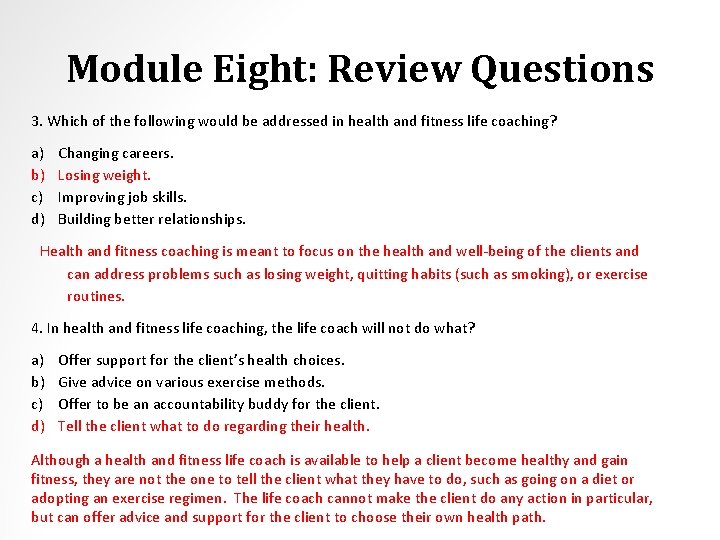
Module Eight: Review Questions 3. Which of the following would be addressed in health and fitness life coaching? a) b) c) d) Changing careers. Losing weight. Improving job skills. Building better relationships. Health and fitness coaching is meant to focus on the health and well-being of the clients and can address problems such as losing weight, quitting habits (such as smoking), or exercise routines. 4. In health and fitness life coaching, the life coach will not do what? a) b) c) d) Offer support for the client’s health choices. Give advice on various exercise methods. Offer to be an accountability buddy for the client. Tell the client what to do regarding their health. Although a health and fitness life coach is available to help a client become healthy and gain fitness, they are not the one to tell the client what they have to do, such as going on a diet or adopting an exercise regimen. The life coach cannot make the client do any action in particular, but can offer advice and support for the client to choose their own health path.
Module Eight: Review Questions 5. Parenting life coaching can be available to whom? a) b) c) d) New parents. Guardians. Experienced parents. All of the above. Parental life coaching is an area of life coaching that focuses on relationships between parents and children. This area of life coaching is available to new parents, experienced or veteran parents, and any person assigned as a guardian over children. 6. Family coaching can be done between ______. a) b) c) d) Only one to two family members. Several family members. Parents and children only. Outside friends. Family life coaching is exactly what the name implies – it is life coaching available to any members of a family. It is often performed between several family members at a time and can include any form of family relationships.
Module Eight: Review Questions 7. It’s a common misbelief that spiritual life coaching is based on what? a) b) c) d) Personal beliefs. Inner peace. Client choice. Religion. Many people make the mistake that spiritual life coaching must be based on some sort of religion. However, spiritual life coaching is based on the client’s spiritual selves, rather than any form of deity or mythology. 8. Spiritual life coaching focuses on what? a) b) c) d) The client’s inner being. The client’s religious preferences. The client’s choice of deity. The client’s choice of worship. Spiritual life coaching focuses on the client’s own spiritual well-being and the balance of their inner being. Spiritual coaching focuses almost exclusively on the client and does not expand much into the other areas of their life.
Module Eight: Review Questions 9. What was one problem Bill was currently facing? a) b) c) d) Problems with one of his coworkers. Problems with his manager. Problems with his daughter. Problems with his mother-in-law. When Bill was speaking with Susan, he told her about the problems he was having, including fighting with his wife and daughter, which was creating problems at work. 10. What type of life coach did Susan suggest Bill go see? a) b) c) d) Image life coach. Family life coach. Health and fitness life coach. General life coach. After listening to Bill’s different problems and situations, Susan suggested Bill should see a family life coach since she feels this type of coach can address a large majority of his problems.
Module Nine: Life Coaching Specialized Areas (II) You have to motivate yourself with challenges. That’s how you know you’re still alive. Jerry Seinfeld Accelerated Instructional Media, Inc.
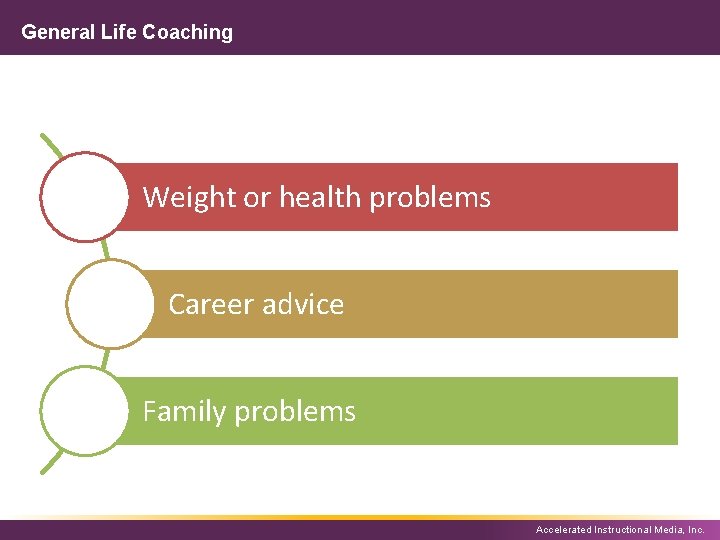
General Life Coaching Weight or health problems Career advice Family problems Accelerated Instructional Media, Inc.
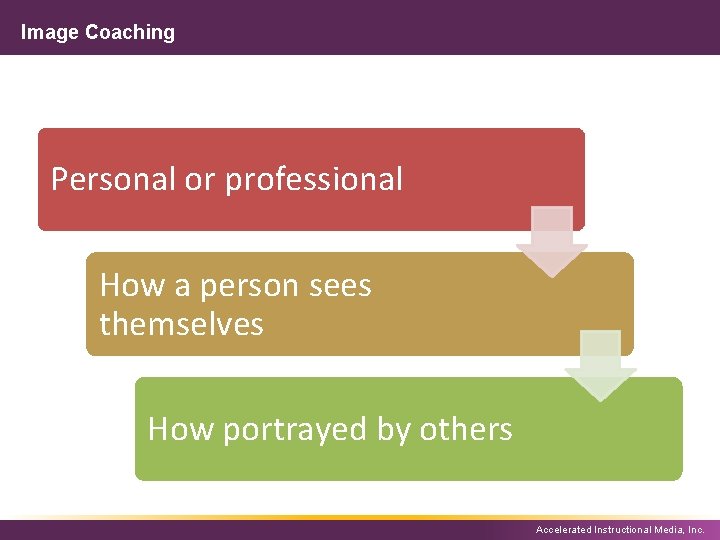
Image Coaching Personal or professional How a person sees themselves How portrayed by others Accelerated Instructional Media, Inc.
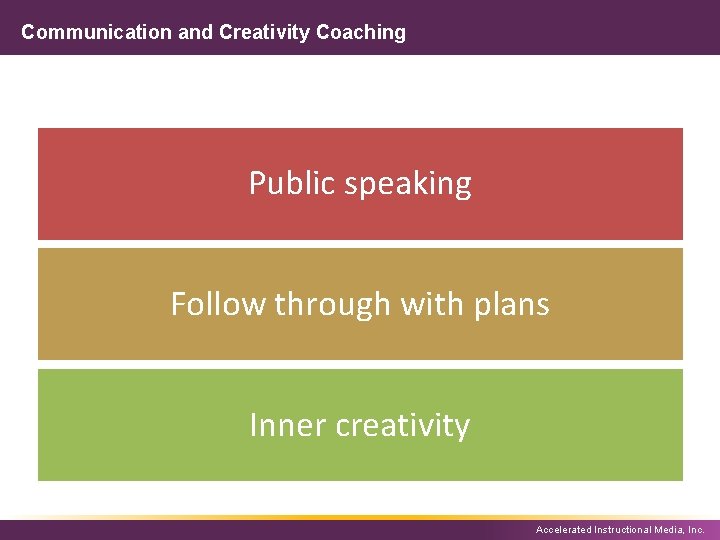
Communication and Creativity Coaching Public speaking Follow through with plans Inner creativity Accelerated Instructional Media, Inc.
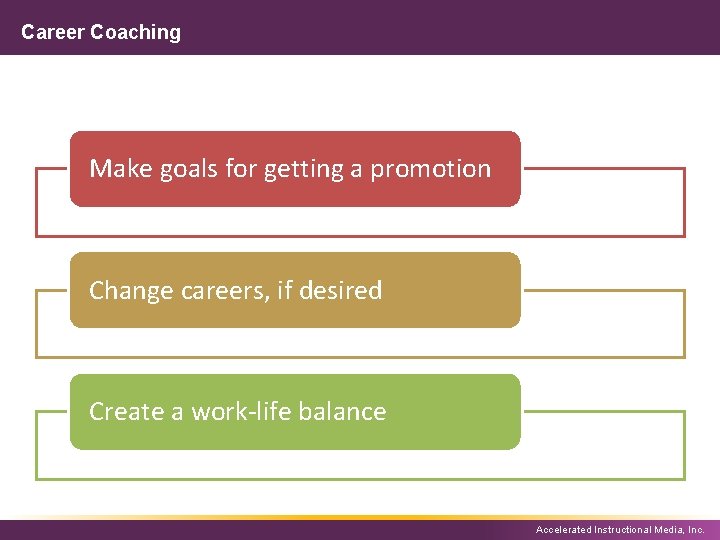
Career Coaching Make goals for getting a promotion Change careers, if desired Create a work-life balance Accelerated Instructional Media, Inc.
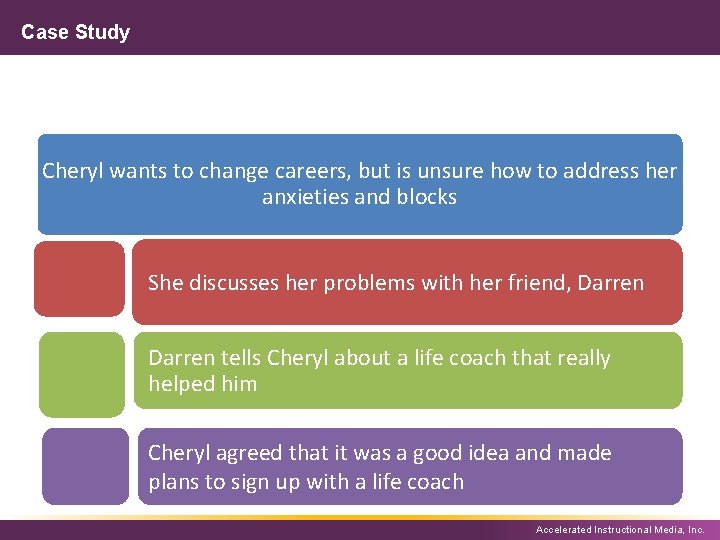
Case Study Cheryl wants to change careers, but is unsure how to address her anxieties and blocks She discusses her problems with her friend, Darren tells Cheryl about a life coach that really helped him Cheryl agreed that it was a good idea and made plans to sign up with a life coach Accelerated Instructional Media, Inc.
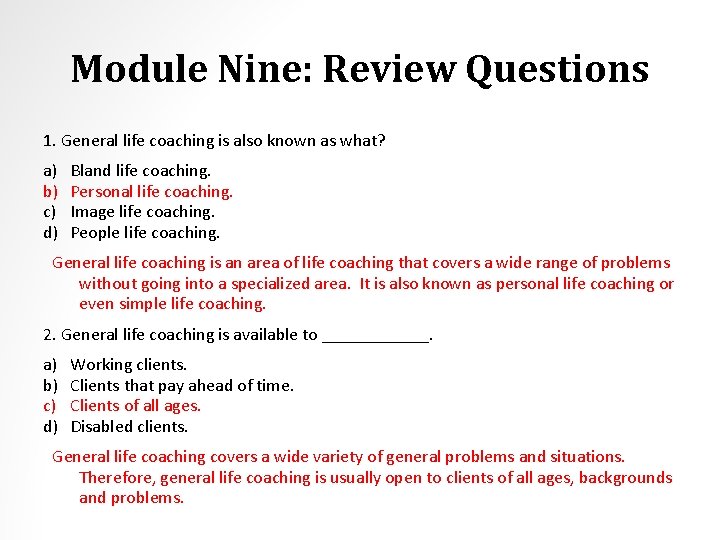
Module Nine: Review Questions 1. General life coaching is also known as what? a) b) c) d) Bland life coaching. Personal life coaching. Image life coaching. People life coaching. General life coaching is an area of life coaching that covers a wide range of problems without going into a specialized area. It is also known as personal life coaching or even simple life coaching. 2. General life coaching is available to ______. a) b) c) d) Working clients. Clients that pay ahead of time. Clients of all ages. Disabled clients. General life coaching covers a wide variety of general problems and situations. Therefore, general life coaching is usually open to clients of all ages, backgrounds and problems.
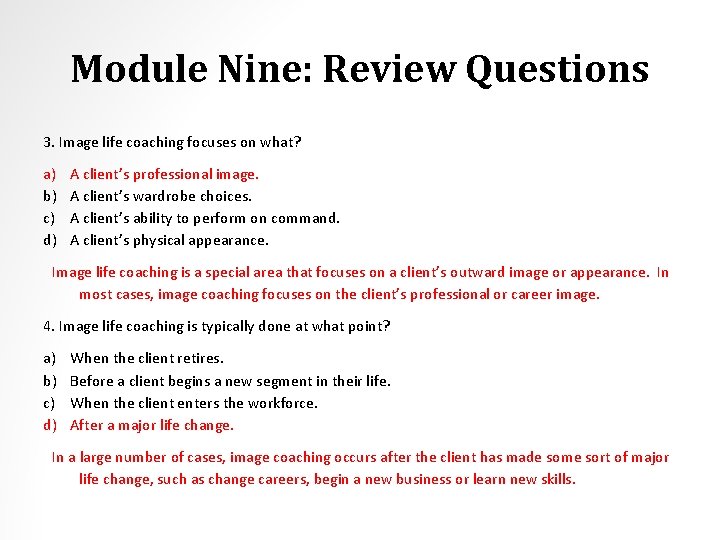
Module Nine: Review Questions 3. Image life coaching focuses on what? a) b) c) d) A client’s professional image. A client’s wardrobe choices. A client’s ability to perform on command. A client’s physical appearance. Image life coaching is a special area that focuses on a client’s outward image or appearance. In most cases, image coaching focuses on the client’s professional or career image. 4. Image life coaching is typically done at what point? a) b) c) d) When the client retires. Before a client begins a new segment in their life. When the client enters the workforce. After a major life change. In a large number of cases, image coaching occurs after the client has made some sort of major life change, such as change careers, begin a new business or learn new skills.
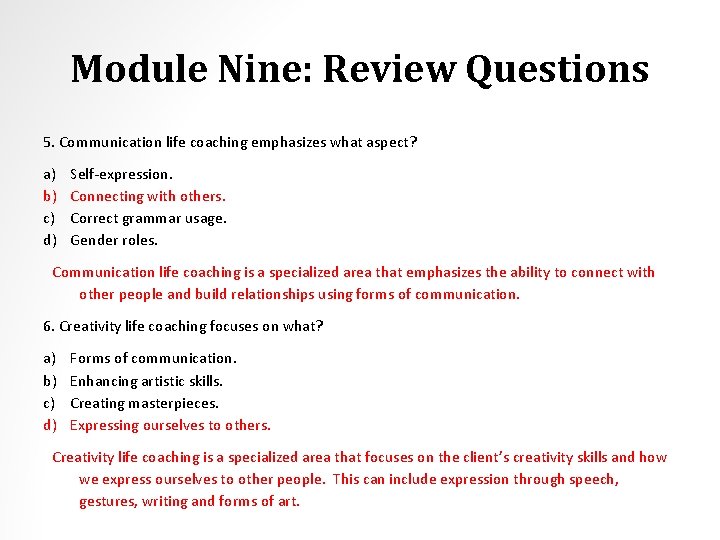
Module Nine: Review Questions 5. Communication life coaching emphasizes what aspect? a) b) c) d) Self-expression. Connecting with others. Correct grammar usage. Gender roles. Communication life coaching is a specialized area that emphasizes the ability to connect with other people and build relationships using forms of communication. 6. Creativity life coaching focuses on what? a) b) c) d) Forms of communication. Enhancing artistic skills. Creating masterpieces. Expressing ourselves to others. Creativity life coaching is a specialized area that focuses on the client’s creativity skills and how we express ourselves to other people. This can include expression through speech, gestures, writing and forms of art.
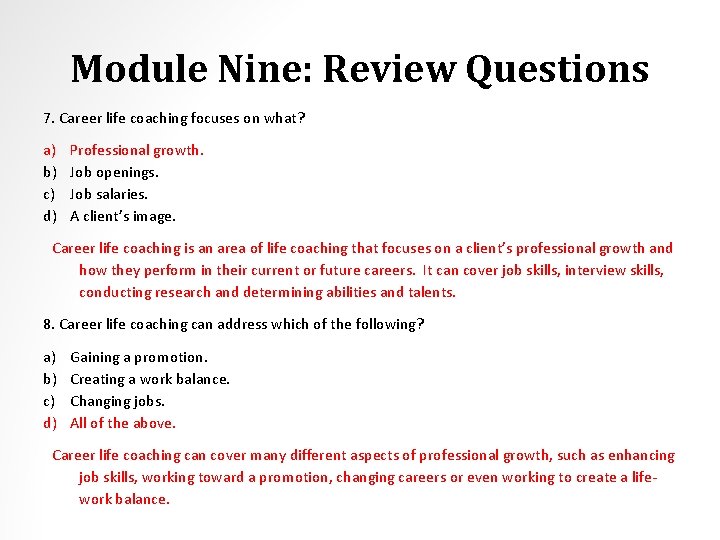
Module Nine: Review Questions 7. Career life coaching focuses on what? a) b) c) d) Professional growth. Job openings. Job salaries. A client’s image. Career life coaching is an area of life coaching that focuses on a client’s professional growth and how they perform in their current or future careers. It can cover job skills, interview skills, conducting research and determining abilities and talents. 8. Career life coaching can address which of the following? a) b) c) d) Gaining a promotion. Creating a work balance. Changing jobs. All of the above. Career life coaching can cover many different aspects of professional growth, such as enhancing job skills, working toward a promotion, changing careers or even working to create a lifework balance.
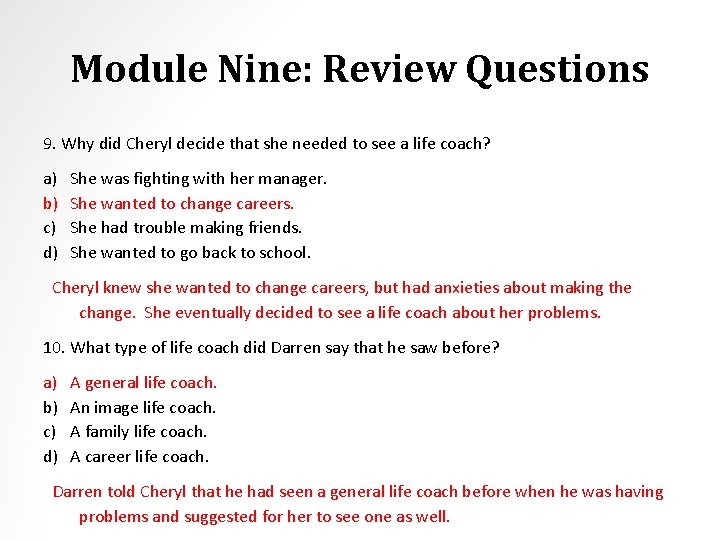
Module Nine: Review Questions 9. Why did Cheryl decide that she needed to see a life coach? a) b) c) d) She was fighting with her manager. She wanted to change careers. She had trouble making friends. She wanted to go back to school. Cheryl knew she wanted to change careers, but had anxieties about making the change. She eventually decided to see a life coach about her problems. 10. What type of life coach did Darren say that he saw before? a) b) c) d) A general life coach. An image life coach. A family life coach. A career life coach. Darren told Cheryl that he had seen a general life coach before when he was having problems and suggested for her to see one as well.
Module Ten: Life Coaching Specialized Areas (III) Success is the progressive realization of predetermined, worthwhile personal goals. Paul J. Meyer Accelerated Instructional Media, Inc.
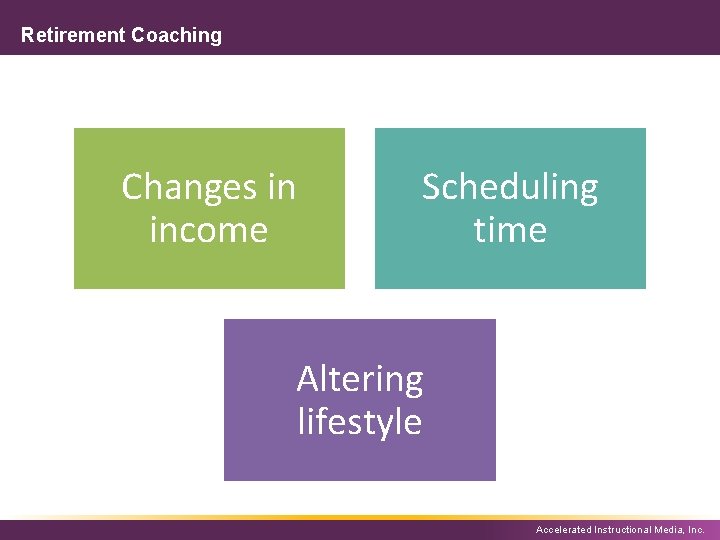
Retirement Coaching Changes in income Scheduling time Altering lifestyle Accelerated Instructional Media, Inc.
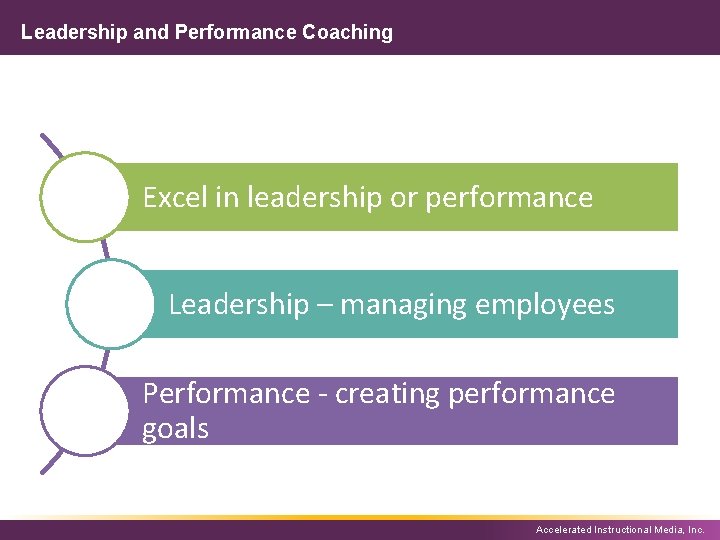
Leadership and Performance Coaching Excel in leadership or performance Leadership – managing employees Performance - creating performance goals Accelerated Instructional Media, Inc.
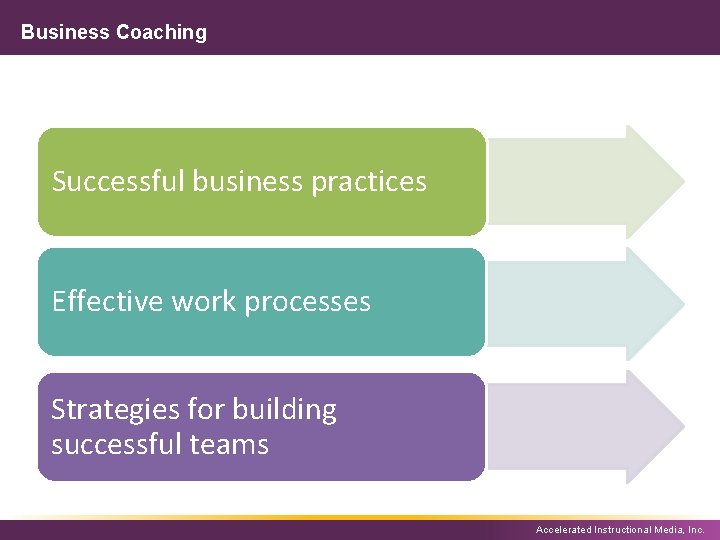
Business Coaching Successful business practices Effective work processes Strategies for building successful teams Accelerated Instructional Media, Inc.
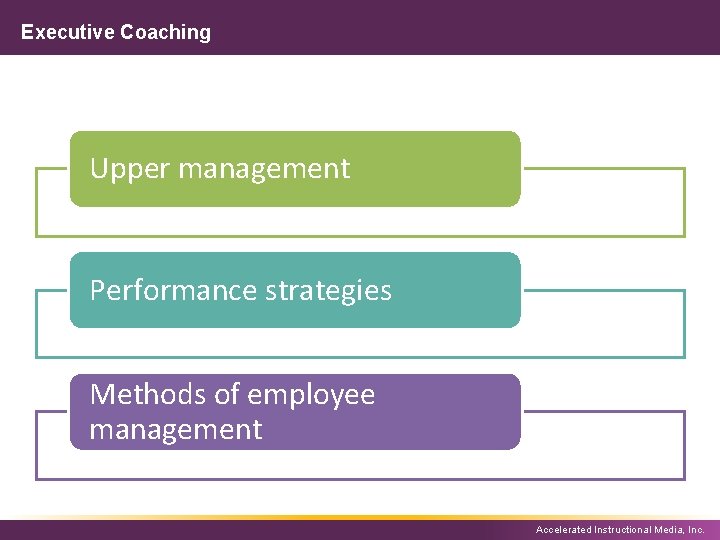
Executive Coaching Upper management Performance strategies Methods of employee management Accelerated Instructional Media, Inc.
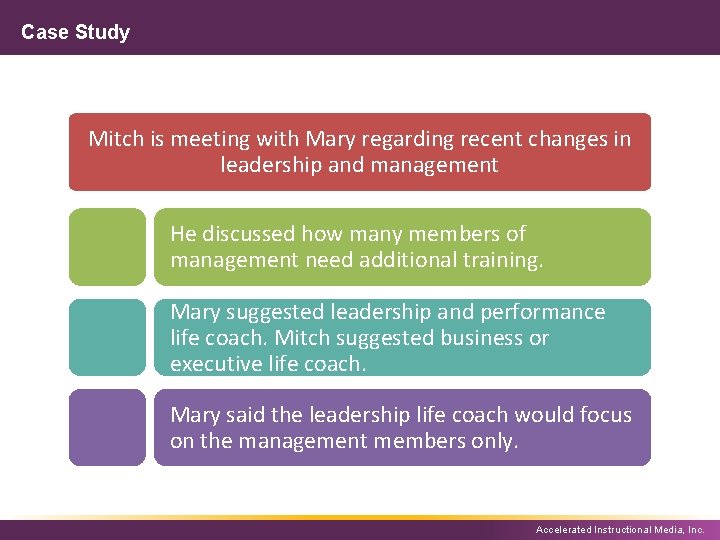
Case Study Mitch is meeting with Mary regarding recent changes in leadership and management He discussed how many members of management need additional training. Mary suggested leadership and performance life coach. Mitch suggested business or executive life coach. Mary said the leadership life coach would focus on the management members only. Accelerated Instructional Media, Inc.
Module Ten: Review Questions 1. When can retirement life coaching begin? a) b) c) d) After a person has retired. When a person starts working. Before a person retires. At any time. Retirement life coaching is available to individuals who want to prepare for and thrive during retirement. This type of life coaching can actually occur at any time, including before, during or after official retirement. 2. What is one thing retirement life coaching can help with? a) b) c) d) Preparing to enter retirement. Making money before retirement. How to convince your spouse to retire. Opening a savings account. Retirement life coaching can help with a number of issues related to retirement, such as general preparation, changes in income or social circles, money management and even changes in schedules and activities.
Module Ten: Review Questions 3. Leadership life coaching emphasizes what? a) b) c) d) Skills in communications. Skills in building relationships. Skills in professional leadership. Skills in building a professional image. Leadership life coaching is a specialized area that focuses on the skills and abilities for professional leadership growth and development. This can include team leaders, managers and even executive can CEOs of companies. 4. Performance life coaching focuses on what? a) b) c) d) Building business partnerships. Improving particular job skills. Improving communication skills. Creating a professional image. Performance life coaching is a specialized area that focuses on developing or improving particular skills or talents. While this area of life coaching can be for personal or professional use, it is more often used for improving job skills and abilities.
Module Ten: Review Questions 5. Business life coaches can be hired ________. a) b) c) d) After a full background check. As a third party employee. As a tax deduction. Only once a year. Business life coaches are used by different type of clients in the business field that may seek help, such as a small business. In any case, a business life coach can either be hired as a third party, or contract, employee or can be hired onto the company itself as a private employee. 6. Business life coaching can be used by which of the following? a) b) c) d) Small businesses. Corporations. Family-owned businesses. All of the above. Business life coaches are used by business owners that seek help and support for their business. These clients can include small business owners, large corporations, non-profit foundations,
Module Ten: Review Questions 7. Executive life coaching is typically used by whom? a) b) c) d) Unemployed clients. Entry level employees. Management members. Newly hired employees. Executive life coaching is a form of life coaching that addresses high levels of leadership and coaches about executive business skills. Executive life coaches are most likely used in large corporations and businesses. 8. One topic covered by executive life coaching is what? a) b) c) d) Employee management. Personal image. Retirement counseling. Interview skills. Executive life coaching is life coaching for high levels of leadership and executive. Typical topics covered in this area include leadership growth, business practices and tools and employee selection and management.
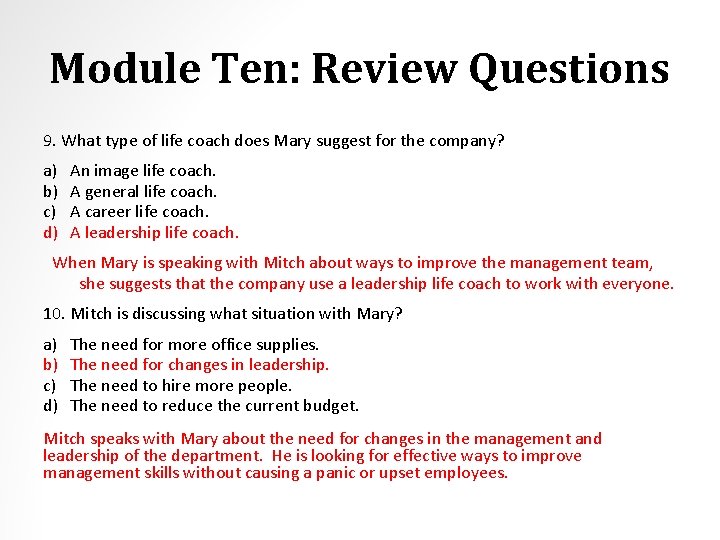
Module Ten: Review Questions 9. What type of life coach does Mary suggest for the company? a) b) c) d) An image life coach. A general life coach. A career life coach. A leadership life coach. When Mary is speaking with Mitch about ways to improve the management team, she suggests that the company use a leadership life coach to work with everyone. 10. Mitch is discussing what situation with Mary? a) b) c) d) The need for more office supplies. The need for changes in leadership. The need to hire more people. The need to reduce the current budget. Mitch speaks with Mary about the need for changes in the management and leadership of the department. He is looking for effective ways to improve management skills without causing a panic or upset employees.
Module Eleven: Apply What You Learned to the Workplace For success, attitude is equally as important as ability. Walter Scott Accelerated Instructional Media, Inc.
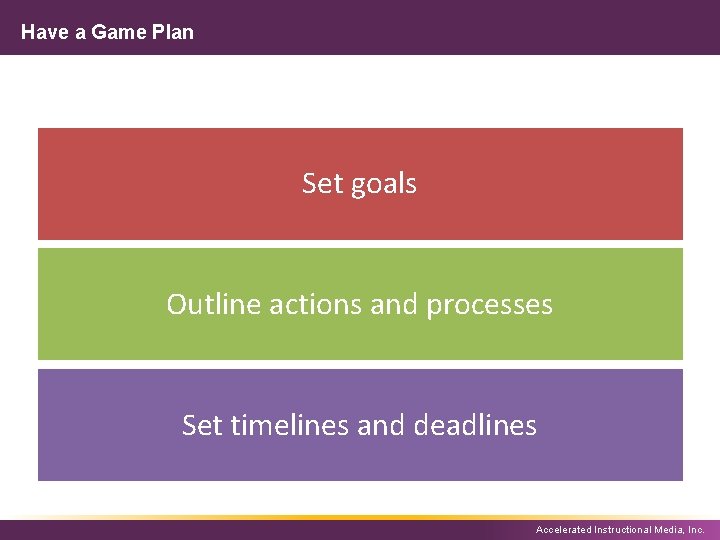
Have a Game Plan Set goals Outline actions and processes Set timelines and deadlines Accelerated Instructional Media, Inc.
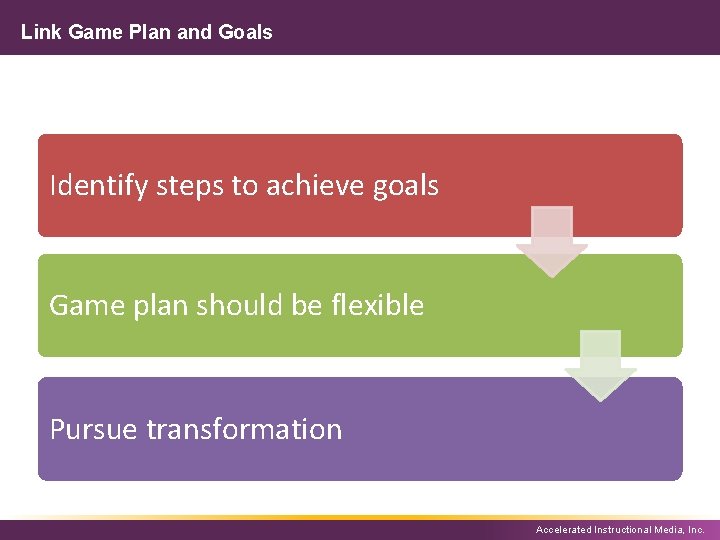
Link Game Plan and Goals Identify steps to achieve goals Game plan should be flexible Pursue transformation Accelerated Instructional Media, Inc.
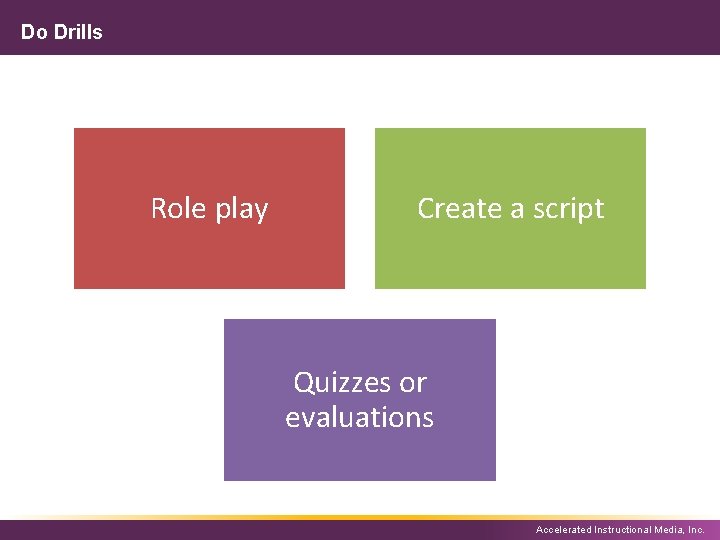
Do Drills Role play Create a script Quizzes or evaluations Accelerated Instructional Media, Inc.
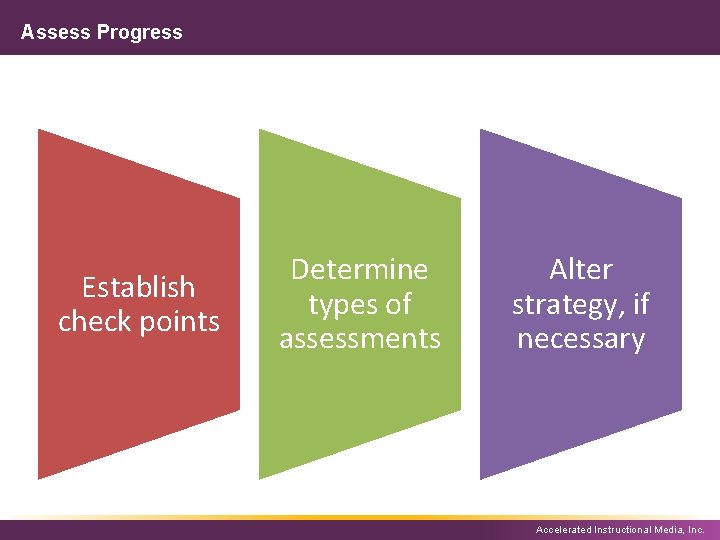
Assess Progress Establish check points Determine types of assessments Alter strategy, if necessary Accelerated Instructional Media, Inc.
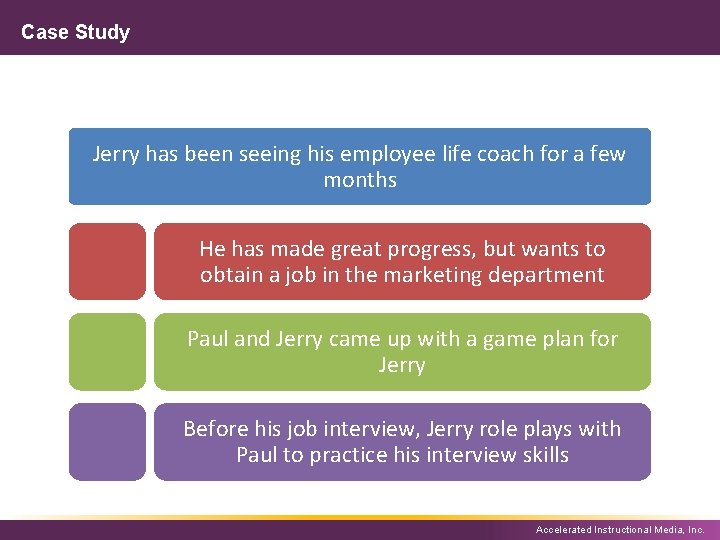
Case Study Jerry has been seeing his employee life coach for a few months He has made great progress, but wants to obtain a job in the marketing department Paul and Jerry came up with a game plan for Jerry Before his job interview, Jerry role plays with Paul to practice his interview skills Accelerated Instructional Media, Inc.
Module Eleven: Review Questions 1. What is one part of an employee game plan? a) b) c) d) Employee evaluations. Assigned tasks. Employee schedules. Potential goals. An employee game plan should include several aspects of what the employee wants to achieve and how they can accomplish them. The game plan starts by addressing the employee’s potential goals and desired achievements. 2. Which of the following should be included in a game plan? a) b) c) d) Homework assignments. Timelines. Job duties. None of the above. An employee game plan should include several aspects of what the employee wants to achieve and how they can accomplish them. The game plan should include the employee’s potential goals, tentative timelines and processes, and if the employee will need some sort of assistance.
Module Eleven: Review Questions 3. The game plan and goals should always be what? a) b) c) d) Flexible. Fast-paced. Easy. Lengthy. When an employee begins to build their game plan and goals, it is important that they remain flexible in form, since some areas or processes may need to be changed or altered at some point during the plan. 4. The linked game plan should outline what? a) b) c) d) A management flow chart. Employee job duties. Processes to follow. Potential salaries. When a game plan is linked to the employee’s goals, the processes or actions that will be taken should be outlined in the plan. This outline plan should also include alternate plans or processes in case the original plan does not work out.
Module Eleven: Review Questions 5. Performing drills allows the employee to do what? a) b) c) d) Prevent boredom. Hone their skills. Become more fatigued. Earn more money. Since practice can make perfect, performing drills can help an employee improve their current skills or talents and lead to learning new ones. 6. One form of a drill is what? a) b) c) d) Role playing a situation. Read silently. Talk with a coworker. Researching other jobs areas. There are many different types of drills and exercises an employee can do. Common examples include creating a script or outline or role playing a particular situation or event.
Module Eleven: Review Questions 7. It is important that employee assessments are what? a) b) c) d) Strict. Universal. Extensive. Individualized. When creating forms of employee assessments, it is important that they are personalized or individualized to the employee, since every employee will learn and grow differently. 8. Assessments area great tool for documenting what? a) b) c) d) Company spending. Employee job duties. Employee progress. Management skills. Assessments and forms are a great tool more management to use in order to track employee growth and progress. Using a variety of assessment tools, the manager can show far they have come and how close they may be to their goals.
Module Eleven: Review Questions 9. What part of the company does Jerry want to transfer to? a) b) c) d) The accounting department. The marketing department. Upper management. The IT department. Jerry is currently working on the sales floor of his company, but he expresses that he would like to work in the company’s marketing department instead. 10. What is one thing Paul suggests for Jerry to do? a) b) c) d) Take communication classes. Change companies. Go back to school. Select another department to work in. When Paul and Jerry are discussing how Jerry can reach his goal, Paul suggests that Jerry take some form of communication class to learn better communication skills. He also helps Jerry prepare for his interview by role playing the situation with him.
Module Twelve: Wrapping Up If you choose, the challenges can make you stronger. Ralph Marston Accelerated Instructional Media, Inc.
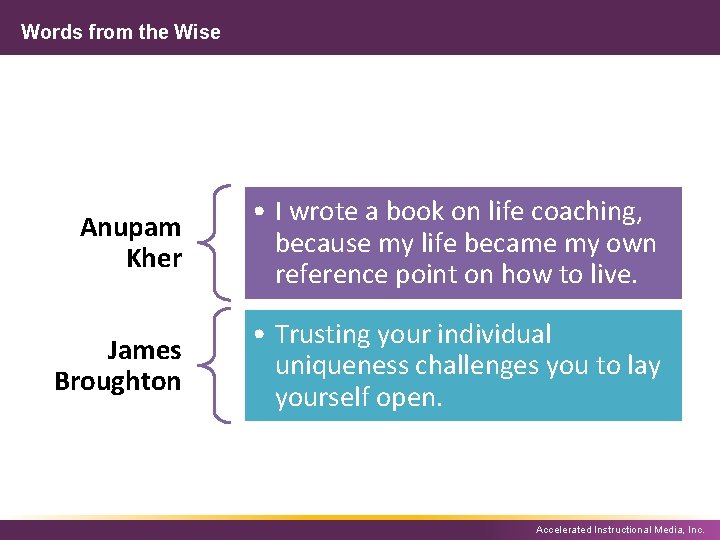
Words from the Wise Anupam Kher • I wrote a book on life coaching, because my life became my own reference point on how to live. James Broughton • Trusting your individual uniqueness challenges you to lay yourself open. Accelerated Instructional Media, Inc.
ISD to Update Conclusion Recap and Reflection Wrap-up Accelerated Instructional Media, Inc.
Revisiting Your Responses What of your original response would have changed if you knew the insights provided today? Next Steps in Success Apply What You’ve Learned Your next step is to complete the On -the-Job section of the XXXX Caree Development topic. ISD to Update Accelerated Instructional Media, Inc. | www. aim 2 train. com
Thank you! Survey ISD to Update Which today Accelerated Instructional Media, Inc. | www. aim 2 train. com
Recap and Reflect ISD to Update
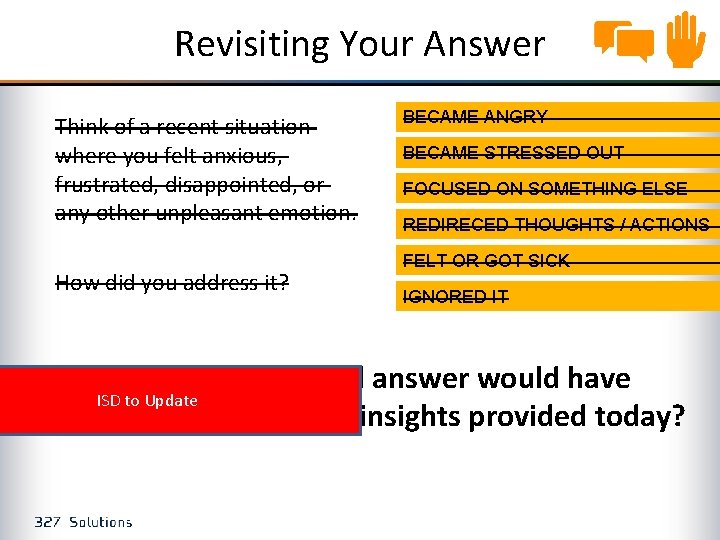
Revisiting Your Answer Think of a recent situation where you felt anxious, frustrated, disappointed, or any other unpleasant emotion. How did you address it? BECAME ANGRY BECAME STRESSED OUT FOCUSED ON SOMETHING ELSE REDIRECED THOUGHTS / ACTIONS FELT OR GOT SICK IGNORED IT What of your original answer would have ISD to Update changed if you knew the insights provided today?
LEARN – APPLY – PRACTICE – EVALUATE Update Image Which insights of leadership and influence from today’s session will you apply immediately? ISD to Update www. 327 solutions. com
- Slides: 132