
Name Hour ASL 1 Unit 4 The Ear

- Slides: 4
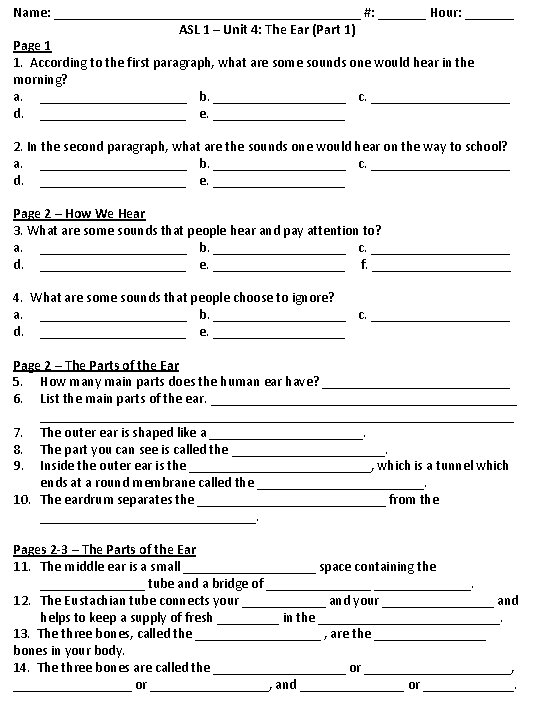
Name: ______________________ #: _______ Hour: _______ ASL 1 – Unit 4: The Ear (Part 1) Page 1 1. According to the first paragraph, what are some sounds one would hear in the morning? a. ___________ b. __________ c. __________ d. ___________ e. __________ 2. In the second paragraph, what are the sounds one would hear on the way to school? a. ___________ b. __________ c. __________ d. ___________ e. __________ Page 2 – How We Hear 3. What are some sounds that people hear and pay attention to? a. ___________ b. __________ c. __________ d. ___________ e. __________ f. __________ 4. What are some sounds that people choose to ignore? a. ___________ b. __________ c. __________ d. ___________ e. __________ Page 2 – The Parts of the Ear 5. How many main parts does the human ear have? ______________ 6. List the main parts of the ear. ________________________________________________________ 7. The outer ear is shaped like a ___________. 8. The part you can see is called the ___________. 9. Inside the outer ear is the _____________, which is a tunnel which ends at a round membrane called the ____________. 10. The eardrum separates the ______________ from the ________________. Pages 2 -3 – The Parts of the Ear 11. The middle ear is a small __________ space containing the ________ tube and a bridge of ________. 12. The Eustachian tube connects your ______ and your ________ and helps to keep a supply of fresh _____ in the _____________. 13. The three bones, called the _________ , are the ________ bones in your body. 14. The three bones are called the __________ or ___________, _________ or _________, and ________ or _______.
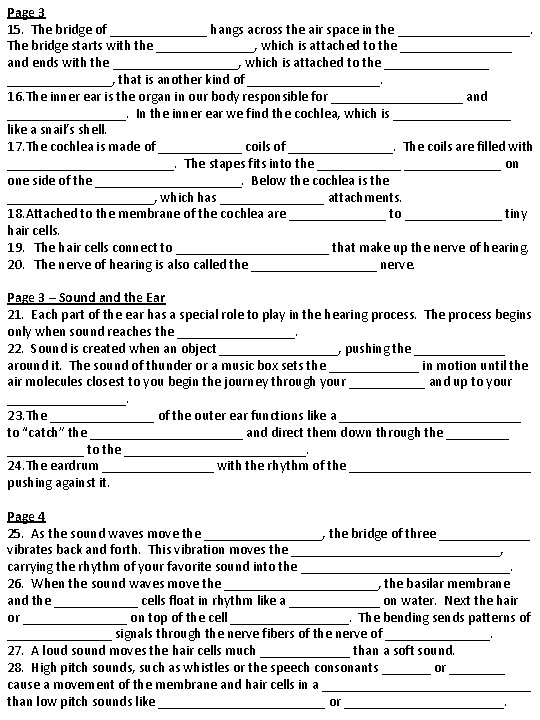
Page 3 15. The bridge of _______ hangs across the air space in the __________. The bridge starts with the _______, which is attached to the ________ and ends with the _________, which is attached to the _______________, that is another kind of __________. 16. The inner ear is the organ in our body responsible for __________ and _________. In the inner ear we find the cochlea, which is _________ like a snail’s shell. 17. The cochlea is made of ______ coils of ________. The coils are filled with ____________. The stapes fits into the ______________ on one side of the ___________. Below the cochlea is the ___________, which has ________ attachments. 18. Attached to the membrane of the cochlea are _______ to _______ tiny hair cells. 19. The hair cells connect to ___________ that make up the nerve of hearing. 20. The nerve of hearing is also called the _________ nerve. Page 3 – Sound and the Ear 21. Each part of the ear has a special role to play in the hearing process. The process begins only when sound reaches the _________. 22. Sound is created when an object _________, pushing the _______ around it. The sound of thunder or a music box sets the _______ in motion until the air molecules closest to you begin the journey through your ______ and up to your _________. 23. The ________ of the outer ear functions like a _____________ to “catch” the ___________ and direct them down through the ___________ to the _____________. 24. The eardrum ________ with the rhythm of the _____________ pushing against it. Page 4 25. As the sound waves move the _________, the bridge of three _______ vibrates back and forth. This vibration moves the _______________, carrying the rhythm of your favorite sound into the _______________. 26. When the sound waves move the ___________, the basilar membrane and the ______ cells float in rhythm like a _______ on water. Next the hair or ________ on top of the cell _________. The bending sends patterns of ________ signals through the nerve fibers of the nerve of ________. 27. A loud sound moves the hair cells much _______ than a soft sound. 28. High pitch sounds, such as whistles or the speech consonants _______ or ____ cause a movement of the membrane and hair cells in a _______________ than low pitch sounds like ____________ or ____________.
Name: ______________________ #: _______ Hour: _______ ASL 1 – Unit 4: The Ear (Part 2) Pages – 4 & 5 - More Than Hearing 29. Wax in your ear canal protects the other parts of the ear from _____ & ______. 30. Too much wax in your ear canal can cause you to ______________. 31. Cold germs can travel from your nose & throat to your ______ by traveling through your ________. 32. A change in your hearing when you have an ear infection happens because liquid fills the ________________. The liquid keeps the _______ & ______ from moving freely. Medication usually dries up the liquid and the parts of the middle ear can be set in motion by ___________. 33. The two parts of your inner ear that have nothing to do with hearing are 1. _____________ & 2. _____________ 34. These two parts of your ear provide information to your brain about _________ and the _________ of your body in space. 35. As you turn your body and head, the hair cells in the ________ and _________ change direction. Electrical signals are sent through the nerve fibers, which connect to your _______ muscles. Your ______ move in different directions depending on how your body is twisting and turning. Directions: Match the parts of the human ear with their function(s). WRITE the letter in the indicated box next to the box. DO NOT draw lines or circle! Ear Part 36. Eardrum 37. Pinna 38. Ear Canal 39. Cochlea Your Answer Function A. transfer the vibrations of the eardrum to the inner ear. B. lets fluid drain down the throat and equalizes pressure on either side of the ear drum. C. converts physical vibrations into electrical impulses (contains thousands of hair cells) D. vibrates when impacted by sound waves that have traveled through the external auditory meatus. 40. The Ossicles: hammer, anvil, and stirrup E. collects sound. 41. Eustachian Tube F. provides a passageway for sound traveling from the pinna to the eardrum, and it protects the ear from infection. G. pathway that transfers neural signals from the cochlea to the brain. 42. Auditory Nerve
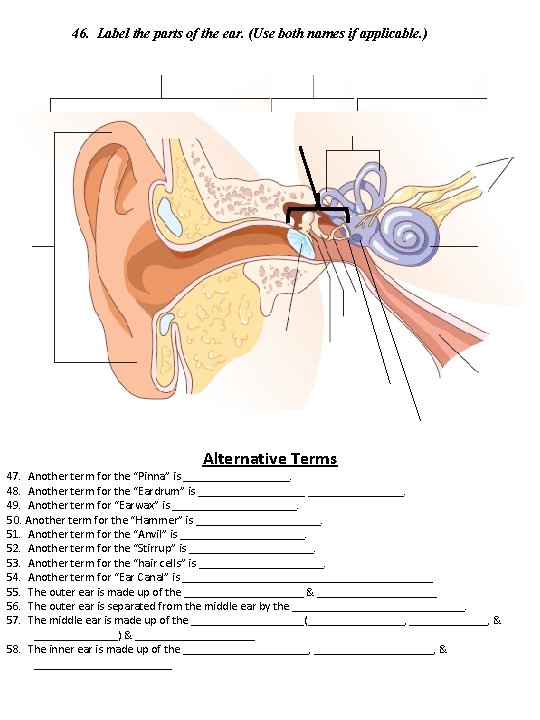
46. Label the parts of the ear. (Use both names if applicable. ) Alternative Terms 47. Another term for the “Pinna” is _________. 48. Another term for the “Eardrum” is _________. 49. Another term for “Earwax” is ___________. 50. Another term for the “Hammer” is ___________. 51. Another term for the “Anvil” is ___________. 52. Another term for the “Stirrup” is ___________. 53. Another term for the “hair cells” is ___________. 54. Another term for “Ear Canal” is _____________________ 55. The outer ear is made up of the __________ & __________ 56. The outer ear is separated from the middle ear by the _______________. 57. The middle ear is made up of the __________(________, & _______) & __________ 58. The inner ear is made up of the ___________, & ____________