
Name Class Unit 4 Cell Membrane Transport Study
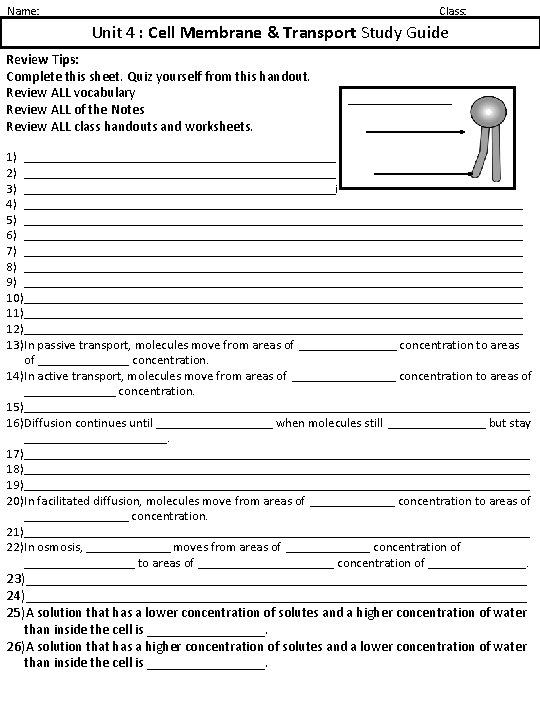
Name: Class: Unit 4 : Cell Membrane & Transport Study Guide Review Tips: Complete this sheet. Quiz yourself from this handout. Review ALL vocabulary Review ALL of the Notes Review ALL class handouts and worksheets. ________ 1) ________________________ 2) ________________________ 3) ________________________i 4) _______________________________________ 5) _______________________________________ 6) _______________________________________ 7) _______________________________________ 8) _______________________________________ 9) _______________________________________ 10)_______________________________________ 11)_______________________________________ 12)_______________________________________ 13)In passive transport, molecules move from areas of ________ concentration to areas of _______ concentration. 14)In active transport, molecules move from areas of ________ concentration to areas of _______ concentration. 15)_______________________________________ 16)Diffusion continues until _________ when molecules still ________ but stay ___________. 17)_______________________________________ 18)_______________________________________ 19)_______________________________________ 20)In facilitated diffusion, molecules move from areas of _______ concentration to areas of ________ concentration. 21)_______________________________________ 22)In osmosis, _______ moves from areas of _______ concentration of _________ to areas of ___________ concentration of ________. 23)____________________________________ 24)____________________________________ 25)A solution that has a lower concentration of solutes and a higher concentration of water than inside the cell is _________. 26)A solution that has a higher concentration of solutes and a lower concentration of water than inside the cell is _________.
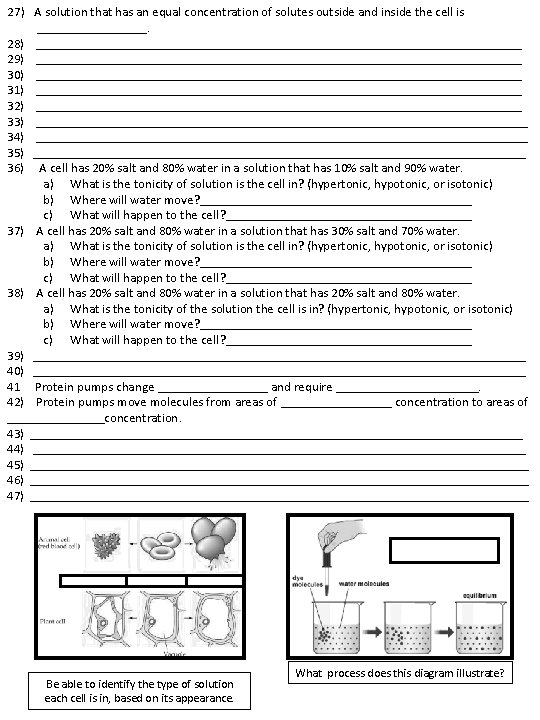
27) A solution that has an equal concentration of solutes outside and inside the cell is _________. 28) ______________________________________ 29) ______________________________________ 30) ______________________________________ 31) ______________________________________ 32) ______________________________________ 33) ______________________________________ 34) ______________________________________ 35) ______________________________________ 36) A cell has 20% salt and 80% water in a solution that has 10% salt and 90% water. a) What is the tonicity of solution is the cell in? (hypertonic, hypotonic, or isotonic) b) Where will water move? _____________________ c) What will happen to the cell? ___________________ 37) A cell has 20% salt and 80% water in a solution that has 30% salt and 70% water. a) What is the tonicity of solution is the cell in? (hypertonic, hypotonic, or isotonic) b) Where will water move? _____________________ c) What will happen to the cell? ___________________ 38) A cell has 20% salt and 80% water in a solution that has 20% salt and 80% water. a) What is the tonicity of the solution the cell is in? (hypertonic, hypotonic, or isotonic) b) Where will water move? _____________________ c) What will happen to the cell? ___________________ 39) ______________________________________ 40) ______________________________________ 41 Protein pumps change _________ and require ___________. 42) Protein pumps move molecules from areas of _________ concentration to areas of ________concentration. 43) ______________________________________ 44) ______________________________________ 45) _______________________________________ 46) _______________________________________ 47) _______________________________________ Be able to identify the type of solution each cell is in, based on its appearance. What process does this diagram illustrate?
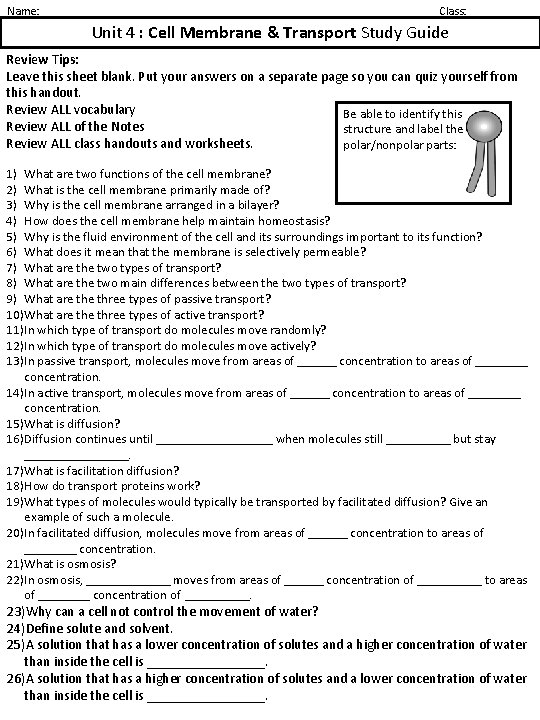
Name: Class: Unit 4 : Cell Membrane & Transport Study Guide Review Tips: Leave this sheet blank. Put your answers on a separate page so you can quiz yourself from this handout. Review ALL vocabulary Be able to identify this Review ALL of the Notes structure and label the Review ALL class handouts and worksheets. polar/nonpolar parts: 1) What are two functions of the cell membrane? 2) What is the cell membrane primarily made of? 3) Why is the cell membrane arranged in a bilayer? 4) How does the cell membrane help maintain homeostasis? 5) Why is the fluid environment of the cell and its surroundings important to its function? 6) What does it mean that the membrane is selectively permeable? 7) What are the two types of transport? 8) What are the two main differences between the two types of transport? 9) What are three types of passive transport? 10)What are three types of active transport? 11)In which type of transport do molecules move randomly? 12)In which type of transport do molecules move actively? 13)In passive transport, molecules move from areas of ______ concentration to areas of ____ concentration. 14)In active transport, molecules move from areas of ______ concentration to areas of ____ concentration. 15)What is diffusion? 16)Diffusion continues until _________ when molecules still _____ but stay ________. 17)What is facilitation diffusion? 18)How do transport proteins work? 19)What types of molecules would typically be transported by facilitated diffusion? Give an example of such a molecule. 20)In facilitated diffusion, molecules move from areas of ______ concentration to areas of ____ concentration. 21)What is osmosis? 22)In osmosis, _______ moves from areas of ______ concentration of _____ to areas of ____ concentration of _____. 23)Why can a cell not control the movement of water? 24)Define solute and solvent. 25)A solution that has a lower concentration of solutes and a higher concentration of water than inside the cell is _________. 26)A solution that has a higher concentration of solutes and a lower concentration of water than inside the cell is _________.
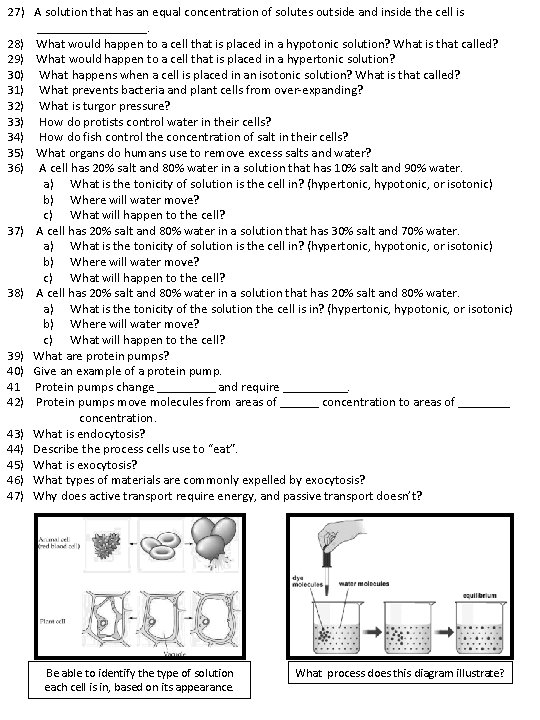
27) A solution that has an equal concentration of solutes outside and inside the cell is _________. 28) What would happen to a cell that is placed in a hypotonic solution? What is that called? 29) What would happen to a cell that is placed in a hypertonic solution? 30) What happens when a cell is placed in an isotonic solution? What is that called? 31) What prevents bacteria and plant cells from over-expanding? 32) What is turgor pressure? 33) How do protists control water in their cells? 34) How do fish control the concentration of salt in their cells? 35) What organs do humans use to remove excess salts and water? 36) A cell has 20% salt and 80% water in a solution that has 10% salt and 90% water. a) What is the tonicity of solution is the cell in? (hypertonic, hypotonic, or isotonic) b) Where will water move? c) What will happen to the cell? 37) A cell has 20% salt and 80% water in a solution that has 30% salt and 70% water. a) What is the tonicity of solution is the cell in? (hypertonic, hypotonic, or isotonic) b) Where will water move? c) What will happen to the cell? 38) A cell has 20% salt and 80% water in a solution that has 20% salt and 80% water. a) What is the tonicity of the solution the cell is in? (hypertonic, hypotonic, or isotonic) b) Where will water move? c) What will happen to the cell? 39) What are protein pumps? 40) Give an example of a protein pump. 41 Protein pumps change _____ and require _____. 42) Protein pumps move molecules from areas of ______ concentration to areas of ____ concentration. 43) What is endocytosis? 44) Describe the process cells use to “eat”. 45) What is exocytosis? 46) What types of materials are commonly expelled by exocytosis? 47) Why does active transport require energy, and passive transport doesn’t? Be able to identify the type of solution each cell is in, based on its appearance. What process does this diagram illustrate?
- Slides: 4