
Nailfold capillaroscopy Joanna Zalewska Definition best method to

Nailfold capillaroscopy Joanna Zalewska

Definition ¨ best method to analyse microvascular abnormalities in autoimmune rheumatic diseases

History ¨ Italian physician, Giovanni Rasori (1766– 1837) described the close relationship between conjunctival inflammation and the presence of an ‘inextricable knot of capillary loops’ by a magnifying glass

Nomal capillaries ¨ the microvascular pattern is characterized by a regular array of microvessels with large intra/interindividual variability ¨ absolute absence of capillary loss and giant capillaries is expected in normal pattern
Scleroderma ¨ architectural disorganization, giant capillaries, haemorrhages, loss of capillaries, angiogenesis and avascular areas characterize >95% of patients

Scleroderma ¨ Early pattern- few enlarged/giant capillaries, few capillary haemorrhages, relatively well-preserved capillary distribution, no evident loss of capillaries
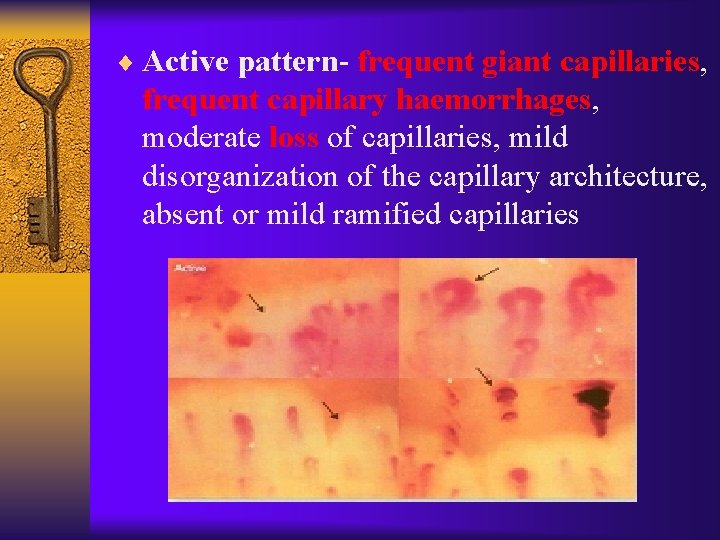
¨ Active pattern- frequent giant capillaries, frequent capillary haemorrhages, moderate loss of capillaries, mild disorganization of the capillary architecture, absent or mild ramified capillaries

¨ Late pattern- irregular enlargement of the capillaries, few or absent giant capillaries and haemorrhages, severe loss of capillaries with extensive avascular areas, disorganization of the normal capillary array, ramified/bushy capillaries
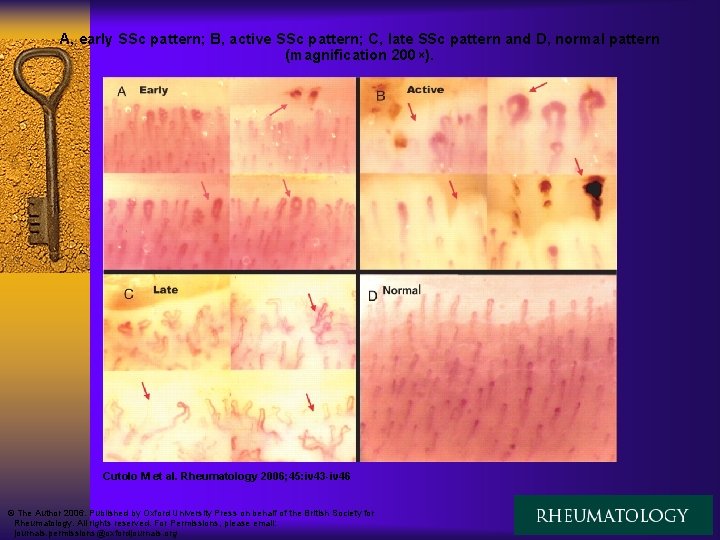
A, early SSc pattern; B, active SSc pattern; C, late SSc pattern and D, normal pattern (magnification 200×). Cutolo M et al. Rheumatology 2006; 45: iv 43 -iv 46 © The Author 2006. Published by Oxford University Press on behalf of the British Society for Rheumatology. All rights reserved. For Permissions, please email: journals. permissions@oxfordjournals. org
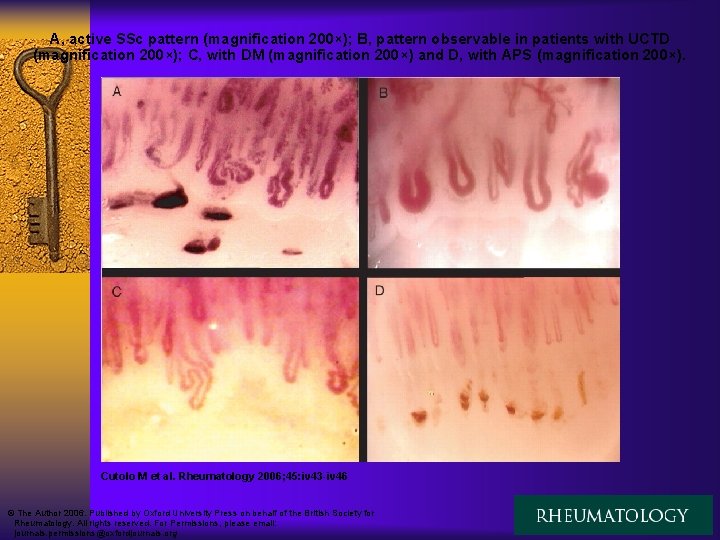
A, active SSc pattern (magnification 200×); B, pattern observable in patients with UCTD (magnification 200×); C, with DM (magnification 200×) and D, with APS (magnification 200×). Cutolo M et al. Rheumatology 2006; 45: iv 43 -iv 46 © The Author 2006. Published by Oxford University Press on behalf of the British Society for Rheumatology. All rights reserved. For Permissions, please email: journals. permissions@oxfordjournals. org
- Slides: 10