
NAFA Best Practice Guideline For Hospitals and Healthcare
NAFA Best Practice Guideline For Hospitals and Healthcare Facilities Accreditation for Technicians involved in the installation, operation and maintenance of air filtration systems NAFA Copyright 2015 V 8
Estimated Deaths – Hospital Acquired Infections 90, 000 People Die of Hospitalacquired Infections per year And Costs… $4. 5 Billion Per Year NAFA Copyright 2013 V 2 -------Centers for Disease Control & Prevention
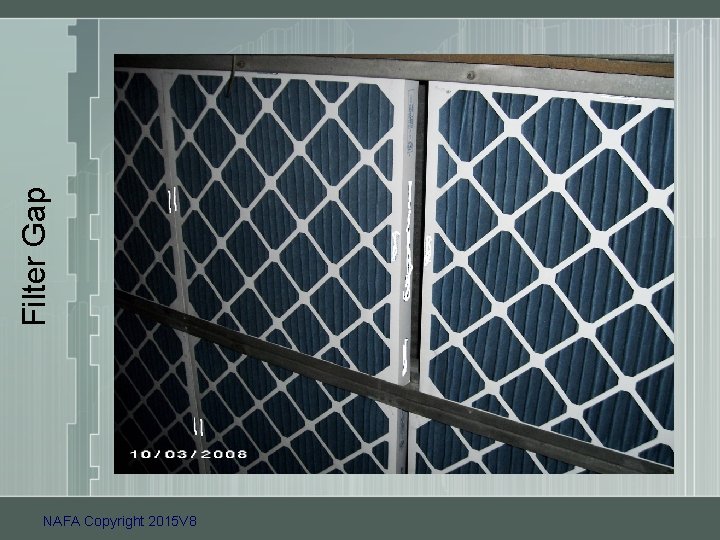
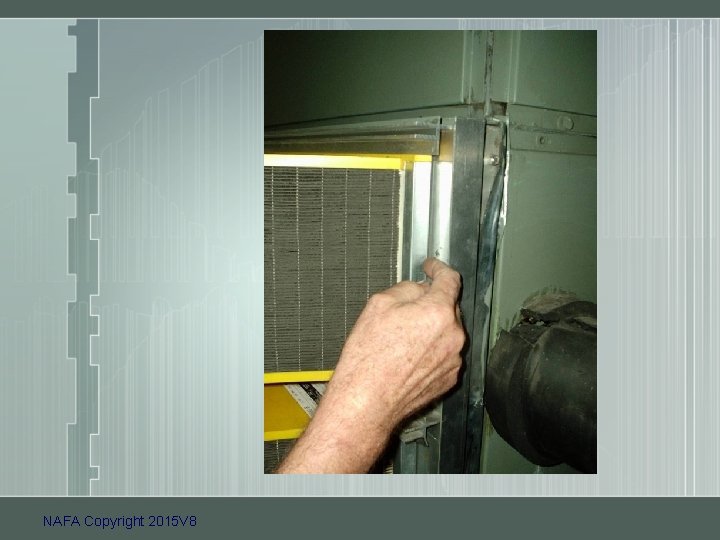
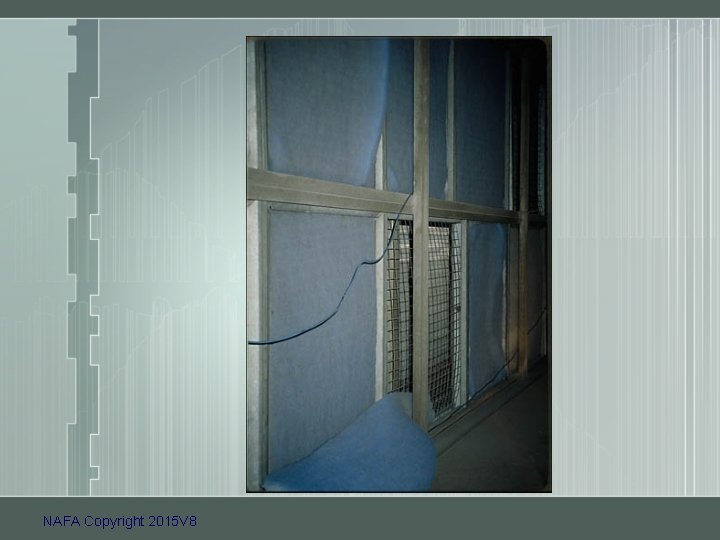
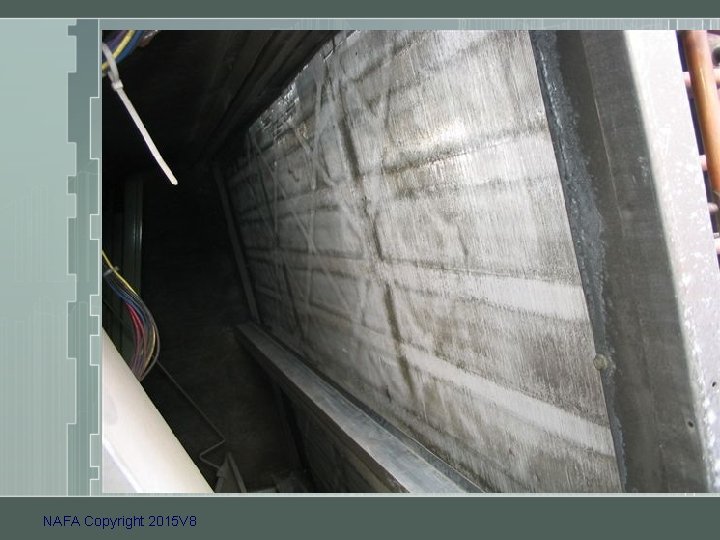
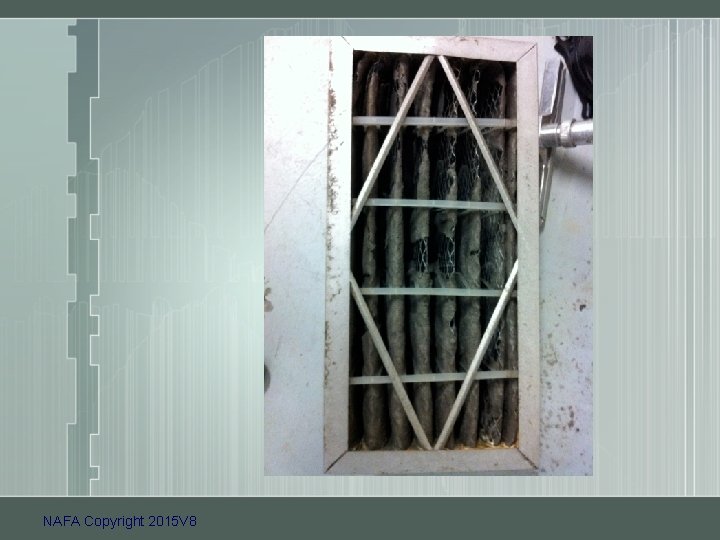
Filter Gap NAFA Copyright 2015 V 8
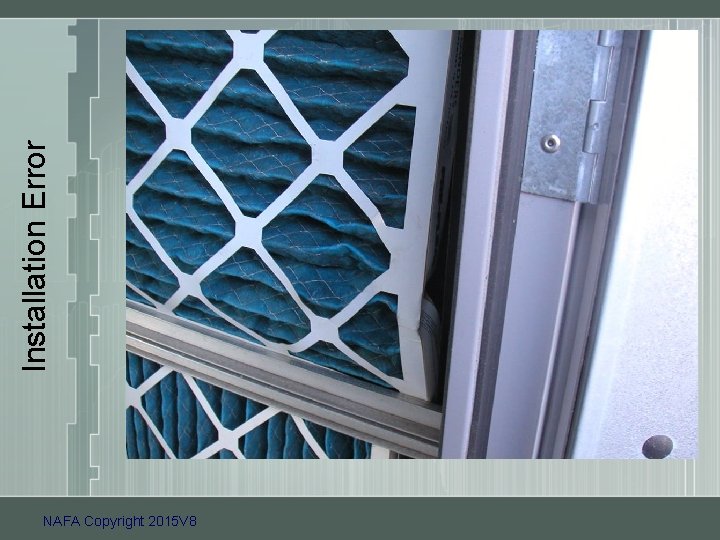
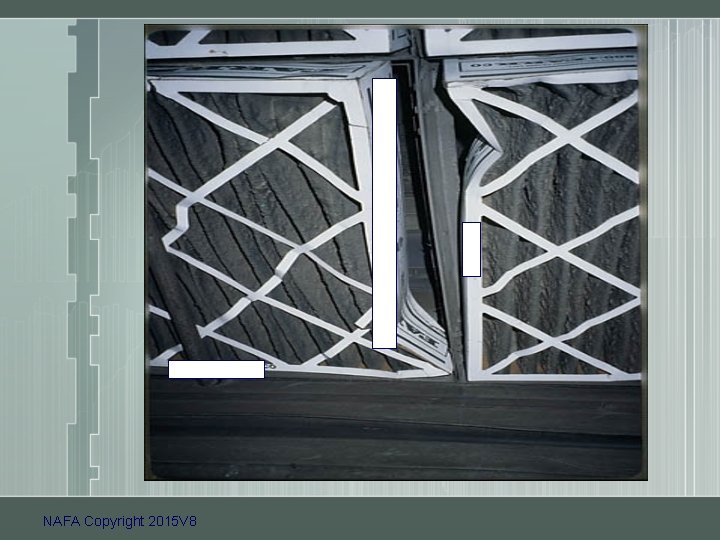
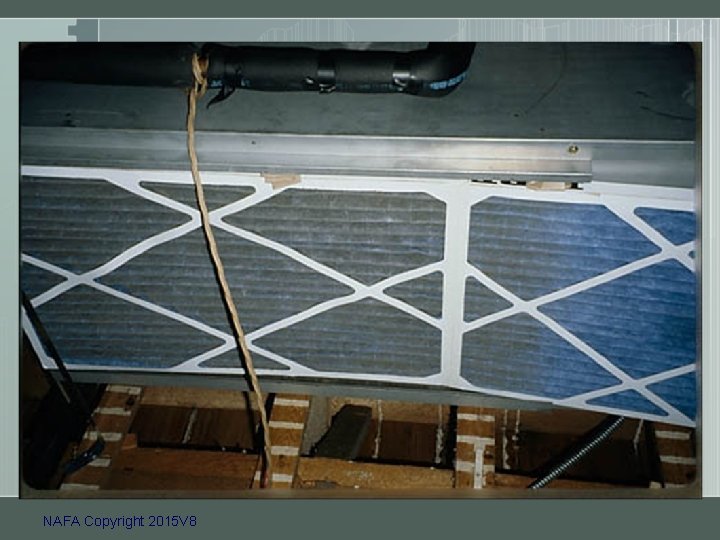
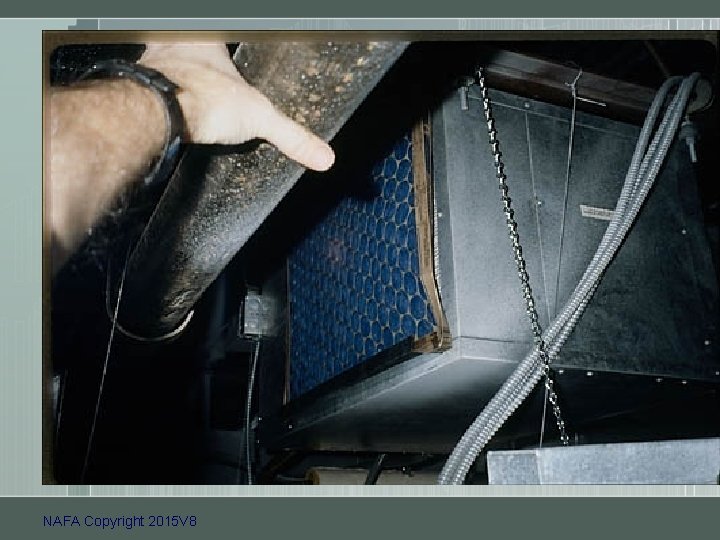
Installation Error NAFA Copyright 2015 V 8
NAFA Copyright 2015 V 8
NAFA Copyright 2015 V 8
NAFA Copyright 2015 V 8
NAFA Copyright 2015 V 8
NAFA Copyright 2015 V 8
NAFA Copyright 2015 V 8
NAFA Copyright 2015 V 8
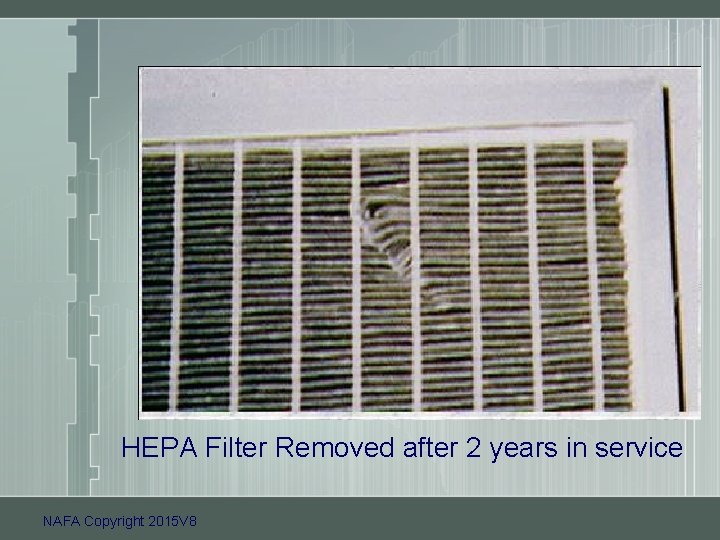
HEPA Filter Removed after 2 years in service NAFA Copyright 2015 V 8
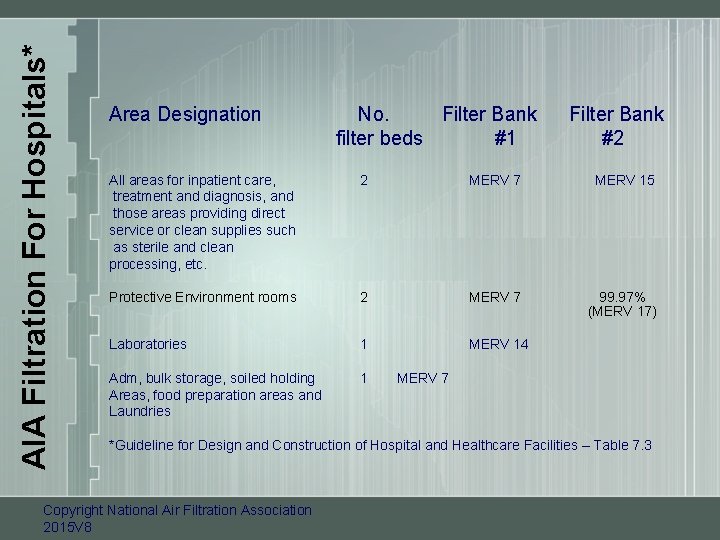
AIA Filtration For Hospitals* Area Designation No. Filter Bank filter beds #1 #2 All areas for inpatient care, treatment and diagnosis, and those areas providing direct service or clean supplies such as sterile and clean processing, etc. 2 MERV 7 MERV 15 Protective Environment rooms 2 MERV 7 99. 97% (MERV 17) Laboratories 1 MERV 14 Adm, bulk storage, soiled holding 1 Areas, food preparation areas and Laundries MERV 7 *Guideline for Design and Construction of Hospital and Healthcare Facilities – Table 7. 3 Copyright National Air Filtration Association 2015 V 8
Simple Logic The cleaner the air, the healthier it is for us to breathe NAFA Copyright 2015 V 8
Your Silent Partner • Air comfort (hot or cold) is a lot more noticeable than air cleanliness • Air filters remove contaminants from the air continually 24/7 • The higher the efficiency of the filter, the higher the level of contaminant removal NAFA Copyright 2015 V 8
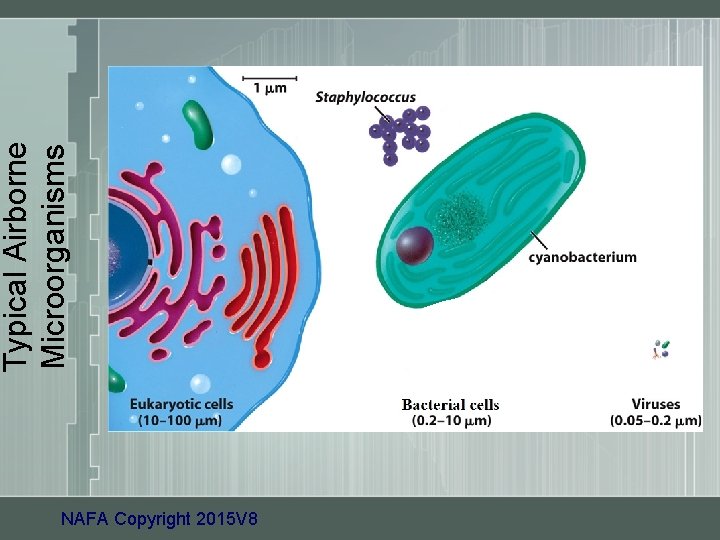
NAFA Copyright 2015 V 8 Typical Airborne Microorganisms
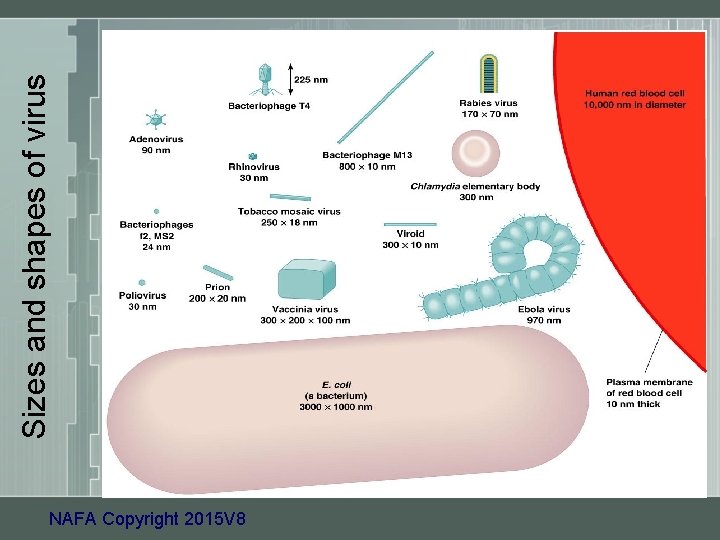
NAFA Copyright 2015 V 8 Sizes and shapes of virus
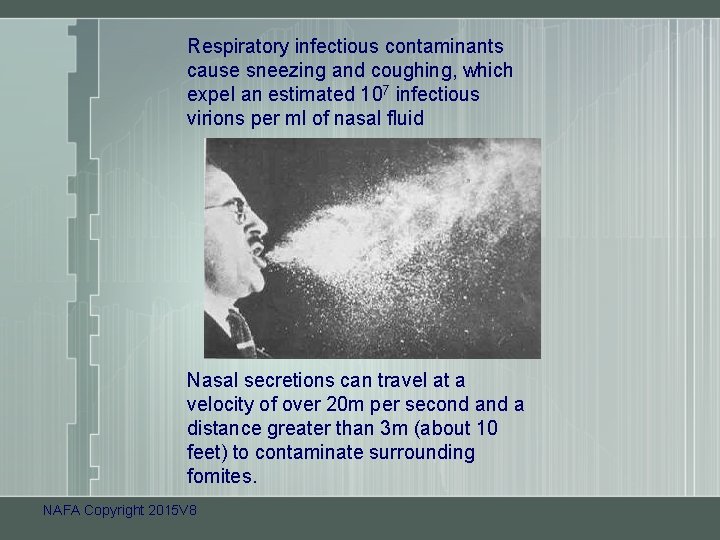
Respiratory infectious contaminants cause sneezing and coughing, which expel an estimated 107 infectious virions per ml of nasal fluid Nasal secretions can travel at a velocity of over 20 m per second a distance greater than 3 m (about 10 feet) to contaminate surrounding fomites. NAFA Copyright 2015 V 8
Influenza - Main Methods of Transmission • Droplet – transmission is by direct sneezing or coughing onto conjunctiva (eyes) or mucosa membrane – (mouth) • Contact Transmission –indirect through touching secretion on fomites (money) or directly by touching infected individual • Airborne – droplet nuclei – does not require direct contact with infected person NAFA Copyright 2015 V 8
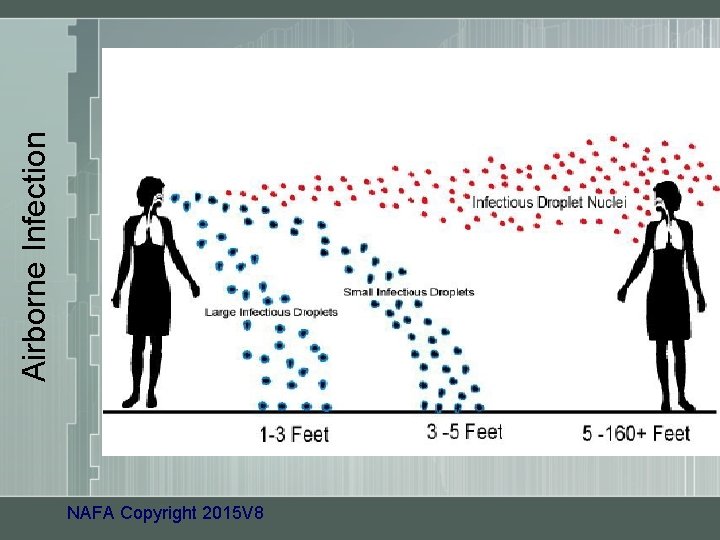
Airborne Infection NAFA Copyright 2015 V 8
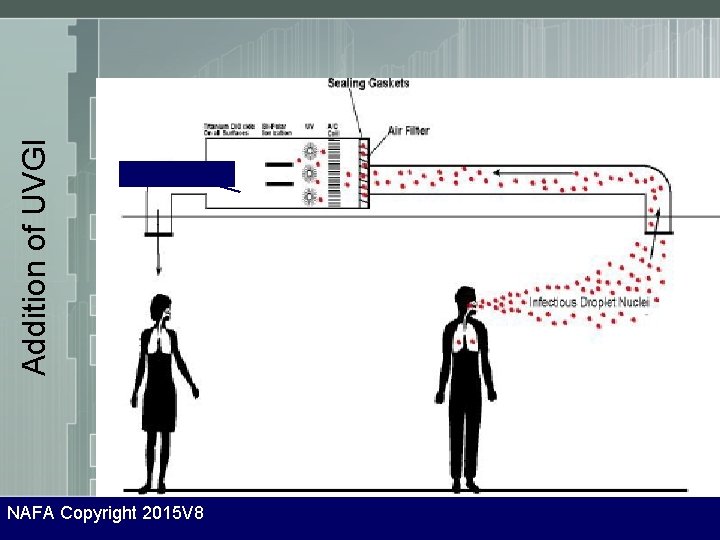
Addition of UVGI NAFA Copyright 2015 V 8
5 Different Areas Hospital Specific Filtration • Emergency Room • Isolation/Intensive Care Unit • Operating Suite • Patient Room • General and Administrative NAFA Copyright 2015 V 8
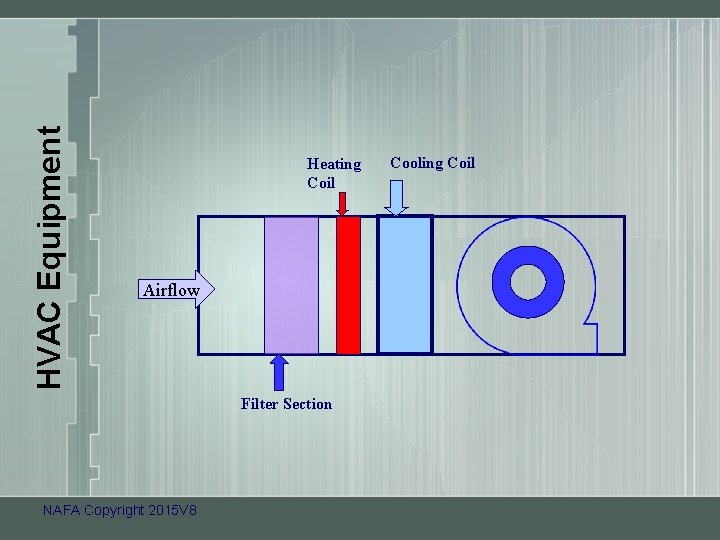
HVAC Equipment Heating Coil Airflow Filter Section NAFA Copyright 2015 V 8 Cooling Coil
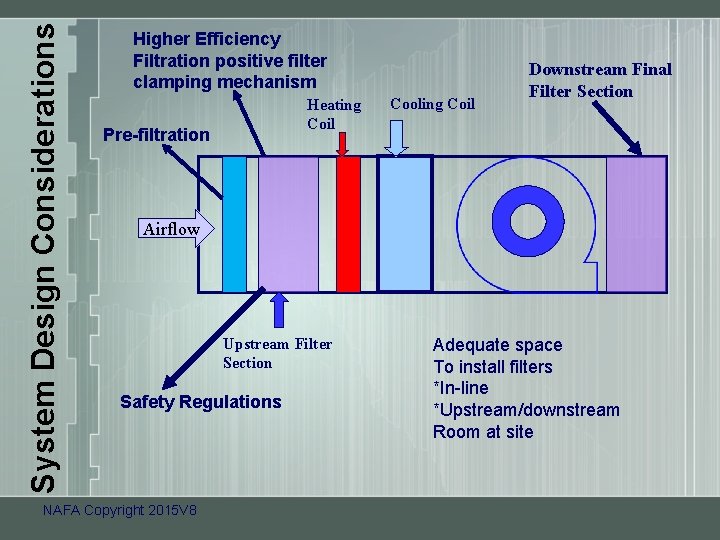
System Design Considerations Higher Efficiency Filtration positive filter clamping mechanism Heating Coil Pre-filtration Cooling Coil Downstream Final Filter Section Airflow Upstream Filter Section Safety Regulations NAFA Copyright 2015 V 8 Adequate space To install filters *In-line *Upstream/downstream Room at site
Equipment Effects In The Past • Clean Coils • Clean fan/motor/bearings • Clean Ductwork • Clean Furniture and Fixtures NAFA Copyright 2015 V 8
People Effects Today • Protect equipment from microorganism growth • Clean air of airborne microorganisms that can cause infection • Remove potential for cross-contamination person-to-person • Prevent contaminant/odor introduction NAFA Copyright 2015 V 8
Principles of Air Filtration How Filters- Filter • Straining • Impingement • Interception • Diffusion • Electrostatic attraction NAFA Copyright 2015 V 8
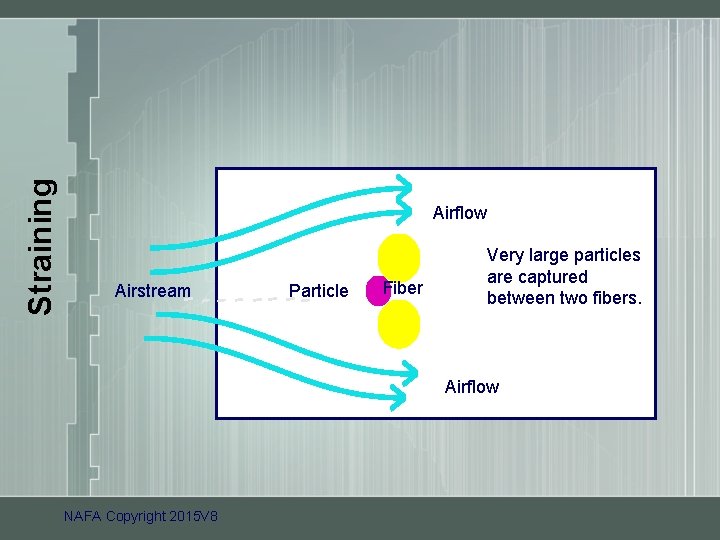
Straining Airflow Airstream Particle Fiber Very large particles are captured between two fibers. Airflow NAFA Copyright 2015 V 8
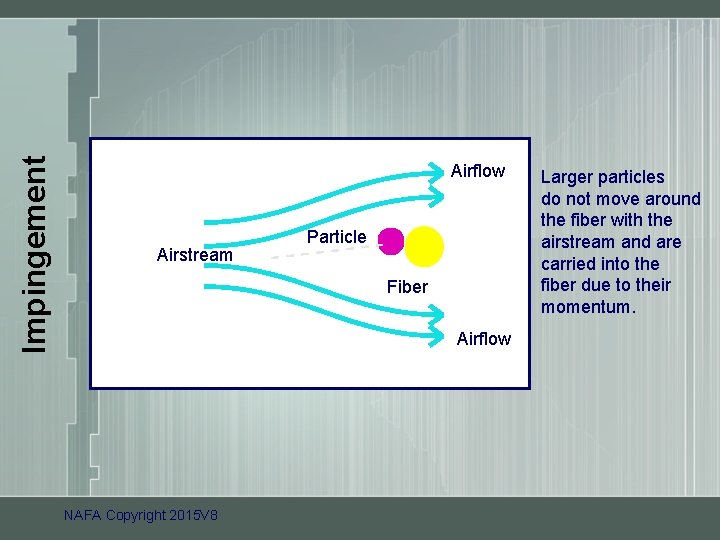
Impingement Airflow Airstream Particle Fiber Airflow NAFA Copyright 2015 V 8 Larger particles do not move around the fiber with the airstream and are carried into the fiber due to their momentum.
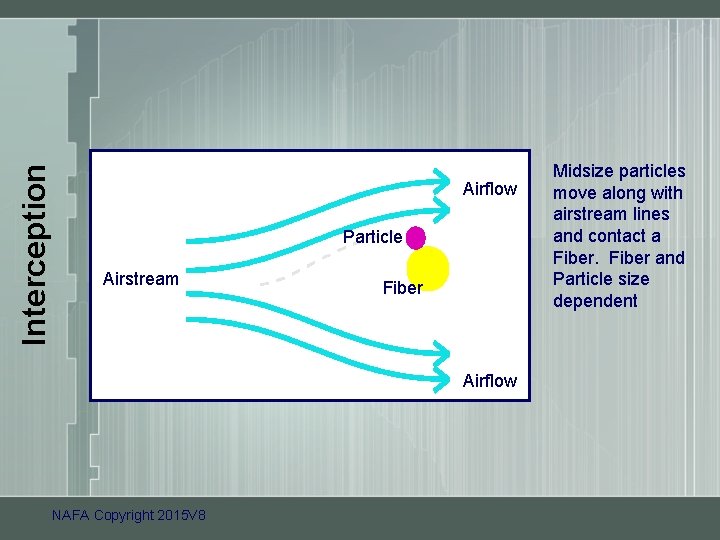
Interception Airflow Particle Airstream Fiber Airflow NAFA Copyright 2015 V 8 Midsize particles move along with airstream lines and contact a Fiber and Particle size dependent
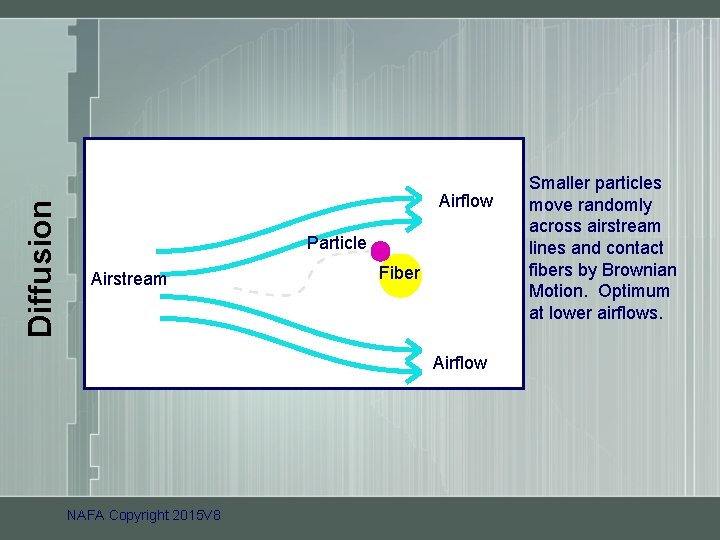
Diffusion Airflow Particle Airstream Fiber Airflow NAFA Copyright 2015 V 8 Smaller particles move randomly across airstream lines and contact fibers by Brownian Motion. Optimum at lower airflows.
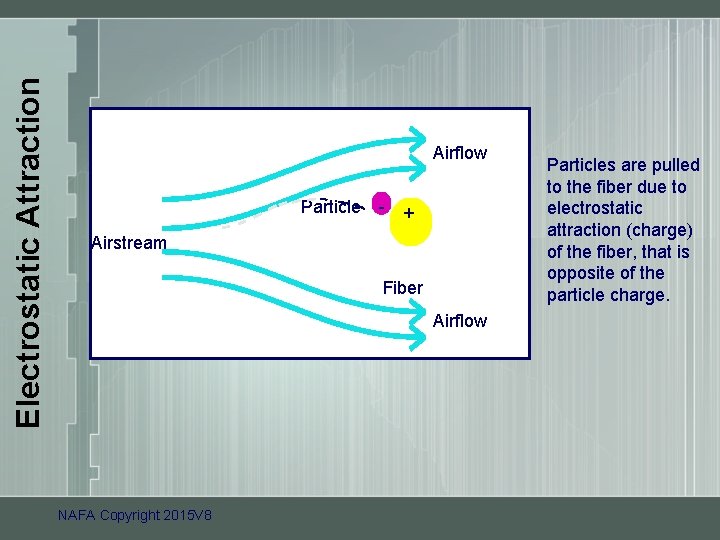
Electrostatic Attraction Airflow Particle - + Airstream Fiber Airflow NAFA Copyright 2015 V 8 Particles are pulled to the fiber due to electrostatic attraction (charge) of the fiber, that is opposite of the particle charge.
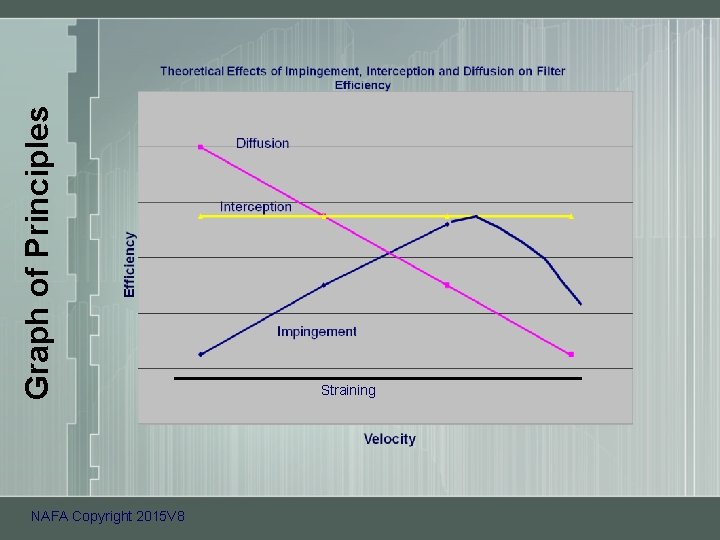
Graph of Principles NAFA Copyright 2015 V 8 Straining
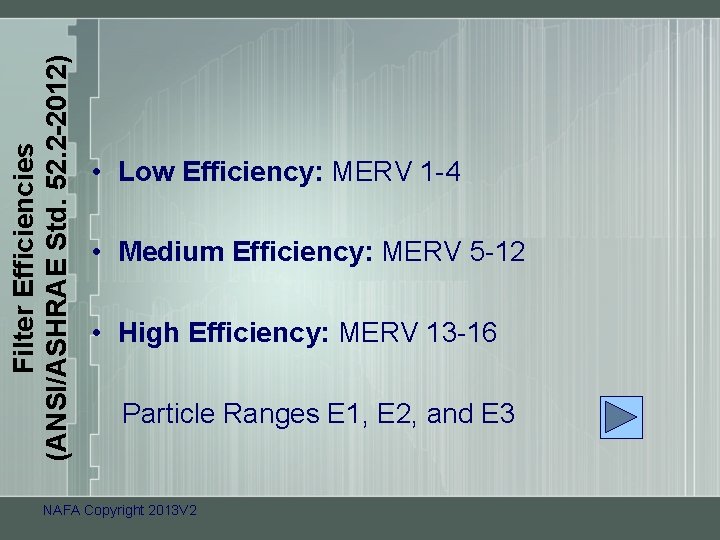
Filter Efficiencies (ANSI/ASHRAE Std. 52. 2 -2012) • Low Efficiency: MERV 1 -4 • Medium Efficiency: MERV 5 -12 • High Efficiency: MERV 13 -16 Particle Ranges E 1, E 2, and E 3 NAFA Copyright 2013 V 2
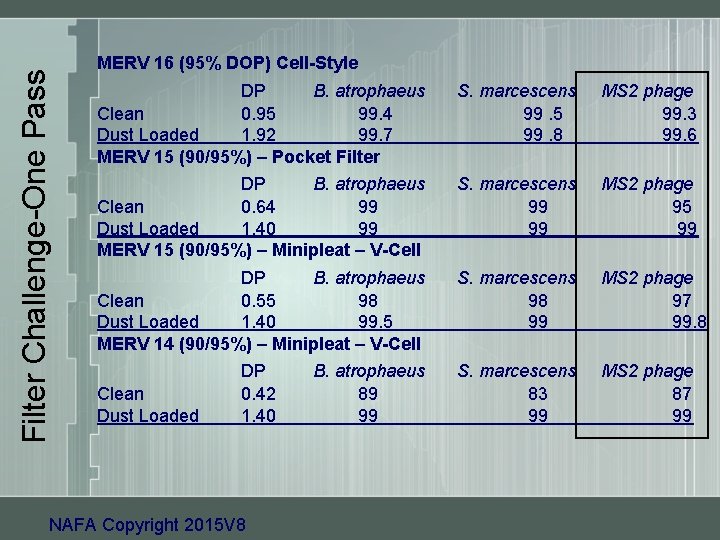
Filter Challenge-One Pass MERV 16 (95% DOP) Cell-Style DP B. atrophaeus S. marcescens MS 2 phage Clean 0. 95 99. 4 99. 5 99. 3 Dust Loaded 1. 92 99. 7 99. 8 99. 6 MERV 15 (90/95%) – Pocket Filter DP B. atrophaeus S. marcescens MS 2 phage Clean 0. 64 99 95 Dust Loaded 1. 40 99 MERV 15 (90/95%) – Minipleat – V-Cell DP B. atrophaeus S. marcescens MS 2 phage Clean 0. 55 98 97 Dust Loaded 1. 40 99. 5 99. 8 MERV 14 (90/95%) – Minipleat – V-Cell Clean Dust Loaded DP 0. 42 1. 40 NAFA Copyright 2015 V 8 B. atrophaeus S. marcescens MS 2 phage 89 83 87 99
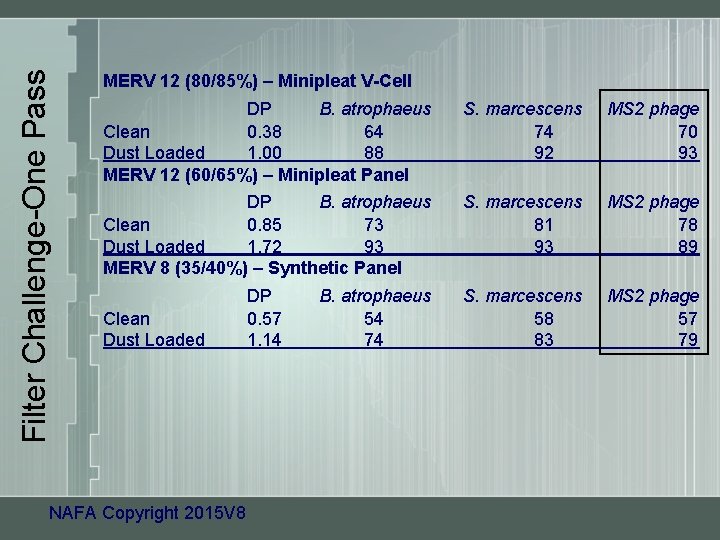
Filter Challenge-One Pass MERV 12 (80/85%) – Minipleat V-Cell DP B. atrophaeus S. marcescens MS 2 phage Clean 0. 38 64 70 Dust Loaded 1. 00 88 92 93 MERV 12 (60/65%) – Minipleat Panel DP B. atrophaeus S. marcescens MS 2 phage Clean 0. 85 73 81 78 Dust Loaded 1. 72 93 89 MERV 8 (35/40%) – Synthetic Panel Clean Dust Loaded NAFA Copyright 2015 V 8 DP 0. 57 1. 14 B. atrophaeus S. marcescens MS 2 phage 54 58 57 74 83 79
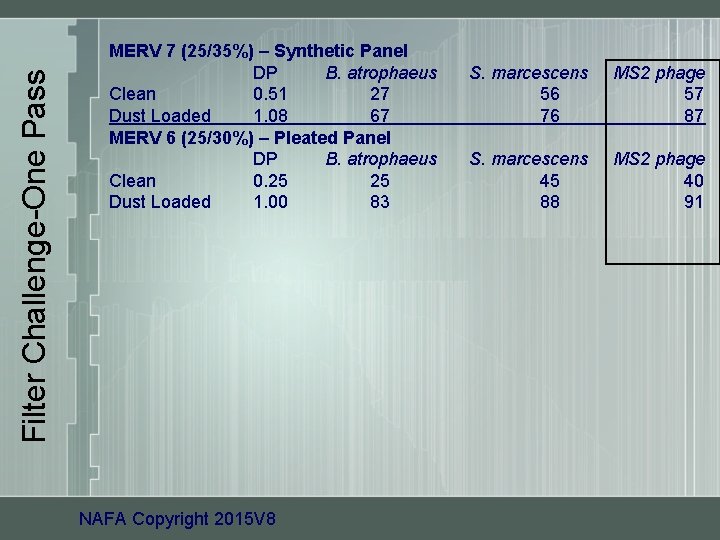
Filter Challenge-One Pass MERV 7 (25/35%) – Synthetic Panel DP B. atrophaeus S. marcescens MS 2 phage Clean 0. 51 27 56 57 Dust Loaded 1. 08 67 76 87 MERV 6 (25/30%) – Pleated Panel DP B. atrophaeus S. marcescens MS 2 phage Clean 0. 25 45 40 Dust Loaded 1. 00 83 88 91 NAFA Copyright 2015 V 8
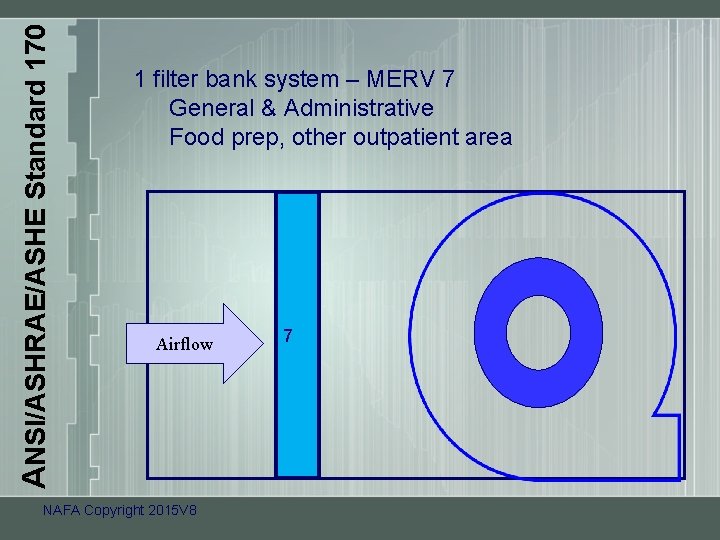
ANSI/ASHRAE/ASHE Standard 170 1 filter bank system – MERV 7 General & Administrative Food prep, other outpatient area Airflow NAFA Copyright 2015 V 8 7
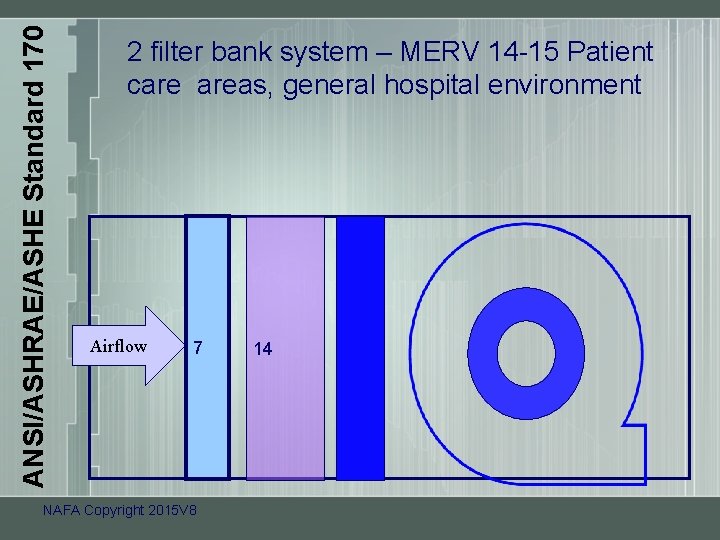
ANSI/ASHRAE/ASHE Standard 170 2 filter bank system – MERV 14 -15 Patient care areas, general hospital environment Airflow 7 NAFA Copyright 2015 V 8 14
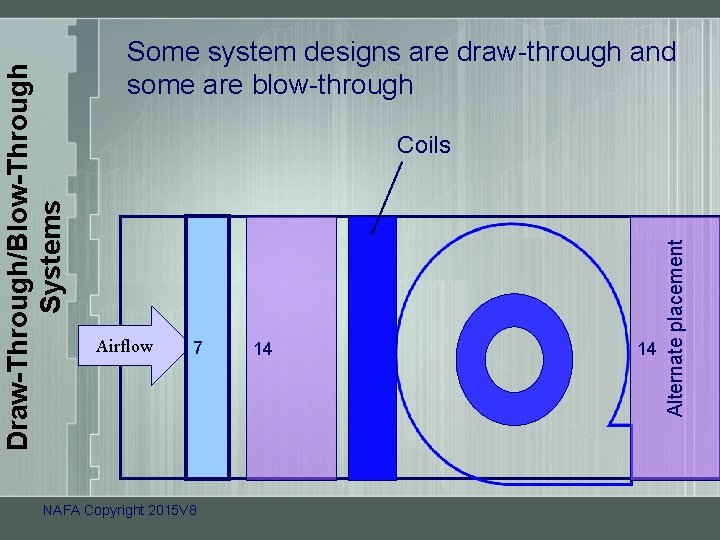
Coils Airflow 7 NAFA Copyright 2015 V 8 14 14 Alternate placement Draw-Through/Blow-Through Systems Some system designs are draw-through and some are blow-through
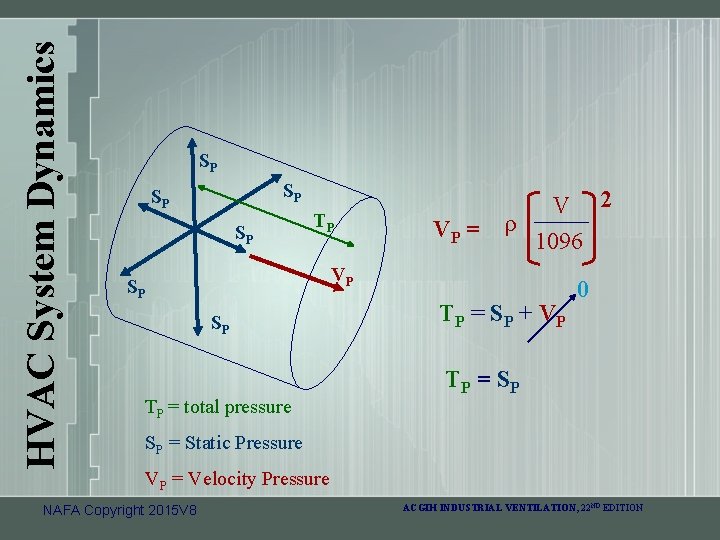
HVAC System Dynamics SP SP TP VP = V 2 ρ 1096 VP SP SP TP = total pressure T P = SP + VP 0 T P = SP SP = Static Pressure VP = Velocity Pressure NAFA Copyright 2015 V 8 ACGIH INDUSTRIAL VENTILATION, 22 ND EDITION
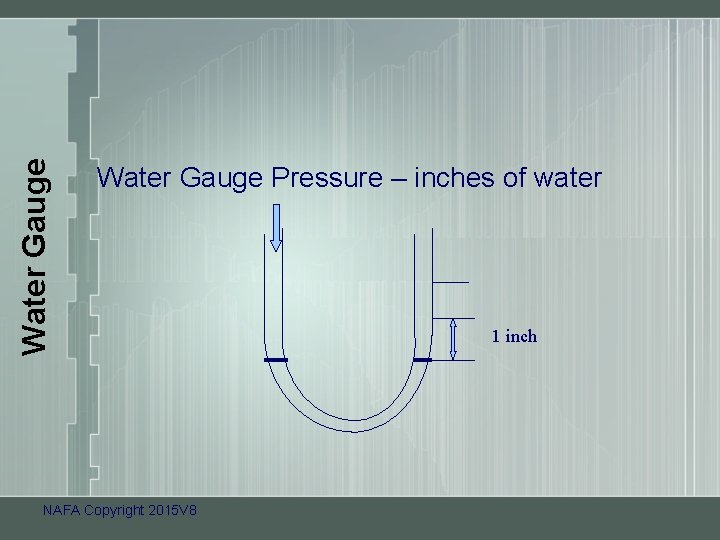
Water Gauge Pressure – inches of water NAFA Copyright 2015 V 8 1 inch
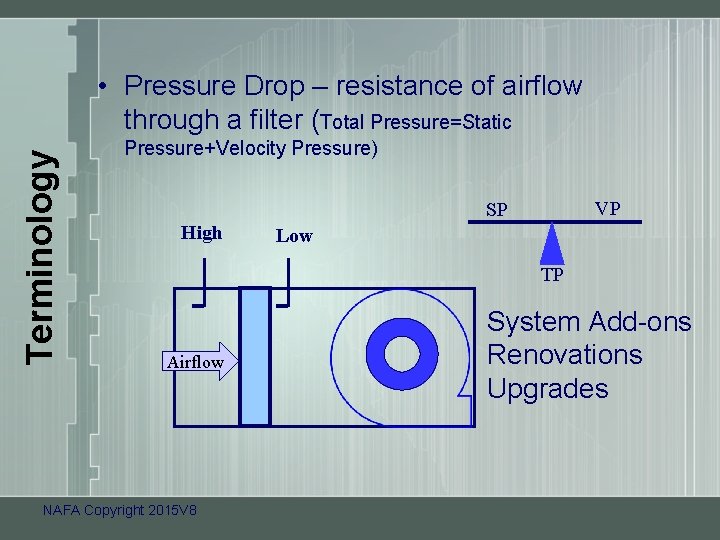
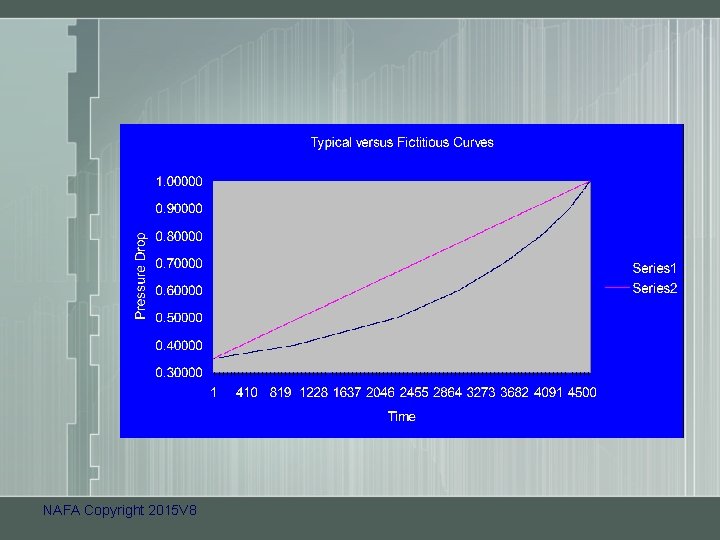
Terminology • Pressure Drop – resistance of airflow through a filter (Total Pressure=Static Pressure+Velocity Pressure) VP SP High Low TP Airflow NAFA Copyright 2015 V 8 System Add-ons Renovations Upgrades
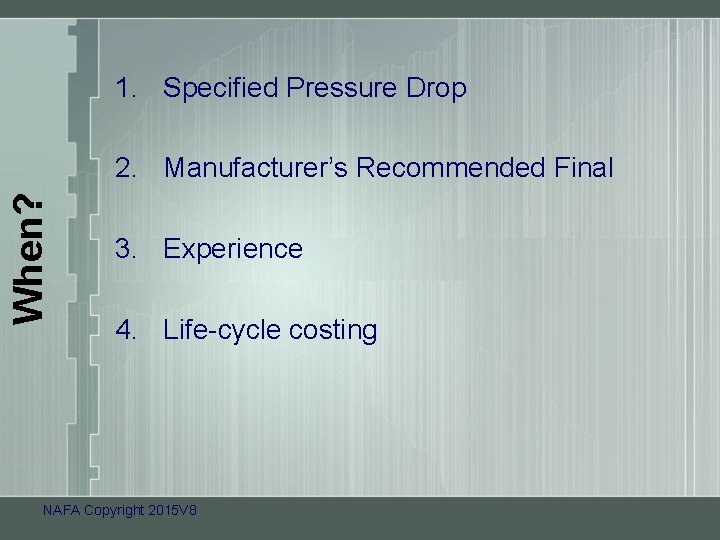
1. Specified Pressure Drop When? 2. Manufacturer’s Recommended Final 3. Experience 4. Life-cycle costing NAFA Copyright 2015 V 8
NAFA Copyright 2015 V 8
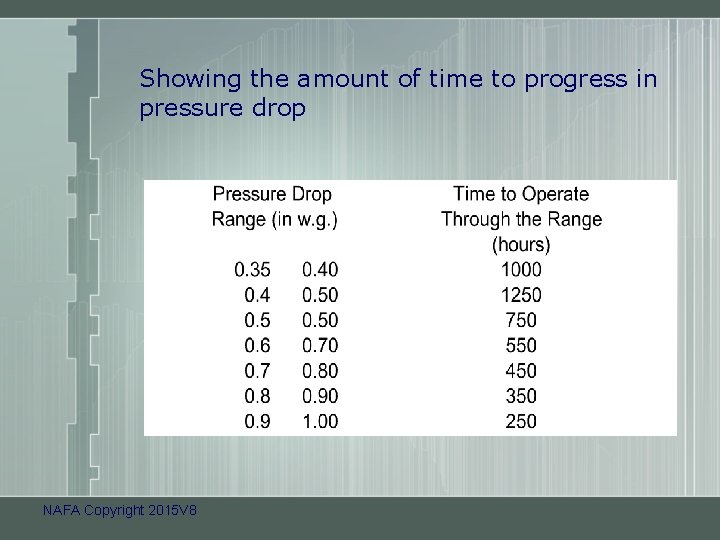
Showing the amount of time to progress in pressure drop NAFA Copyright 2015 V 8
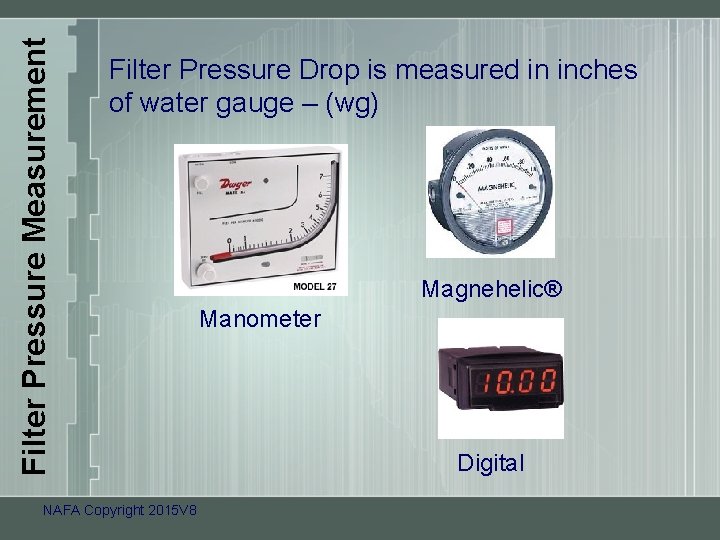
Filter Pressure Measurement Filter Pressure Drop is measured in inches of water gauge – (wg) NAFA Copyright 2015 V 8 Magnehelic® Manometer Digital
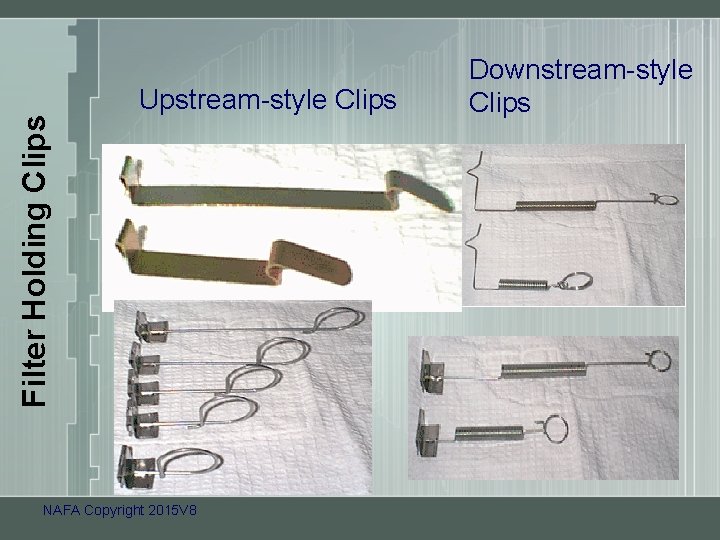
Filter Holding Clips Upstream-style Clips NAFA Copyright 2015 V 8 Downstream-style Clips
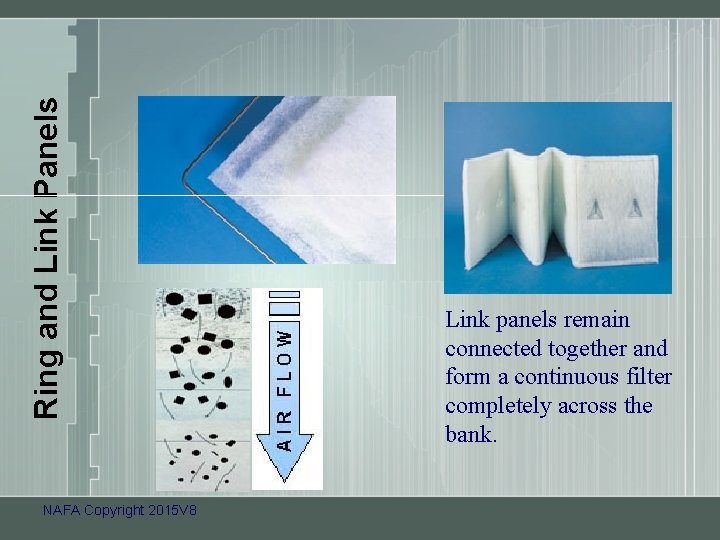
Ring and Link Panels NAFA Copyright 2015 V 8 Link panels remain connected together and form a continuous filter completely across the bank.
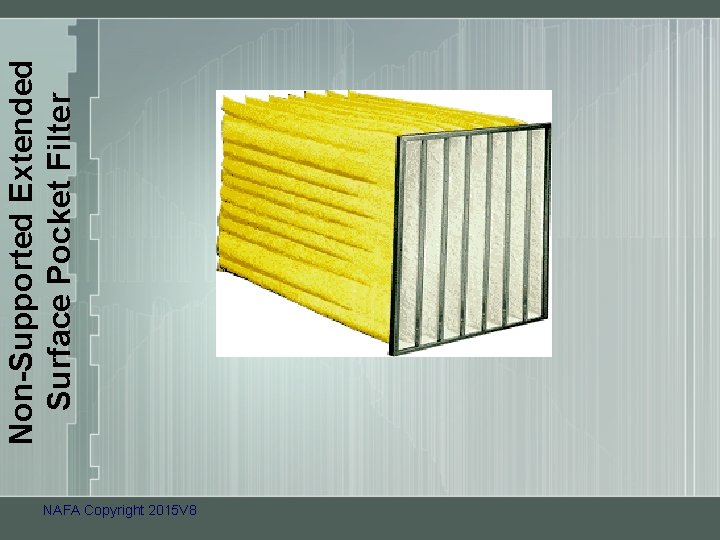
NAFA Copyright 2015 V 8 Non-Supported Extended Surface Pocket Filter
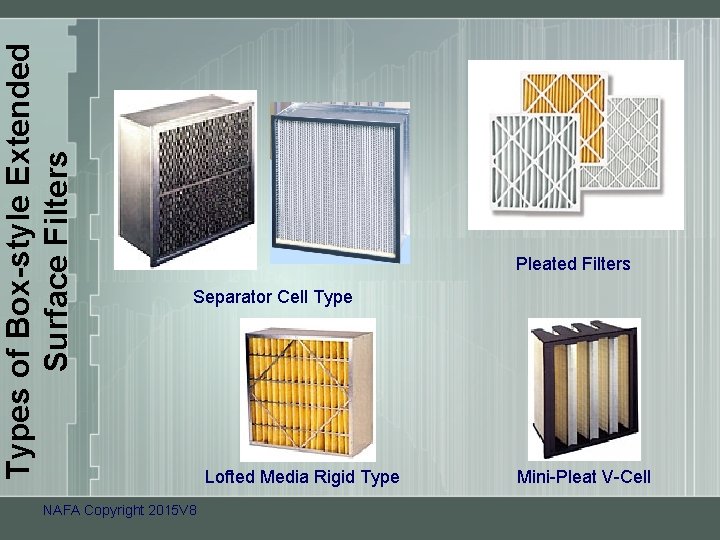
Types of Box-style Extended Surface Filters Pleated Filters Separator Cell Type NAFA Copyright 2015 V 8 Lofted Media Rigid Type Mini-Pleat V-Cell
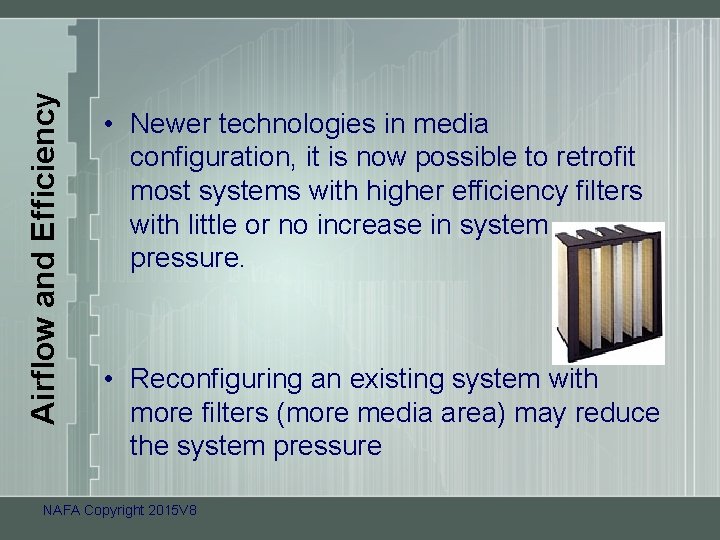
Airflow and Efficiency • Newer technologies in media configuration, it is now possible to retrofit most systems with higher efficiency filters with little or no increase in system pressure. • Reconfiguring an existing system with more filters (more media area) may reduce the system pressure NAFA Copyright 2015 V 8
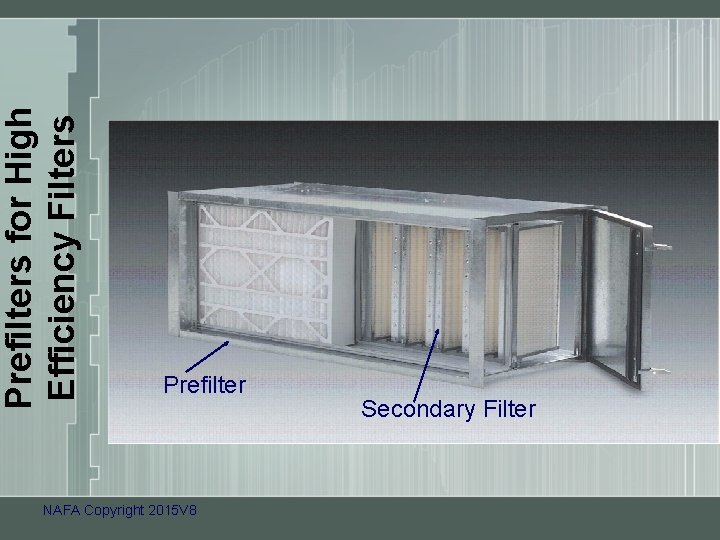
Prefilters for High Efficiency Filters Prefilter NAFA Copyright 2015 V 8 Secondary Filter
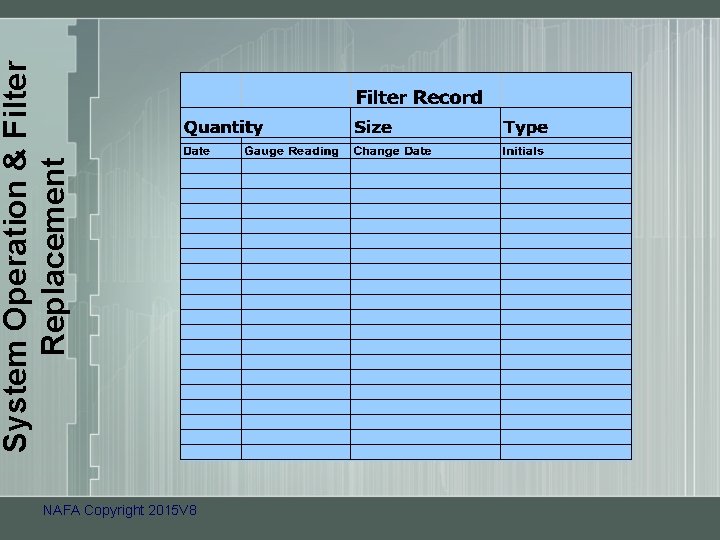
System Operation & Filter Replacement NAFA Copyright 2015 V 8
Filter Pressure Drop • Total pressure added by the filter should be close to the air filter manufacturers’ listed initial. – If Lower – check for tears, leaks or other damage that would let air bypass the bank – If Higher – check for incomplete inflation of pocket filters or debris on filters NAFA Copyright 2015 V 8
Changing Prefilters - Checklist 1. Confirm • Replacement filters correct with size and number to complete replacement 2. Shut down system – Lock out/Tag out 3. Place filters and carton inside plenum 4. Remove dirty filters – place in empty carton NAFA Copyright 2015 V 8
Changing Prefilters - Checklist 5. Install clean filters – assure airflow direction is correct and pleats and pockets are in the vertical position 6. Reinstall fastening devices 7. Remove dirty filters and dispose of in proper manner NAFA Copyright 2015 V 8
Changing Prefilters -Checklist 8. Sweep or vacuum area as needed – zero pressure measuring device 9. Restart system and check for properation - record pressure and other data on Filter System Record sheet NAFA Copyright 2015 V 8
Secondary Filters Changing High-efficiency Filters: Same Change Checklist as Prefilters with the exception: Secondary Filters may contain smaller sometimes hazardous particles. When in doubt, always wear PPE when changing secondary filters, especially in a hospital environment NAFA Copyright 2015 V 8
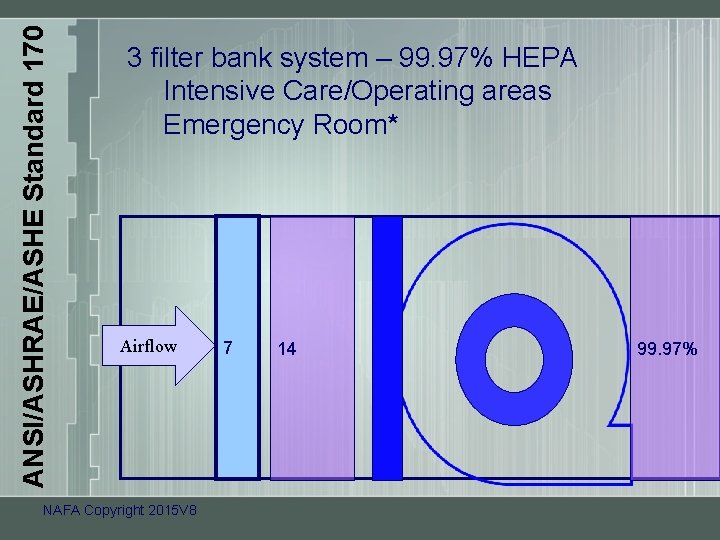
ANSI/ASHRAE/ASHE Standard 170 3 filter bank system – 99. 97% HEPA Intensive Care/Operating areas Emergency Room* Airflow NAFA Copyright 2015 V 8 7 14 99. 97%
High Efficiency Particulate (HEPA) Air Filter Throwaway extended-medium dry-type filter in rigid frame having minimum particlecollection efficiency of 99. 97% (that is a maximum particle penetration of 0. 03%) for 0. 3 µm particles of thermally-generated DOP particles or specified alternative aerosol. ” --IEST NAFA Copyright 2015 V 8
HEPA Filter Are Always • Always Second or Third Filter Bank • Usually Prefiltered with MERV 6 and MERV 14 (Pocket /Rigid or Cell) • Always Gasketed – neoprene or fluid seal • Always In Locking HEPA Filter Holding Frame • Always Exact Size – Not Nominal • Always Requires Special Handling & Installation – Personal Protection Equipment NAFA Copyright 2015 V 8
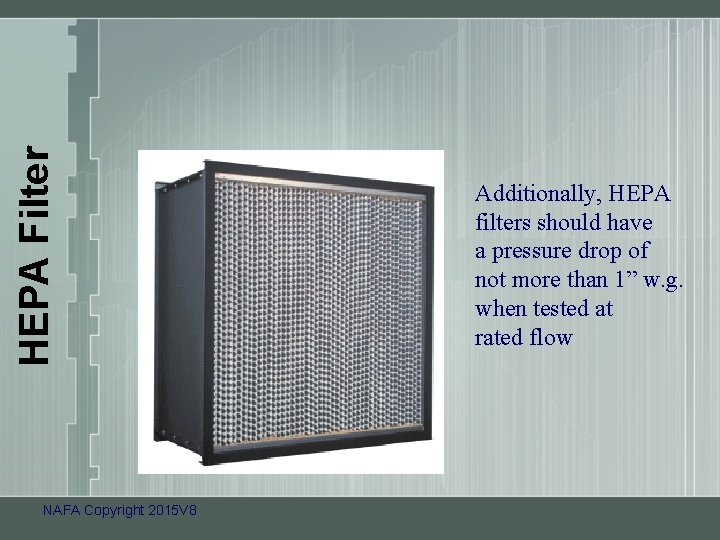
HEPA Filter NAFA Copyright 2015 V 8 Additionally, HEPA filters should have a pressure drop of not more than 1” w. g. when tested at rated flow
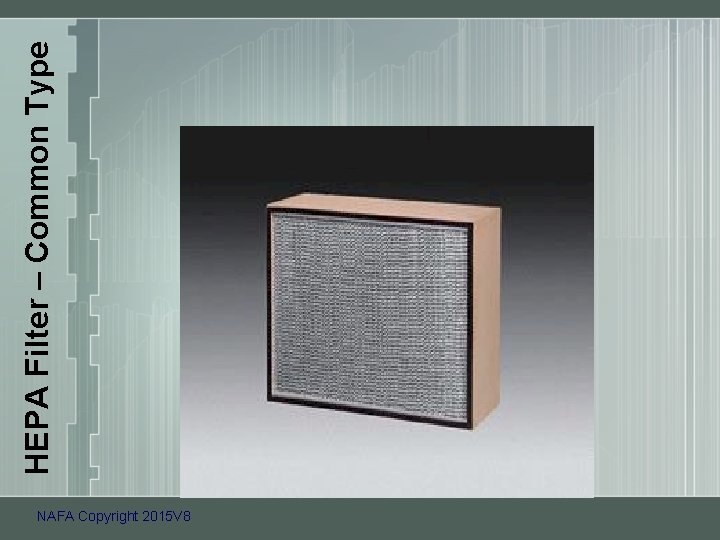
NAFA Copyright 2015 V 8 HEPA Filter – Common Type
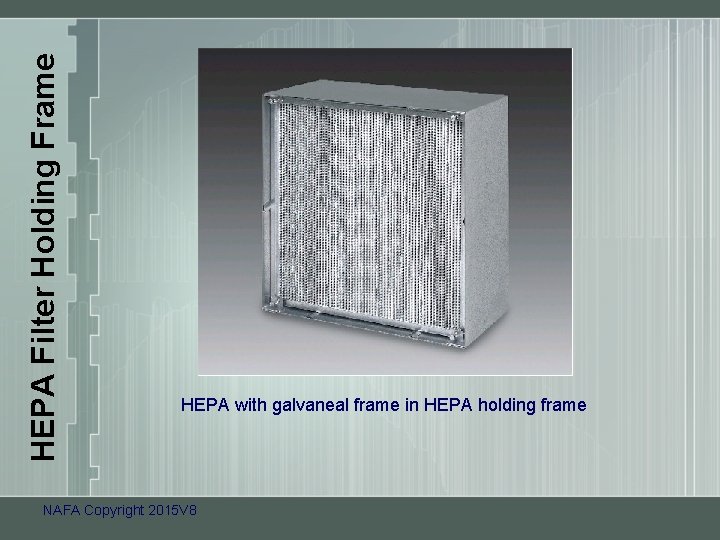
HEPA Filter Holding Frame HEPA with galvaneal frame in HEPA holding frame NAFA Copyright 2015 V 8
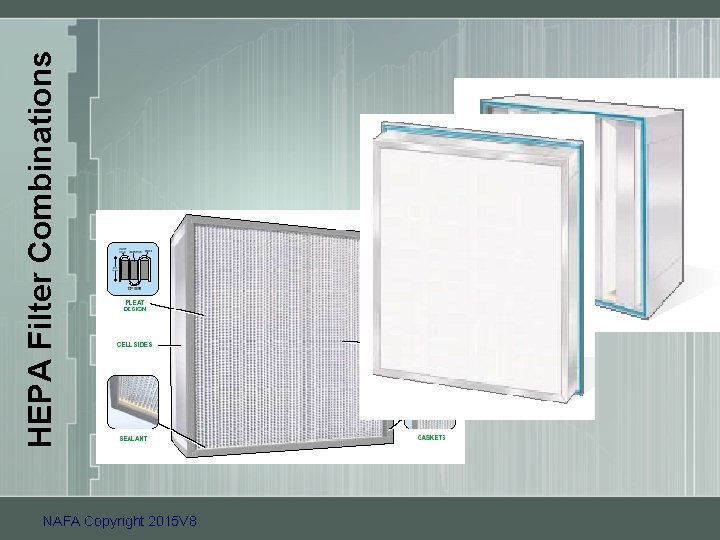
NAFA Copyright 2015 V 8 HEPA Filter Combinations
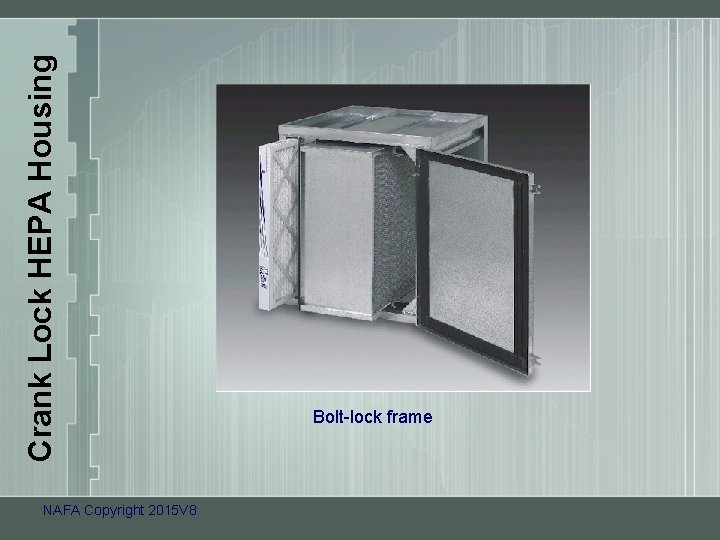
Crank Lock HEPA Housing NAFA Copyright 2015 V 8 Bolt-lock frame
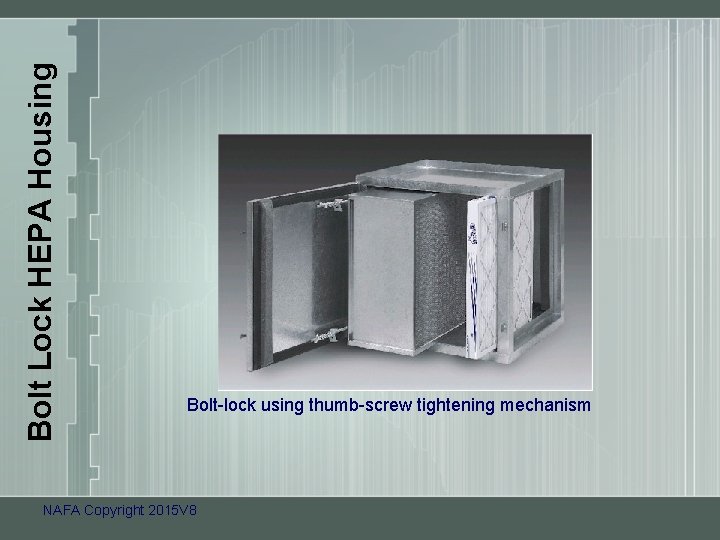
Bolt Lock HEPA Housing Bolt-lock using thumb-screw tightening mechanism NAFA Copyright 2015 V 8
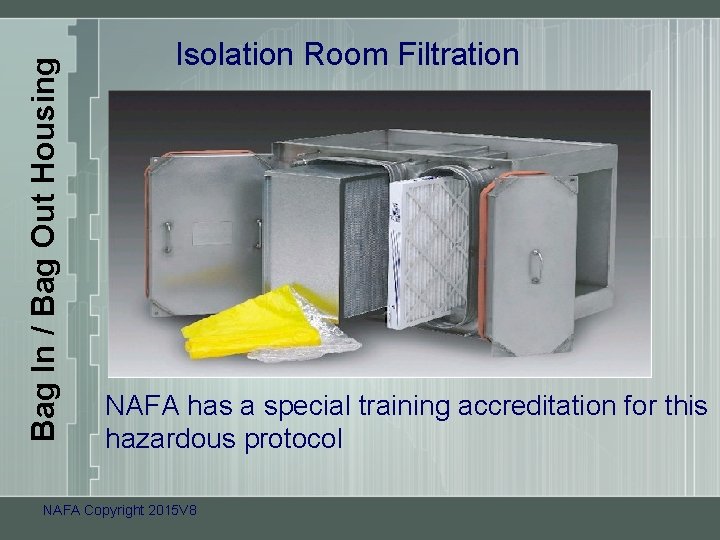
Bag In / Bag Out Housing Isolation Room Filtration NAFA has a special training accreditation for this hazardous protocol NAFA Copyright 2015 V 8
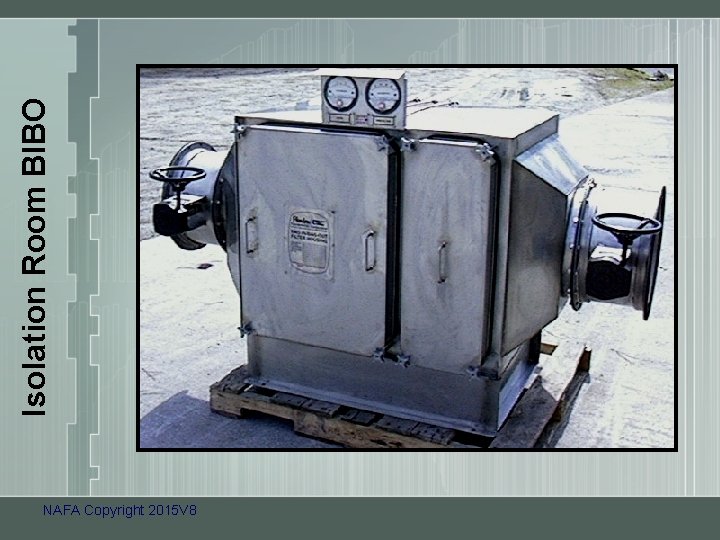
Isolation Room BIBO NAFA Copyright 2015 V 8
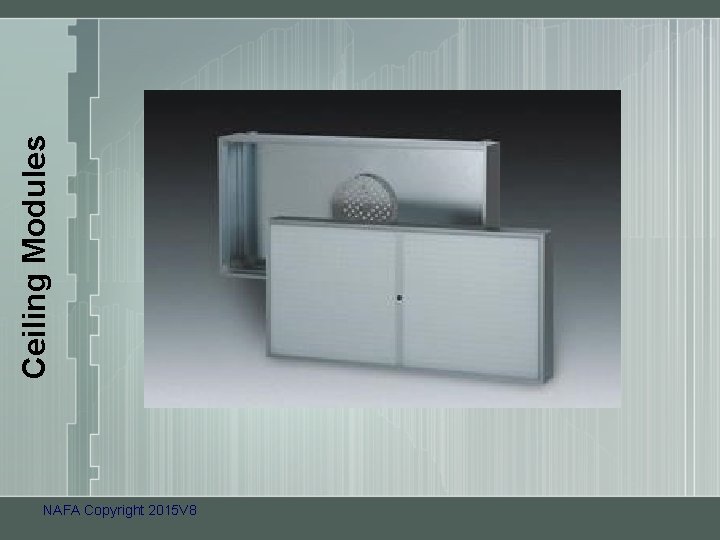
Ceiling Modules NAFA Copyright 2015 V 8
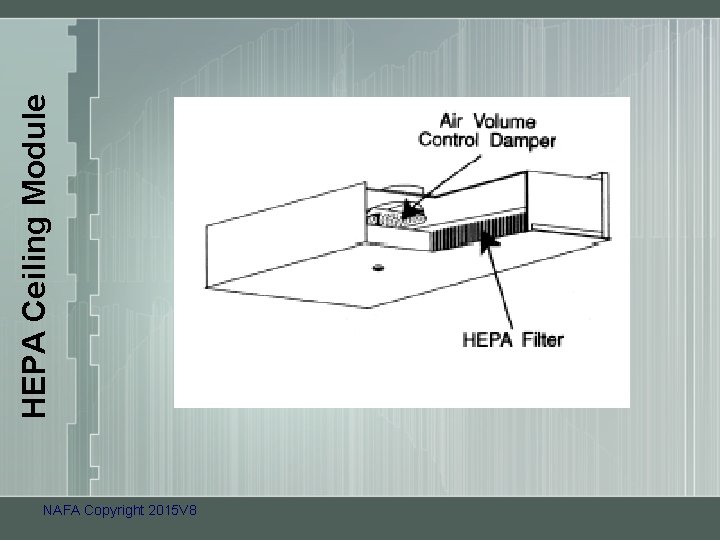
HEPA Ceiling Module NAFA Copyright 2015 V 8
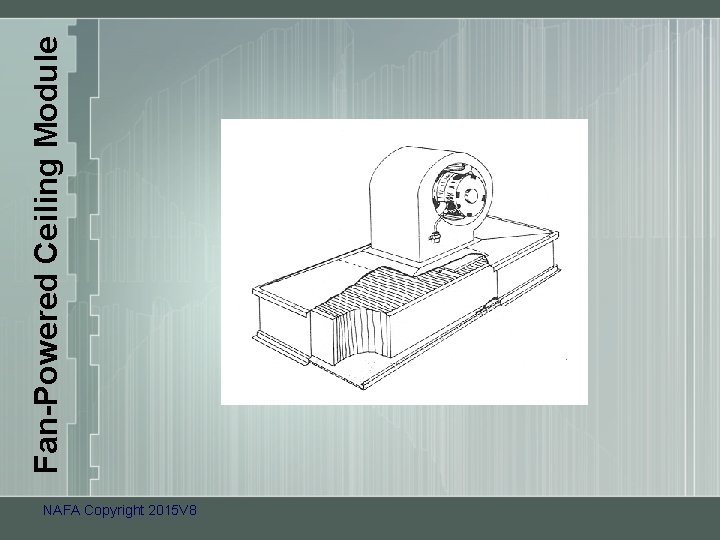
NAFA Copyright 2015 V 8 Fan-Powered Ceiling Module
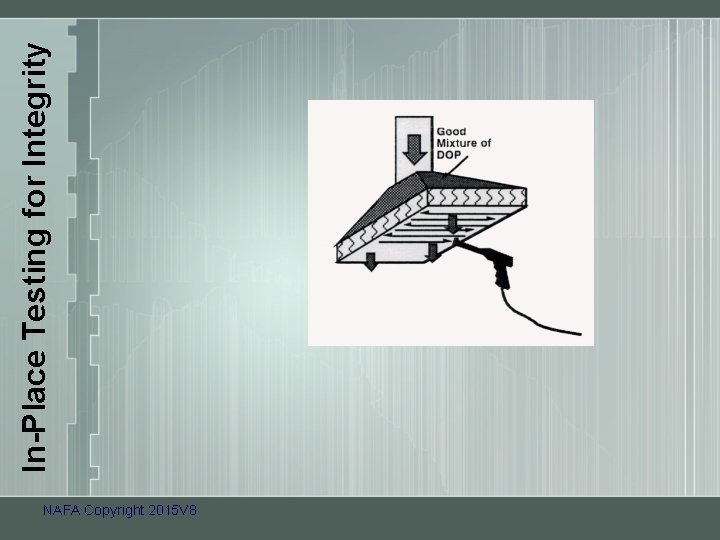
NAFA Copyright 2015 V 8 In-Place Testing for Integrity
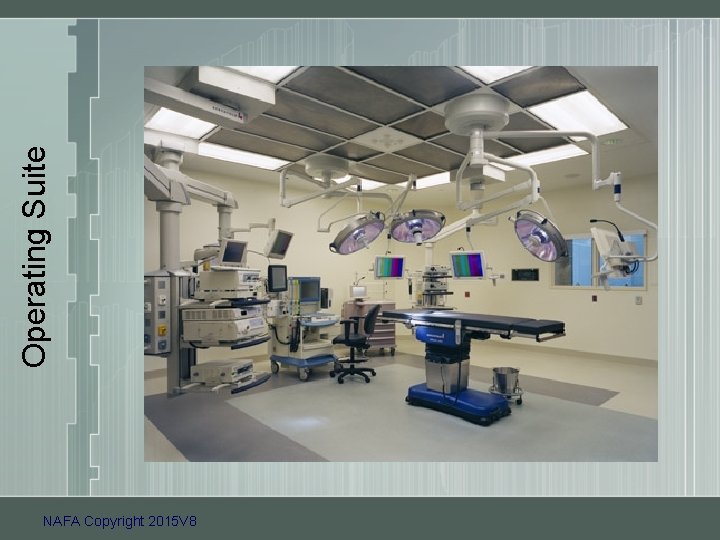
Operating Suite NAFA Copyright 2015 V 8
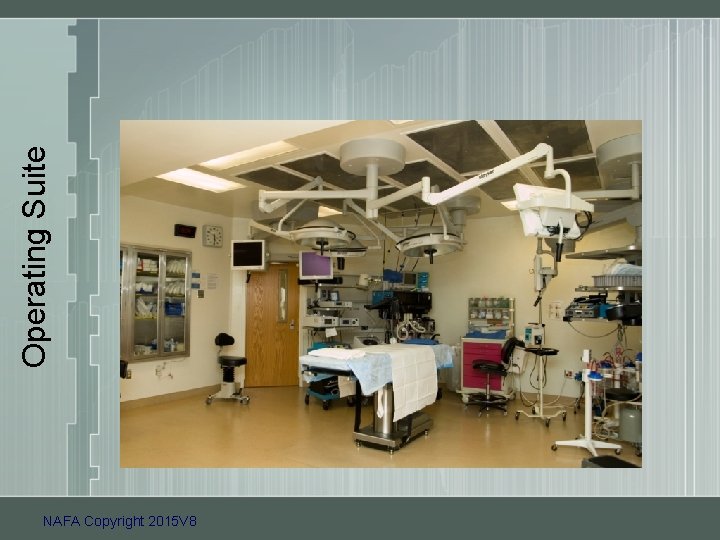
Operating Suite NAFA Copyright 2015 V 8
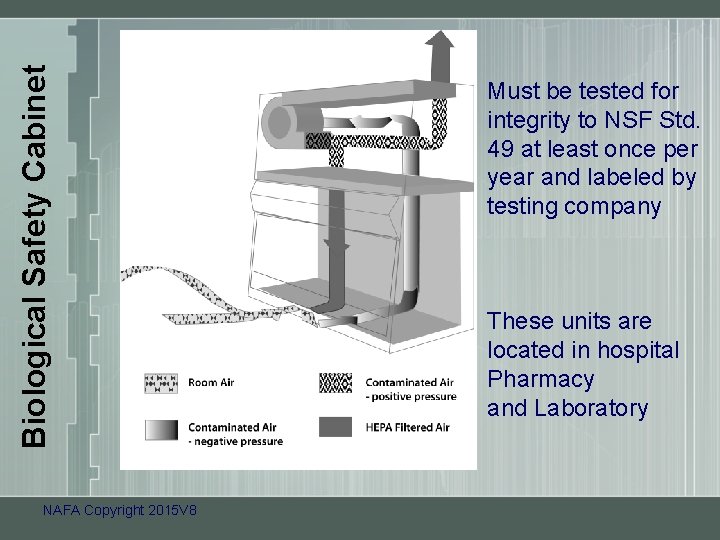
Biological Safety Cabinet NAFA Copyright 2015 V 8 Must be tested for integrity to NSF Std. 49 at least once per year and labeled by testing company These units are located in hospital Pharmacy and Laboratory
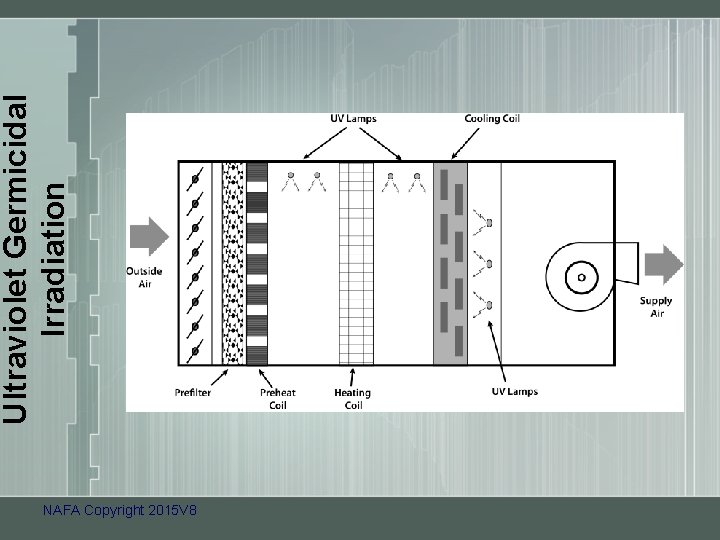
NAFA Copyright 2015 V 8 Ultraviolet Germicidal Irradiation
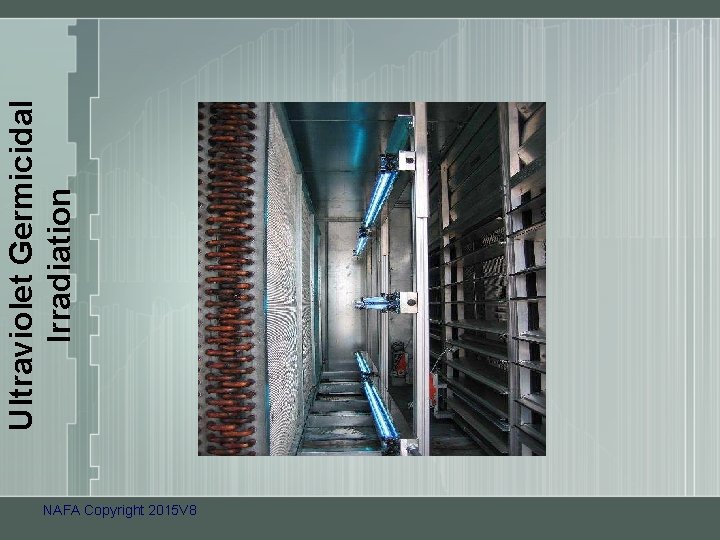
NAFA Copyright 2015 V 8 Ultraviolet Germicidal Irradiation
Gas Phase Control Systems • Adsorption, Chemisorption saturation and breakthrough • Types of Adsorbing Systems • Installation, changing and disposal Applications: Soiled laundry, air intakes near loading docks and heliports, laboratories, construction/renovation odors, chemical odors, nuisance odors NAFA Copyright 2015 V 8
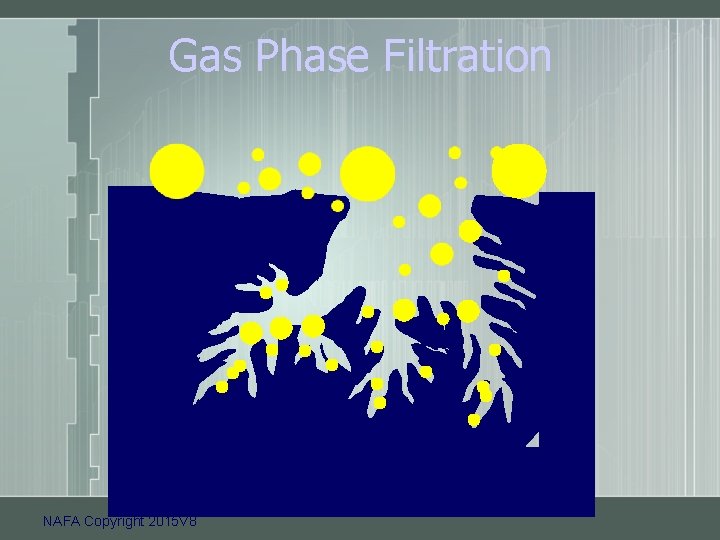
Gas Phase Filtration NAFA Copyright 2015 V 8
Gas-Phase Filtration • Gas molecules are extremely small – well below 1 micrometer range and cannot be captured by typical particulate media. • Different Principles for gas-phase filtration NAFA Copyright 2015 V 8
Gaseous Contaminant Removal Principle Methods • Physical - Adsorption – Activated carbons • Chemical - Chemisorption – Potassium permanganate impregnated media – Chemically treated activated carbons NAFA Copyright 2015 V 8
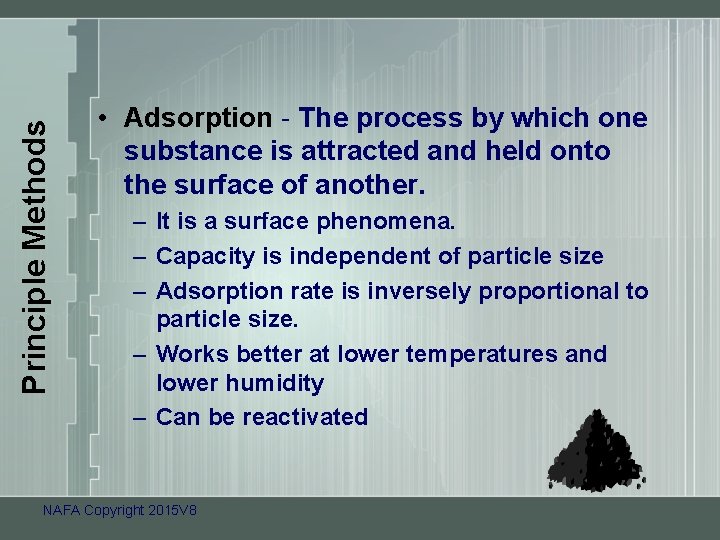
Principle Methods • Adsorption - The process by which one substance is attracted and held onto the surface of another. – It is a surface phenomena. – Capacity is independent of particle size – Adsorption rate is inversely proportional to particle size. – Works better at lower temperatures and lower humidity – Can be reactivated NAFA Copyright 2015 V 8
MEDIA • Activated carbon • Coal • Coconut • Wood • etc. NAFA Copyright 2015 V 8
Surface Area 1 Kilogram (2. 2 lbs. ) of Activated Carbon Has Enough Surface Area to Pave a Two Lane Highway Over 160 Kilometers (100 Miles) NAFA Copyright 2015 V 8
Principle Methods • Chemisorption - The result of chemical reactions on and in the surface of the adsorbent. – Fairly specific and depends upon chemical nature of media and the contaminant – Irreversible & essentially instantaneous – Works better at higher temperatures and higher humidity NAFA Copyright 2015 V 8
Chemisorption • Activated Carbon treated with a chemical (Phosphoric Acid for ammonia odors) • Potassium Permanganate (powder) on alumina or other substrate NAFA Copyright 2015 V 8
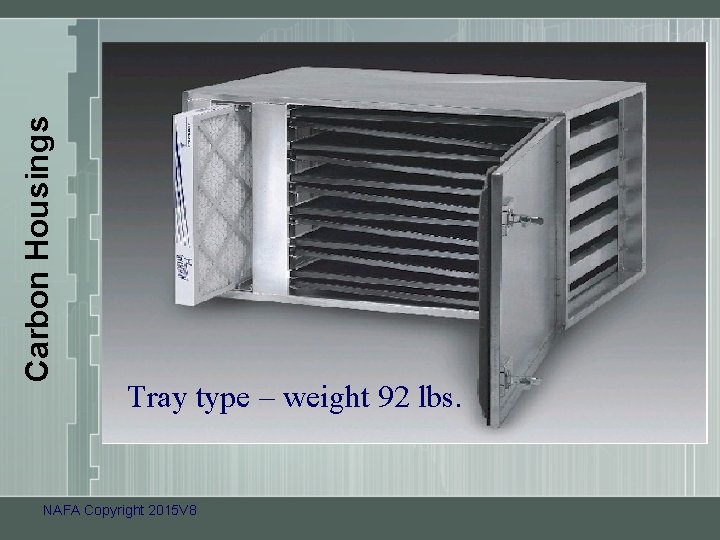
Carbon Housings Tray type – weight 92 lbs. NAFA Copyright 2015 V 8
Summary • Removing contaminants from the air with efficient air filters helps reduces the spread of microorganisms via the HVAC system • Newer, higher MERV number filters are available with low resistance to airflow • Facility managers and HVAC Technicians can play a vital role in improving the quality of indoor air for building occupants especially hospital and healthcare facilities Cleaner Air Is Healthier Air NAFA Copyright 2015 V 8
Disposal of Gas Phase Media Gas phase media may have restrictions on its disposal – check with local regulations regarding legal hauling and disposal NAFA Copyright 2015 V 8
• Over 750 Members Worldwide NAFA • 2 textbooks on Air Filtration • 3 Certification Programs • Cognizant Authority on Air Filtration www. nafahq. org NAFA Copyright 2015 V 8

Questions
- Slides: 93