
NADD COMPETENCYBASED DSP CERTIFICATION PROGRAM COMPETENCY STANDARD 1
NADD COMPETENCY-BASED DSP CERTIFICATION PROGRAM- COMPETENCY STANDARD #1 ASSESSMENT AND OBSERVATION Authors: Tony Thomas, Macdonald Metzger, Melissa Cheplic 1
NADD-DSP Assessment and Observation is one area of competency in the NADD DSP Certification program. Below is the full list of all the areas in the DSP competency set. Competency Standard 1: Assessment and Observation Competency Standard 2: Behavior Support Competency Standard 3: Crisis Prevention and Intervention Competency Standard 4: Health and Wellness Competency Standard 5: Community Collaboration and Teamwork PLUS…Application and commitment to the Code of Ethics https: //www. nadsp. org/library/code-of-ethics/10 -library/72 -code-of-ethics-full-text. htm
Educational Objectives By the end of this webinar, participants will have received training on the first NADD DSP Competency Standard: Assessment and Observation and be able to: Define Formal and informal assessments Describe the use of assessment and observation tools Demonstrate proficiency in observing and recording behavior Demonstrate use of helpful documentation practices and communication related to assessment and observation 3
Benchmark 1 A: Knowledge of Assessment and Observation Process The qualified DSP is knowledgeable regarding specific methods of assessment. The DSP is aware of potential cultural bias in formal assessment and works with others to ensure accuracy. The DSP uses results of assessments in planning, implementing, and evaluating services and outcomes. 4
Benchmark 1 A: Knowledge of Assessment and Observation Process Assessment is the process of collecting information about a person’s strengths and needs. It can be used in decision-making. It can also be used to overcome potential barriers to quality services and supports in a person’s environment. Some examples of what assessment can help with: identifying physical or mental health concerns; identifying environmental triggers to behaviors; identifying how well medications or therapies are working; identifying areas where a person may need additional skills and supports; and much more. 5
Why Is Assessment Important? A person-centered assessment helps understand the person as a part of the community and in the context of their strengths, preference, and expectations. Assessments help identify barriers to people living an ordinary life where they can be supported. Accurate assessments help identify opportunities to understand strengths, goals, and support in achieving them. 6
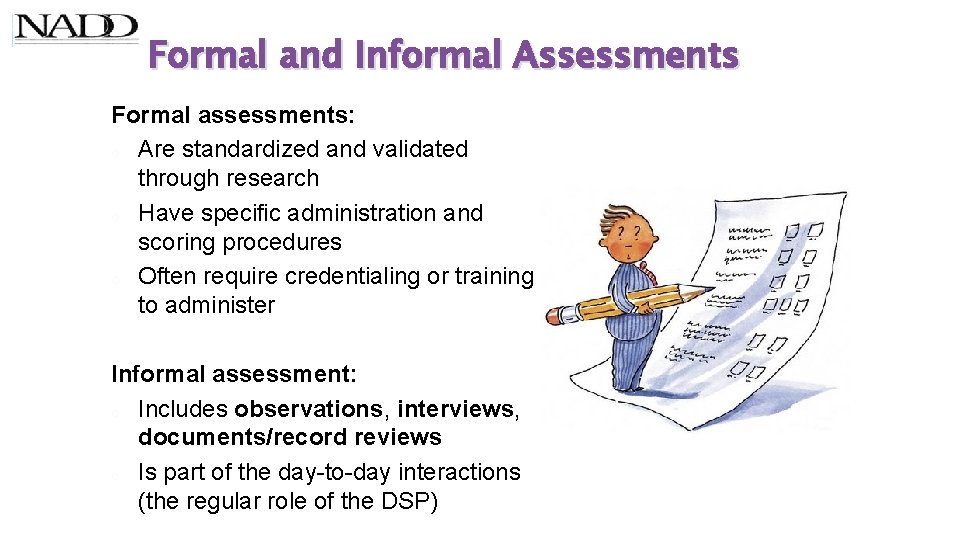
Formal and Informal Assessments Formal assessments: o Are standardized and validated through research o Have specific administration and scoring procedures o Often require credentialing or training to administer Informal assessment: o Includes observations, interviews, documents/record reviews o Is part of the day-to-day interactions (the regular role of the DSP)
Common Formal Assessments Medical or Health Assessments: Measures physical and functional capabilities such as vision or speech. These may include diagnostic procedures such as testing for blood sugars or drug testing. Psychological Assessments: Measures neuropsychological, behavioral, social, and emotional skills and abilities. Mental health screenings (mental health diagnosis) and chemical dependency tests are often a part of psychological assessments. 8
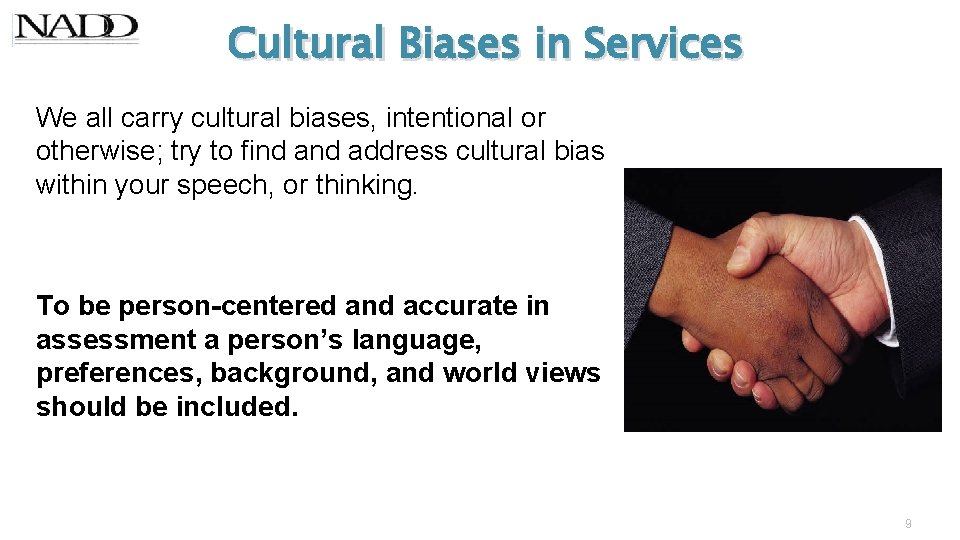
Cultural Biases in Services We all carry cultural biases, intentional or otherwise; try to find address cultural bias within your speech, or thinking. To be person-centered and accurate in assessment a person’s language, preferences, background, and world views should be included. 9
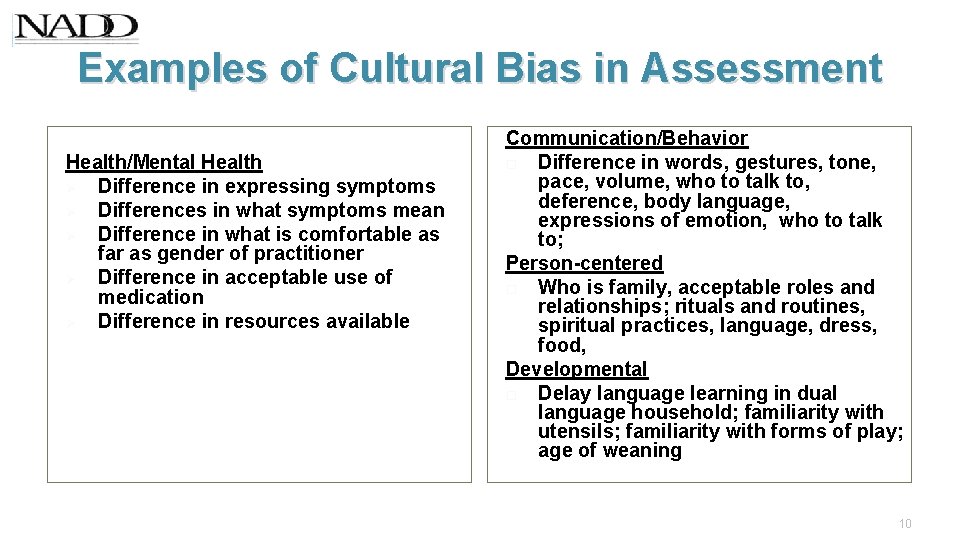
Examples of Cultural Bias in Assessment Health/Mental Health Ø Difference in expressing symptoms Ø Differences in what symptoms mean Ø Difference in what is comfortable as far as gender of practitioner Ø Difference in acceptable use of medication Ø Difference in resources available Communication/Behavior Difference in words, gestures, tone, pace, volume, who to talk to, deference, body language, expressions of emotion, who to talk to; Person-centered Who is family, acceptable roles and relationships; rituals and routines, spiritual practices, language, dress, food, Developmental Delay language learning in dual language household; familiarity with utensils; familiarity with forms of play; age of weaning 10
Benchmark 1 B: Use of Assessment and Observation Tools The qualified DSP demonstrates proficiency in the use of assessments and observation methods to support needs of individuals served. You are the one person who is there on the person’s good days and bad days 11
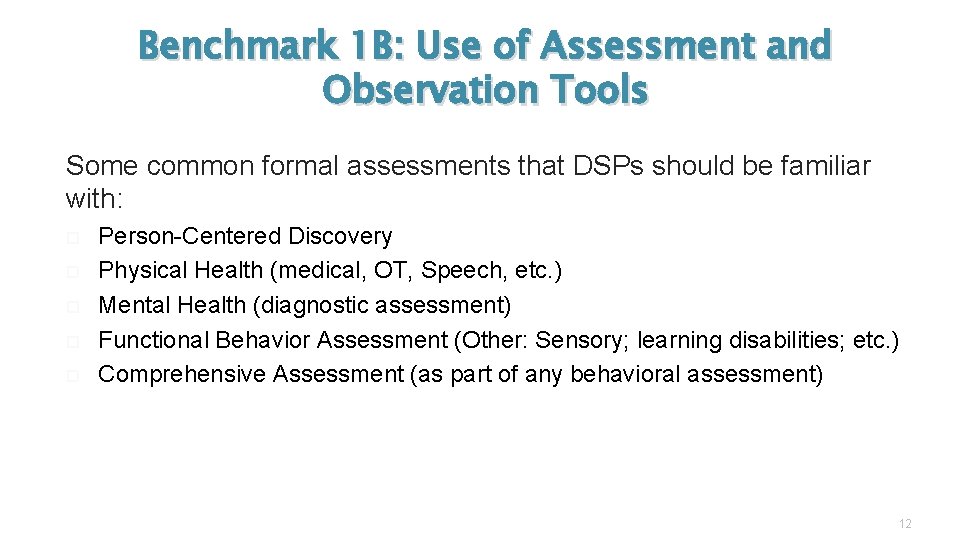
Benchmark 1 B: Use of Assessment and Observation Tools Some common formal assessments that DSPs should be familiar with: Person-Centered Discovery Physical Health (medical, OT, Speech, etc. ) Mental Health (diagnostic assessment) Functional Behavior Assessment (Other: Sensory; learning disabilities; etc. ) Comprehensive Assessment (as part of any behavioral assessment) 12
Basic DSP Skills for Assessment In all forms of assessment (both formal and informal) you will use the following skills: Observation Checking with the person (Interviews) Communication Documentation 13
Core Skills For Daily Success Knowledge of common formal assessment Understanding of critical status changes Recognizing medication side effects or other problems Behavioral and clinical signs and symptoms of a medical or mental health conditions onset or crises 14
Participating in Formal Assessments As a DSP, you may be required by your organization to assist a professional assessment administrator (clinician, behaviorist) in gathering assessment information. Before participating in formal assessments: Make sure you understand requests Clarify expectations as needed Follow directions and pay attention to specific details Be objective Report and or communicate person-centered information 15
Learn the Signs and Symptoms of Mental Illness One half of all mental illness begins by age 14 and 75% begins by age 24 (American Psychiatric Association). Mental health illnesses like schizophrenia or bipolar disorder usually do not occur suddenly. Symptoms are less observable than anxiety. A person will usually begin to notice small changes or a feeling that something is not normal or right about their thinking, feelings, or behavior. They will usually begin to realize some of these symptoms before these illness are fully developed. For example: 16
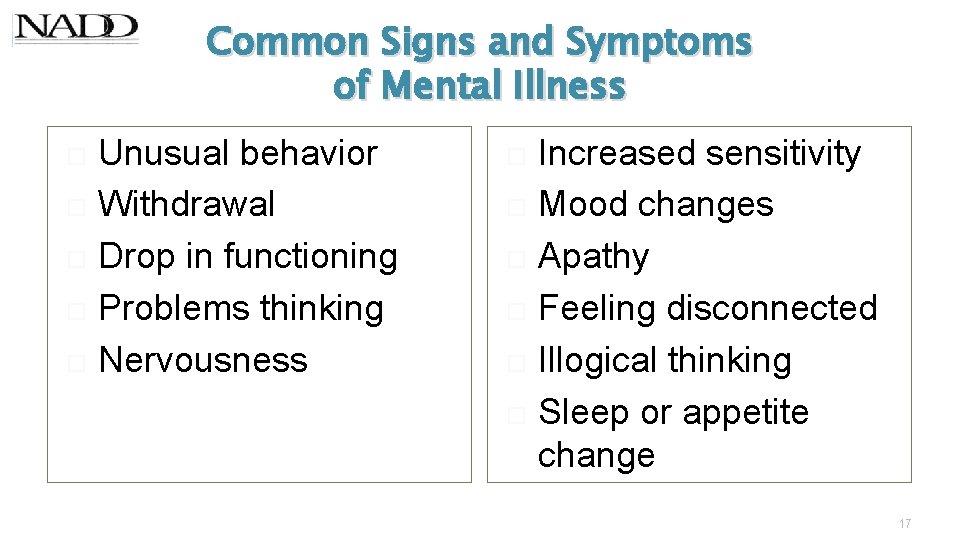
Common Signs and Symptoms of Mental Illness Unusual behavior Withdrawal Drop in functioning Problems thinking Nervousness Increased sensitivity Mood changes Apathy Feeling disconnected Illogical thinking Sleep or appetite change 17
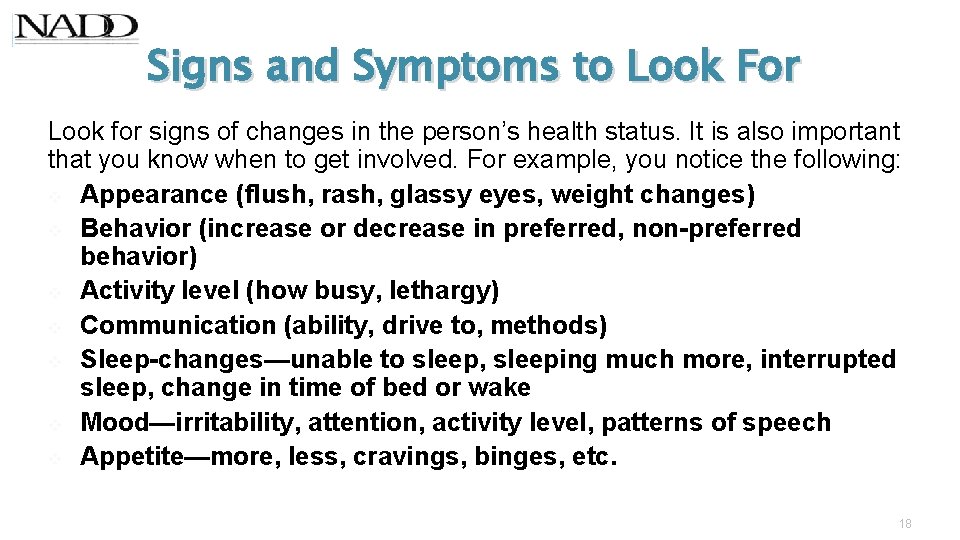
Signs and Symptoms to Look For Look for signs of changes in the person’s health status. It is also important that you know when to get involved. For example, you notice the following: v Appearance (flush, rash, glassy eyes, weight changes) v Behavior (increase or decrease in preferred, non-preferred behavior) v Activity level (how busy, lethargy) v Communication (ability, drive to, methods) v Sleep-changes—unable to sleep, sleeping much more, interrupted sleep, change in time of bed or wake v Mood—irritability, attention, activity level, patterns of speech v Appetite—more, less, cravings, binges, etc. 18
Benchmark 1 C: Behavioral Assessment The qualified DSP recognizes behavior as a form of communication. The DSP demonstrates proficiency in observing and recording behavior. The DSP is able to summarize and analyze behavioral assessment information. The qualified DSP collaborates in the planning and implementation of interventions and services aimed at increasing desirable behavioral skills. 19
Behavior Assessment Behavioral assessment (especially functional assessment) involves direct support professionals as key informants and observers of a person’s behavior in their environment. It is important that DSPs observe an individual in different settings, situations or circumstances. But it will be your observations of what the person was doing before you provided that intervention and occurred after that are critical. 20
Behavioral Assessment During behavioral assessments, patterns are identified and recommendations are made for behavior prevention and modification. The most common types of behavioral assessment include: v Clinical or psychological assessment v Functional Behavior Assessment (FBA) 21
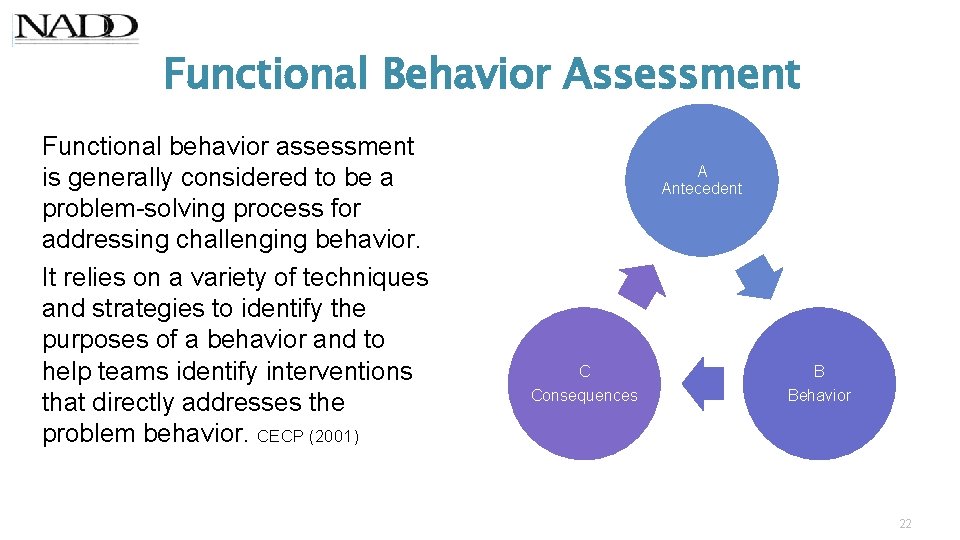
Functional Behavior Assessment Functional behavior assessment is generally considered to be a problem-solving process for addressing challenging behavior. It relies on a variety of techniques and strategies to identify the purposes of a behavior and to help teams identify interventions that directly addresses the problem behavior. CECP (2001) A Antecedent C B Consequences Behavior 22
The ABC Method The ABC method is a direct observation approach that can be used to obtain information about what influences behavior � "A" refers to the antecedent, or the event or trigger that immediately precedes a problem behavior. � The "B" refers to observed behavior, and "C" refers to the consequence, or the event that immediately follows a response. These will be review in more detail in the following slides. 23
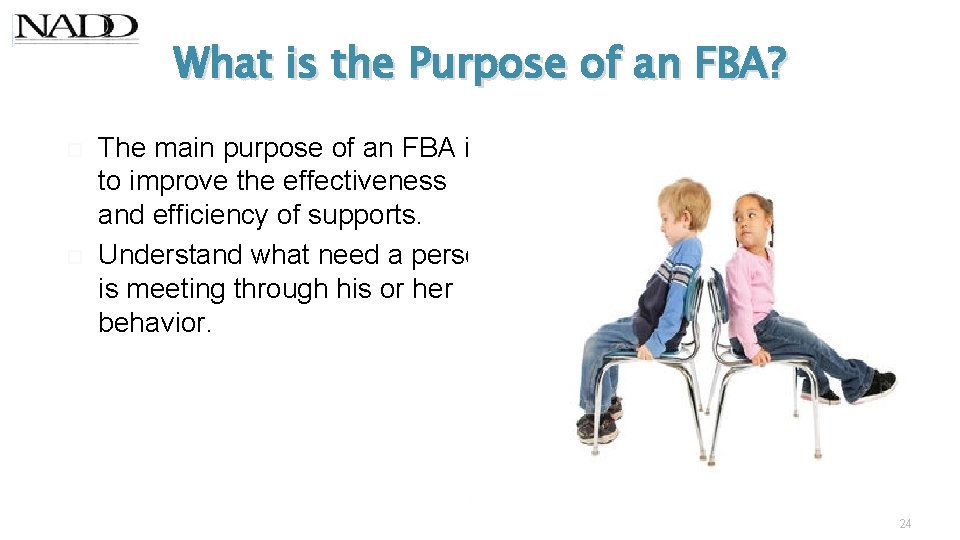
What is the Purpose of an FBA? The main purpose of an FBA is to improve the effectiveness and efficiency of supports. Understand what need a person is meeting through his or her behavior. 24
Antecedent Explains why the behavior is occurring now as opposed to some other time (a setting event may contribute but is not direct cause) Pay close attention to the person Check for signs of discomfort, illness (fever, rash, cut, etc. ) Are these signs of emerging mental or physical conditions the person previously experienced? (i. e. a symptom, side effect) 25
Behavior is how a person acts either toward themselves or toward others. Behavior is externally visible--meaning it is observable, and it can be seen. Behavior can be verbal (talking, shouting, swearing) or non-verbal (biting, hitting, smiling, walking, punching, waving, etc. ) For assessment purposes, it’s important to give an objective description of behavior. What can you see and describe without bias? 26
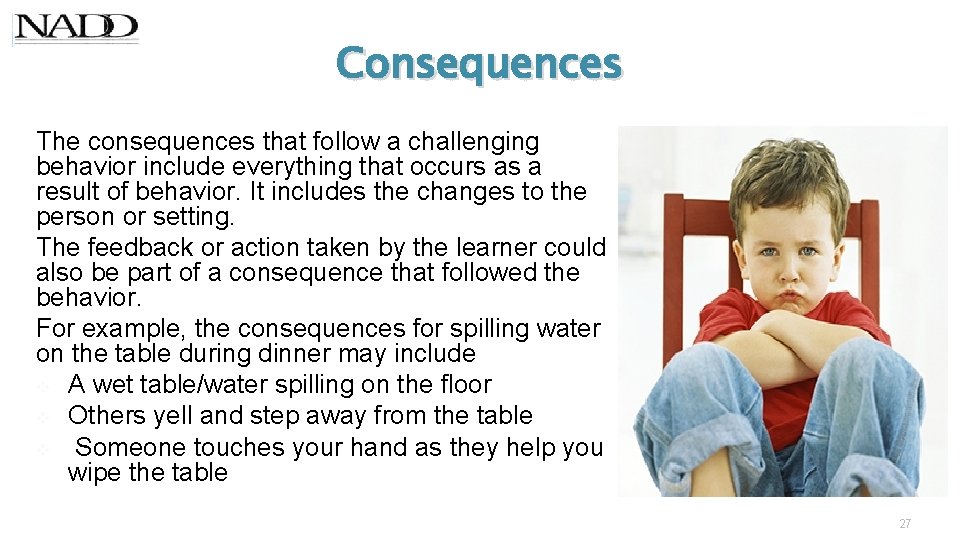
Consequences The consequences that follow a challenging behavior include everything that occurs as a result of behavior. It includes the changes to the person or setting. The feedback or action taken by the learner could also be part of a consequence that followed the behavior. For example, the consequences for spilling water on the table during dinner may include v A wet table/water spilling on the floor v Others yell and step away from the table v Someone touches your hand as they help you wipe the table 27
Benchmark 1 D: Documentation and Communication Related to Assessment and Observation The qualified DSP demonstrates effective skills in documentation and communication of assessment information and observations to others. The DSP maintains ethical and legal standards of confidentiality. 28
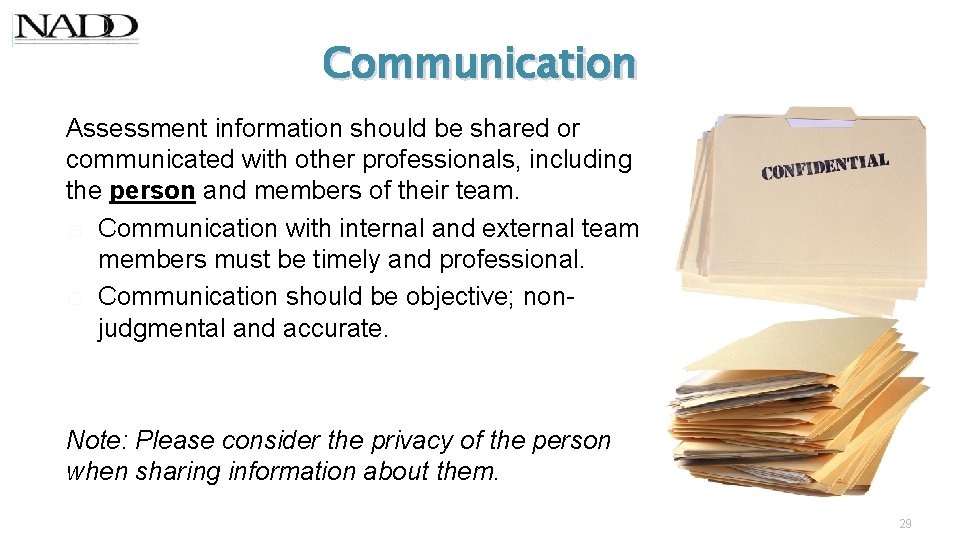
Communication Assessment information should be shared or communicated with other professionals, including the person and members of their team. � Communication with internal and external team members must be timely and professional. � Communication should be objective; nonjudgmental and accurate. Note: Please consider the privacy of the person when sharing information about them. 29
Differences in Communication with Different People Person—make an effort to engage the person with language he or she prefers Coworkers/supervisor—know proper terms to use, keep discussions and information confidential, use documentation as well as face-to-face discussion Family? Professionals? 30
Documentation includes information (meaningful data) and its supporting medium, which could be in the form of � Paper � Audio � Video � Pictures, etc. Documentation also involves recording, capturing, storing, or printing information. 31
What is Helpful (Good)Documentation? Helpful (good)documentation is accurate, legible, and objective documentation of assessment and observation information. For this course, helpful documentation is person-centered, objective, culturally sensitive, and organize. � When engaging in documentation, do not use technical terms that others on the team may not be familiar with. � Each time you write, you take responsibility for your work and what you have written by signing or initialing. Ensure the information is truthful and accurate to the best of your knowledge 32
Unhelpful Documentation Unhelpful documentation is documentation that lacks significant user information that clearly explains the Who, What, Where, When, and How � � � Unhelpful documentation is confusing, vague, and unclear. There are consequences to bad or poor documentation. An example is the person loosing or missing out on treatment or opportunities because of missing information or records. 33
Example of Helpful (Good) Documentation Helpful documentation is error free, legible, and answers the who, what, where, when and how questions. It also includes the user’s signature or initial and date. When documenting behavioral observations, it is important to include an operational definition of behaviors, as well as the frequency, intensity and duration of the behavior. Helpful example Not helpful example Melissa left the table early 5 times last week during dinner and went to her room. She screamed and cried in her room for 10 -15 minutes each time. Once, she knocked over her dishes before she left. Melissa left the table mad and was depressed in her room after dinner most nights. 34
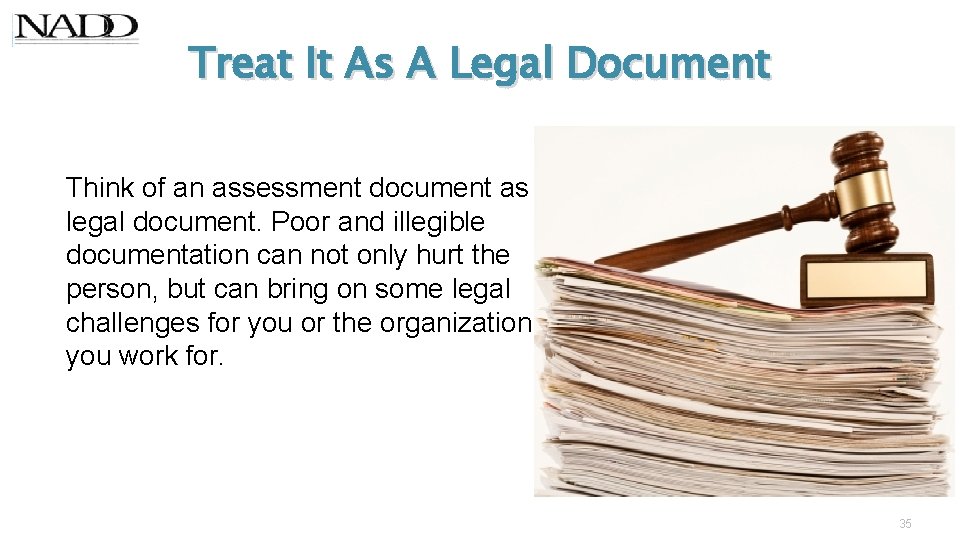
Treat It As A Legal Document Think of an assessment document as a legal document. Poor and illegible documentation can not only hurt the person, but can bring on some legal challenges for you or the organization you work for. 35
When and What to Document � � � It is important to document sudden and unexpected changes in a person’s behavior. When you notice changes even if you think it might go nowhere, when needed as far as mental health symptoms or signs of illness, etc. (changes in health status) Track usual (baseline) and unusual changes in diet, weight, sleep pattern, behaviors, possible medication side effects. 36
Sharing Assessment and Observation Information Much of the information you will gather is confidential information. Read your organization’s policy on confidentiality prior to sharing assessment information with unauthorized individuals (this can include anyone with whom the person does not give consent to share). There are times when information is useful and relevant and can help someone get needed support. 37
CONCLUSION Thank you for participating today in this NADD webinar Please plan to attend the next one and the entire series. If you need to contact today’s presenter please do so with this info below: Tony Thomas, Executive Director, Welcome House, Inc. 802 Sharon Drive, Suite A, Westlake, Ohio 44145 Phone: 440 -356 -2330, ext 226 Email: tthomas@welcomehouseinc. org 38
- Slides: 38