
n The MDFT Model n And Some Notes





- Slides: 15
n The MDFT Model n And Some Notes on Germany Andreas Gantner
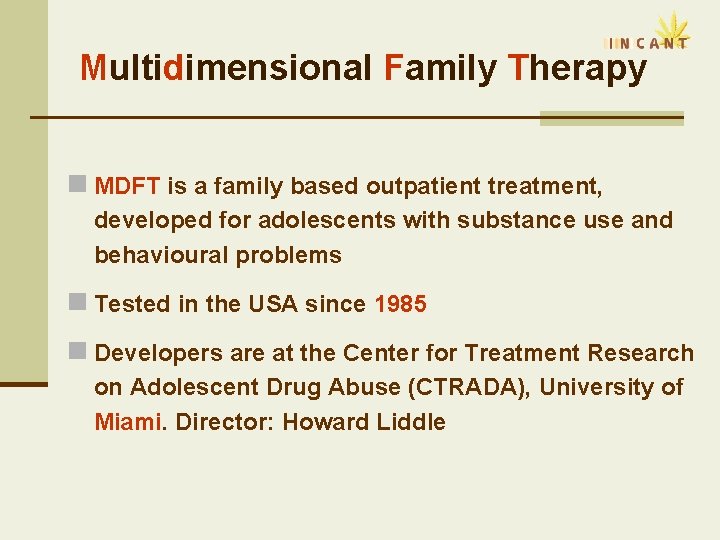
Multidimensional Family Therapy n MDFT is a family based outpatient treatment, developed for adolescents with substance use and behavioural problems n Tested in the USA since 1985 n Developers are at the Center for Treatment Research on Adolescent Drug Abuse (CTRADA), University of Miami. Director: Howard Liddle
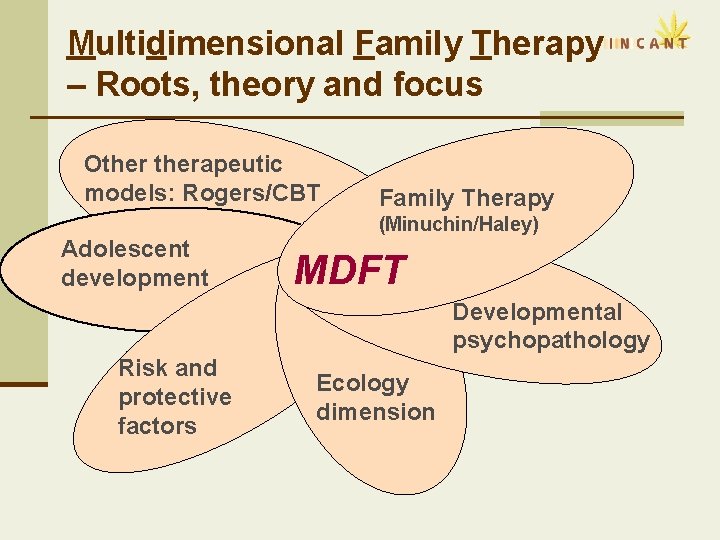
Multidimensional Family Therapy – Roots, theory and focus Otherapeutic models: Rogers/CBT Family Therapy (Minuchin/Haley) Adolescent development MDFT Developmental psychopathology Risk and protective factors Ecology dimension
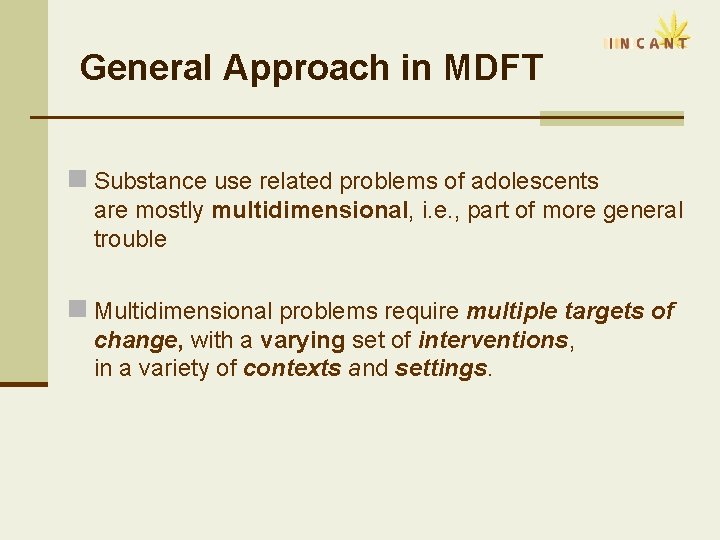
General Approach in MDFT n Substance use related problems of adolescents are mostly multidimensional, i. e. , part of more general trouble n Multidimensional problems require multiple targets of change, with a varying set of interventions, in a variety of contexts and settings.
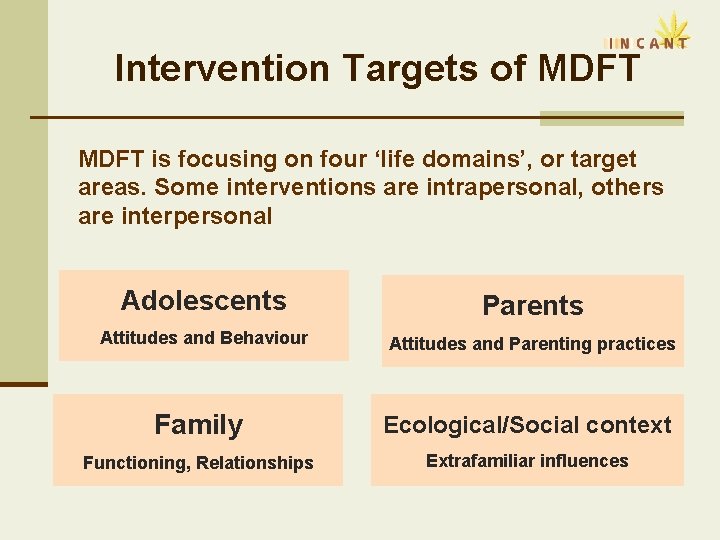
Intervention Targets of MDFT is focusing on four ‘life domains’, or target areas. Some interventions are intrapersonal, others are interpersonal Adolescents Parents Attitudes and Behaviour Attitudes and Parenting practices Family Ecological/Social context Functioning, Relationships Extrafamiliar influences
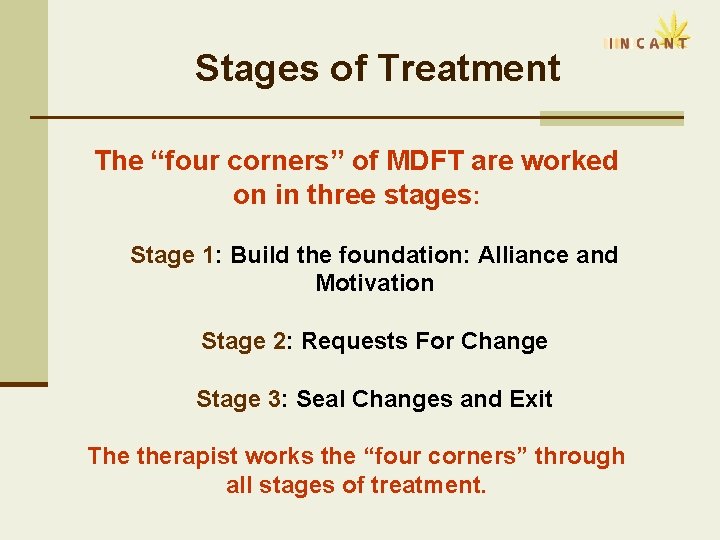
Stages of Treatment The “four corners” of MDFT are worked on in three stages: Stage 1: Build the foundation: Alliance and Motivation Stage 2: Requests For Change Stage 3: Seal Changes and Exit The therapist works the “four corners” through all stages of treatment.
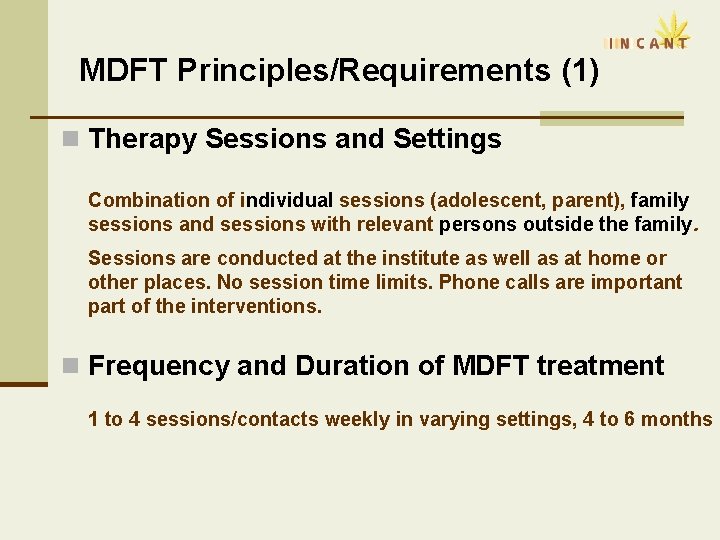
MDFT Principles/Requirements (1) n Therapy Sessions and Settings Combination of individual sessions (adolescent, parent), family sessions and sessions with relevant persons outside the family. Sessions are conducted at the institute as well as at home or other places. No session time limits. Phone calls are important part of the interventions. n Frequency and Duration of MDFT treatment 1 to 4 sessions/contacts weekly in varying settings, 4 to 6 months
MDFT Principles/Requirements (2) n MDFT Forms Case Conceptualization Form, Therapist Session Planning Sheet, Treatment Contact Log n MDFT Supervision Weekly team supervision, individual supervision, live supervision, videotape reviews
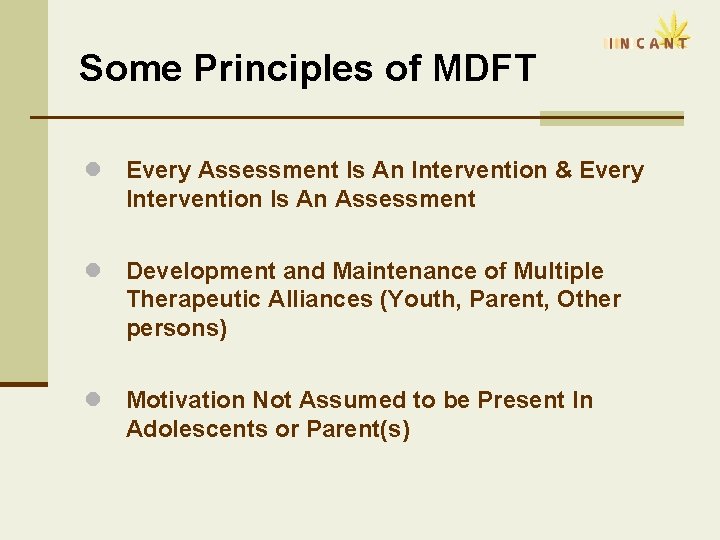
Some Principles of MDFT l Every Assessment Is An Intervention & Every Intervention Is An Assessment l Development and Maintenance of Multiple Therapeutic Alliances (Youth, Parent, Other persons) l Motivation Not Assumed to be Present In Adolescents or Parent(s)
Some Principles of MDFT l Identify and enlarge upon Strengths & Competencies l Planning and Flexibility Are Necessary Complementary Components: Read client feedback and shift focus, when necessary, to respond to clients needs and concerns
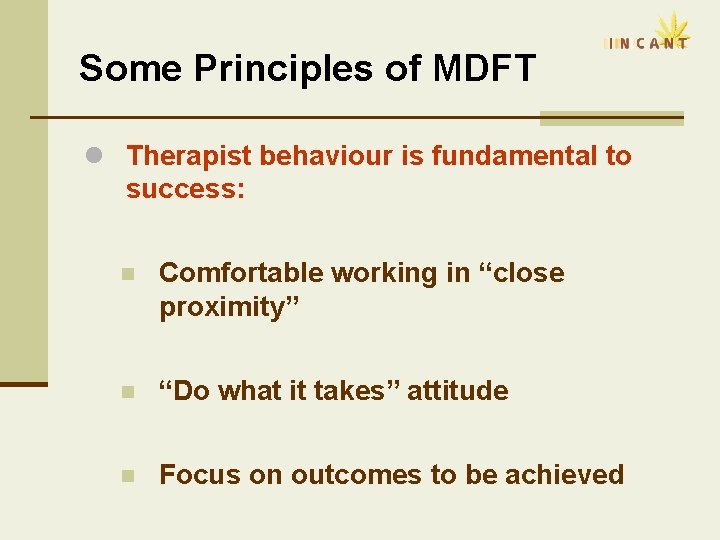
Some Principles of MDFT l Therapist behaviour is fundamental to success: n Comfortable working in “close proximity” n “Do what it takes” attitude n Focus on outcomes to be achieved
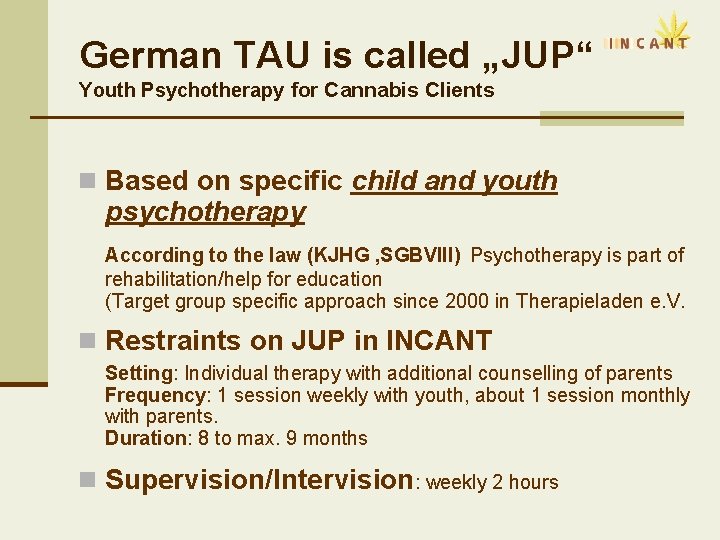
German TAU is called „JUP“ Youth Psychotherapy for Cannabis Clients n Based on specific child and youth psychotherapy According to the law (KJHG , SGBVIII) Psychotherapy is part of rehabilitation/help for education (Target group specific approach since 2000 in Therapieladen e. V. n Restraints on JUP in INCANT Setting: Individual therapy with additional counselling of parents Frequency: 1 session weekly with youth, about 1 session monthly with parents. Duration: 8 to max. 9 months n Supervision/Intervision: weekly 2 hours
General approach of JUP Integrative Psychotherapy approach n Client-centred Psychotherapy n Cognitive Behavioural Therapy (CBT) n Motivational Interviewing (MI) n drug- and addiction-specific oriented, including comorbidity n based on developmental psychology n integrated in the pedagogic/educational context
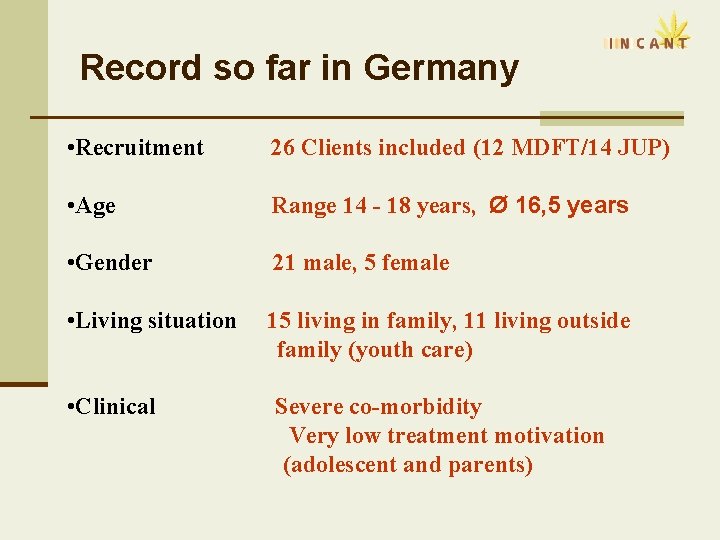
Record so far in Germany • Recruitment 26 Clients included (12 MDFT/14 JUP) • Age Range 14 - 18 years, Ø 16, 5 years • Gender 21 male, 5 female • Living situation 15 living in family, 11 living outside family (youth care) • Clinical Severe co-morbidity Very low treatment motivation (adolescent and parents)
Thank you for your attention www. incant. de www. incant. eu