
n R gravity as viable alternative to dark
n R gravity as viable alternative to dark matter: application to stellar dynamics V. Borka Jovanović1, P. Jovanović2, D. Borka 1, S. Capozziello 3, 4 1 Atomic Physics Laboratory (040), Vinča Institute of Nuclear Sciences, P. O. Box 522, 11001 Belgrade, Serbia 2 Astronomical Observatory, Volgina 7, P. O. Box 74, 11060 Belgrade, Serbia 3 Dipartimento di Fisica, Università di Napoli ''Federico II'', 4 INFN - Sezione di Napoli, Via Cinthia, Napoli, Italy
Outline of the talk Object and goal: to present Rn gravity application to stellar dynamics around Galactic Center Motivation: the role of f(R) gravity, as well as the other modifications of standard Einstein's gravity, is to explain some observed phenomena without dark matter and dark energy Data (NTT/VLT and Keck telescope): Gillessen et al. 2009, Ap. J, 692, 1075; Ghez et al. 2008, Apj, 689, 1044 Method: Rn is analyzed using observed orbits of S-stars and also using two-body simulations Results: we review the various consequences of the f(R) gravity parameters on stellar dynamics and investigate their constraints from the observed S-star orbits Conclusions References
Extended Theories of Gravity (ETGs) ETGs are physical theories that attempt to describe the phenomena of gravitation in competition to Einstein's theory of general relativity, by preserving the undoubtedly positive results of Einstein's theory. Instead of introducing Dark Matter (DM), which is a hypothetical type of matter does not emitting or interacting with electromagnetic radiation, some theories, which modify the laws of gravity, could explain in a very natural fashion several astrophysical and cosmological observations. - it is aimed to address conceptual and experimental problems recently emerged in astrophysics, cosmology and high energy physics (such as rotational velocity curves of spiral galaxies, their baryonic Tully. Fischer relation and fundamental plane of elliptical galaxies) - some of the alternatives to general relativity: MOND: (Milgrom 1983) ETG: (f(R) gravity (family of models f(R, φ), f(T), Yukawa-like …), Brans-Dicke gravity, scalar-tensor theories, Palatini formalism, conformal transformations. . .
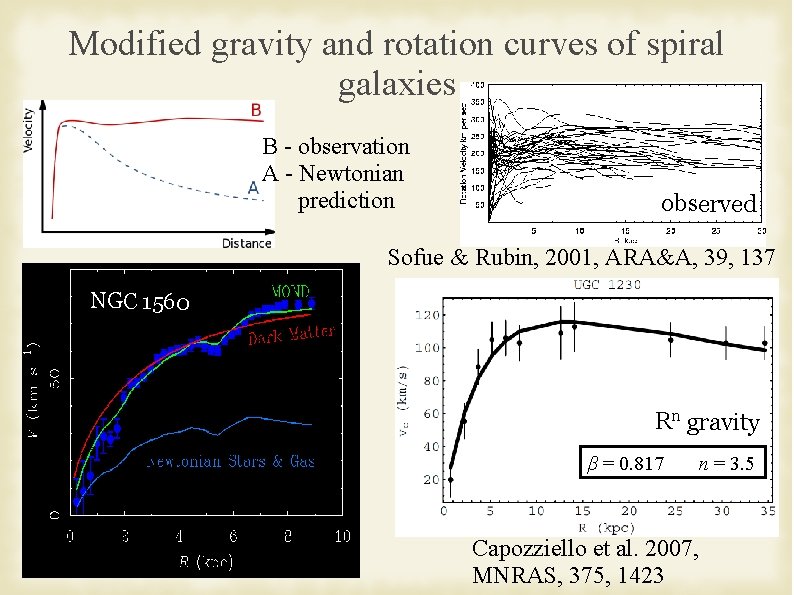
Modified gravity and rotation curves of spiral galaxies B - observation A - Newtonian prediction observed Sofue & Rubin, 2001, ARA&A, 39, 137 NGC 1560 Rn gravity β = 0. 817 Capozziello et al. 2007, MNRAS, 375, 1423 n = 3. 5
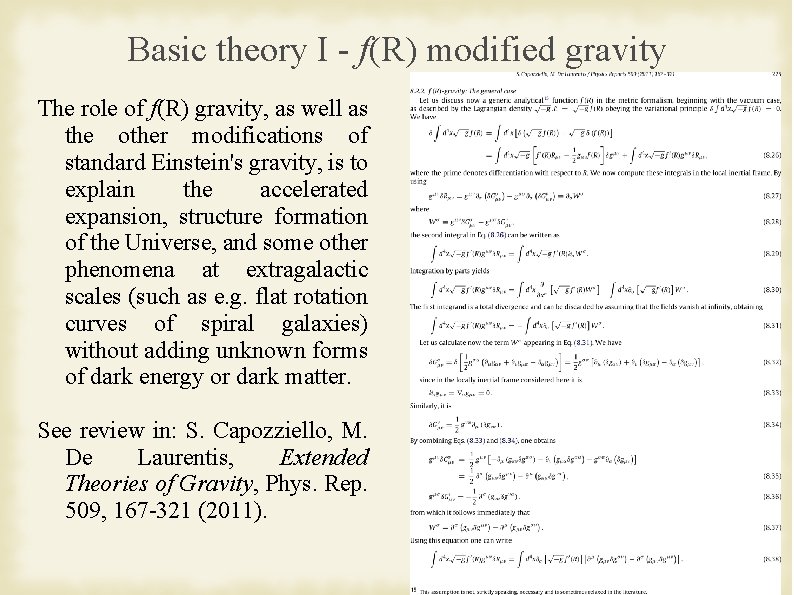
Basic theory I - f(R) modified gravity The role of f(R) gravity, as well as the other modifications of standard Einstein's gravity, is to explain the accelerated expansion, structure formation of the Universe, and some other phenomena at extragalactic scales (such as e. g. flat rotation curves of spiral galaxies) without adding unknown forms of dark energy or dark matter. See review in: S. Capozziello, M. De Laurentis, Extended Theories of Gravity, Phys. Rep. 509, 167 -321 (2011).
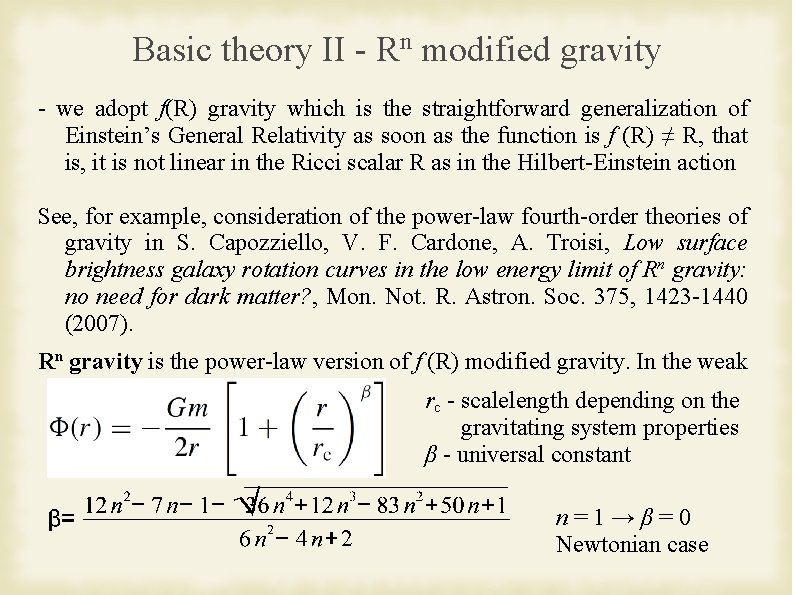
Basic theory II - Rn modified gravity - we adopt f(R) gravity which is the straightforward generalization of Einstein’s General Relativity as soon as the function is f (R) ≠ R, that is, it is not linear in the Ricci scalar R as in the Hilbert-Einstein action See, for example, consideration of the power-law fourth-order theories of gravity in S. Capozziello, V. F. Cardone, A. Troisi, Low surface brightness galaxy rotation curves in the low energy limit of Rn gravity: no need for dark matter? , Mon. Not. R. Astron. Soc. 375, 1423 -1440 (2007). Rn gravity is the power-law version of f (R) modified gravity. In the weak field limit, its potential is: rc - scalelength depending on the gravitating system properties β - universal constant n=1→β=0 Newtonian case
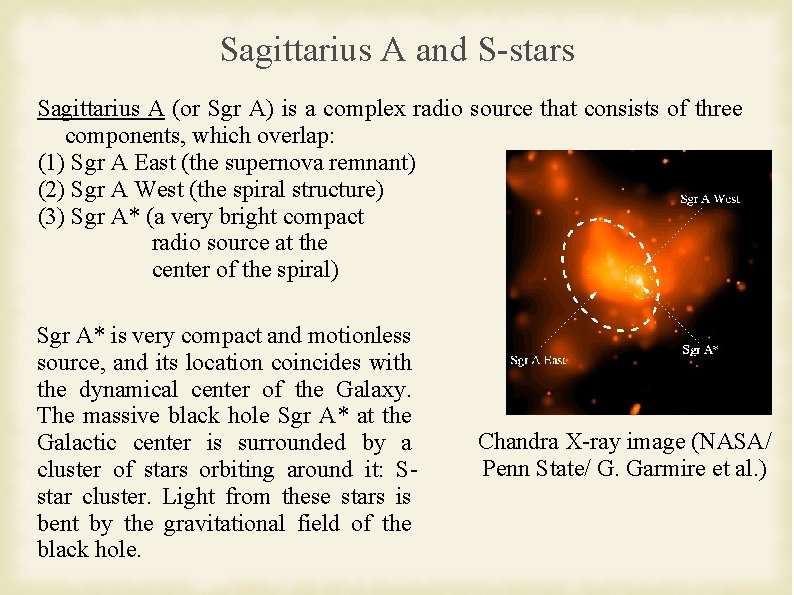
Sagittarius A and S-stars Sagittarius A (or Sgr A) is a complex radio source that consists of three components, which overlap: (1) Sgr A East (the supernova remnant) (2) Sgr A West (the spiral structure) (3) Sgr A* (a very bright compact radio source at the center of the spiral) Sgr A* is very compact and motionless source, and its location coincides with the dynamical center of the Galaxy. The massive black hole Sgr A* at the Galactic center is surrounded by a cluster of stars orbiting around it: Sstar cluster. Light from these stars is bent by the gravitational field of the black hole. Chandra X-ray image (NASA/ Penn State/ G. Garmire et al. )
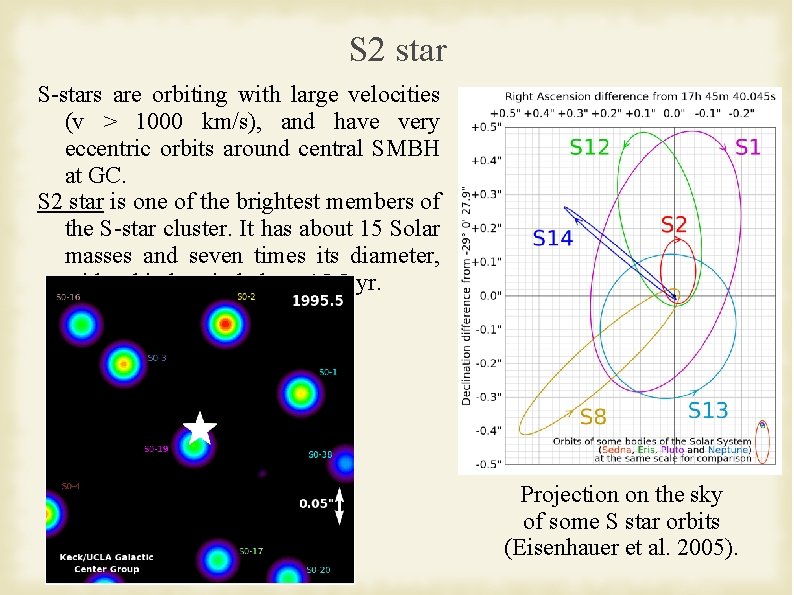
S 2 star S-stars are orbiting with large velocities (v > 1000 km/s), and have very eccentric orbits around central SMBH at GC. S 2 star is one of the brightest members of the S-star cluster. It has about 15 Solar masses and seven times its diameter, with orbital period about 15. 8 yr. Projection on the sky of some S star orbits (Eisenhauer et al. 2005).
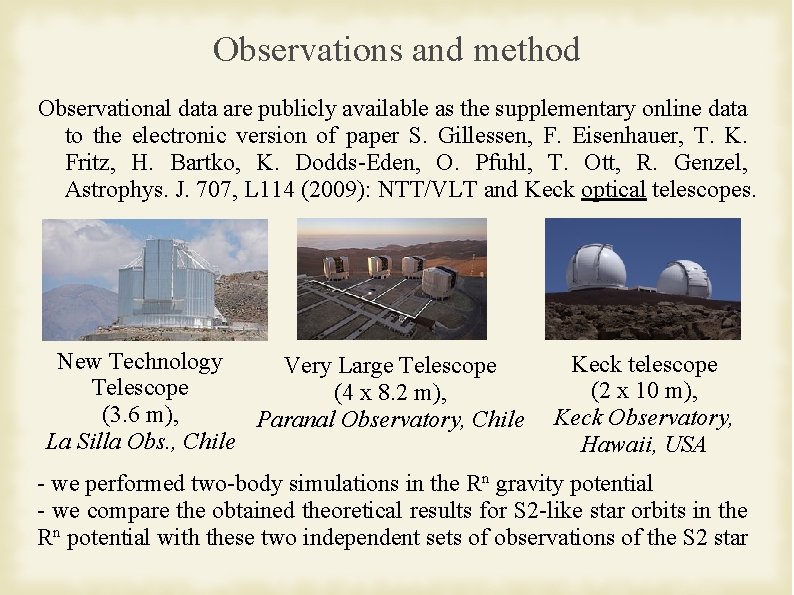
Observations and method Observational data are publicly available as the supplementary online data to the electronic version of paper S. Gillessen, F. Eisenhauer, T. K. Fritz, H. Bartko, K. Dodds-Eden, O. Pfuhl, T. Ott, R. Genzel, Astrophys. J. 707, L 114 (2009): NTT/VLT and Keck optical telescopes. New Technology Very Large Telescope (4 x 8. 2 m), (3. 6 m), Paranal Observatory, Chile La Silla Obs. , Chile Keck telescope (2 x 10 m), Keck Observatory, Hawaii, USA - we performed two-body simulations in the Rn gravity potential - we compare the obtained theoretical results for S 2 -like star orbits in the Rn potential with these two independent sets of observations of the S 2 star
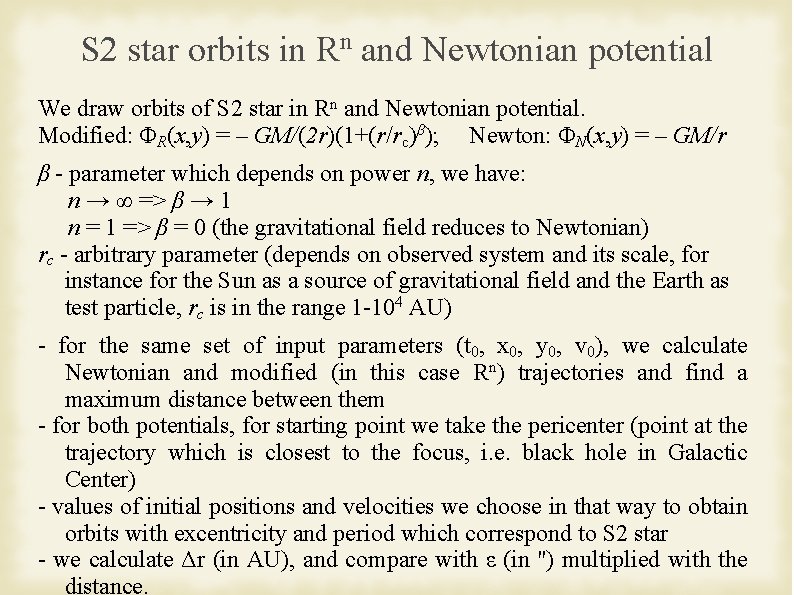
S 2 star orbits in Rn and Newtonian potential We draw orbits of S 2 star in Rn and Newtonian potential. Modified: ΦR(x, y) = – GM/(2 r)(1+(r/rc)β); Newton: ΦN(x, y) = – GM/r β - parameter which depends on power n, we have: n → ∞ => β → 1 n = 1 => β = 0 (the gravitational field reduces to Newtonian) rc - arbitrary parameter (depends on observed system and its scale, for instance for the Sun as a source of gravitational field and the Earth as test particle, rc is in the range 1 -104 AU) - for the same set of input parameters (t 0, x 0, y 0, v 0), we calculate Newtonian and modified (in this case Rn) trajectories and find a maximum distance between them - for both potentials, for starting point we take the pericenter (point at the trajectory which is closest to the focus, i. e. black hole in Galactic Center) - values of initial positions and velocities we choose in that way to obtain orbits with excentricity and period which correspond to S 2 star - we calculate Δr (in AU), and compare with ε (in '') multiplied with the distance.
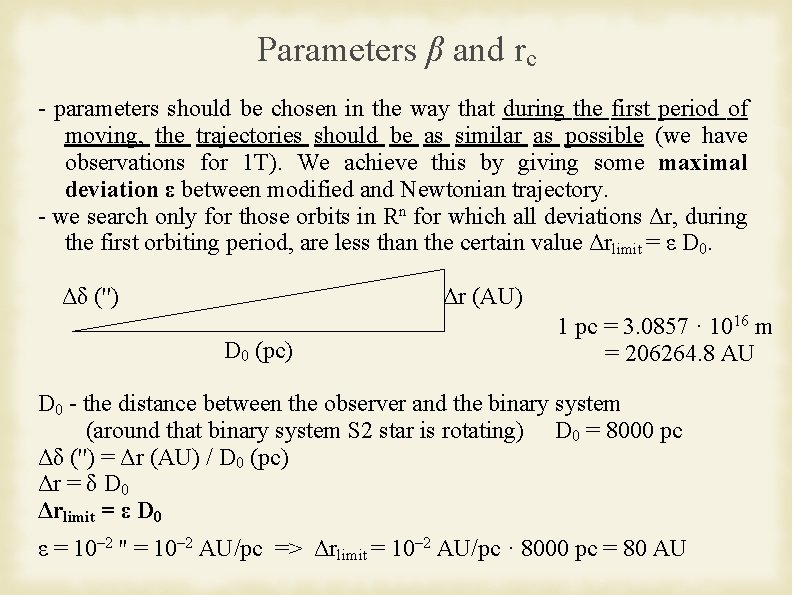
Parameters β and rc - parameters should be chosen in the way that during the first period of moving, the trajectories should be as similar as possible (we have observations for 1 T). We achieve this by giving some maximal deviation ε between modified and Newtonian trajectory. - we search only for those orbits in Rn for which all deviations Δr, during the first orbiting period, are less than the certain value Δrlimit = ε D 0. Δδ ('') Δr (AU) D 0 (pc) 1 pc = 3. 0857 · 1016 m = 206264. 8 AU D 0 - the distance between the observer and the binary system (around that binary system S 2 star is rotating) D 0 = 8000 pc Δδ ('') = Δr (AU) / D 0 (pc) Δr = δ D 0 Δrlimit = ε D 0 ε = 10– 2 '' = 10– 2 AU/pc => Δrlimit = 10– 2 AU/pc · 8000 pc = 80 AU
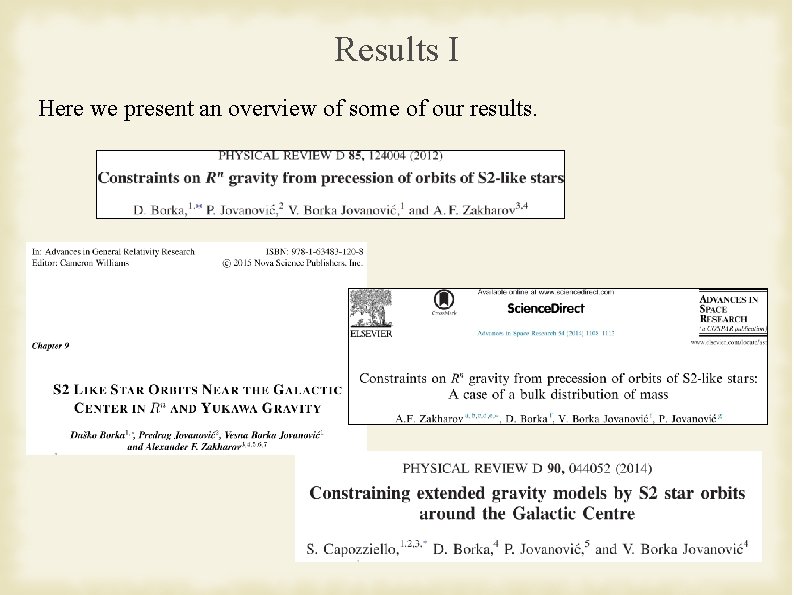
Results I Here we present an overview of some of our results.
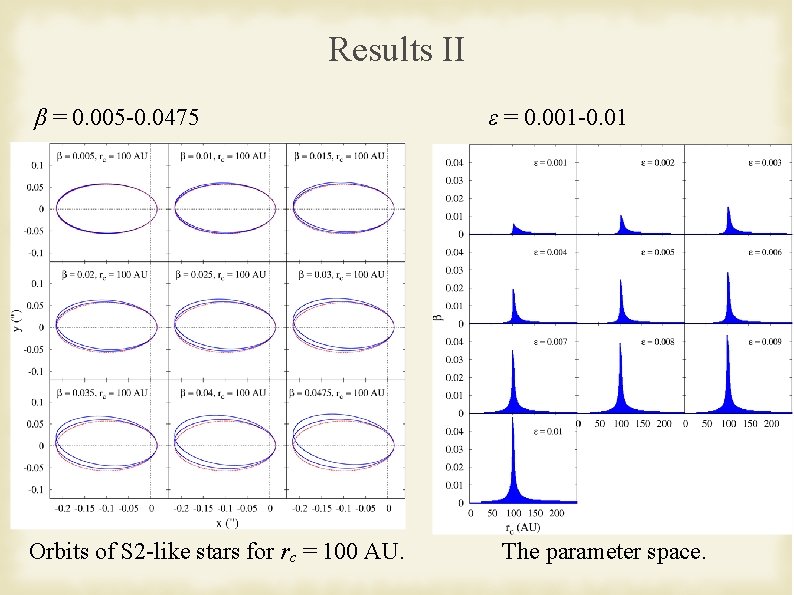
Results II β = 0. 005 -0. 0475 Orbits of S 2 -like stars for rc = 100 AU. ε = 0. 001 -0. 01 The parameter space.
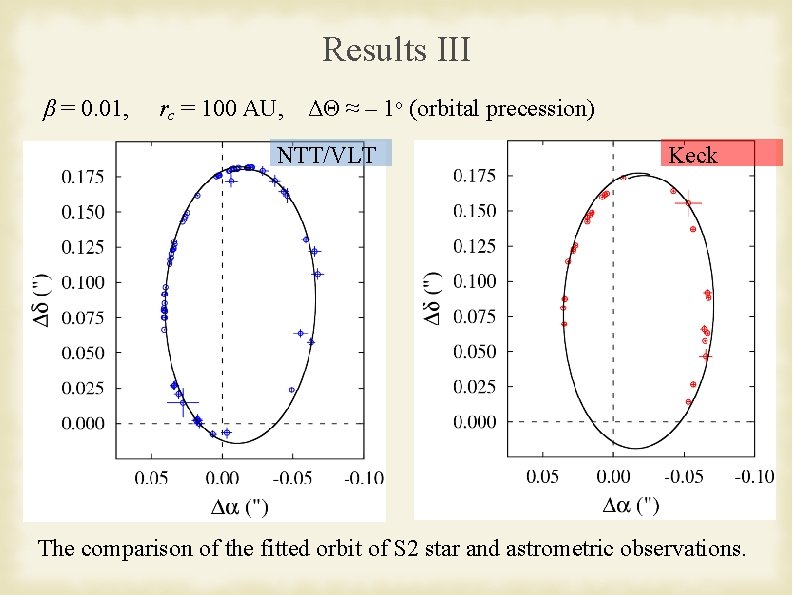
Results III β = 0. 01, rc = 100 AU, ΔΘ ≈ – 1 o (orbital precession) NTT/VLT Keck The comparison of the fitted orbit of S 2 star and astrometric observations.
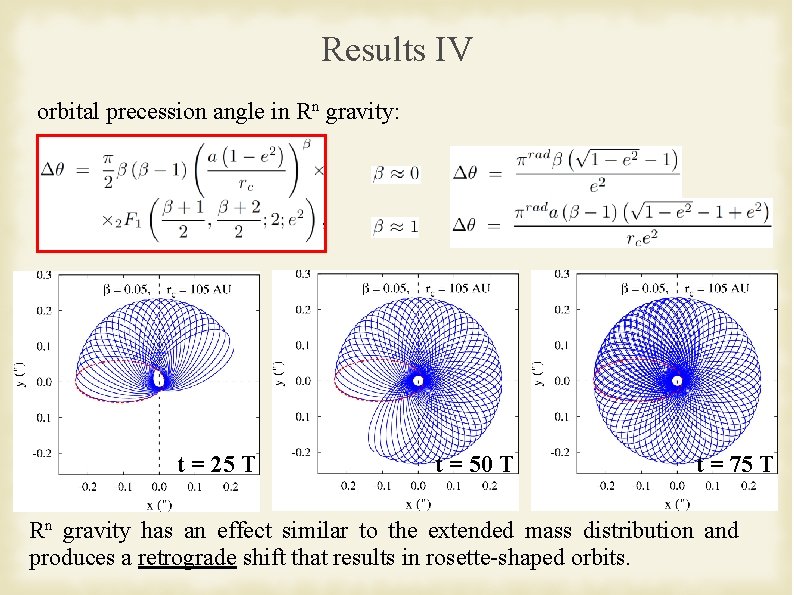
Results IV orbital precession angle in Rn gravity: tekst t = 25 T t = 50 T t = 75 T Rn gravity has an effect similar to the extended mass distribution and produces a retrograde shift that results in rosette-shaped orbits.
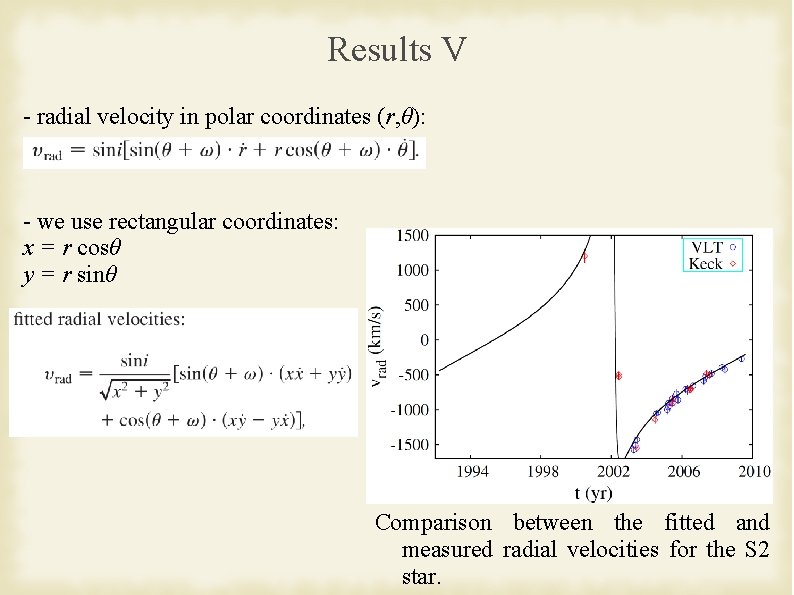
Results V - radial velocity in polar coordinates (r, θ): - we use rectangular coordinates: x = r cosθ y = r sinθ Comparison between the fitted and measured radial velocities for the S 2 star.
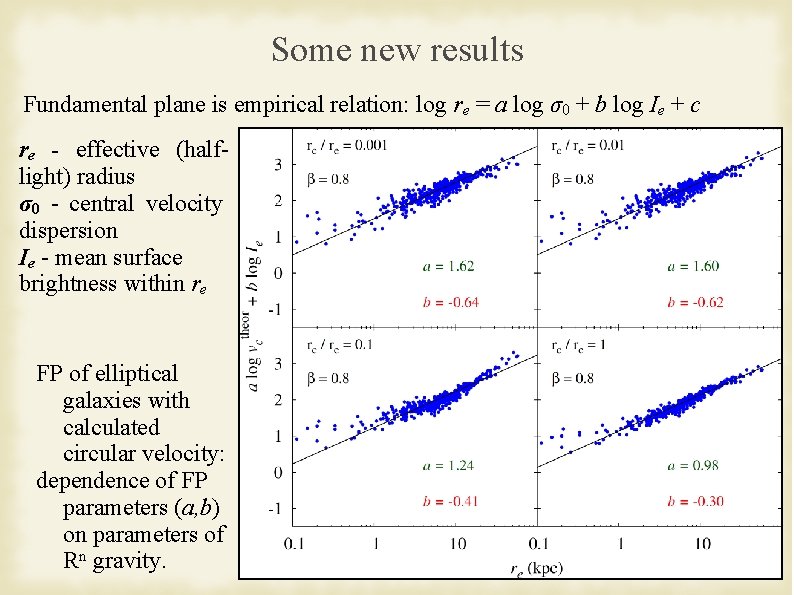
Some new results Fundamental plane is empirical relation: log re = a log σ0 + b log Ie + c re - effective (halflight) radius σ0 - central velocity dispersion Ie - mean surface brightness within re FP of elliptical galaxies with calculated circular velocity: dependence of FP parameters (a, b) on parameters of Rn gravity.
Conclusions For now, General Relativity (GR) is the best theory of gravitation with the largest number of experimentally confirmed predictions, but there is a need to review and extend Einstein Relativity to scales where it has not been properly tested, with aim to better explain observed phenomena at galactic scales, such as flat rotation curves of spiral galaxies, their BTFR, and FP of ellipticals f(R) theories of modified gravity represent good alternative to DM, and they are good basis to construct an effective theory of gravity f(R) theories, in particular Rn, can explain (without DM hypothesis) moving of S 2 star around SMBH at GC, although the different orbital precession in regard to GR is obtained Our future work: revising and extending theory of gravitational interaction in order to overcome the shortcomings of GR at galactic and cosmological scales (thus, to explain observations and phenomenology without introducing "ad hoc" ingredients).
![References [1] D. Borka, P. Jovanović, V. Borka Jovanović, A. F. Zakharov, Phys. Rev.](http://slidetodoc.com/presentation_image_h2/74d796b1e40f31f2ede1a876aa34cd9a/image-19.jpg "References [1] D. Borka, P. Jovanović, V. Borka Jovanović, A. F. Zakharov, Phys. Rev.")
References [1] D. Borka, P. Jovanović, V. Borka Jovanović, A. F. Zakharov, Phys. Rev. D 85, 124004 -1 -11 (2012). [2] D. Borka, P. Jovanović, V. Borka Jovanović, A. F. Zakharov, J. Cosmol. Astropart. P. 11, 050 -1 -16 (2013). [3] D. Borka, P. Jovanović, V. Borka Jovanović, A. F. Zakharov, SFIN year XXVI Series A: Conferences No. A 1, 61 -66 (2013). [4] S. Capozziello, D. Borka, P. Jovanović, V. Borka Jovanović, Phys. Rev. D 90, 044052 -1 -8 (2014). [5] A. F. Zakharov, D. Borka, V. Borka Jovanović, P. Jovanović, Adv. Space Res. 54, 1108 -1112 (2014).
![References II [6] D. Borka, P. Jovanović, V. Borka Jovanović, A. F. Zakharov, Chapter](http://slidetodoc.com/presentation_image_h2/74d796b1e40f31f2ede1a876aa34cd9a/image-20.jpg "References II [6] D. Borka, P. Jovanović, V. Borka Jovanović, A. F. Zakharov, Chapter")
References II [6] D. Borka, P. Jovanović, V. Borka Jovanović, A. F. Zakharov, Chapter 9 in "Advances in General Relativity Research", 343 -362, Nova Science Publishers (2015). [7] D. Borka, P. Jovanović, V. Borka Jovanović, A. F. Zakharov, SFIN year XXVIII Series A: Conferences No. A 1, 13 -21 (2015). [8] D. Borka, S. Capozziello, P. Jovanović, V. Borka Jovanović, Astropart. Phys. 79, 41 -48 (2016). [9] A. F. Zakharov, P. Jovanović, D. Borka, V. Borka Jovanović, J. Cosmol. Astropart. P. 5, 045 -1 -10 (2016). [10] V. Borka Jovanović, S. Capozziello, P. Jovanović, D. Borka, Astropart. Phys. , submitted.


- Slides: 22