
n QUIC NoiseBased Packet Protection Mathias HallAndersen University
n. QUIC: Noise-Based Packet Protection Mathias Hall-Andersen* University of Copenhagen David Wong* Facebook Nick Sullivan Cloudflare Alishah Chator† Johns Hopkins University *Work done while at NCC Group †Work done while at Cloudflare
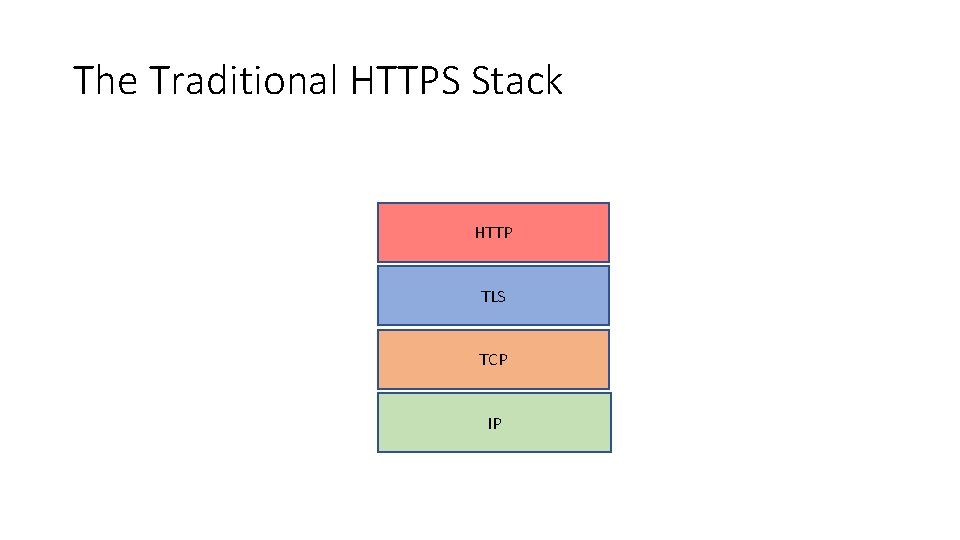
The Traditional HTTPS Stack HTTP TLS TCP IP

The Traditional HTTPS Stack HTTP TLS TCP IP Multiplexed Streams
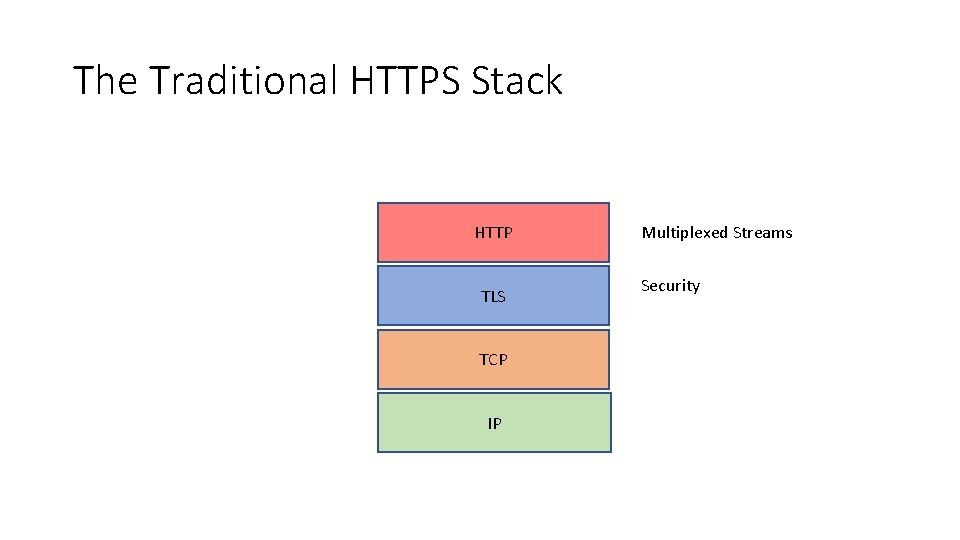
The Traditional HTTPS Stack HTTP TLS TCP IP Multiplexed Streams Security
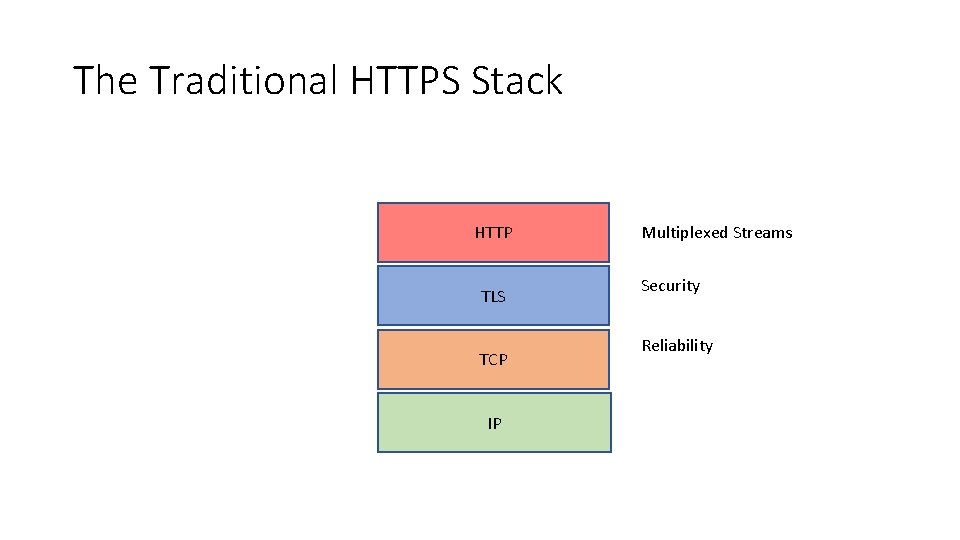
The Traditional HTTPS Stack HTTP TLS TCP IP Multiplexed Streams Security Reliability
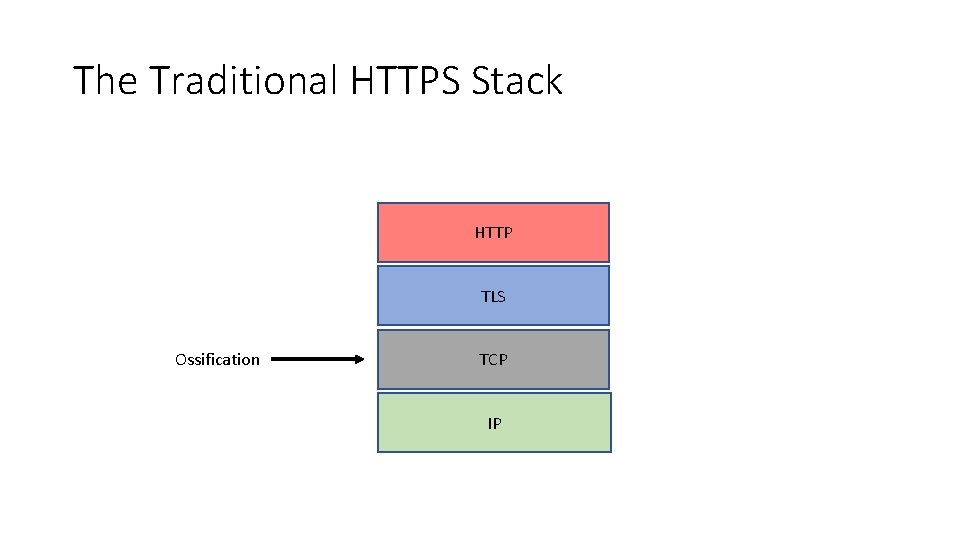
The Traditional HTTPS Stack HTTP TLS Ossification TCP IP
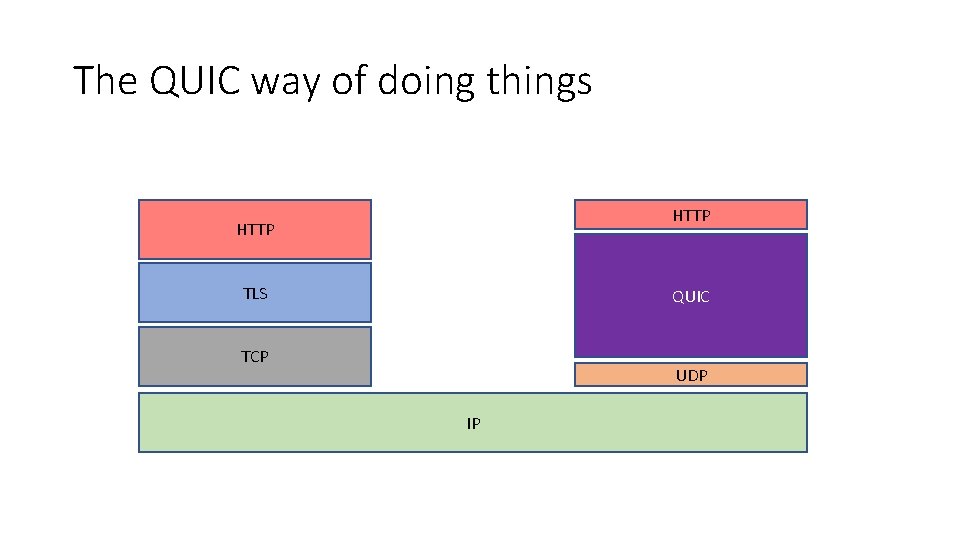
The QUIC way of doing things HTTP TLS QUIC TCP UDP IP
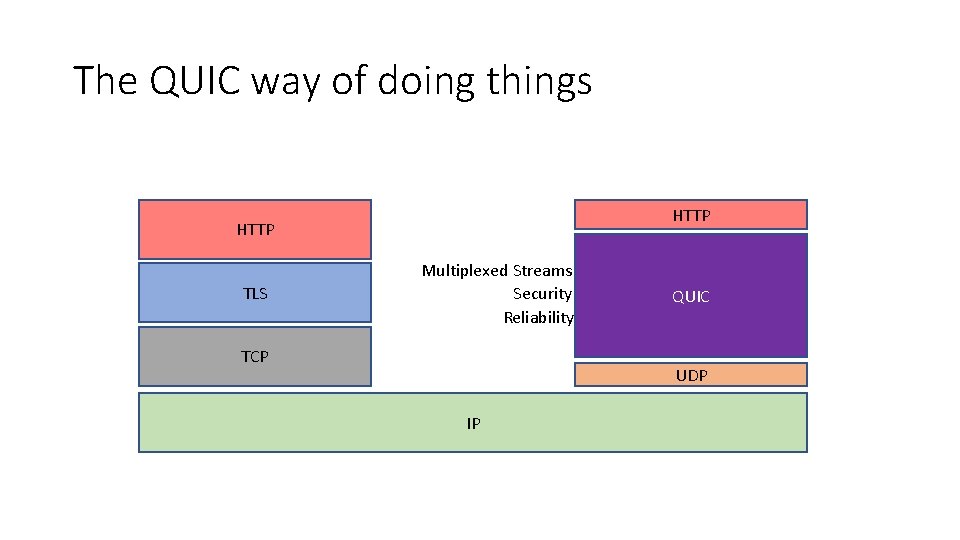
The QUIC way of doing things HTTP TLS Multiplexed Streams Security Reliability TCP QUIC UDP IP
Securing Protocols with TLS
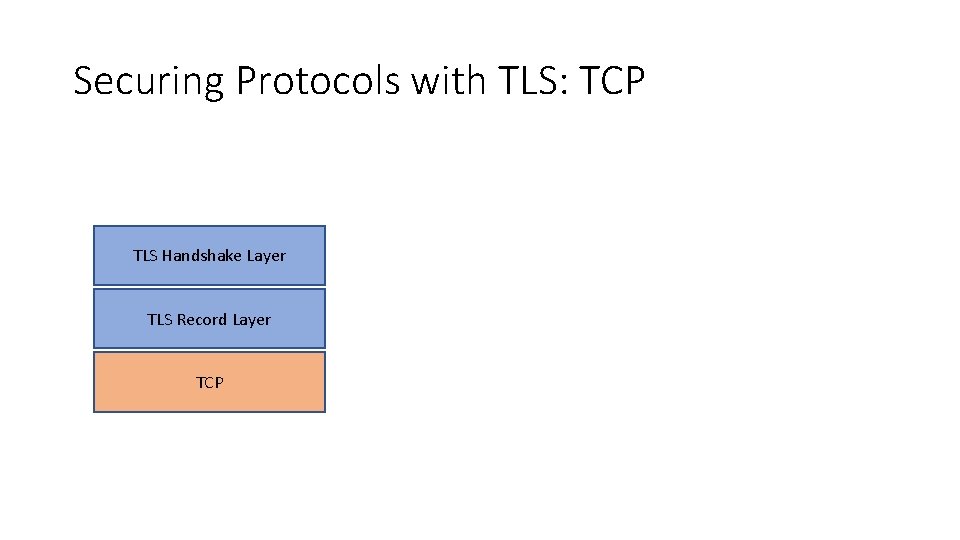
Securing Protocols with TLS: TCP TLS Handshake Layer TLS Record Layer TCP
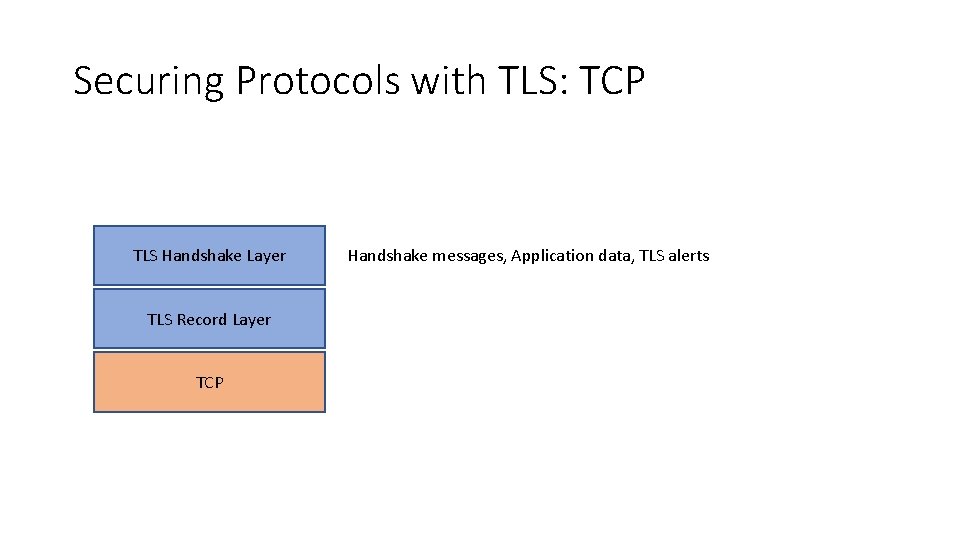
Securing Protocols with TLS: TCP TLS Handshake Layer TLS Record Layer TCP Handshake messages, Application data, TLS alerts
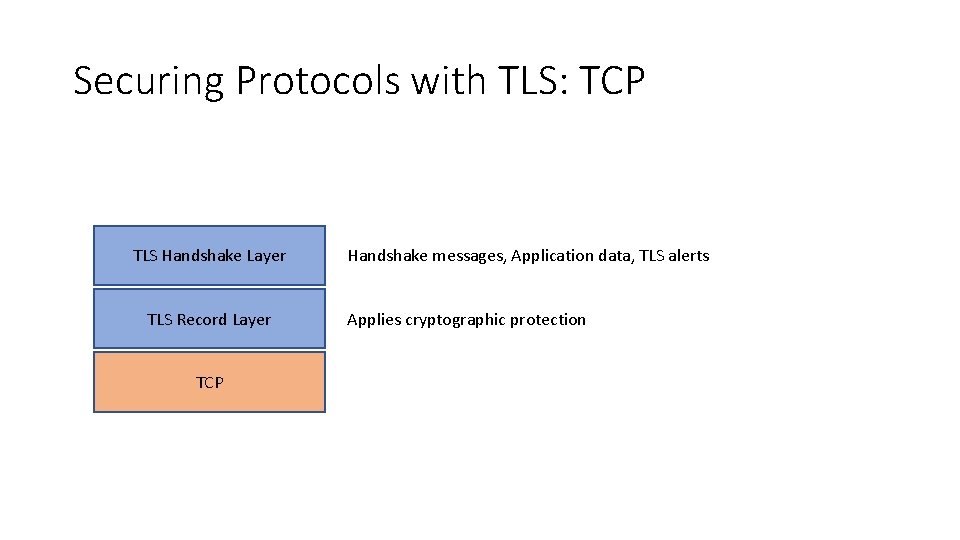
Securing Protocols with TLS: TCP TLS Handshake Layer TLS Record Layer TCP Handshake messages, Application data, TLS alerts Applies cryptographic protection
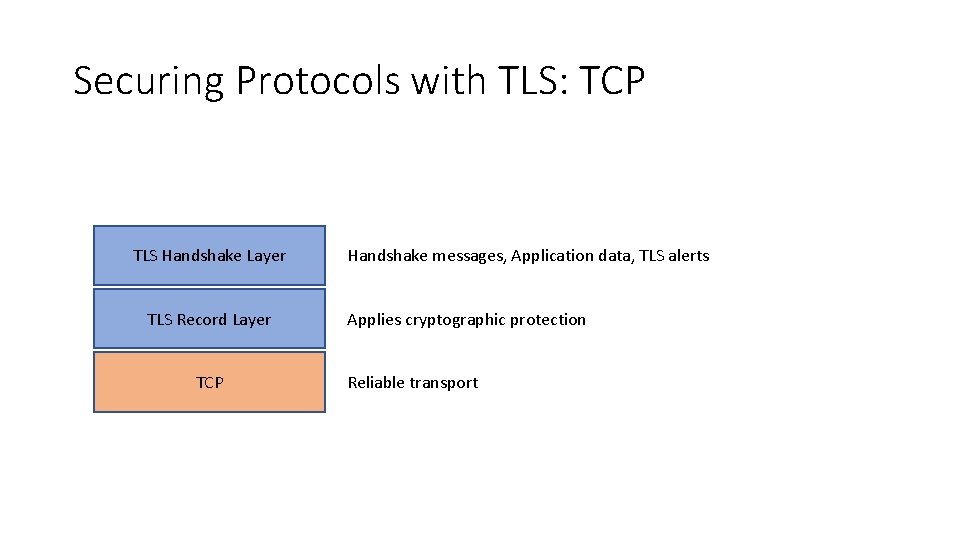
Securing Protocols with TLS: TCP TLS Handshake Layer TLS Record Layer TCP Handshake messages, Application data, TLS alerts Applies cryptographic protection Reliable transport
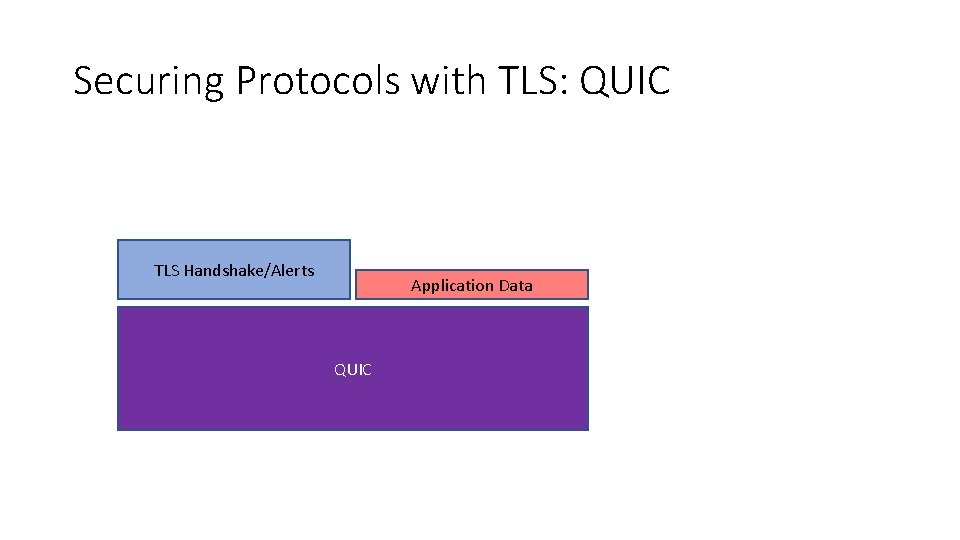
Securing Protocols with TLS: QUIC TLS Handshake/Alerts Application Data QUIC
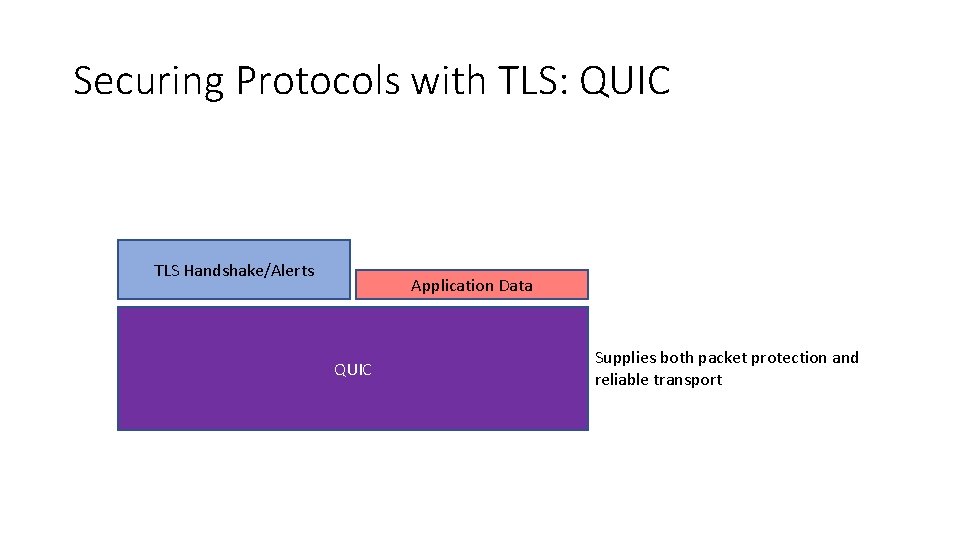
Securing Protocols with TLS: QUIC TLS Handshake/Alerts Application Data QUIC Supplies both packet protection and reliable transport
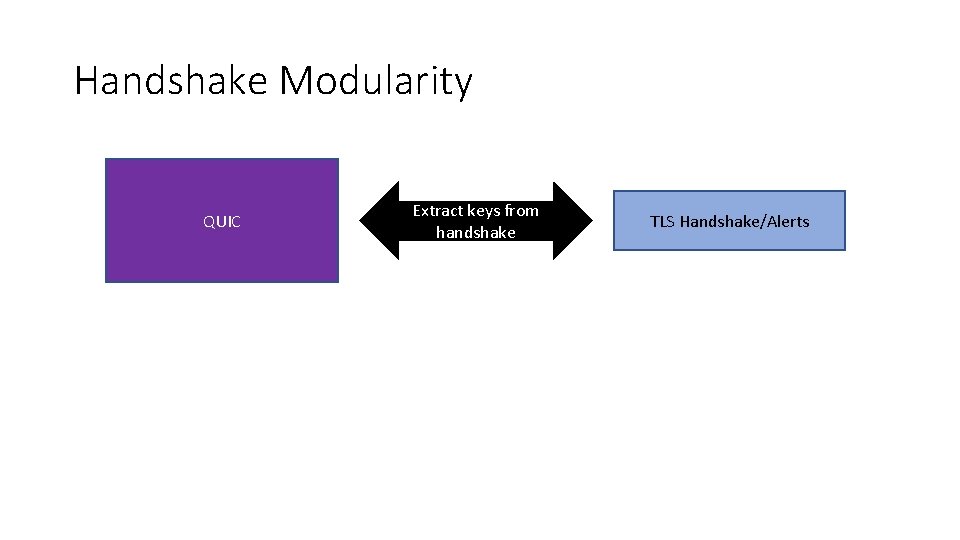
Handshake Modularity QUIC Extract keys from handshake TLS Handshake/Alerts
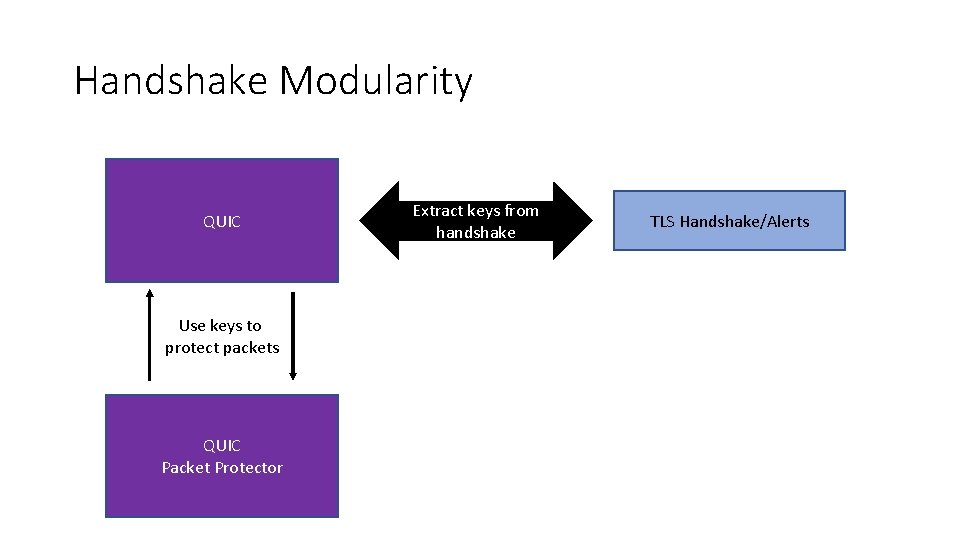
Handshake Modularity QUIC Use keys to protect packets QUIC Packet Protector Extract keys from handshake TLS Handshake/Alerts
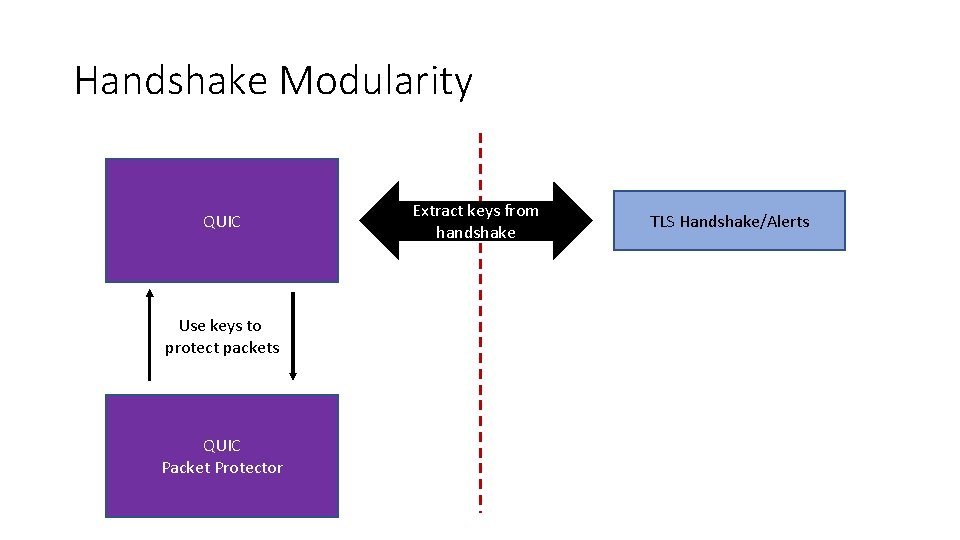
Handshake Modularity QUIC Use keys to protect packets QUIC Packet Protector Extract keys from handshake TLS Handshake/Alerts
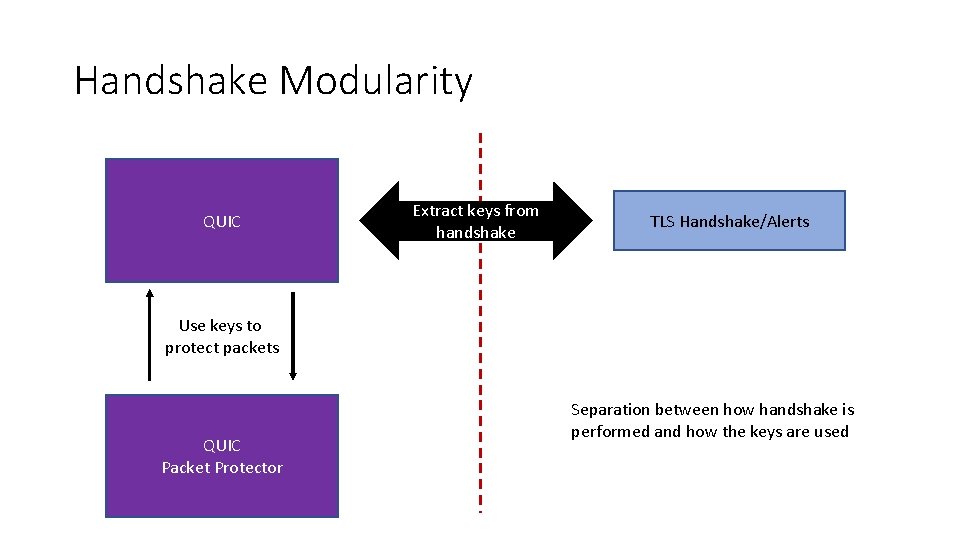
Handshake Modularity QUIC Extract keys from handshake TLS Handshake/Alerts Use keys to protect packets QUIC Packet Protector Separation between how handshake is performed and how the keys are used
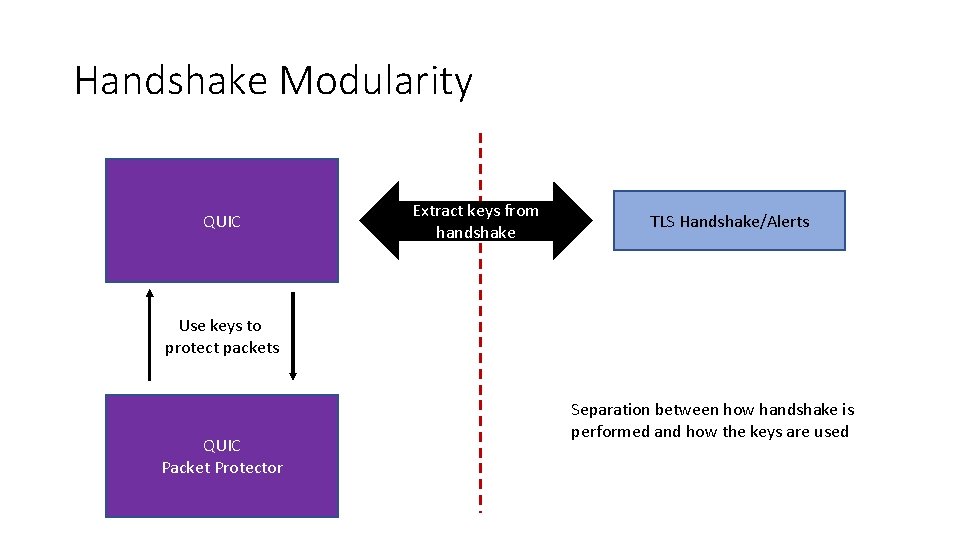
Handshake Modularity QUIC Extract keys from handshake TLS Handshake/Alerts Use keys to protect packets QUIC Packet Protector Separation between how handshake is performed and how the keys are used
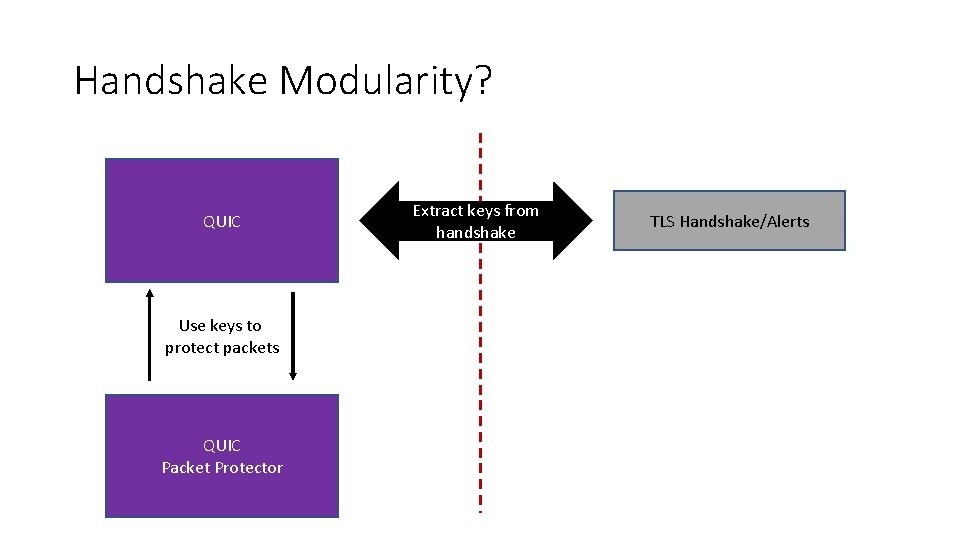
Handshake Modularity? QUIC Use keys to protect packets QUIC Packet Protector Extract keys from handshake TLS Handshake/Alerts
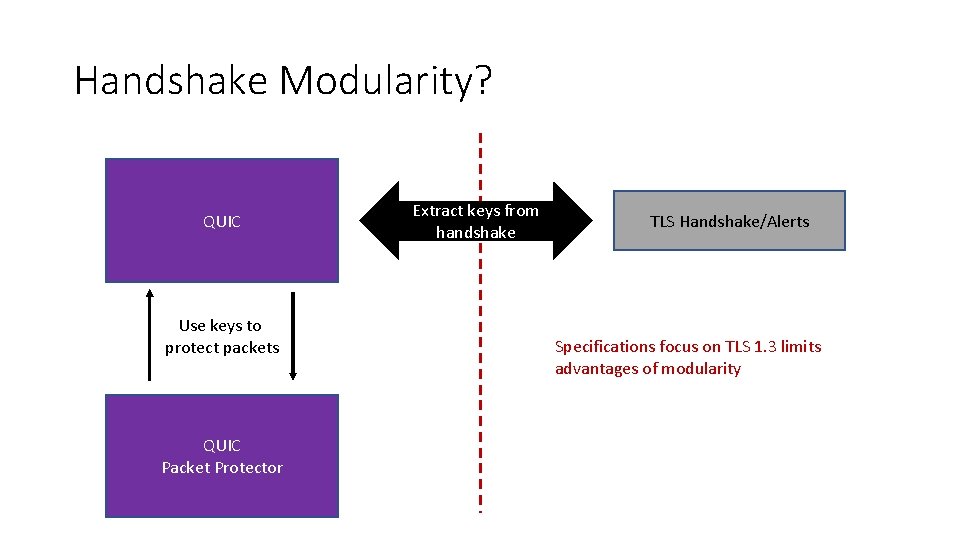
Handshake Modularity? QUIC Use keys to protect packets QUIC Packet Protector Extract keys from handshake TLS Handshake/Alerts Specifications focus on TLS 1. 3 limits advantages of modularity
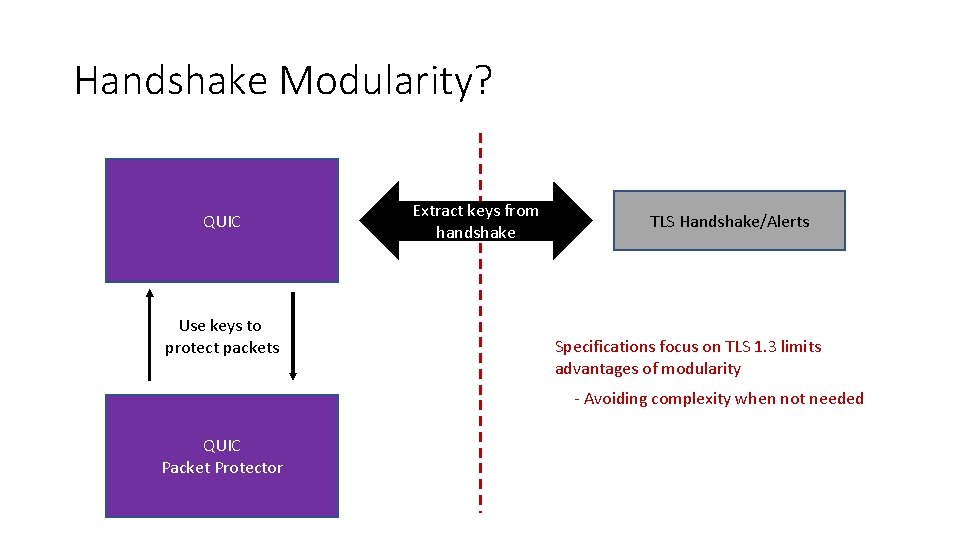
Handshake Modularity? QUIC Use keys to protect packets Extract keys from handshake TLS Handshake/Alerts Specifications focus on TLS 1. 3 limits advantages of modularity - Avoiding complexity when not needed QUIC Packet Protector
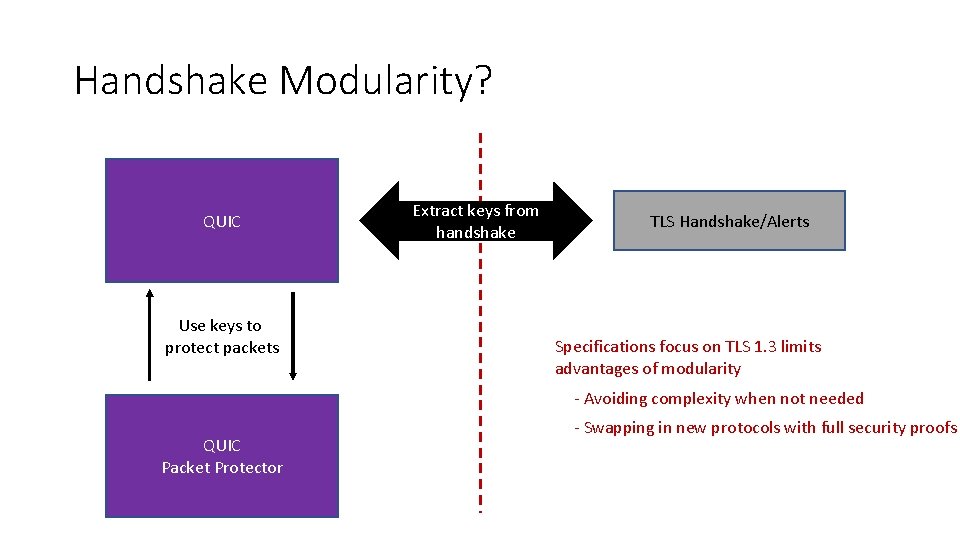
Handshake Modularity? QUIC Use keys to protect packets Extract keys from handshake TLS Handshake/Alerts Specifications focus on TLS 1. 3 limits advantages of modularity - Avoiding complexity when not needed QUIC Packet Protector - Swapping in new protocols with full security proofs
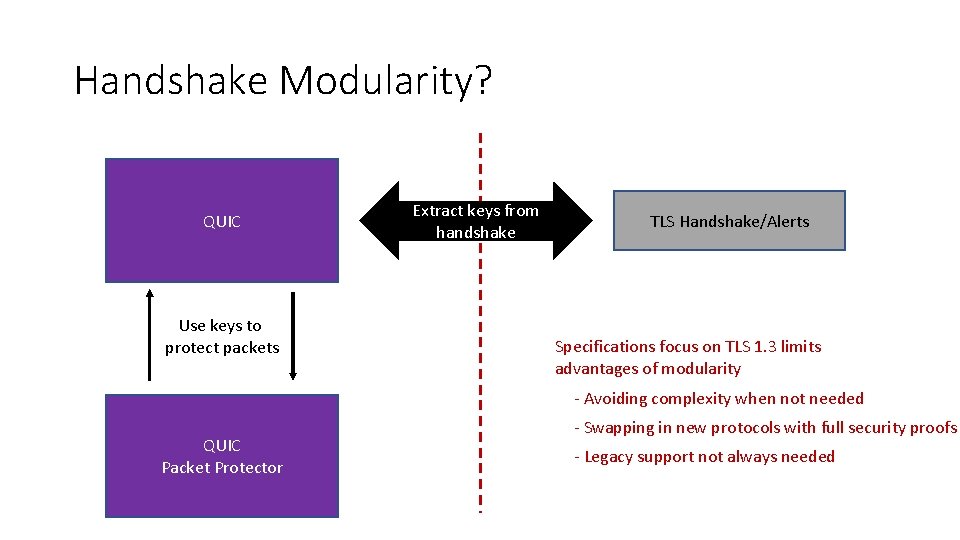
Handshake Modularity? QUIC Use keys to protect packets Extract keys from handshake TLS Handshake/Alerts Specifications focus on TLS 1. 3 limits advantages of modularity - Avoiding complexity when not needed QUIC Packet Protector - Swapping in new protocols with full security proofs - Legacy support not always needed
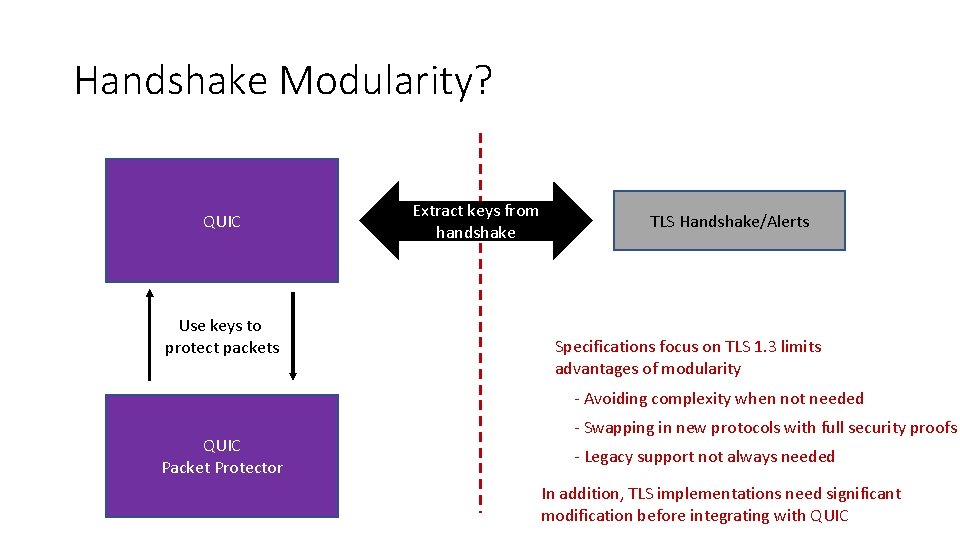
Handshake Modularity? QUIC Use keys to protect packets Extract keys from handshake TLS Handshake/Alerts Specifications focus on TLS 1. 3 limits advantages of modularity - Avoiding complexity when not needed QUIC Packet Protector - Swapping in new protocols with full security proofs - Legacy support not always needed In addition, TLS implementations need significant modification before integrating with QUIC
Are there circumstances we can do better than TLS 1. 3?
What is Noise A framework for specifying Cryptographic Handshakes
What is Noise A framework for specifying Cryptographic Handshakes A variety of protocols can be specified using the simple Noise language
What is Noise A framework for specifying Cryptographic Handshakes A variety of protocols can be specified using the simple Noise language These protocols can vary in their guarantees and complexity
What is Noise A framework for specifying Cryptographic Handshakes A variety of protocols can be specified using the simple Noise language These protocols can vary in their guarantees and complexity However, once a protocol is selected, the handshake proceeds in a straightforward fashion
What is Noise The Noise language consists of tokens, which combine into message patterns, when combine into handshake patterns
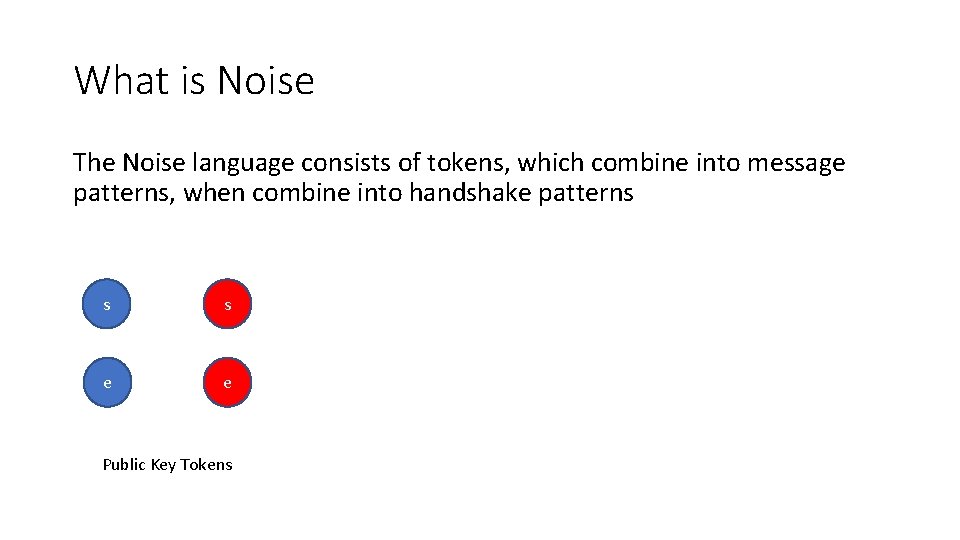
What is Noise The Noise language consists of tokens, which combine into message patterns, when combine into handshake patterns s s e e Public Key Tokens
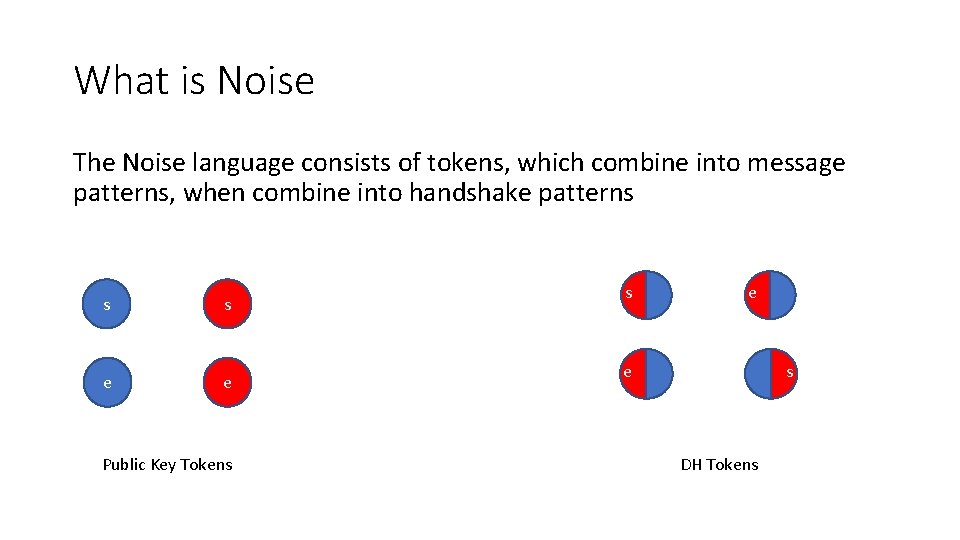
What is Noise The Noise language consists of tokens, which combine into message patterns, when combine into handshake patterns s e Public Key Tokens s e s e e DH Tokens
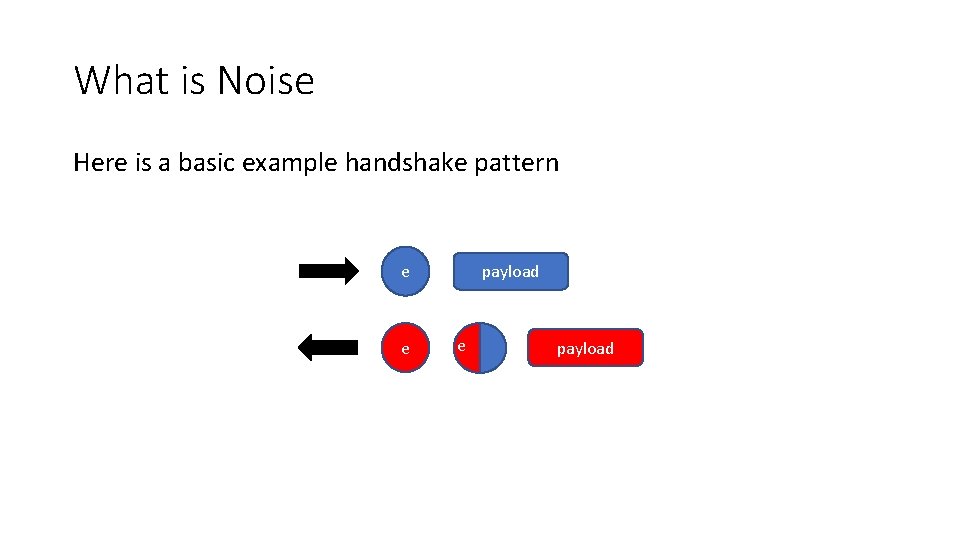
What is Noise Here is a basic example handshake pattern payload e e payload
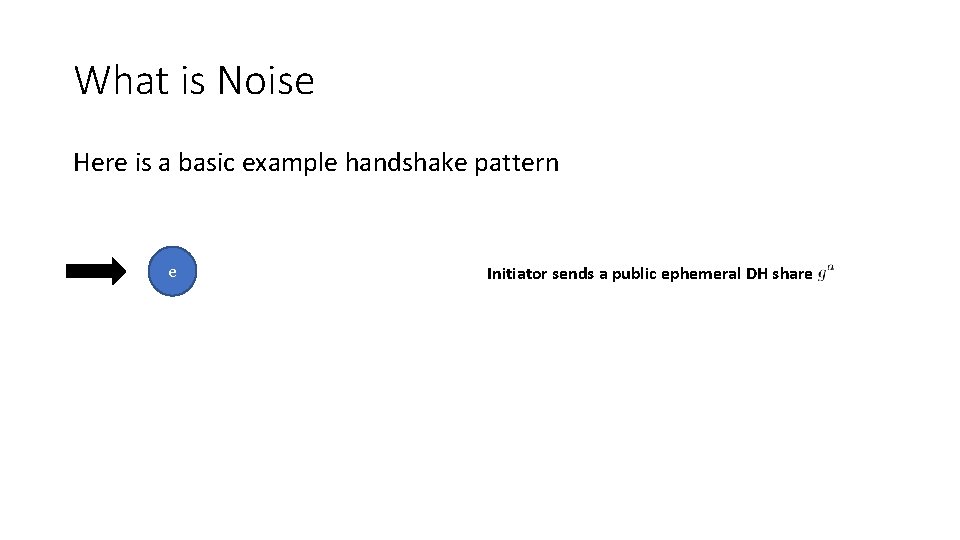
What is Noise Here is a basic example handshake pattern e Initiator sends a public ephemeral DH share
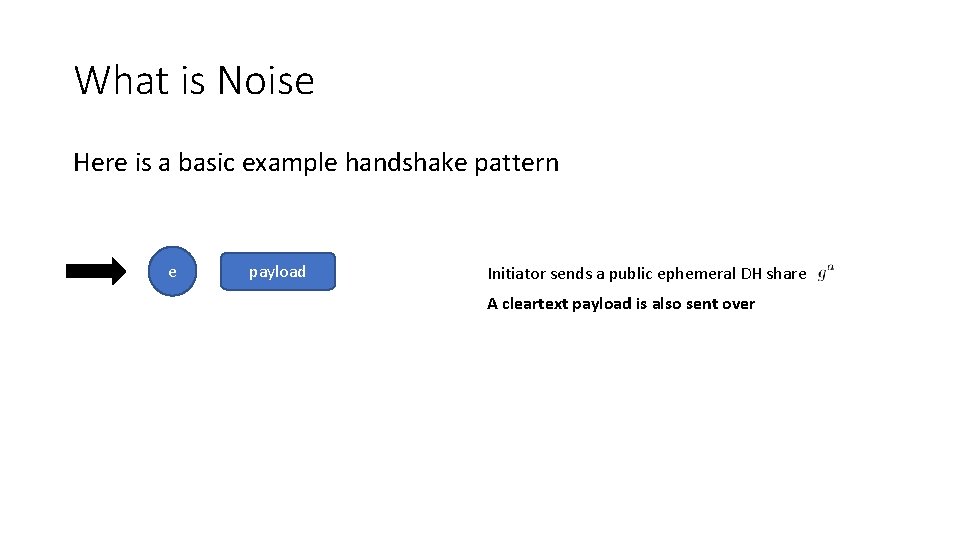
What is Noise Here is a basic example handshake pattern e payload Initiator sends a public ephemeral DH share A cleartext payload is also sent over
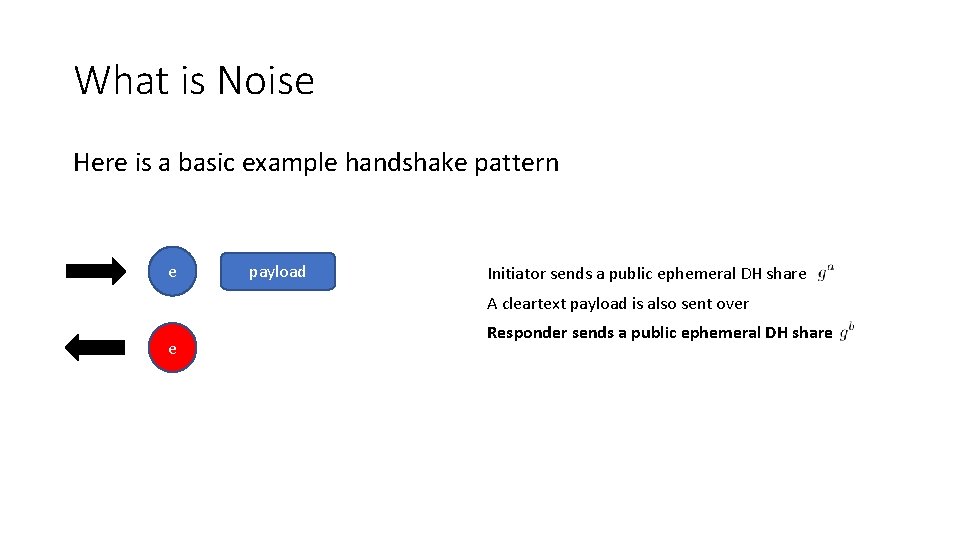
What is Noise Here is a basic example handshake pattern e payload Initiator sends a public ephemeral DH share A cleartext payload is also sent over e Responder sends a public ephemeral DH share
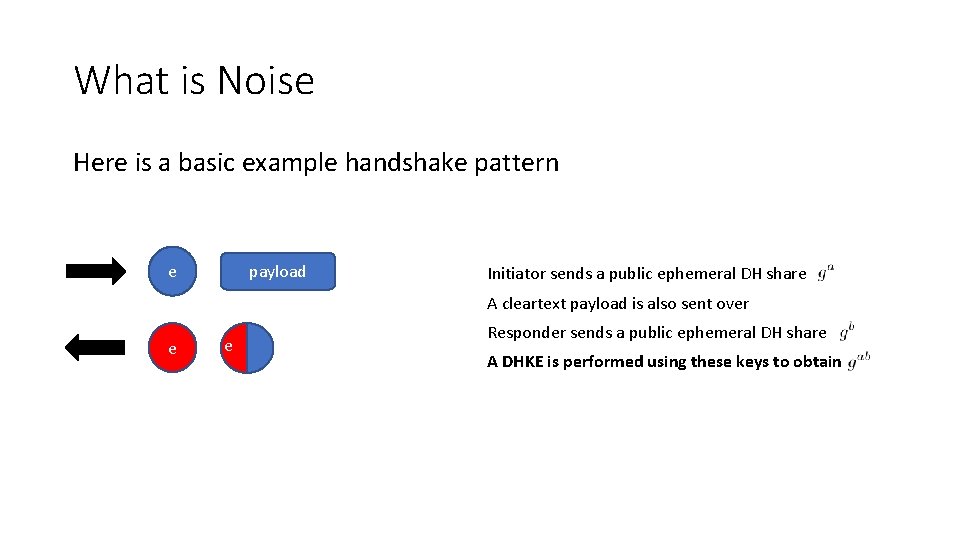
What is Noise Here is a basic example handshake pattern payload e Initiator sends a public ephemeral DH share A cleartext payload is also sent over e e e Responder sends a public ephemeral DH share A DHKE is performed using these keys to obtain
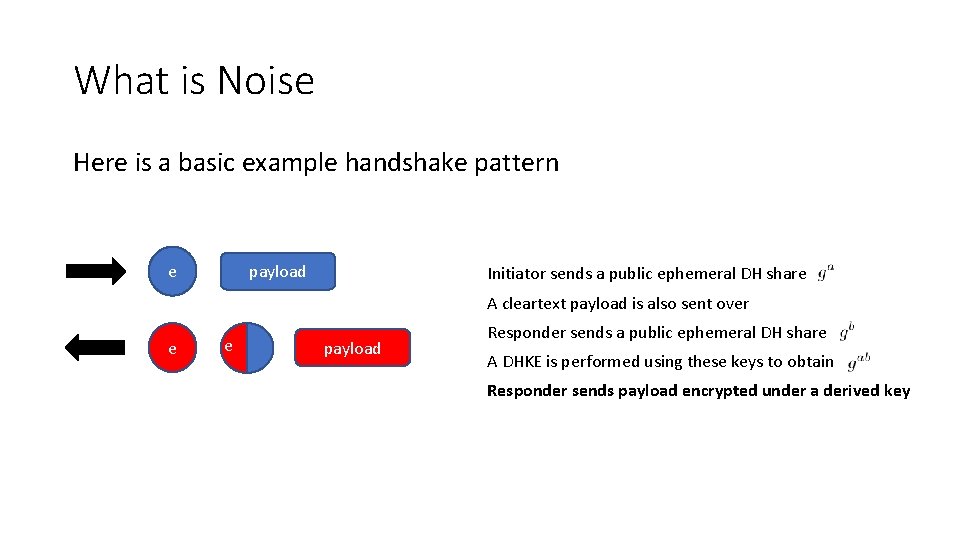
What is Noise Here is a basic example handshake pattern payload e Initiator sends a public ephemeral DH share A cleartext payload is also sent over e e e payload Responder sends a public ephemeral DH share A DHKE is performed using these keys to obtain Responder sends payload encrypted under a derived key
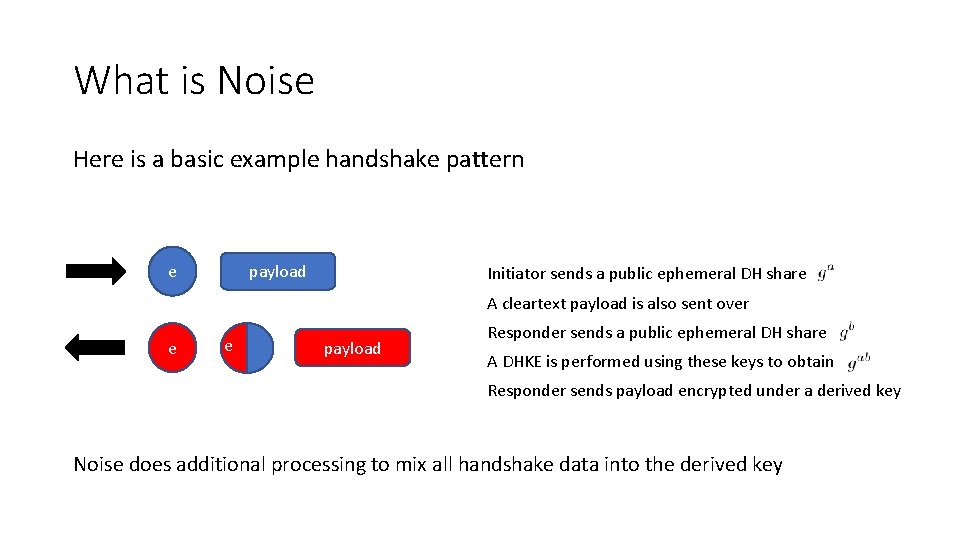
What is Noise Here is a basic example handshake pattern payload e Initiator sends a public ephemeral DH share A cleartext payload is also sent over e e e payload Responder sends a public ephemeral DH share A DHKE is performed using these keys to obtain Responder sends payload encrypted under a derived key Noise does additional processing to mix all handshake data into the derived key
Noise vs TLS • Once a handshake pattern is selected, noise follows a simple linear state machine
Noise vs TLS • Once a handshake pattern is selected, Noise follows a simple linear state machine • Noise is easy to prove secure
Noise vs TLS • Once a handshake pattern is selected, Noise follows a simple linear state machine • Noise is easy to prove secure • Noise is generally implemented as a “build your own protocol” library
Noise vs TLS • Once a handshake pattern is selected, Noise follows a simple linear state machine • Noise is easy to prove secure • Noise is generally implemented as a “build your own protocol” library • Noise lacks cryptographic agility
Peer Authentication and Pinning Traditionally, Authentication of peers in TLS involves a PKI
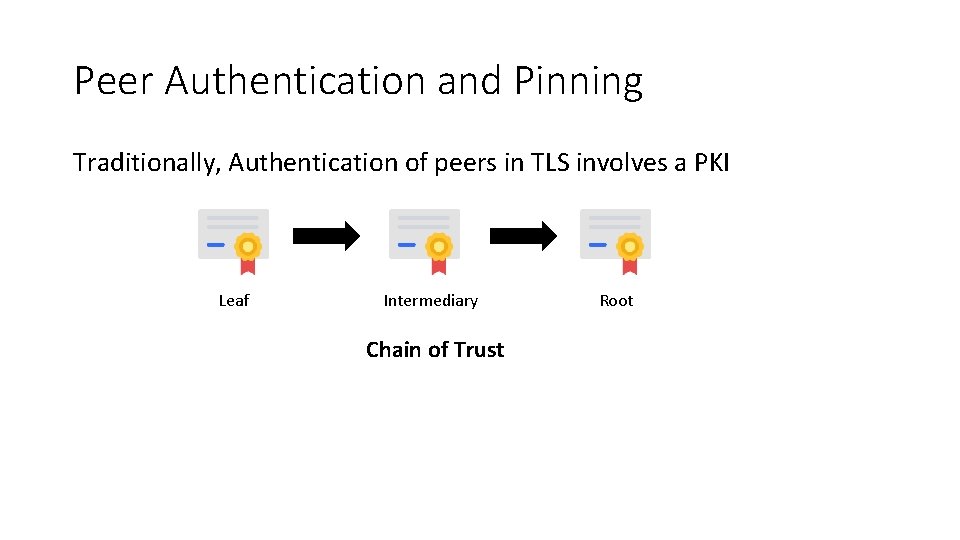
Peer Authentication and Pinning Traditionally, Authentication of peers in TLS involves a PKI Leaf Intermediary Chain of Trust Root
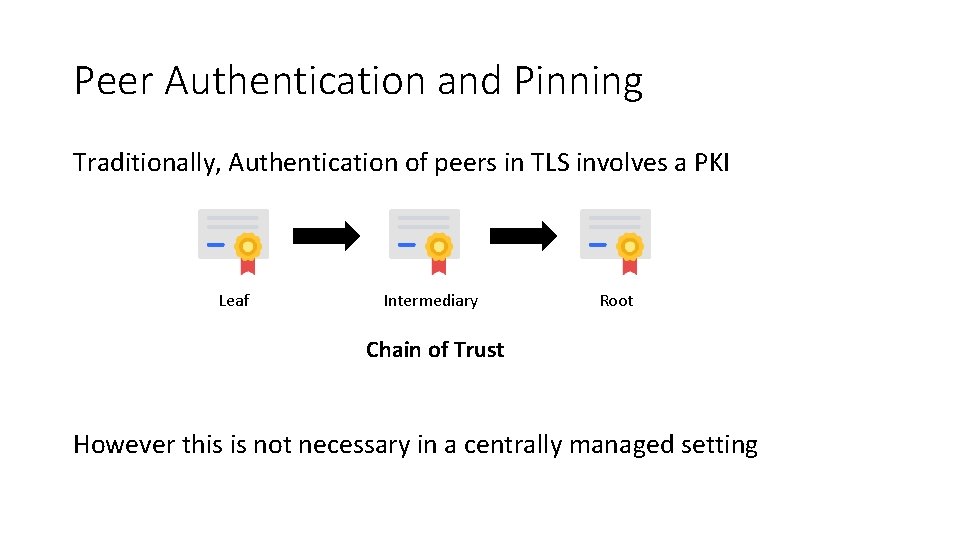
Peer Authentication and Pinning Traditionally, Authentication of peers in TLS involves a PKI Leaf Intermediary Root Chain of Trust However this is not necessary in a centrally managed setting
Peer Authentication and Pinning instructs a peer to expect a specific key
Peer Authentication and Pinning instructs a peer to expect a specific key This is similar to the Preshared Symmetric Keys (PSKs) setting
Peer Authentication and Pinning instructs a peer to expect a specific key This is similar to the Preshared Symmetric Keys (PSKs) setting However, PSKs require many more keys, since every pair of endpoints must have its own unique key
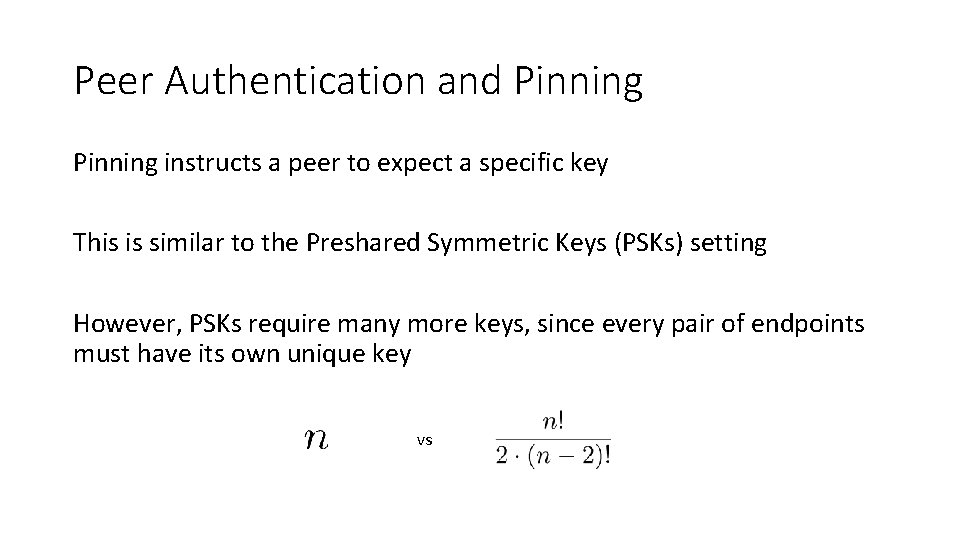
Peer Authentication and Pinning instructs a peer to expect a specific key This is similar to the Preshared Symmetric Keys (PSKs) setting However, PSKs require many more keys, since every pair of endpoints must have its own unique key vs
Peer Authentication and Pinning n. QUIC is designed for the public key pinning setting
Peer Authentication and Pinning n. QUIC is designed for the public key pinning setting This applies to cases where: • Public keys or Certificate Chains are obtained out-of-band
Peer Authentication and Pinning n. QUIC is designed for the public key pinning setting This applies to cases where: • Public keys or Certificate Chains are obtained out-of-band • Peers are bootstrapped with keys
Peer Authentication and Pinning n. QUIC is designed for the public key pinning setting This applies to cases where: • Public keys or Certificate Chains are obtained out-of-band • Peers are bootstrapped with keys • Public keys are managed by a trusted key management service
n. QUIC Motivated by simplicity while still satisfying the following requirements: 1. Authenticated Key Exchange 2. Authentication of Transport Parameters 3. Authenticated Version Negotiation 4. Authenticated Negotiation of Application Protocol 5. Address Validation
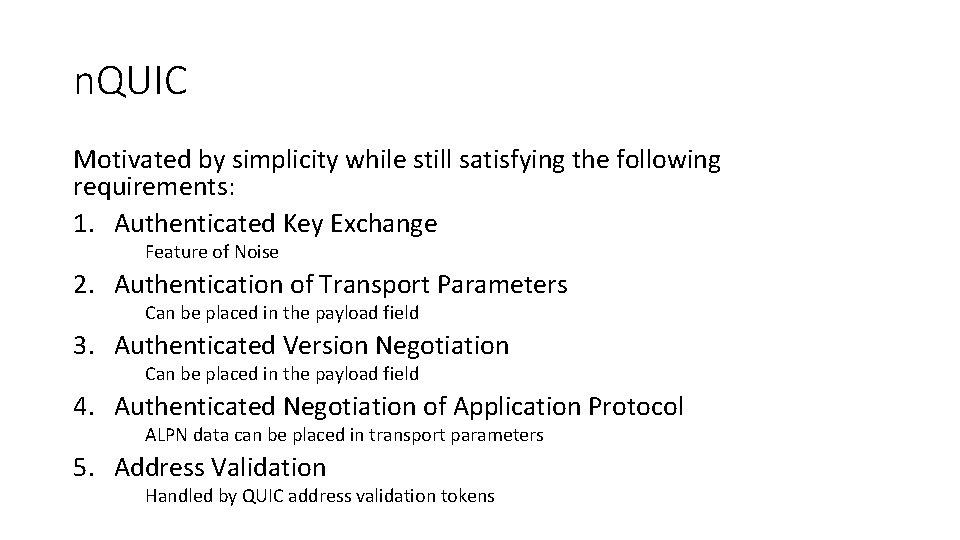
n. QUIC Motivated by simplicity while still satisfying the following requirements: 1. Authenticated Key Exchange Feature of Noise 2. Authentication of Transport Parameters Can be placed in the payload field 3. Authenticated Version Negotiation Can be placed in the payload field 4. Authenticated Negotiation of Application Protocol ALPN data can be placed in transport parameters 5. Address Validation Handled by QUIC address validation tokens
n. QUIC’s Noise Pattern We needed a handshake that:
n. QUIC’s Noise Pattern We needed a handshake that: Authenticates the server
n. QUIC’s Noise Pattern We needed a handshake that: Authenticates the server Optionally authenticates the client
n. QUIC’s Noise Pattern We needed a handshake that: Authenticates the server Optionally authenticates the client Encrypts transport parameters
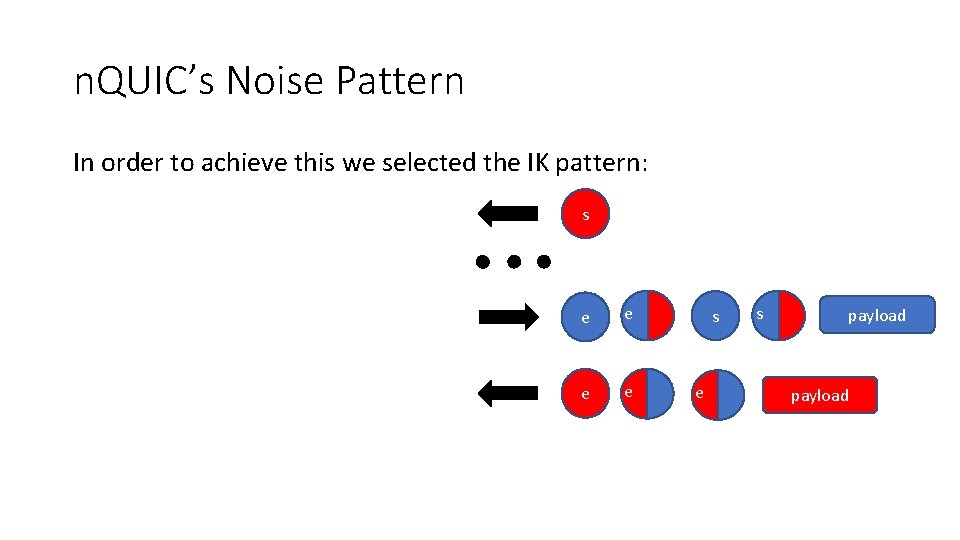
n. QUIC’s Noise Pattern In order to achieve this we selected the IK pattern: s e e s s e s payload s e e e s payload
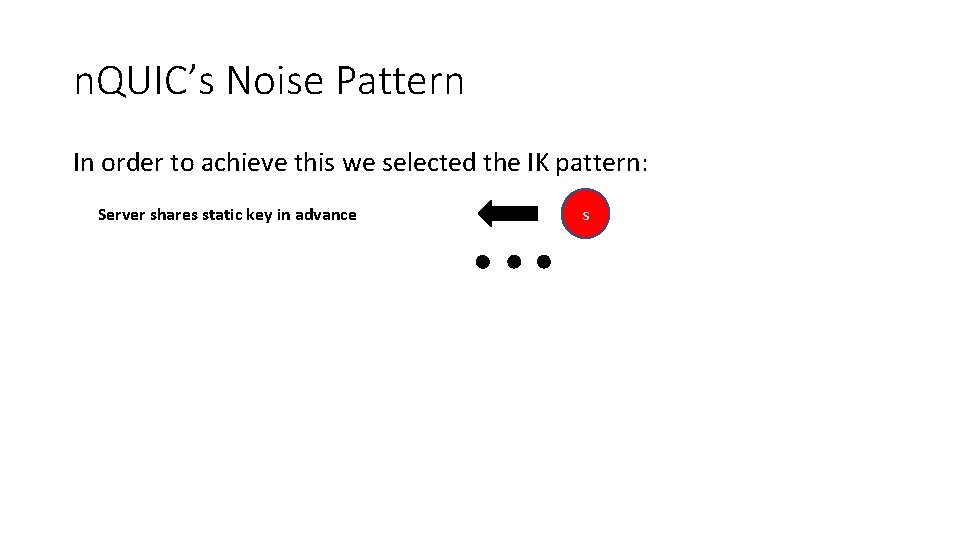
n. QUIC’s Noise Pattern In order to achieve this we selected the IK pattern: Server shares static key in advance s
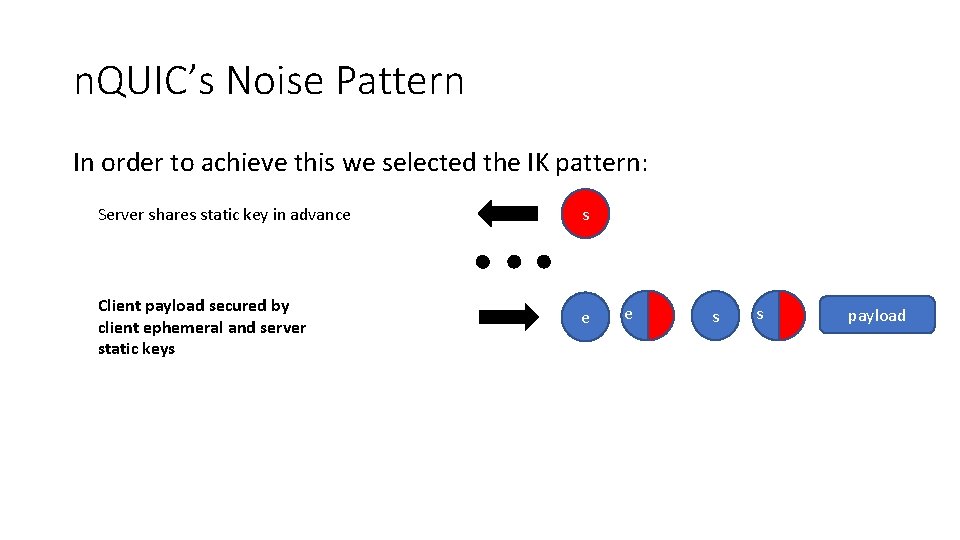
n. QUIC’s Noise Pattern In order to achieve this we selected the IK pattern: Server shares static key in advance Client payload secured by client ephemeral and server static keys s e e s s payload
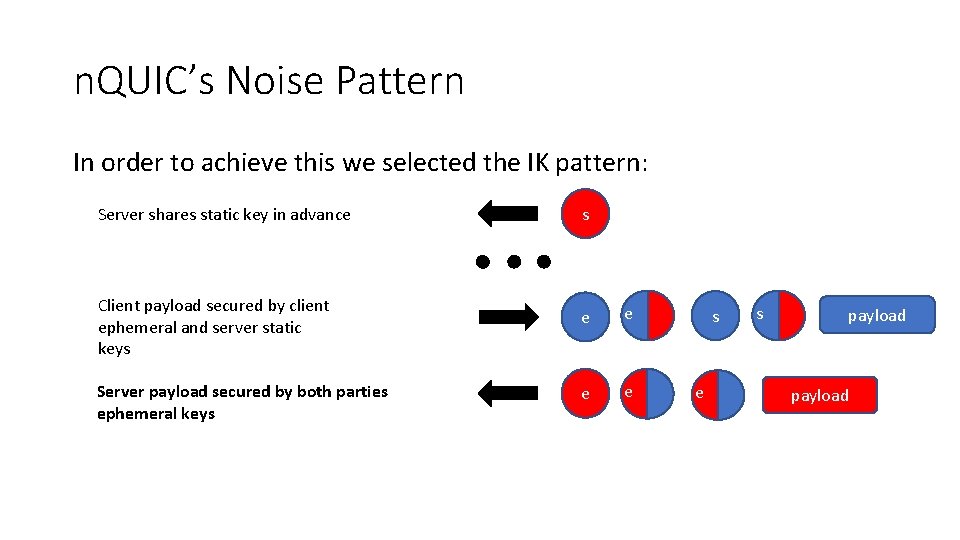
n. QUIC’s Noise Pattern In order to achieve this we selected the IK pattern: Server shares static key in advance Client payload secured by client ephemeral and server static keys Server payload secured by both parties ephemeral keys s e e s s e s payload s e e e s payload
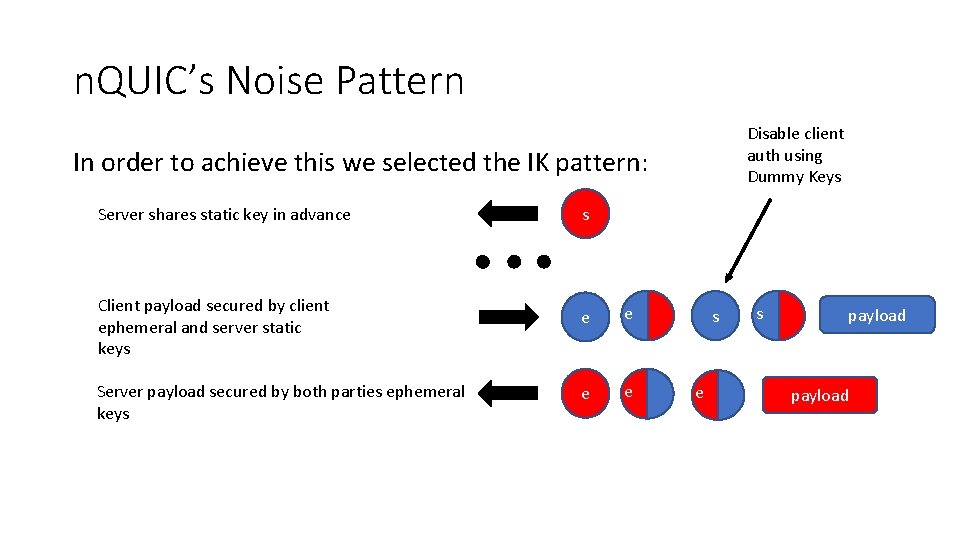
n. QUIC’s Noise Pattern Disable client auth using Dummy Keys In order to achieve this we selected the IK pattern: Server shares static key in advance Client payload secured by client ephemeral and server static keys Server payload secured by both parties ephemeral keys s e e s s e s payload s e e e s payload
Why IK? There were other Noise patterns that offered similar guarantees
Why IK? There were other Noise patterns that offered similar guarantees Some patterns did not require server to share static key beforehand
Why IK? There were other Noise patterns that offered similar guarantees Some patterns did not require server to share static key beforehand • Supports more settings, but also may require a PKI
Why IK? There were other Noise patterns that offered similar guarantees Some patterns did not require server to share static key beforehand • Supports more settings, but also may require a PKI The XK Pattern also sends server static key beforehand, but is 3 rounds
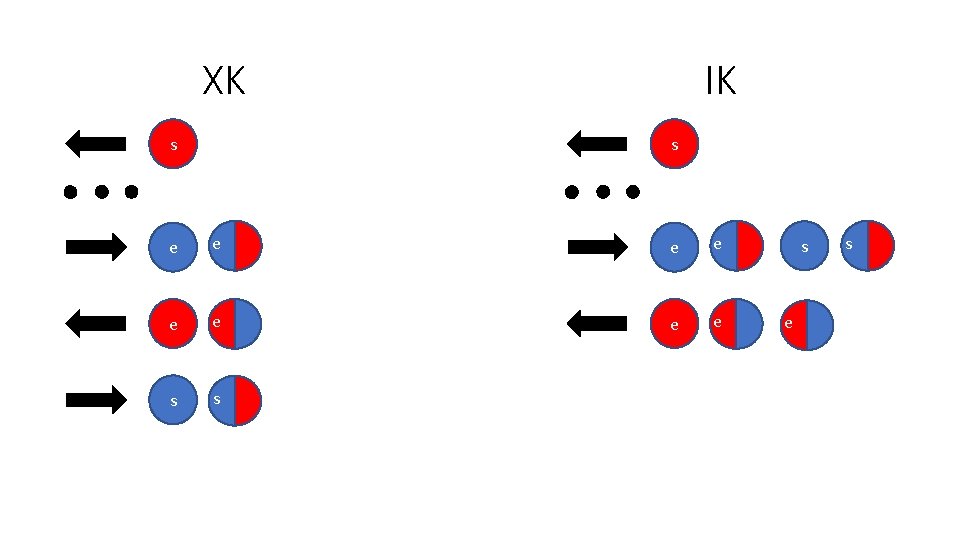
XK s e IK s e e e s s e e e s
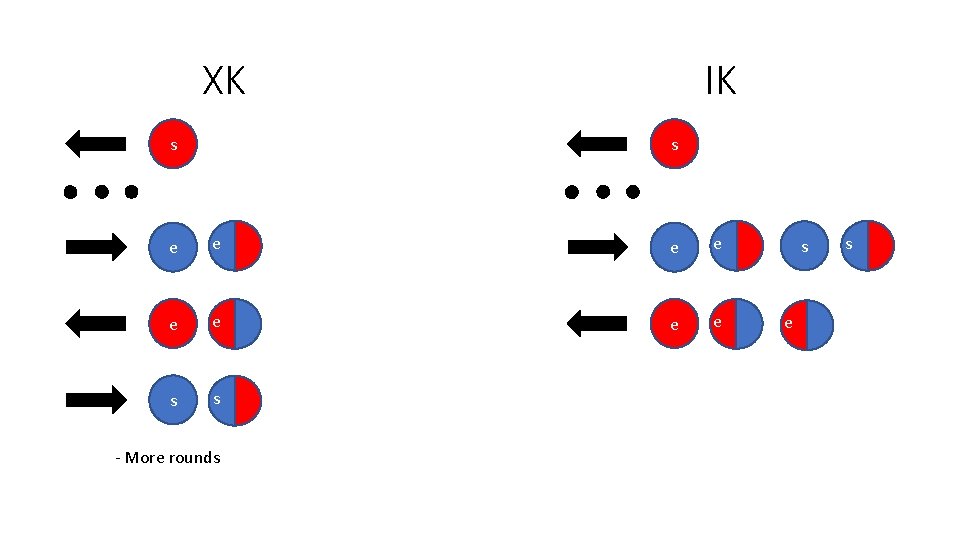
XK s e IK s e e e s s e - More rounds e s s e e e s
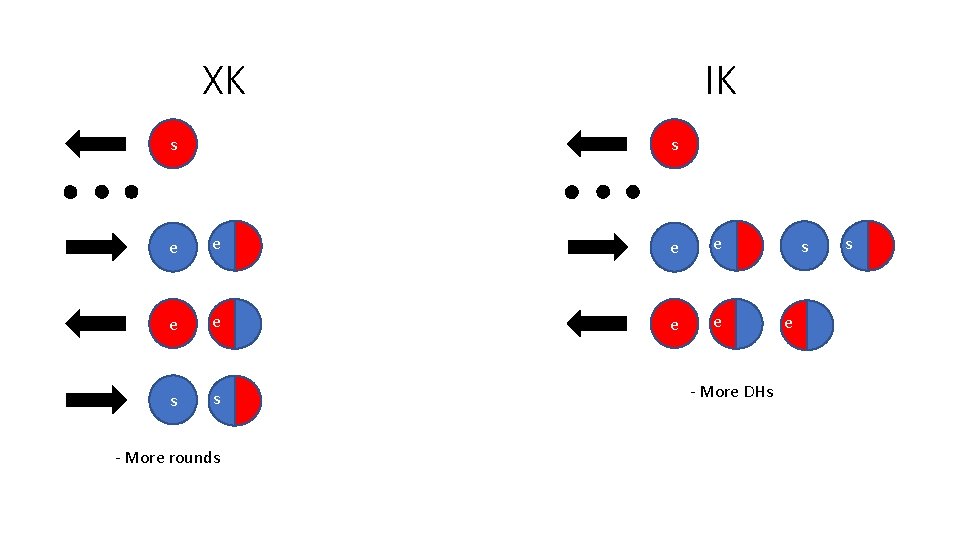
XK s e IK s e e e s s e - More rounds e s s e e s - More DHs
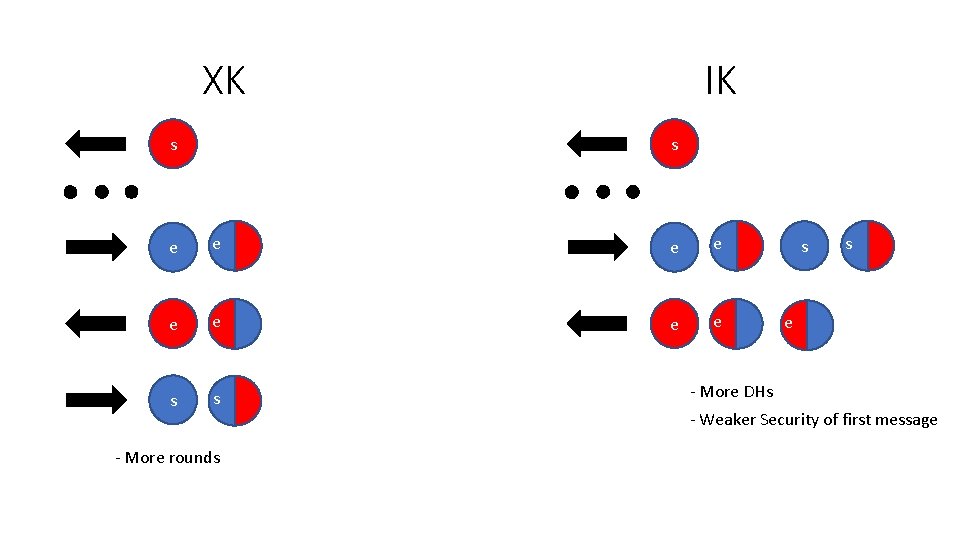
XK s e IK s e e e s s e - More rounds e s s e e s - More DHs - Weaker Security of first message
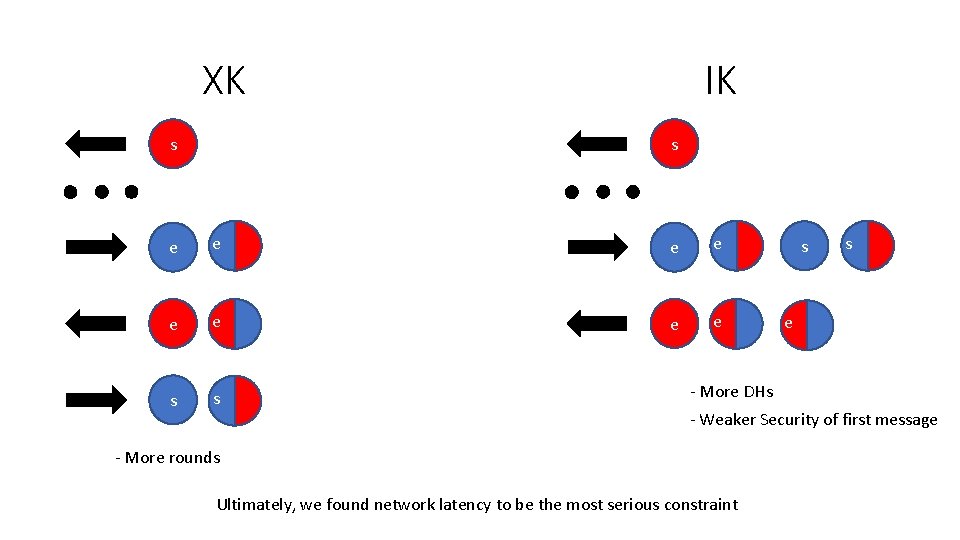
XK s e IK s e e e s s e - More rounds e s s e e s - More DHs - Weaker Security of first message Ultimately, we found network latency to be the most serious constraint
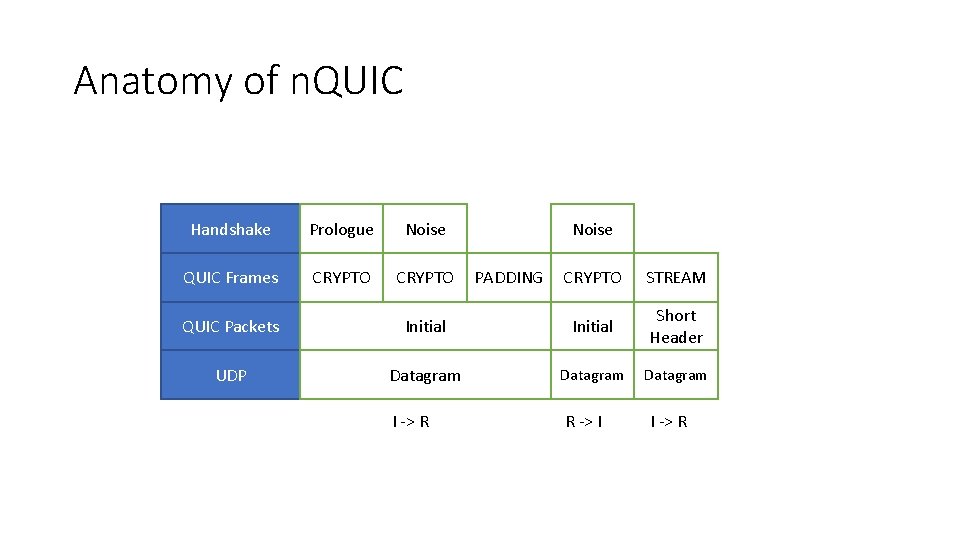
Anatomy of n. QUIC Handshake Prologue Noise QUIC Frames CRYPTO Noise PADDING CRYPTO STREAM QUIC Packets Initial Short Header UDP Datagram I -> R R -> I I -> R
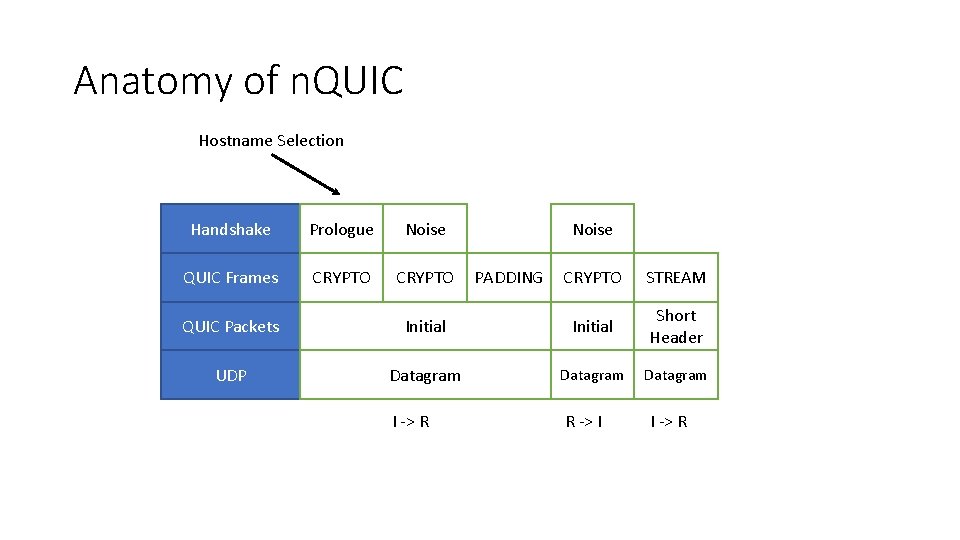
Anatomy of n. QUIC Hostname Selection Handshake Prologue Noise QUIC Frames CRYPTO Noise PADDING CRYPTO STREAM QUIC Packets Initial Short Header UDP Datagram I -> R R -> I I -> R
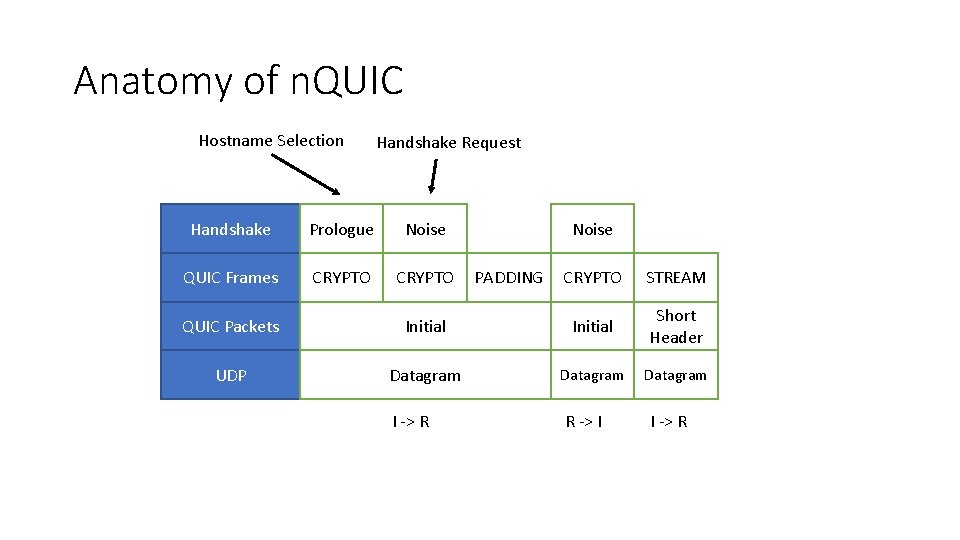
Anatomy of n. QUIC Hostname Selection Handshake Request Handshake Prologue Noise QUIC Frames CRYPTO Noise PADDING CRYPTO STREAM QUIC Packets Initial Short Header UDP Datagram I -> R R -> I I -> R
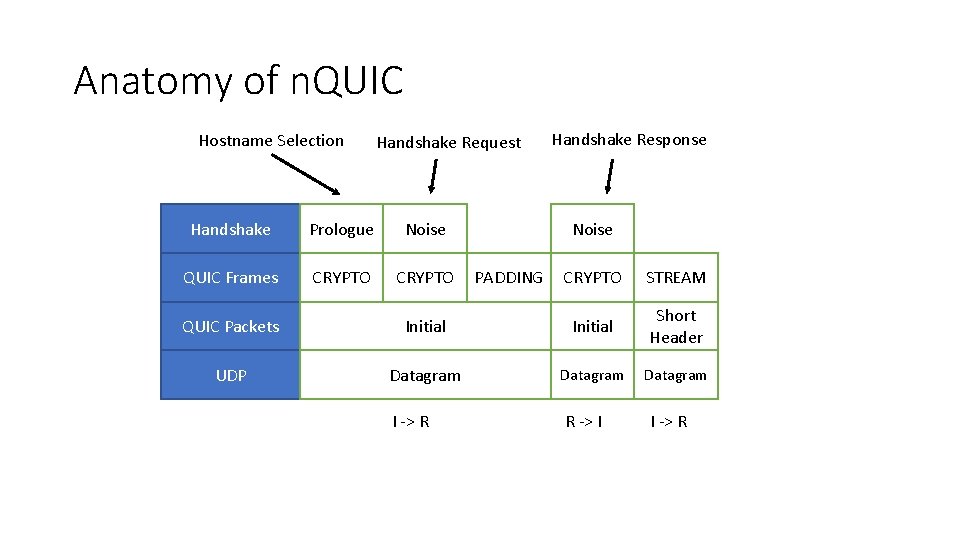
Anatomy of n. QUIC Hostname Selection Handshake Request Handshake Prologue Noise QUIC Frames CRYPTO Handshake Response Noise PADDING CRYPTO STREAM QUIC Packets Initial Short Header UDP Datagram I -> R R -> I I -> R
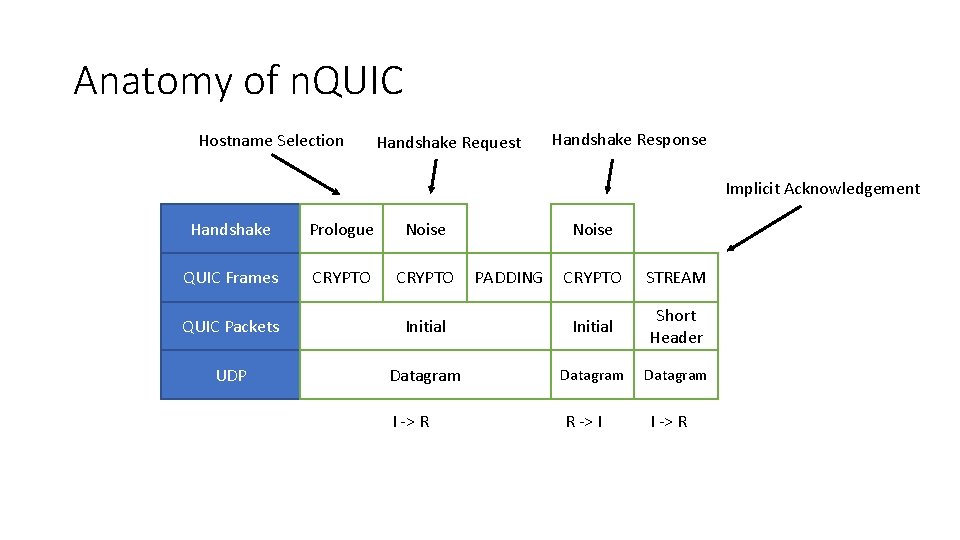
Anatomy of n. QUIC Hostname Selection Handshake Request Handshake Response Implicit Acknowledgement Handshake Prologue Noise QUIC Frames CRYPTO Noise PADDING CRYPTO STREAM QUIC Packets Initial Short Header UDP Datagram I -> R R -> I I -> R
Hostname Selection Problem: A server may be responsible for multiple endpoints, only one of which has the correct key.
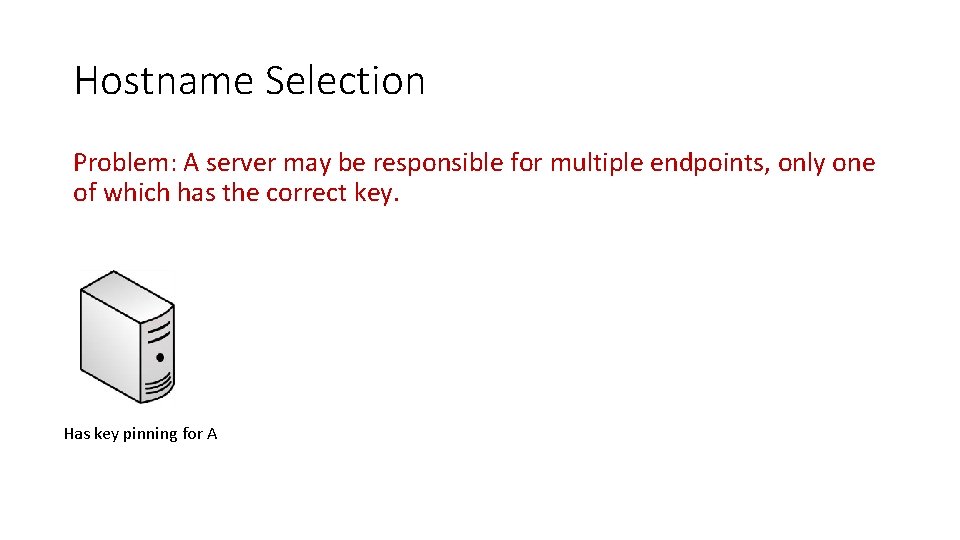
Hostname Selection Problem: A server may be responsible for multiple endpoints, only one of which has the correct key. Has key pinning for A
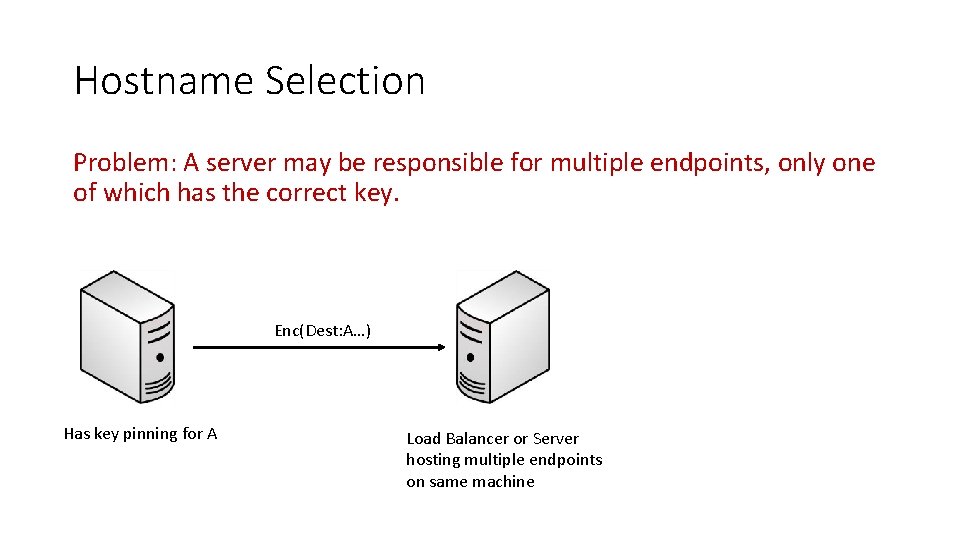
Hostname Selection Problem: A server may be responsible for multiple endpoints, only one of which has the correct key. Enc(Dest: A…) Has key pinning for A Load Balancer or Server hosting multiple endpoints on same machine
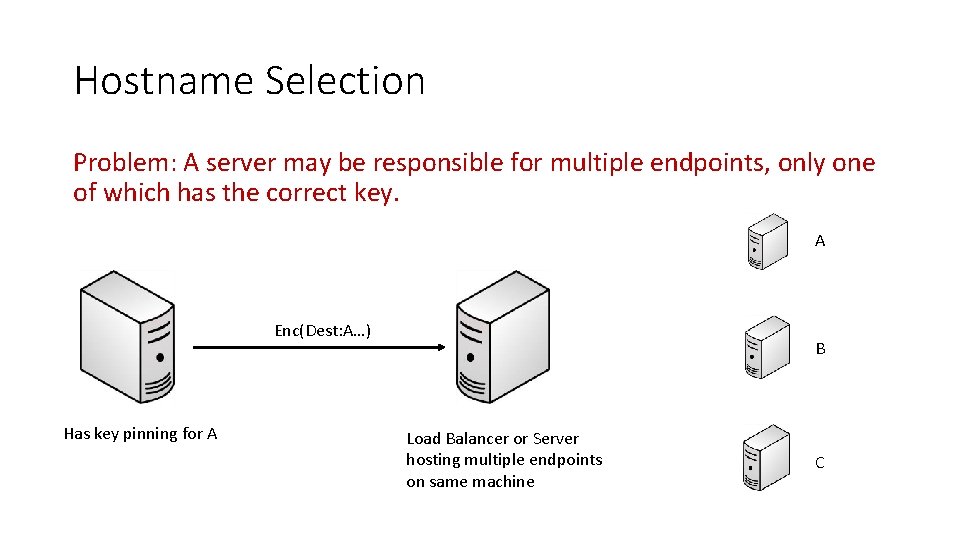
Hostname Selection Problem: A server may be responsible for multiple endpoints, only one of which has the correct key. A Enc(Dest: A…) Has key pinning for A B Load Balancer or Server hosting multiple endpoints on same machine C
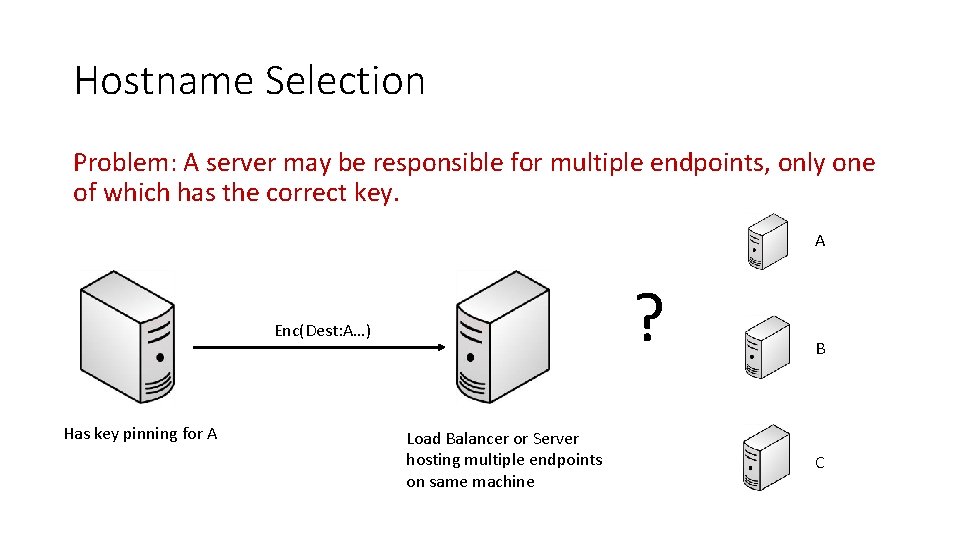
Hostname Selection Problem: A server may be responsible for multiple endpoints, only one of which has the correct key. A ? Enc(Dest: A…) Has key pinning for A Load Balancer or Server hosting multiple endpoints on same machine B C
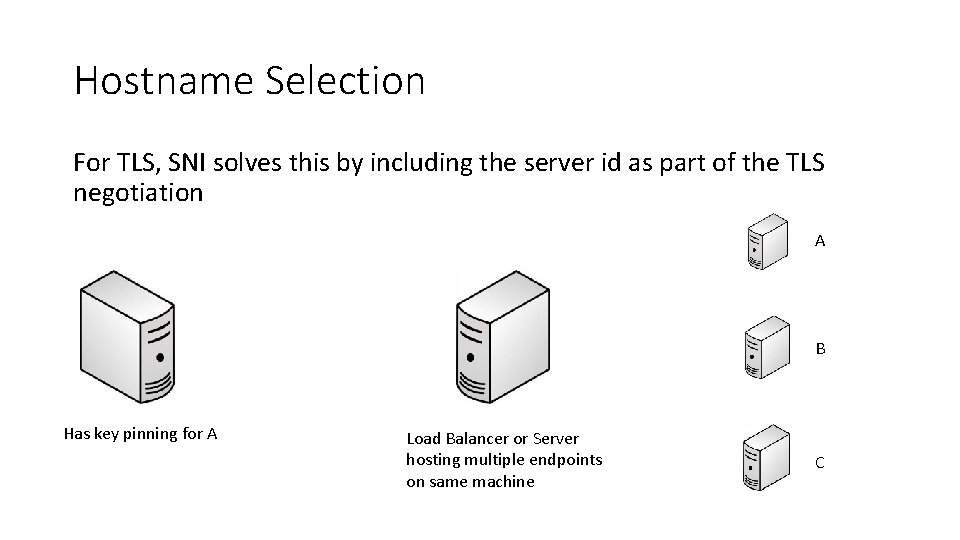
Hostname Selection For TLS, SNI solves this by including the server id as part of the TLS negotiation A B Has key pinning for A Load Balancer or Server hosting multiple endpoints on same machine C
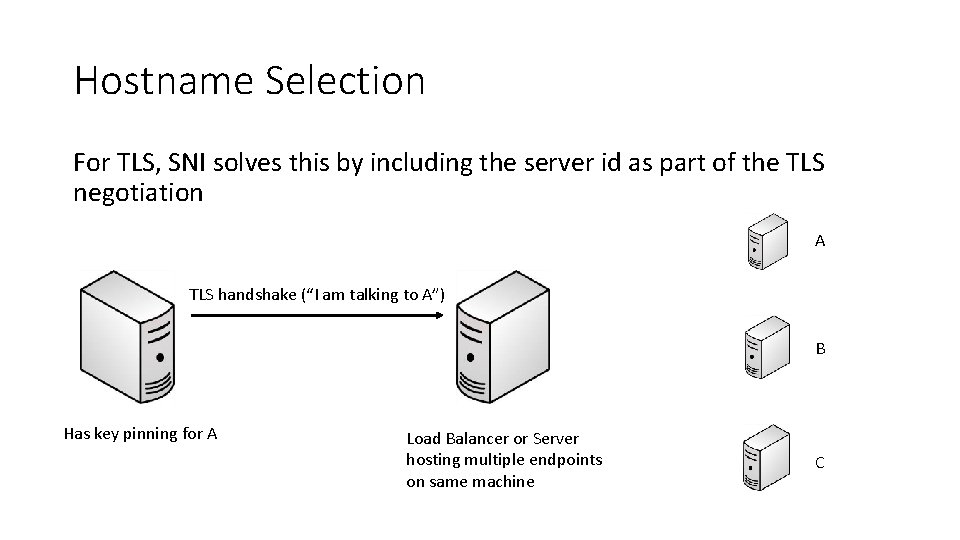
Hostname Selection For TLS, SNI solves this by including the server id as part of the TLS negotiation A TLS handshake (“I am talking to A”) B Has key pinning for A Load Balancer or Server hosting multiple endpoints on same machine C
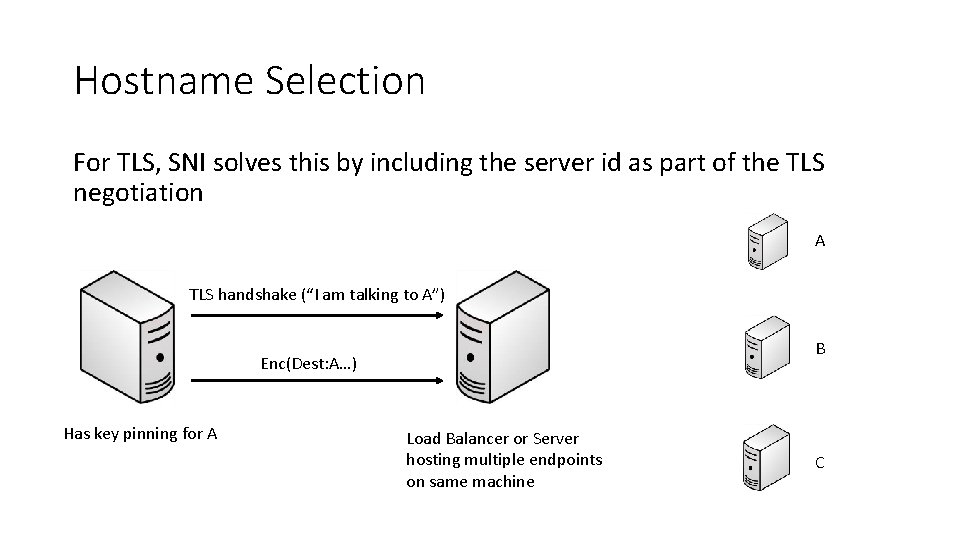
Hostname Selection For TLS, SNI solves this by including the server id as part of the TLS negotiation A TLS handshake (“I am talking to A”) B Enc(Dest: A…) Has key pinning for A Load Balancer or Server hosting multiple endpoints on same machine C
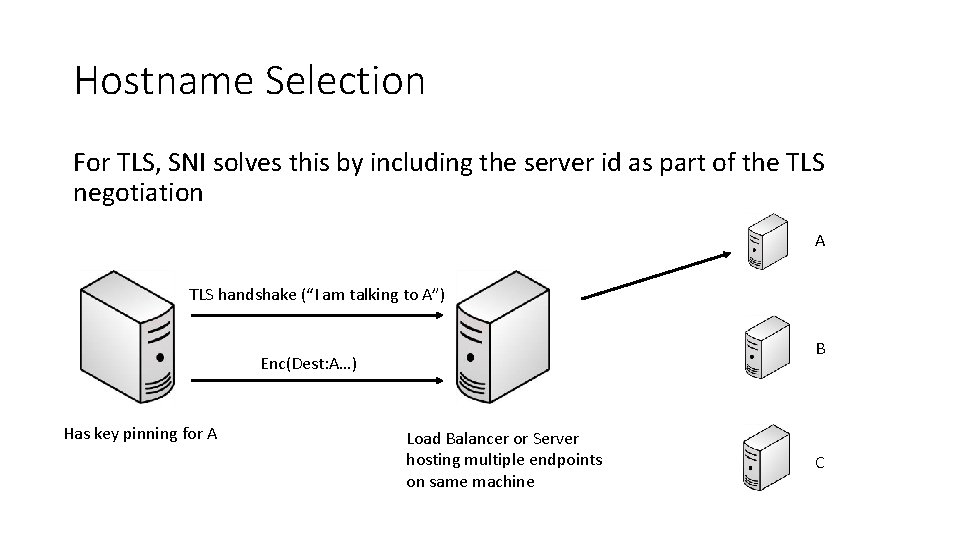
Hostname Selection For TLS, SNI solves this by including the server id as part of the TLS negotiation A TLS handshake (“I am talking to A”) B Enc(Dest: A…) Has key pinning for A Load Balancer or Server hosting multiple endpoints on same machine C
Hostname Selection • Noise has a Prologue field that requires both parties to initialize the handshake with the same value
Hostname Selection • Noise has a Prologue field that requires both parties to initialize the handshake with the same value • We can use this field to support SNI
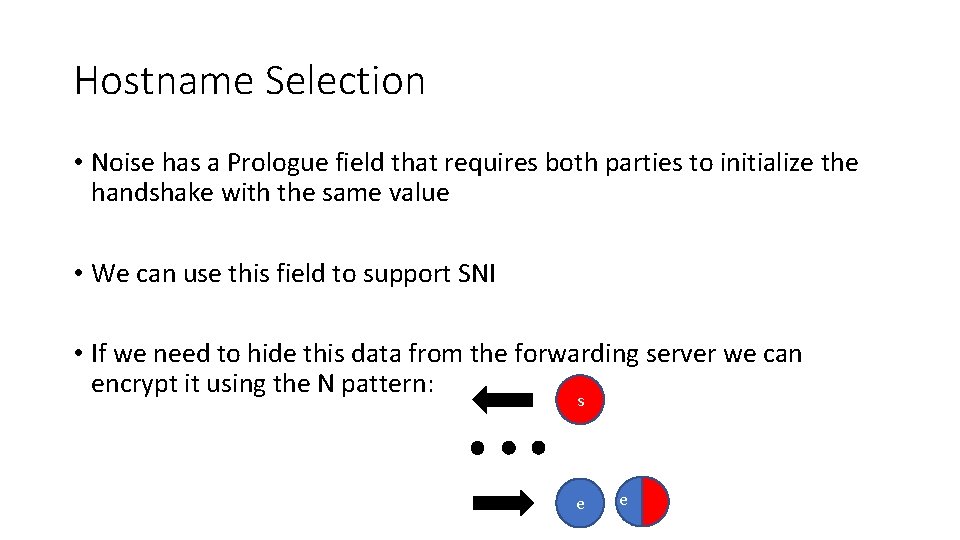
Hostname Selection • Noise has a Prologue field that requires both parties to initialize the handshake with the same value • We can use this field to support SNI • If we need to hide this data from the forwarding server we can encrypt it using the N pattern: s e e
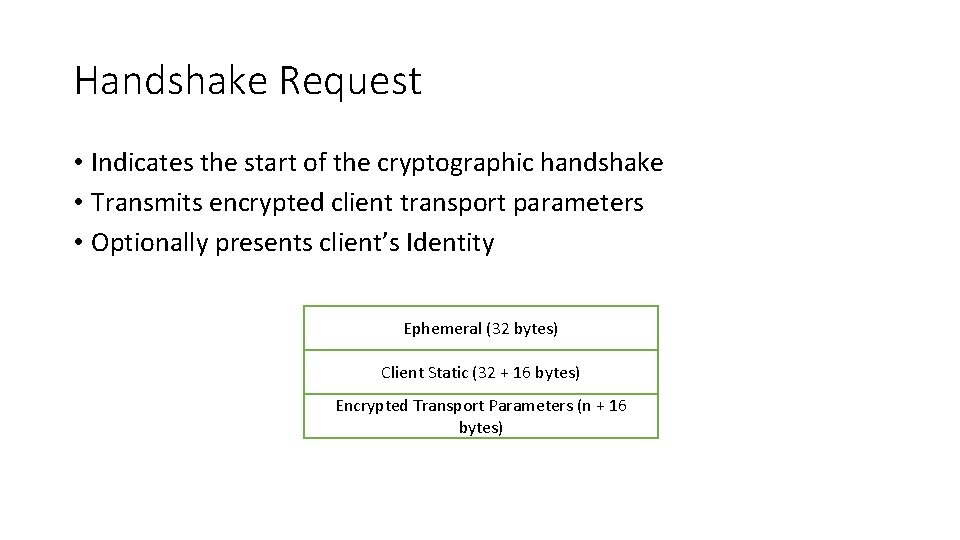
Handshake Request • Indicates the start of the cryptographic handshake • Transmits encrypted client transport parameters • Optionally presents client’s Identity Ephemeral (32 bytes) Client Static (32 + 16 bytes) Encrypted Transport Parameters (n + 16 bytes)
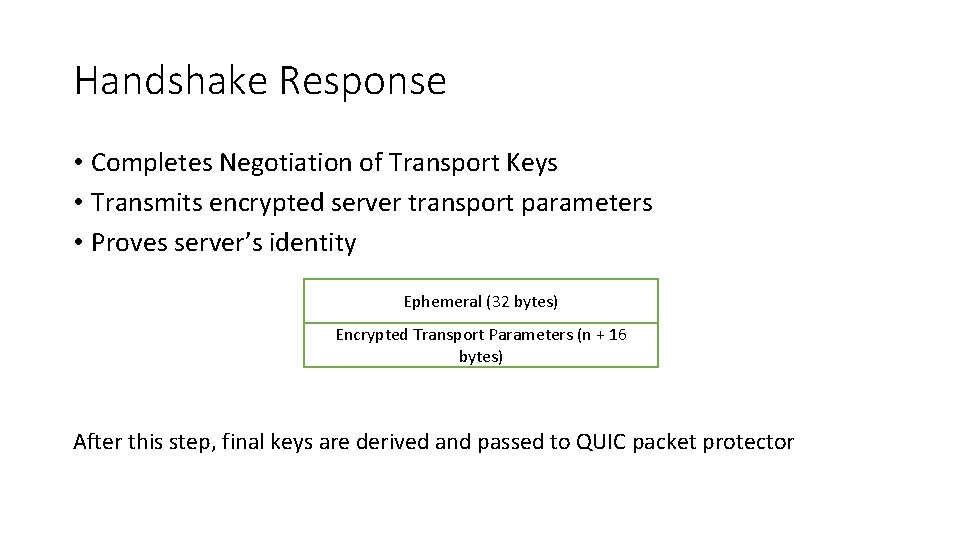
Handshake Response • Completes Negotiation of Transport Keys • Transmits encrypted server transport parameters • Proves server’s identity Ephemeral (32 bytes) Encrypted Transport Parameters (n + 16 bytes) After this step, final keys are derived and passed to QUIC packet protector
Implicit Acknowledgement • In order to avoid replay or Key Compromise attacks, client must immediately send a packet encrypted under transport keys upon completing the handshake
Implicit Acknowledgement • In order to avoid replay or Key Compromise attacks, client must immediately send a packet encrypted under transport keys upon completing the handshake • Only after this does the server consider the handshake finished
Implicit Acknowledgement • In order to avoid replay or Key Compromise attacks, client must immediately send a packet encrypted under transport keys upon completing the handshake • Only after this does the server consider the handshake finished • If application data is not available a PADDING or PING frame is sent
Implicit Acknowledgement • In order to avoid replay or Key Compromise attacks, client must immediately send a packet encrypted under transport keys upon completing the handshake • Only after this does the server consider the handshake finished • If application data is not available a PADDING or PING frame is sent • Clients ACK frames are not sufficient for this
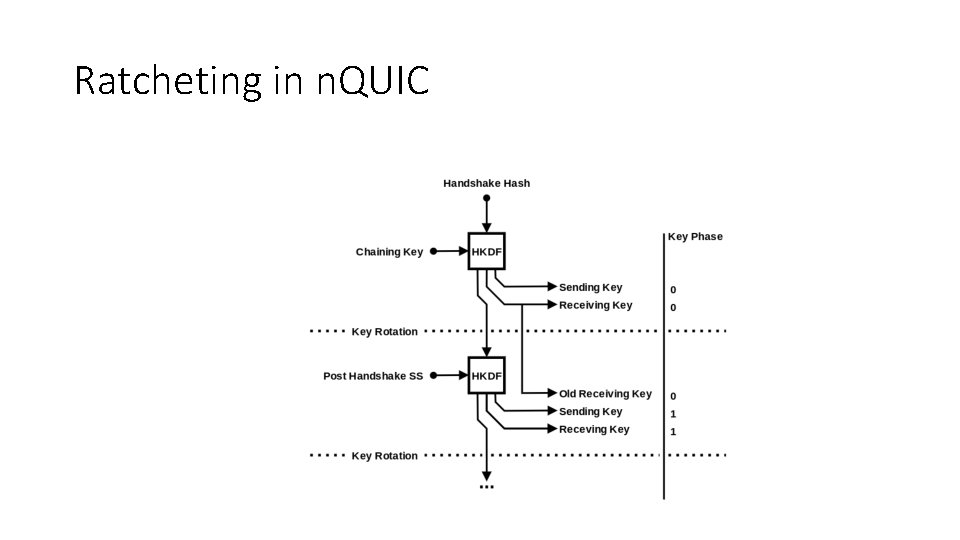
Ratcheting in n. QUIC
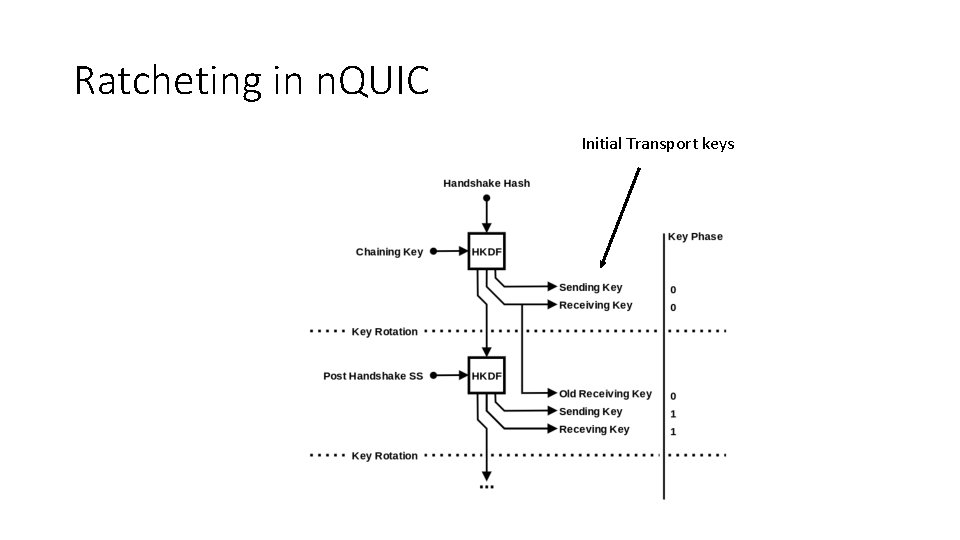
Ratcheting in n. QUIC Initial Transport keys
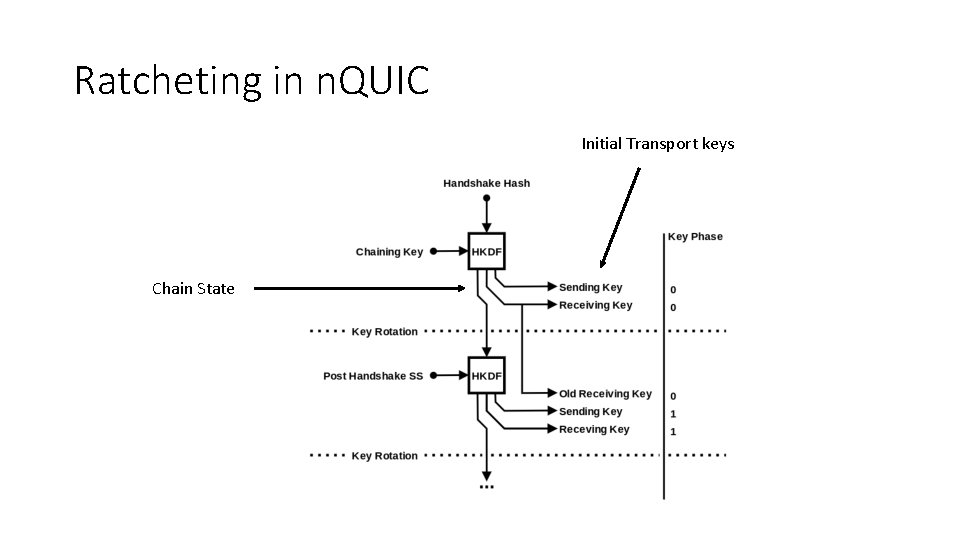
Ratcheting in n. QUIC Initial Transport keys Chain State
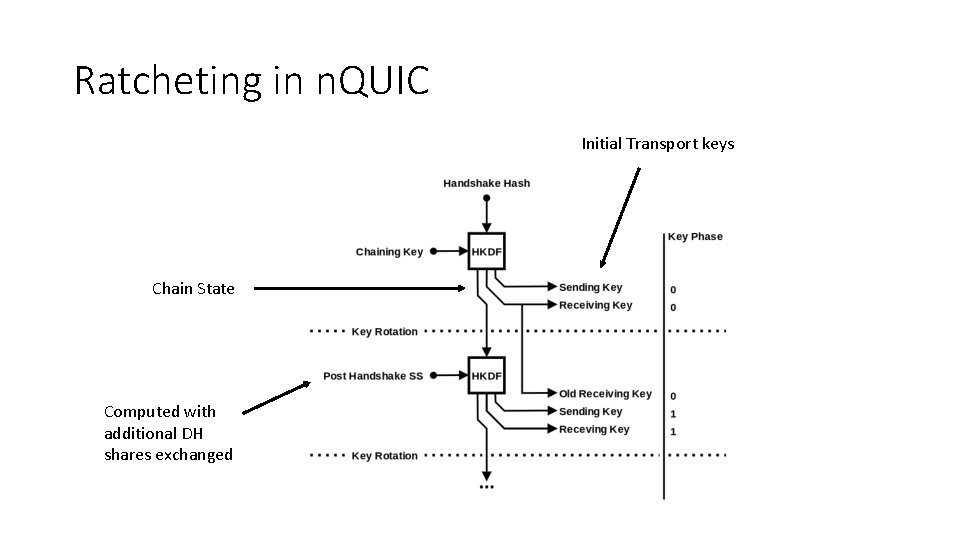
Ratcheting in n. QUIC Initial Transport keys Chain State Computed with additional DH shares exchanged
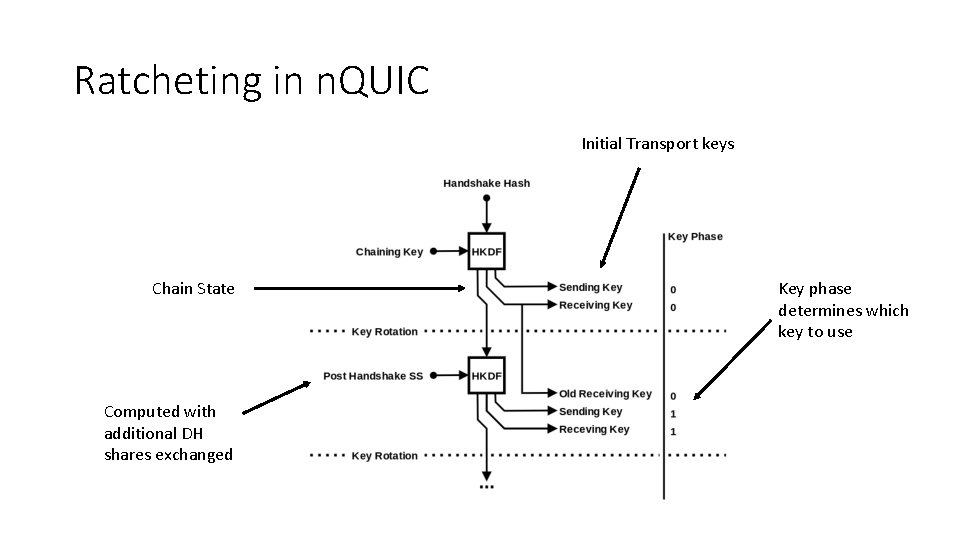
Ratcheting in n. QUIC Initial Transport keys Chain State Computed with additional DH shares exchanged Key phase determines which key to use
Interoperability • n. QUIC is intended to be a minimal update to QUIC-TLS
Interoperability • n. QUIC is intended to be a minimal update to QUIC-TLS • Potentially can be specified as a new QUIC version compatible with existing RFCs
Interoperability • n. QUIC is intended to be a minimal update to QUIC-TLS • Potentially can be specified as a new QUIC version compatible with existing RFCs • Since versions with the upper 16 bits clear are reserved for future IETF use we chose 0 xff 00000 b for n. QUIC
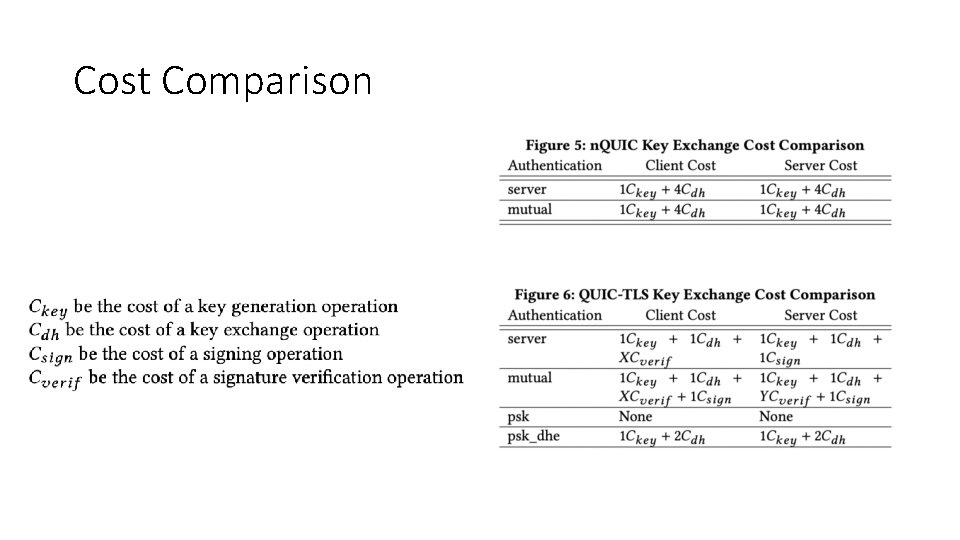
Cost Comparison
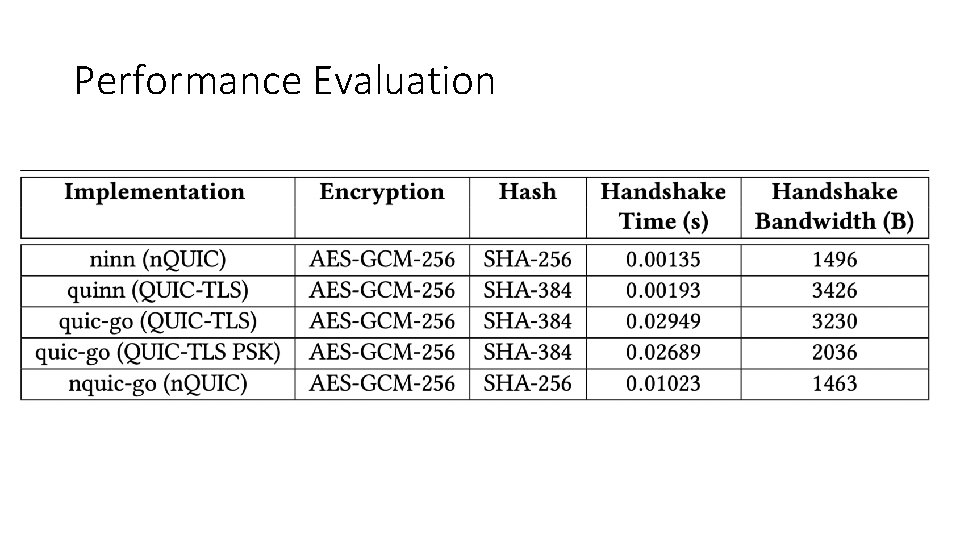
Performance Evaluation The key difference in n. QUIC and QUIC-TLS is the handshake
Performance Evaluation The key difference in n. QUIC and QUIC-TLS is the handshake We created proof of concept implementations of n. QUIC in Rust and Go
Performance Evaluation The key difference in n. QUIC and QUIC-TLS is the handshake We created proof of concept implementations of n. QUIC in Rust and Go These libraries where significantly smaller than the QUIC libraries they were based on
Performance Evaluation
Moving Forward Noise is adding tokens to support KEMs and digital signatures n. QUIC can be extended to Post Quantum handshakes without invalidating formal analysis Groups (such as Denis Kolegov) currently implementing PQ noise patterns for n. QUIC and performing a comprehensive measurement study
Conclusion n. QUIC offers the following advantages:
Conclusion n. QUIC offers the following advantages: • Improved performance
Conclusion n. QUIC offers the following advantages: • Improved performance • Simplementations
Conclusion n. QUIC offers the following advantages: • Improved performance • Simplementations • Clearer Security properties
Conclusion n. QUIC offers the following advantages: • Improved performance • Simplementations • Clearer Security properties Supporting a variety of handshake protocols will help avoid ossification and allow for scenario specific optimizations
Questions? • Thank you!
- Slides: 119