
n Prof n Kaan Cebesoy EMREGL Ankara University
n Prof. n Kaan Cebesoy EMREGÜL Ankara University Science Faculty n n Dept. Of Chemistry Physical Chemistry Division n n Room No: 33 Students Meeting Hours: Thursday 10. 30 -12. 00 am. n 10/7/2020 1
What is Chemistry? n n 10/7/2020 Chemistry - descriptive and quantitative study of the properties of matter Ø composition and structure Ø physical and chemical properties Ø transformations (changes in any of the above or energy) Chemistry is typically involved in making new materials for society, measuring the amount of matter in something, or determining the physical/chemical properties of matter 2
Experimentation in Chemistry is an Experimental Science n The Experiment – observation of natural phenomena under controlled conditions such that the results can be duplicated and conclusions made n Law – statement or equation describing the regularity of a fundamental occurrence in nature n Hypothesis – statement of fact governing an observed natural processes testable through experimentation n Theory (Model) – repeatedly tested and observed relationships in nature involving natural phenomena 10/7/2020 3
Matter: Physical and Chemical Make Up n Matter - Anything which has mass and occupies space Mass = quantity of matter Space = volume of matter n Physical Forms Of Matter Solid - Matter with fixed shape and volume; generally incompressible Liquid- Matter with fixed volume and shape according to container; generally, incompressible Gas 10/7/2020 - Matter which conforms to the shape and volume of its container; compressible 4
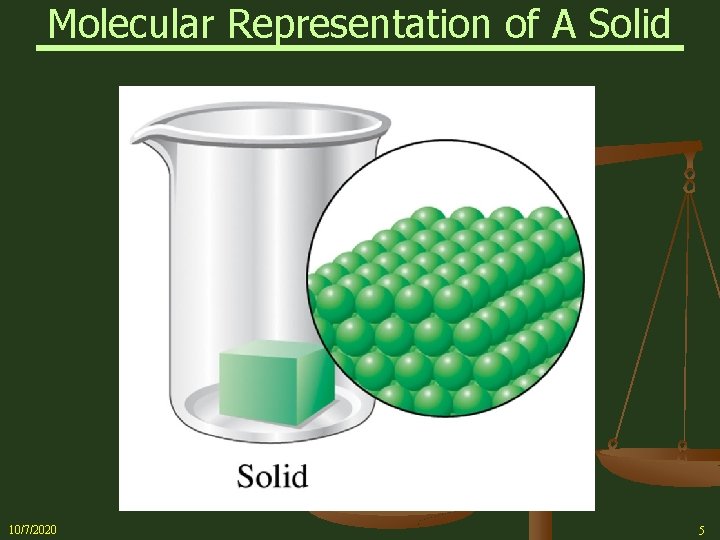
Molecular Representation of A Solid 10/7/2020 5
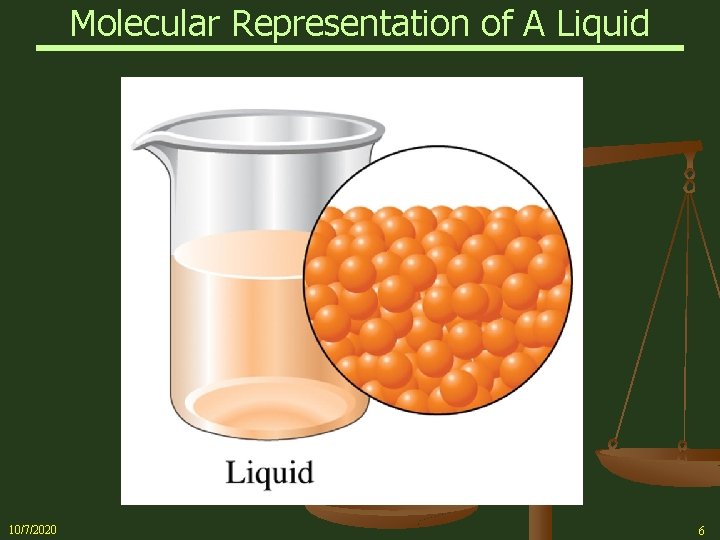
Molecular Representation of A Liquid 10/7/2020 6
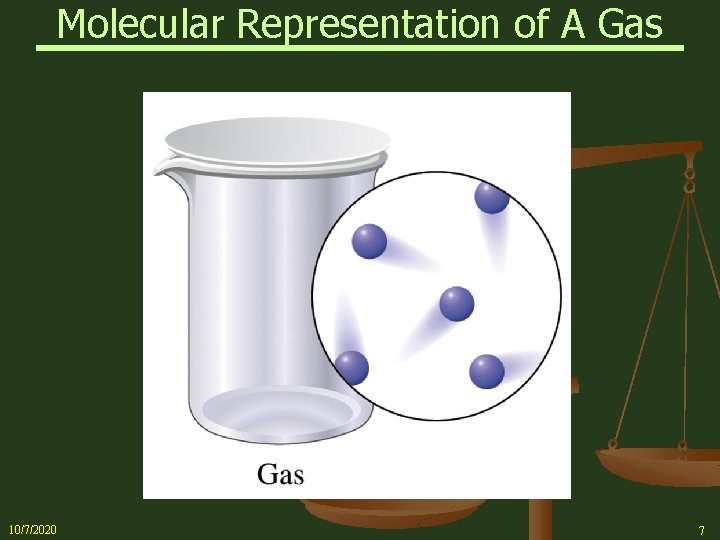
Molecular Representation of A Gas 10/7/2020 7
Physical & Chemical Properties n Physical Change – a change in which the form of matter does not change identity n Physical Property – an observed characteristic whereby the chemical form remains intact (e. g. , mp, bp, density, color, refractive index) n Chemical Change – change in which matter changes from one form to another or to other forms, through a chemical reaction n Chemical Property- Any of a material's properties that becomes evident during a chemical reaction; that is, any quality that can be established only by changing a substance's chemical identity 10/7/2020 8
Elements and Compounds n Substance – type of matter than cannot be further separated by physical processes n Element – substance that cannot be decomposed into simpler substances n Compound – a substance formed when two or more elements are combined Ø Compounds obey the Law of Definite Proportions A pure compound contains constant proportions of elements by mass 10/7/2020 9
Mixtures n 10/7/2020 Mixture –material that can be separated into two or more substances Ø Heterogeneous mixture – mixture that is divided among parts with distinctly different physical properties Ø phase – part of mixture with uniform properties Ø Homogeneous mixture – mixture with no visible boundaries and uniform physical properties throughout 10
Mixtures n 10/7/2020 Mixtures separated by: Ø Filtration: Mixture consists of a solid and liquid; liquid separated by filtration. Ø Chromatography: Separates mixtures by distributing components between a mobile and stationary phase. Ø Distillation: Liquid mixture is boiled; components in the mixture boil off at different temperatures. 11
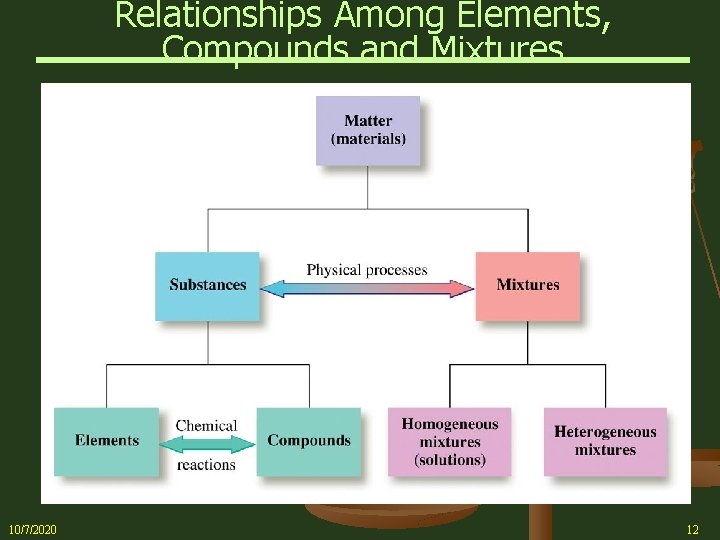
Relationships Among Elements, Compounds and Mixtures 10/7/2020 12
Significant Figures n Significant figure is a number derived from a measurement or calculation that indicates all relevant digits. The final digit is uncertain n Every measurement has a reporting limit (detection limit) n The greater the number of digits usually indicates the higher the precision 10/7/2020 13
Significant Figures (Con’t) 1. All nonzero numbers are significant. 2. Zeros in between nonzero numbers are significant. 3. Trailing zeros (zeros to the right of a nonzero number) that fall AFTER a decimal point are significant. 4. Trailing zeros BEFORE a decimal point are not significant unless indicated w/ a bar over them or an explicit decimal point. 5. Leading zeros (zeros to the left of the first nonzero number) are not significant. 10/7/2020 14
Significant Figures (Con’t) Examples: Determine the number of significant figures in each number below 10/7/2020 1. 12 (3) 0. 00345 (3) 0. 0300 (3) 125. 999 (6) 1. 00056 (6) 1000 (? , 1 -4, no decimal point) 1000. (4) 15
Scientific Notation n Number of significant figures can be stated unequivocally by using Scientific Notation Ø In scientific notation, a number is represented by the form A. bcd… x 10 n A = A 1 digit number to the left of the decimal point (1 -9) bcd = The remaining significant figures n 10/7/2020 = an integer that indicates how many powers of 10 the number must be multiplied by to restore the original value; n can be negative (-) or positive (+) 16
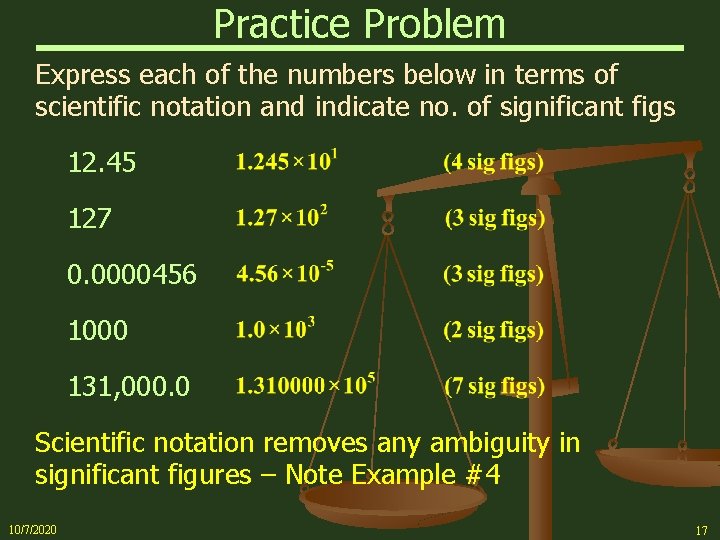
Practice Problem Express each of the numbers below in terms of scientific notation and indicate no. of significant figs 12. 45 127 0. 0000456 1000 131, 000. 0 Scientific notation removes any ambiguity in significant figures – Note Example #4 10/7/2020 17
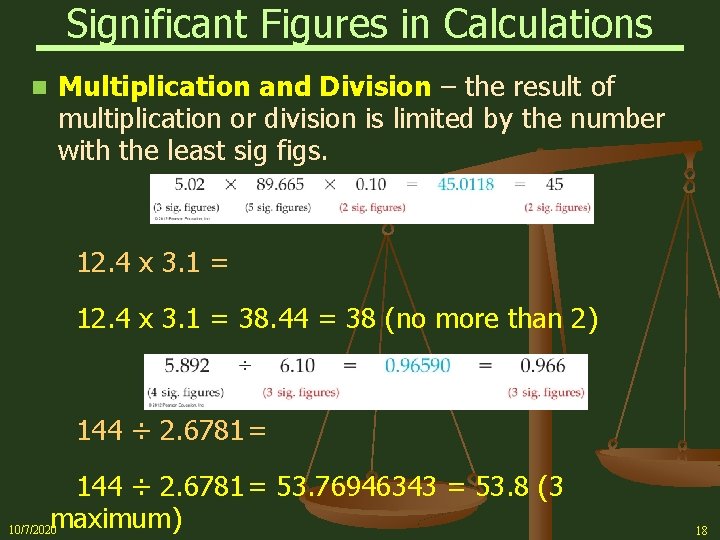
Significant Figures in Calculations n Multiplication and Division – the result of multiplication or division is limited by the number with the least sig figs. 12. 4 x 3. 1 = 38. 44 = 38 (no more than 2) 144 ÷ 2. 6781= 53. 76946343 = 53. 8 (3 maximum) 10/7/2020 18
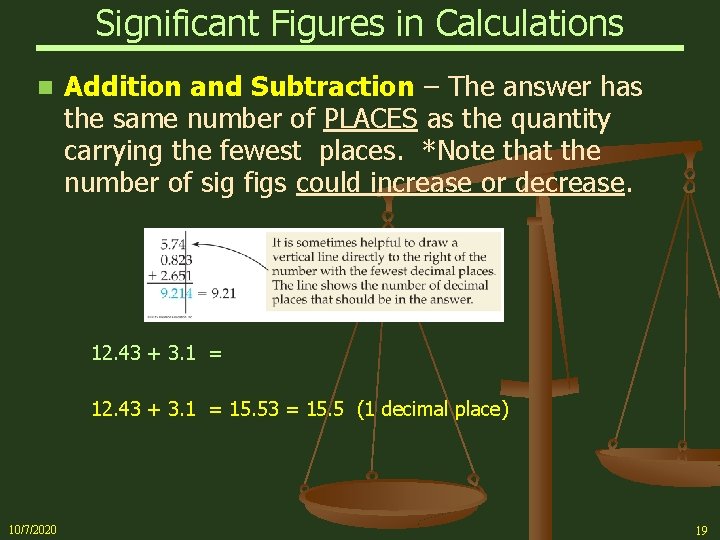
Significant Figures in Calculations n Addition and Subtraction – The answer has the same number of PLACES as the quantity carrying the fewest places. *Note that the number of sig figs could increase or decrease. 12. 43 + 3. 1 = 15. 53 = 15. 5 (1 decimal place) 10/7/2020 19
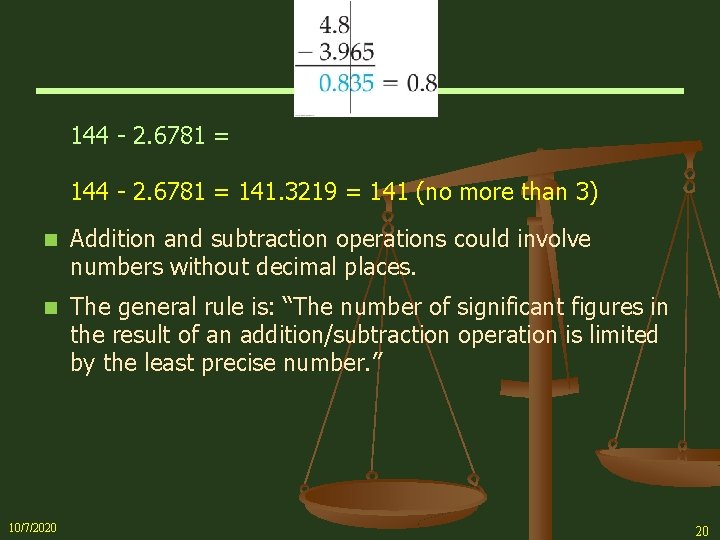
144 - 2. 6781 = 141. 3219 = 141 (no more than 3) n Addition and subtraction operations could involve numbers without decimal places. n The general rule is: “The number of significant figures in the result of an addition/subtraction operation is limited by the least precise number. ” 10/7/2020 20
Significant Figures in Calculations n Exact Numbers – exact numbers are numbers known without uncertainty (because they are not derived from measurement), and they have no influence on the significant figures in the result 12. 43 x 12 (exact) = 149. 16 = 149. 2 (4 sig figs) 144. 22 3 (exact) = 48. 07333333 = 48. 073 (5 sig fig) 10/7/2020 21
Practice Problem How many significant figures should be reported for the difference between 235. 7631 and 235. 57? a. 1 b. 2 c. 3 d. 5 e. 7 Ans: b 235. 7631 - 235. 57 = 0. 19 (2 sig figs) 235. 57 is less precise than 235. 7631 10/7/2020 22
Rounding n Rounding is the process of dropping nonsignificant digits in a calculation and adjusting the last digit reported Ø If the number following the last sig fig is 5 or greater, add 1 to the last digit reported and drop all digits that follow Ø If the last sig fig is <5, simply drop all digits farther to the right 14. 2258 to 5 sig figs = 14. 226 3. 4411 to 4 sig figs = 3. 441 7. 752237 to 2 sig figs = 10/7/2020 7. 8 23
Practice Problem n Carry out the following calculation, paying special attention to sig figs, rounding, and units [(1. 84 x 102 g)(44. 7 m/s)2] / 2 Ans: 1. 8382 x 105 = 1. 84 x 105 g m 2/s 2 3 Significant figures Note: Assumes “ 2” is an exact number 10/7/2020 24
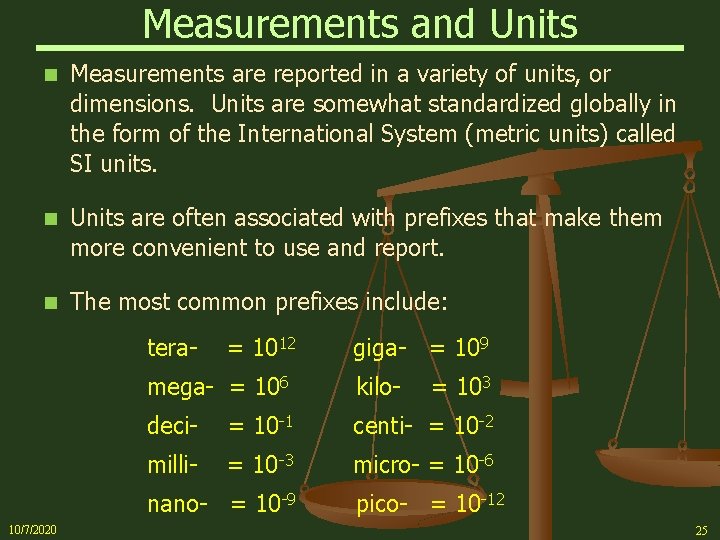
Measurements and Units n Measurements are reported in a variety of units, or dimensions. Units are somewhat standardized globally in the form of the International System (metric units) called SI units. n Units are often associated with prefixes that make them more convenient to use and report. n The most common prefixes include: tera- = 1012 mega- = 106 kilo- deci- = 10 -1 centi- = 10 -2 milli- = 10 -3 micro- = 10 -6 nano- = 10 -9 10/7/2020 giga- = 109 = 103 pico- = 10 -12 25
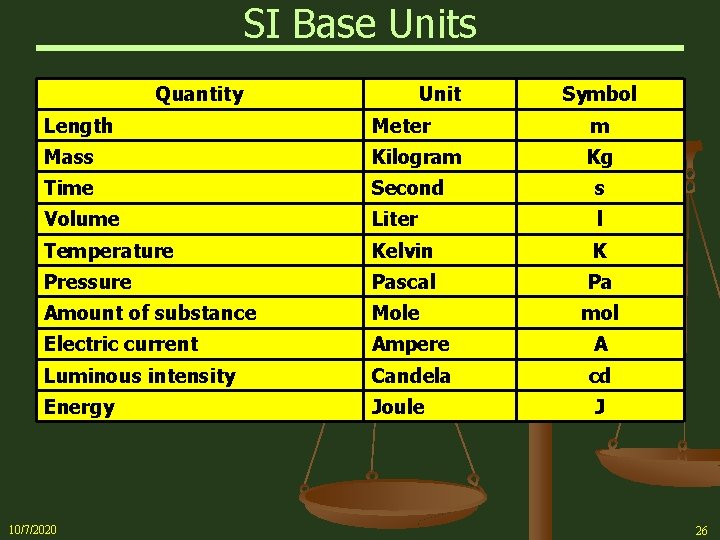
SI Base Units Quantity Unit Symbol Length Meter m Mass Kilogram Kg Time Second s Volume Liter l Temperature Kelvin K Pressure Pascal Pa Amount of substance Mole Electric current Ampere A Luminous intensity Candela cd Energy Joule 10/7/2020 mol J 26
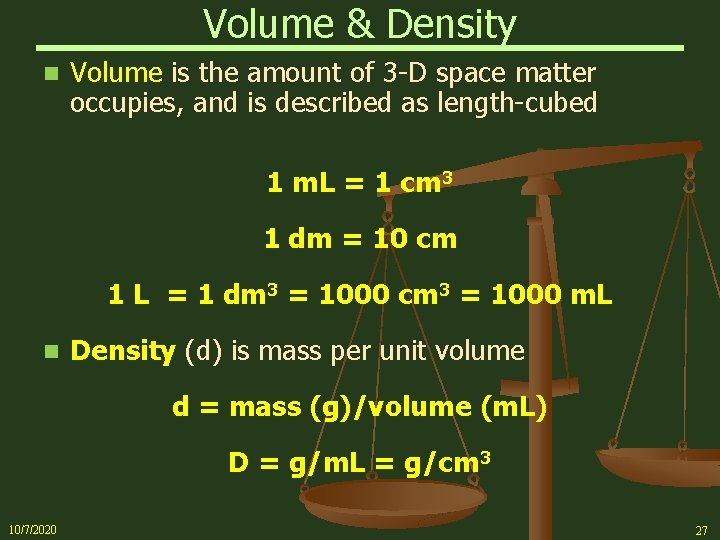
Volume & Density n Volume is the amount of 3 -D space matter occupies, and is described as length-cubed 1 m. L = 1 cm 3 1 dm = 10 cm 1 L = 1 dm 3 = 1000 cm 3 = 1000 m. L n Density (d) is mass per unit volume d = mass (g)/volume (m. L) D = g/m. L = g/cm 3 10/7/2020 27
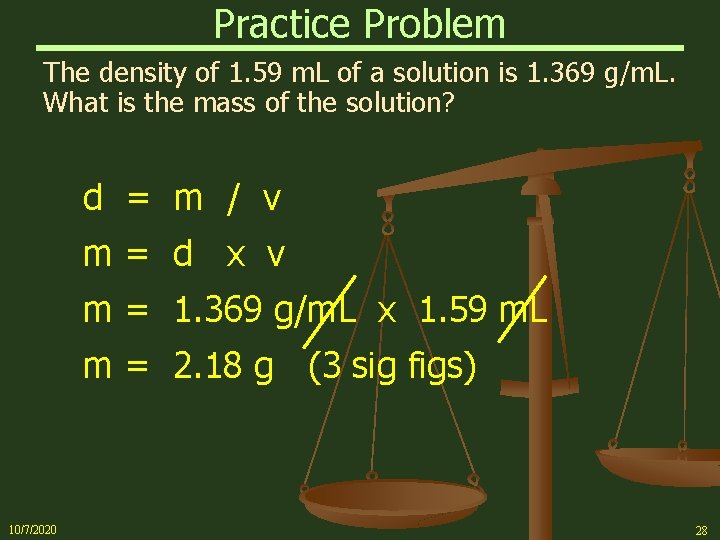
Practice Problem The density of 1. 59 m. L of a solution is 1. 369 g/m. L. What is the mass of the solution? d = m / v m= d x v m = 1. 369 g/m. L x 1. 59 m. L m = 2. 18 g (3 sig figs) 10/7/2020 28
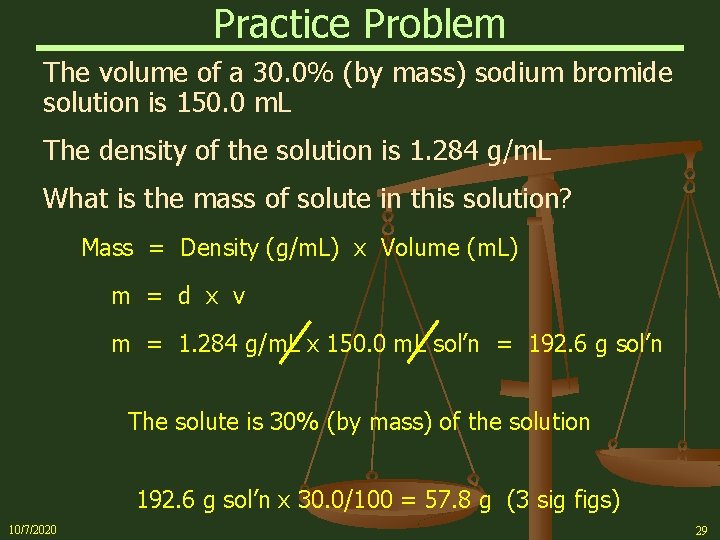
Practice Problem The volume of a 30. 0% (by mass) sodium bromide solution is 150. 0 m. L The density of the solution is 1. 284 g/m. L What is the mass of solute in this solution? Mass = Density (g/m. L) x Volume (m. L) m = d x v m = 1. 284 g/m. L x 150. 0 m. L sol’n = 192. 6 g sol’n The solute is 30% (by mass) of the solution 192. 6 g sol’n x 30. 0/100 = 57. 8 g (3 sig figs) 10/7/2020 29
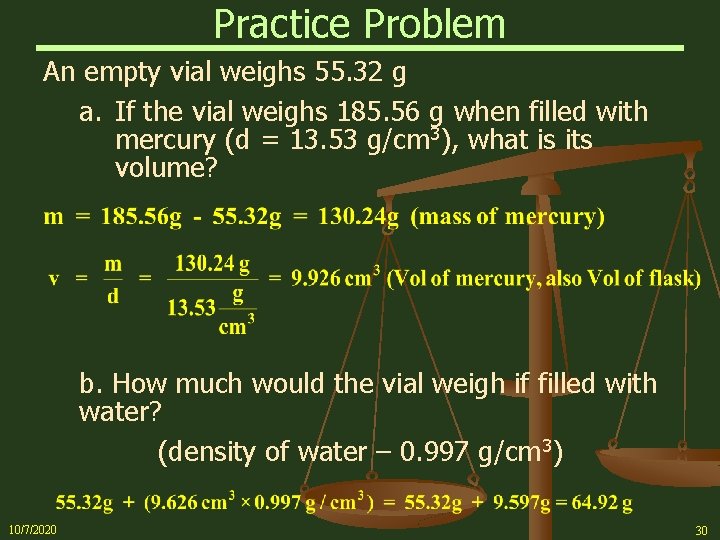
Practice Problem An empty vial weighs 55. 32 g a. If the vial weighs 185. 56 g when filled with mercury (d = 13. 53 g/cm 3), what is its volume? b. How much would the vial weigh if filled with water? (density of water – 0. 997 g/cm 3) 10/7/2020 30
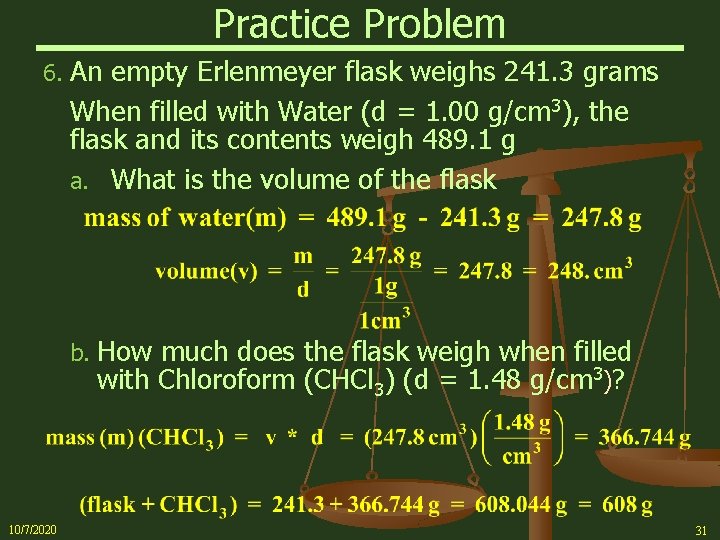
Practice Problem 6. An empty Erlenmeyer flask weighs 241. 3 grams When filled with Water (d = 1. 00 g/cm 3), the flask and its contents weigh 489. 1 g a. What is the volume of the flask b. 10/7/2020 How much does the flask weigh when filled with Chloroform (CHCl 3) (d = 1. 48 g/cm 3)? 31
- Slides: 31