
n o tr Polarized Electron Footprint at JLab
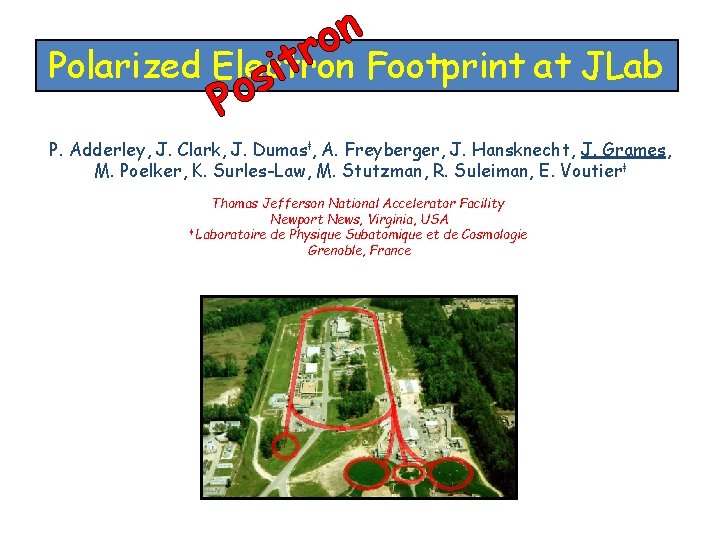
n o tr Polarized Electron Footprint at JLab i s Po P. Adderley, J. Clark, J. Dumasǂ, A. Freyberger, J. Hansknecht, J. Grames, M. Poelker, K. Surles-Law, M. Stutzman, R. Suleiman, E. Voutierǂ Thomas Jefferson National Accelerator Facility Newport News, Virginia, USA ǂ Laboratoire de Physique Subatomique et de Cosmologie Grenoble, France
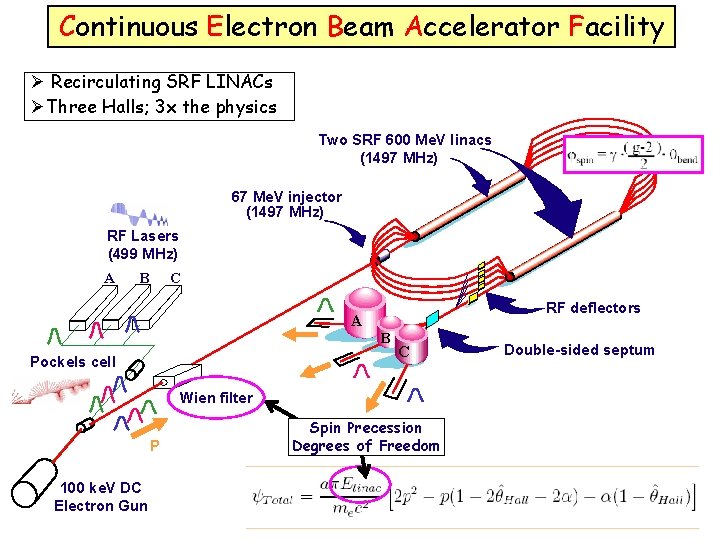
Continuous Electron Beam Accelerator Facility Ø Recirculating SRF LINACs ØThree Halls; 3 x the physics Two SRF 600 Me. V linacs (1497 MHz) 67 Me. V injector (1497 MHz) RF Lasers (499 MHz) A B C A Pockels cell RF deflectors B C Wien filter P 100 ke. V DC Electron Gun Spin Precession Degrees of Freedom Double-sided septum
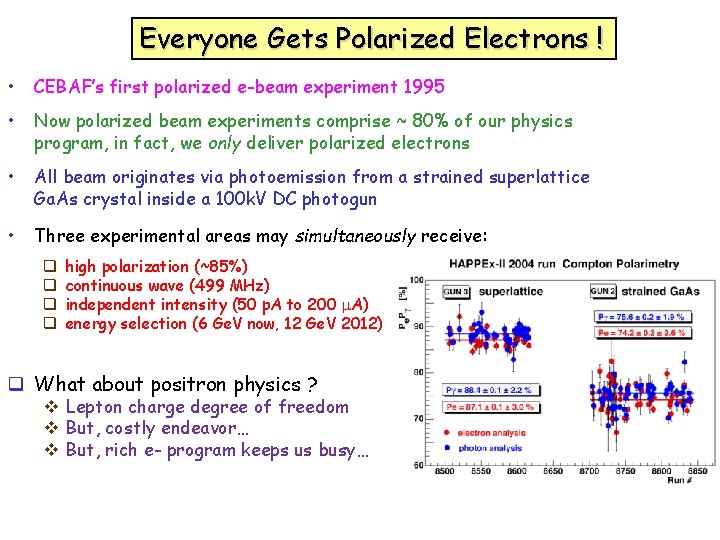
Everyone Gets Polarized Electrons ! • CEBAF’s first polarized e-beam experiment 1995 • Now polarized beam experiments comprise ~ 80% of our physics program, in fact, we only deliver polarized electrons • All beam originates via photoemission from a strained superlattice Ga. As crystal inside a 100 k. V DC photogun • Three experimental areas may simultaneously receive: q q high polarization (~85%) continuous wave (499 MHz) independent intensity (50 p. A to 200 m. A) energy selection (6 Ge. V now, 12 Ge. V 2012) q What about positron physics ? v Lepton charge degree of freedom v But, costly endeavor… v But, rich e- program keeps us busy…
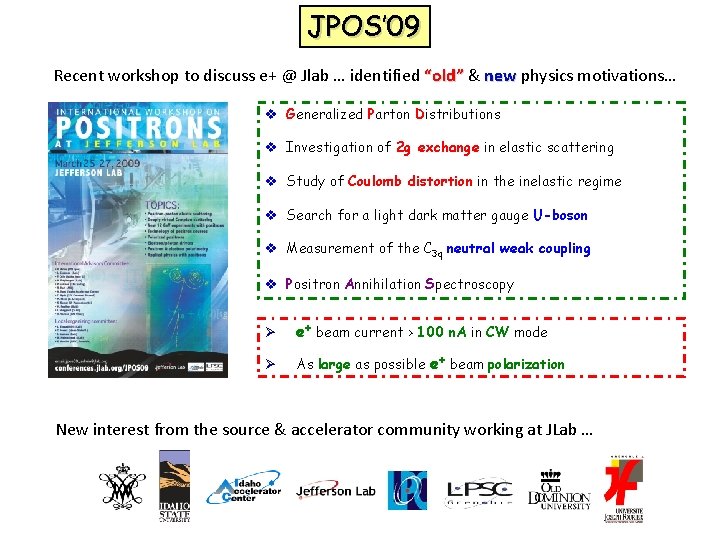
JPOS’ 09 Recent workshop to discuss e+ @ Jlab … identified “old” & new physics motivations… v Generalized Parton Distributions v Investigation of 2 g exchange in elastic scattering v Study of Coulomb distortion in the inelastic regime v Search for a light dark matter gauge U-boson v Measurement of the C 3 q neutral weak coupling v Positron Annihilation Spectroscopy Ø e+ beam current > 100 n. A in CW mode Ø As large as possible e+ beam polarization New interest from the source & accelerator community working at JLab …
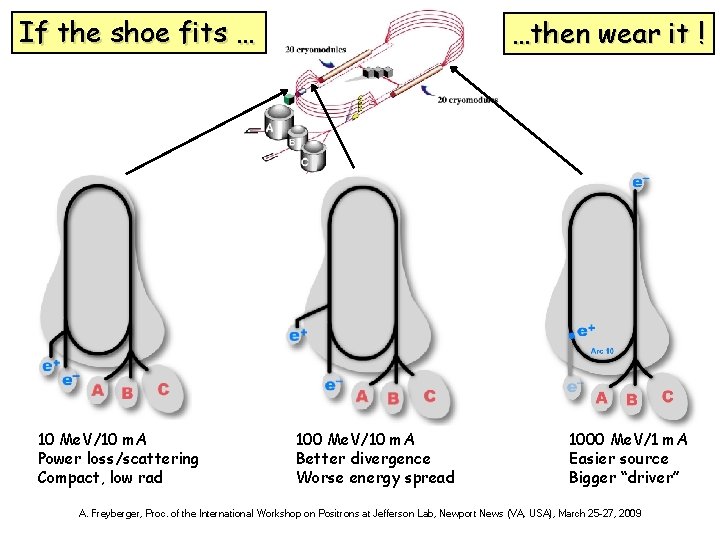
If the shoe fits … 10 Me. V/10 m. A Power loss/scattering Compact, low rad …then wear it ! 100 Me. V/10 m. A Better divergence Worse energy spread 1000 Me. V/1 m. A Easier source Bigger “driver” A. Freyberger, Proc. of the International Workshop on Positrons at Jefferson Lab, Newport News (VA, USA), March 25 -27, 2009
![R&D Effort for a continuous wave [polarized] positron source at JLab for fixed target](http://slidetodoc.com/presentation_image_h2/68c99ec244c5943743d54f8b5a07901d/image-6.jpg "R&D Effort for a continuous wave [polarized] positron source at JLab for fixed target")
R&D Effort for a continuous wave [polarized] positron source at JLab for fixed target experiments to take place in the 12 Ge. V era. J. Dumas, C. Hyde, T. Forest, A. Freyberger, S. Golge, J. Grames, R. Kazimi, E. Voutier S. Golge et al. , Proc. of the International Workshop on Positrons at Jefferson Lab, Newport News (VA, USA), March 25 -27, 2009 Ø A possible concept involves the construction of a dedicated e+ tunnel at the end of the injector and parallel to the north linac. Ø Positrons would be produced with 120 Me. V e- (JLab 12 Ge. V) incident on a tungsten target. Ø e+’s are selected with a quadrupole triplet and transported to the accelerator section. G 4 beamline simulations indicate a global efficiency of 10 -5 e+/e- for 120 Me. V e- off a 3 mm W target. 10 m. A e- → 100 n. A e+
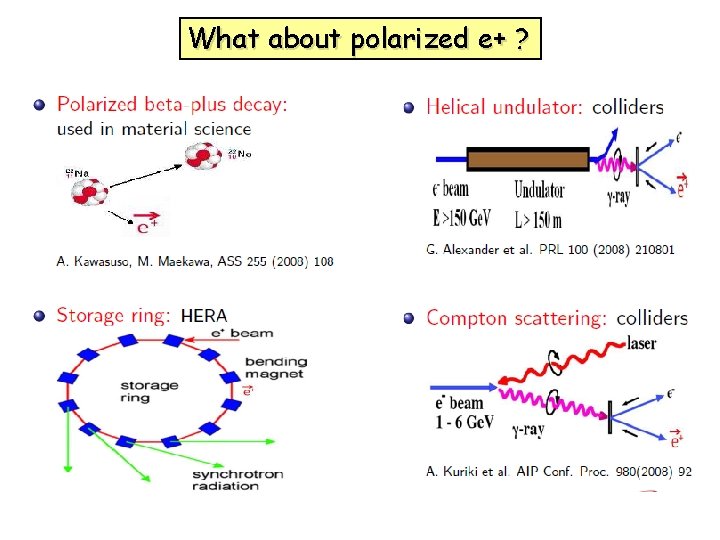
What about polarized e+ ?
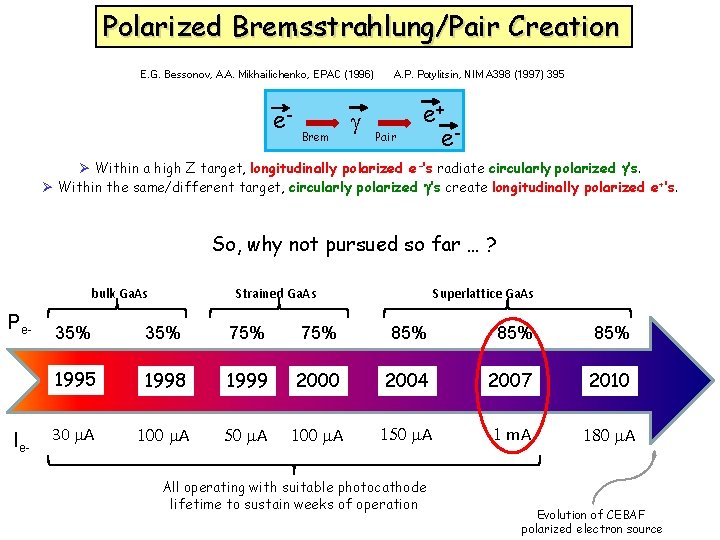
Polarized Bremsstrahlung/Pair Creation E. G. Bessonov, A. A. Mikhailichenko, EPAC (1996) e- Brem g A. P. Potylitsin, NIM A 398 (1997) 395 Pair e+ e- Ø Within a high Z target, longitudinally polarized e-’s radiate circularly polarized g’s. Ø Within the same/different target, circularly polarized g’s create longitudinally polarized e+’s. So, why not pursued so far … ? bulk Ga. As Pe- Ie- Strained Ga. As Superlattice Ga. As 35% 75% 85% 85% 1995 1998 1999 2000 2004 2007 2010 30 m. A 100 m. A 50 m. A 100 m. A 150 m. A 180 m. A All operating with suitable photocathode lifetime to sustain weeks of operation Evolution of CEBAF polarized electron source
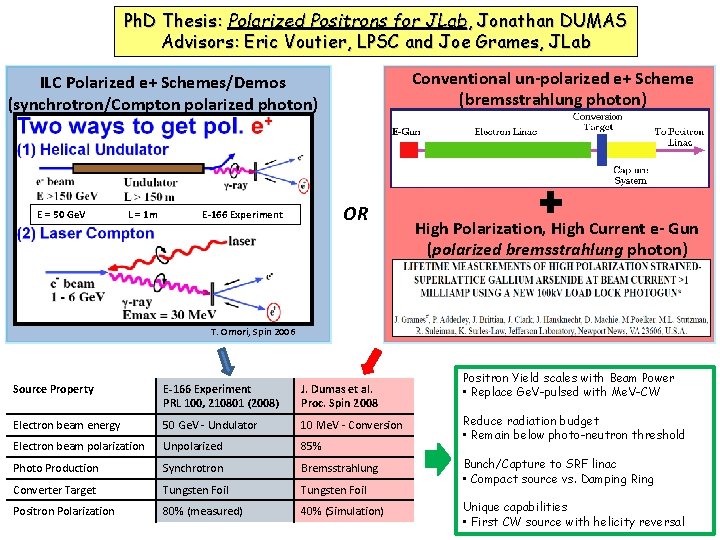
Ph. D Thesis: Polarized Positrons for JLab, Jonathan DUMAS Advisors: Eric Voutier, LPSC and Joe Grames, JLab Conventional un-polarized e+ Scheme (bremsstrahlung photon) ILC Polarized e+ Schemes/Demos (synchrotron/Compton polarized photon) E = 50 Ge. V L = 1 m OR E-166 Experiment High Polarization, High Current e- Gun (polarized bremsstrahlung photon) T. Omori, Spin 2006 Source Property E-166 Experiment PRL 100, 210801 (2008) J. Dumas et al. Proc. Spin 2008 Electron beam energy 50 Ge. V - Undulator 10 Me. V - Conversion Electron beam polarization Unpolarized 85% Photo Production Synchrotron Bremsstrahlung Converter Target Tungsten Foil Positron Polarization 80% (measured) 40% (Simulation) Positron Yield scales with Beam Power • Replace Ge. V-pulsed with Me. V-CW Reduce radiation budget • Remain below photo-neutron threshold Bunch/Capture to SRF linac • Compact source vs. Damping Ring Unique capabilities • First CW source with helicity reversal
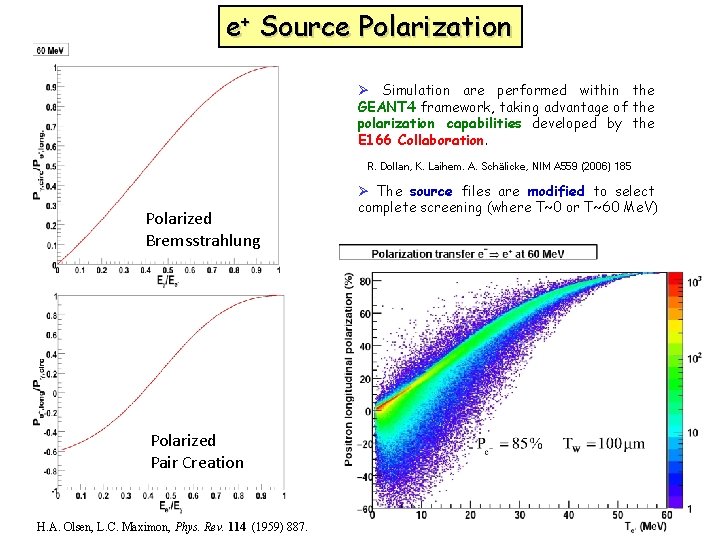
e+ Source Polarization Ø Simulation are performed within the GEANT 4 framework, taking advantage of the polarization capabilities developed by the E 166 Collaboration. R. Dollan, K. Laihem. A. Schälicke, NIM A 559 (2006) 185 Polarized Bremsstrahlung Polarized Pair Creation H. A. Olsen, L. C. Maximon, Phys. Rev. 114 (1959) 887. Ø The source files are modified to select complete screening (where T~0 or T~60 Me. V)
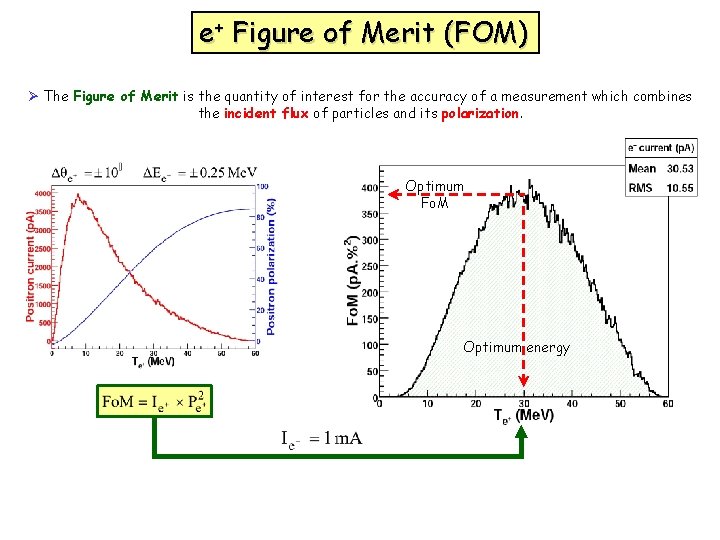
e+ Figure of Merit (FOM) Ø The Figure of Merit is the quantity of interest for the accuracy of a measurement which combines the incident flux of particles and its polarization. Optimum Fo. M Optimum energy
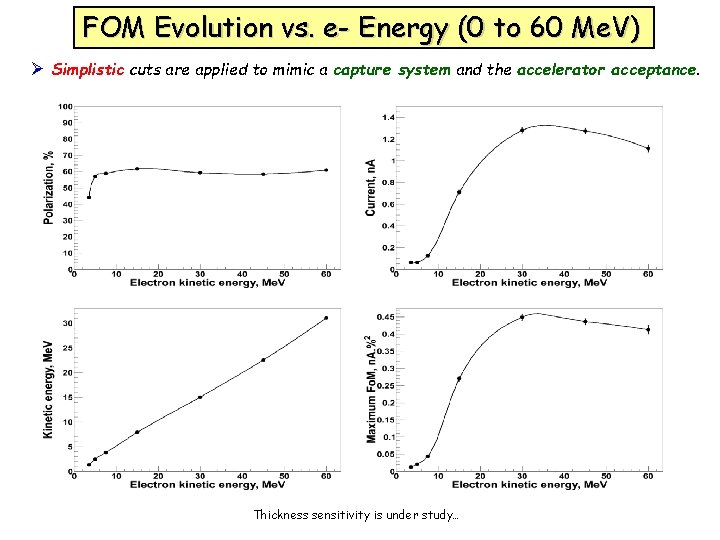
FOM Evolution vs. e- Energy (0 to 60 Me. V) Ø Simplistic cuts are applied to mimic a capture system and the accelerator acceptance. Thickness sensitivity is under study…
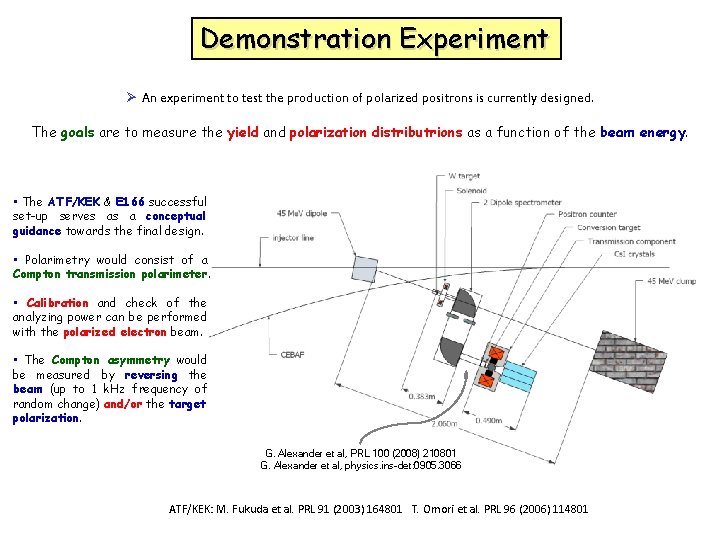
Demonstration Experiment Ø An experiment to test the production of polarized positrons is currently designed. The goals are to measure the yield and polarization distributrions as a function of the beam energy. • The ATF/KEK & E 166 successful set-up serves as a conceptual guidance towards the final design. • Polarimetry would consist of a Compton transmission polarimeter. • Calibration and check of the analyzing power can be performed with the polarized electron beam. • The Compton asymmetry would be measured by reversing the beam (up to 1 k. Hz frequency of random change) and/or the target polarization. G. Alexander et al, PRL 100 (2008) 210801 G. Alexander et al, physics. ins-det: 0905. 3066 ATF/KEK: M. Fukuda et al. PRL 91 (2003) 164801 T. Omori et al. PRL 96 (2006) 114801
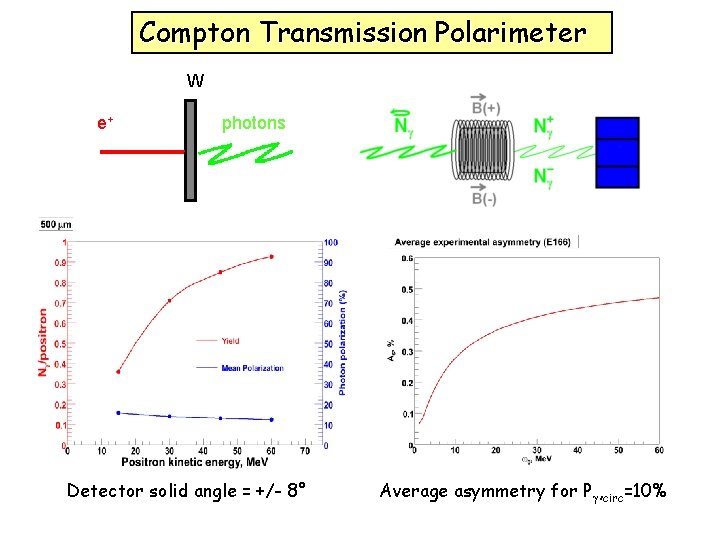
Compton Transmission Polarimeter W e+ photons Pg, circ=100% Detector solid angle = +/- 8° Average asymmetry for Pg, circ=10%
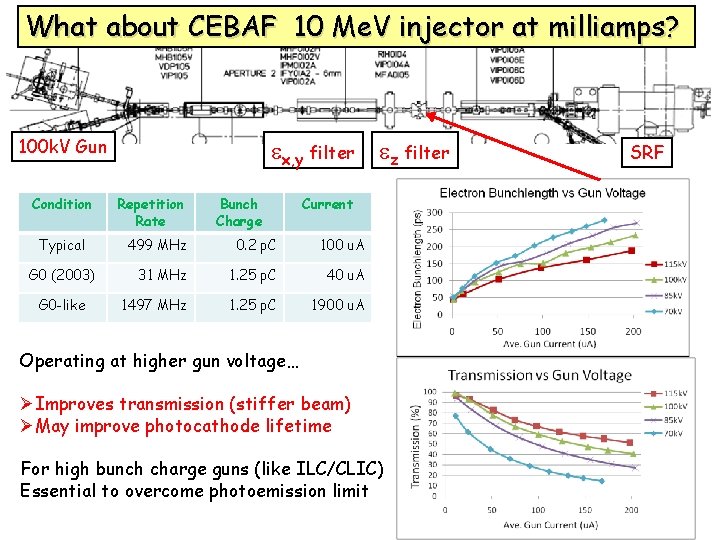
What about CEBAF 10 Me. V injector at milliamps? 100 k. V Gun Condition Typical G 0 (2003) G 0 -like ex, y filter Repetition Rate Bunch Charge ez filter Current 499 MHz 0. 2 p. C 100 u. A 31 MHz 1. 25 p. C 40 u. A 1497 MHz 1. 25 p. C 1900 u. A Operating at higher gun voltage… ØImproves transmission (stiffer beam) ØMay improve photocathode lifetime For high bunch charge guns (like ILC/CLIC) Essential to overcome photoemission limit SRF
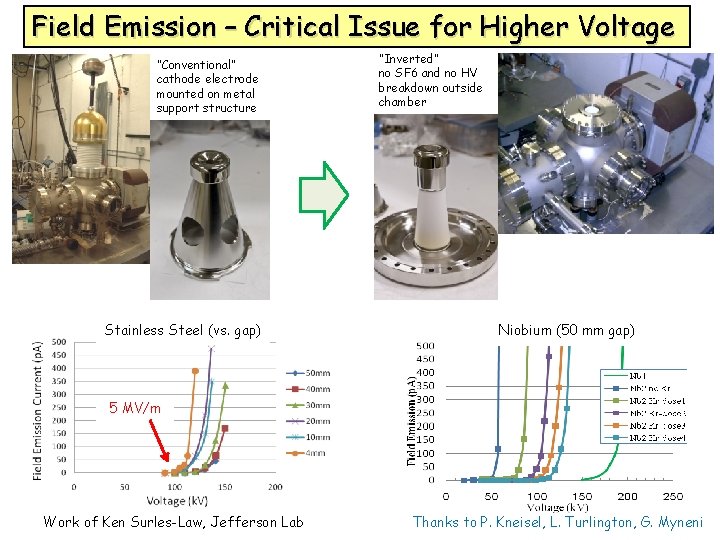
Field Emission – Critical Issue for Higher Voltage “Conventional” cathode electrode mounted on metal support structure Stainless Steel (vs. gap) “Inverted” no SF 6 and no HV breakdown outside chamber Niobium (50 mm gap) 5 MV/m Work of Ken Surles-Law, Jefferson Lab Thanks to P. Kneisel, L. Turlington, G. Myneni
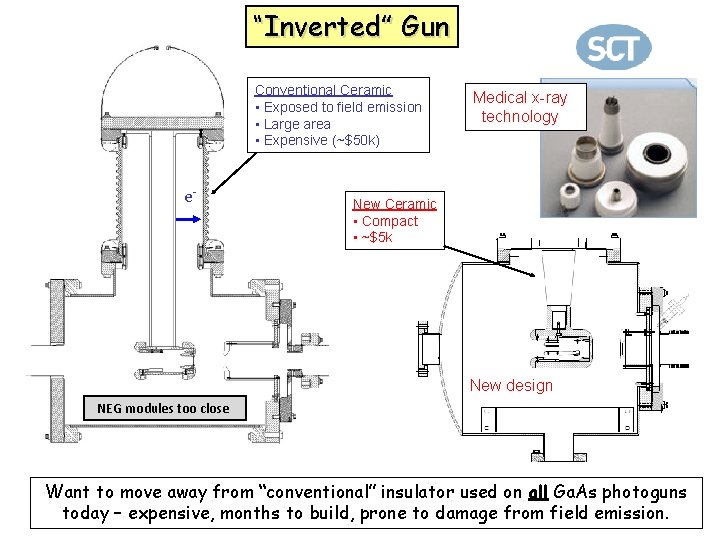
“Inverted” Gun Conventional Ceramic • Exposed to field emission • Large area • Expensive (~$50 k) e- Medical x-ray technology New Ceramic • Compact • ~$5 k New design NEG modules too close Want to move away from “conventional” insulator used on all Ga. As photoguns today – expensive, months to build, prone to damage from field emission.
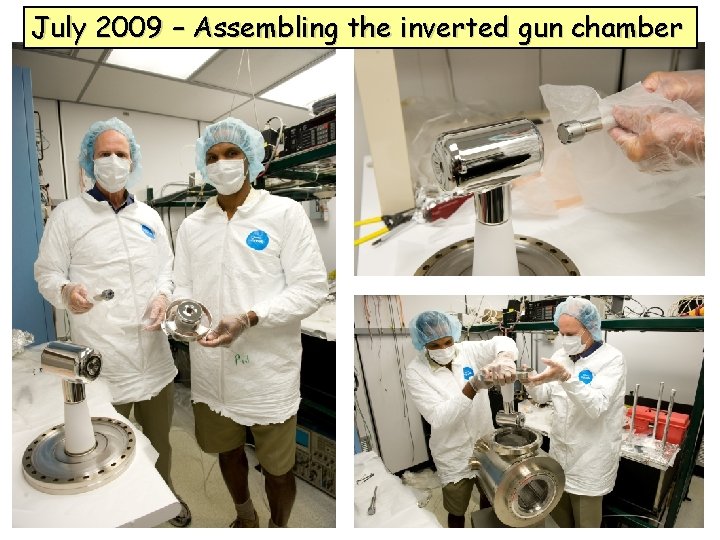
July 2009 – Assembling the inverted gun chamber
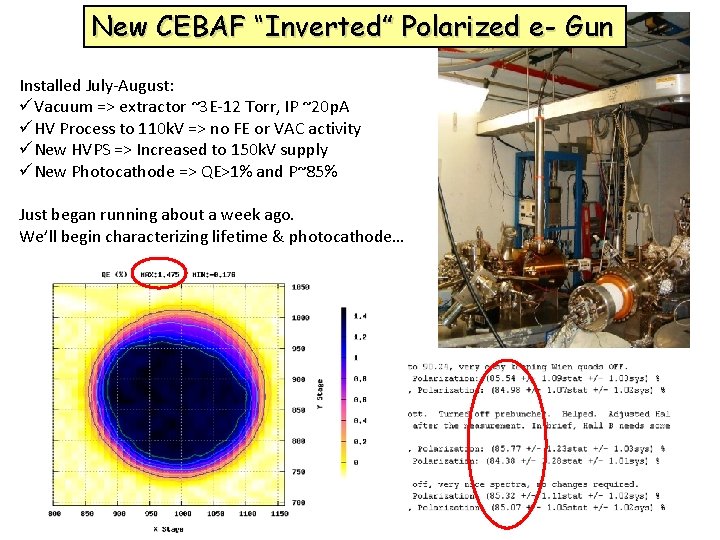
New CEBAF “Inverted” Polarized e- Gun Installed July-August: üVacuum => extractor ~3 E-12 Torr, IP ~20 p. A üHV Process to 110 k. V => no FE or VAC activity üNew HVPS => Increased to 150 k. V supply üNew Photocathode => QE>1% and P~85% Just began running about a week ago. We’ll begin characterizing lifetime & photocathode…
- Slides: 19