
n Measurement of the Neutron Spin Rotation in
- Slides: 30
n Measurement of the Neutron Spin. Rotation in Solid Orthodeuterium Diane Markoff North Carolina Central University (NCCU) Triangle Universities Nuclear Laboratory (TUNL) INT – June 07
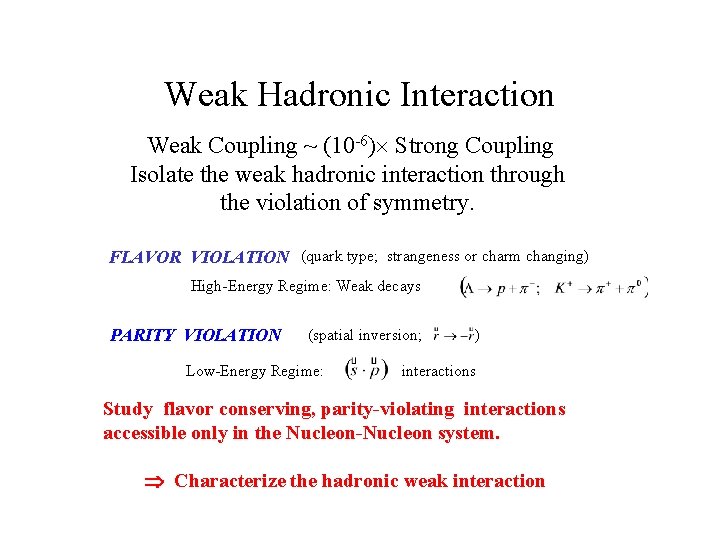
Weak Hadronic Interaction Weak Coupling ~ (10 -6) Strong Coupling Isolate the weak hadronic interaction through the violation of symmetry. FLAVOR VIOLATION (quark type; strangeness or charm changing) High-Energy Regime: Weak decays PARITY VIOLATION (spatial inversion; Low-Energy Regime: ) interactions Study flavor conserving, parity-violating interactions accessible only in the Nucleon-Nucleon system. Þ Characterize the hadronic weak interaction
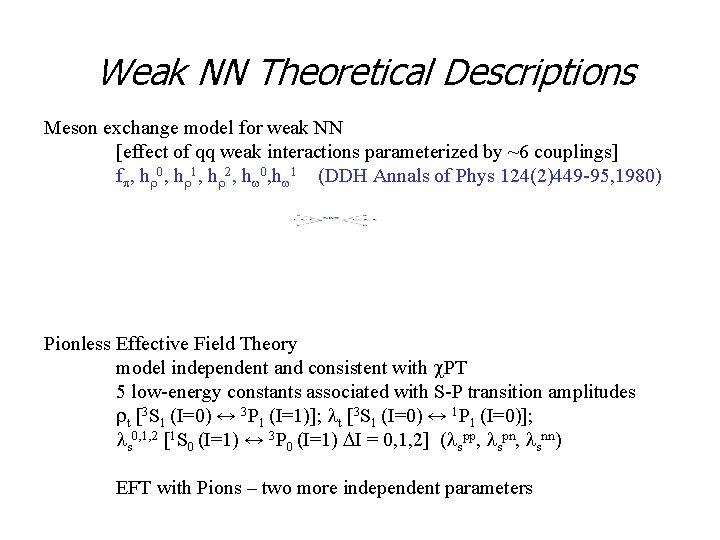
Weak NN Theoretical Descriptions Meson exchange model for weak NN [effect of qq weak interactions parameterized by ~6 couplings] fp, hr 0, hr 1, hr 2, hw 0, hw 1 (DDH Annals of Phys 124(2)449 -95, 1980) Pionless Effective Field Theory model independent and consistent with c. PT 5 low-energy constants associated with S-P transition amplitudes rt [3 S 1 (I=0) ↔ 3 P 1 (I=1)]; lt [3 S 1 (I=0) ↔ 1 P 1 (I=0)]; ls 0, 1, 2 [1 S 0 (I=1) ↔ 3 P 0 (I=1) DI = 0, 1, 2] (lspp, lspn, lsnn) EFT with Pions – two more independent parameters
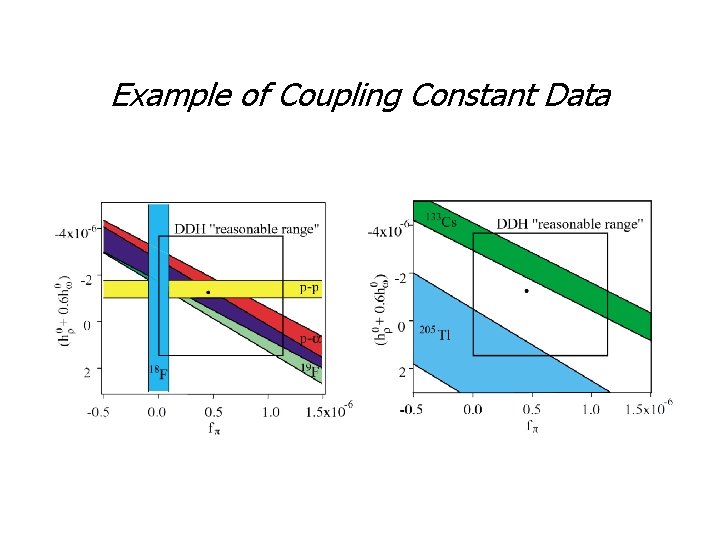
Example of Coupling Constant Data
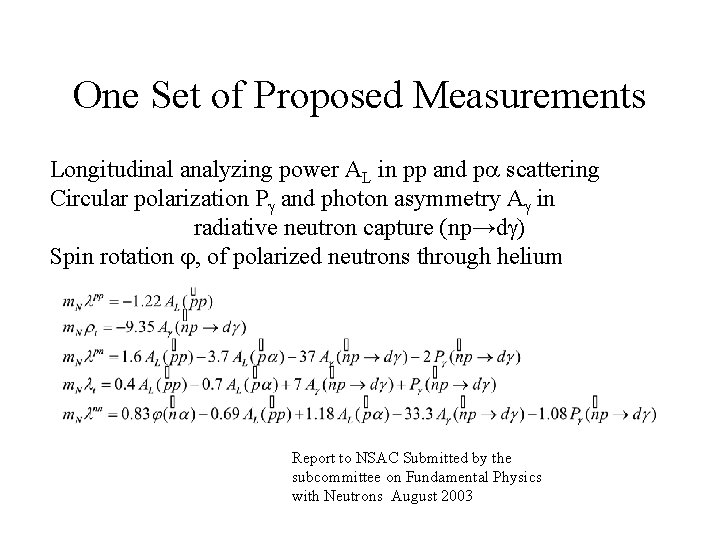
One Set of Proposed Measurements Longitudinal analyzing power AL in pp and pa scattering Circular polarization P and photon asymmetry A in radiative neutron capture (np→d ) Spin rotation j, of polarized neutrons through helium Report to NSAC Submitted by the subcommittee on Fundamental Physics with Neutrons August 2003
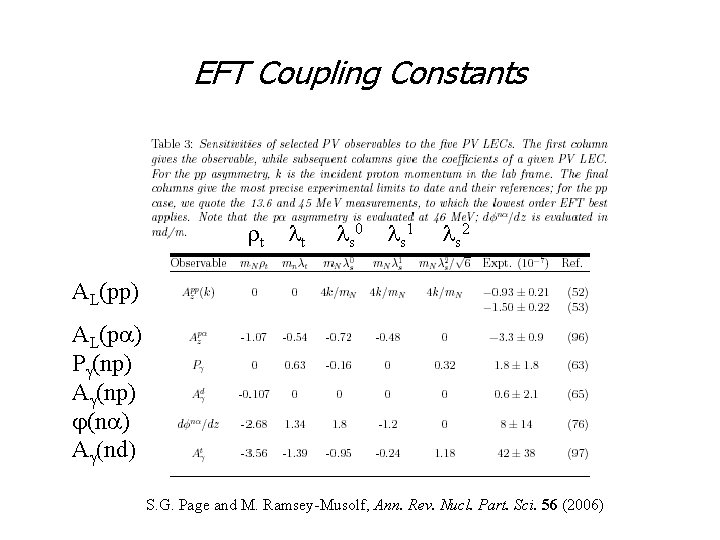
EFT Coupling Constants rt lt l s 0 l s 1 l s 2 AL(pp) AL(pa) P (np) A (np) j(na) A (nd) S. G. Page and M. Ramsey-Musolf, Ann. Rev. Nucl. Part. Sci. 56 (2006)
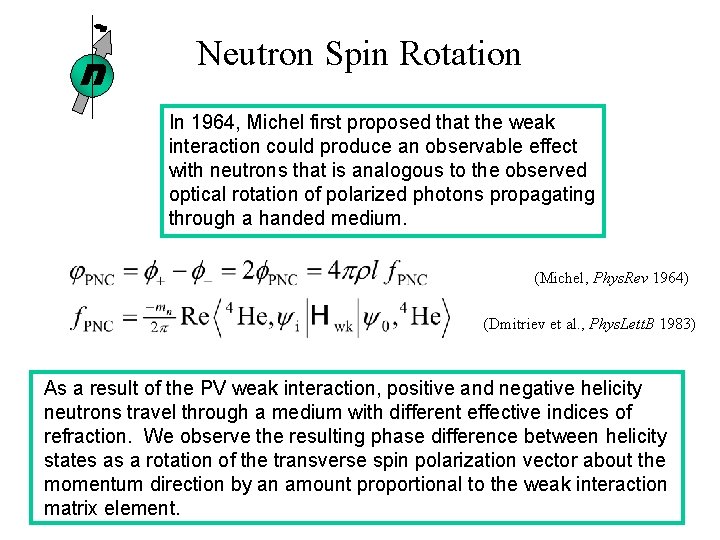
n Neutron Spin Rotation In 1964, Michel first proposed that the weak interaction could produce an observable effect with neutrons that is analogous to the observed optical rotation of polarized photons propagating through a handed medium. (Michel, Phys. Rev 1964) (Dmitriev et al. , Phys. Lett. B 1983) As a result of the PV weak interaction, positive and negative helicity neutrons travel through a medium with different effective indices of refraction. We observe the resulting phase difference between helicity states as a rotation of the transverse spin polarization vector about the momentum direction by an amount proportional to the weak interaction matrix element.
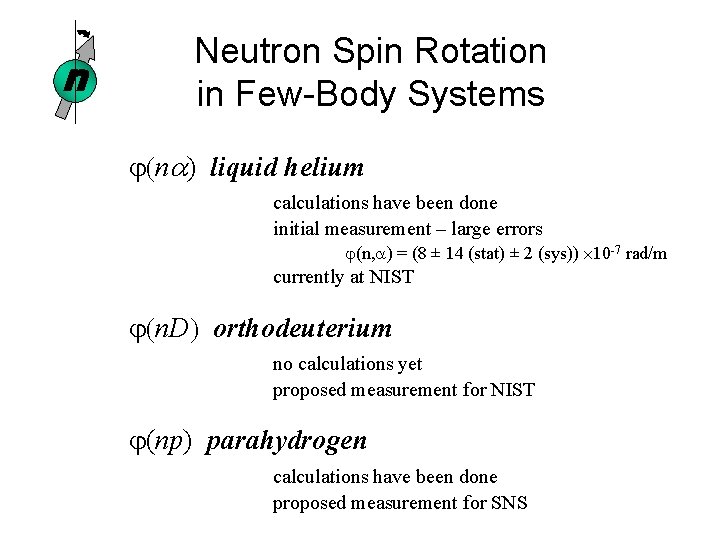
n Neutron Spin Rotation in Few-Body Systems j(na) liquid helium calculations have been done initial measurement – large errors j(n, a) = (8 ± 14 (stat) ± 2 (sys)) 10 -7 rad/m currently at NIST j(n. D) orthodeuterium no calculations yet proposed measurement for NIST j(np) parahydrogen calculations have been done proposed measurement for SNS
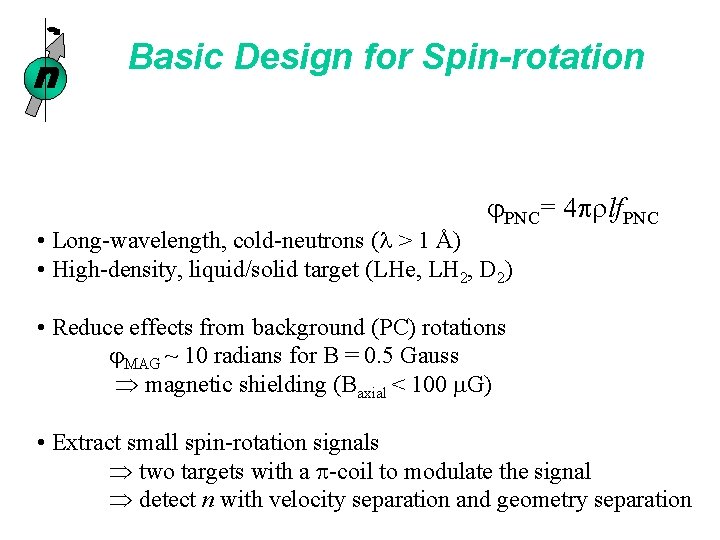
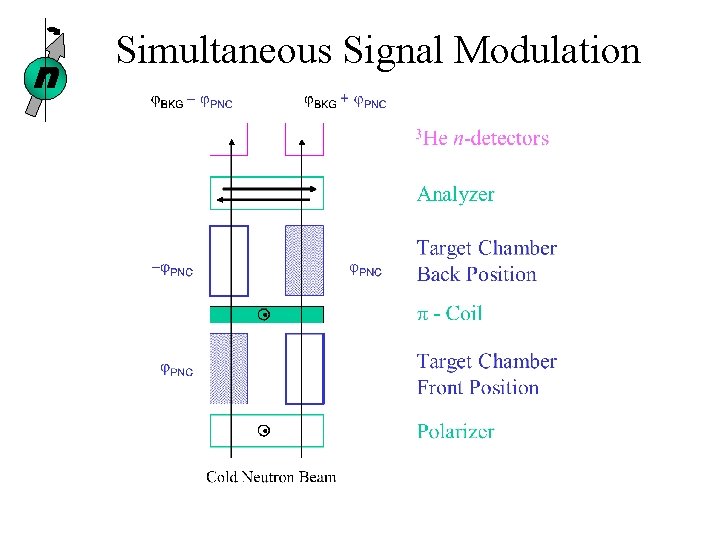
n Basic Design for Spin-rotation j. PNC= 4 prlf. PNC • Long-wavelength, cold-neutrons (l > 1 Å) • High-density, liquid/solid target (LHe, LH 2, D 2) • Reduce effects from background (PC) rotations j. MAG ~ 10 radians for B = 0. 5 Gauss magnetic shielding (Baxial < 100 m. G) • Extract small spin-rotation signals two targets with a p-coil to modulate the signal detect n with velocity separation and geometry separation
n Simultaneous Signal Modulation
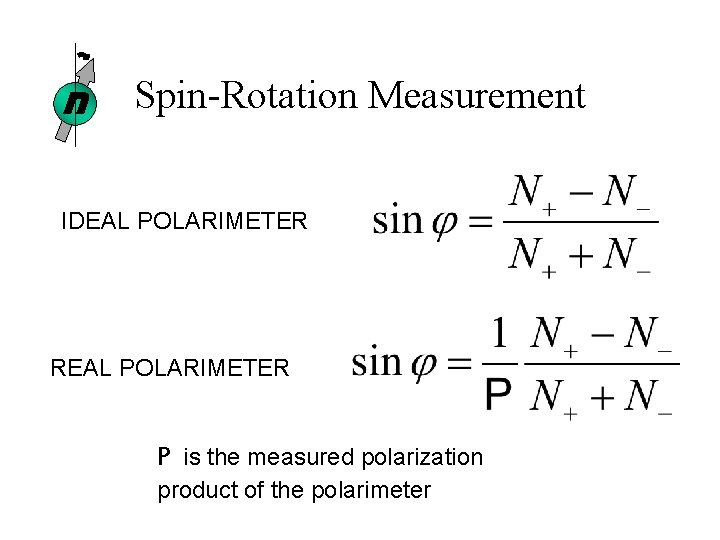
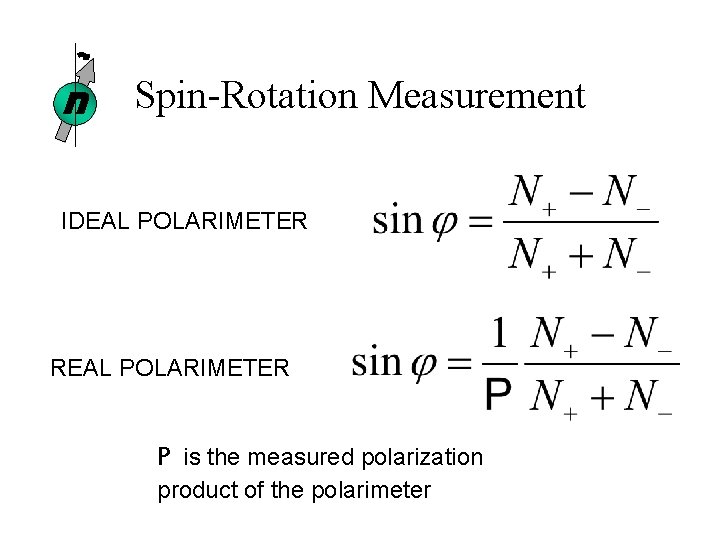
n Spin-Rotation Measurement IDEAL POLARIMETER REAL POLARIMETER P is the measured polarization product of the polarimeter
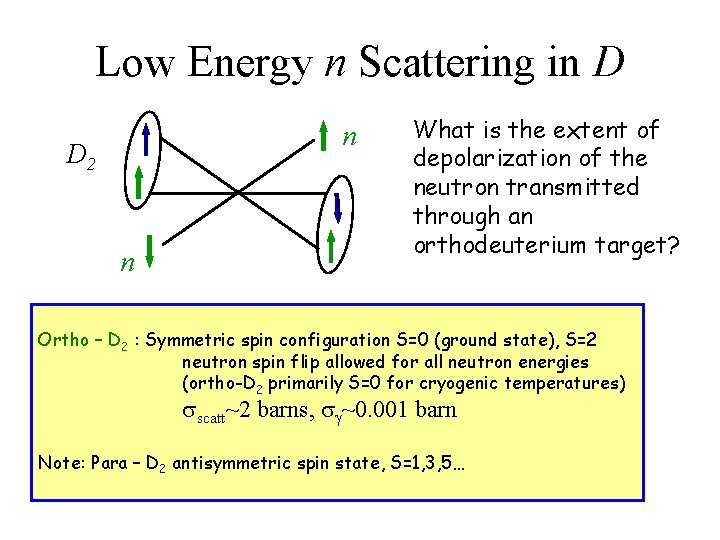
Low Energy n Scattering in D 2 n What is the extent of depolarization of the neutron transmitted through an orthodeuterium target? Ortho – D 2 : Symmetric spin configuration S=0 (ground state), S=2 neutron spin flip allowed for all neutron energies (ortho-D 2 primarily S=0 for cryogenic temperatures) scatt~2 barns, ~0. 001 barn Note: Para – D 2 antisymmetric spin state, S=1, 3, 5…
Measurement of Cold Neutron Depolarization in Liquid and Solid Deuterium A. Komives, A. Bever, S. Carlson De. Pauw University W. M. Snow, Y. Shin, C. Y. Liu Indiana University J. Dawson University of New Hampshire K. Kirch, M. Kasprzak, M. Kuzniak, B. Van den Brandt, P. Hautle, T. Konter, A. Pichlmaier Paul Scherrer Institute K. Bodek, S. Kistryn, J. Zejma Institute of Physics; Jagiellonian University
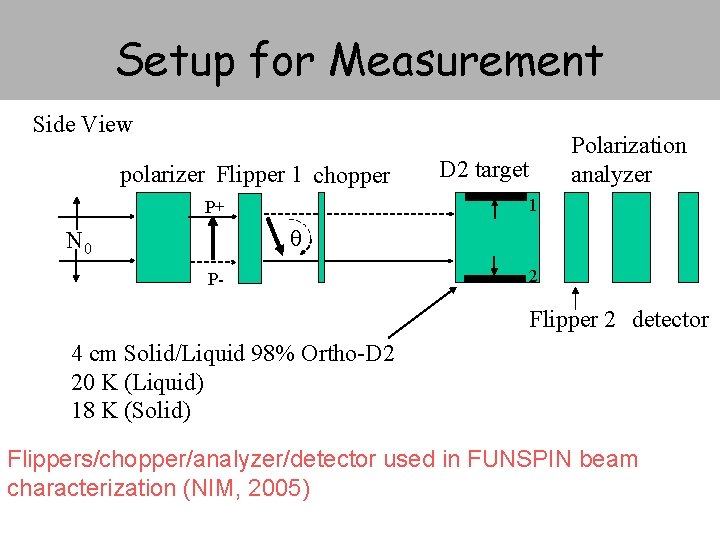
Setup for Measurement Side View polarizer Flipper 1 chopper Polarization analyzer D 2 target 1 P+ q N 0 P- 2 Flipper 2 detector 4 cm Solid/Liquid 98% Ortho-D 2 20 K (Liquid) 18 K (Solid) Flippers/chopper/analyzer/detector used in FUNSPIN beam characterization (NIM, 2005)
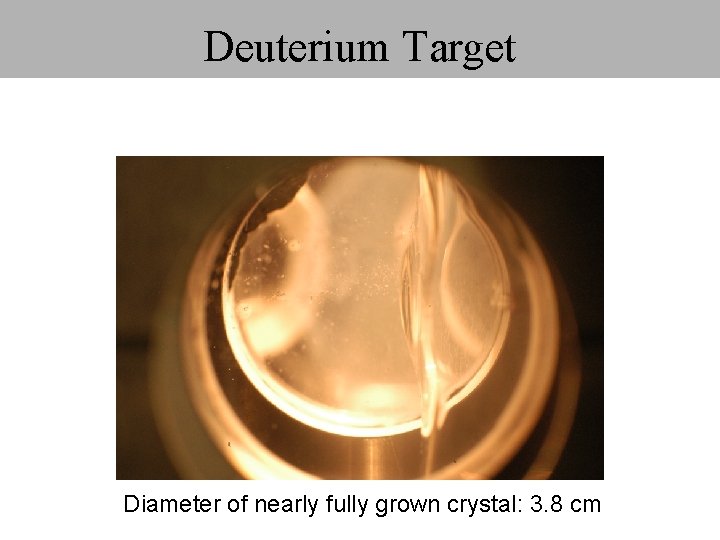
Deuterium Target Diameter of nearly fully grown crystal: 3. 8 cm
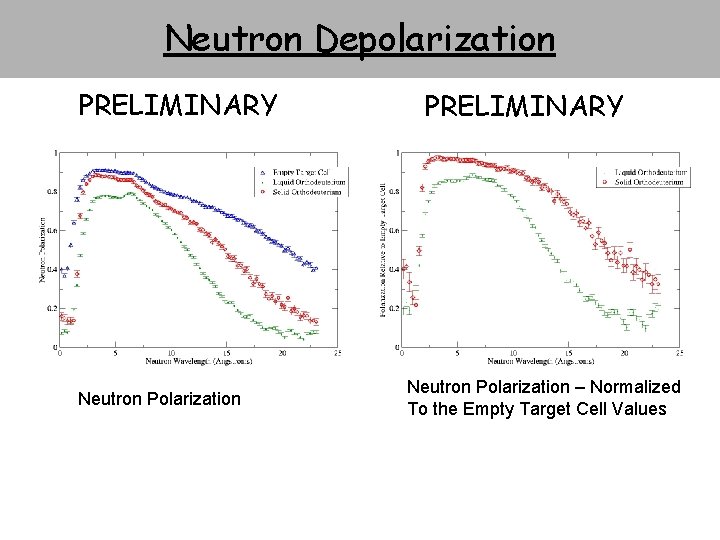
Neutron Depolarization PRELIMINARY Neutron Polarization – Normalized To the Empty Target Cell Values
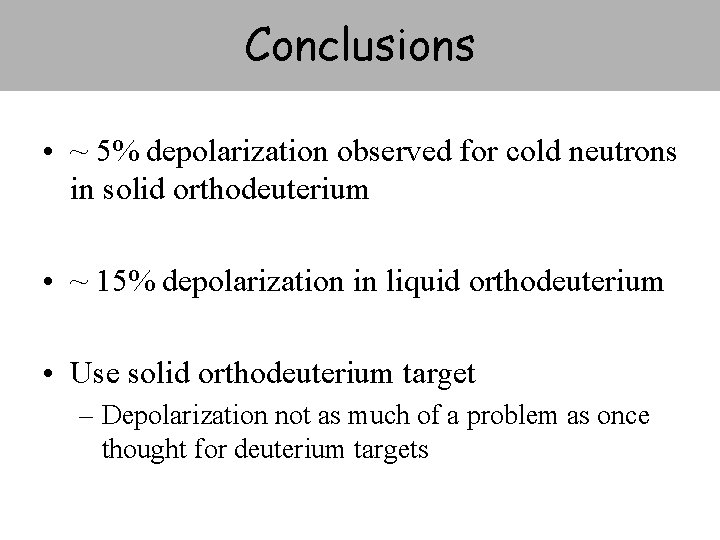
Conclusions • ~ 5% depolarization observed for cold neutrons in solid orthodeuterium • ~ 15% depolarization in liquid orthodeuterium • Use solid orthodeuterium target – Depolarization not as much of a problem as once thought for deuterium targets
n Spin-Rotation Measurement IDEAL POLARIMETER REAL POLARIMETER P is the measured polarization product of the polarimeter
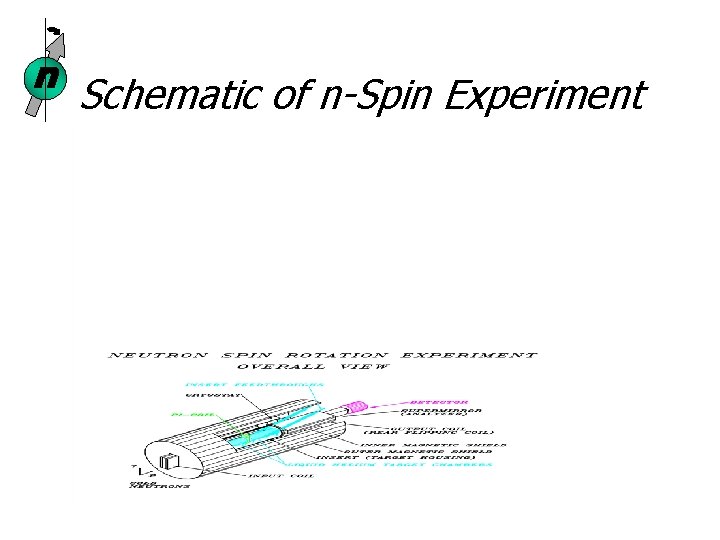
n Schematic of n-Spin Experiment
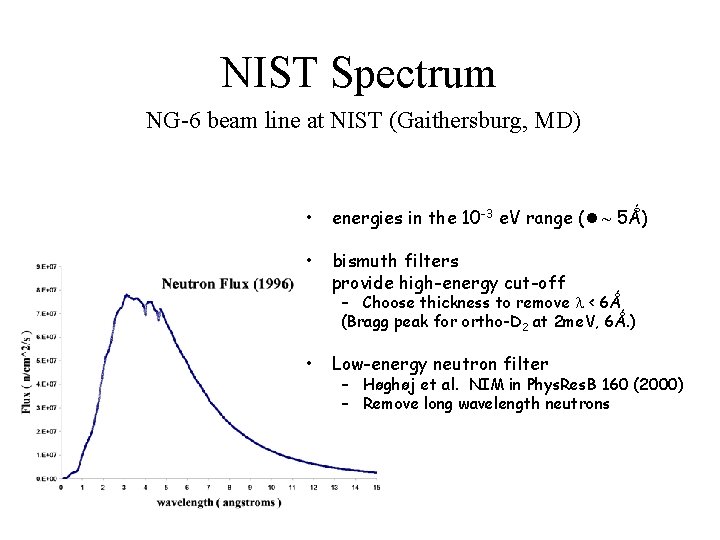
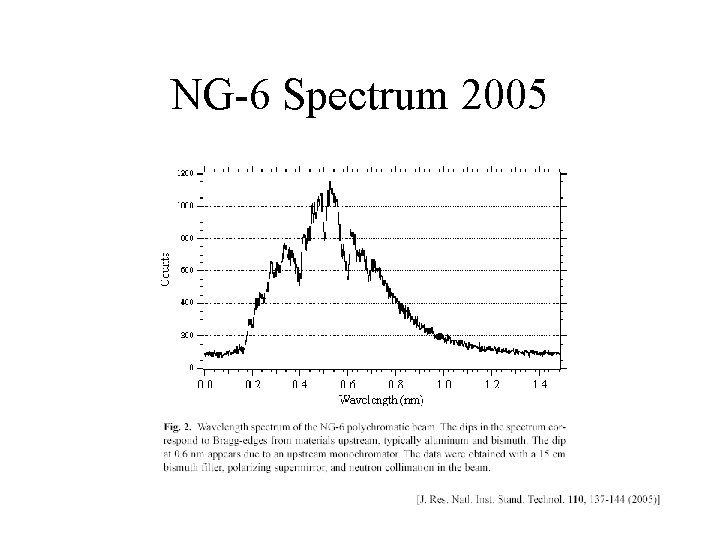
NIST Spectrum NG-6 beam line at NIST (Gaithersburg, MD) • energies in the 10 -3 e. V range (l ~ 5Ǻ) • bismuth filters provide high-energy cut-off – Choose thickness to remove l < 6Ǻ (Bragg peak for ortho-D 2 at 2 me. V, 6Ǻ. ) • Low-energy neutron filter – Høghøj et al. NIM in Phys. Res. B 160 (2000) – Remove long wavelength neutrons
NG-6 Spectrum 2005
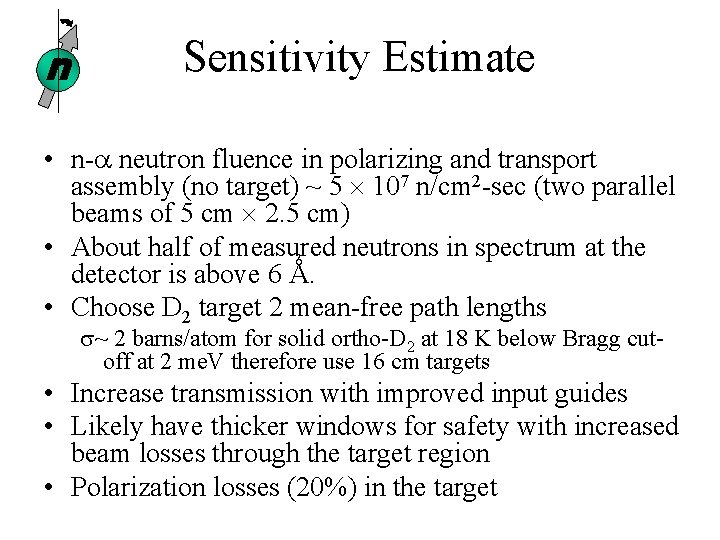
n Sensitivity Estimate • n-a neutron fluence in polarizing and transport assembly (no target) ~ 5 107 n/cm 2 -sec (two parallel beams of 5 cm 2. 5 cm) • About half of measured neutrons in spectrum at the detector is above 6 Ǻ. • Choose D 2 target 2 mean-free path lengths ~ 2 barns/atom for solid ortho-D 2 at 18 K below Bragg cutoff at 2 me. V therefore use 16 cm targets • Increase transmission with improved input guides • Likely have thicker windows for safety with increased beam losses through the target region • Polarization losses (20%) in the target
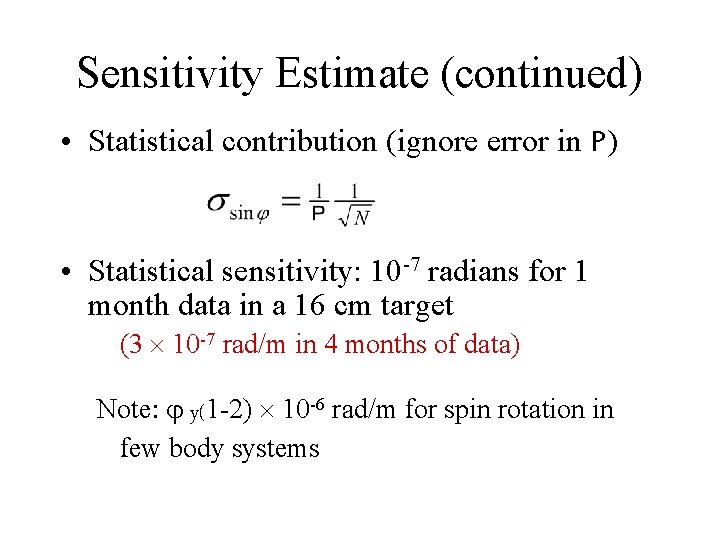
Sensitivity Estimate (continued) • Statistical contribution (ignore error in P) • Statistical sensitivity: 10 -7 radians for 1 month data in a 16 cm target (3 10 -7 rad/m in 4 months of data) Note: j y(1 -2) 10 -6 rad/m for spin rotation in few body systems
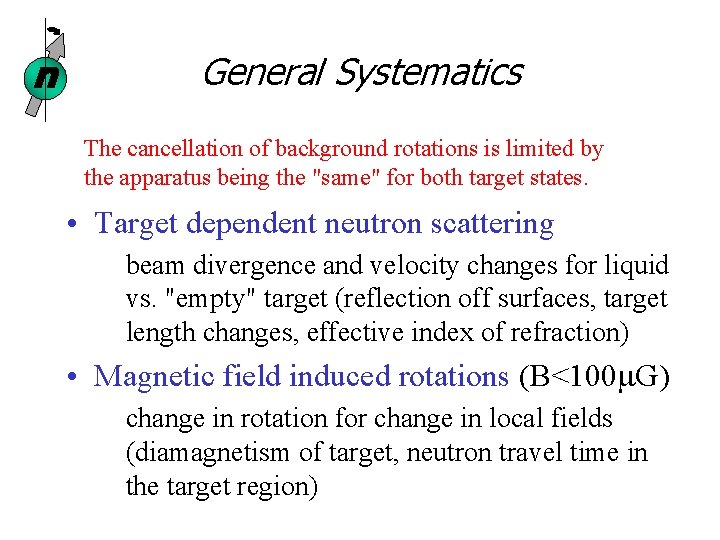
n General Systematics The cancellation of background rotations is limited by the apparatus being the "same" for both target states. • Target dependent neutron scattering beam divergence and velocity changes for liquid vs. "empty" target (reflection off surfaces, target length changes, effective index of refraction) • Magnetic field induced rotations (B<100 m. G) change in rotation for change in local fields (diamagnetism of target, neutron travel time in the target region)
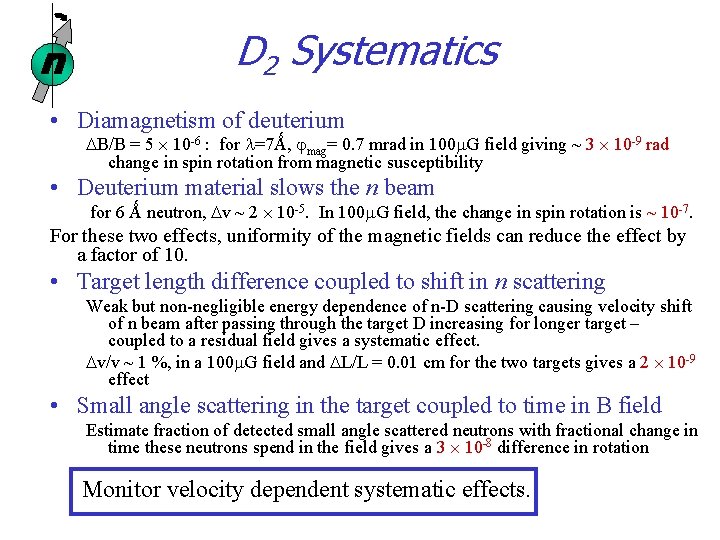
n D 2 Systematics • Diamagnetism of deuterium DB/B = 5 10 -6 : for l=7Ǻ, jmag= 0. 7 mrad in 100 m. G field giving ~ 3 10 -9 rad change in spin rotation from magnetic susceptibility • Deuterium material slows the n beam for 6 Ǻ neutron, Dv ~ 2 10 -5. In 100 m. G field, the change in spin rotation is ~ 10 -7. For these two effects, uniformity of the magnetic fields can reduce the effect by a factor of 10. • Target length difference coupled to shift in n scattering Weak but non-negligible energy dependence of n-D scattering causing velocity shift of n beam after passing through the target D increasing for longer target – coupled to a residual field gives a systematic effect. Dv/v ~ 1 %, in a 100 m. G field and DL/L = 0. 01 cm for the two targets gives a 2 10 -9 effect • Small angle scattering in the target coupled to time in B field Estimate fraction of detected small angle scattered neutrons with fractional change in time these neutrons spend in the field gives a 3 10 -8 difference in rotation Monitor velocity dependent systematic effects.
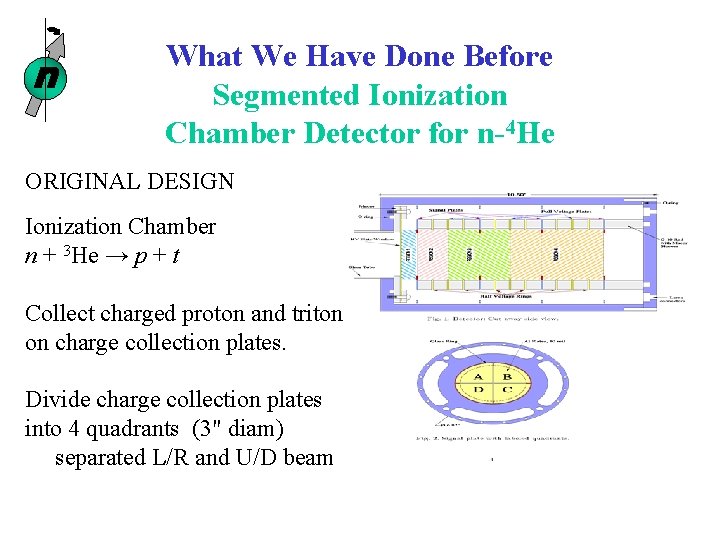
n What We Have Done Before Segmented Ionization Chamber Detector for n-4 He ORIGINAL DESIGN Ionization Chamber n + 3 He → p + t Collect charged proton and triton on charge collection plates. Divide charge collection plates into 4 quadrants (3" diam) separated L/R and U/D beam
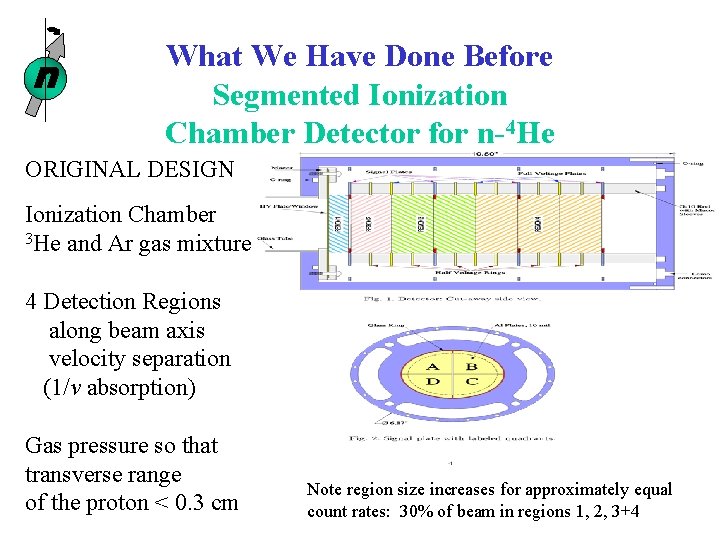
n What We Have Done Before Segmented Ionization Chamber Detector for n-4 He ORIGINAL DESIGN Ionization Chamber 3 He and Ar gas mixture 4 Detection Regions along beam axis velocity separation (1/v absorption) Gas pressure so that transverse range of the proton < 0. 3 cm Note region size increases for approximately equal count rates: 30% of beam in regions 1, 2, 3+4
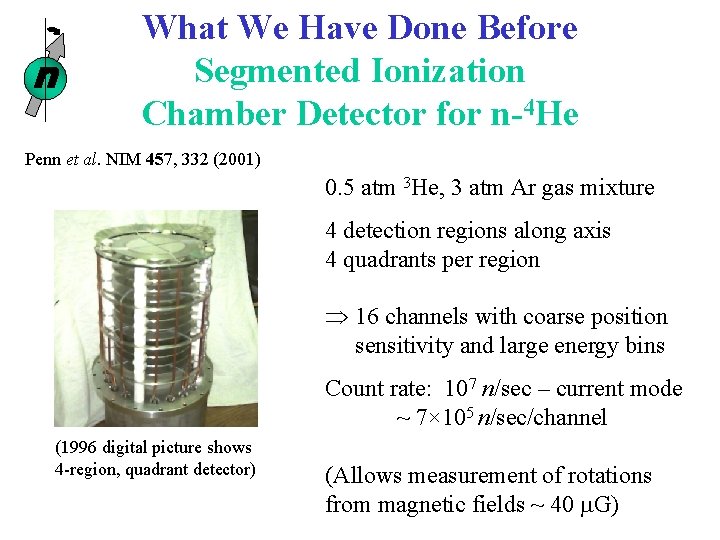
n What We Have Done Before Segmented Ionization Chamber Detector for n-4 He Penn et al. NIM 457, 332 (2001) 0. 5 atm 3 He, 3 atm Ar gas mixture 4 detection regions along axis 4 quadrants per region 16 channels with coarse position sensitivity and large energy bins Count rate: 107 n/sec – current mode ~ 7× 10⁵ n/sec/channel (1996 digital picture shows 4 -region, quadrant detector) (Allows measurement of rotations from magnetic fields ~ 40 m. G)
n Proposed n-D Spin Rotation Experiment • Use polarimeter apparatus from current n-a experiment at NIST • Design D 2 target system and cryostat – Gas handling and safety system for ~ 1. 5 liters solid ortho-D 2 – Para-ortho conversion catalyst – Move 3 -region target chamber sideways for target in and dummy target in beam position • Schedule data runs in 2010
n Summary • n-D spin rotation is a feasible measurement • Looking toward success of n-a measurement • Calculation needed to place j(n. D) observable into perspective to determine its contribution to the scheme of specifying the weak hadronic coupling constants