
N HARIKA CSC Normalization We discuss four normal


- Slides: 29
N. HARIKA (CSC)
Normalization We discuss four normal forms: first, second, third, and Boyce- Codd , fourth normal forms 1 NF, 2 NF, 3 NF, BCNF and 4 NF. Normalization is a process that “improves” a database design by generating relations that are of higher normal forms. The objective of normalization: “to create relations where every dependency is on the key, the whole key, and nothing but the key”. NORMALIZATION
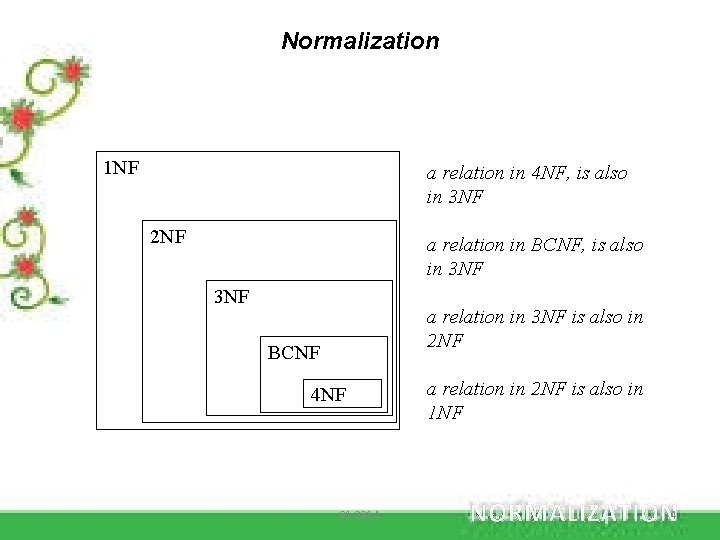
There is a sequence to normal forms: 1 NF is considered the weakest, 2 NF is stronger than 1 NF, 3 NF is stronger than 2 NF, and BCNF is considered the strongest, 4 NF is considered the higher normal form. Also, any relation that is in 4 NF, is in 3 NF; any relation that is in BCNF, is in 3 NF; any relation in 3 NF is in 2 NF; and any relation in 2 NF is in 1 NF. NORMALIZATION
Normalization 1 NF a relation in 4 NF, is also in 3 NF 2 NF a relation in BCNF, is also in 3 NF a relation in 3 NF is also in 2 NF BCNF 4 NF 91. 2914 a relation in 2 NF is also in 1 NF NORMALIZATION 4
We consider a relation in BCNF to be fully normalized. The benefit of higher normal forms is that update semantics for the affected data are simplified. This means that applications required to maintain the database are simpler. A design that has a lower normal form than another design has more redundancy. Uncontrolled redundancy can lead to data integrity problems. First we introduce the concept of functional dependency NORMALIZATION
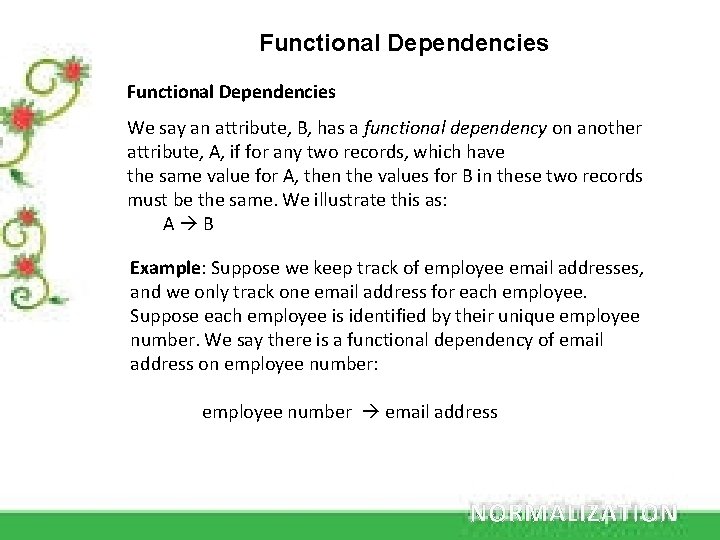
Functional Dependencies We say an attribute, B, has a functional dependency on another attribute, A, if for any two records, which have the same value for A, then the values for B in these two records must be the same. We illustrate this as: A B Example: Suppose we keep track of employee email addresses, and we only track one email address for each employee. Suppose each employee is identified by their unique employee number. We say there is a functional dependency of email address on employee number: employee number email address NORMALIZATION
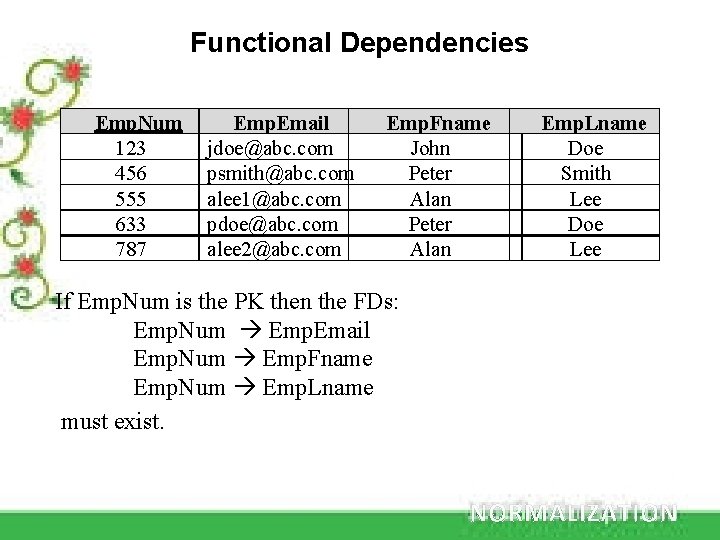
Functional Dependencies Emp. Num 123 456 555 633 787 Emp. Email jdoe@abc. com psmith@abc. com alee 1@abc. com pdoe@abc. com alee 2@abc. com Emp. Fname John Peter Alan Emp. Lname Doe Smith Lee Doe Lee If Emp. Num is the PK then the FDs: Emp. Num Emp. Email Emp. Num Emp. Fname Emp. Num Emp. Lname must exist. NORMALIZATION
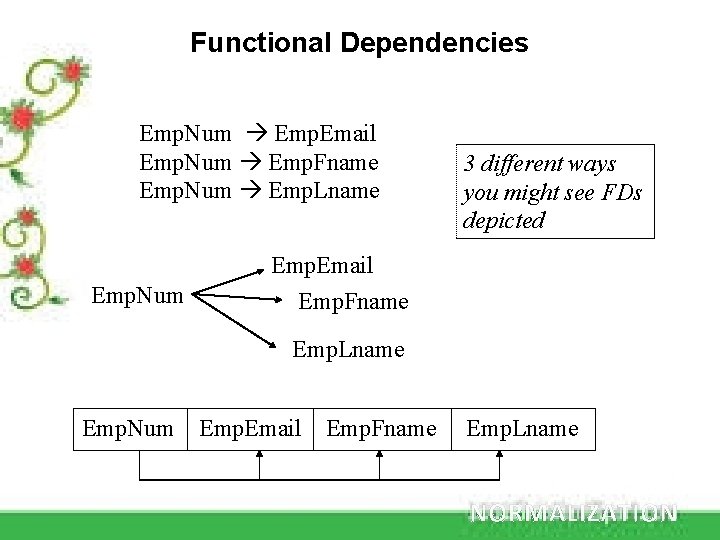
Functional Dependencies Emp. Num Emp. Email Emp. Num Emp. Fname Emp. Num Emp. Lname Emp. Num 3 different ways you might see FDs depicted Emp. Email Emp. Fname Emp. Lname Emp. Num Emp. Email Emp. Fname Emp. Lname NORMALIZATION
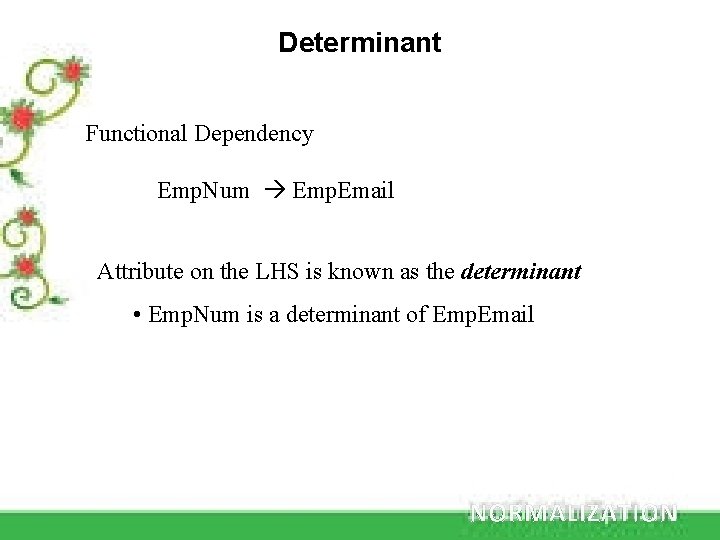
Determinant Functional Dependency Emp. Num Emp. Email Attribute on the LHS is known as the determinant • Emp. Num is a determinant of Emp. Email NORMALIZATION
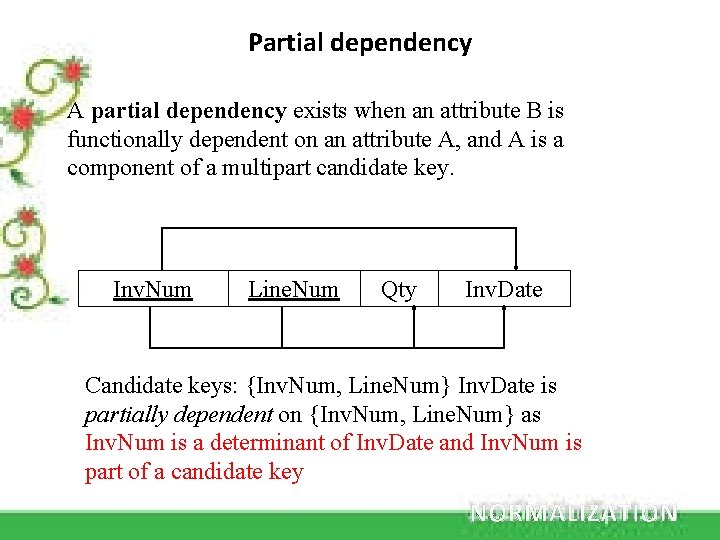
Partial dependency A partial dependency exists when an attribute B is functionally dependent on an attribute A, and A is a component of a multipart candidate key. Inv. Num Line. Num Qty Inv. Date Candidate keys: {Inv. Num, Line. Num} Inv. Date is partially dependent on {Inv. Num, Line. Num} as Inv. Num is a determinant of Inv. Date and Inv. Num is part of a candidate key NORMALIZATION
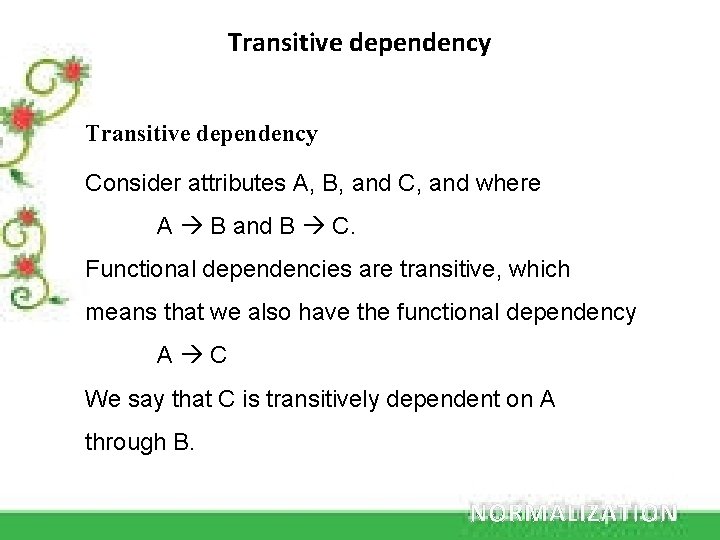
Transitive dependency Consider attributes A, B, and C, and where A B and B C. Functional dependencies are transitive, which means that we also have the functional dependency A C We say that C is transitively dependent on A through B. NORMALIZATION
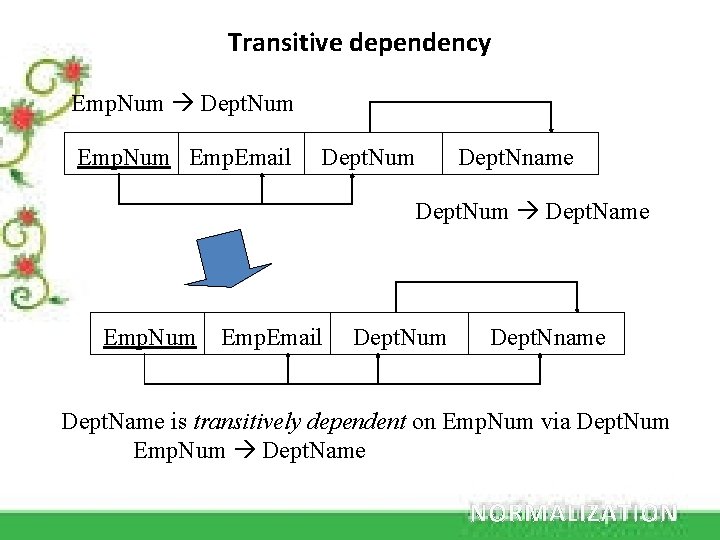
Transitive dependency Emp. Num Dept. Num Emp. Email Dept. Num Dept. Nname Dept. Num Dept. Name Emp. Num Emp. Email Dept. Num Dept. Nname Dept. Name is transitively dependent on Emp. Num via Dept. Num Emp. Num Dept. Name NORMALIZATION
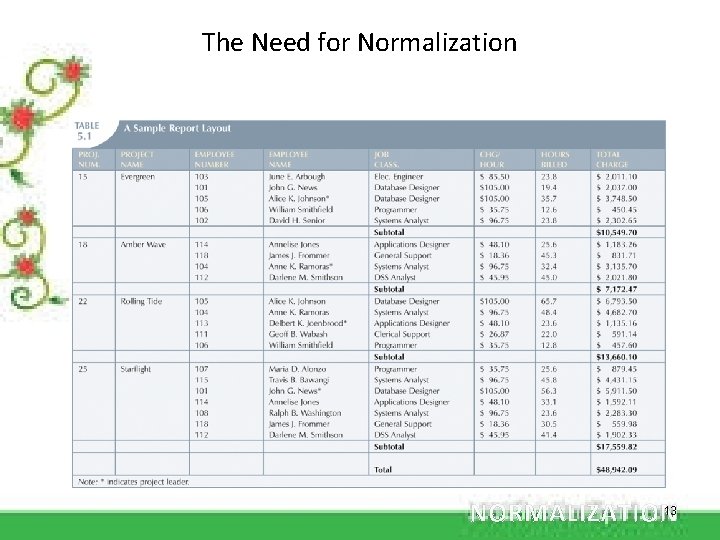
The Need for Normalization 13 NORMALIZATION
The Normalization Process • Each table represents a single subject • No data item will be unnecessarily stored in more than one table • All attributes in a table are dependent on the primary key NORMALIZATION
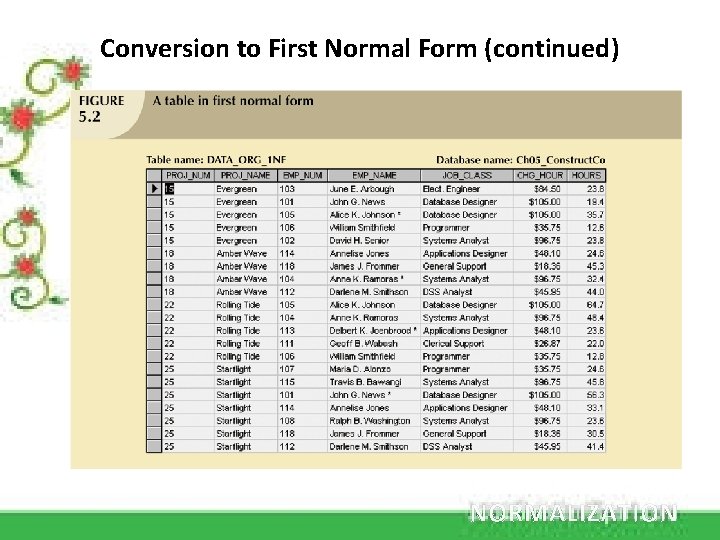
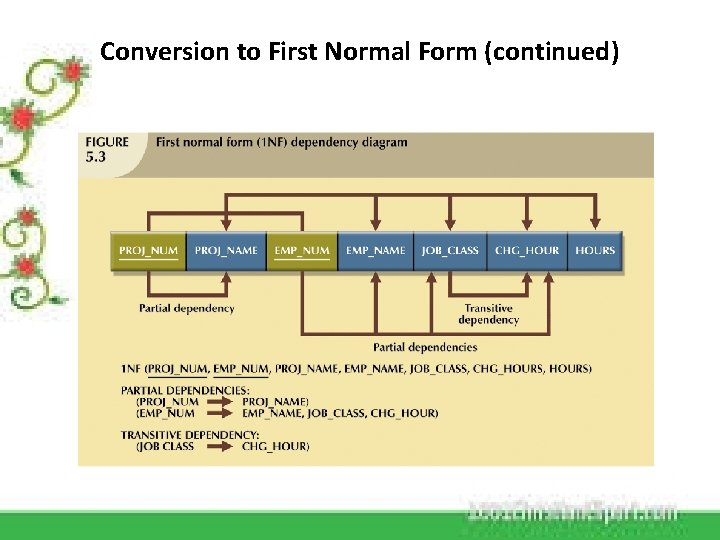
Conversion to First Normal Form • Repeating group – Derives its name from the fact that a group of multiple entries of same type can exist for any single key attribute occurrence • Relational table must not contain repeating groups • Normalizing table structure will reduce data redundancies • Normalization is three-step procedure Step 1: Eliminate the Repeating Groups – Present data in tabular format, where each cell has single value and there are no repeating groups – Eliminate repeating groups, eliminate nulls by making sure that each repeating group attribute contains an appropriate data value 15 NORMALIZATION
Conversion to First Normal Form (continued) NORMALIZATION
Conversion to First Normal Form (continued) • Step 2: Identify the Primary Key – Primary key must uniquely identify attribute value – New key must be composed • Step 3: Identify All Dependencies – Dependencies can be depicted with help of a diagram – Dependency diagram: • Depicts all dependencies found within given table structure • Helpful in getting bird’s-eye view of all relationships among table’s attributes • Makes it less likely that will overlook an important dependency
Conversion to First Normal Form (continued)
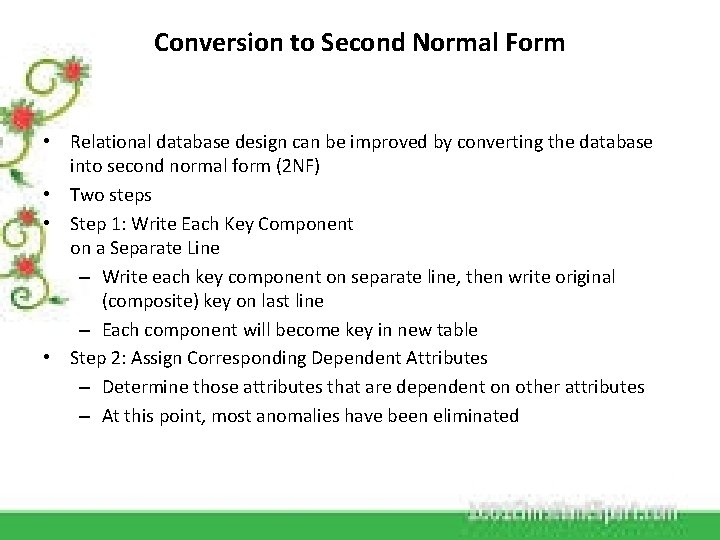
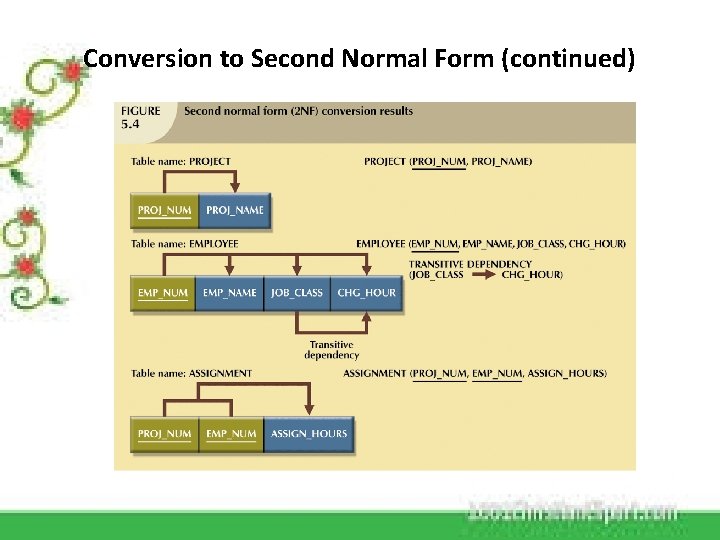
Conversion to Second Normal Form • Relational database design can be improved by converting the database into second normal form (2 NF) • Two steps • Step 1: Write Each Key Component on a Separate Line – Write each key component on separate line, then write original (composite) key on last line – Each component will become key in new table • Step 2: Assign Corresponding Dependent Attributes – Determine those attributes that are dependent on other attributes – At this point, most anomalies have been eliminated
Conversion to Second Normal Form (continued)
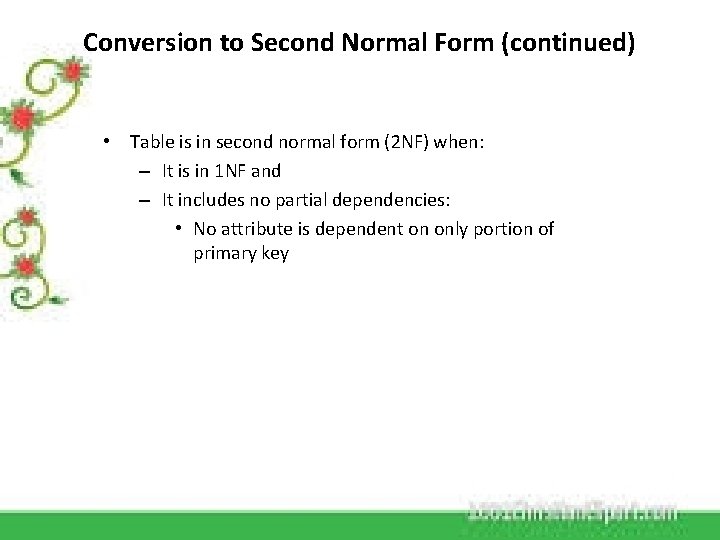
Conversion to Second Normal Form (continued) • Table is in second normal form (2 NF) when: – It is in 1 NF and – It includes no partial dependencies: • No attribute is dependent on only portion of primary key
Conversion to Third Normal Form • Data anomalies created are easily eliminated by completing three steps • Step 1: Identify Each New Determinant – For every transitive dependency, write its determinant as PK for new table • Determinant – Any attribute whose value determines other values within a row • Step 2: Identify the Dependent Attributes – Identify attributes dependent on each determinant identified in Step 1 and identify dependency – Name table to reflect its contents and function
Conversion to Third Normal Form (continued) • Step 3: Remove the Dependent Attributes from Transitive Dependencies – Eliminate all dependent attributes in transitive relationship(s) from each of the tables that have such a transitive relationship – Draw new dependency diagram to show all tables defined in Steps 1– 3 – Check new tables as well as tables modified in Step 3 to make sure that each table has determinant and that no table contains inappropriate dependencies
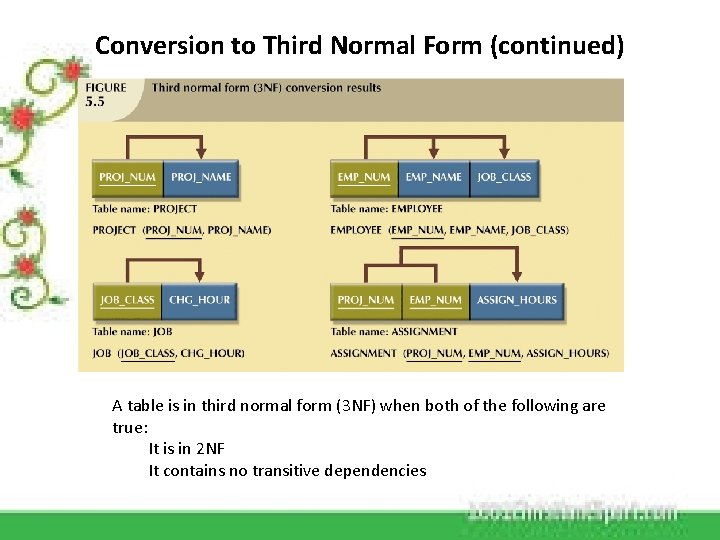
Conversion to Third Normal Form (continued) A table is in third normal form (3 NF) when both of the following are true: It is in 2 NF It contains no transitive dependencies
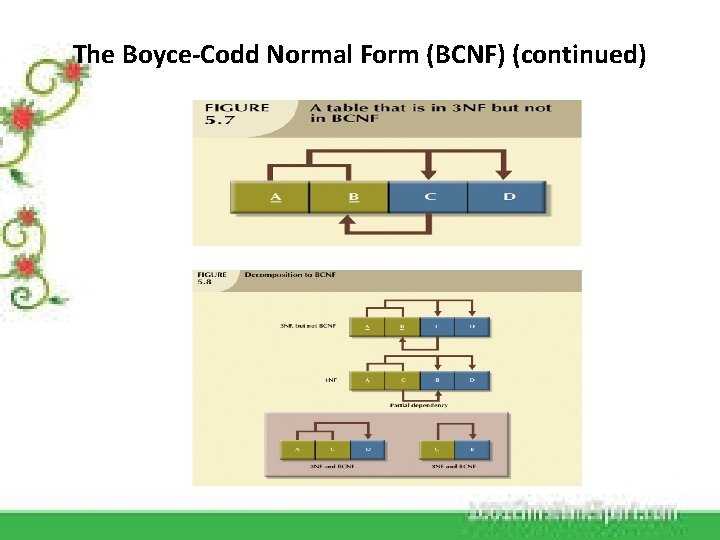
The Boyce-Codd Normal Form (BCNF) • Every determinant in table is a candidate key – Has same characteristics as primary key, but for some reason, not chosen to be primary key • When table contains only one candidate key, the 3 NF and the BCNF are equivalent • BCNF can be violated only when table contains more than one candidate key • Most designers consider the BCNF as special case of 3 NF • Table is in 3 NF when it is in 2 NF and there are no transitive dependencies • Table can be in 3 NF and fails to meet BCNF – No partial dependencies, nor does it contain transitive dependencies – A nonkey attribute is the determinant of a key attribute
The Boyce-Codd Normal Form (BCNF) (continued)
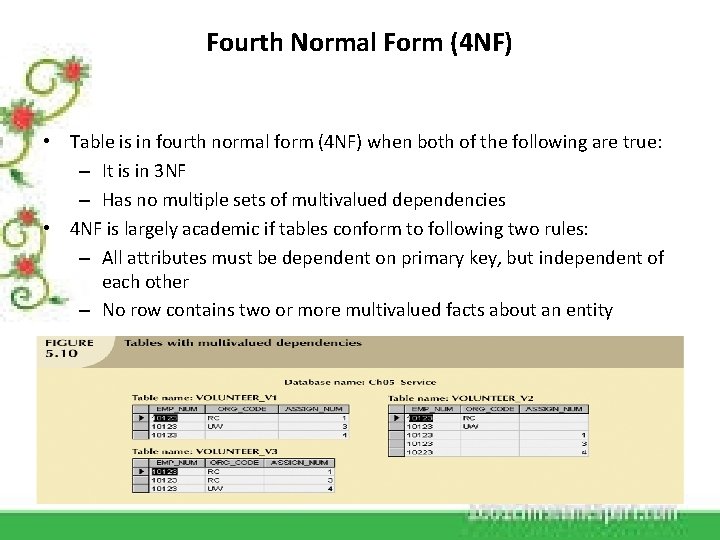
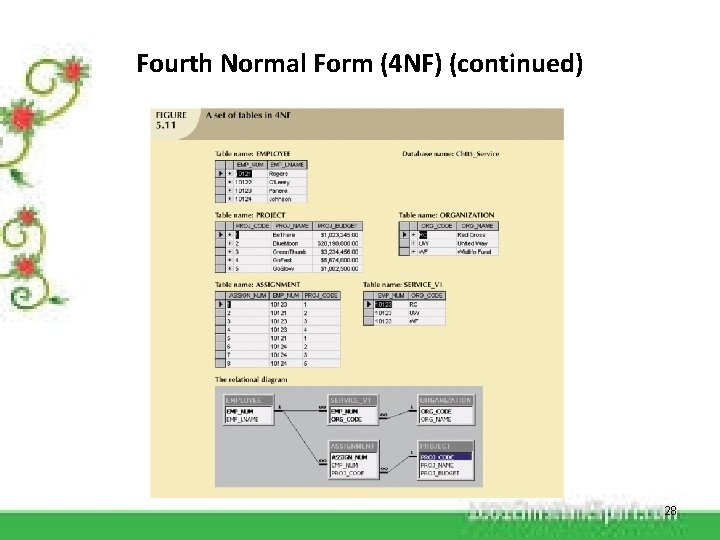
Fourth Normal Form (4 NF) • Table is in fourth normal form (4 NF) when both of the following are true: – It is in 3 NF – Has no multiple sets of multivalued dependencies • 4 NF is largely academic if tables conform to following two rules: – All attributes must be dependent on primary key, but independent of each other – No row contains two or more multivalued facts about an entity
Fourth Normal Form (4 NF) (continued) 28