
n Essential Question Question What events from 1868

- Slides: 29
n Essential Question: Question – What events from 1868 to 1876 led to the abandonment of federal reconstruction attempts in the South by 1877? n Reading Quiz 17 A (p 568 -585)
Reconstruction in the Grant Administration (1869 -1877) Grant Video
Election of 1868 Tennessee The. Arkansas Louisiana Alabama South Carolina n In 1867, Thaddeus Stevens’ Florida Northplan Carolina Georgia Radical Reconstruction was in place & a southern Republican party hoped to build a New South n By 1868, 8 of the 11 former Confederate states were accepted back into the Union after creating state constitutions & ratifying the 14 th Amendment
The Election of 1868 n But, the U. S. had lots of problems: – Excessive printing of greenbacks during the Civil War led to high inflation which hurt both the Northern & Southern economies – Southern “Redeemers” Redeemers & secret societies tried to undermine Congressional attempts to reconstruct the South
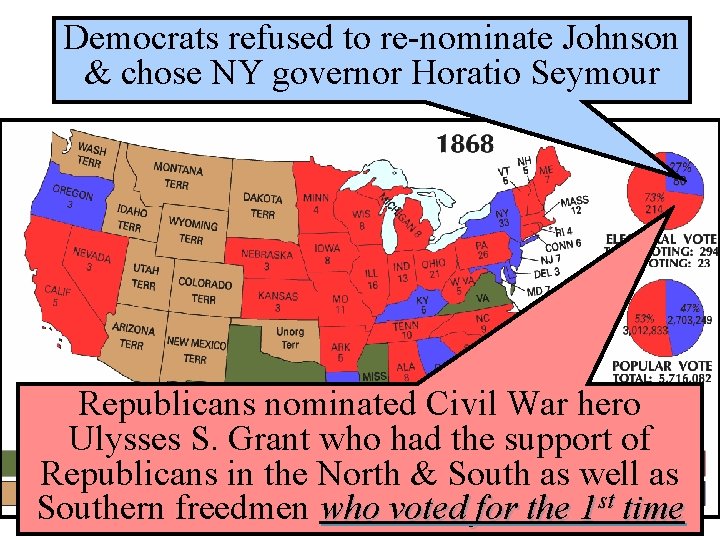
Democrats refused to re-nominate Johnson The 1868 Presidential Election & chose NY governor Horatio Seymour Republicans nominated Civil War hero Ulysses S. Grant who had the support of Republicans in the North & South as well as Southern freedmen who voted for the 1 st time
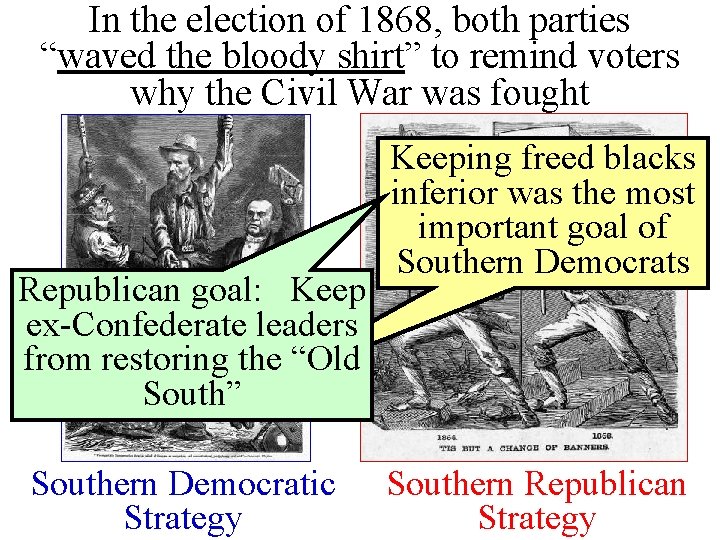
In the election of 1868, both parties “waved the bloody shirt” to remind voters why the Civil War was fought Republican goal: Keep ex-Confederate leaders from restoring the “Old South” Southern Democratic Strategy Keeping freed blacks inferior was the most important goal of Southern Democrats Southern Republican Strategy
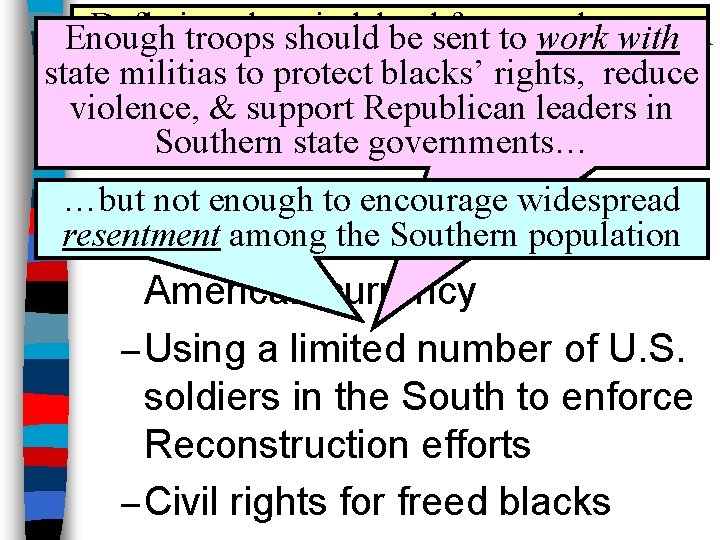
Deflations hurt indebted farmers the with most Grant’s National Reconstruction Plan Enough troops should be sent to work state militias to protect blacks’ Party rights, was reduce In 1876, the Greenback n When Grant was elected, he violence, leaders in formed & to support Republican keeping “soft” money supported: Southern state governments… – Shifting back to gold (“sound” …but not enough to encourage widespread resentment among the Southern population or “hard” money) to deflate American currency – Using a limited number of U. S. soldiers in the South to enforce Reconstruction efforts – Civil rights for freed blacks
Grant’s National Reconstruction Plan n Republicans sought equal protection for blacks; ratified the 15 th Amendment in 1870: – Prohibited any state from denying men the right to vote due to race – But…the amendment said nothing about literacy tests, poll taxes, & property qualifications
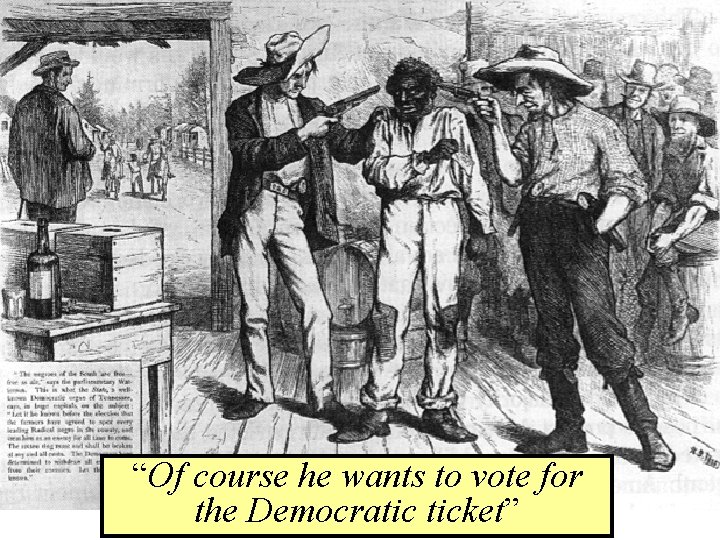
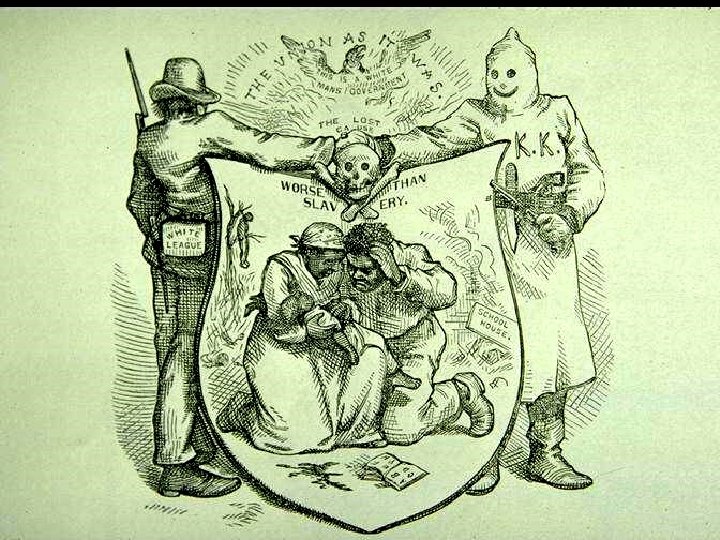
A Reign of Terror Against Blacks n From 1868 to 1872, southern Republicans were threatened by secret societies like Ku Klux Klan – Hoped to restore the “Old South” – Sought to restrict black voting – Oppose Republican state gov’ts n The KKK was successful in its terror campaigns, helping turn GA, NC, & TN to the Democratic Party
The “Invisible Empire of the South” “Of course he wants to vote for the Democratic ticket”
The Failure of Federal Enforcement
A Reign of Terror Against Blacks n In 1870, Congress passed the Force Acts (the “KKK Acts”): – Made interference in elections a federal crime – Gave the president the military power to protect polling places – Allowed for high black turnout & Republicans victories in 1872 – “Redeemer” Democrats openly appealed to white supremacy & laissez-faire government
A Reign of Terror Against Blacks n The KKK responded by becoming more open with its terror tactics: – Northerners grew impatient with federal Reconstruction efforts & “corrupt” Southern state gov’ts – Grant began to refuse to use military force against KKK terrorist attacks n By 1876, only SC, FL, & LA were controlled by Republicans
The 1875 Civil Rights Act In the Slaughterhouse Cases (1873), the court ruled that the 14 thpassed Amendment protects only n Congress the Civil Rights national citizenship rights & does not protect Act of 1875 to protect freedmen: citizens from discrimination by the states – Outlawed racial discrimination in public places & in jury selection n But the Supreme Court ruled it unconstitutional & weakened the In U. S. & U. S. v Cruikshank 14 thv Reese & 15 th(1876) Amendments, leaving (1876), the court weakened the KKK Act by southern defenseless stating that theblacks 14 th Amendment does not protect against actions by individuals against discrimination
Corruption in Grant’s Administration
Corruption in Grant’s Administration n The Republicans experienced rampant corruption during Grant’s 1 st term as president: – Grant’s Secretary of War was impeached & Attorney General These scandals Americans resigned duedistracted to corruption from Reconstruction efforts – Grant’s VP & others were ruined by the Crédit Mobilier scandal involving railroad stock in exchange for political favors
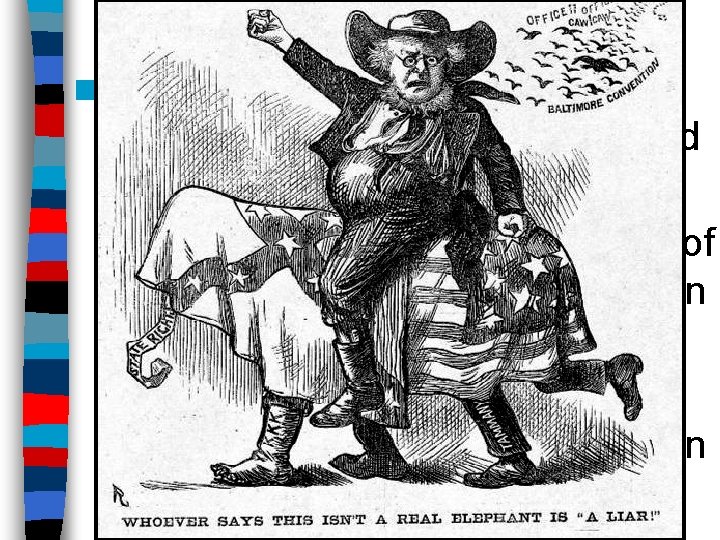
The Election of 1872 n Corruption scandals & the failure of Reconstruction in the South led to a split among Republicans: – Liberal Republicans were tired of the Grant scandals & believed in reconciling with the South, not military intervention – In 1872, Liberal Republicans ran Horace Greeley against Grant
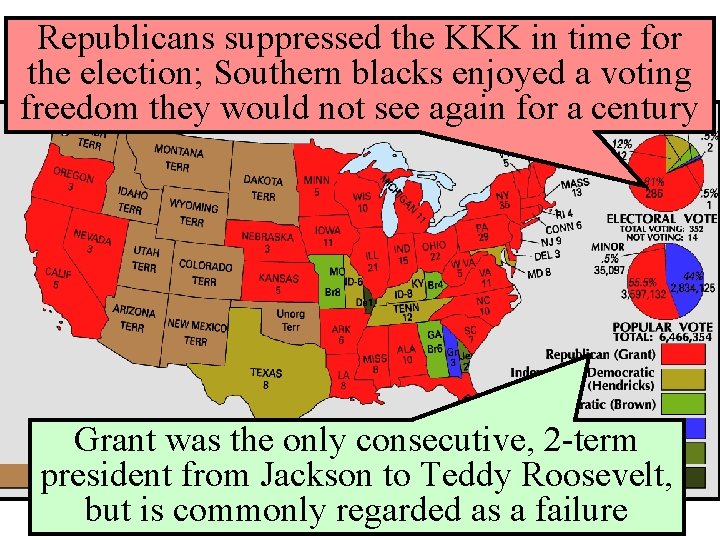
Republicans 1872 suppressed KKK in time for Presidentialthe. Election the election; Southern blacks enjoyed a voting freedom they would not see again for a century Grant was the only consecutive, 2 -term president from Jackson to Teddy Roosevelt, but is commonly regarded as a failure
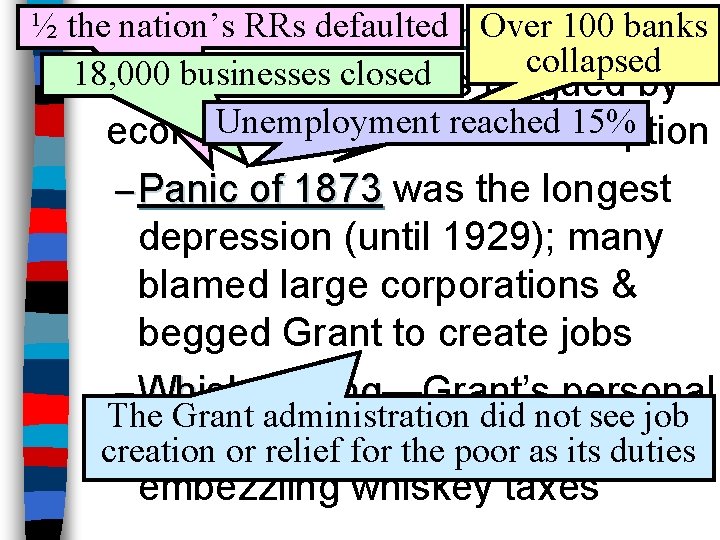
100 banks ½ the nation’s RRs defaulted Grant’s Second. Over Term collapsed 18, 000 businesses closed n Grant s 2 nd term was plagued by Unemployment reached 15% economic depression & corruption – Panic of 1873 was the longest depression (until 1929); many blamed large corporations & begged Grant to create jobs – Whiskey Ring—Grant’s personal Ring The Grant administration did not see job secretary was creation or relief for caught the poor as its duties embezzling whiskey taxes
n Essential Question: Question – What events from 1868 to 1876 led to the abandonment of federal reconstruction attempts in the South by 1877? n Reading Quiz 17 B (p 585 -598)
The New South & the Rise of Jim Crow Rutherford B. Hayes Video
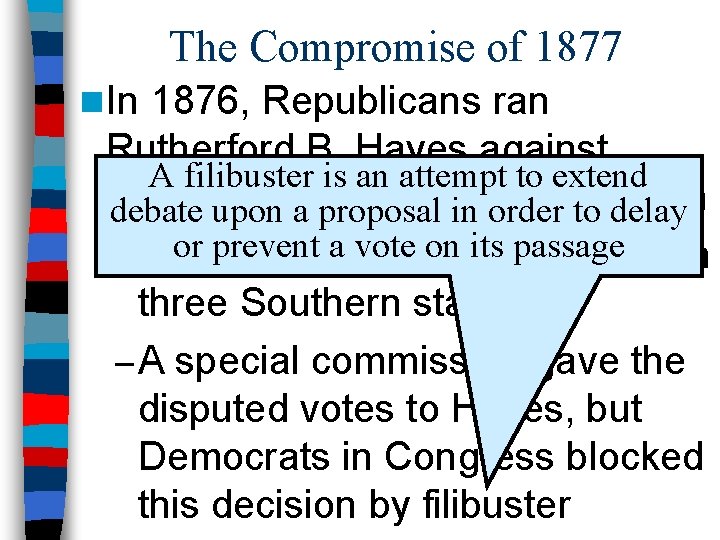
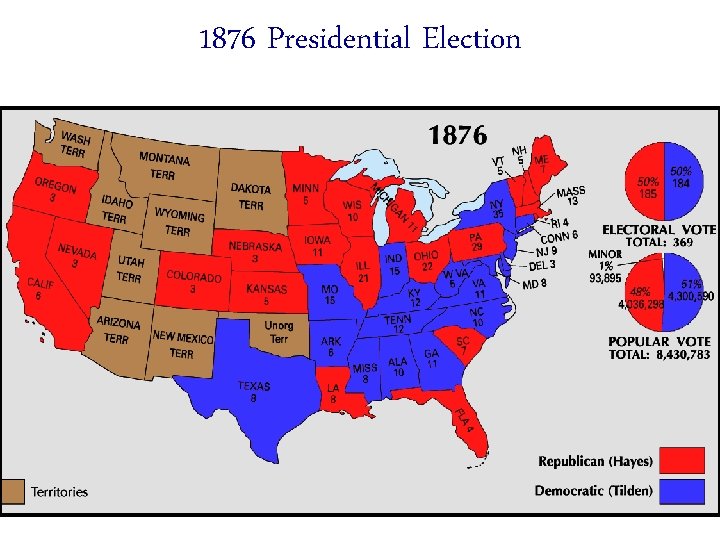
The Compromise of 1877 n In 1876, Republicans ran Rutherford B. Hayes against A filibuster is an attempt to extend Democrat Samuel debate upon reformer a proposal in order to. Tilden delay or prevent a vote were on its passage – Election results disputed in three Southern states – A special commission gave the disputed votes to Hayes, but Democrats in Congress blocked this decision by filibuster
1876 Presidential Election
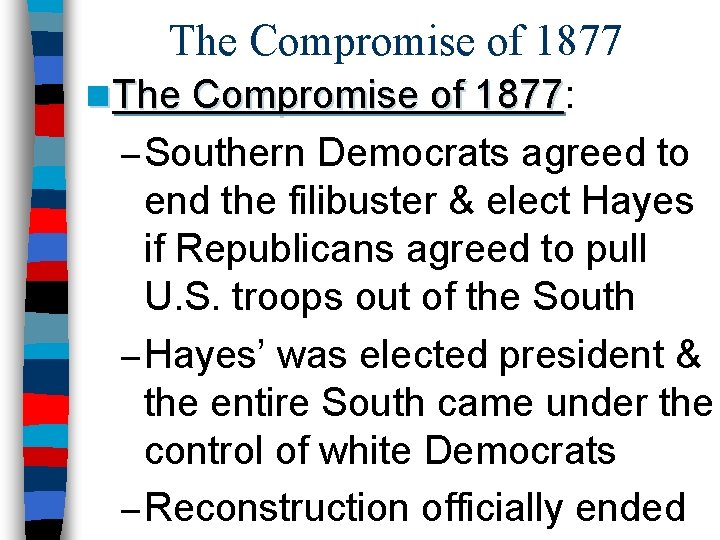
The Compromise of 1877 n The Compromise of 1877: 1877 – Southern Democrats agreed to end the filibuster & elect Hayes if Republicans agreed to pull U. S. troops out of the South – Hayes’ was elected president & the entire South came under the control of white Democrats – Reconstruction officially ended
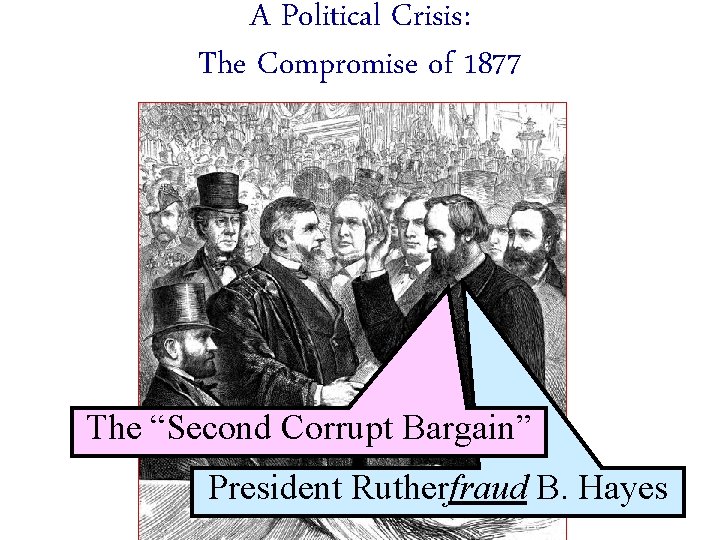
A Political Crisis: The Compromise of 1877 The “Second Corrupt Bargain” President Rutherfraud B. Hayes
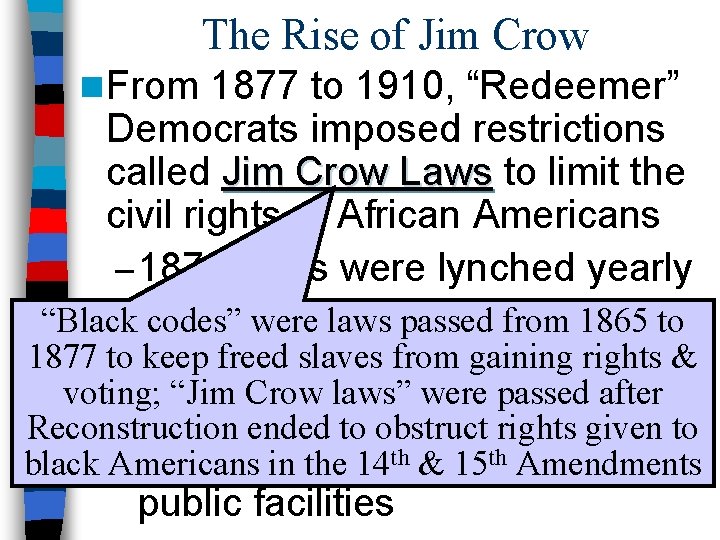
The Rise of Jim Crow n From 1877 to 1910, “Redeemer” Democrats imposed restrictions called Jim Crow Laws to limit the civil rights of African Americans – 187 blacks were lynched yearly “Black codes” were laws passed from&1865 to –A convict-lease system prison 1877 to farms keep freed slaves fromslavery gaining rights & resembled voting; “Jim Crow laws” were passed after – Segregation ledrights to given to Reconstruction ended tolaws obstruct th Amendments separate & black Americans in railroads, the 14 th & 15 streetcars, public facilities
Conclusion: The “Unfinished Revolution”
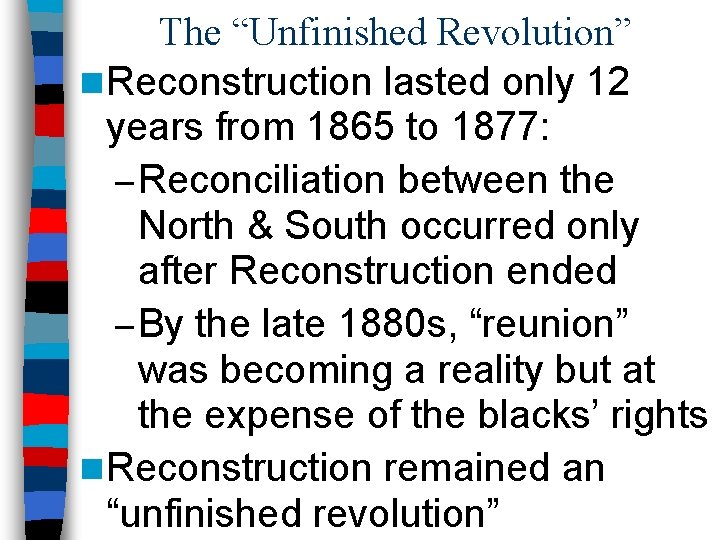
The “Unfinished Revolution” n Reconstruction lasted only 12 years from 1865 to 1877: – Reconciliation between the North & South occurred only after Reconstruction ended – By the late 1880 s, “reunion” was becoming a reality but at the expense of the blacks’ rights n Reconstruction remained an “unfinished revolution”
The End of Reconstruction Part II