
N 7 THERMODYNAMICS Gibbs Free Energy N 7
N 7 - THERMODYNAMICS Gibbs Free Energy
N 7 - THERMODYNAMICS Target: I can use the relationships between Gibbs Free Energy, Enthalpy, Entropy, and Equilibrium to solve for a variety of things.

Now it is time for some math! Yay !
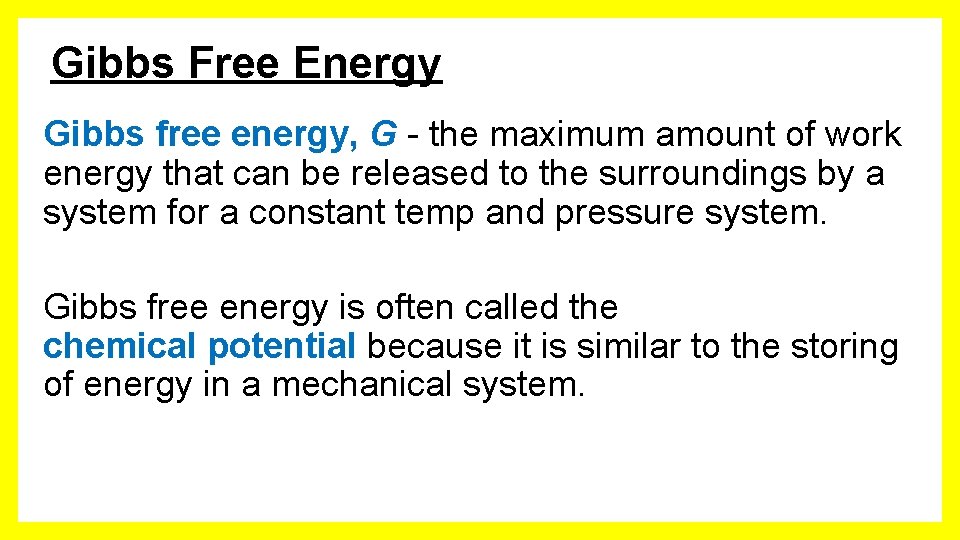
Gibbs Free Energy Gibbs free energy, G - the maximum amount of work energy that can be released to the surroundings by a system for a constant temp and pressure system. Gibbs free energy is often called the chemical potential because it is similar to the storing of energy in a mechanical system.
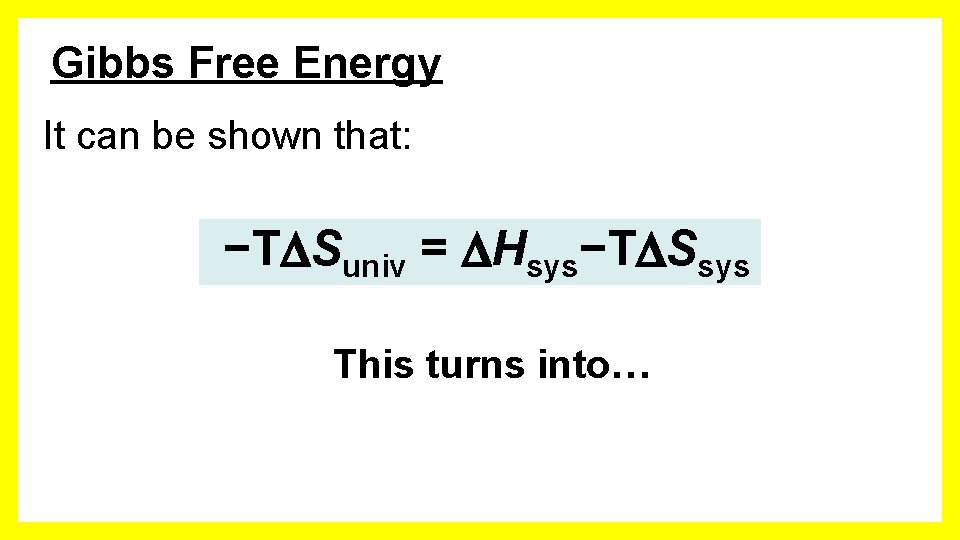
Gibbs Free Energy It can be shown that: −T Suniv = Hsys−T Ssys This turns into…
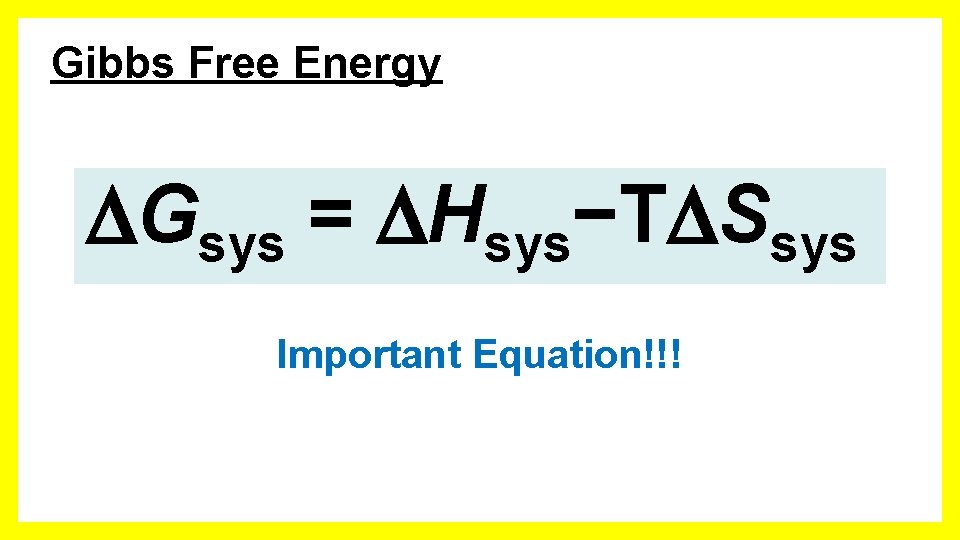
Gibbs Free Energy Gsys = Hsys−T Ssys Important Equation!!!
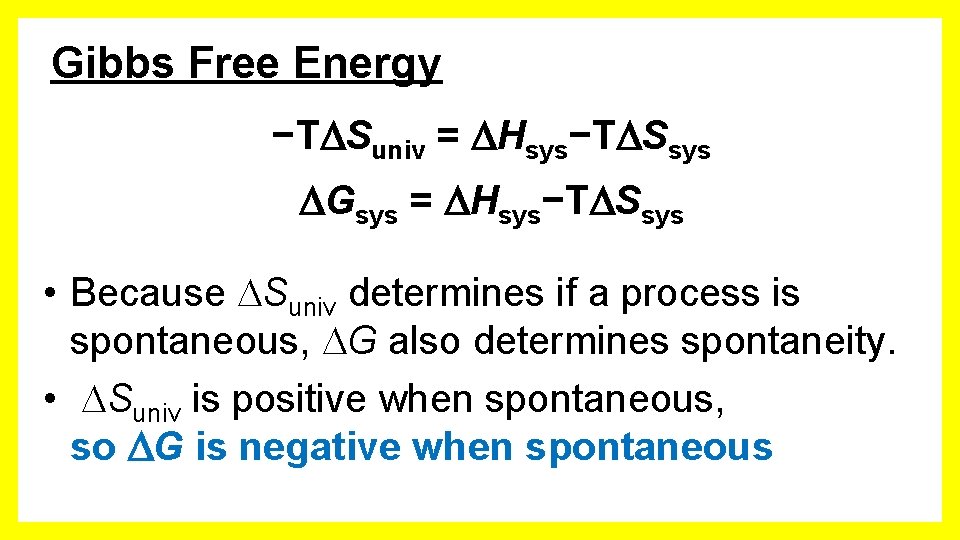
Gibbs Free Energy −T Suniv = Hsys−T Ssys Gsys = Hsys−T Ssys • Because Suniv determines if a process is spontaneous, G also determines spontaneity. • Suniv is positive when spontaneous, so G is negative when spontaneous
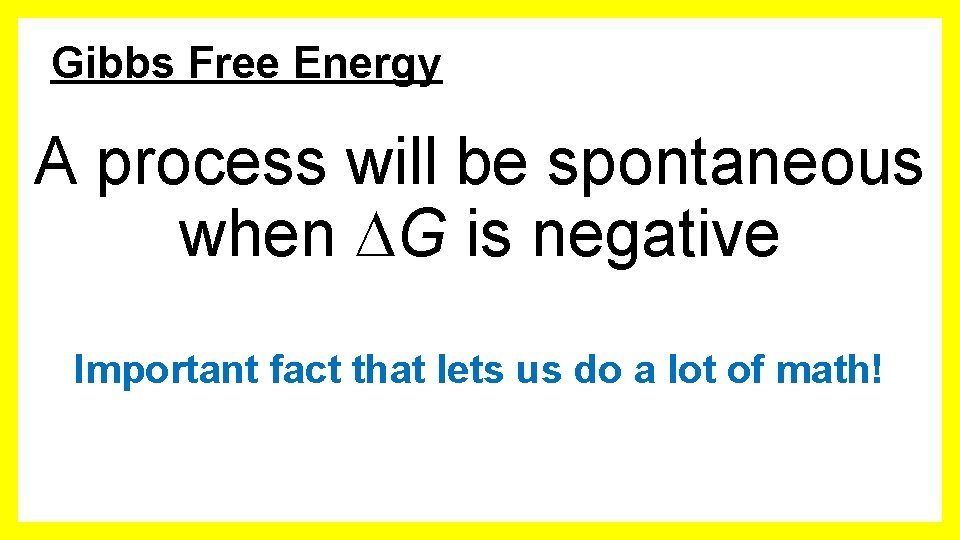
Gibbs Free Energy A process will be spontaneous when G is negative Important fact that lets us do a lot of math!
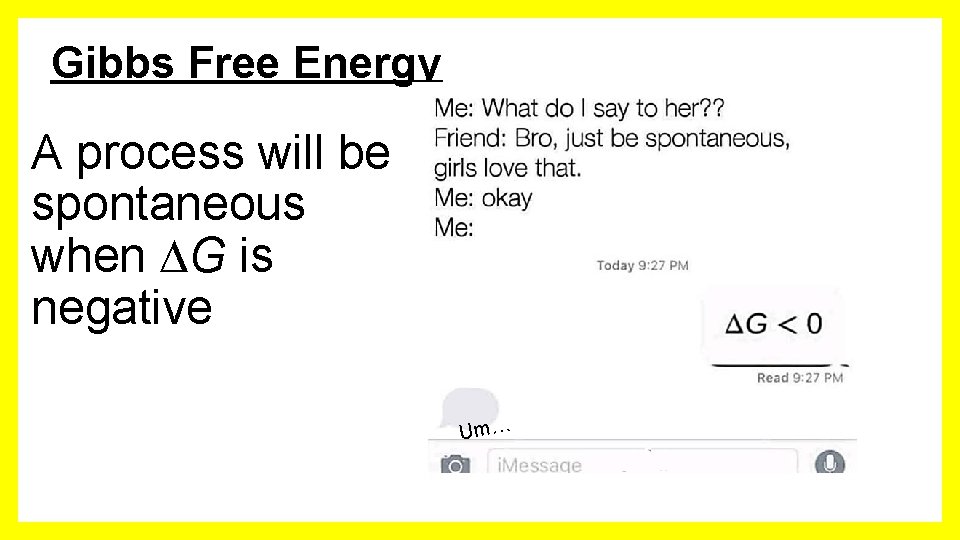
Gibbs Free Energy A process will be spontaneous when G is negative Um…
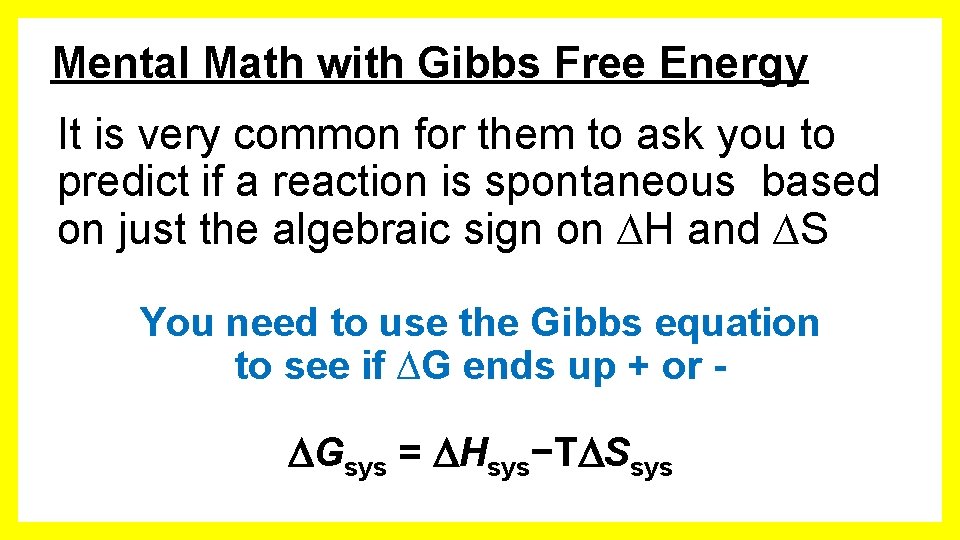
Mental Math with Gibbs Free Energy It is very common for them to ask you to predict if a reaction is spontaneous based on just the algebraic sign on ∆H and ∆S You need to use the Gibbs equation to see if ∆G ends up + or Gsys = Hsys−T Ssys
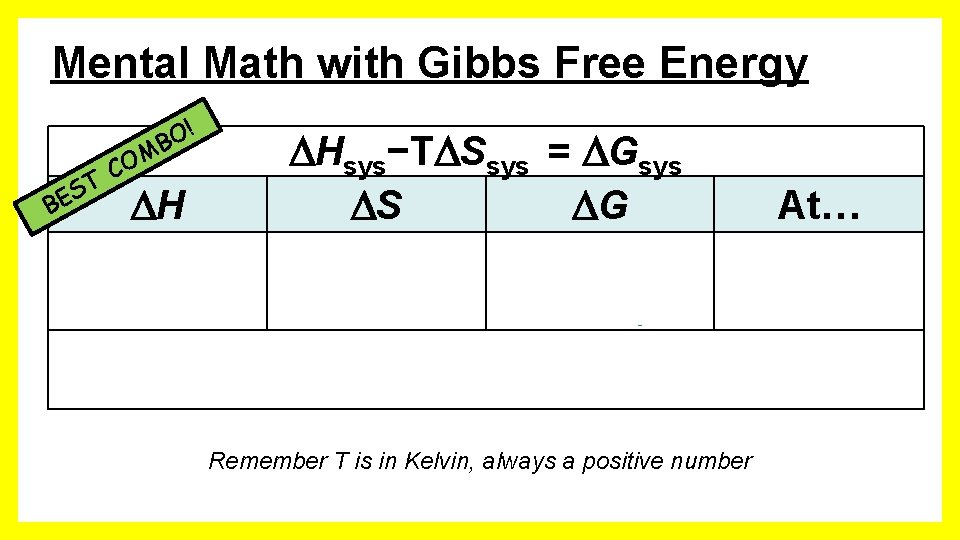
Mental Math with Gibbs Free Energy T S BE M O C ! O B Hsys−T Ssys = Gsys S G H − + exothermic At… − Any more disorder ALWAYS spont. temperature (Negative #) – any. T(Positive #) = Always Negative # Remember T is in Kelvin, always a positive number
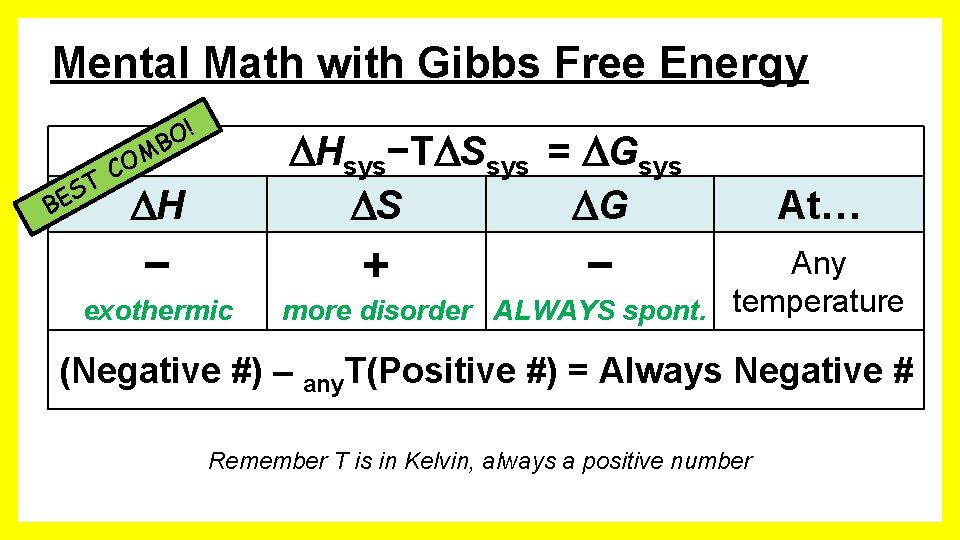
Mental Math with Gibbs Free Energy T S BE M O C ! O B Hsys−T Ssys = Gsys S G H − + exothermic At… − Any more disorder ALWAYS spont. temperature (Negative #) – any. T(Positive #) = Always Negative # Remember T is in Kelvin, always a positive number
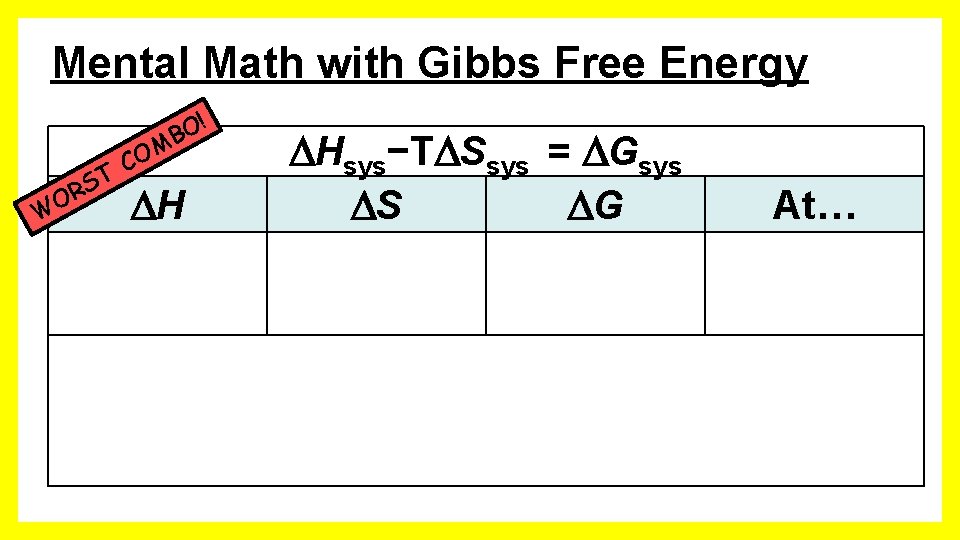
Mental Math with Gibbs Free Energy ! O B W T S OR M O C H Hsys−T Ssys = Gsys S G + − + endothermic less disorder NEVER spont. At… Any temp (Positive #) – any. T(Negative #) = Always Positive # Notice the double negative! (Positive #) + (Positive #)
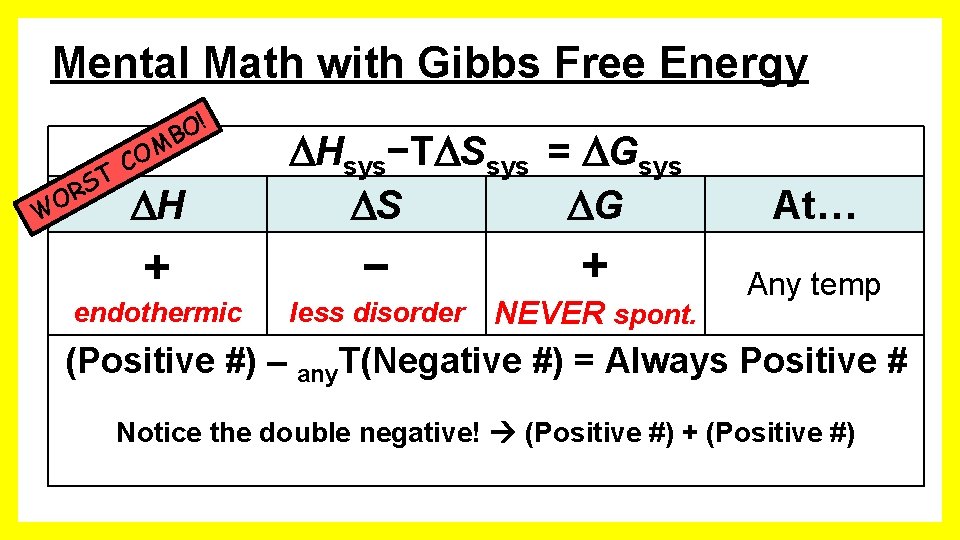
Mental Math with Gibbs Free Energy ! O B W T S OR M O C H Hsys−T Ssys = Gsys S G + − + endothermic less disorder NEVER spont. At… Any temp (Positive #) – any. T(Negative #) = Always Positive # Notice the double negative! (Positive #) + (Positive #)
Mental Math with Gibbs Free Energy LE B A ! I R BO A V OM C H Hsys−T Ssys = Gsys S G + + − endothermic more disorder spont. At… High Temp (Positive #) – large. T(Positive #) = Negative # H needs to be a smaller positive number than T Ssys Small # - Big # = Negative # H < T Ssys
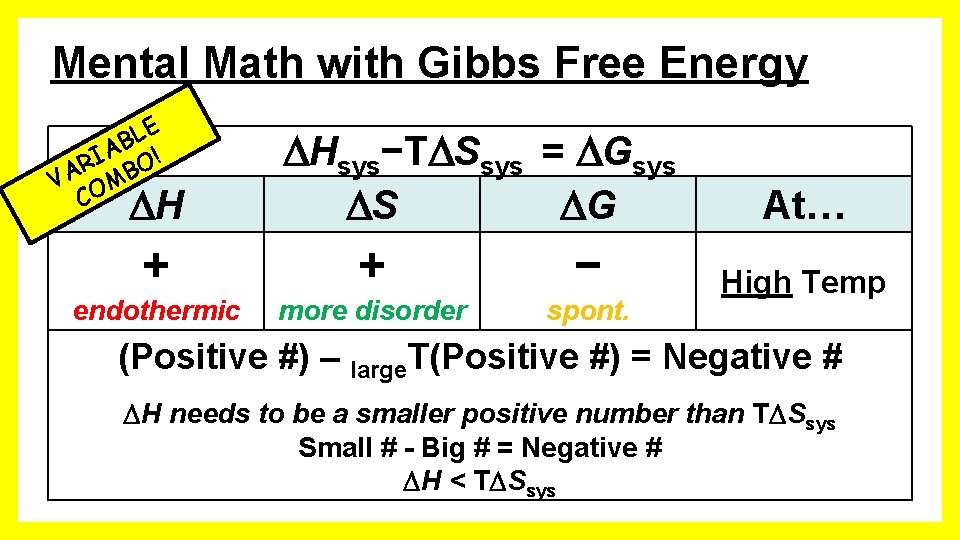
Mental Math with Gibbs Free Energy LE B A ! I R BO A V OM C H Hsys−T Ssys = Gsys S G + + − endothermic more disorder spont. At… High Temp (Positive #) – large. T(Positive #) = Negative # H needs to be a smaller positive number than T Ssys Small # - Big # = Negative # H < T Ssys
Mental Math with Gibbs Free Energy LE B A ! I R BO A V OM C H Hsys−T Ssys = Gsys S G − − − exothermic less disorder spont. At… Low Temp (Negative #) – small. T(Negative #) = Negative # Notice the double negative! (Negative #) + (Positive #) H needs to be a larger negative than T Ssys H < T Ssys
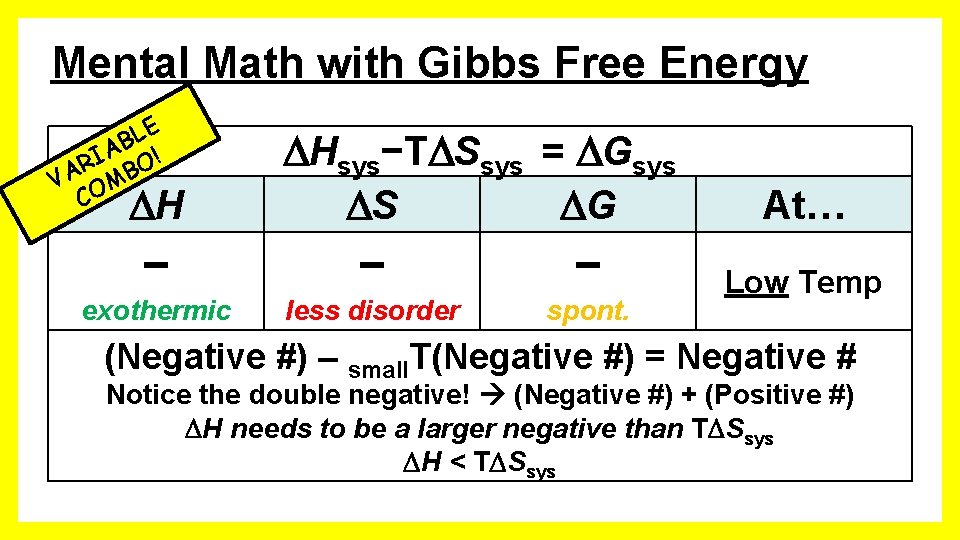
Mental Math with Gibbs Free Energy LE B A ! I R BO A V OM C H Hsys−T Ssys = Gsys S G − − − exothermic less disorder spont. At… Low Temp (Negative #) – small. T(Negative #) = Negative # Notice the double negative! (Negative #) + (Positive #) H needs to be a larger negative than T Ssys H < T Ssys
Mental Math with Gibbs Free Energy This always makes my brain feel scrambled… figure out what works for you. Flat out memorize it (best, fastest) • Write out the equation and +/- and walk through the mental math each time (what I do because I’m lazy, and I’m not taking • timed tests like you are – ha!) • Find/make a mnemonic? (Tell me if you find a good one!) YOU CAN’T LET YOUR BRAIN SHUT DOWN Don’t let it feel confused and shut off… just walk through it slowly…
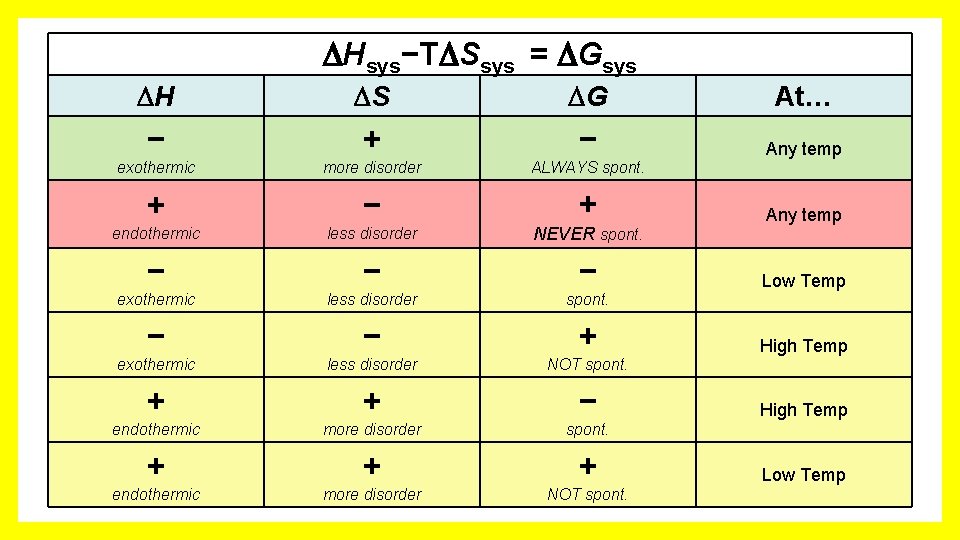
Hsys−T Ssys = Gsys H S G At… − + − Any temp exothermic more disorder ALWAYS spont. + − + endothermic less disorder NEVER spont. − − − exothermic less disorder spont. − − + exothermic less disorder NOT spont. + + − endothermic more disorder spont. + + + endothermic more disorder NOT spont. Any temp Low Temp High Temp Low Temp
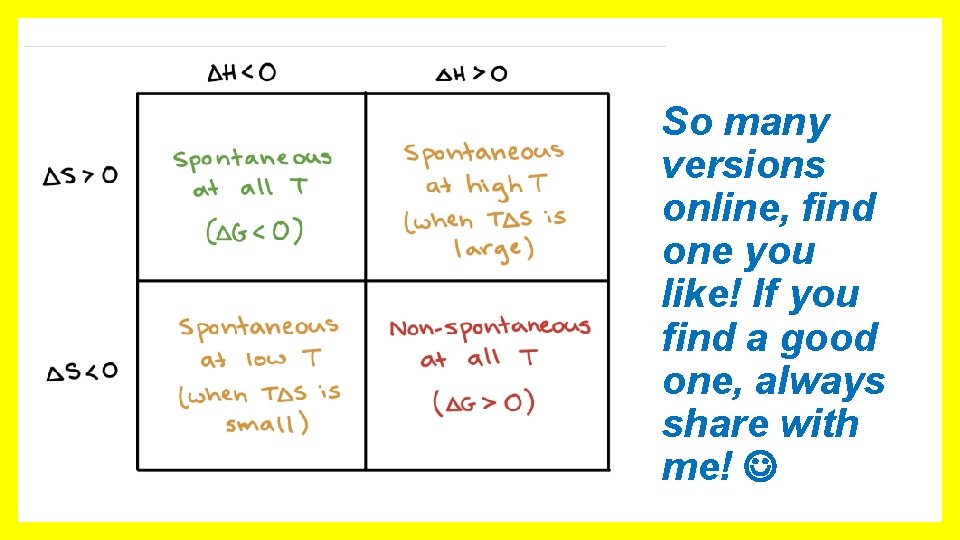
So many versions online, find one you like! If you find a good one, always share with me!
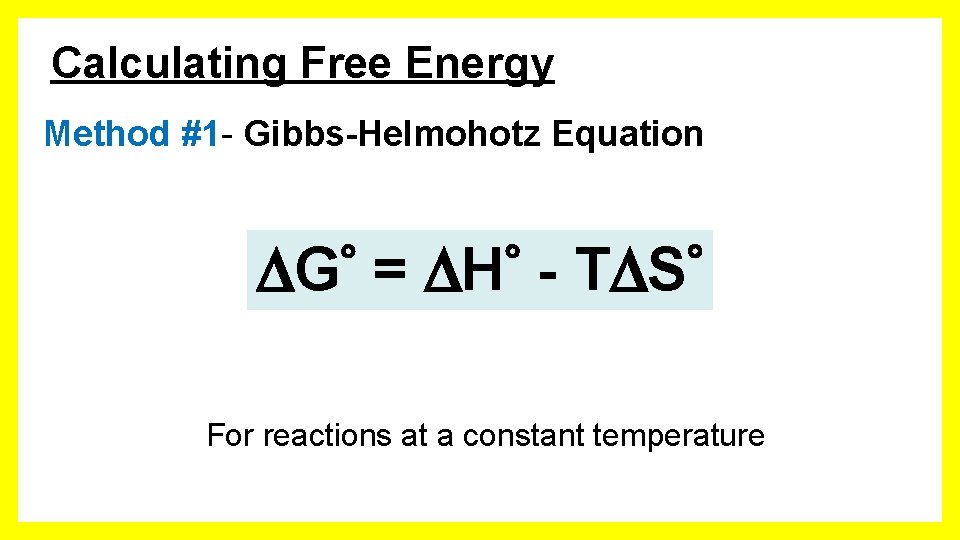
Calculating Free Energy Method #1 - Gibbs-Helmohotz Equation G = H - T S For reactions at a constant temperature
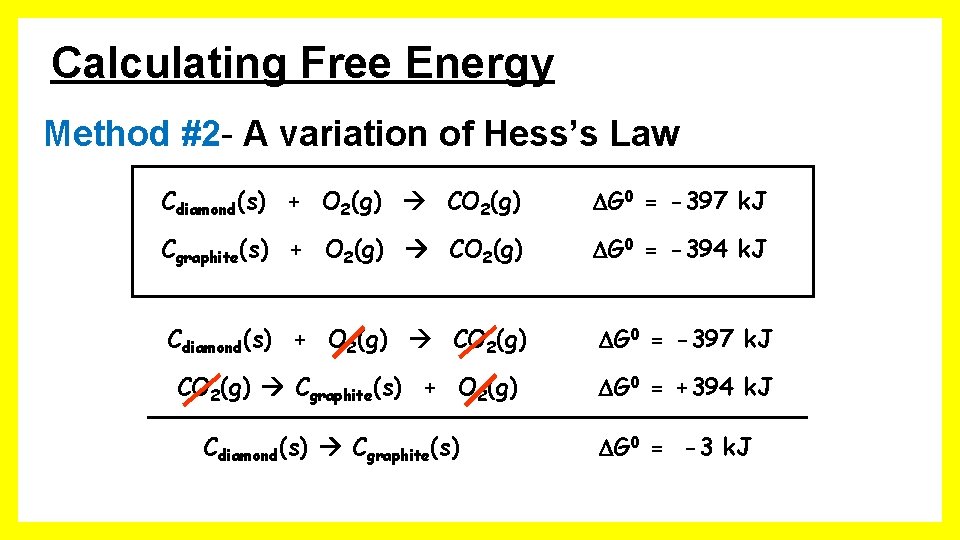
Calculating Free Energy Method #2 - A variation of Hess’s Law Cdiamond(s) + O 2(g) CO 2(g) G 0 = -397 k. J Cgraphite(s) + O 2(g) CO 2(g) G 0 = -394 k. J Cdiamond(s) + O 2(g) CO 2(g) G 0 = -397 k. J CO 2(g) Cgraphite(s) + O 2(g) G 0 = +394 k. J Cdiamond(s) Cgraphite(s) G 0 = -3 k. J
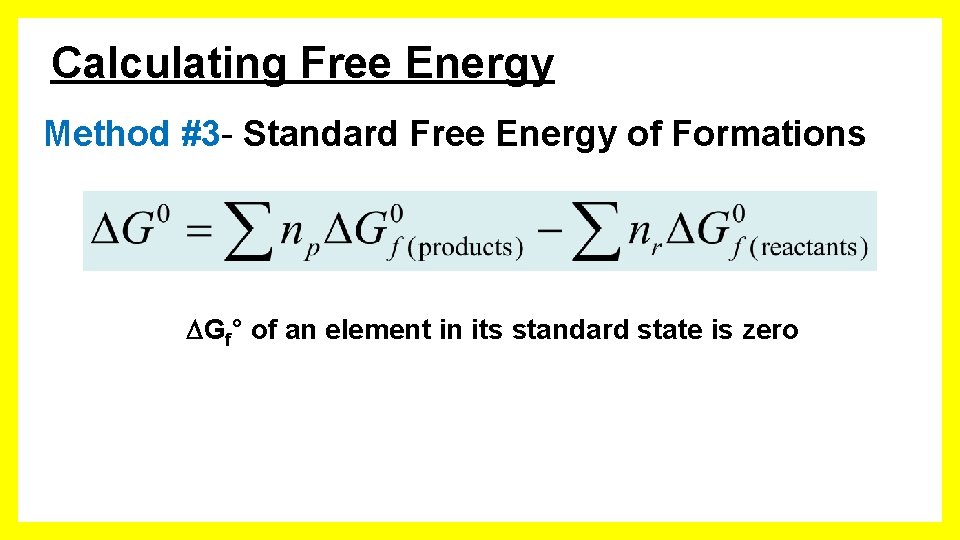
Calculating Free Energy Method #3 - Standard Free Energy of Formations Gf° of an element in its standard state is zero
Free Energy and Pressure • Enthalpy, H, is not pressure dependent • Entropy, S – yes pressure dependent – Depends on volume, so also depends on pressure • So Gibbs will change because S changes Slarge volume > Ssmall volume Slow pressure > Shigh pressure
Gibbs at Equilibrium When G = 0 the reaction is at equilibrium.
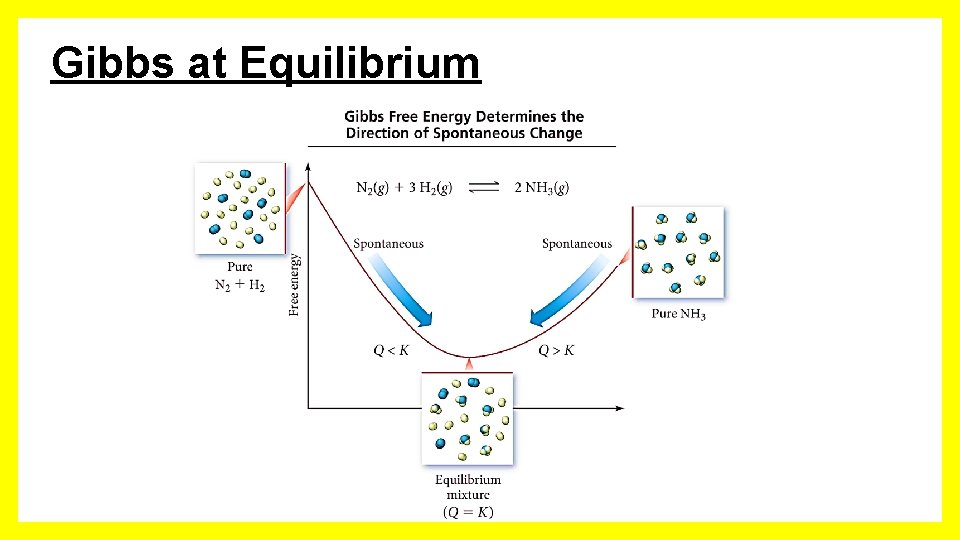
Gibbs at Equilibrium
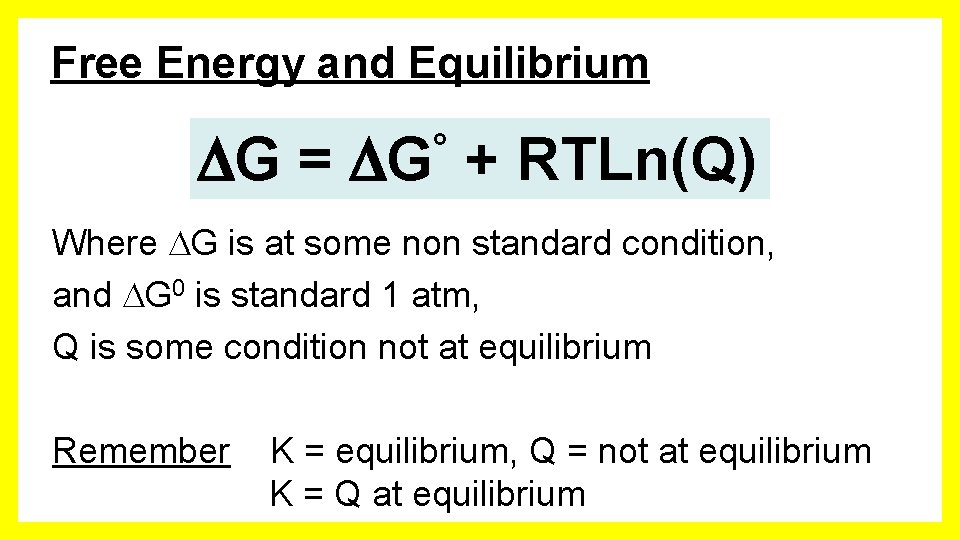
Free Energy and Equilibrium G = ° G + RTLn(Q) Where G is at some non standard condition, and G 0 is standard 1 atm, Q is some condition not at equilibrium Remember K = equilibrium, Q = not at equilibrium K = Q at equilibrium
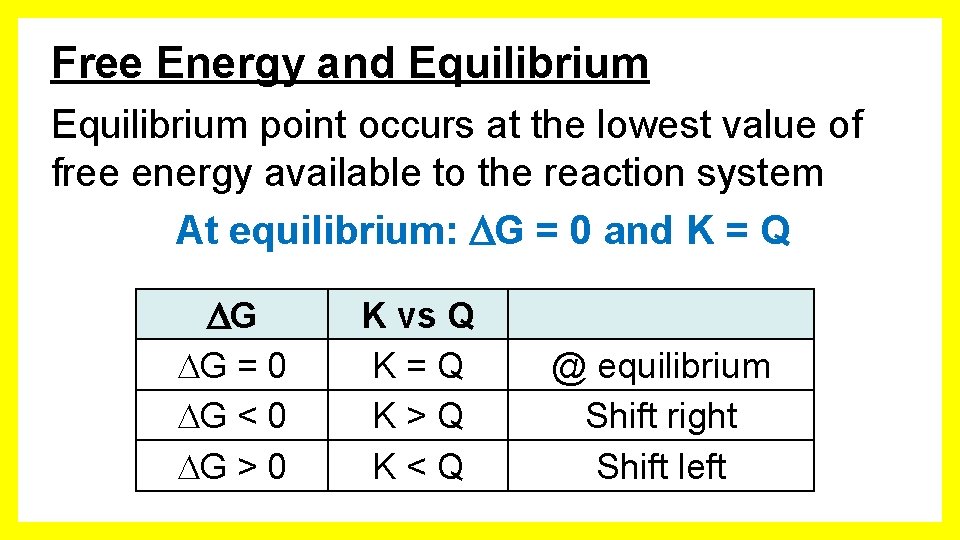
Free Energy and Equilibrium point occurs at the lowest value of free energy available to the reaction system At equilibrium: G = 0 and K = Q G G = 0 G < 0 G > 0 K vs Q K=Q K>Q K<Q @ equilibrium Shift right Shift left
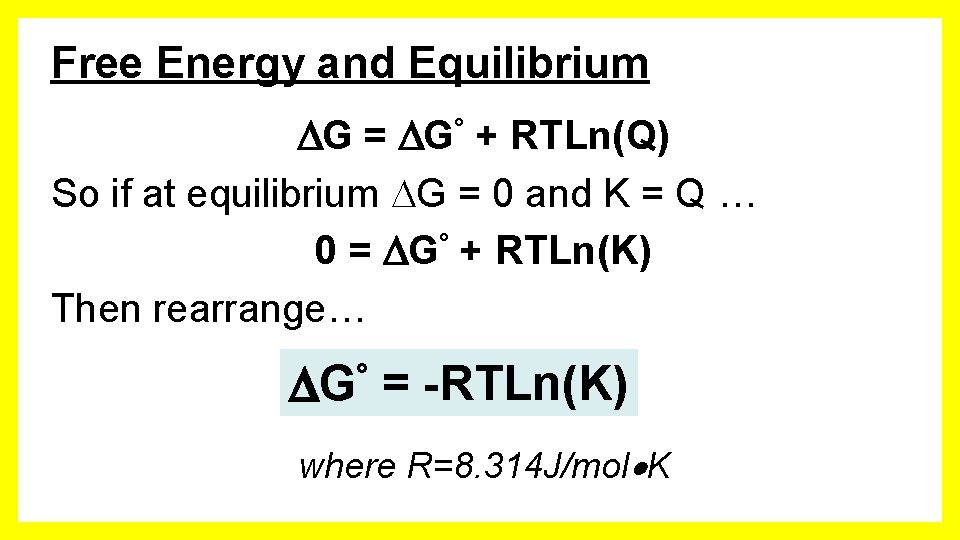
Free Energy and Equilibrium G = G° + RTLn(Q) So if at equilibrium G = 0 and K = Q … 0 = G° + RTLn(K) Then rearrange… ° G = -RTLn(K) where R=8. 314 J/mol K
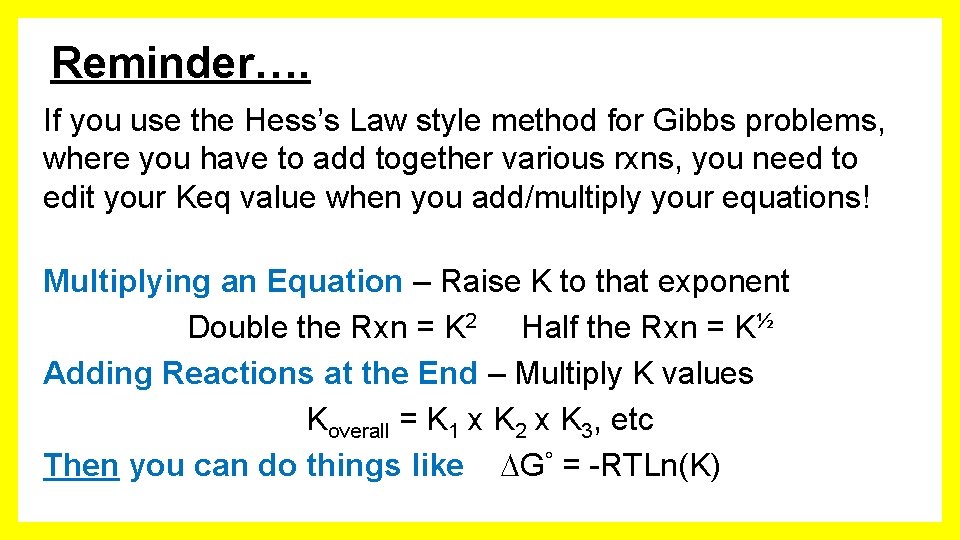
Reminder…. If you use the Hess’s Law style method for Gibbs problems, where you have to add together various rxns, you need to edit your Keq value when you add/multiply your equations! Multiplying an Equation – Raise K to that exponent Double the Rxn = K 2 Half the Rxn = K½ Adding Reactions at the End – Multiply K values Koverall = K 1 x K 2 x K 3, etc Then you can do things like G° = -RTLn(K)
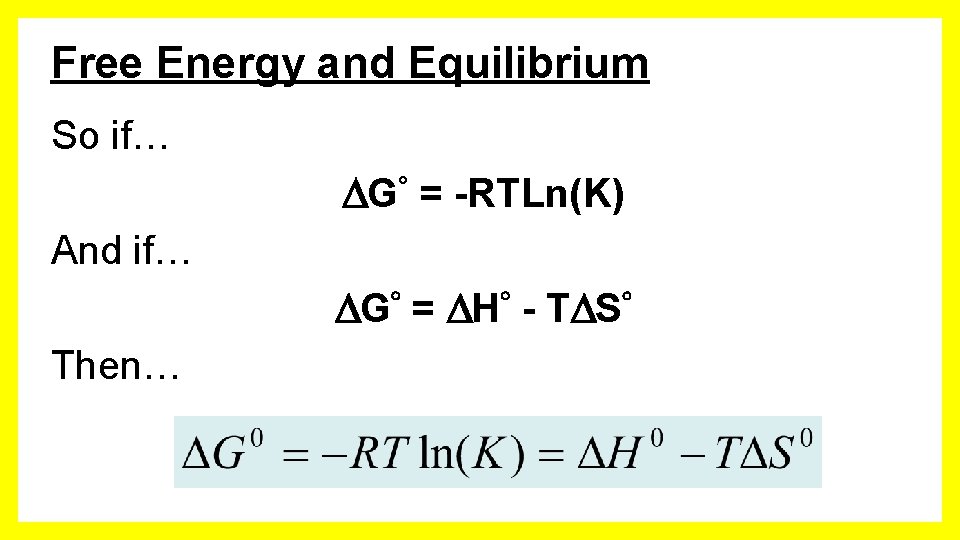
Free Energy and Equilibrium So if… G° = -RTLn(K) And if… G = H - T S Then…

Free Energy and Equilibrium Rearrange to solve for ln(K)…. So…. ln(K) 1/T AND…that equation looks like y = mx + b ….
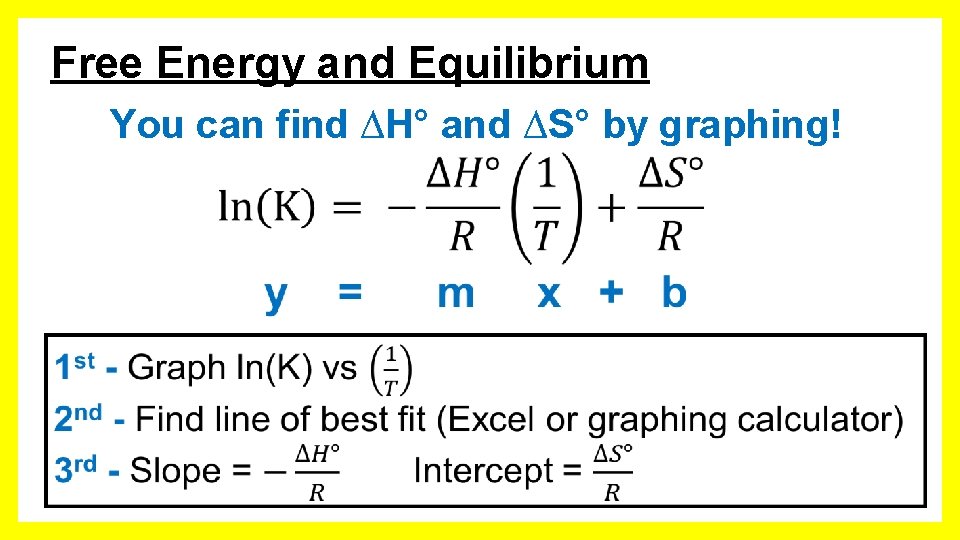
Free Energy and Equilibrium You can find ∆H° and ∆S° by graphing!
Soooo many rearrangements… • There are so many ways to rearrange, substitute, and solve for various things when it comes to Thermodynamics. You HAVE to have decent algebra skills! • My best advice if algebra is not your strong suit… – Practice over and over until it becomes “muscle memory” how to rearrange. – Every time you have a question that requires a different equation rearrangement/substitution, write it down! Start making your own equation cheat sheet.
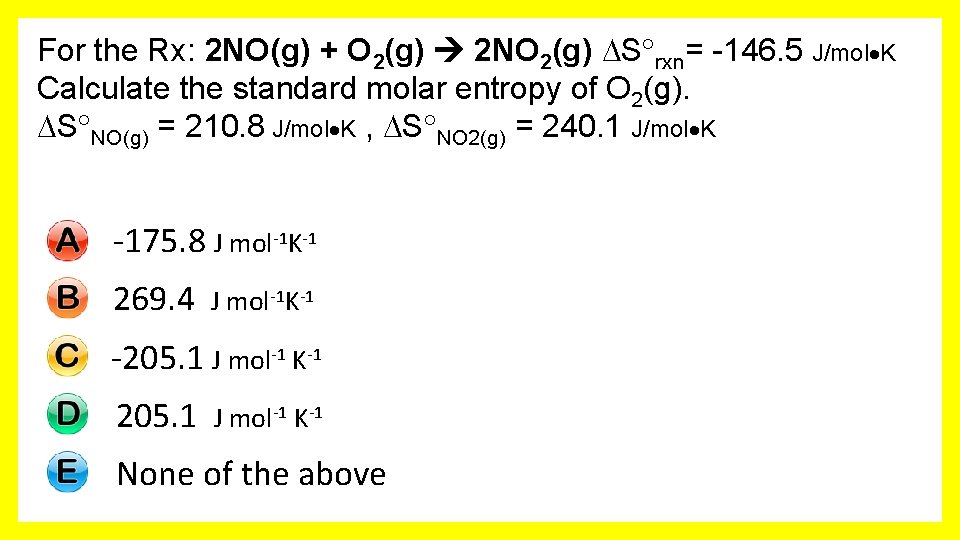
For the Rx: 2 NO(g) + O 2(g) 2 NO 2(g) S rxn= -146. 5 J/mol K Calculate the standard molar entropy of O 2(g). S NO(g) = 210. 8 J/mol K , S NO 2(g) = 240. 1 J/mol K -175. 8 J mol-1 K-1 269. 4 J mol-1 K-1 -205. 1 J mol-1 K-1 None of the above
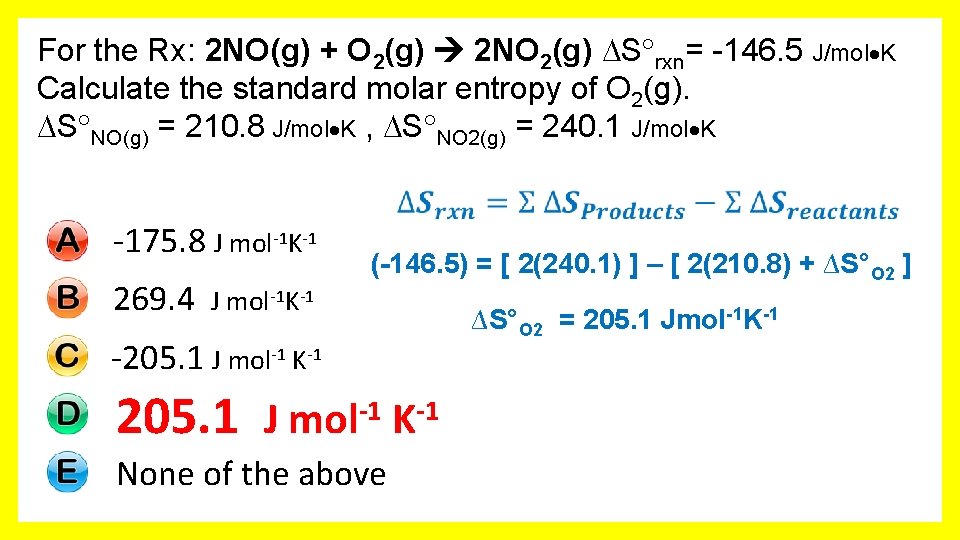
For the Rx: 2 NO(g) + O 2(g) 2 NO 2(g) S rxn= -146. 5 J/mol K Calculate the standard molar entropy of O 2(g). S NO(g) = 210. 8 J/mol K , S NO 2(g) = 240. 1 J/mol K -175. 8 J mol-1 K-1 269. 4 J mol-1 K-1 (-146. 5) = [ 2(240. 1) ] – [ 2(210. 8) + ∆S°O 2 ] ∆S°O 2 = 205. 1 Jmol-1 K-1 -205. 1 J mol-1 K-1 205. 1 J -1 mol None of the above -1 K
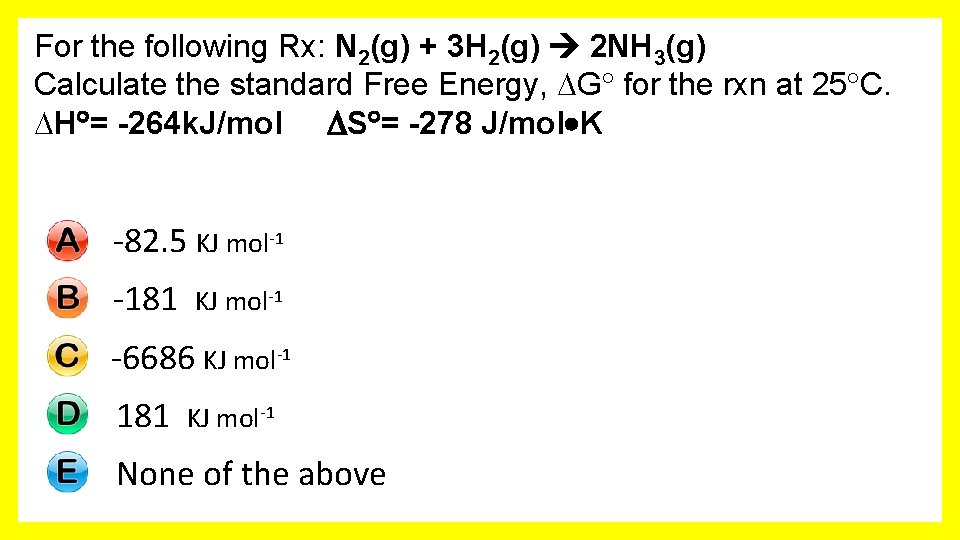
For the following Rx: N 2(g) + 3 H 2(g) 2 NH 3(g) Calculate the standard Free Energy, G for the rxn at 25 C. H = -264 k. J/mol S = -278 J/mol K -82. 5 KJ mol-1 -181 KJ mol-1 -6686 KJ mol-1 181 KJ mol-1 None of the above
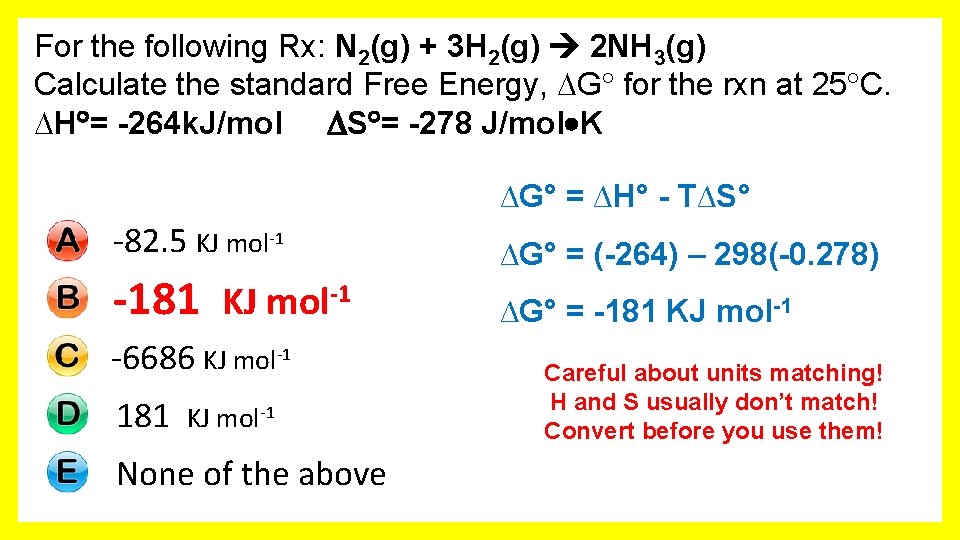
For the following Rx: N 2(g) + 3 H 2(g) 2 NH 3(g) Calculate the standard Free Energy, G for the rxn at 25 C. H = -264 k. J/mol S = -278 J/mol K ∆G° = ∆H° - T∆S° -82. 5 KJ mol-1 -181 KJ mol-1 -6686 KJ mol-1 181 KJ mol-1 None of the above ∆G° = (-264) – 298(-0. 278) ∆G° = -181 KJ mol-1 Careful about units matching! H and S usually don’t match! Convert before you use them!
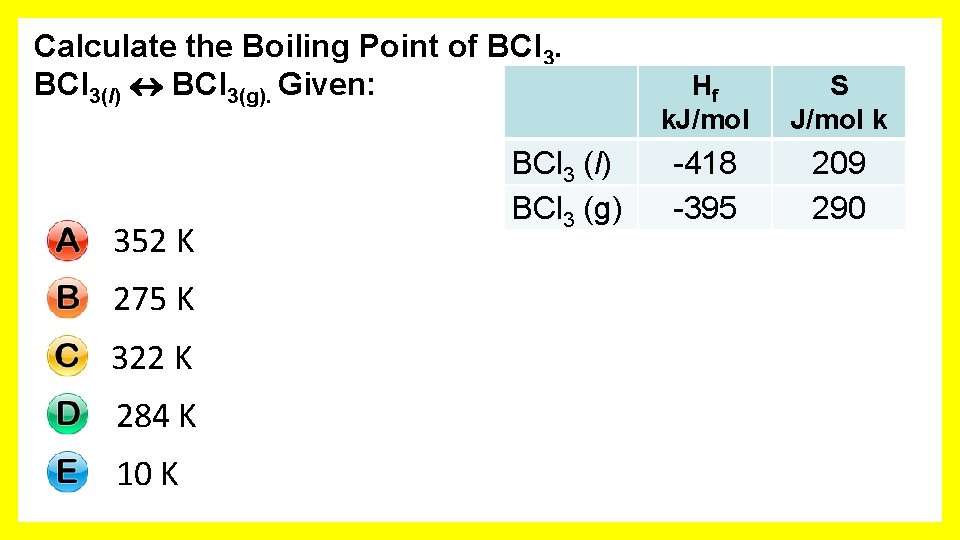
Calculate the Boiling Point of BCl 3(l) BCl 3(g). Given: 352 K 275 K 322 K 284 K 10 K BCl 3 (l) BCl 3 (g) Hf k. J/mol S J/mol k -418 -395 209 290
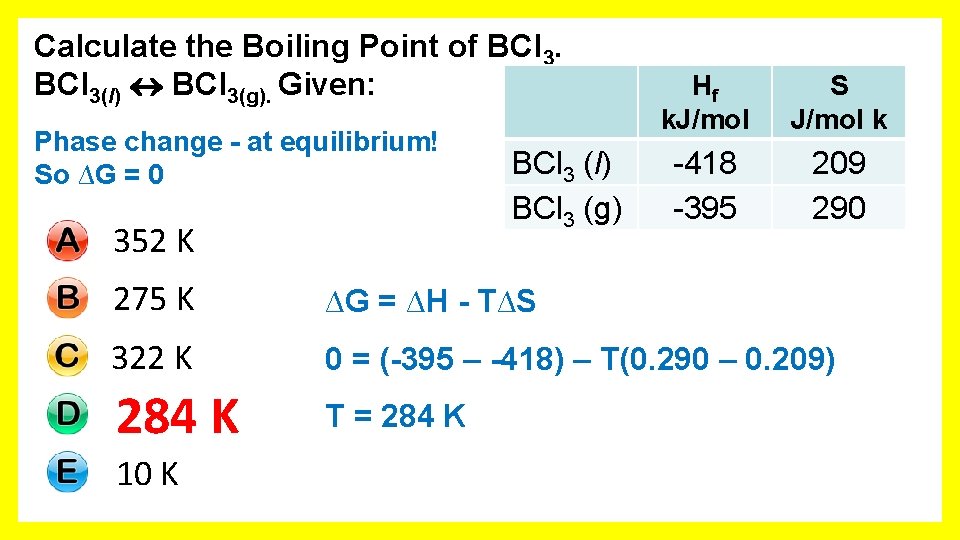
Calculate the Boiling Point of BCl 3(l) BCl 3(g). Given: Phase change - at equilibrium! So ∆G = 0 352 K BCl 3 (l) BCl 3 (g) Hf k. J/mol S J/mol k -418 -395 209 290 275 K ∆G = ∆H - T∆S 322 K 0 = (-395 – -418) – T(0. 290 – 0. 209) 284 K T = 284 K 10 K
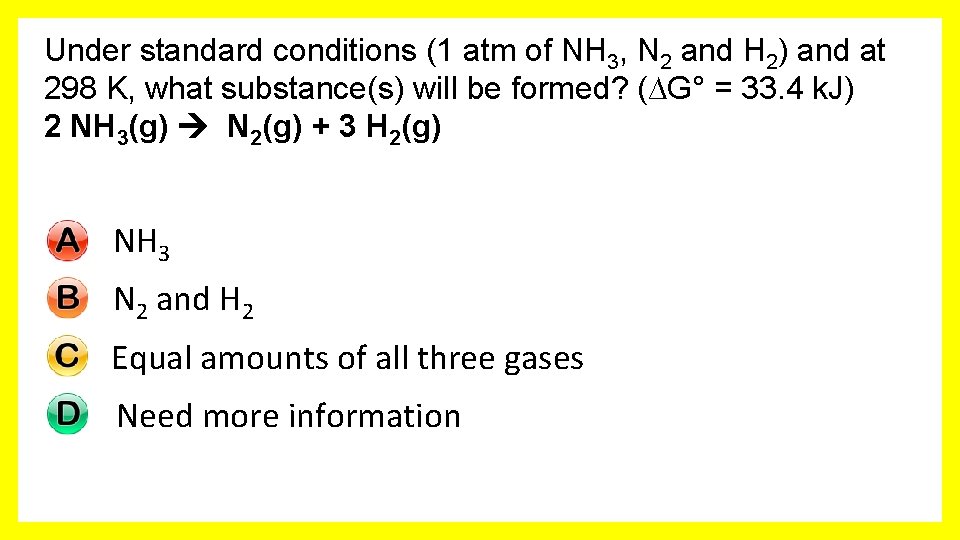
Under standard conditions (1 atm of NH 3, N 2 and H 2) and at 298 K, what substance(s) will be formed? (∆G° = 33. 4 k. J) 2 NH 3(g) N 2(g) + 3 H 2(g) NH 3 N 2 and H 2 Equal amounts of all three gases Need more information
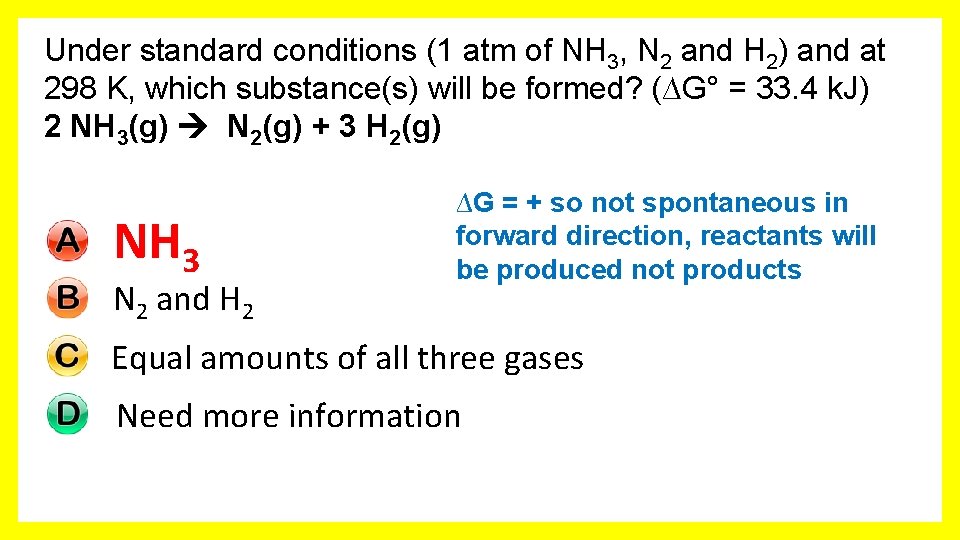
Under standard conditions (1 atm of NH 3, N 2 and H 2) and at 298 K, which substance(s) will be formed? (∆G° = 33. 4 k. J) 2 NH 3(g) N 2(g) + 3 H 2(g) NH 3 N 2 and H 2 ∆G = + so not spontaneous in forward direction, reactants will be produced not products Equal amounts of all three gases Need more information
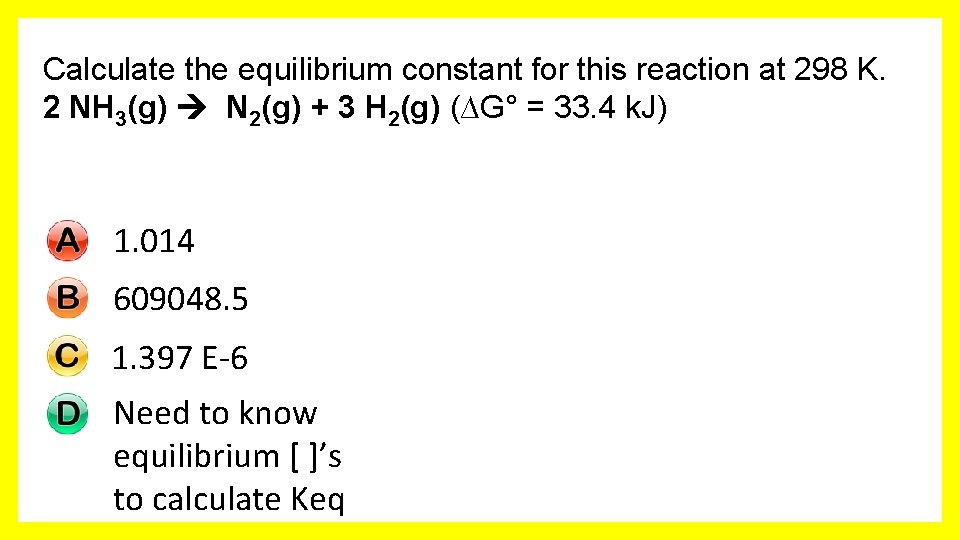
Calculate the equilibrium constant for this reaction at 298 K. 2 NH 3(g) N 2(g) + 3 H 2(g) (∆G° = 33. 4 k. J) 1. 014 609048. 5 1. 397 E-6 Need to know equilibrium [ ]’s to calculate Keq
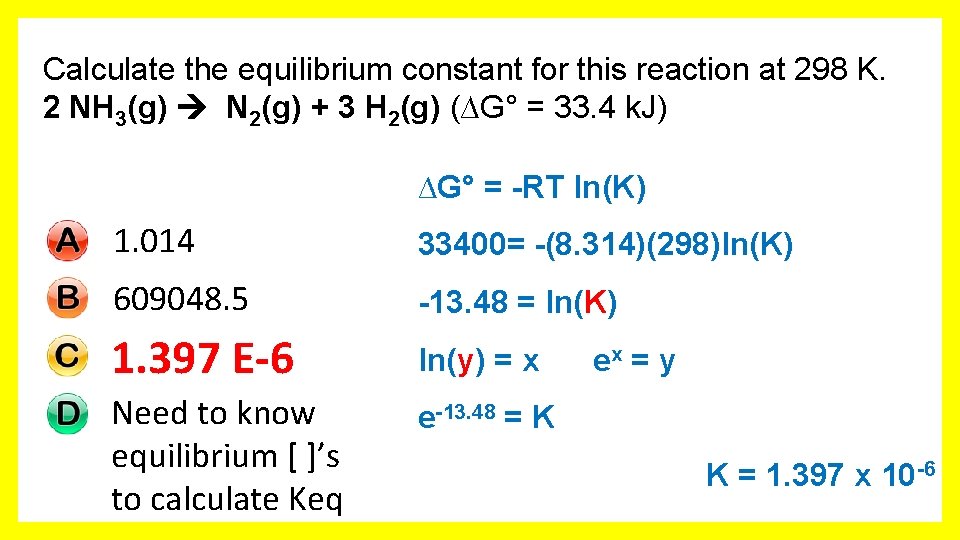
Calculate the equilibrium constant for this reaction at 298 K. 2 NH 3(g) N 2(g) + 3 H 2(g) (∆G° = 33. 4 k. J) ∆G° = -RT ln(K) 1. 014 33400= -(8. 314)(298)ln(K) 609048. 5 -13. 48 = ln(K) 1. 397 E-6 ln(y) = x Need to know equilibrium [ ]’s to calculate Keq e-13. 48 = K ex = y K = 1. 397 x 10 -6

Link to You. Tube Presentation https: //youtu. be/9 IUI 6 T 5 ynf. U
- Slides: 46