
n 7 Be crosssections of astrophysical interest at
n + 7 Be cross-sections of astrophysical interest at the CERN n_TOF facility: The Cosmological 7 Li problem Mario Mastromarco on behalf of the n_TOF collaboration 2/21/2021 M. Mastromarco@ICNFP 2018, Creta, Greece 1
Big Bang Nucleosynthesis Theory: Introduction n Big Bang Nucleosynthesis (BBN) theory describes the production of the lighest nuclides (D, 3 He, 4 He, 7 Li) between 1 s and 3 min after the Big Bang n It rests on well understood physics of nuclear reaction crosssections and Standard Model weak and electromagnetic interactions n BBN predictions are in a broad quantitative agreement with measured primordial light-elements derived from observations of the local and high-redshift universe 2/21/2021 M. Mastromarco@ICNFP 2018, Creta, Greece 2
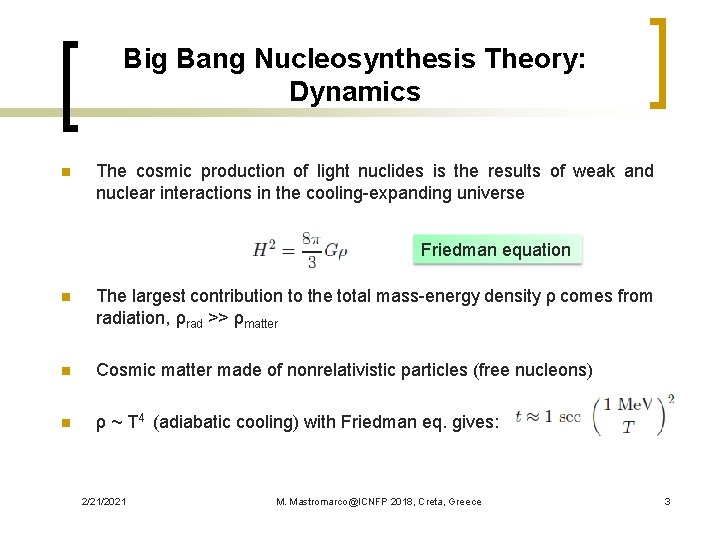
Big Bang Nucleosynthesis Theory: Dynamics n The cosmic production of light nuclides is the results of weak and nuclear interactions in the cooling-expanding universe Friedman equation n The largest contribution to the total mass-energy density ρ comes from radiation, ρrad >> ρmatter n Cosmic matter made of nonrelativistic particles (free nucleons) n ρ ~ T 4 (adiabatic cooling) with Friedman eq. gives: 2/21/2021 M. Mastromarco@ICNFP 2018, Creta, Greece 3
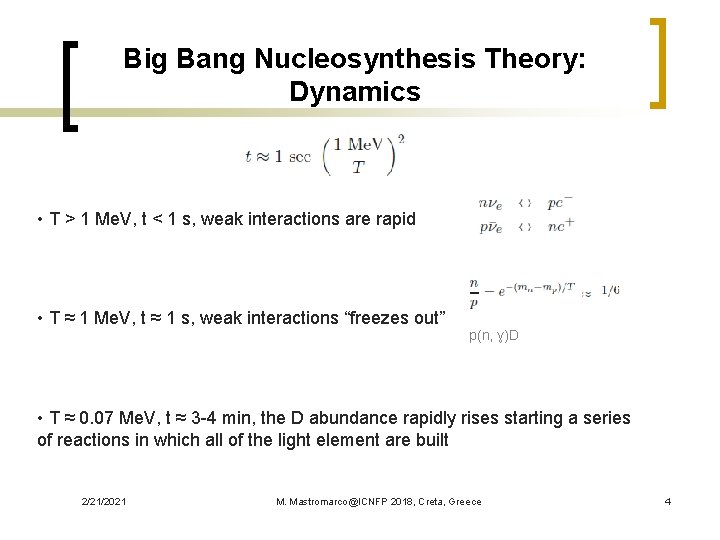
Big Bang Nucleosynthesis Theory: Dynamics • T > 1 Me. V, t < 1 s, weak interactions are rapid • T ≈ 1 Me. V, t ≈ 1 s, weak interactions “freezes out” p(n, ɣ)D • T ≈ 0. 07 Me. V, t ≈ 3 -4 min, the D abundance rapidly rises starting a series of reactions in which all of the light element are built 2/21/2021 M. Mastromarco@ICNFP 2018, Creta, Greece 4
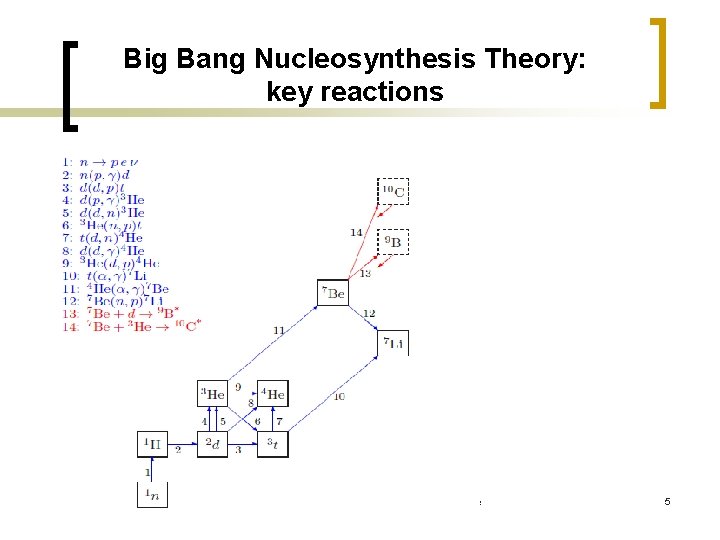
Big Bang Nucleosynthesis Theory: key reactions 2/21/2021 M. Mastromarco@ICNFP 2018, Creta, Greece 5
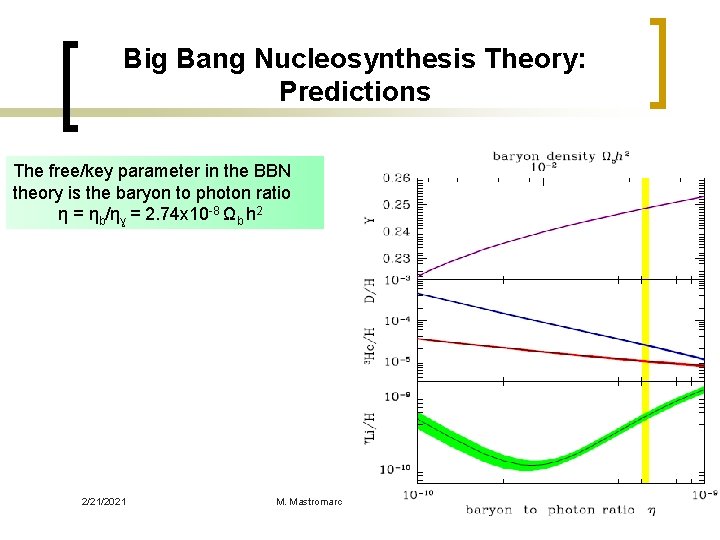
Big Bang Nucleosynthesis Theory: Predictions The free/key parameter in the BBN theory is the baryon to photon ratio η = ηb/ηɣ = 2. 74 x 10 -8 Ωb h 2 2/21/2021 M. Mastromarco@ICNFP 2018, Creta, Greece 6
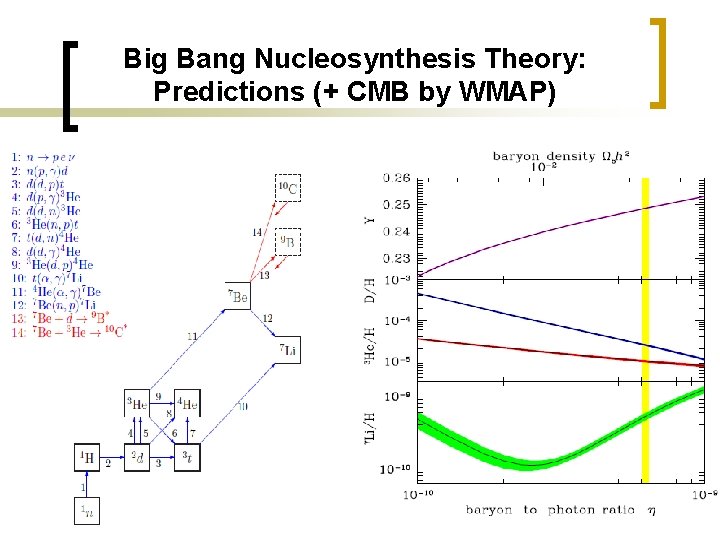
Big Bang Nucleosynthesis Theory: Predictions (+ CMB by WMAP) The free/key parameter in the BBN theory is the baryon to photon ratio η = ηb/ηɣ = 2. 74 x 10 -8 Ωb h 2 2/21/2021 M. Mastromarco@ICNFP 2018, Creta, Greece 7
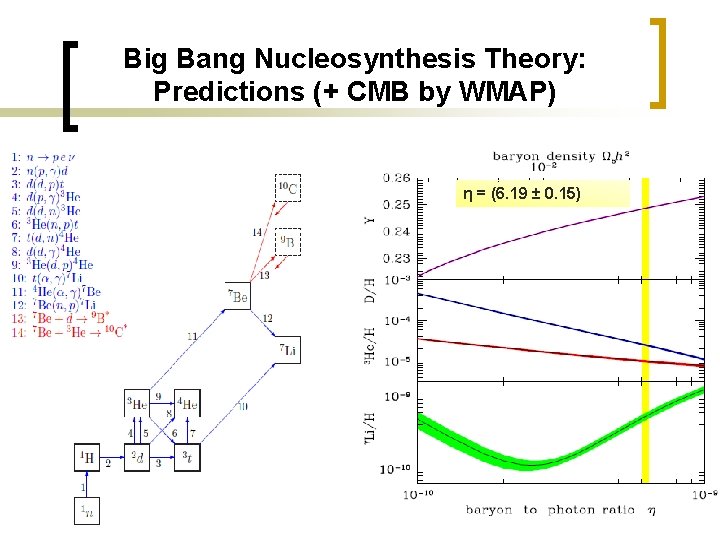
Big Bang Nucleosynthesis Theory: Predictions (+ CMB by WMAP) The free/key parameter in the BBN theory is the baryon to photon ratio η = ηb/ηɣ = 2. 74 x 10 -8 Ωb h 2 2/21/2021 η = (6. 19 ± 0. 15) M. Mastromarco@ICNFP 2018, Creta, Greece 8
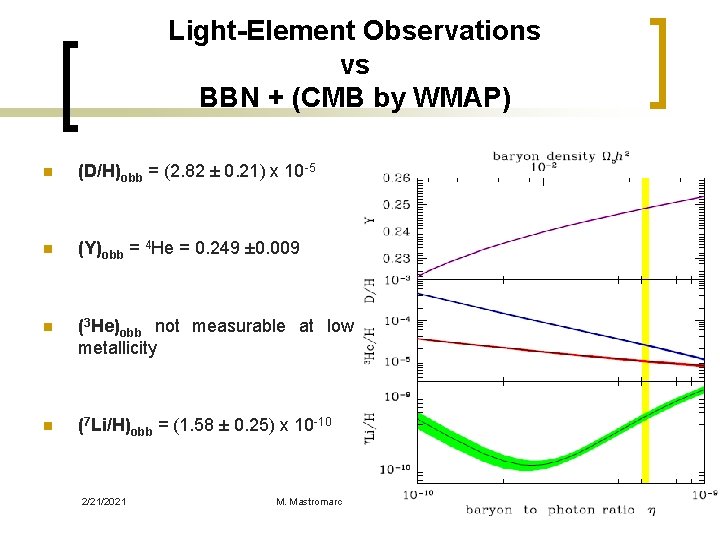
Light-Element Observations vs BBN + (CMB by WMAP) n (D/H)obb = (2. 82 ± 0. 21) x 10 -5 n (Y)obb = 4 He = 0. 249 ± 0. 009 n (3 He)obb not measurable at low metallicity n (7 Li/H)obb = (1. 58 ± 0. 25) x 10 -10 2/21/2021 M. Mastromarco@ICNFP 2018, Creta, Greece 9
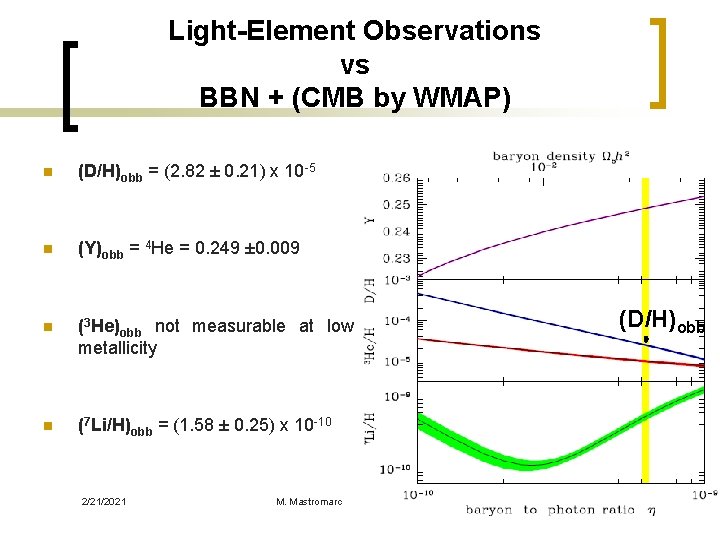
Light-Element Observations vs BBN + (CMB by WMAP) n (D/H)obb = (2. 82 ± 0. 21) x 10 -5 n (Y)obb = 4 He = 0. 249 ± 0. 009 n (3 He)obb not measurable at low metallicity n (7 Li/H)obb = (1. 58 ± 0. 25) x 10 -10 2/21/2021 M. Mastromarco@ICNFP 2018, Creta, Greece (D/H)obb 10
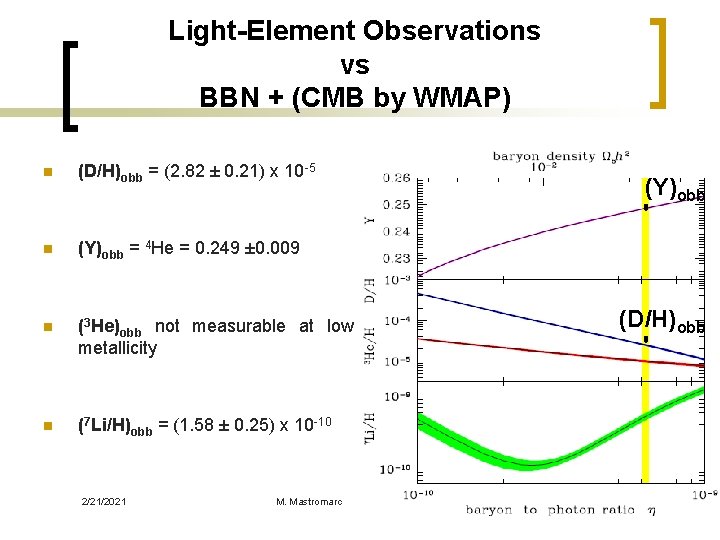
Light-Element Observations vs BBN + (CMB by WMAP) n (D/H)obb = (2. 82 ± 0. 21) x 10 -5 n (Y)obb = 4 He = 0. 249 ± 0. 009 n (3 He)obb not measurable at low metallicity n (7 Li/H)obb = (1. 58 ± 0. 25) x 10 -10 2/21/2021 M. Mastromarco@ICNFP 2018, Creta, Greece (Y)obb (D/H)obb 11
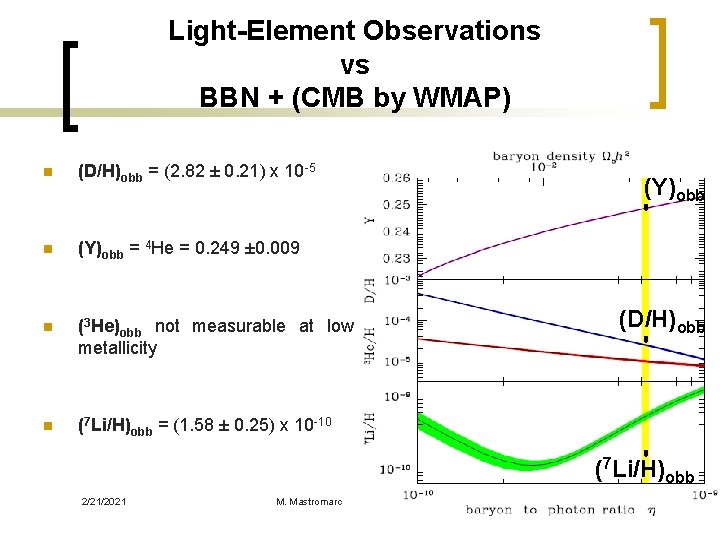
Light-Element Observations vs BBN + (CMB by WMAP) n (D/H)obb = (2. 82 ± 0. 21) x 10 -5 n (Y)obb = 4 He = 0. 249 ± 0. 009 n (3 He)obb not measurable at low metallicity n (7 Li/H)obb = (1. 58 ± 0. 25) x 10 -10 (Y)obb (D/H)obb (7 Li/H)obb 2/21/2021 M. Mastromarco@ICNFP 2018, Creta, Greece 12
The Cosmological Lithium Problem: possible solutions n Astrophysical n Nuclear Physics n Beyond the Standard Model 2/21/2021 M. Mastromarco@ICNFP 2018, Creta, Greece 13
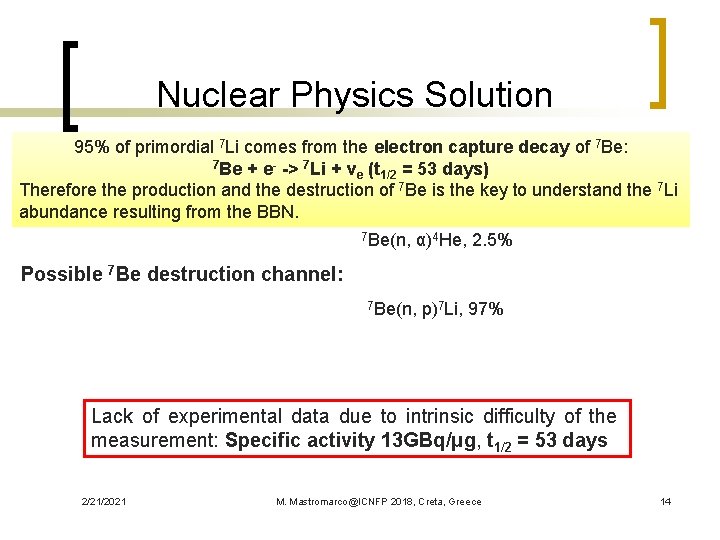
Nuclear Physics Solution 95% of primordial 7 Li comes from the electron capture decay of 7 Be: 7 Be + e- -> 7 Li + v (t = 53 days) e 1/2 Therefore the production and the destruction of 7 Be is the key to understand the 7 Li abundance resulting from the BBN. 7 Be(n, α)4 He, 2. 5% Possible 7 Be destruction channel: 7 Be(n, p)7 Li, 97% Lack of experimental data due to intrinsic difficulty of the measurement: Specific activity 13 GBq/μg, t 1/2 = 53 days 2/21/2021 M. Mastromarco@ICNFP 2018, Creta, Greece 14
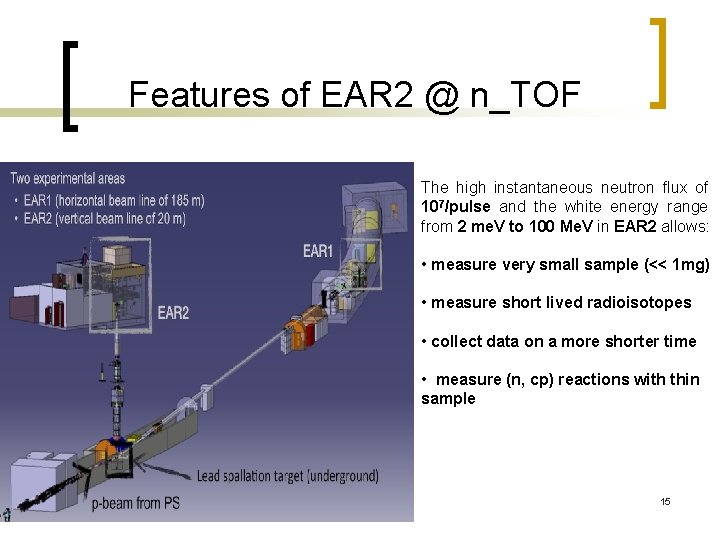
Features of EAR 2 @ n_TOF The high instantaneous neutron flux of 107/pulse and the white energy range from 2 me. V to 100 Me. V in EAR 2 allows: • measure very small sample (<< 1 mg) • measure short lived radioisotopes • collect data on a more shorter time • measure (n, cp) reactions with thin sample 2/21/2021 15
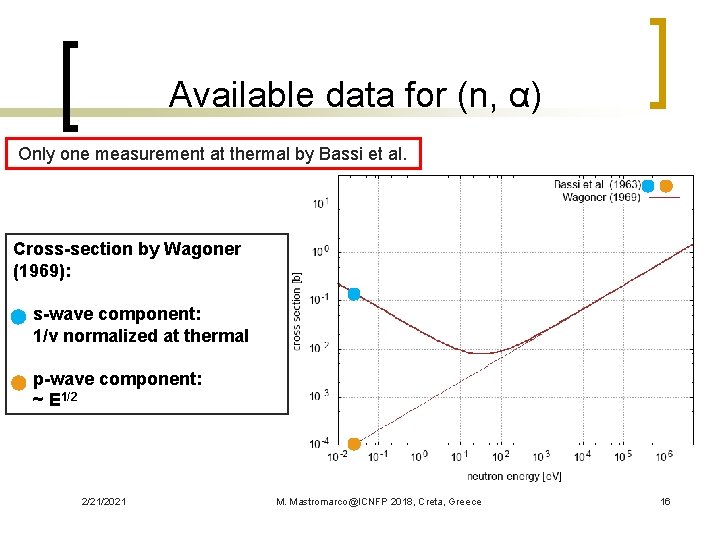
Available data for (n, α) Only one measurement at thermal by Bassi et al. Cross-section by Wagoner (1969): s-wave component: 1/v normalized at thermal p-wave component: ~ E 1/2 2/21/2021 M. Mastromarco@ICNFP 2018, Creta, Greece 16
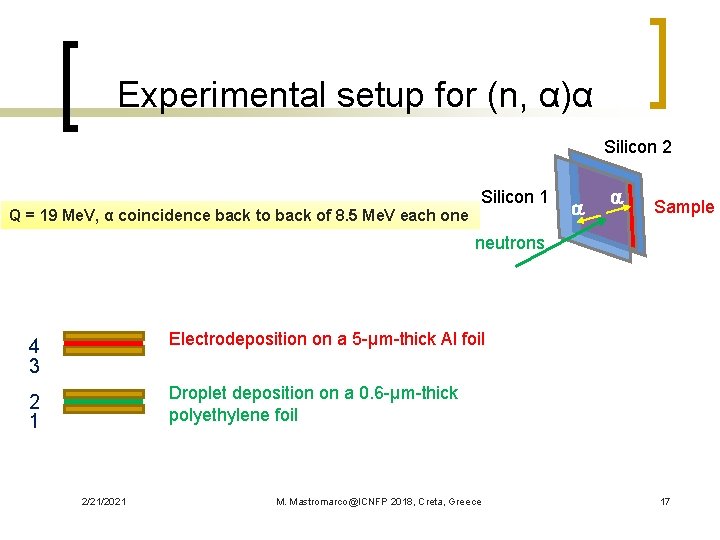
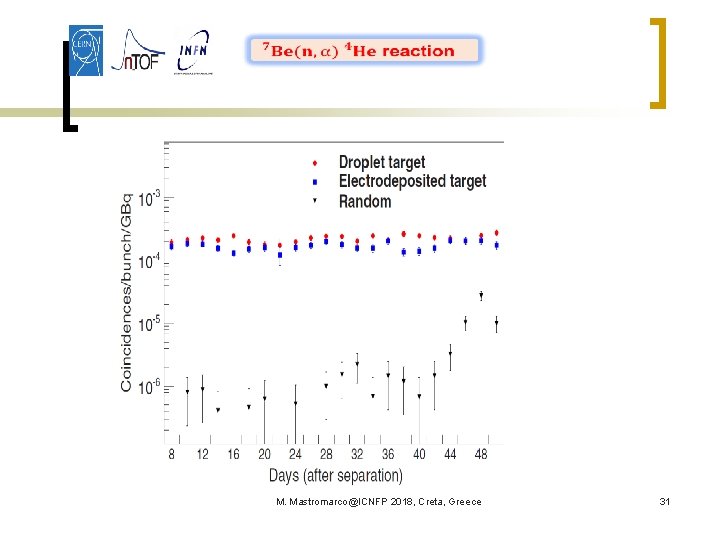
Experimental setup for (n, α)α Silicon 2 Silicon 1 Q = 19 Me. V, α coincidence back to back of 8. 5 Me. V each one a a Sample neutrons 4 3 Electrodeposition on a 5 -μm-thick Al foil 2 1 Droplet deposition on a 0. 6 -μm-thick polyethylene foil 2/21/2021 M. Mastromarco@ICNFP 2018, Creta, Greece 17
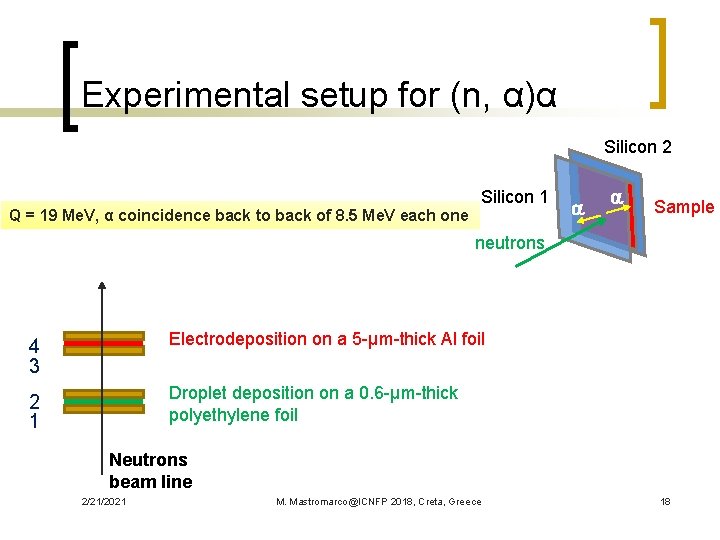
Experimental setup for (n, α)α Silicon 2 Silicon 1 Q = 19 Me. V, α coincidence back to back of 8. 5 Me. V each one a a Sample neutrons 4 3 Electrodeposition on a 5 -μm-thick Al foil 2 1 Droplet deposition on a 0. 6 -μm-thick polyethylene foil Neutrons beam line 2/21/2021 M. Mastromarco@ICNFP 2018, Creta, Greece 18
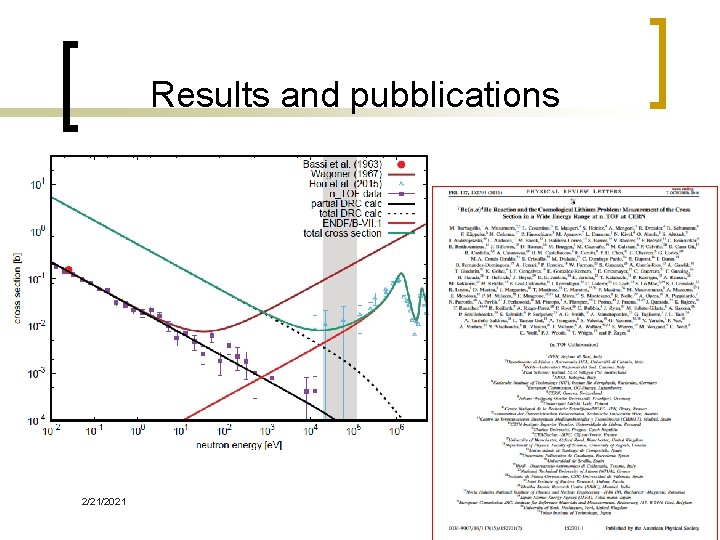
Results and pubblications 2/21/2021 19
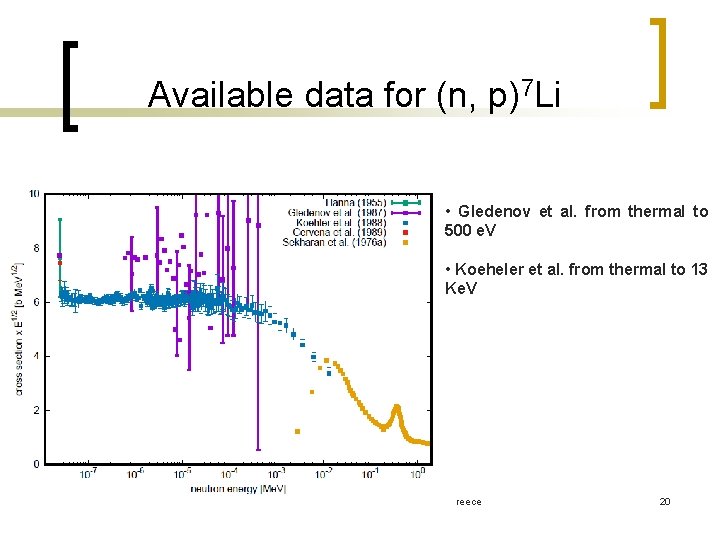
Available data for (n, p)7 Li • Gledenov et al. from thermal to 500 e. V • Koeheler et al. from thermal to 13 Ke. V 2/21/2021 M. Mastromarco@ICNFP 2018, Creta, Greece 20
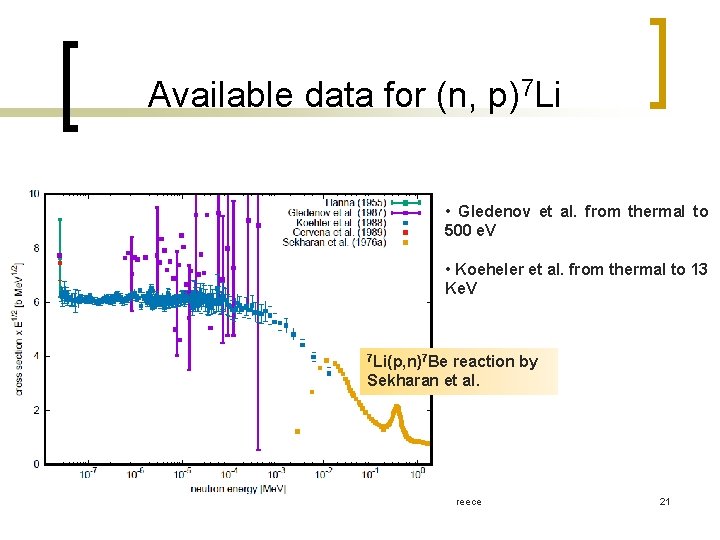
Available data for (n, p)7 Li • Gledenov et al. from thermal to 500 e. V • Koeheler et al. from thermal to 13 Ke. V 7 Li(p, n)7 Be reaction by Sekharan et al. 2/21/2021 M. Mastromarco@ICNFP 2018, Creta, Greece 21
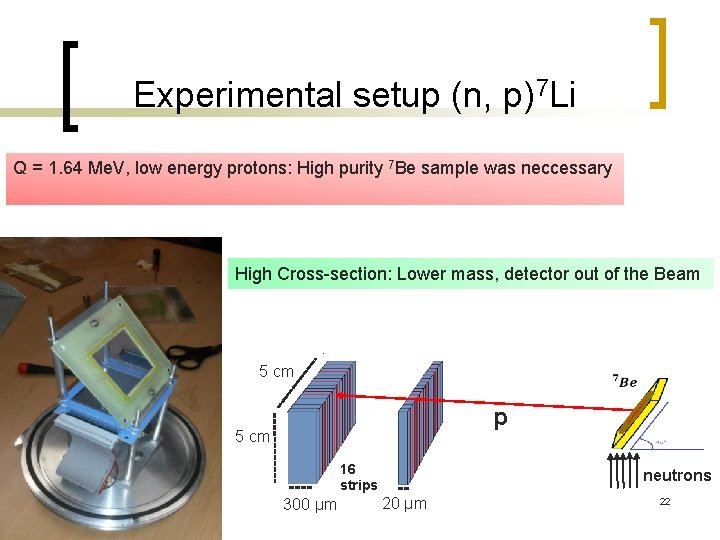
Experimental setup (n, p)7 Li Q = 1. 64 Me. V, low energy protons: High purity 7 Be sample was neccessary High Cross-section: Lower mass, detector out of the Beam 5 cm 16 strips 2/21/2021 300 µm p neutrons 20 µm 22
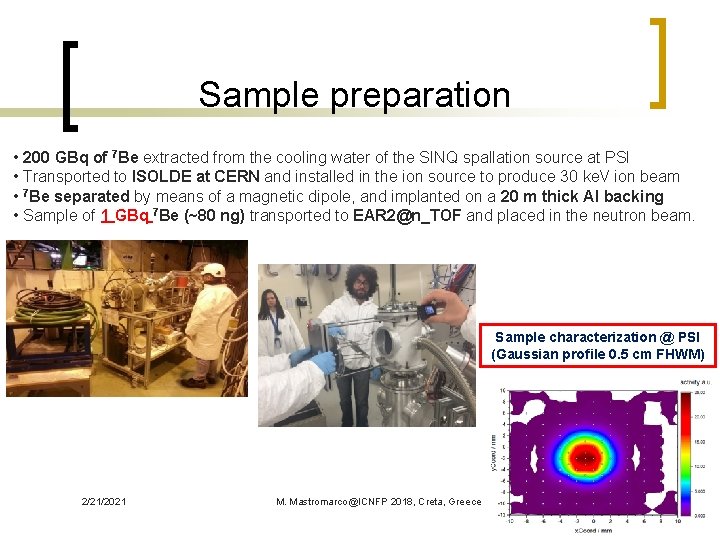
Sample preparation • 200 GBq of 7 Be extracted from the cooling water of the SINQ spallation source at PSI • Transported to ISOLDE at CERN and installed in the ion source to produce 30 ke. V ion beam • 7 Be separated by means of a magnetic dipole, and implanted on a 20 m thick Al backing • Sample of 1 GBq 7 Be (~80 ng) transported to EAR 2@n_TOF and placed in the neutron beam. Sample characterization @ PSI (Gaussian profile 0. 5 cm FHWM) 2/21/2021 M. Mastromarco@ICNFP 2018, Creta, Greece 23
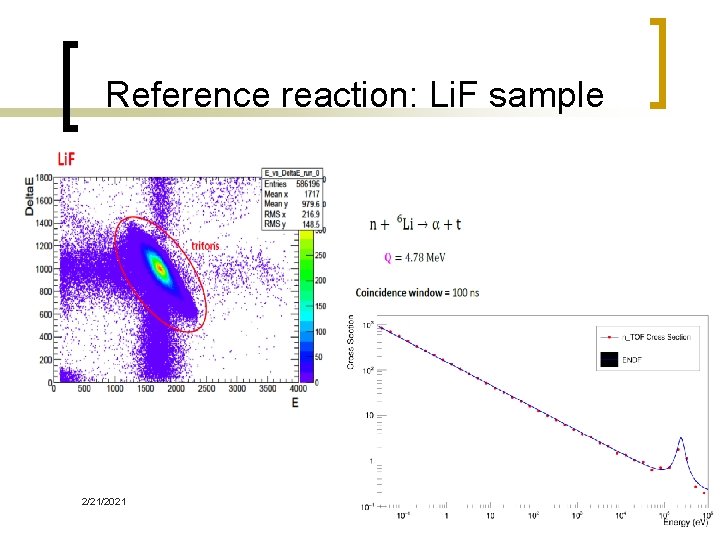
Reference reaction: Li. F sample 2/21/2021 24
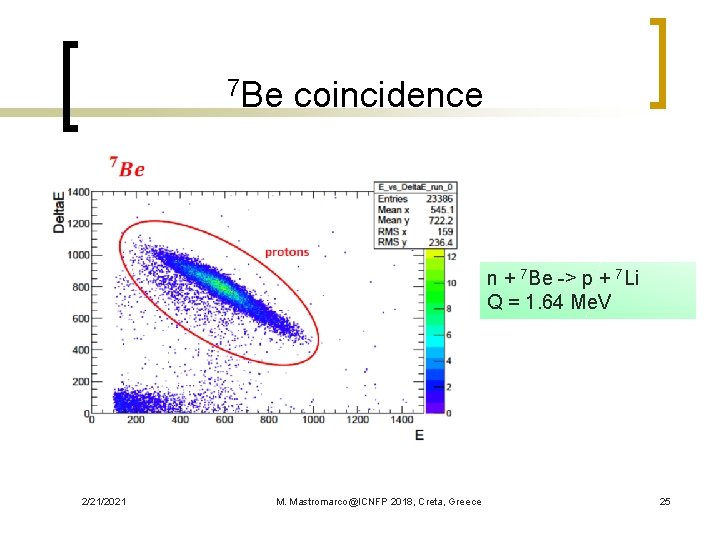
7 Be coincidence n + 7 Be -> p + 7 Li Q = 1. 64 Me. V 2/21/2021 M. Mastromarco@ICNFP 2018, Creta, Greece 25
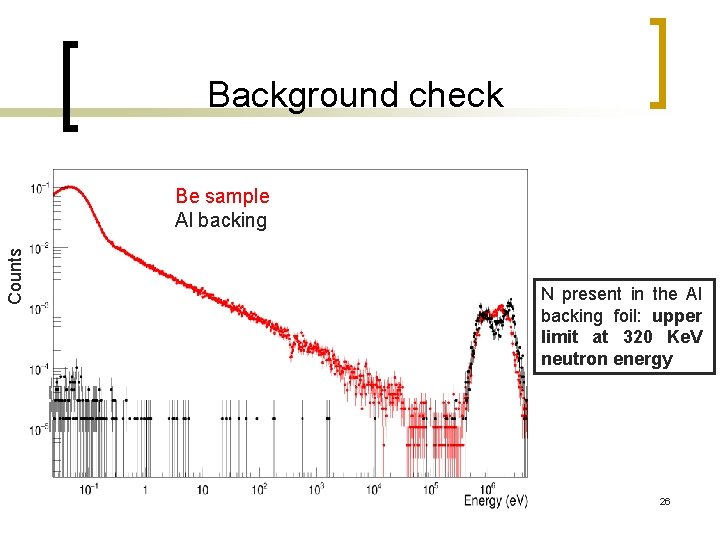
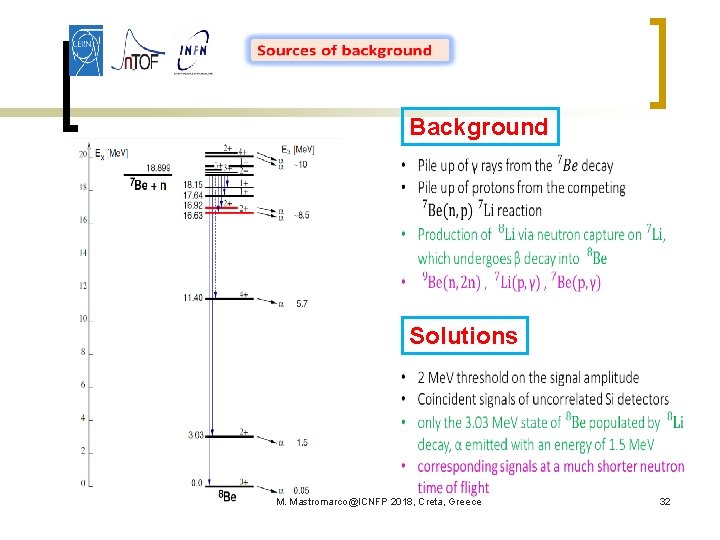
Background check Counts Be sample Al backing N present in the Al backing foil: upper limit at 320 Ke. V neutron energy 2/21/2021 M. Mastromarco@ICNFP 2018, Creta, Greece 26
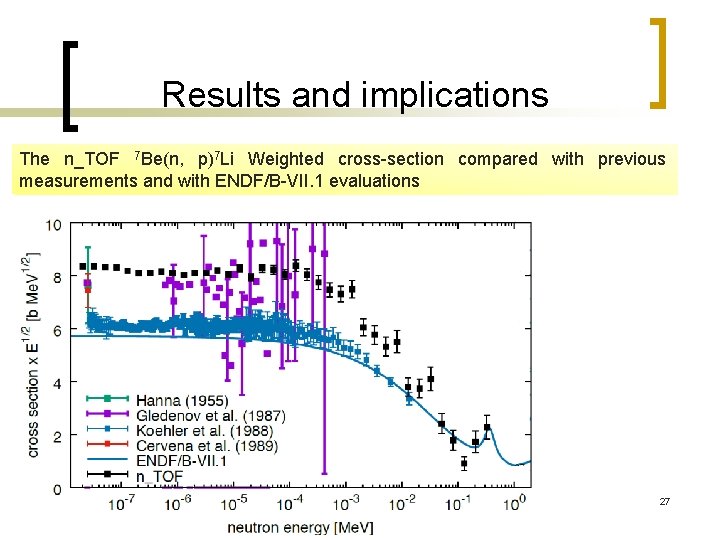
Results and implications The n_TOF 7 Be(n, p)7 Li Weighted cross-section compared with previous measurements and with ENDF/B-VII. 1 evaluations 2/21/2021 M. Mastromarco@ICNFP 2018, Creta, Greece 27
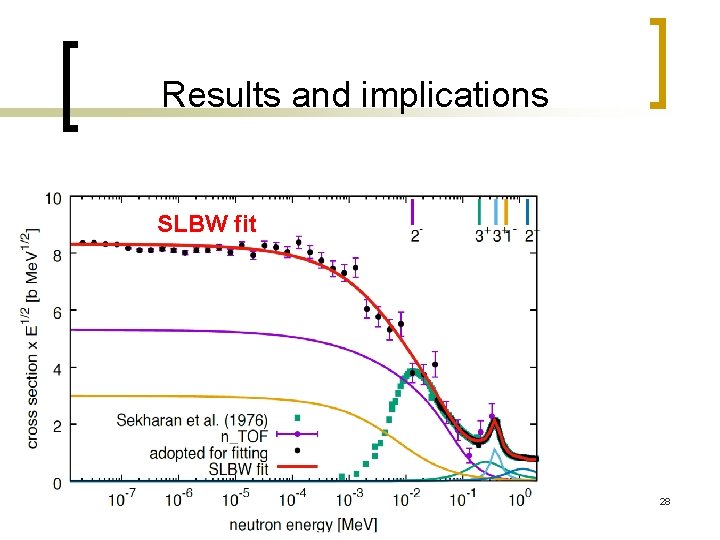
Results and implications SLBW fit 2/21/2021 M. Mastromarco@ICNFP 2018, Creta, Greece 28
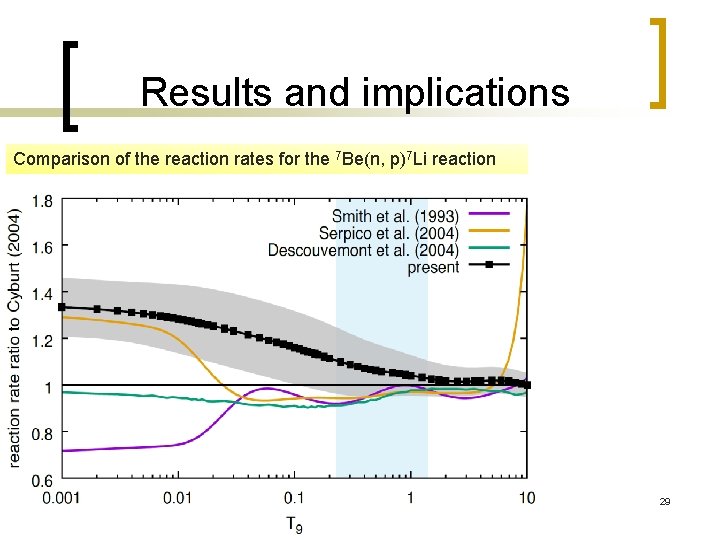
Results and implications Comparison of the reaction rates for the 7 Be(n, p)7 Li reaction 2/21/2021 M. Mastromarco@ICNFP 2018, Creta, Greece 29
Conclusions n At n_TOF the 7 Be(n, ɣα)α and the 7 Be(n, p)7 Li cross-section have been measured for the first time in the energetic range of interest for the problem n The 7 Be(n, ɣα)α relative large change in the reaction rate has a minor effect on the lithium and beryllium production during the BBN (≈ 2%) n The reaction rate of the 7 Be(n, p)7 Li performed at n_TOF cause a decrease of 10% of the abundance predicted for the primordial 7 Li n We have not solved the problem, but at least now we are sure that the solution is not linked to the neutron channel reaction. 2/21/2021 M. Mastromarco@ICNFP 2018, Creta, Greece 30
M. Mastromarco@ICNFP 2018, Creta, Greece 31
Background Solutions M. Mastromarco@ICNFP 2018, Creta, Greece 32
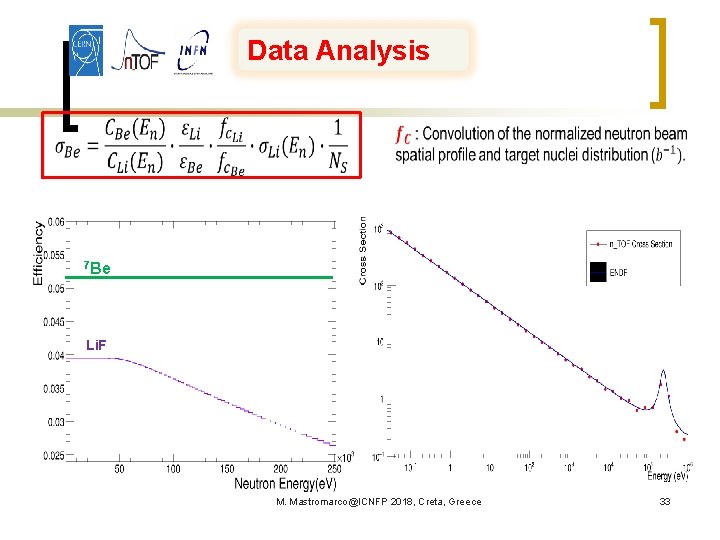
Data Analysis 7 Be Li. F M. Mastromarco@ICNFP 2018, Creta, Greece 33
- Slides: 33