
N 6 THERMODYNAMICS Entropy N 6 THERMODYNAMICS Target
- Slides: 24
N 6 - THERMODYNAMICS Entropy
N 6 - THERMODYNAMICS Target: I can describe entropy and ways that a reaction may have an increase (or decrease) in entropy.
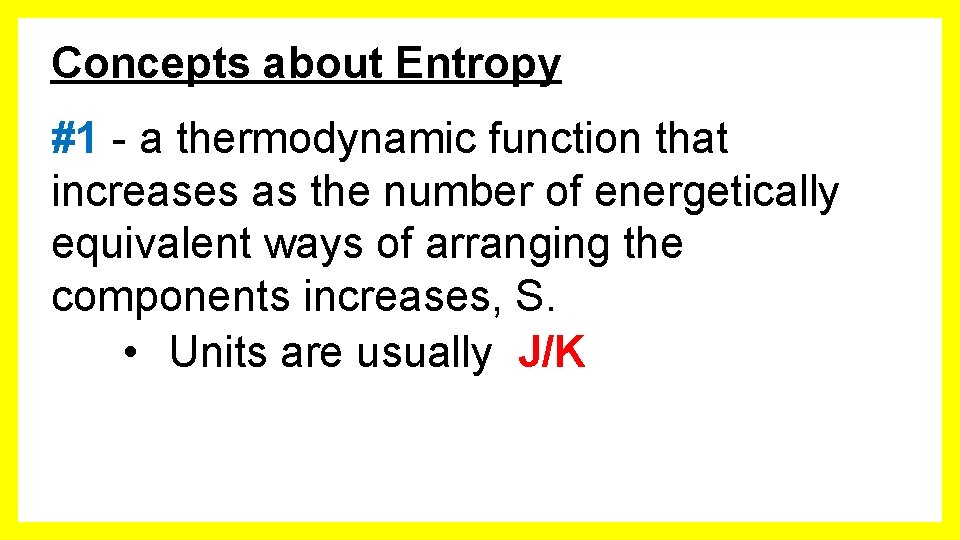
Concepts about Entropy #1 - a thermodynamic function that increases as the number of energetically equivalent ways of arranging the components increases, S. • Units are usually J/K
Concepts about Entropy #2 – Random systems are more energetically stable, lower energy, than ordered systems
Concepts about Entropy #3 – Increase in entropy of the universe is the driving force for spontaneous reactions.
Concepts about Entropy #4 – Nature proceeds toward the states that have the highest probabilities of existing.
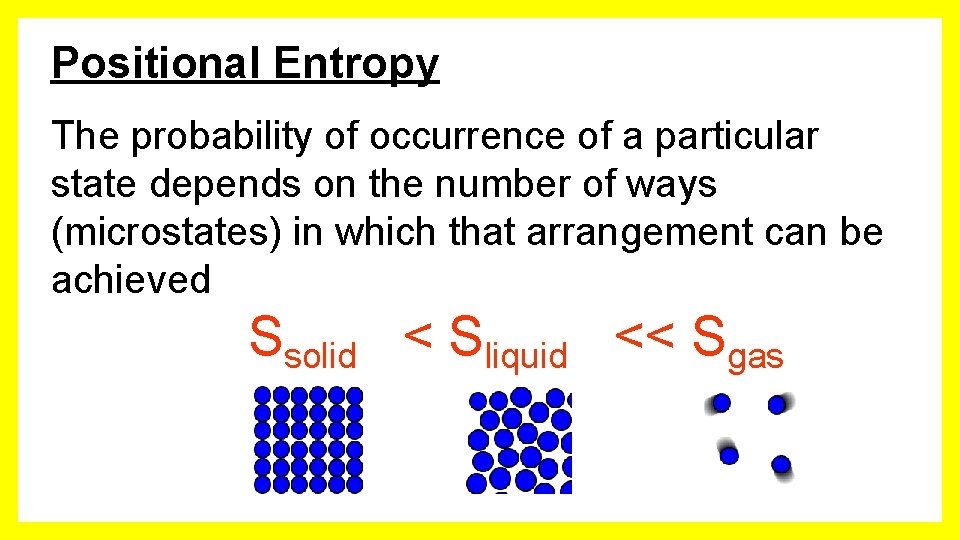
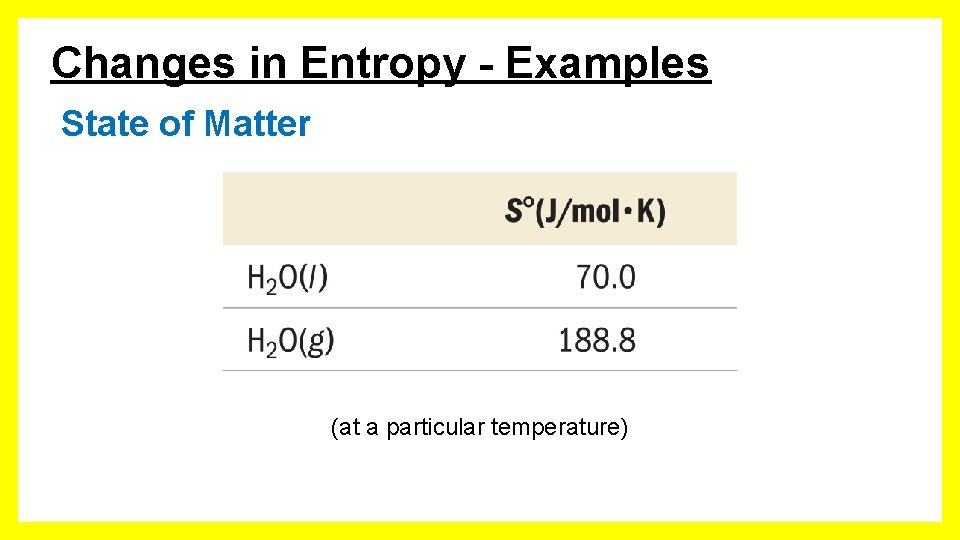
Positional Entropy The probability of occurrence of a particular state depends on the number of ways (microstates) in which that arrangement can be achieved Ssolid < Sliquid << Sgas
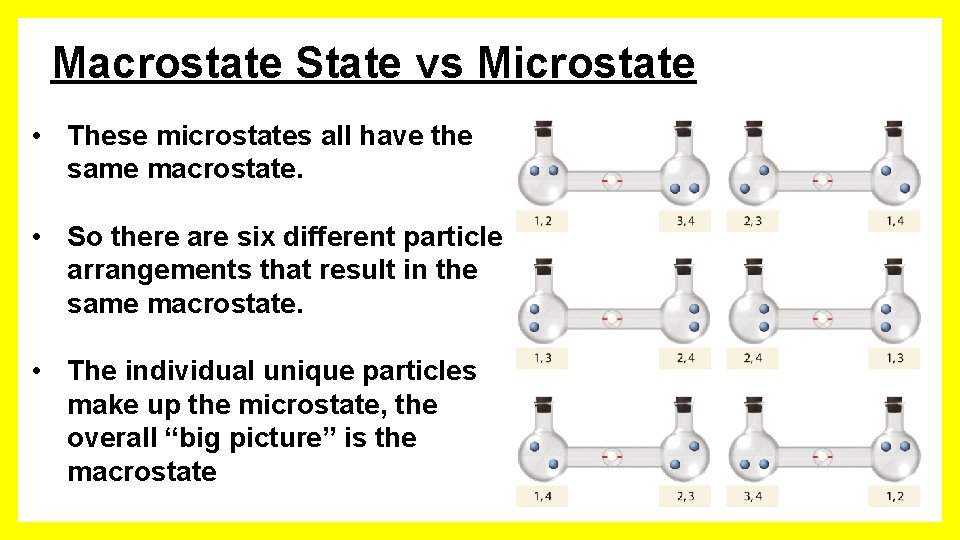
Macrostate State vs Microstate • These microstates all have the same macrostate. • So there are six different particle arrangements that result in the same macrostate. • The individual unique particles make up the microstate, the overall “big picture” is the macrostate
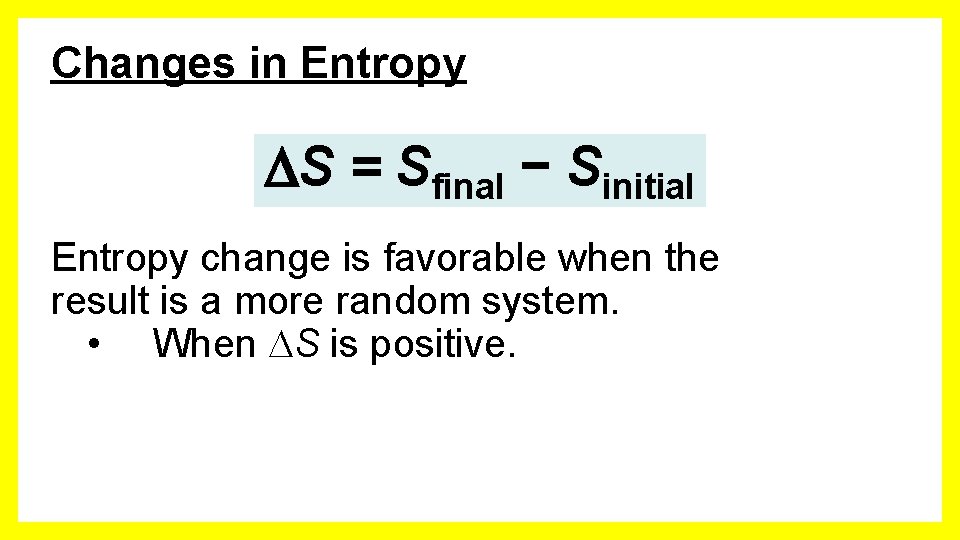
Changes in Entropy DS = Sfinal − Sinitial Entropy change is favorable when the result is a more random system. • When DS is positive.
Changes in Entropy Some changes that increase entropy: #1 - Rxn’s whose products are in a more random state
Changes in Entropy Some changes that increase entropy: #2 - Rxn’s that have larger numbers of product molecules than reactant molecules
Changes in Entropy Some changes that increase entropy: #3 - Rxn’s that have an increase in temperature (exothermic)
Changes in Entropy Some changes that increase entropy: #4 - Rxn’s that have solids dissociating into ions Na. Cl(s) Na. Cl(aq) Na+ + Cl-
Changes in Entropy - Examples State of Matter (at a particular temperature)
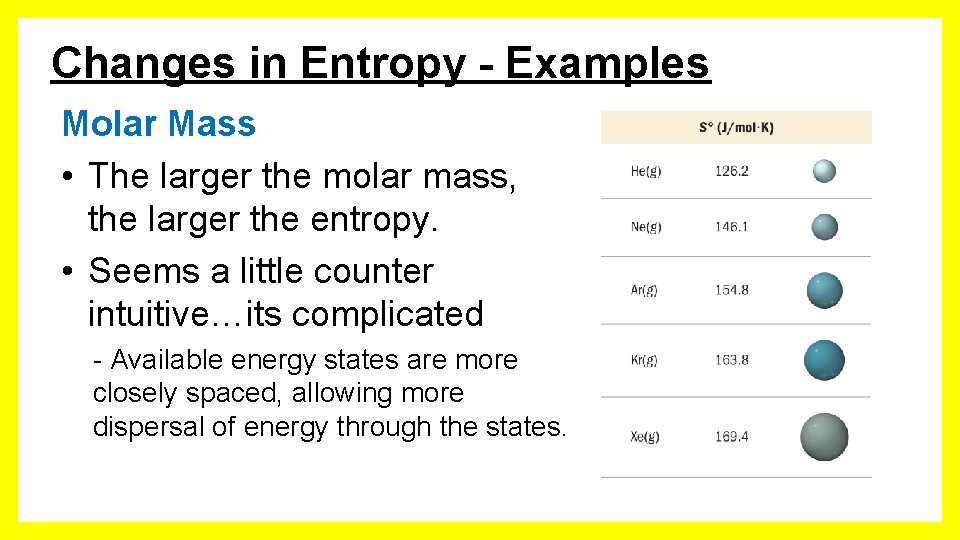
Changes in Entropy - Examples Molar Mass • The larger the molar mass, the larger the entropy. • Seems a little counter intuitive…its complicated - Available energy states are more closely spaced, allowing more dispersal of energy through the states.
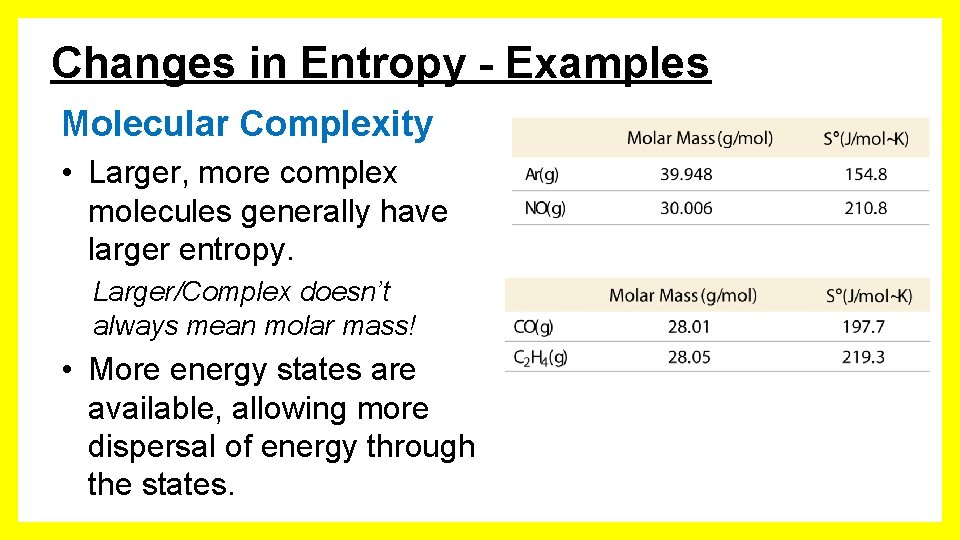
Changes in Entropy - Examples Molecular Complexity • Larger, more complex molecules generally have larger entropy. Larger/Complex doesn’t always mean molar mass! • More energy states are available, allowing more dispersal of energy through the states.
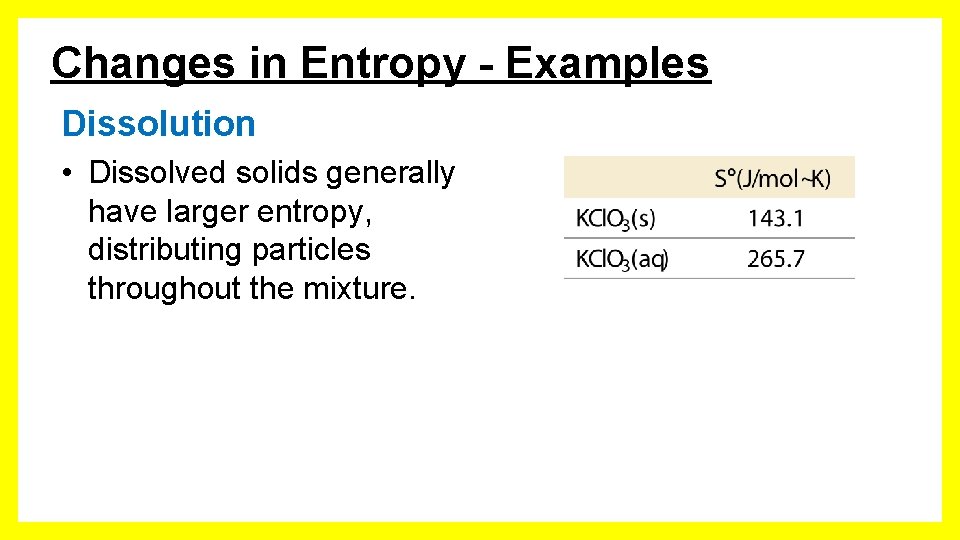
Changes in Entropy - Examples Dissolution • Dissolved solids generally have larger entropy, distributing particles throughout the mixture.
2 nd Law of Thermodynamics The total entropy change of the universe must be positive for a process to be spontaneous Reversible process ∆Suniv = 0 Irreversible spontaneous process ∆Suniv > 0
2 nd Law of Thermodynamics DSuniverse = DSsystem + DSsurroundings If the entropy of the system ↓ Then the entropy of the surroundings must ↑ by a larger amount.
2 nd Law of Thermodynamics DSuniverse = DSsystem + DSsurroundings When DSsystem is negative, DSsurroundings must be positive and bigger for a spontaneous process.
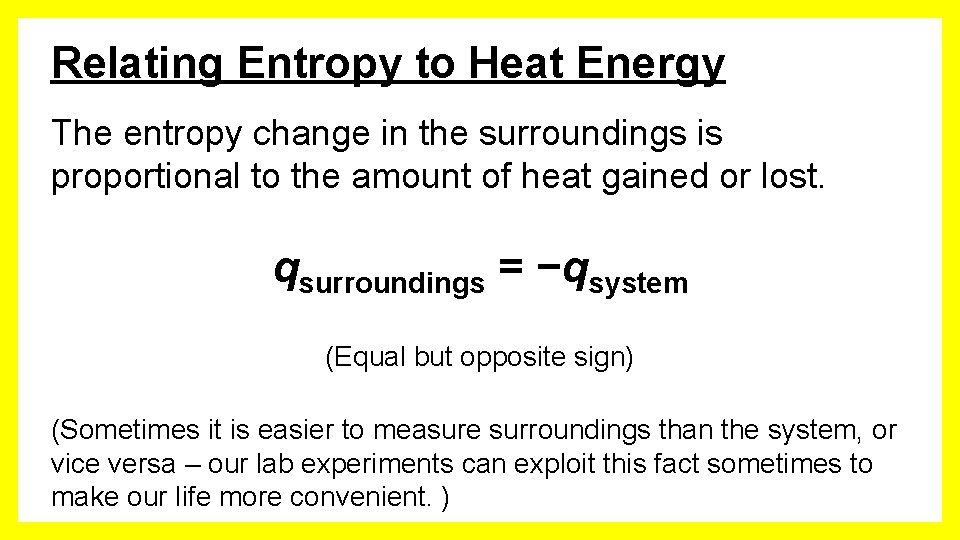
Relating Entropy to Heat Energy The entropy change in the surroundings is proportional to the amount of heat gained or lost. qsurroundings = −qsystem (Equal but opposite sign) (Sometimes it is easier to measure surroundings than the system, or vice versa – our lab experiments can exploit this fact sometimes to make our life more convenient. )
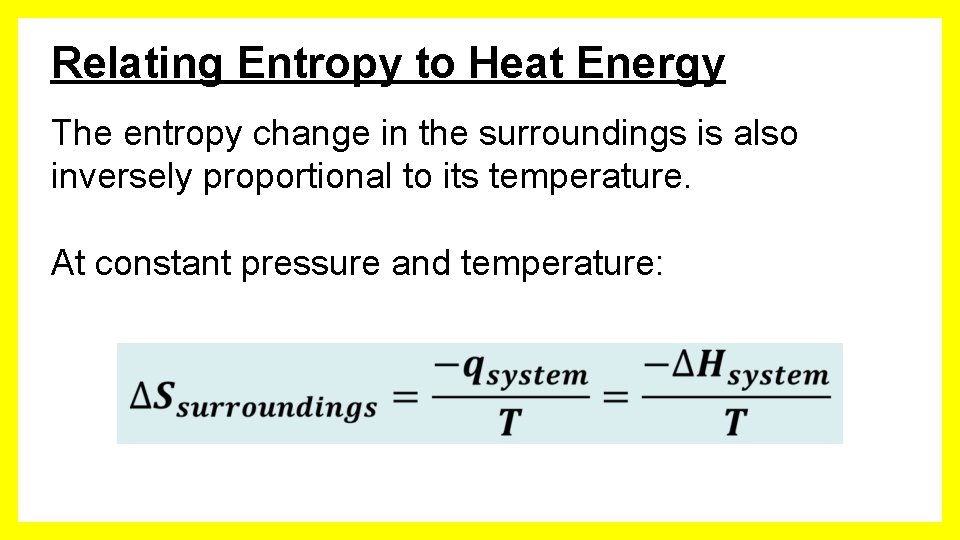
Relating Entropy to Heat Energy The entropy change in the surroundings is also inversely proportional to its temperature. At constant pressure and temperature:
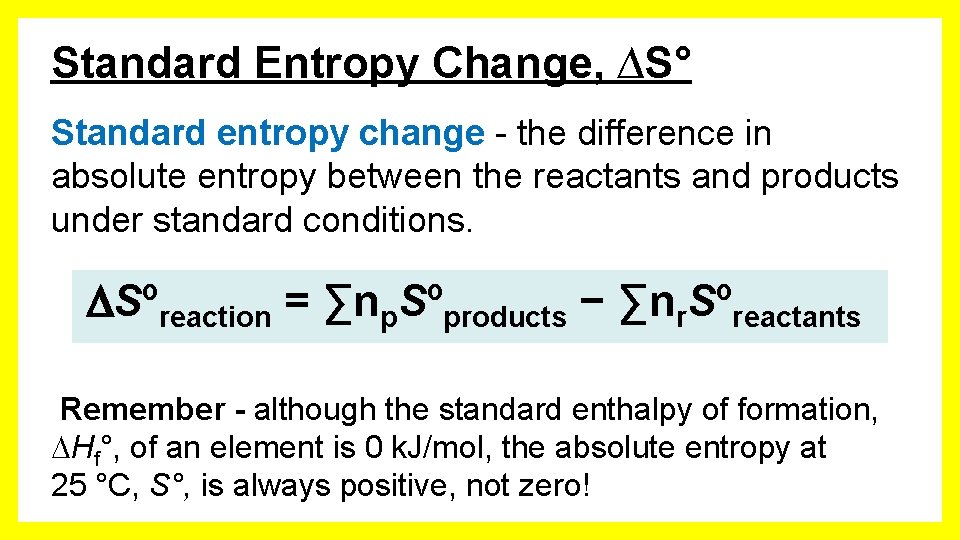
Standard Entropy Change, ∆S° Standard entropy change - the difference in absolute entropy between the reactants and products under standard conditions. DSºreaction = ∑np. Sºproducts − ∑nr. Sºreactants Remember - although the standard enthalpy of formation, DHf°, of an element is 0 k. J/mol, the absolute entropy at 25 °C, S°, is always positive, not zero!
You. Tube Link to Presentation https: //youtu. be/_ta. VUOPK 3 PQ