
N 6 H and O 6 H charge
![Radial coupling matrix elements: [NH] 6+](https://slidetodoc.com/presentation_image_h2/5674073285a1ada5429563807f565c83/image-7.jpg "Radial coupling matrix elements: [NH] 6+")
![Rotational coupling matrix elements : [NH] 6+](https://slidetodoc.com/presentation_image_h2/5674073285a1ada5429563807f565c83/image-8.jpg "Rotational coupling matrix elements : [NH] 6+")
![Radial coupling matrix elements: [OH] 6+](https://slidetodoc.com/presentation_image_h2/5674073285a1ada5429563807f565c83/image-10.jpg "Radial coupling matrix elements: [OH] 6+")
![Rotational coupling matrix elements: [OH] 6+](https://slidetodoc.com/presentation_image_h2/5674073285a1ada5429563807f565c83/image-11.jpg "Rotational coupling matrix elements: [OH] 6+")
![Results Asymptotic energy: [NH]6+ singlet states The largest energy difference less than 0. 05](https://slidetodoc.com/presentation_image_h2/5674073285a1ada5429563807f565c83/image-13.jpg "Results Asymptotic energy: [NH]6+ singlet states The largest energy difference less than 0. 05")
![Results Asymptotic energy: [OH]6+ The largest energy difference is about 0. 03 e. V!!](https://slidetodoc.com/presentation_image_h2/5674073285a1ada5429563807f565c83/image-14.jpg "Results Asymptotic energy: [OH]6+ The largest energy difference is about 0. 03 e. V!!")

- Slides: 22
N 6+ +H and O 6+ +H charge exchange Y. Wu, P. C. Stancil University of Georgia H. P. Lieberman, R. J. Buenker Bergische Universit at Wuppertal D. R. Schultz, Y. Hui , C. C. Havener Oak Ridge National Laboratory ADAS 16 th, Auburn, 06 -10 -2011
Outline ¡ Background ¡ Theoretical Methods ¡ Results ¡ Summary
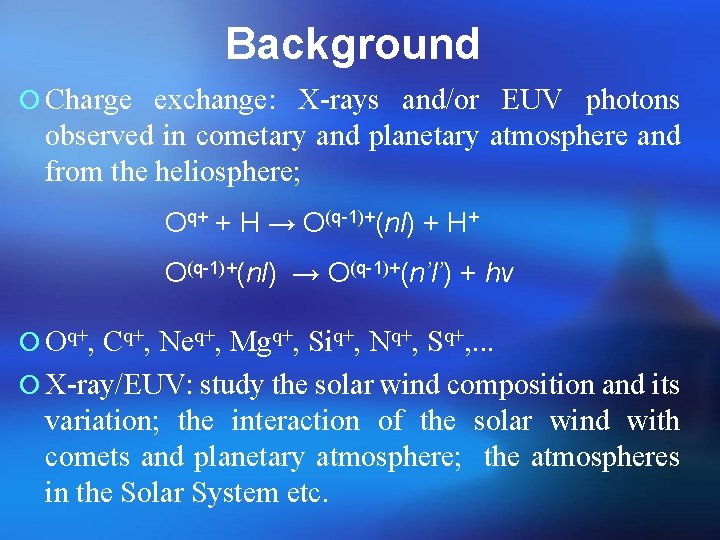
Background ¡ Charge exchange: X-rays and/or EUV photons observed in cometary and planetary atmosphere and from the heliosphere; Oq+ + H → O(q-1)+(nl) + H+ O(q-1)+(nl) → O(q-1)+(n’l’) + hν ¡ Oq+, Cq+, Neq+, Mgq+, Siq+, Nq+, Sq+, . . . ¡ X-ray/EUV: study the solar wind composition and its variation; the interaction of the solar wind with comets and planetary atmosphere; the atmospheres in the Solar System etc.
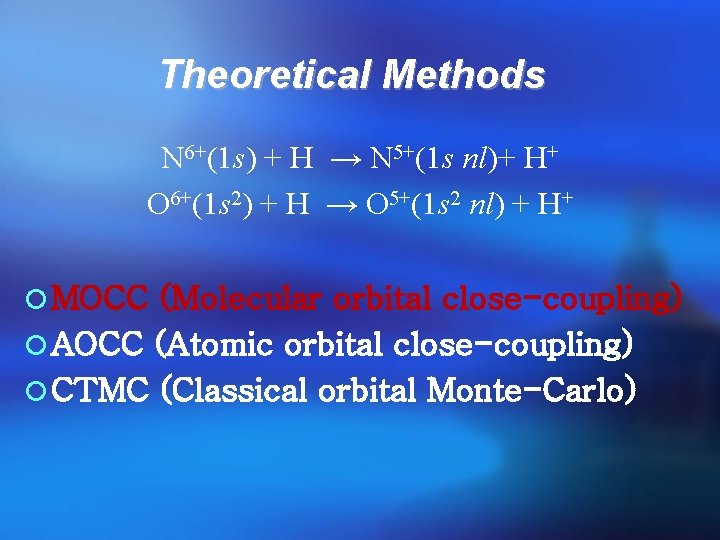
Theoretical Methods N 6+(1 s) + H → N 5+(1 s nl)+ H+ O 6+(1 s 2) + H → O 5+(1 s 2 nl) + H+ ¡ MOCC (Molecular orbital close-coupling) ¡ AOCC (Atomic orbital close-coupling) ¡ CTMC (Classical orbital Monte-Carlo)
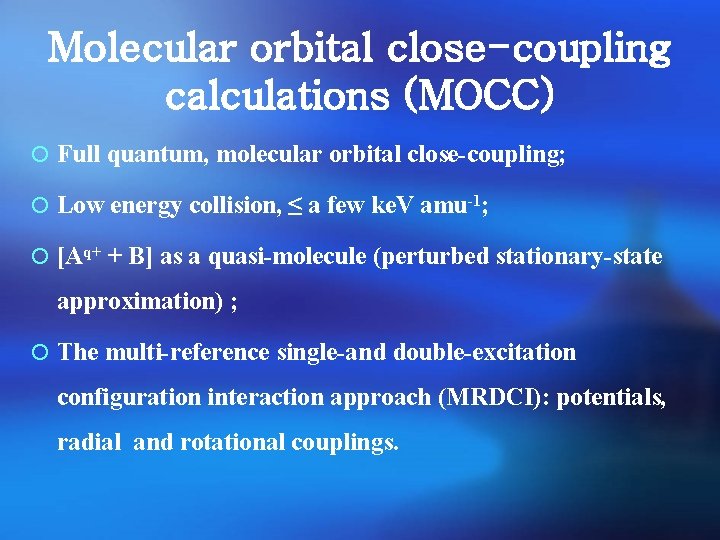
Molecular orbital close-coupling calculations (MOCC) ¡ Full quantum, molecular orbital close-coupling; ¡ Low energy collision, ≤ a few ke. V amu-1; ¡ [Aq+ + B] as a quasi-molecule (perturbed stationary-state approximation) ; ¡ The multi-reference single-and double-excitation configuration interaction approach (MRDCI): potentials, radial and rotational couplings.
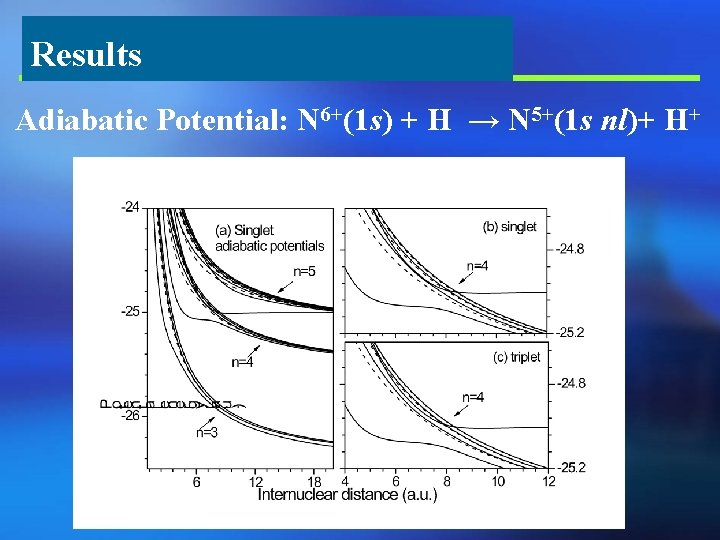
Results Adiabatic Potential: N 6+(1 s) + H → N 5+(1 s nl)+ H+
Radial coupling matrix elements: [NH] 6+
Rotational coupling matrix elements : [NH] 6+
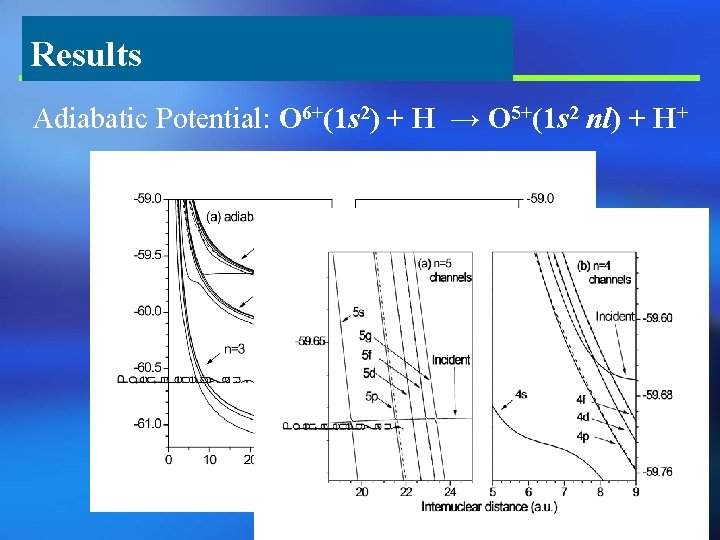
Results Adiabatic Potential: O 6+(1 s 2) + H → O 5+(1 s 2 nl) + H+
Radial coupling matrix elements: [OH] 6+
Rotational coupling matrix elements: [OH] 6+
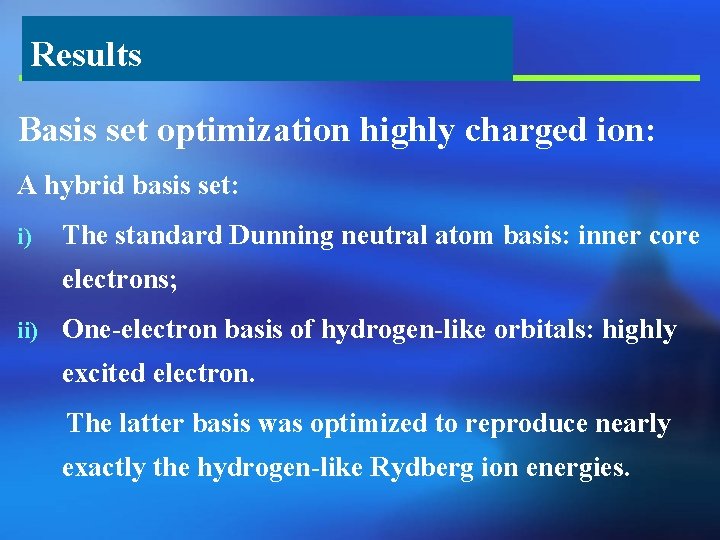
Results Basis set optimization highly charged ion: A hybrid basis set: i) The standard Dunning neutral atom basis: inner core electrons; ii) One-electron basis of hydrogen-like orbitals: highly excited electron. The latter basis was optimized to reproduce nearly exactly the hydrogen-like Rydberg ion energies.
Results Asymptotic energy: [NH]6+ singlet states The largest energy difference less than 0. 05 e. V!!
Results Asymptotic energy: [OH]6+ The largest energy difference is about 0. 03 e. V!!
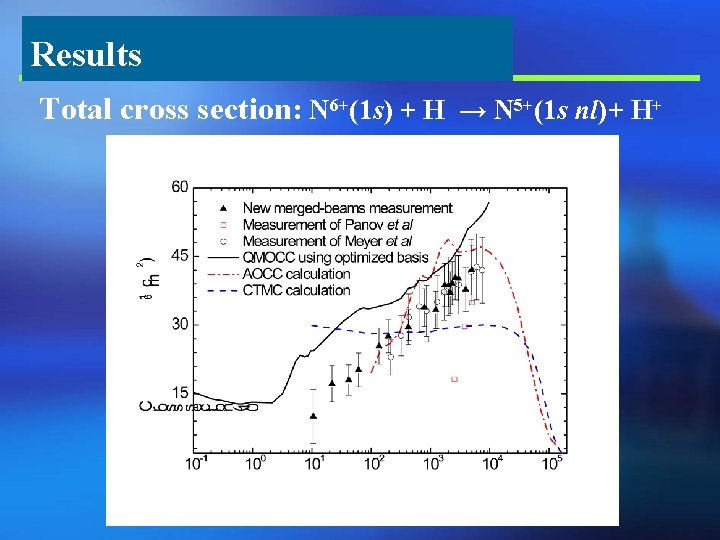
Results Total cross section: N 6+(1 s) + H → N 5+(1 s nl)+ H+
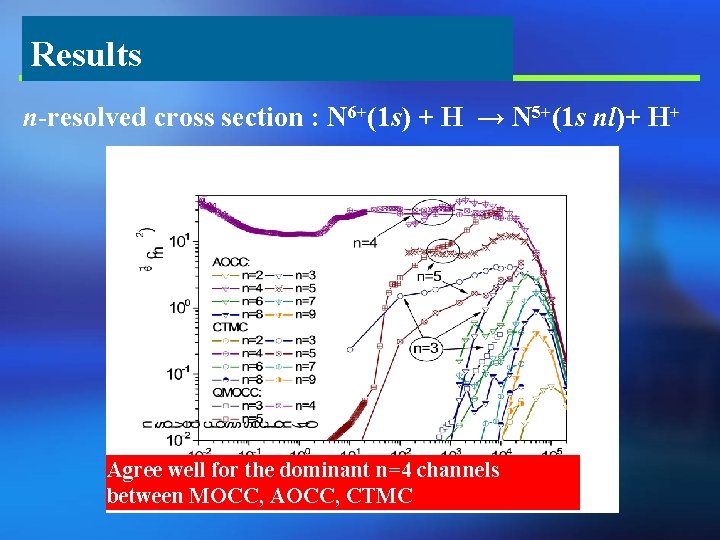
Results n-resolved cross section : N 6+(1 s) + H → N 5+(1 s nl)+ H+ Agree well for the dominant n=4 channels between MOCC, AOCC, CTMC
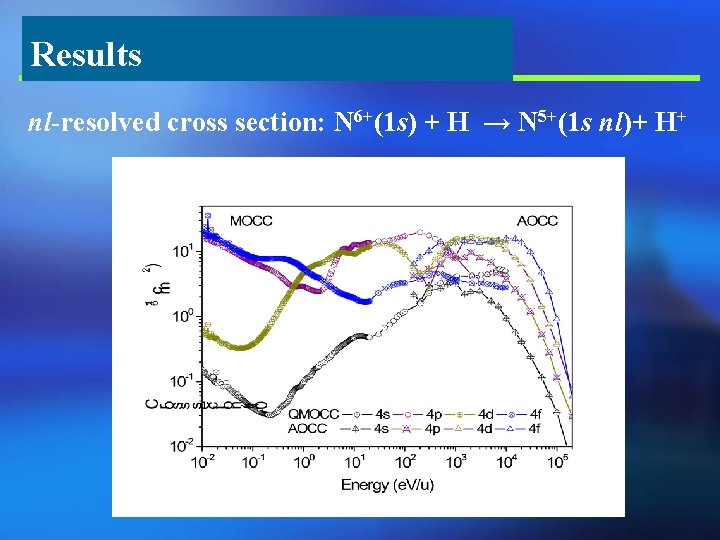
Results nl-resolved cross section: N 6+(1 s) + H → N 5+(1 s nl)+ H+
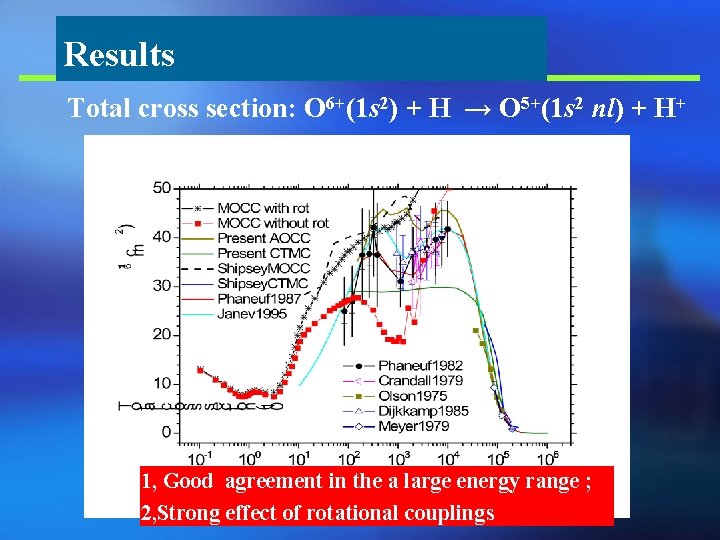
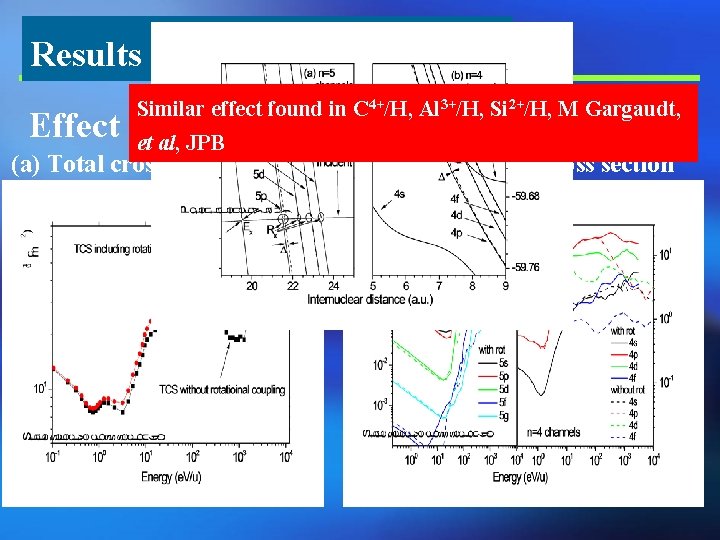
Results Total cross section: O 6+(1 s 2) + H → O 5+(1 s 2 nl) + H+ 1, Good agreement in the a large energy range ; 2, Strong effect of rotational couplings
Results Similar effect found in C 4+/H, Al 3+/H, Si 2+/H, M Gargaudt, Effect setof rotational couplings: al, JPB (a) Total cross section; (b) State-selective cross section
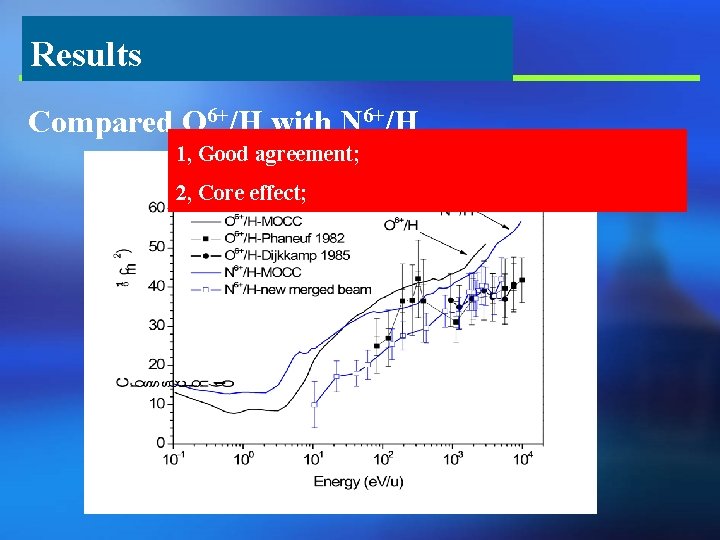
Results Compared O 6+/H with N 6+/H 1, Good agreement; 2, Core effect;
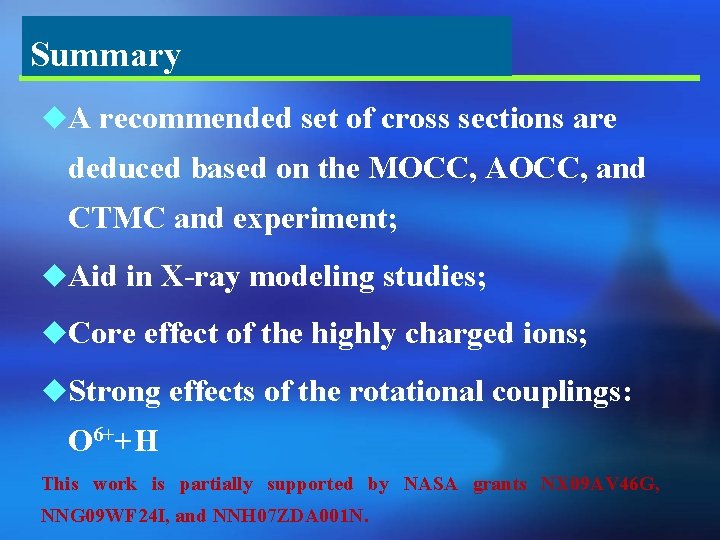
Summary u. A recommended set of cross sections are deduced based on the MOCC, AOCC, and CTMC and experiment; u. Aid in X-ray modeling studies; u. Core effect of the highly charged ions; u. Strong effects of the rotational couplings: O 6++H This work is partially supported by NASA grants NX 09 AV 46 G, NNG 09 WF 24 I, and NNH 07 ZDA 001 N.
Thank you for your attention !!!