
N 5 Assignment Guidelines for students Teachers my

- Slides: 10
N 5 Assignment Guidelines for students Teachers my wish to use the SQA N 5 Assignment instructions for candidates when going through this Power. Point or printed copies of this Power. Point This has been designed to go along with the Added Value Pupil booklet
The Assignment This assignment is worth 20 marks out of the total of 80 marks. This is 25% of the overall marks for the Course assessment. The Course will be graded A–D. The assessment for the assignment will be in the form of a report of your research and findings. You must complete this report within one hour. You will take Processed Information, collected during your research, into the assessment and you should refer to this information in your assessment. This Processed Information should be no more than two singlesides of A 4 paper.
The Assignment In order to complete this assignment you will: Choose, with minimum support, an appropriate geographical topic or issue. Collect information from a limited range of sources of information, which should include the use of fieldwork where possible and/or maps Process the information gathered, using geographical skills/techniques Draw on knowledge and understanding to explain and analyse key features of the topic or issue Reach a well-supported conclusion, supported by evidence about the topic or issue studied
Choosing a topic You will have a very wide choice of possible topics to research. You can research something you have studied in class or a topic or issue about which you are personally interested in finding out more. It can be local or based on something further afield. It will be easier to write a good report on a topic which has generated clear results, so that you can comment on and explain these findings rather than just making descriptive points. It would be helpful if you have a very clear idea of what you are trying to find out. This might take the form of a research question or questions or statement(s) which you try to prove or disprove. Make sure you can gather information on your geographical topic in two different ways.
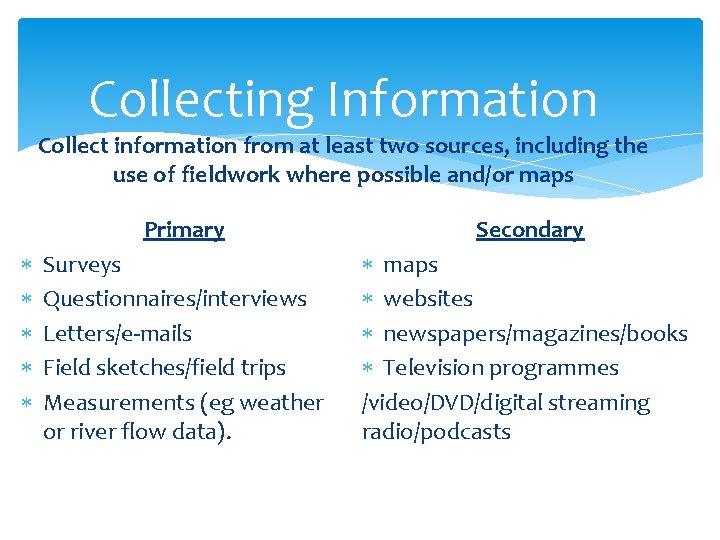
Collecting Information Collect information from at least two sources, including the use of fieldwork where possible and/or maps Primary Secondary Surveys Questionnaires/interviews Letters/e-mails Field sketches/field trips Measurements (eg weather or river flow data). maps websites newspapers/magazines/books Television programmes /video/DVD/digital streaming radio/podcasts
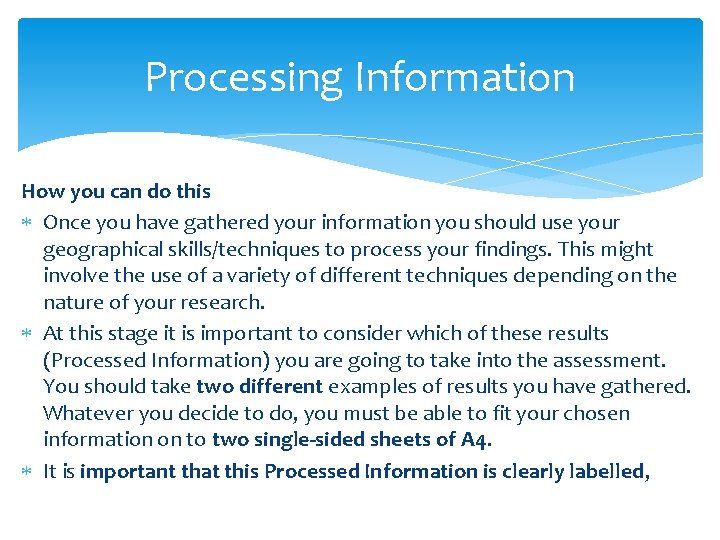
Processing Information How you can do this Once you have gathered your information you should use your geographical skills/techniques to process your findings. This might involve the use of a variety of different techniques depending on the nature of your research. At this stage it is important to consider which of these results (Processed Information) you are going to take into the assessment. You should take two different examples of results you have gathered. Whatever you decide to do, you must be able to fit your chosen information on to two single-sided sheets of A 4. It is important that this Processed Information is clearly labelled,
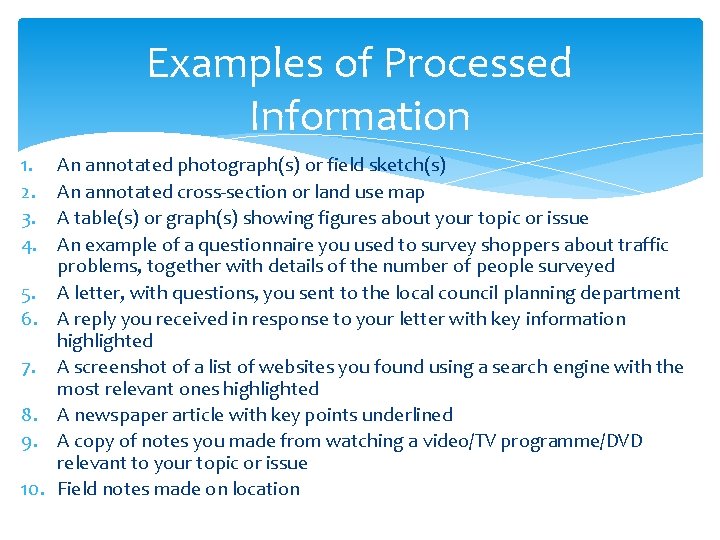
Examples of Processed Information 1. 2. 3. 4. 5. 6. 7. 8. 9. 10. An annotated photograph(s) or field sketch(s) An annotated cross-section or land use map A table(s) or graph(s) showing figures about your topic or issue An example of a questionnaire you used to survey shoppers about traffic problems, together with details of the number of people surveyed A letter, with questions, you sent to the local council planning department A reply you received in response to your letter with key information highlighted A screenshot of a list of websites you found using a search engine with the most relevant ones highlighted A newspaper article with key points underlined A copy of notes you made from watching a video/TV programme/DVD relevant to your topic or issue Field notes made on location
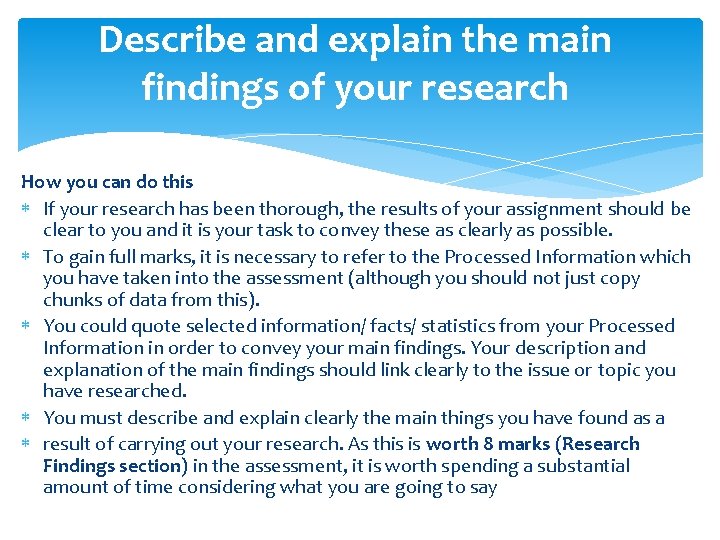
Describe and explain the main findings of your research How you can do this If your research has been thorough, the results of your assignment should be clear to you and it is your task to convey these as clearly as possible. To gain full marks, it is necessary to refer to the Processed Information which you have taken into the assessment (although you should not just copy chunks of data from this). You could quote selected information/ facts/ statistics from your Processed Information in order to convey your main findings. Your description and explanation of the main findings should link clearly to the issue or topic you have researched. You must describe and explain clearly the main things you have found as a result of carrying out your research. As this is worth 8 marks (Research Findings section) in the assessment, it is worth spending a substantial amount of time considering what you are going to say
Give a conclusion based on your geographical knowledge and the evidence gathered during your research How you can do this The final part of your assignment is to come to a conclusion about the topic or issue which you have been researching. This should involve interpreting or highlighting the main results of your research by making judgements linked to your findings. For example you could: 1. Make a decision or recommendation about your topic or issue 2. Explain the most important things you found out in your research 3. Provide answers to the question or questions you set yourself at the start of your research 4. Say whether or not the statement you started with has been proved or disproved
Good Luck!