
N 4 CHEMISTRY BONDING STRUCTURES PROPERTIES N 4
N 4 CHEMISTRY BONDING, STRUCTURES & PROPERTIES N 4 CHEMISTRY BONDING EXPLAINED
N 5 CHEMISTRY BONDING, STRUCTURE & PROPERTIES N 5 CHEMISTRY BONDING EXPLAINED After completing this topic you should be able to : • State in forming bonds atoms can achieve a stable electron arrangement. • Explain how metal and non-metal atoms achieve the stable electron arrangement by forming ions when they form an ionic compound. • Work out the electron arrangement of an ion. • Explain how non-metal atoms achieve the stable electron arrangement by sharing electrons in covalent bonding. • State the covalent bond is a result of two positive nuclei being held together by their common attraction for the shared pair of electrons.
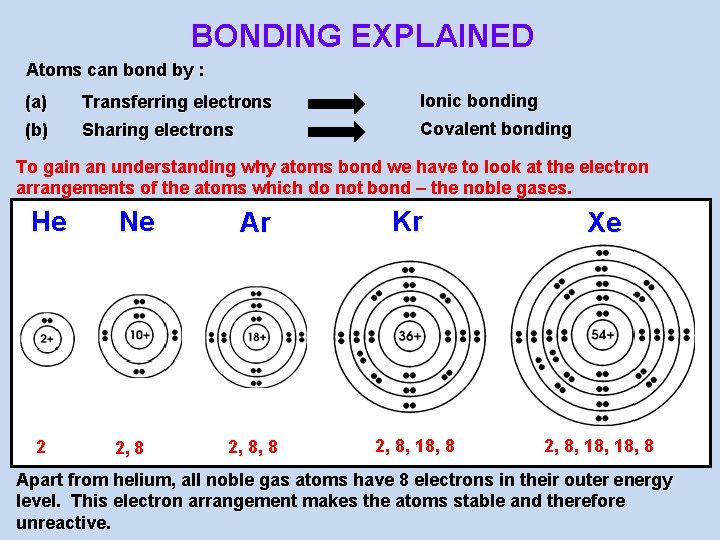
BONDING EXPLAINED Atoms can bond by : (a) Transferring electrons Ionic bonding (b) Sharing electrons Covalent bonding To gain an understanding why atoms bond we have to look at the electron arrangements of the atoms which do not bond – the noble gases. He Ne 2 2, 8 Ar 2, 8, 8 Kr 2, 8, 18, 8 Xe 2, 8, 18, 8 Apart from helium, all noble gas atoms have 8 electrons in their outer energy level. This electron arrangement makes the atoms stable and therefore unreactive.
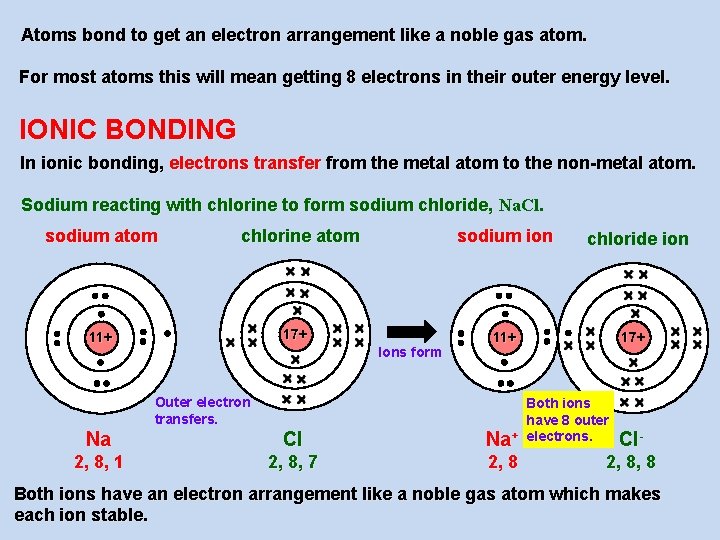
Atoms bond to get an electron arrangement like a noble gas atom. For most atoms this will mean getting 8 electrons in their outer energy level. IONIC BONDING In ionic bonding, electrons transfer from the metal atom to the non-metal atom. Sodium reacting with chlorine to form sodium chloride, Na. Cl. sodium atom sodium ion chlorine atom 17+ 11+ Ions form Outer electron transfers. Na Cl 2, 8, 1 2, 8, 7 chloride ion 17+ 11+ Both ions have 8 outer Na+ electrons. 2, 8 Cl- 2, 8, 8 Both ions have an electron arrangement like a noble gas atom which makes each ion stable.
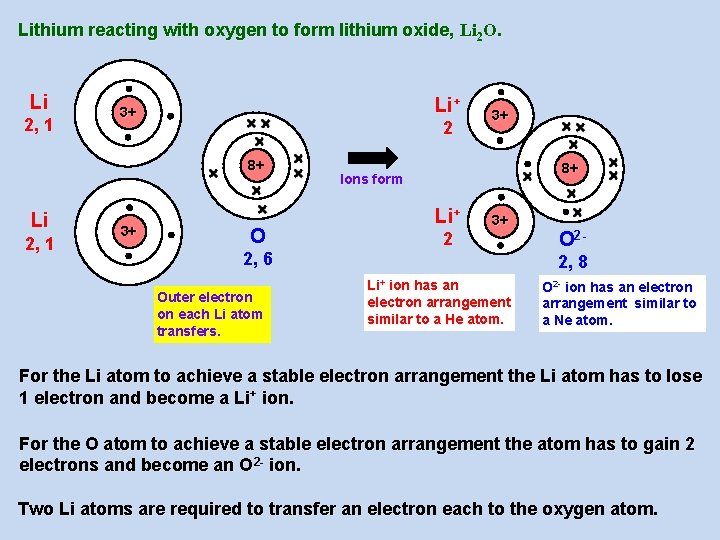
Lithium reacting with oxygen to form lithium oxide, Li 2 O. Li 2, 1 Li+ 3+ 2 8+ Li 2, 1 3+ O 2, 6 Outer electron on each Li atom transfers. 3+ 8+ Ions form Li+ 2 3+ O 22, 8 Li+ ion has an electron arrangement similar to a He atom. O 2 - ion has an electron arrangement similar to a Ne atom. For the Li atom to achieve a stable electron arrangement the Li atom has to lose 1 electron and become a Li+ ion. For the O atom to achieve a stable electron arrangement the atom has to gain 2 electrons and become an O 2 - ion. Two Li atoms are required to transfer an electron each to the oxygen atom.
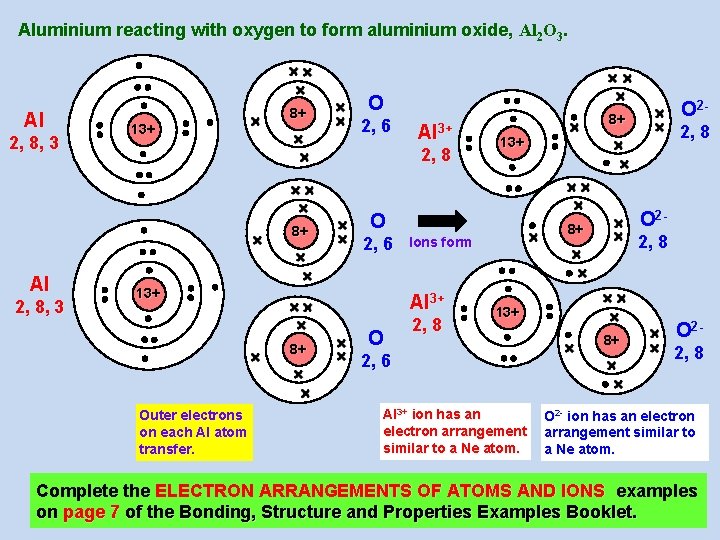
Aluminium reacting with oxygen to form aluminium oxide, Al 2 O 3. Al 2, 8, 3 13+ 8+ 2, 8, 3 2, 6 Al 3+ 2, 8 8+ Al O 13+ Outer electrons on each Al atom transfer. O 2, 8 13+ O 2 - 8+ Ions form Al 3+ 8+ 8+ O 2, 6 O 2 - 2, 8 13+ 2, 6 Al 3+ ion has an electron arrangement similar to a Ne atom. 8+ O 22, 8 O 2 - ion has an electron arrangement similar to a Ne atom. Complete the ELECTRON ARRANGEMENTS OF ATOMS AND IONS examples on page 7 of the Bonding, Structure and Properties Examples Booklet.
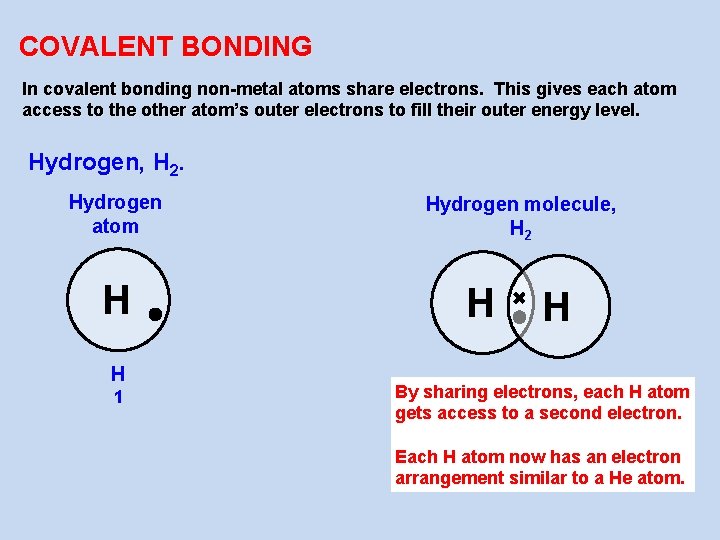
COVALENT BONDING In covalent bonding non-metal atoms share electrons. This gives each atom access to the other atom’s outer electrons to fill their outer energy level. Hydrogen, H 2. Hydrogen atom H H 1 Hydrogen molecule, H 2 H H By sharing electrons, each H atom gets access to a second electron. Each H atom now has an electron arrangement similar to a He atom.
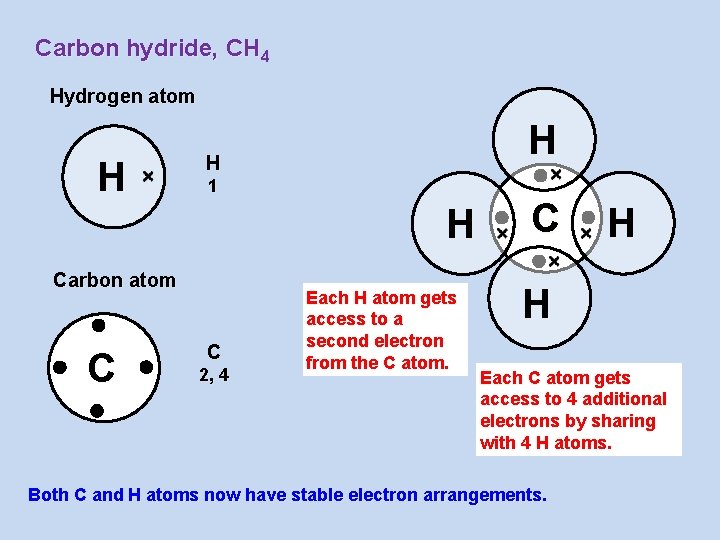
Carbon hydride, CH 4 Hydrogen atom H H H 1 H Carbon atom C C 2, 4 Each H atom gets access to a second electron from the C atom. C H H Each C atom gets access to 4 additional electrons by sharing with 4 H atoms. Both C and H atoms now have stable electron arrangements.
BONDING SUMMARY Atoms bond in order to get a stable electron arrangement – an electron arrangement similar to a Noble Gas atom. • Metal atoms achieve stability by losing their outer electrons and forming positive ions. • Non-metal atoms achieve stability by: gaining electrons forming negative ions; OR sharing electrons with other non-metal atoms and forming covalent bonds.
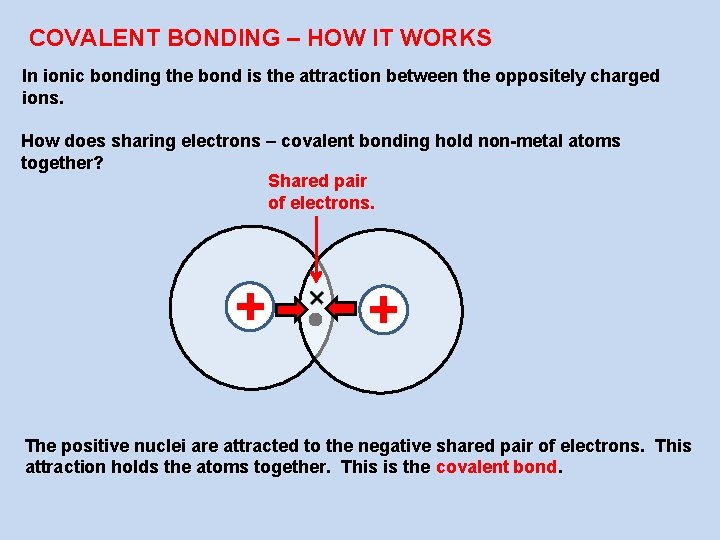
COVALENT BONDING – HOW IT WORKS In ionic bonding the bond is the attraction between the oppositely charged ions. How does sharing electrons – covalent bonding hold non-metal atoms together? Shared pair of electrons. + + The positive nuclei are attracted to the negative shared pair of electrons. This attraction holds the atoms together. This is the covalent bond.
- Slides: 10