
N 318 b Winter 2002 Nursing Statistics Michael

N 318 b Winter 2002 Nursing Statistics Michael S. Kerr, Ph. D School of Nursing, University of Western Ontario and Scientist, Workplace Studies Area, Institute for Work & Health Toronto, Ontario
Introduction Background: MSc and Ph. D in epidemiology Research interests include: - occupational epidemiology - work stress - biomarkers - health services research What is the “Institute for Work & Health”? School of Nursing Institute for Work & Health 2
Today’s Class(es) ö Overview of the course ö Why take a statistics course? - a quick look at some real data << 10 min break >> ö First lecture: Levels of measurement, hypotheses and types of variables Followed by small groups from 12 -2 PM Group work: hypotheses and levels of measurement School of Nursing Institute for Work & Health 3
Course Faculty Professor: Mickey Kerr Office: H 28 Phone: 661 -2111 Ext. 86580 Office Hours: Wednesdays 1030 -1200, 1300 -1400 or by appointment e-mail (mkerr@iwh. on. ca) or phone my office Teaching Assistants: Kristen Lethbridge, Heidi Siu Offices: H 035, H 021 Office Hours: Tuesdays after class 1400 -1600 (KL) Mondays 1500 -1700 (HS) School of Nursing Institute for Work & Health 4
Course Supplies Text: Munro, B. H. (2001). Statistical methods for health care research. (4 th Ed). Philadelphia: Lippincott. 2001 Course syllabus: - available from UWO Bookstore (#M 4476) - contains lecture outlines, required readings and questions for weekly assignments School of Nursing Institute for Work & Health 5
Course Description 1. an introduction to basic statistics 2. goal is for students to develop an understanding of statistical concepts and findings in research articles. 3. builds upon Nursing 319 a course Research Methodology 4. develop critical analysis skills to enable integration of research into practice School of Nursing Institute for Work & Health 6
i) Lectures Large Class: Tuesdays: 2 hours from 1000 - 1200 in MS 341 Content: 1. discussion to clarify what was read in text and prepared for class 2. review of data analyzed using the "test of the week" 3. direction for small working group (i. e. the weekly assignment) and next class School of Nursing Institute for Work & Health 7
ii) Small groups Time and Locations: Tuesdays following class: 2 hours from 1200 -1400 in rooms H 018, H 19, and H 9, (MS 016, MS 017), MS 018, MS 022, MS 023, MS 027, MS 028, MS 029. - course faculty available for consultation - focus is on collaborative learning activities such as: 1. weekly critique of results sections of specific studies highlighting the "test of the week" 2. time with your group to work on group assignments. Group Membership: Self-selected groups of approximately 7 -9 students Don’t take these sessions for granted as they are important opportunities to test knowledge – they will help with the exam ! School of Nursing Institute for Work & Health 8
Suggested Format for Small Working Groups At the beginning of each week select: 1. Group leader - who is responsible for facilitating discussion and decision making, and 2. Recorder - who is responsible for writing answers to the learning activity and ensuring all participating students sign the cover page; and, 3. An observer - who is responsible for noting involvement of group members and encouraging those who are not participating to do so. Rotate who has each of the three roles each week over the course so that each group members assumes all of the roles Please don’t take these sessions for granted as they are important opportunities to test knowledge – they will help with the exam ! School of Nursing Institute for Work & Health 9
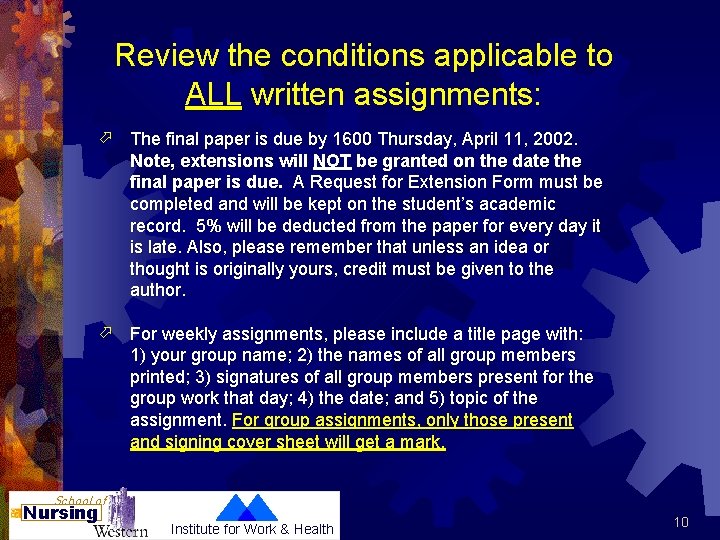
Review the conditions applicable to ALL written assignments: ö The final paper is due by 1600 Thursday, April 11, 2002. Note, extensions will NOT be granted on the date the final paper is due. A Request for Extension Form must be completed and will be kept on the student’s academic record. 5% will be deducted from the paper for every day it is late. Also, please remember that unless an idea or thought is originally yours, credit must be given to the author. ö For weekly assignments, please include a title page with: 1) your group name; 2) the names of all group members printed; 3) signatures of all group members present for the group work that day; 4) the date; and 5) topic of the assignment. For group assignments, only those present and signing cover sheet will get a mark. School of Nursing Institute for Work & Health 10
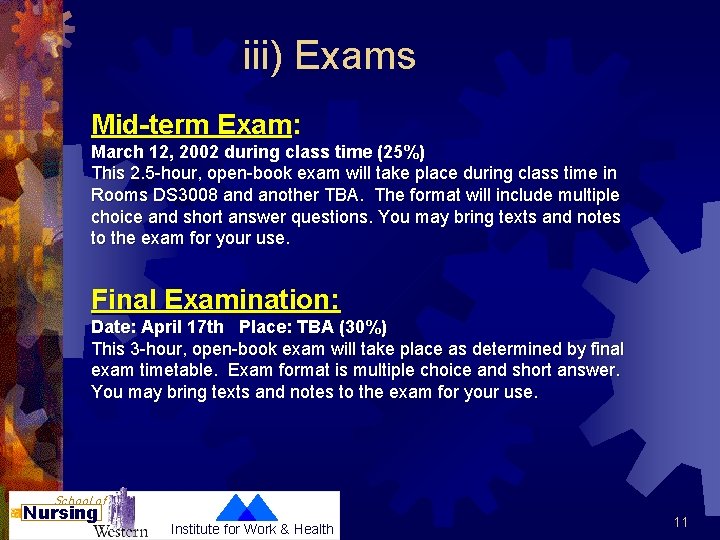
iii) Exams Mid-term Exam: March 12, 2002 during class time (25%) This 2. 5 -hour, open-book exam will take place during class time in Rooms DS 3008 and another TBA. The format will include multiple choice and short answer questions. You may bring texts and notes to the exam for your use. Final Examination: Date: April 17 th Place: TBA (30%) This 3 -hour, open-book exam will take place as determined by final exam timetable. Exam format is multiple choice and short answer. You may bring texts and notes to the exam for your use. School of Nursing Institute for Work & Health 11
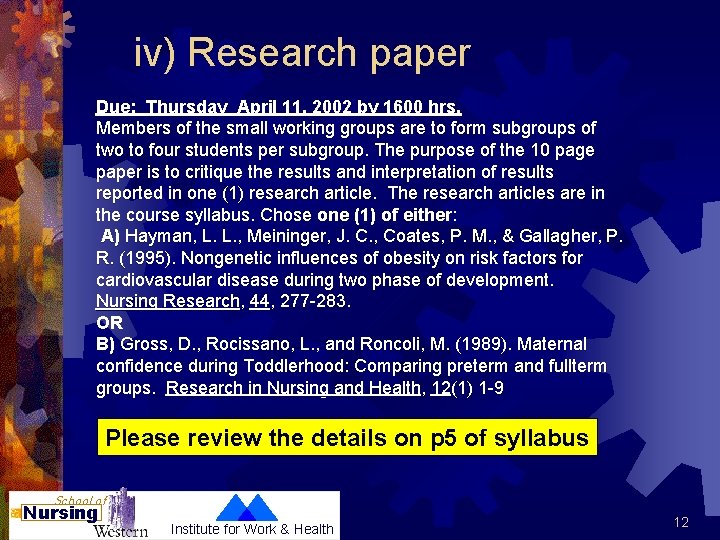
iv) Research paper Due: Thursday April 11, 2002 by 1600 hrs. Members of the small working groups are to form subgroups of two to four students per subgroup. The purpose of the 10 page paper is to critique the results and interpretation of results reported in one (1) research article. The research articles are in the course syllabus. Chose one (1) of either: A) Hayman, L. L. , Meininger, J. C. , Coates, P. M. , & Gallagher, P. R. (1995). Nongenetic influences of obesity on risk factors for cardiovascular disease during two phase of development. Nursing Research, 44, 277 -283. OR B) Gross, D. , Rocissano, L. , and Roncoli, M. (1989). Maternal confidence during Toddlerhood: Comparing preterm and fullterm groups. Research in Nursing and Health, 12(1) 1 -9 Please review the details on p 5 of syllabus School of Nursing Institute for Work & Health 12
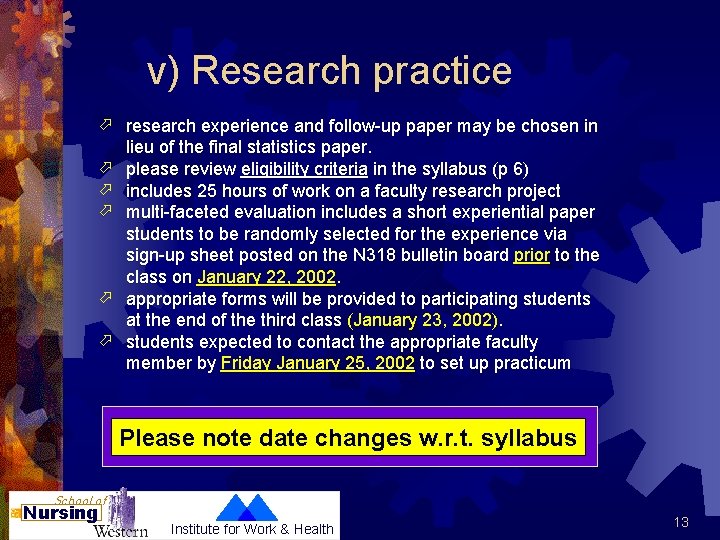
v) Research practice ö research experience and follow-up paper may be chosen in lieu of the final statistics paper. ö please review eligibility criteria in the syllabus (p 6) ö includes 25 hours of work on a faculty research project ö multi-faceted evaluation includes a short experiential paper students to be randomly selected for the experience via sign-up sheet posted on the N 318 bulletin board prior to the class on January 22, 2002. ö appropriate forms will be provided to participating students at the end of the third class (January 23, 2002). ö students expected to contact the appropriate faculty member by Friday January 25, 2002 to set up practicum Please note date changes w. r. t. syllabus School of Nursing Institute for Work & Health 13
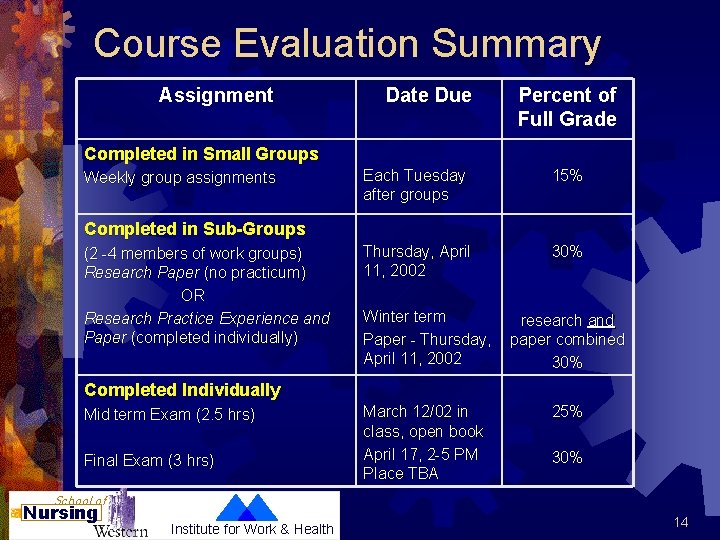
Course Evaluation Summary Assignment Date Due Percent of Full Grade Completed in Small Groups Weekly group assignments Each Tuesday after groups 15% Thursday, April 11, 2002 30% Completed in Sub-Groups (2 -4 members of work groups) Research Paper (no practicum) OR Research Practice Experience and Paper (completed individually) Winter term Paper - Thursday, April 11, 2002 research and paper combined 30% March 12/02 in class, open book April 17, 2 -5 PM Place TBA 25% Completed Individually Mid term Exam (2. 5 hrs) Final Exam (3 hrs) 30% School of Nursing Institute for Work & Health 14
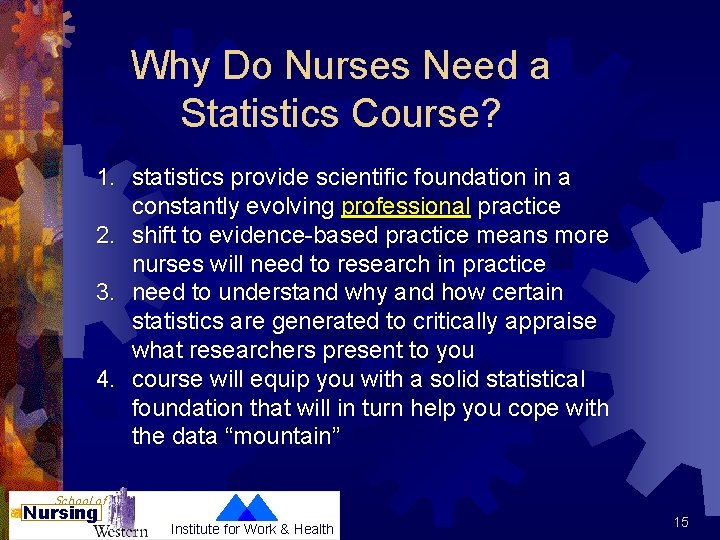
Why Do Nurses Need a Statistics Course? 1. statistics provide scientific foundation in a constantly evolving professional practice 2. shift to evidence-based practice means more nurses will need to research in practice 3. need to understand why and how certain statistics are generated to critically appraise what researchers present to you 4. course will equip you with a solid statistical foundation that will in turn help you cope with the data “mountain” School of Nursing Institute for Work & Health 15
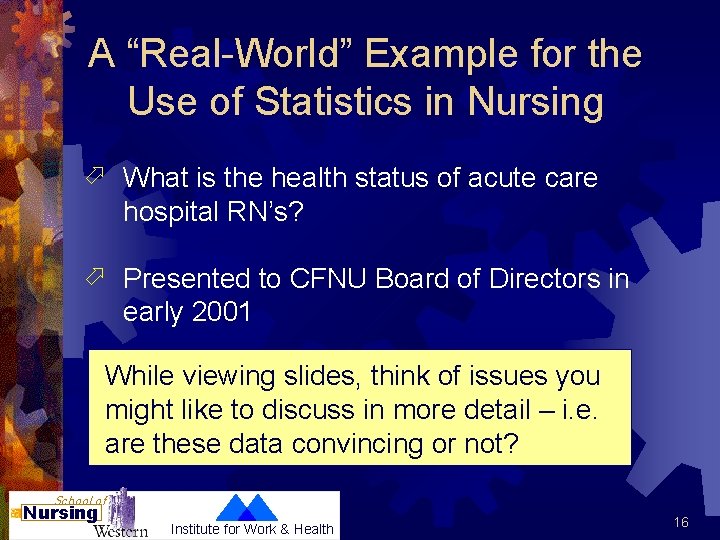
A “Real-World” Example for the Use of Statistics in Nursing ö What is the health status of acute care hospital RN’s? ö Presented to CFNU Board of Directors in early 2001 While viewing slides, think of issues you might like to discuss in more detail – i. e. are these data convincing or not? School of Nursing Institute for Work & Health 16
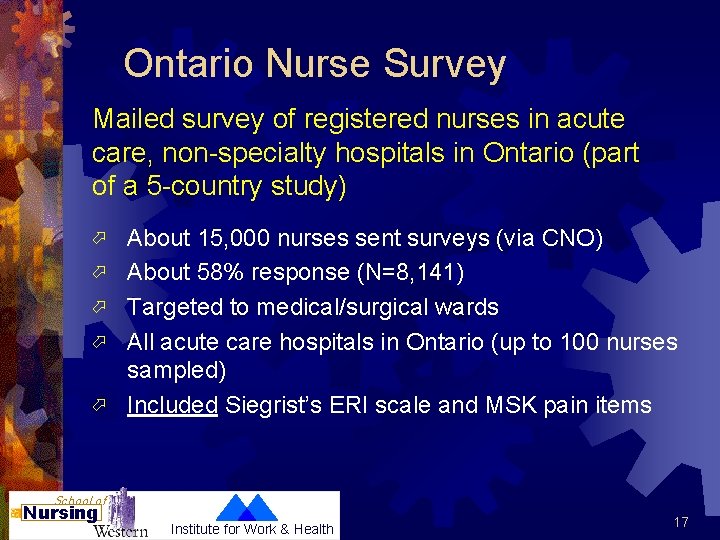
Ontario Nurse Survey Mailed survey of registered nurses in acute care, non-specialty hospitals in Ontario (part of a 5 -country study) ö ö ö About 15, 000 nurses sent surveys (via CNO) About 58% response (N=8, 141) Targeted to medical/surgical wards All acute care hospitals in Ontario (up to 100 nurses sampled) Included Siegrist’s ERI scale and MSK pain items School of Nursing Institute for Work & Health 17
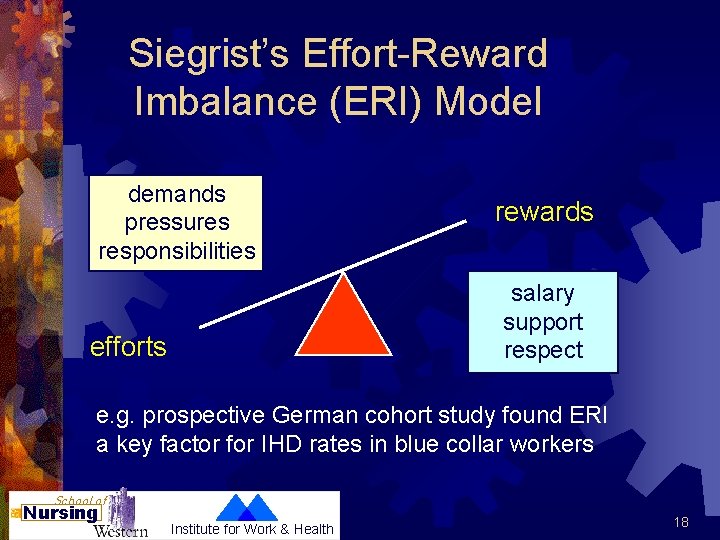
Siegrist’s Effort-Reward Imbalance (ERI) Model demands pressures responsibilities rewards salary support respect efforts e. g. prospective German cohort study found ERI a key factor for IHD rates in blue collar workers School of Nursing Institute for Work & Health 18
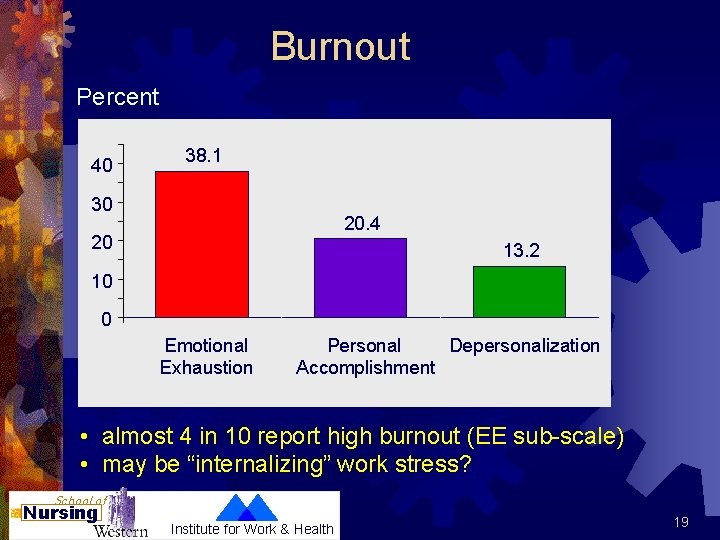
Burnout Percent 40 38. 1 30 20. 4 20 13. 2 10 0 Emotional Exhaustion Personal Depersonalization Accomplishment • almost 4 in 10 report high burnout (EE sub-scale) • may be “internalizing” work stress? School of Nursing Institute for Work & Health 19
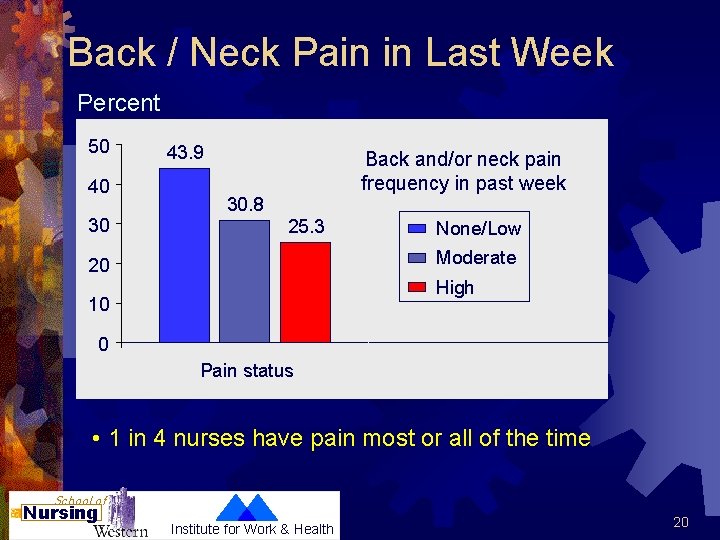
Back / Neck Pain in Last Week Percent 50 40 30 43. 9 Back and/or neck pain frequency in past week 30. 8 25. 3 None/Low Moderate 20 High 10 0 Pain status • 1 in 4 nurses have pain most or all of the time School of Nursing Institute for Work & Health 20
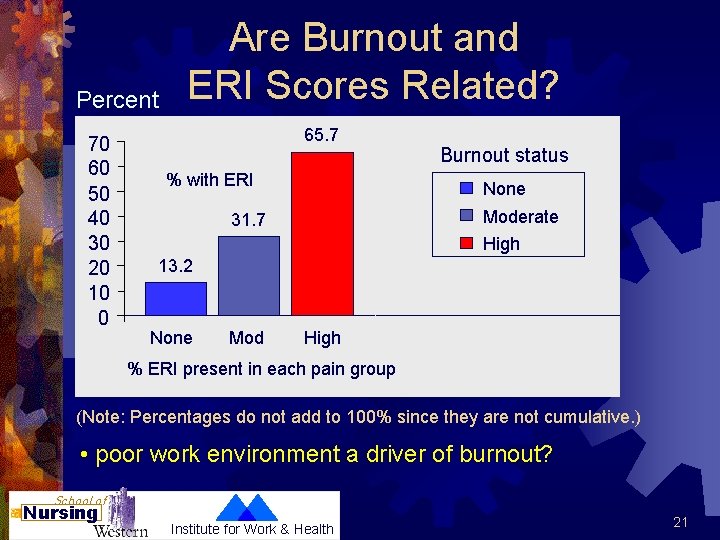
Percent 70 60 50 40 30 20 10 0 Are Burnout and ERI Scores Related? 65. 7 % with ERI Burnout status None Moderate 31. 7 High 13. 2 None Mod High % ERI present in each pain group (Note: Percentages do not add to 100% since they are not cumulative. ) • poor work environment a driver of burnout? School of Nursing Institute for Work & Health 21
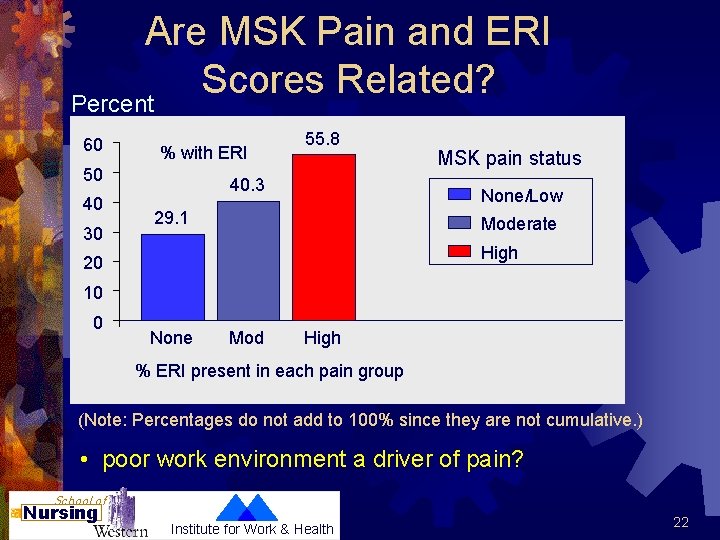
Are MSK Pain and ERI Scores Related? Percent 60 % with ERI 50 40 30 55. 8 40. 3 MSK pain status None/Low 29. 1 Moderate High 20 10 0 None Mod High % ERI present in each pain group (Note: Percentages do not add to 100% since they are not cumulative. ) • poor work environment a driver of pain? School of Nursing Institute for Work & Health 22
Main Conclusions ö Nurses report high rates of back/neck pain and burnout (emotional exhaustion only, not personal accomplishment or depersonalization) ö The workplace psychosocial environment is strongly associated with the health of the nurses (physical demands also important though!) School of Nursing Institute for Work & Health 23
Data Summary How easy was it to follow the presentation of these data? Any questions? The main aim of the course is to make this type of thing easier for you to understand even be able to present on your own !! School of Nursing Institute for Work & Health 24
10 minute break ! School of Nursing Institute for Work & Health 25
Lecture 1: Measurement Scales, Types of Variables and Hypotheses School of Nursing Institute for Work & Health 26
The Research Process (For Quantitative Studies) Identify the Problem Develop a study protocol N 319 a Research Methods Collect the data Analyze the data N 318 b Statistics Draw inferences School of Nursing Institute for Work & Health 27
Some Background Terms Descriptive statistics: – for summarizing or describing a sample Inferential statistics: – for making inferences (conclusions) or to generalize from a sample to a population Sample – part of a population and what you will use in almost all studies Population – all members of a particular group of interest School of Nursing Institute for Work & Health 28
A Few Key Points Statistics is largely about quantifying the probability of error when making a generalization from a study sample to a population for research, focus is on inferential statistics WHY? ö reliability and validity of inference depends on quality of sample ö good statistics can’t save a bad study ! ö School of Nursing Institute for Work & Health 29
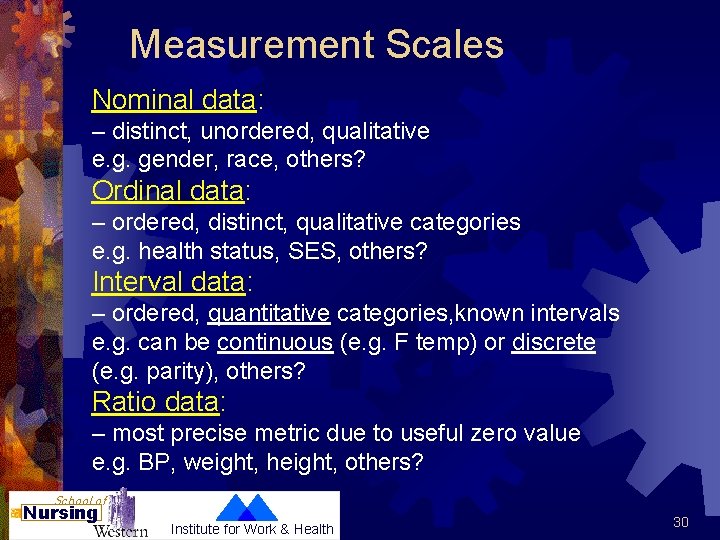
Measurement Scales Nominal data: – distinct, unordered, qualitative e. g. gender, race, others? Ordinal data: – ordered, distinct, qualitative categories e. g. health status, SES, others? Interval data: – ordered, quantitative categories, known intervals e. g. can be continuous (e. g. F temp) or discrete (e. g. parity), others? Ratio data: – most precise metric due to useful zero value e. g. BP, weight, height, others? School of Nursing Institute for Work & Health 30
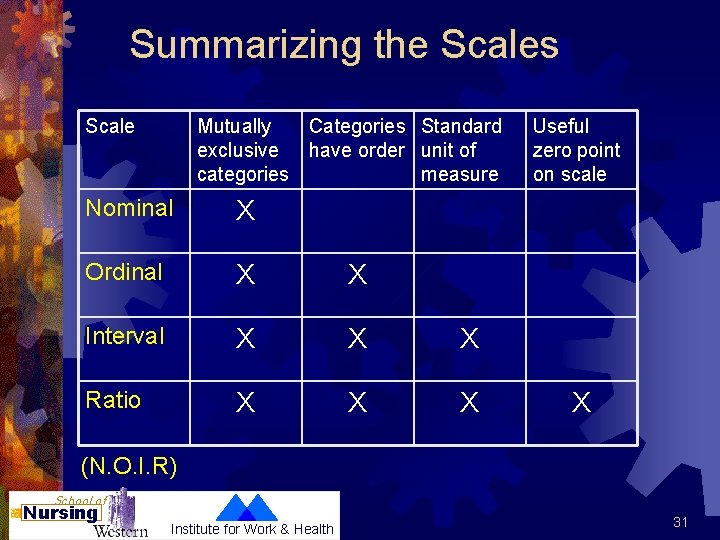
Summarizing the Scales Scale Mutually Categories Standard exclusive have order unit of categories measure Nominal X Ordinal X X Interval X X X Ratio X X X Useful zero point on scale X (N. O. I. R) School of Nursing Institute for Work & Health 31
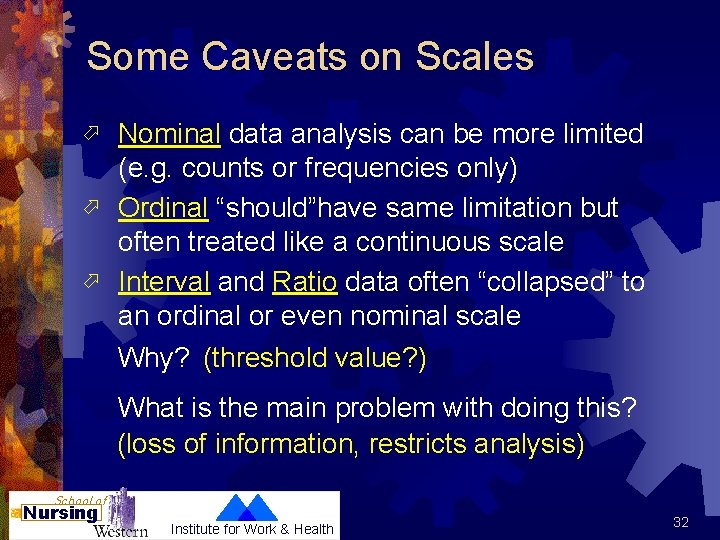
Some Caveats on Scales Nominal data analysis can be more limited (e. g. counts or frequencies only) ö Ordinal “should”have same limitation but often treated like a continuous scale ö Interval and Ratio data often “collapsed” to an ordinal or even nominal scale ö Why? (threshold value? ) What is the main problem with doing this? (loss of information, restricts analysis) School of Nursing Institute for Work & Health 32
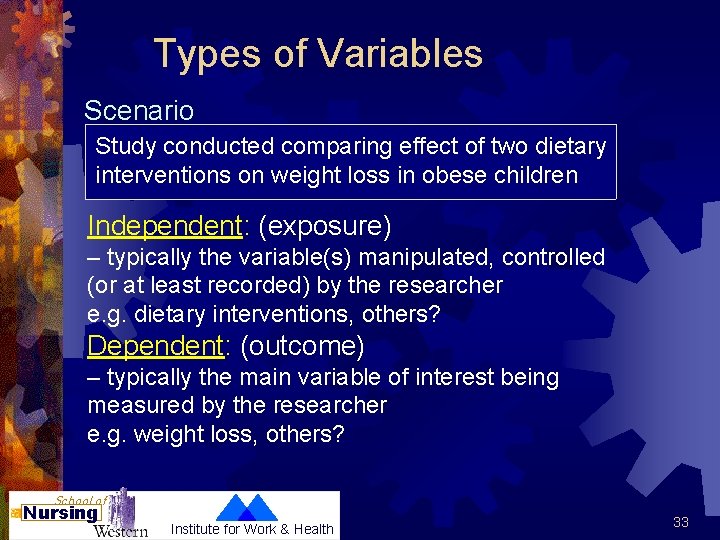
Types of Variables Scenario Study conducted comparing effect of two dietary interventions on weight loss in obese children Independent: (exposure) – typically the variable(s) manipulated, controlled (or at least recorded) by the researcher e. g. dietary interventions, others? Dependent: (outcome) – typically the main variable of interest being measured by the researcher e. g. weight loss, others? School of Nursing Institute for Work & Health 33
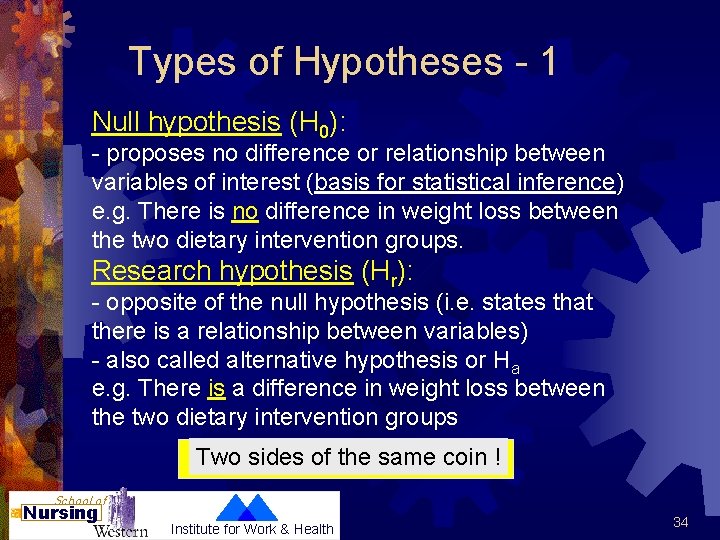
Types of Hypotheses - 1 Null hypothesis (H 0): - proposes no difference or relationship between variables of interest (basis for statistical inference) e. g. There is no difference in weight loss between the two dietary intervention groups. Research hypothesis (Hr): - opposite of the null hypothesis (i. e. states that there is a relationship between variables) - also called alternative hypothesis or Ha e. g. There is a difference in weight loss between the two dietary intervention groups Two sides of the same coin ! School of Nursing Institute for Work & Health 34
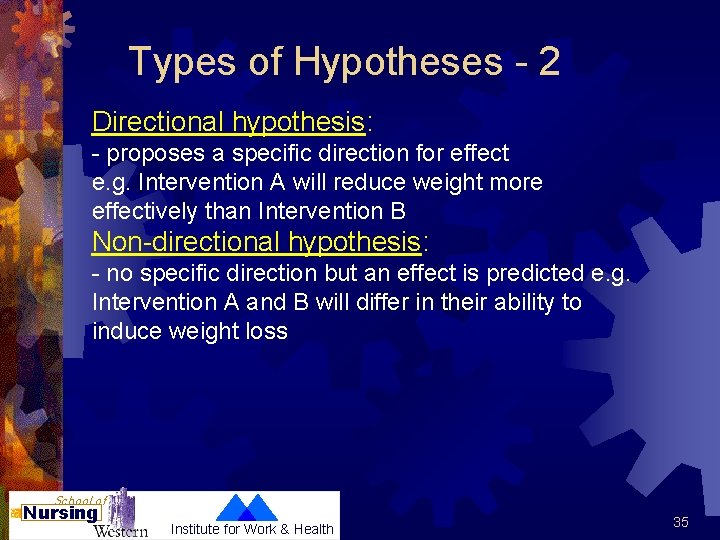
Types of Hypotheses - 2 Directional hypothesis: - proposes a specific direction for effect e. g. Intervention A will reduce weight more effectively than Intervention B Non-directional hypothesis: - no specific direction but an effect is predicted e. g. Intervention A and B will differ in their ability to induce weight loss School of Nursing Institute for Work & Health 35
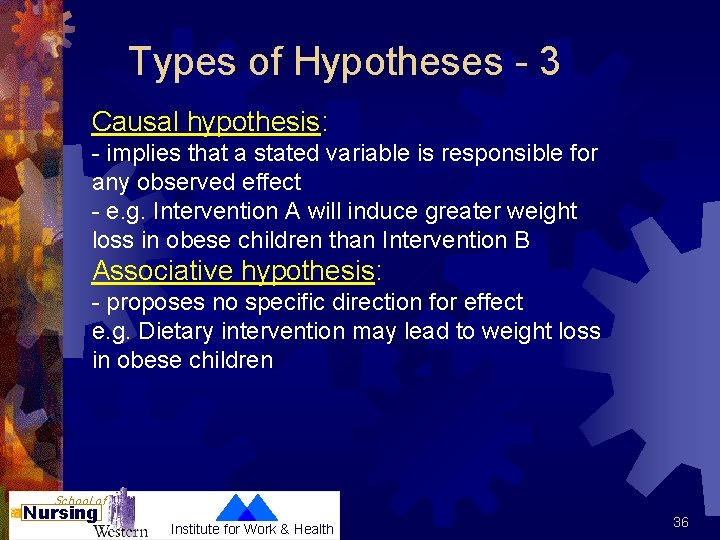
Types of Hypotheses - 3 Causal hypothesis: - implies that a stated variable is responsible for any observed effect - e. g. Intervention A will induce greater weight loss in obese children than Intervention B Associative hypothesis: - proposes no specific direction for effect e. g. Dietary intervention may lead to weight loss in obese children School of Nursing Institute for Work & Health 36
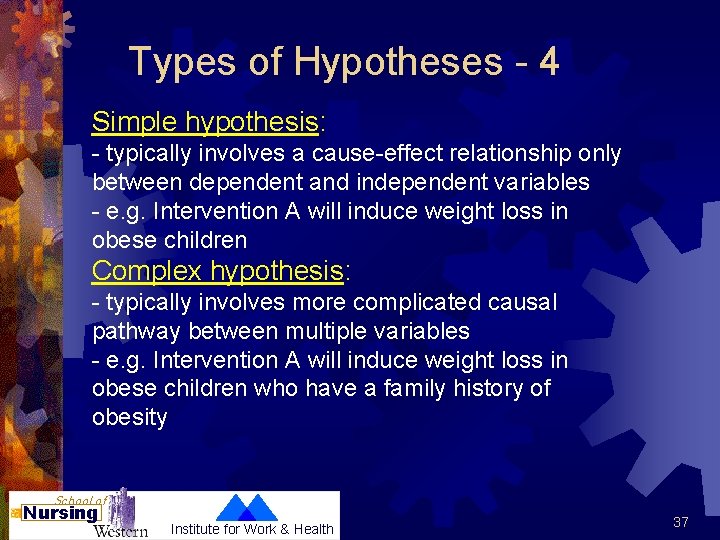
Types of Hypotheses - 4 Simple hypothesis: - typically involves a cause-effect relationship only between dependent and independent variables - e. g. Intervention A will induce weight loss in obese children Complex hypothesis: - typically involves more complicated causal pathway between multiple variables - e. g. Intervention A will induce weight loss in obese children who have a family history of obesity School of Nursing Institute for Work & Health 37
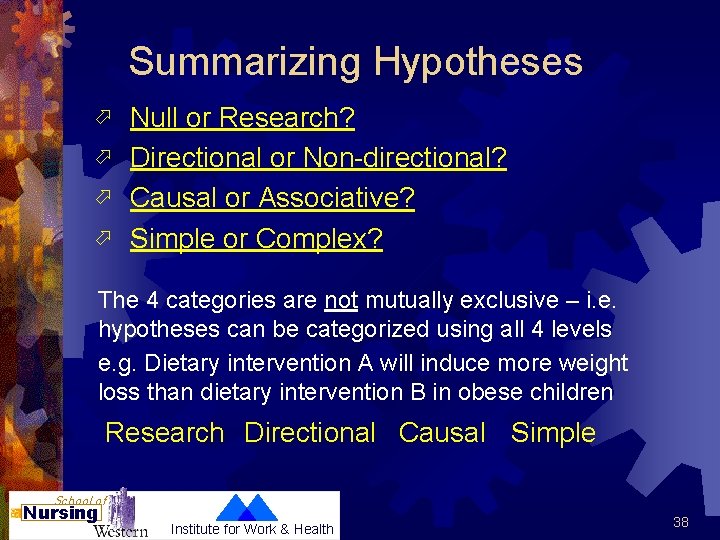
Summarizing Hypotheses Null or Research? ö Directional or Non-directional? ö Causal or Associative? ö Simple or Complex? ö The 4 categories are not mutually exclusive – i. e. hypotheses can be categorized using all 4 levels e. g. Dietary intervention A will induce more weight loss than dietary intervention B in obese children Research Directional Causal Simple School of Nursing Institute for Work & Health 38
Next Week - Lecture 2: Measures of Central Tendency and Variability For next week’s class please review: 1. Page 12 in syllabus 2. Textbook Chapter 1, pages 8 -23 3. Textbook Chapter 2, pages 29 -44 4. Syllabus papers: 5. i) Arathuzik (1994) 6. ii) Hayman et al. (1995) School of Nursing Institute for Work & Health 39
Workshop Rooms: H 018, H 19 and H 9 (MS 016, MS 017)*, MS 018, MS 022 MS 023, MS 027, MS 028, and MS 029 Please go to one of these rooms with your group from last term or join one School of Nursing Institute for Work & Health 40
School of Nursing Institute for Work & Health 41
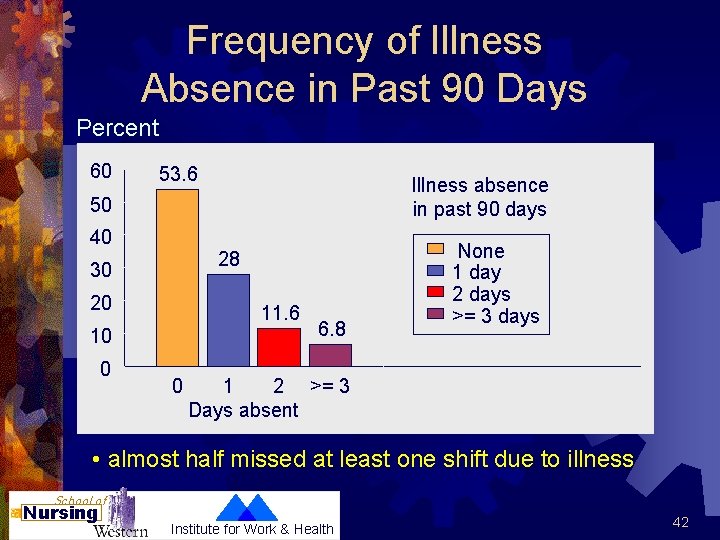
Frequency of Illness Absence in Past 90 Days Percent 60 53. 6 Illness absence in past 90 days 50 40 28 30 20 11. 6 10 0 0 6. 8 None 1 day 2 days >= 3 days 1 2 >= 3 Days absent • almost half missed at least one shift due to illness School of Nursing Institute for Work & Health 42
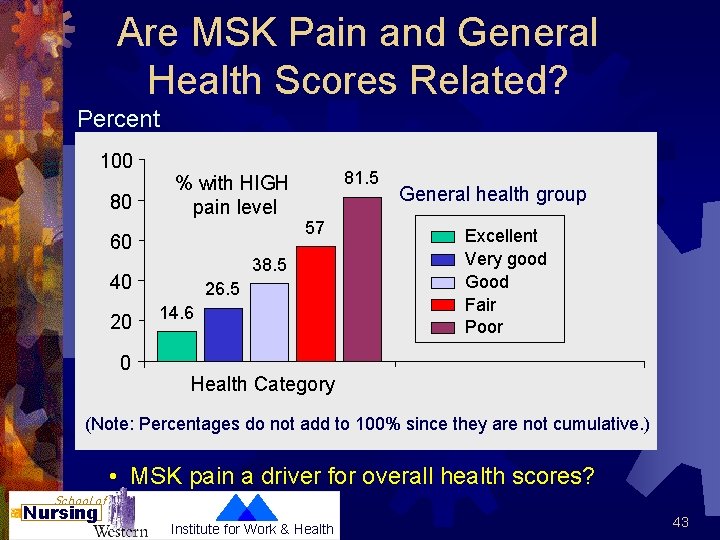
Are MSK Pain and General Health Scores Related? Percent 100 80 % with HIGH pain level 60 0 57 38. 5 40 20 81. 5 26. 5 14. 6 General health group Excellent Very good Good Fair Poor Health Category (Note: Percentages do not add to 100% since they are not cumulative. ) • MSK pain a driver for overall health scores? School of Nursing Institute for Work & Health 43
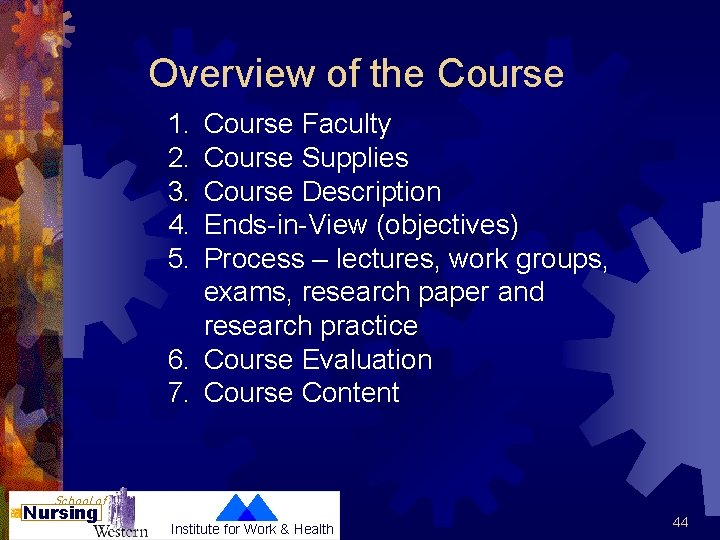
Overview of the Course 1. 2. 3. 4. 5. Course Faculty Course Supplies Course Description Ends-in-View (objectives) Process – lectures, work groups, exams, research paper and research practice 6. Course Evaluation 7. Course Content School of Nursing Institute for Work & Health 44
- Slides: 44