
N 30 COMBUSTION ANALYSIS Its just a more
N 30 – COMBUSTION ANALYSIS It’s just a more involved form of empirical formulas!
Target: I can apply my knowledge of empirical formulas to data obtained from combustion analysis
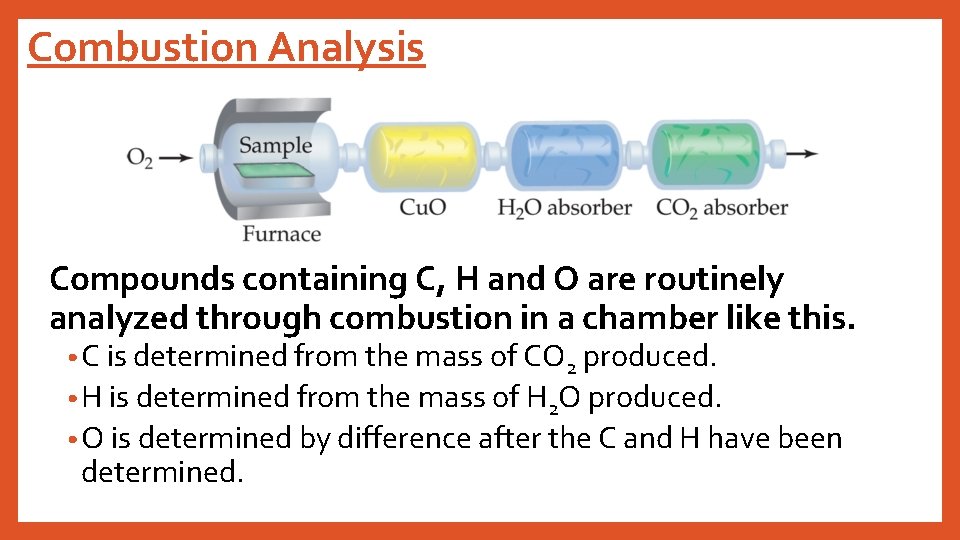
Combustion Analysis Compounds containing C, H and O are routinely analyzed through combustion in a chamber like this. • C is determined from the mass of CO 2 produced. • H is determined from the mass of H 2 O produced. • O is determined by difference after the C and H have been determined.
We have been working problems where we start with a % composition and doing this: • % to mass • Mass to mole • Divide by small • Multiply until whole
We don’t HAVE to start with a % composition though… • As long as we can find the number of grams of each element, then we can find the empirical formula!

So…in combustion analysis problems… • You will be figuring out the grams of each element in the sample using data and dimensional analysis, and do the normal empirical formula calculation!
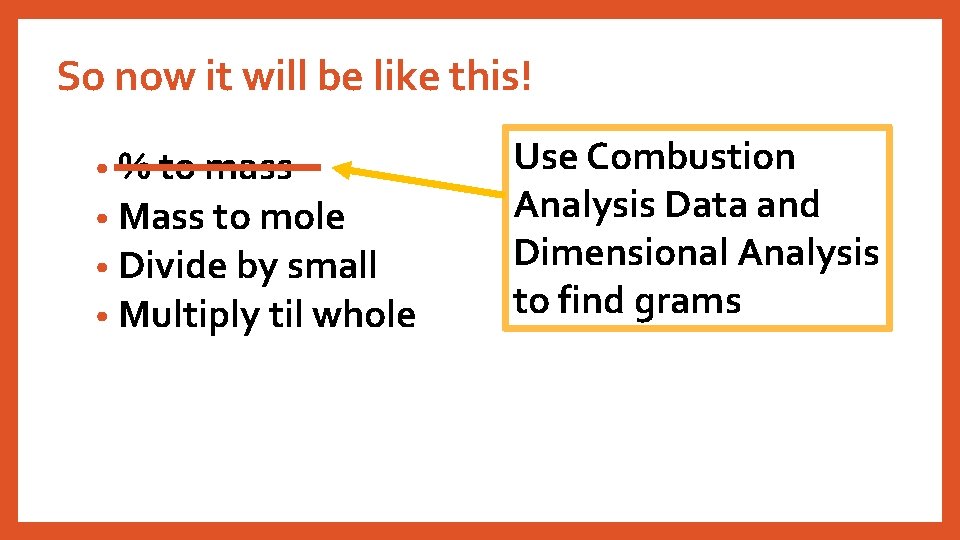
So now it will be like this! • % to mass • Mass to mole • Divide by small • Multiply til whole Use Combustion Analysis Data and Dimensional Analysis to find grams
The amount of CO 2 gives the amount of C originally present in the sample compound • All the carbon atoms in the unknown starting sample are rearranged into CO 2 product • Why you ask? Because the law of conservation of mass is ALWAYS TRUE!
The amount of H 2 O gives the amount of H originally present in the sample • Why you ask? Why yes, that is correct. Because the law of conservation of mass is ALWAYS TRUE! • Watch the subscript stoichiometry: 1 mol H 2 O contains 2 mol H.
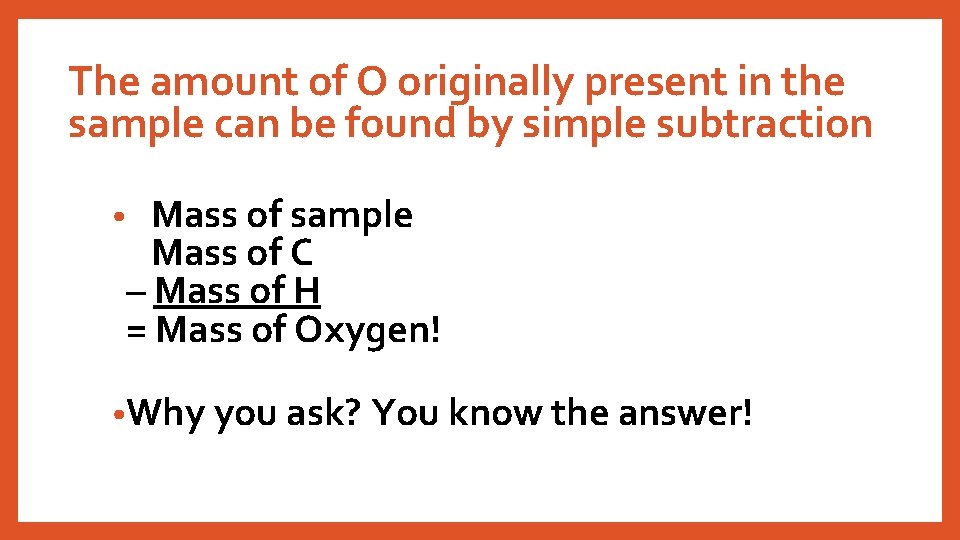
The amount of O originally present in the sample can be found by simple subtraction • Mass of sample Mass of C – Mass of H = Mass of Oxygen! • Why you ask? You know the answer!
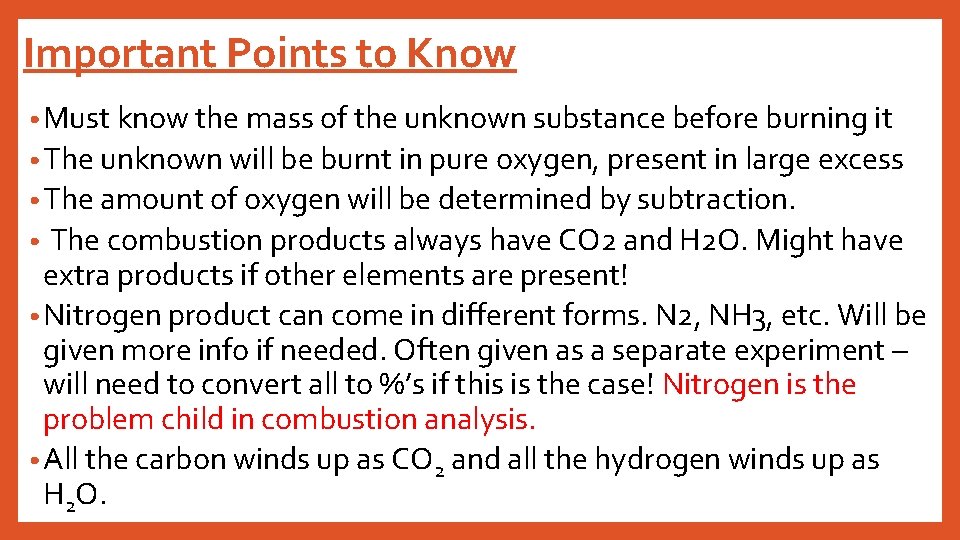
Important Points to Know • Must know the mass of the unknown substance before burning it • The unknown will be burnt in pure oxygen, present in large excess • The amount of oxygen will be determined by subtraction. The combustion products always have CO 2 and H 2 O. Might have extra products if other elements are present! • Nitrogen product can come in different forms. N 2, NH 3, etc. Will be given more info if needed. Often given as a separate experiment – will need to convert all to %’s if this is the case! Nitrogen is the problem child in combustion analysis. • All the carbon winds up as CO 2 and all the hydrogen winds up as H 2 O. •
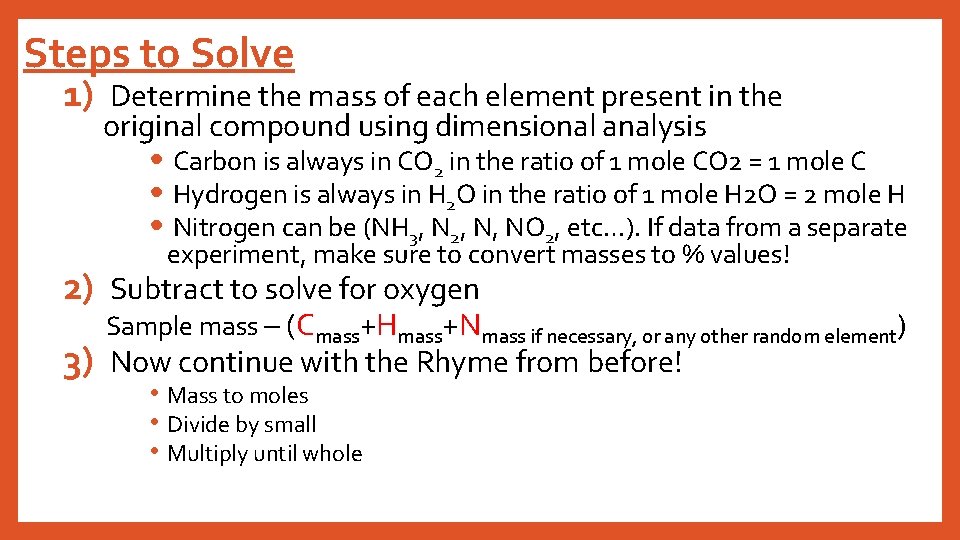
Steps to Solve 1) Determine the mass of each element present in the original compound using dimensional analysis • Carbon is always in CO 2 in the ratio of 1 mole CO 2 = 1 mole C • Hydrogen is always in H 2 O in the ratio of 1 mole H 2 O = 2 mole H • Nitrogen can be (NH 3, N 2, N, NO 2, etc…). If data from a separate experiment, make sure to convert masses to % values! 2) Subtract to solve for oxygen Sample mass – (Cmass+Hmass+Nmass if necessary, or any other random element) 3) Now continue with the Rhyme from before! • Mass to moles • Divide by small • Multiply until whole
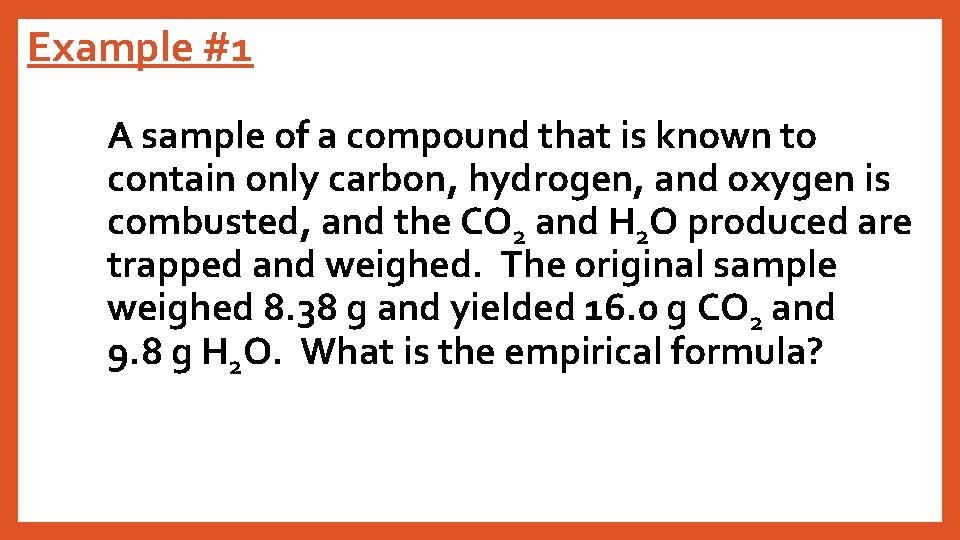
Example #1 A sample of a compound that is known to contain only carbon, hydrogen, and oxygen is combusted, and the CO 2 and H 2 O produced are trapped and weighed. The original sample weighed 8. 38 g and yielded 16. 0 g CO 2 and 9. 8 g H 2 O. What is the empirical formula?
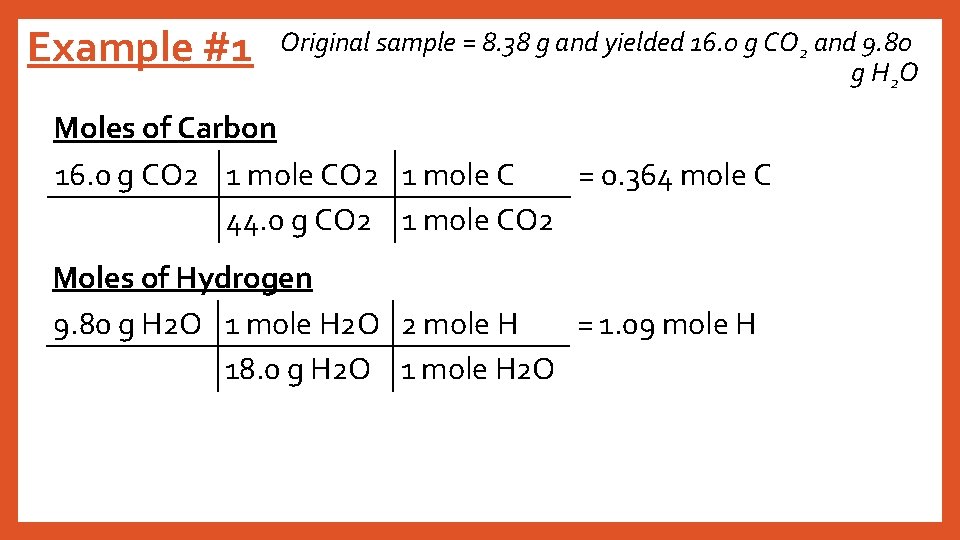
Example #1 Original sample = 8. 38 g and yielded 16. 0 g CO 2 and 9. 80 g H 2 O Moles of Carbon 16. 0 g CO 2 1 mole C = 0. 364 mole C 44. 0 g CO 2 1 mole CO 2 Moles of Hydrogen 9. 80 g H 2 O 1 mole H 2 O 2 mole H = 1. 09 mole H 18. 0 g H 2 O 1 mole H 2 O
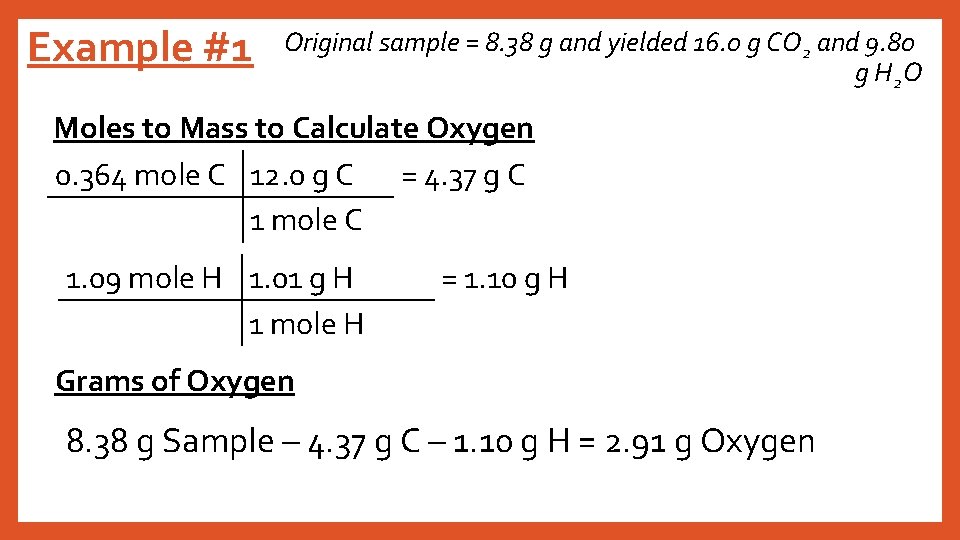
Example #1 Original sample = 8. 38 g and yielded 16. 0 g CO 2 and 9. 80 g H 2 O Moles to Mass to Calculate Oxygen 0. 364 mole C 12. 0 g C = 4. 37 g C 1 mole C 1. 09 mole H 1. 01 g H 1 mole H = 1. 10 g H Grams of Oxygen 8. 38 g Sample – 4. 37 g C – 1. 10 g H = 2. 91 g Oxygen
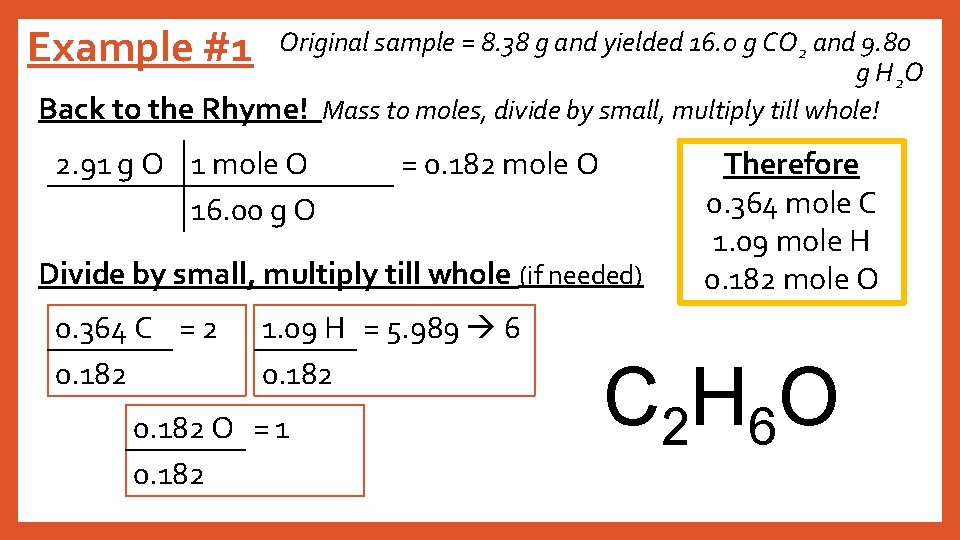
Example #1 Original sample = 8. 38 g and yielded 16. 0 g CO 2 and 9. 80 g H 2 O Back to the Rhyme! Mass to moles, divide by small, multiply till whole! 2. 91 g O 1 mole O 16. 00 g O = 0. 182 mole O Divide by small, multiply till whole (if needed) 0. 364 C = 2 0. 182 1. 09 H = 5. 989 6 0. 182 O = 1 0. 182 Therefore 0. 364 mole C 1. 09 mole H 0. 182 mole O C 2 H 6 O
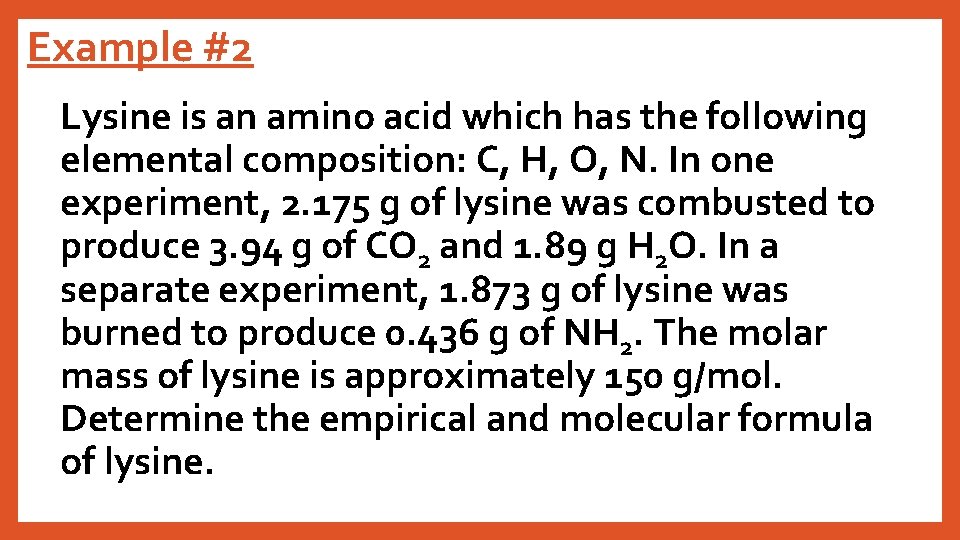
Example #2 Lysine is an amino acid which has the following elemental composition: C, H, O, N. In one experiment, 2. 175 g of lysine was combusted to produce 3. 94 g of CO 2 and 1. 89 g H 2 O. In a separate experiment, 1. 873 g of lysine was burned to produce 0. 436 g of NH 2. The molar mass of lysine is approximately 150 g/mol. Determine the empirical and molecular formula of lysine.
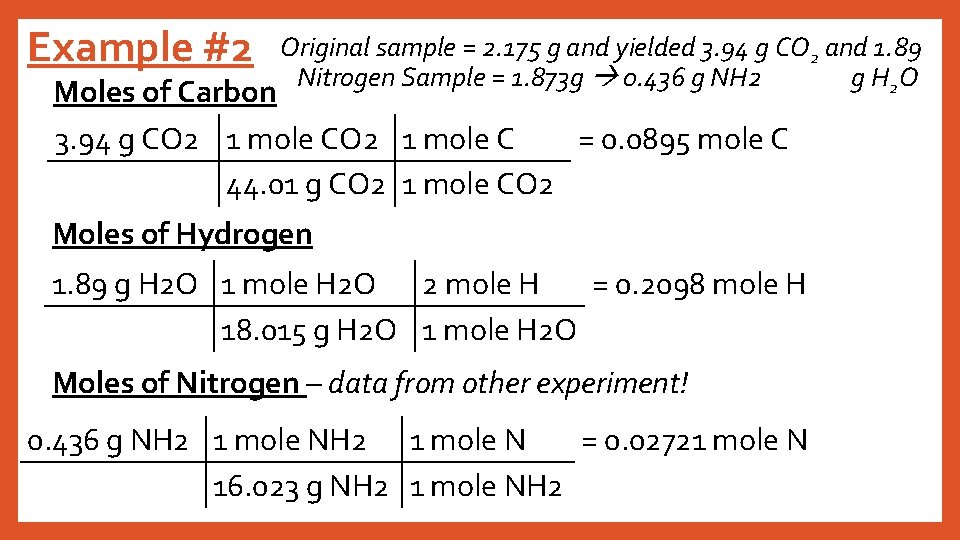
Example #2 Original sample = 2. 175 g and yielded 3. 94 g CO 2 and 1. 89 Nitrogen Sample = 1. 873 g 0. 436 g NH 2 g H 2 O Moles of Carbon 3. 94 g CO 2 1 mole C = 0. 0895 mole C 44. 01 g CO 2 1 mole CO 2 Moles of Hydrogen 1. 89 g H 2 O 1 mole H 2 O 2 mole H = 0. 2098 mole H 18. 015 g H 2 O 1 mole H 2 O Moles of Nitrogen – data from other experiment! 0. 436 g NH 2 1 mole N = 0. 02721 mole N 16. 023 g NH 2 1 mole NH 2
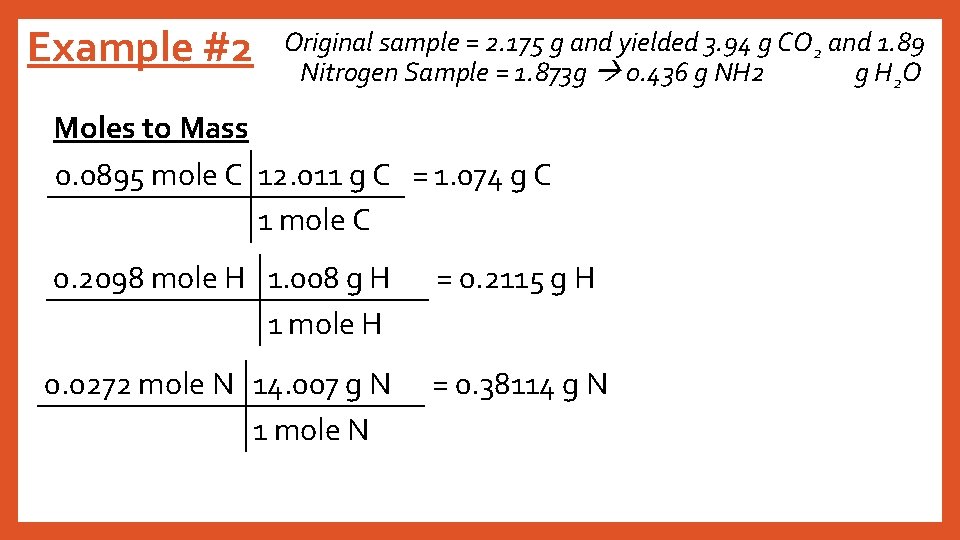
Example #2 Original sample = 2. 175 g and yielded 3. 94 g CO 2 and 1. 89 Nitrogen Sample = 1. 873 g 0. 436 g NH 2 g H 2 O Moles to Mass 0. 0895 mole C 12. 011 g C = 1. 074 g C 1 mole C 0. 2098 mole H 1. 008 g H 1 mole H = 0. 2115 g H 0. 0272 mole N 14. 007 g N 1 mole N = 0. 38114 g N
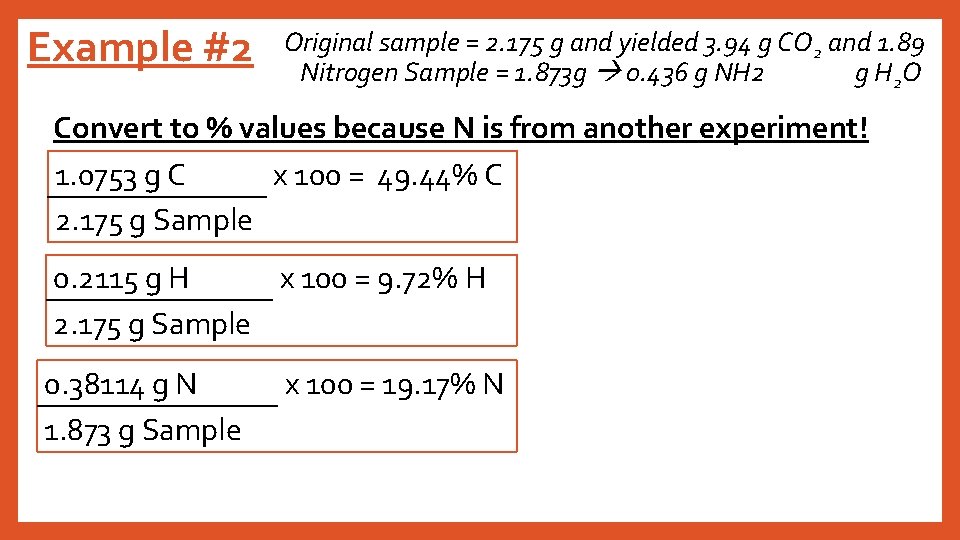
Example #2 Original sample = 2. 175 g and yielded 3. 94 g CO 2 and 1. 89 Nitrogen Sample = 1. 873 g 0. 436 g NH 2 g H 2 O Convert to % values because N is from another experiment! 1. 0753 g C x 100 = 49. 44% C 2. 175 g Sample 0. 2115 g H x 100 = 9. 72% H 2. 175 g Sample 0. 38114 g N 1. 873 g Sample x 100 = 19. 17% N
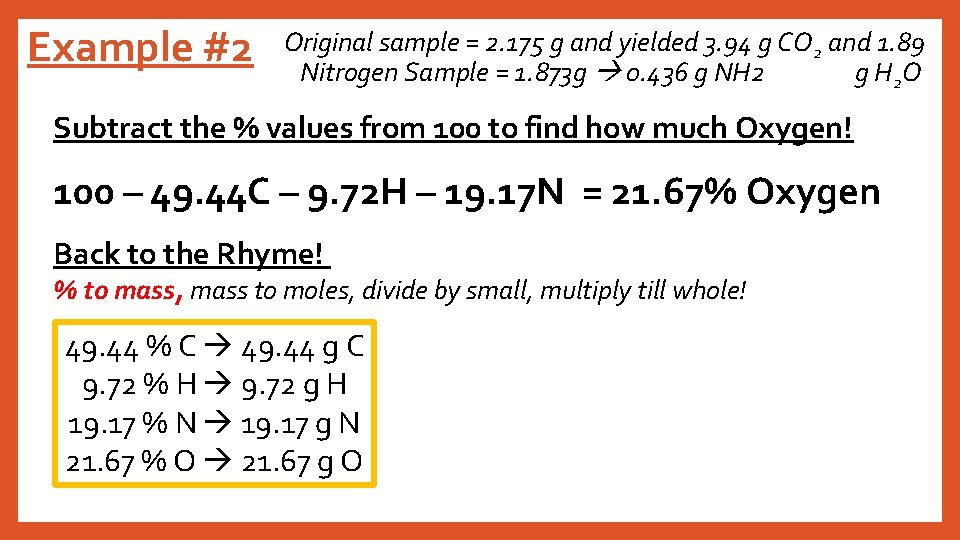
Example #2 Original sample = 2. 175 g and yielded 3. 94 g CO 2 and 1. 89 Nitrogen Sample = 1. 873 g 0. 436 g NH 2 g H 2 O Subtract the % values from 100 to find how much Oxygen! 100 – 49. 44 C – 9. 72 H – 19. 17 N = 21. 67% Oxygen Back to the Rhyme! % to mass, mass to moles, divide by small, multiply till whole! 49. 44 % C 49. 44 g C 9. 72 % H 9. 72 g H 19. 17 % N 19. 17 g N 21. 67 % O 21. 67 g O
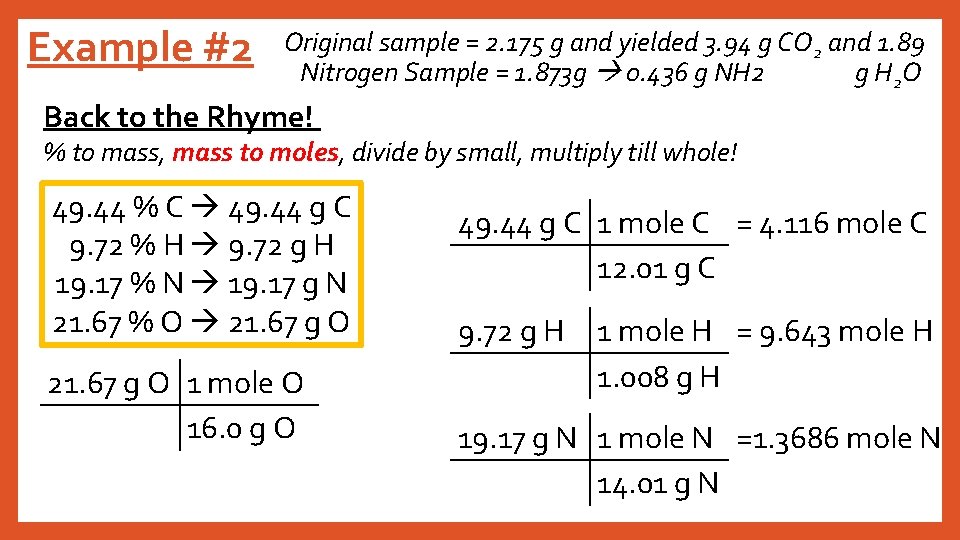
Example #2 Original sample = 2. 175 g and yielded 3. 94 g CO 2 and 1. 89 Nitrogen Sample = 1. 873 g 0. 436 g NH 2 g H 2 O Back to the Rhyme! % to mass, mass to moles, divide by small, multiply till whole! 49. 44 % C 49. 44 g C 9. 72 % H 9. 72 g H 19. 17 % N 19. 17 g N 21. 67 % O 21. 67 g O 1 mole O 16. 0 g O = 1. 3544 mole O 49. 44 g C 1 mole C = 4. 116 mole C 12. 01 g C 9. 72 g H 1 mole H = 9. 643 mole H 1. 008 g H 19. 17 g N 1 mole N =1. 3686 mole N 14. 01 g N
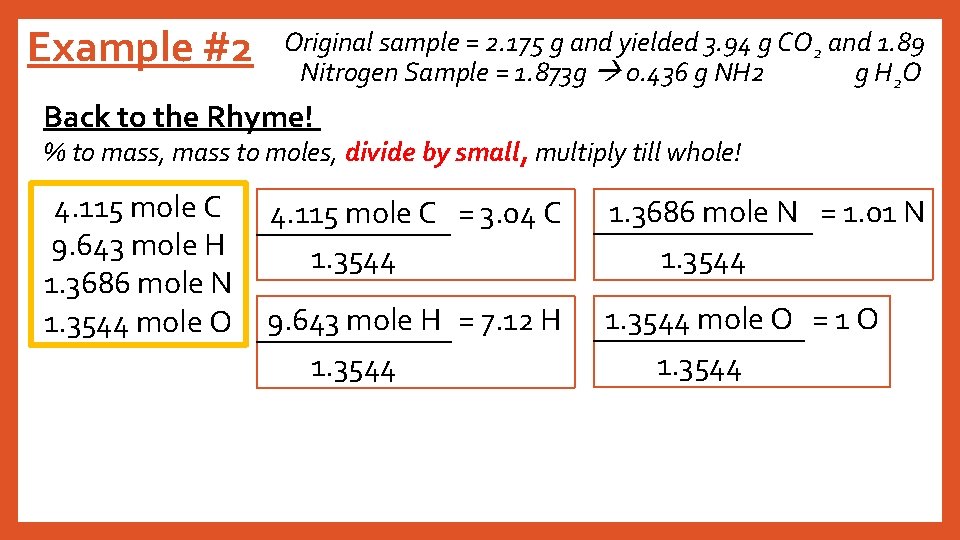
Example #2 Original sample = 2. 175 g and yielded 3. 94 g CO 2 and 1. 89 Nitrogen Sample = 1. 873 g 0. 436 g NH 2 g H 2 O Back to the Rhyme! % to mass, mass to moles, divide by small, multiply till whole! 4. 115 mole C 9. 643 mole H 1. 3686 mole N 1. 3544 mole O 4. 115 mole C = 3. 04 C 1. 3544 1. 3686 mole N = 1. 01 N 1. 3544 9. 643 mole H = 7. 12 H 1. 3544 mole O = 1 O 1. 3544
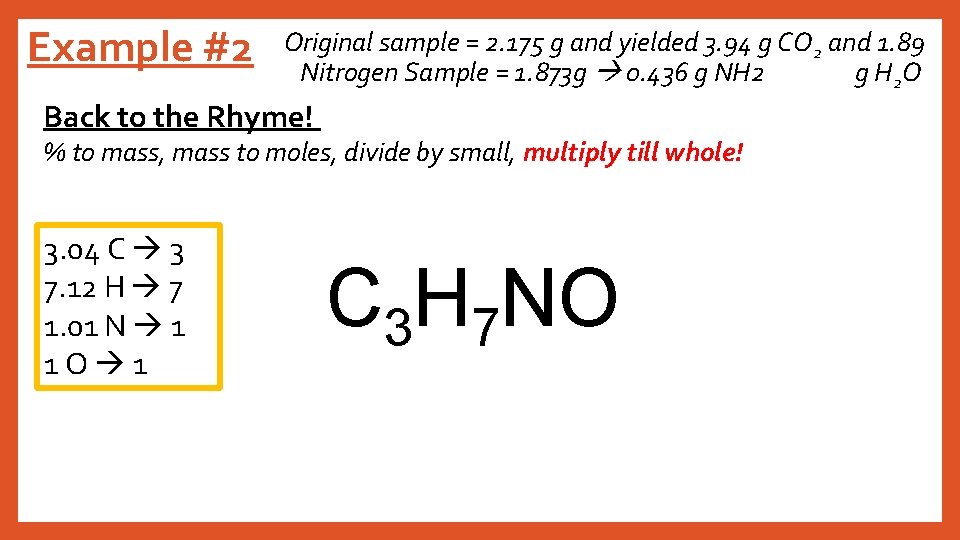
Example #2 Original sample = 2. 175 g and yielded 3. 94 g CO 2 and 1. 89 Nitrogen Sample = 1. 873 g 0. 436 g NH 2 g H 2 O Back to the Rhyme! % to mass, mass to moles, divide by small, multiply till whole! 3. 04 C 3 7. 12 H 7 1. 01 N 1 1 O 1 C 3 H 7 NO
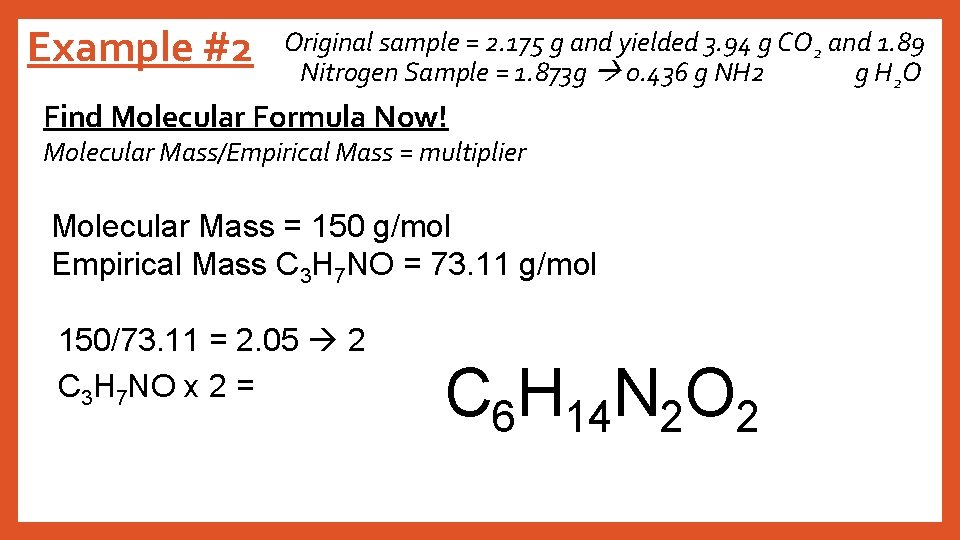
Example #2 Original sample = 2. 175 g and yielded 3. 94 g CO 2 and 1. 89 Nitrogen Sample = 1. 873 g 0. 436 g NH 2 g H 2 O Find Molecular Formula Now! Molecular Mass/Empirical Mass = multiplier Molecular Mass = 150 g/mol Empirical Mass C 3 H 7 NO = 73. 11 g/mol 150/73. 11 = 2. 05 2 C 3 H 7 NO x 2 = C 6 H 14 N 2 O 2
- Slides: 25