
Myrdals Model of Cumulative Causation and Spatial interaction



- Slides: 8
Myrdal’s Model of Cumulative Causation and Spatial interaction
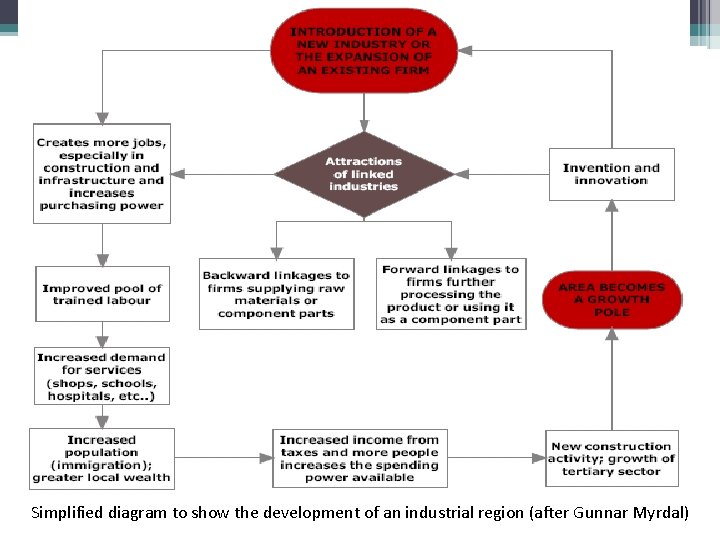
CUMULATIVE CAUSATION (THE MULTIPLIER EFFECT) • Cumulative causation (the multiplier effect) occurs as acquired advantages are developed and reinforce the area’s reputation which will then create a multiplier effect. This thus attracts further investment. • Therefore the success of a large firm or industry in a area will attract other forms of economic development.
This will in turn create: üJobs üServices üWealth Success breeds success
Myrdal believed that. . . • Over time economic forces increase regional inequalities rather than reduce them. • Development was caused by two things; i. natural advantages ii. regional interaction.
Natural Advantages • Comparative advantages provide the stimulus for development in a particular location. They include: - Location - Natural resources - labour
• Acquired advantages are further investments that ensures that the core grows and stays ahead of other region. These include: -Improvements in infrastructure -Skilled workforce -Increased tax revenues
Synopsis The introduction of a new industry or the expansion of an existing industry in an area also encourages growth in other industrial sectors. This is known as the multiplier effect which in its simplest form is how many times money spent circulates through a country's economy. Money invested in an industry helps to create jobs directly in the industry, but it also creates jobs indirectly elsewhere in the economy. New industrial development, for example, requires construction workers who themselves require housing, and services such as schools and shops. An increased demand for food will benefit local farmers who may increase their spending on fertiliser. Workers employed directly in the new industry increase the local supply of skilled labour, attracting other companies who benefit from sharing this labour pool. Other companies who supply components or use the new industry's products are attracted to the area to benefit from reduced transport costs. Spin-off effects include new inventions or innovations that may lead to further industrial development and new linkages. Through this multiplier effect, an area can develop as a growth pole, as illustrated in the diagram below
Simplified diagram to show the development of an industrial region (after Gunnar Myrdal)