
Myerscough School of Veterinary Nursing So you want







- Slides: 40
Myerscough School of Veterinary Nursing So you want to be a HE Veterinary Nurse? ? ?
UCLan Associate School
The Veterinary Nursing Teaching and Placement Officer Team
Myerscough Veterinary Nursing Team • Head of Area: – Lorraine Allan MA Ed BVSc MRCVS PGCE • Assistant Head of Higher Education: – Claire Bloor MA Ed BSc (Hons) RVN PGCE QTLS Cert VN (Dent) • Placement Officers (and Year 2 Course Tutors): – Andrea O’Rourke BSc (Hons) CVN RVN CTTLLS D 32/33 V 1 – Kate Lomas BSc (Hons) CVN Dip AVN (Equine) Dip HE CVN REVN A 1 PTTLS – Leanne Stagg BSc (Hons) AS RVN – Samara Hill Fd. Sc RVN – Alexa Callwood BSc (Hons) RVN
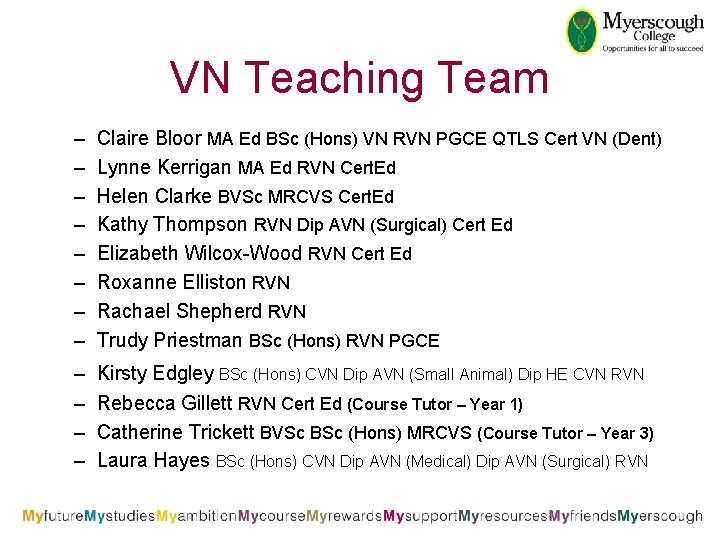
VN Teaching Team – – – – Claire Bloor MA Ed BSc (Hons) VN RVN PGCE QTLS Cert VN (Dent) Lynne Kerrigan MA Ed RVN Cert. Ed Helen Clarke BVSc MRCVS Cert. Ed Kathy Thompson RVN Dip AVN (Surgical) Cert Ed Elizabeth Wilcox-Wood RVN Cert Ed Roxanne Elliston RVN Rachael Shepherd RVN Trudy Priestman BSc (Hons) RVN PGCE – – Kirsty Edgley BSc (Hons) CVN Dip AVN (Small Animal) Dip HE CVN Rebecca Gillett RVN Cert Ed (Course Tutor – Year 1) Catherine Trickett BVSc BSc (Hons) MRCVS (Course Tutor – Year 3) Laura Hayes BSc (Hons) CVN Dip AVN (Medical) Dip AVN (Surgical) RVN
The Veterinary Nursing Higher Education Courses Entry Criteria
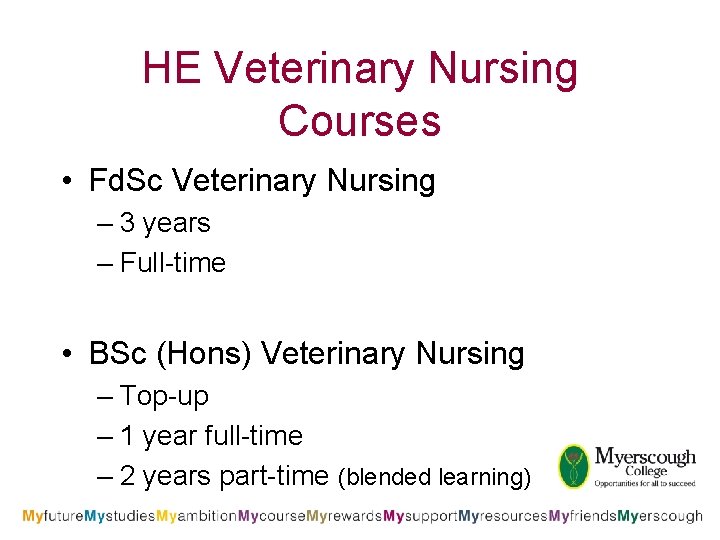
HE Veterinary Nursing Courses • Fd. Sc Veterinary Nursing – 3 years – Full-time • BSc (Hons) Veterinary Nursing – Top-up – 1 year full-time – 2 years part-time (blended learning)
Entry Criteria • Two equally important criteria that must be satisfied: – Academic requirements – Work experience requirements
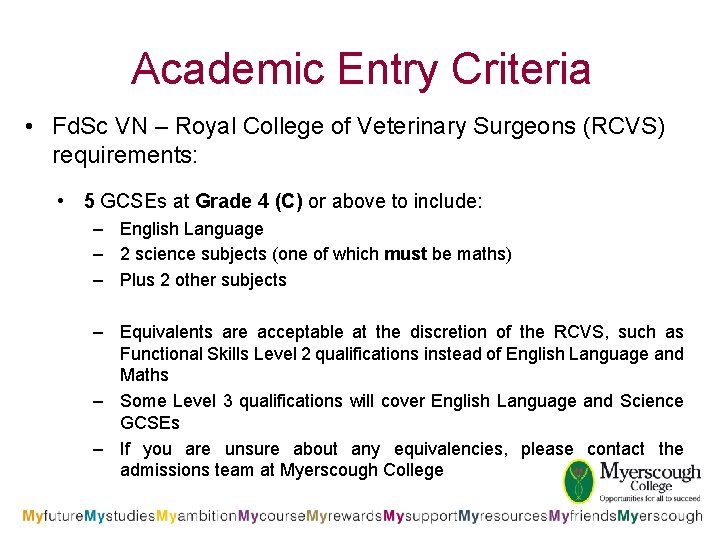
Academic Entry Criteria • Fd. Sc VN – Royal College of Veterinary Surgeons (RCVS) requirements: • 5 GCSEs at Grade 4 (C) or above to include: – English Language – 2 science subjects (one of which must be maths) – Plus 2 other subjects – Equivalents are acceptable at the discretion of the RCVS, such as Functional Skills Level 2 qualifications instead of English Language and Maths – Some Level 3 qualifications will cover English Language and Science GCSEs – If you are unsure about any equivalencies, please contact the admissions team at Myerscough College
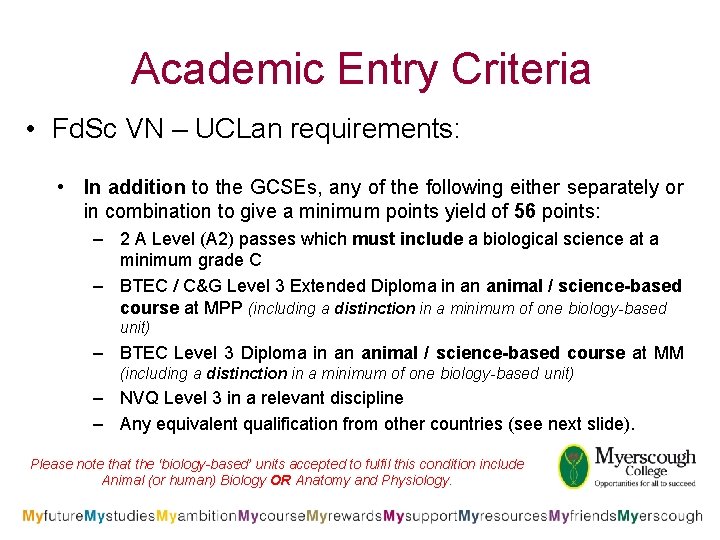
Academic Entry Criteria • Fd. Sc VN – UCLan requirements: • In addition to the GCSEs, any of the following either separately or in combination to give a minimum points yield of 56 points: – 2 A Level (A 2) passes which must include a biological science at a minimum grade C – BTEC / C&G Level 3 Extended Diploma in an animal / science-based course at MPP (including a distinction in a minimum of one biology-based unit) – BTEC Level 3 Diploma in an animal / science-based course at MM (including a distinction in a minimum of one biology-based unit) – NVQ Level 3 in a relevant discipline – Any equivalent qualification from other countries (see next slide). Please note that the ‘biology-based’ units accepted to fulfil this condition include Animal (or human) Biology OR Anatomy and Physiology.
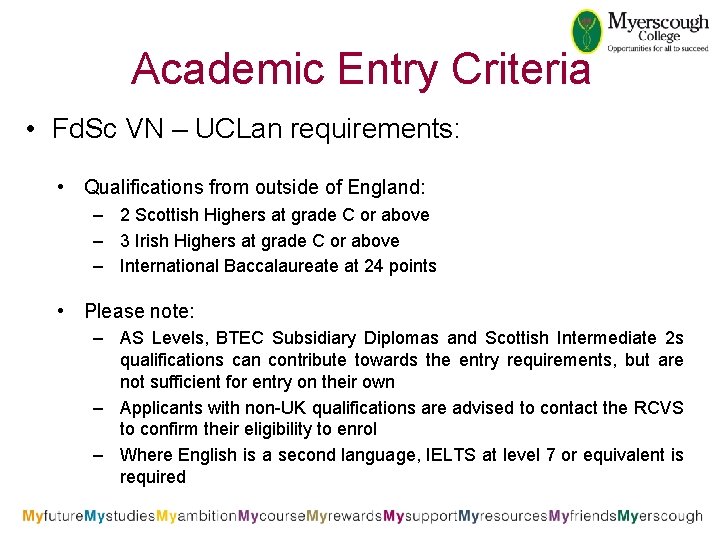
Academic Entry Criteria • Fd. Sc VN – UCLan requirements: • Qualifications from outside of England: – 2 Scottish Highers at grade C or above – 3 Irish Highers at grade C or above – International Baccalaureate at 24 points • Please note: – AS Levels, BTEC Subsidiary Diplomas and Scottish Intermediate 2 s qualifications can contribute towards the entry requirements, but are not sufficient for entry on their own – Applicants with non-UK qualifications are advised to contact the RCVS to confirm their eligibility to enrol – Where English is a second language, IELTS at level 7 or equivalent is required
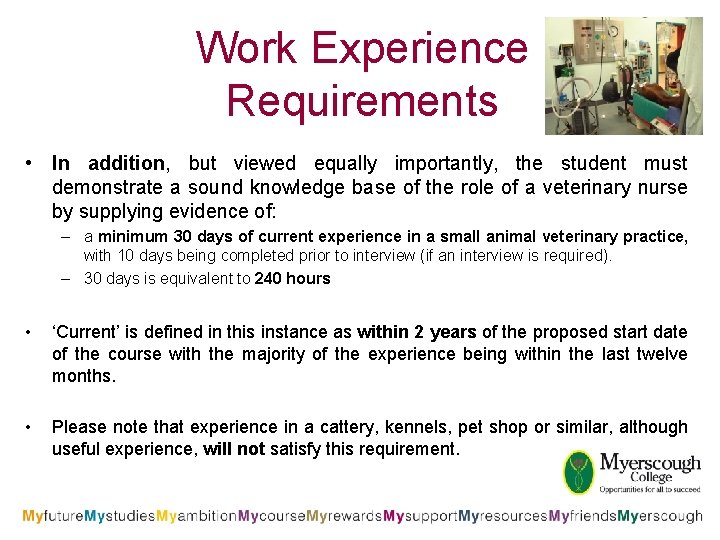
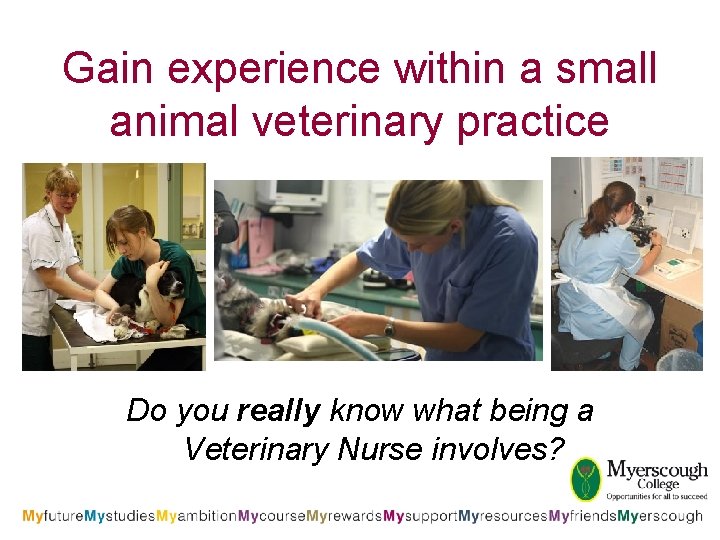
Work Experience Requirements • In addition, but viewed equally importantly, the student must demonstrate a sound knowledge base of the role of a veterinary nurse by supplying evidence of: – a minimum 30 days of current experience in a small animal veterinary practice, with 10 days being completed prior to interview (if an interview is required). – 30 days is equivalent to 240 hours • ‘Current’ is defined in this instance as within 2 years of the proposed start date of the course with the majority of the experience being within the last twelve months. • Please note that experience in a cattery, kennels, pet shop or similar, although useful experience, will not satisfy this requirement.
Gain experience within a small animal veterinary practice Do you really know what being a Veterinary Nurse involves?
The Fd. Sc Veterinary Nursing Course Placements
Course Placements • Placements must be within an RCVS Approved Training Practice (TP). • You will need a CC to support you with the NPL skills completion. • A list of TPs in your area can be found on the RCVS website: http: //www. rcvs. org. uk/education/i-want-to-be-a-veterinarynurse/approved-training-practices/
Course Placements Although help and advice will be given wherever possible by the Placement Officers, it is ultimately your responsibility to secure yourself a training practice in which to complete your placement hours. • Do you want a placement near to home, accommodation or are you prepared to travel? Cost? with • You will be visited by your allocated Placement Officer, and they will monitor your NPL progress remotely.
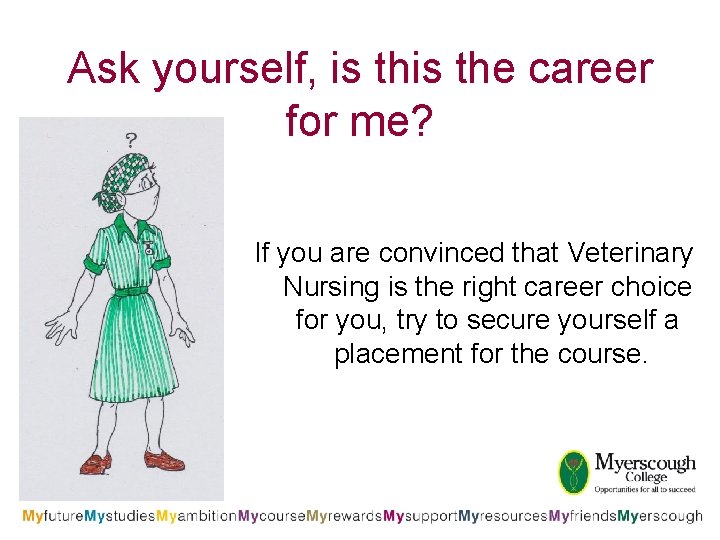
Ask yourself, is the career for me? If you are convinced that Veterinary Nursing is the right career choice for you, try to secure yourself a placement for the course.
Course Structure and Progression
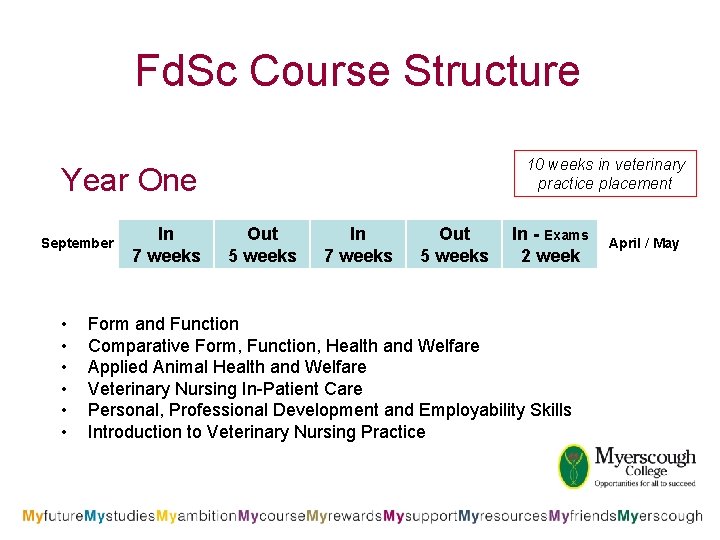
Fd. Sc Course Structure 10 weeks in veterinary practice placement Year One September • • • In 7 weeks Out 5 weeks In - Exams 2 week Form and Function Comparative Form, Function, Health and Welfare Applied Animal Health and Welfare Veterinary Nursing In-Patient Care Personal, Professional Development and Employability Skills Introduction to Veterinary Nursing Practice April / May
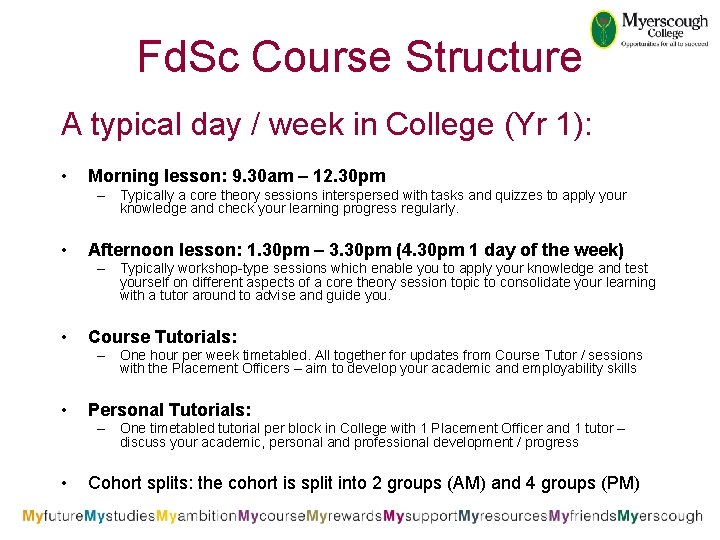
Fd. Sc Course Structure A typical day / week in College (Yr 1): • Morning lesson: 9. 30 am – 12. 30 pm – Typically a core theory sessions interspersed with tasks and quizzes to apply your knowledge and check your learning progress regularly. • Afternoon lesson: 1. 30 pm – 3. 30 pm (4. 30 pm 1 day of the week) – Typically workshop-type sessions which enable you to apply your knowledge and test yourself on different aspects of a core theory session topic to consolidate your learning with a tutor around to advise and guide you. • Course Tutorials: – One hour per week timetabled. All together for updates from Course Tutor / sessions with the Placement Officers – aim to develop your academic and employability skills • Personal Tutorials: – One timetabled tutorial per block in College with 1 Placement Officer and 1 tutor – discuss your academic, personal and professional development / progress • Cohort splits: the cohort is split into 2 groups (AM) and 4 groups (PM)
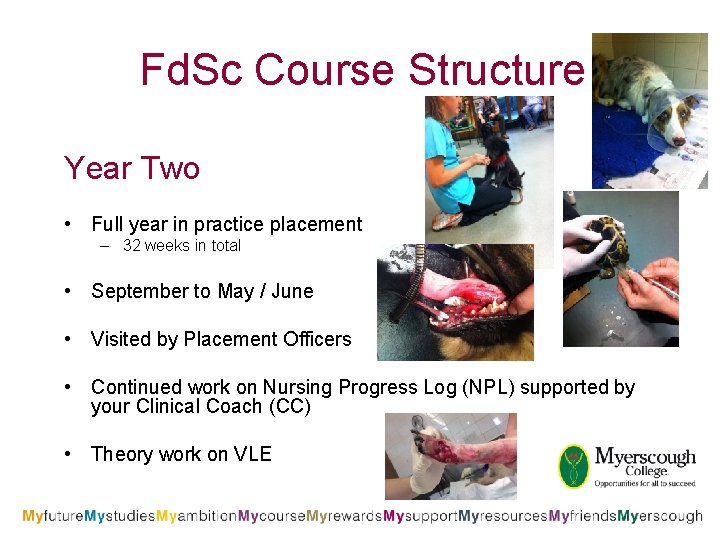
Fd. Sc Course Structure Year Two • Full year in practice placement – 32 weeks in total • September to May / June • Visited by Placement Officers • Continued work on Nursing Progress Log (NPL) supported by your Clinical Coach (CC) • Theory work on VLE
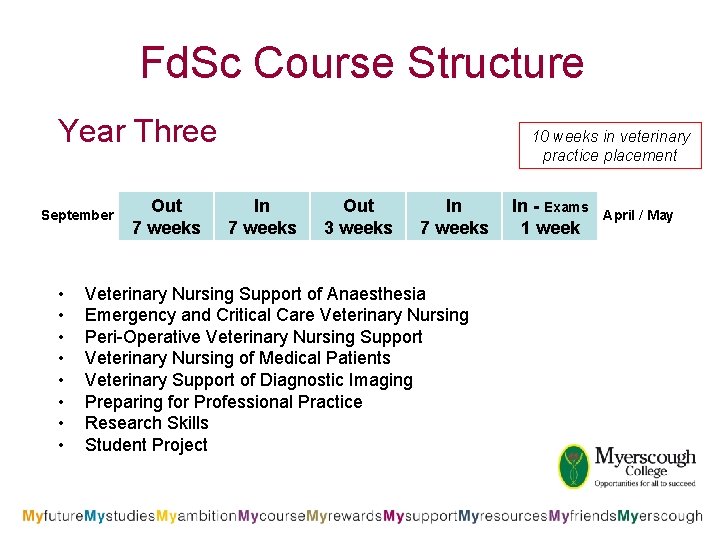
Fd. Sc Course Structure Year Three September • • Out 7 weeks 10 weeks in veterinary practice placement In 7 weeks Out 3 weeks In 7 weeks Veterinary Nursing Support of Anaesthesia Emergency and Critical Care Veterinary Nursing Peri-Operative Veterinary Nursing Support Veterinary Nursing of Medical Patients Veterinary Support of Diagnostic Imaging Preparing for Professional Practice Research Skills Student Project In - Exams 1 week April / May
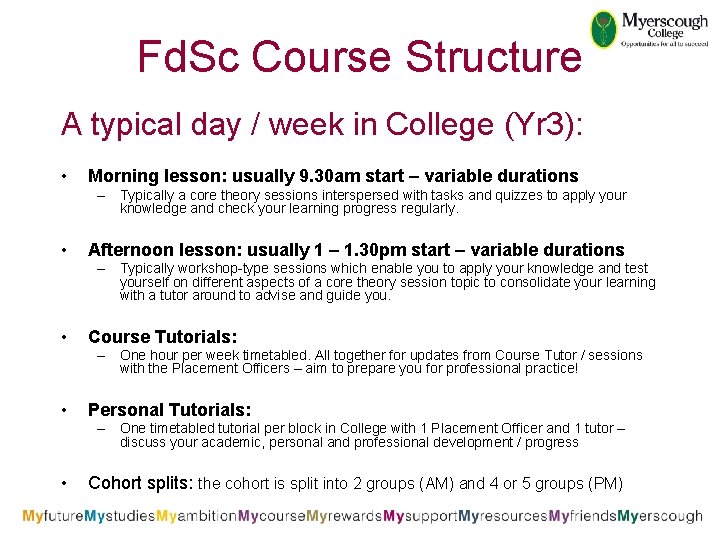
Fd. Sc Course Structure A typical day / week in College (Yr 3): • Morning lesson: usually 9. 30 am start – variable durations – Typically a core theory sessions interspersed with tasks and quizzes to apply your knowledge and check your learning progress regularly. • Afternoon lesson: usually 1 – 1. 30 pm start – variable durations – Typically workshop-type sessions which enable you to apply your knowledge and test yourself on different aspects of a core theory session topic to consolidate your learning with a tutor around to advise and guide you. • Course Tutorials: – One hour per week timetabled. All together for updates from Course Tutor / sessions with the Placement Officers – aim to prepare you for professional practice! • Personal Tutorials: – One timetabled tutorial per block in College with 1 Placement Officer and 1 tutor – discuss your academic, personal and professional development / progress • Cohort splits: the cohort is split into 2 groups (AM) and 4 or 5 groups (PM)
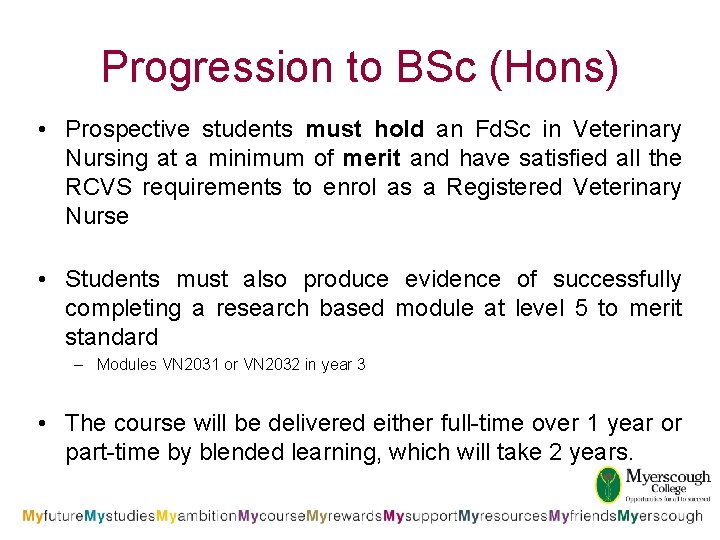
Progression to BSc (Hons) • Prospective students must hold an Fd. Sc in Veterinary Nursing at a minimum of merit and have satisfied all the RCVS requirements to enrol as a Registered Veterinary Nurse • Students must also produce evidence of successfully completing a research based module at level 5 to merit standard – Modules VN 2031 or VN 2032 in year 3 • The course will be delivered either full-time over 1 year or part-time by blended learning, which will take 2 years.
BSc (Hons) Course Structure • Dissertation (year-long module) PLUS • 4 other modules spread over 1 year fulltime or 2 years part-time • Modules include: – Professional Development Skills / Rehabilitation Therapy for Veterinary Patients / Veterinary Nursing Support of Pain Management / Veterinary Nursing of Life Limiting Conditions
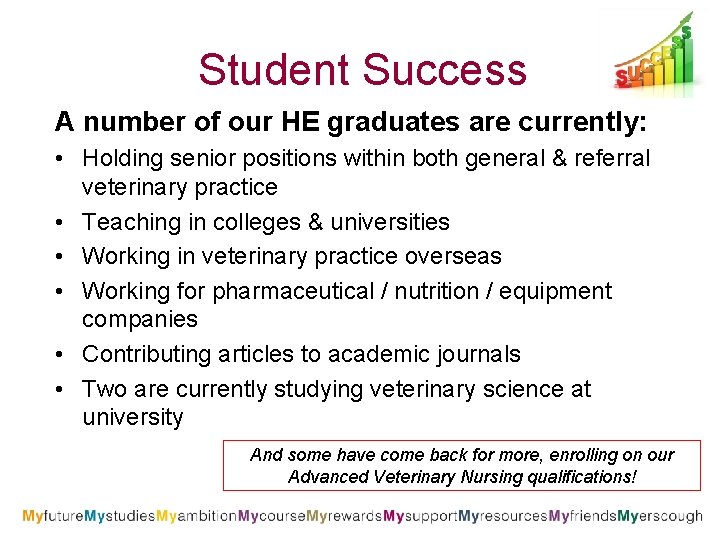
Student Success A number of our HE graduates are currently: • Holding senior positions within both general & referral veterinary practice • Teaching in colleges & universities • Working in veterinary practice overseas • Working for pharmaceutical / nutrition / equipment companies • Contributing articles to academic journals • Two are currently studying veterinary science at university And some have come back for more, enrolling on our Advanced Veterinary Nursing qualifications!
Additional Course and College-Related Information
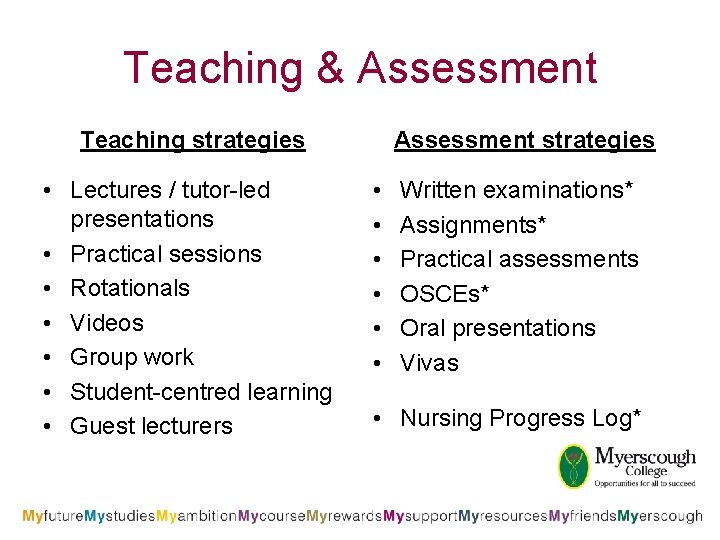
Teaching & Assessment Teaching strategies • Lectures / tutor-led presentations • Practical sessions • Rotationals • Videos • Group work • Student-centred learning • Guest lecturers Assessment strategies • • • Written examinations* Assignments* Practical assessments OSCEs* Oral presentations Vivas • Nursing Progress Log*
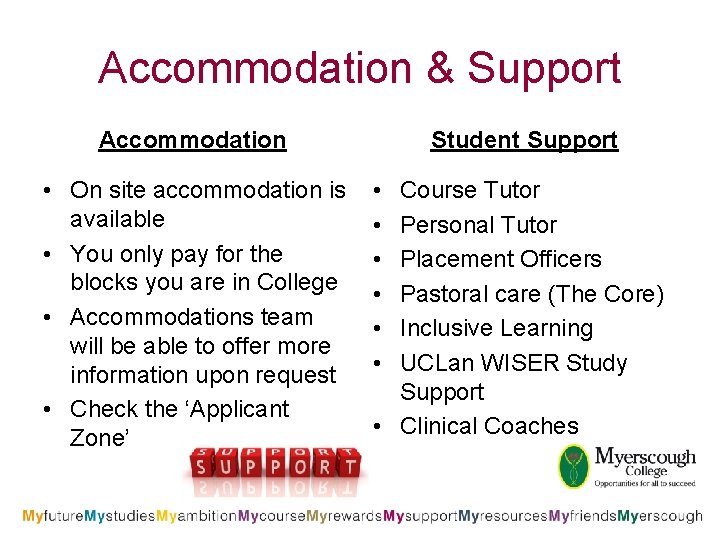
Accommodation & Support Accommodation • On site accommodation is available • You only pay for the blocks you are in College • Accommodations team will be able to offer more information upon request • Check the ‘Applicant Zone’ Student Support • • • Course Tutor Personal Tutor Placement Officers Pastoral care (The Core) Inclusive Learning UCLan WISER Study Support • Clinical Coaches
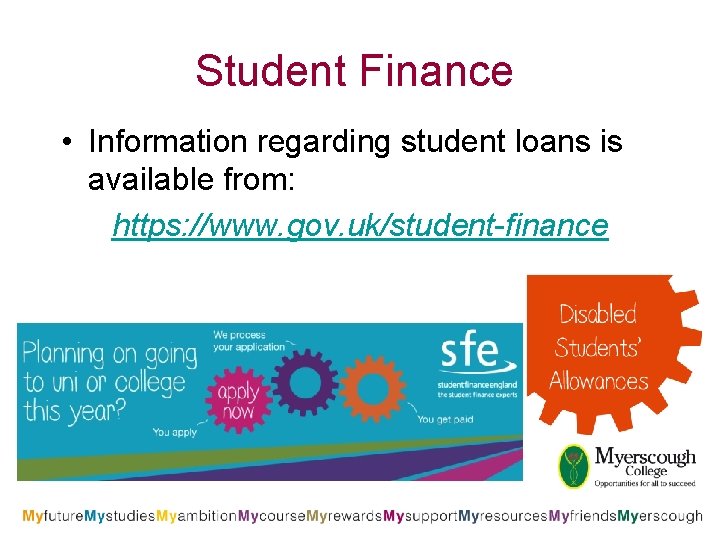
Student Finance • Information regarding student loans is available from: https: //www. gov. uk/student-finance
Hidden Extras • RCVS Enrolment fee: £ 169 (approx. ) • RCVS Registration fee: £ 112 (approx. ) • Uniforms: £ 70 (approx. ) – Other equipment available too • Human first aid course: £ 40 (approx. ) • Books: £ 120? ? – Depends which books you want! • Travel expenses to practice placement – Potentially accommodation costs
My Application You will be directed to the My Application section of the website in your offer or interview letter (it can be found in the “My Myerscough” Section). It contains important information about every aspect of your application up to the point of your enrolment. You should bookmark the page and visit it on a regular basis for updates and latest applicant news. www. myerscough. ac. uk
Good luck from the Myerscough VN Team
Study hard! You know what academic grades you are striving for!
Competition is tough!
Success Rates • Exemplary achievement by students: – 96% achievement: Fd. Sc VN – 100% achievement: BSc (Hons) VN – 100% achievement: Dip AVN f HE o % 100 into s e t a gradu yment emplo • Excellent feedback from students: – – – 97% agree staff are good at explaining things 97% agree staff are enthusiastic about what they teach 97% agree feedback on assessments is prompt, fair and useful 97% agree staff can be contacted when needed 97% agree the course has enabled them to present themselves with confidence 97% overall satisfaction
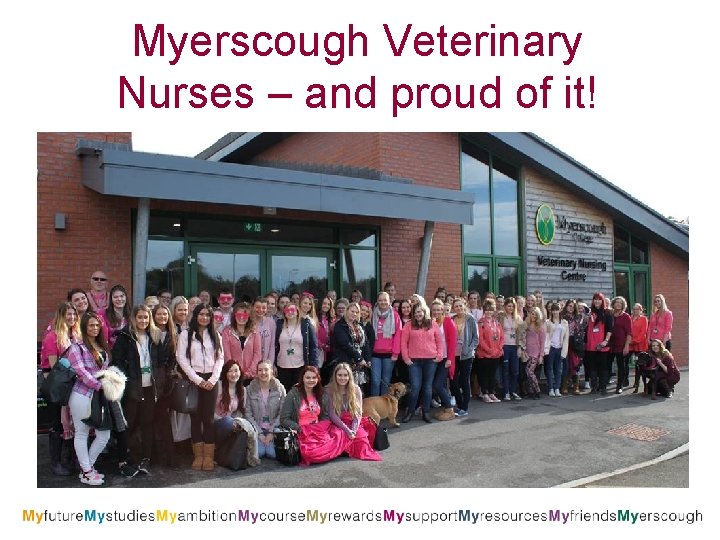
Myerscough Veterinary Nurses – and proud of it!
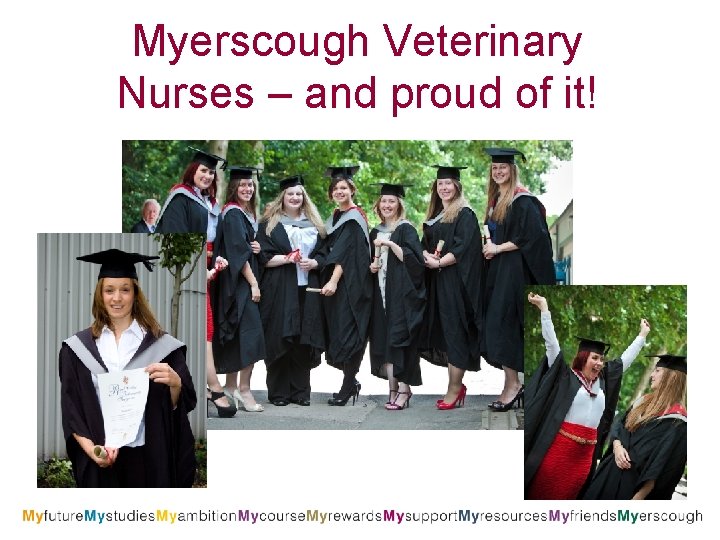
Myerscough Veterinary Nurses – and proud of it!
The End Thanks for your attention Good luck with your examinations / remainder of your courses We look forward to meeting you at the Applicant Day
Questions If you have any questions at all following this presentation, please do not hesitate to contact: Claire Bloor HE Assistant Head of Veterinary Nursing 01995 642366 cbloor@myerscough. ac. uk