
MyersBriggs Type Indicator Four dichotomies that define sixteen
Myers-Briggs Type Indicator • Four dichotomies that define sixteen categories – Each is a continuum, not a binary choice • This is not “what you are” – It is “right now, what you prefer” (and strength of preference) – For example, most introverts can operate in extrovert mode when needed. • Results can vary from test to test or day to day by several points. – Results are generally consistent, between “adjacent” types • Wikipedia has good articles for some types 1
Why Does it Matter? • Presumably, different types are better/worse at different tasks – CS needs an unusually broad range of types to get everything done – Numerical analysis vs. HCI – Mangers, architects, programmers, testers, documentation writers • How do you best learn and work? Interact in organizations? • Type/type interpersonal interactions • Team building 2

What Type Am I? • Depending on which test you take/ your current mood, you might end up assigned to different categories on different attempts. • Testers often defer to the person on “best fit” category. • Be careful when reading the descriptions – They tend to be general – They tend to be a bit flattering (which category type is for scatterbrained people? For couch potatoes? ) – In general, readers tend to agree with any generic assignment that they are given (Forer effect) 3
Potential Failings • Is it accurate? • Unstable: Lots of variation in results between instruments and over time • Does it make sense to say there are 16 personality types? • Does it actually predict anything? 4

Four Dichotomies • The words used for the poles on each of the four dichotomies have technical meanings – You can’t interpret what these mean using the everyday definitions of the words – A person isn’t “more judgmental” or “less perceptive” in these words’ everyday meaning 5
Introvert/Extravert [Attitude] • Defines the source and direction of energy expression for a person. – Extravert has a source and direction of energy expression mainly in the external world. Act/reflect/act. Energy/motivation decline with inactivity. – Introvert has a source of energy mainly in the internal world. Reflect/act/reflect. Needs downtime after action to reflect. 6

Introvert/Extravert (Cont) • These meanings are different from common use. • You reflect before you act, and you might need plenty of “reflect time” after acting, but can still enjoy and interact at a party without being shy • An extravert might draw strength from acting rather than from reflecting, but that doesn’t tell us whether he is a “loud” person or not 7
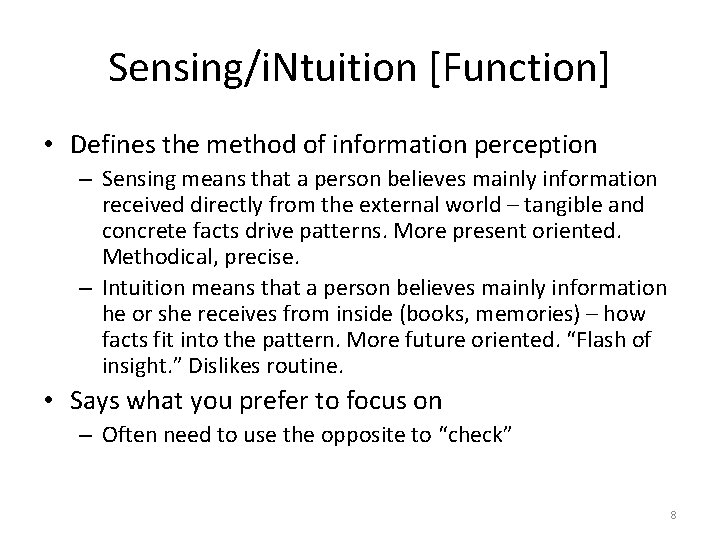
Sensing/i. Ntuition [Function] • Defines the method of information perception – Sensing means that a person believes mainly information received directly from the external world – tangible and concrete facts drive patterns. More present oriented. Methodical, precise. – Intuition means that a person believes mainly information he or she receives from inside (books, memories) – how facts fit into the pattern. More future oriented. “Flash of insight. ” Dislikes routine. • Says what you prefer to focus on – Often need to use the opposite to “check” 8
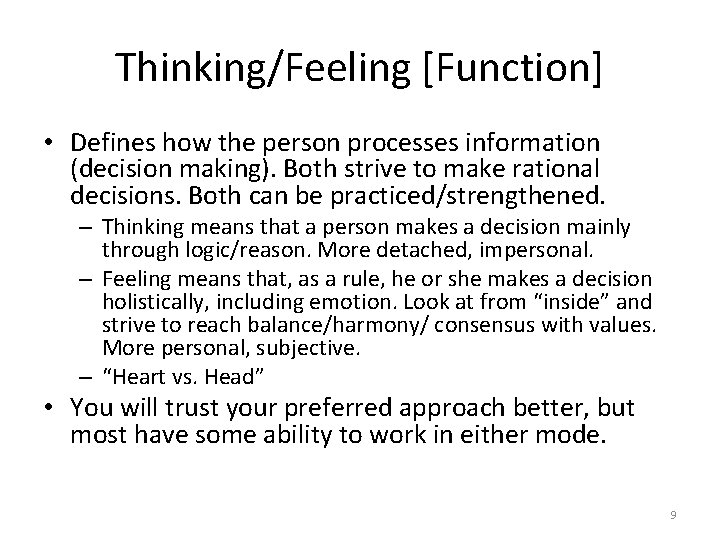
Thinking/Feeling [Function] • Defines how the person processes information (decision making). Both strive to make rational decisions. Both can be practiced/strengthened. – Thinking means that a person makes a decision mainly through logic/reason. More detached, impersonal. – Feeling means that, as a rule, he or she makes a decision holistically, including emotion. Look at from “inside” and strive to reach balance/harmony/ consensus with values. More personal, subjective. – “Heart vs. Head” • You will trust your preferred approach better, but most have some ability to work in either mode. 9
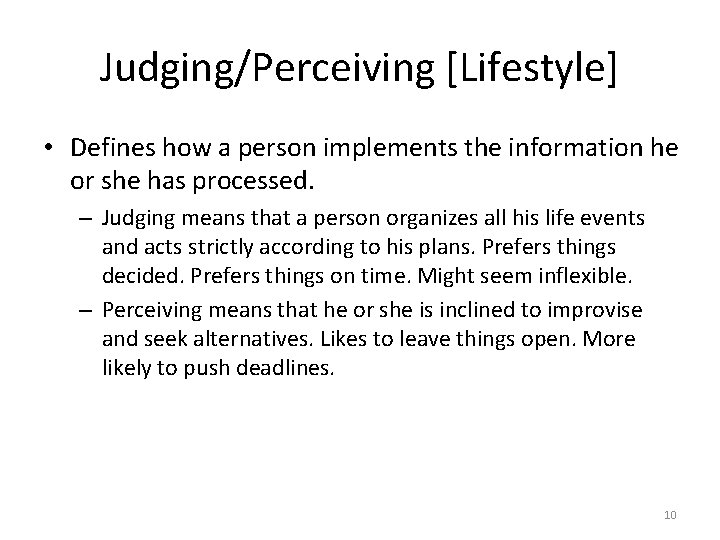
Judging/Perceiving [Lifestyle] • Defines how a person implements the information he or she has processed. – Judging means that a person organizes all his life events and acts strictly according to his plans. Prefers things decided. Prefers things on time. Might seem inflexible. – Perceiving means that he or she is inclined to improvise and seek alternatives. Likes to leave things open. More likely to push deadlines. 10
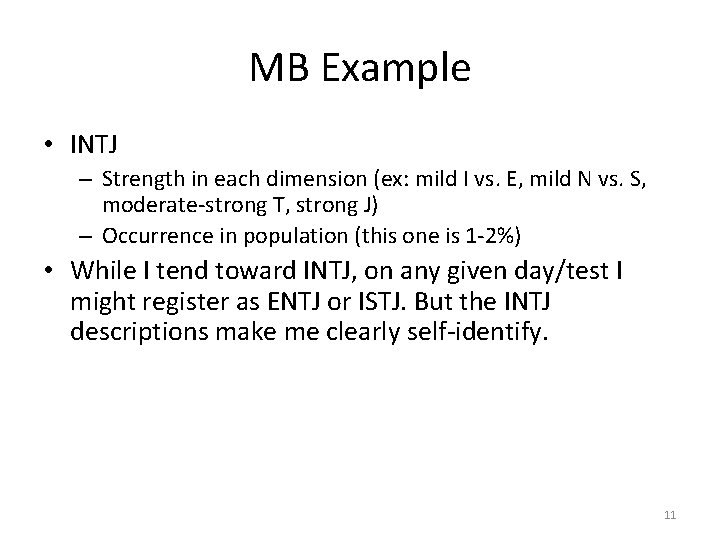
MB Example • INTJ – Strength in each dimension (ex: mild I vs. E, mild N vs. S, moderate-strong T, strong J) – Occurrence in population (this one is 1 -2%) • While I tend toward INTJ, on any given day/test I might register as ENTJ or ISTJ. But the INTJ descriptions make me clearly self-identify. 11
What is the CS Personality? • What is the “public perception” of CS? • What is your perception? 12
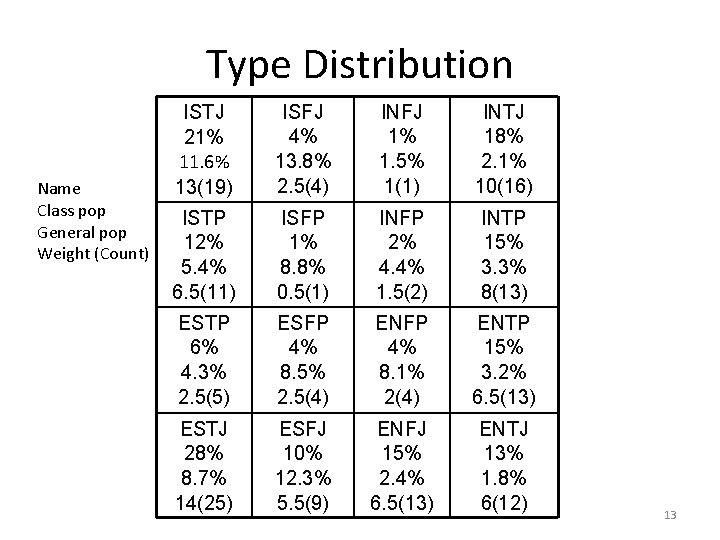
Type Distribution Name Class pop General pop Weight (Count) ISTJ 21% 11. 6% 13(19) ISFJ 4% 13. 8% 2. 5(4) INFJ 1% 1. 5% 1(1) INTJ 18% 2. 1% 10(16) ISTP 12% 5. 4% 6. 5(11) ISFP 1% 8. 8% 0. 5(1) INFP 2% 4. 4% 1. 5(2) INTP 15% 3. 3% 8(13) ESTP 6% 4. 3% 2. 5(5) ESFP 4% 8. 5% 2. 5(4) ENFP 4% 8. 1% 2(4) ENTP 15% 3. 2% 6. 5(13) ESTJ 28% 8. 7% 14(25) ESFJ 10% 12. 3% 5. 5(9) ENFJ 15% 2. 4% 6. 5(13) ENTJ 13% 1. 8% 6(12) 13
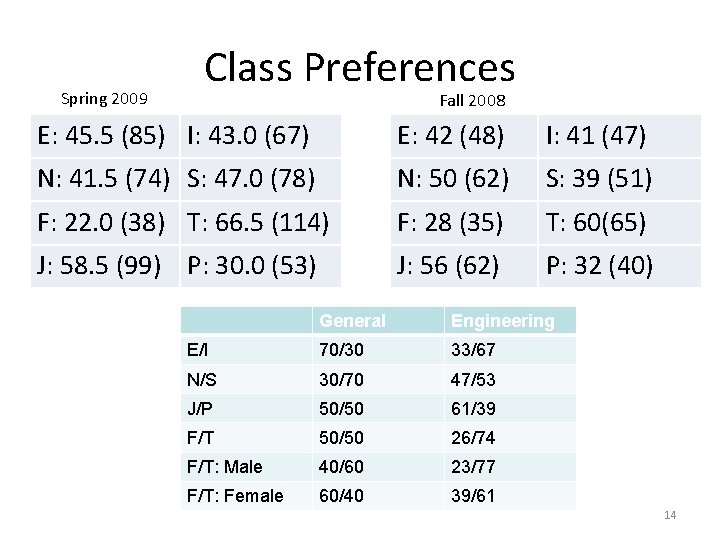
Spring 2009 Class Preferences Fall 2008 E: 45. 5 (85) I: 43. 0 (67) E: 42 (48) I: 41 (47) N: 41. 5 (74) S: 47. 0 (78) N: 50 (62) S: 39 (51) F: 22. 0 (38) T: 66. 5 (114) F: 28 (35) T: 60(65) J: 58. 5 (99) P: 30. 0 (53) J: 56 (62) P: 32 (40) General Engineering E/I 70/30 33/67 N/S 30/70 47/53 J/P 50/50 61/39 F/T 50/50 26/74 F/T: Male 40/60 23/77 F/T: Female 60/40 39/61 14
Relevance to Education • Different types prefer various teaching/testing styles – – Sensing and Judging types prefer memorization and recall i. Ntuition types prefer hypothesis/essay Most in population are sensing Most faculty are intuition • Engineering students are split evenly N/S, but these groups have different needs 15
- Slides: 15