
Myers PSYCHOLOGY 7 th Ed Chapter 7 B
Myers’ PSYCHOLOGY (7 th Ed) Chapter 7 B Thinking and Language James A. Mc. Cubbin, Ph. D Clemson University Worth Publishers
Thinking § Cognition § mental activities associated with thinking, knowing, remembering, and communicating § Cognitive Psychologists § study these mental activities § concept formation § problem solving § decision making § judgment formation
Thinking § Concept § mental grouping of similar objects, events, ideas, or people § Prototype § mental image or best example of a category § Ex. Describe what a bird looks like?
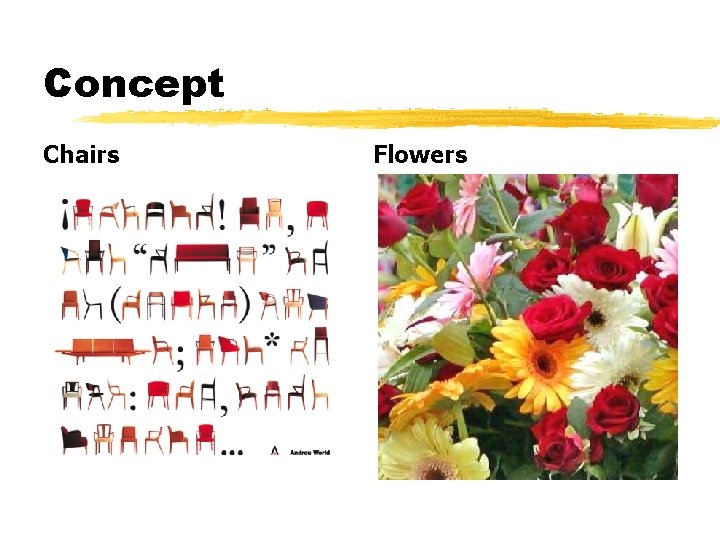
Concept Chairs Flowers
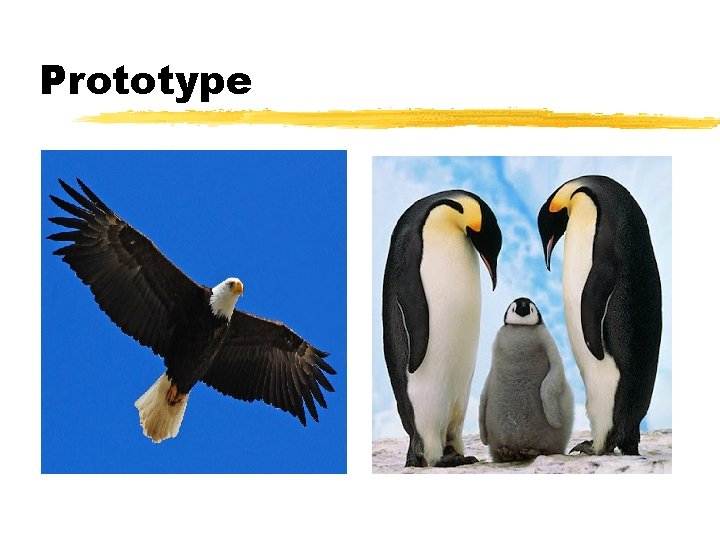
Prototype
Solving Problems 4 Strategies z. Algorithms y. Step-by-step z. Heuristic z. Insight z. Trial and Error
Thinking: Problem Solving § Algorithm § methodical, logical rule or procedure that guarantees solving a particular problem § For example solving an equation using Order of Operations. § 2 x+6 = 14; Solve for X
Thinking: Problem Solving § Heuristic § simple thinking strategy that often allows us to make judgments and solve problems efficiently § Rules of thumb derived from experience. No guarantee of accuracy or usefulness § Example, counting seconds between lighting and thunder to see how far away storm is. § Racial Profiling, stereotyping are heuristics.
Thinking: Problem Solving § Insight § sudden and often novel realization of the solution to a problem § contrasts with strategy-based solutions z Trial and Error y make attempts until correct solution is found.
Thinking Unscramble SPLOYOCHYG § Algorithm § all 907, 208 combinations § Heuristic § throw out all YY combinations § other heuristics?
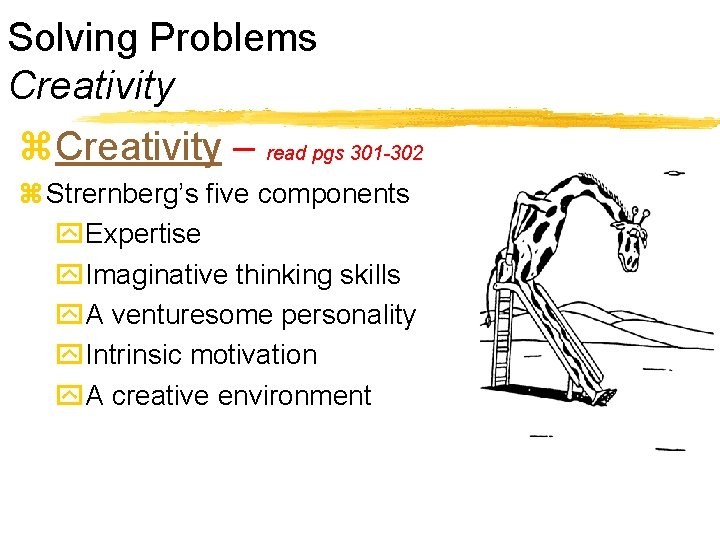
Solving Problems Creativity z. Creativity – read pgs 301 -302 z Strernberg’s five components y. Expertise y. Imaginative thinking skills y. A venturesome personality y. Intrinsic motivation y. A creative environment
Thinking: Problem Solving Hurdles to § Confirmation Bias § tendency to search for information that confirms one’s preconceptions § Fixation § inability to see a problem from a new perspective § impediment to problem solving
Thinking § Functional Fixedness § tendency to think of things only in terms of their usual functions § impediment to problem solving
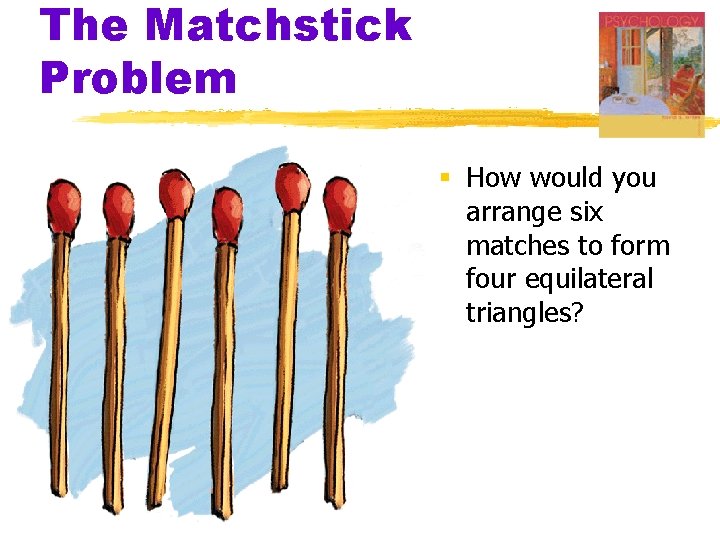
The Matchstick Problem § How would you arrange six matches to form four equilateral triangles?
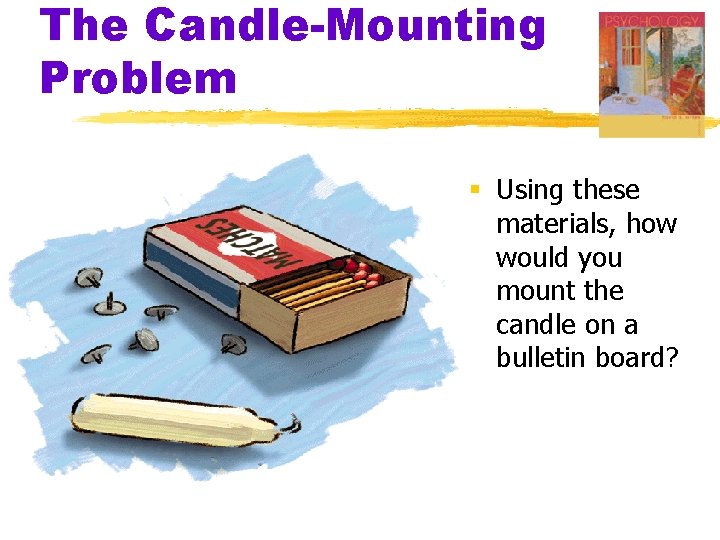
The Candle-Mounting Problem § Using these materials, how would you mount the candle on a bulletin board?
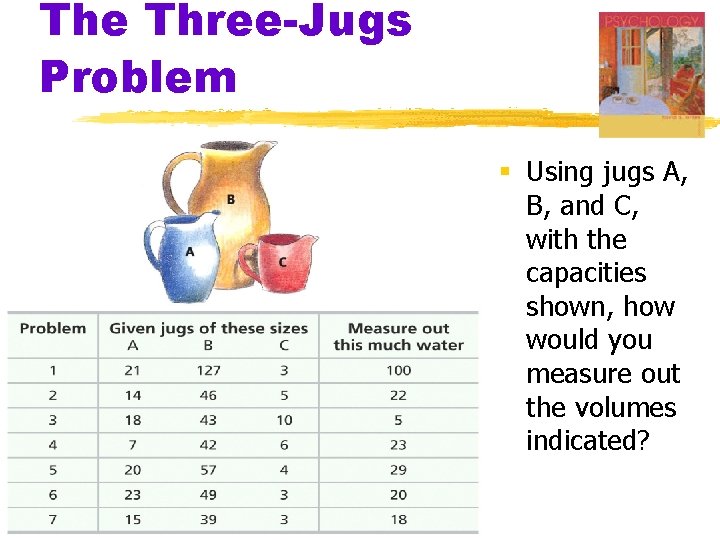
The Three-Jugs Problem § Using jugs A, B, and C, with the capacities shown, how would you measure out the volumes indicated?
Heuristics § Representativeness Heuristic § judging the likelihood of things in terms of how well they seem to represent, or match, particular prototypes § may lead one to ignore other relevant information
Representativeness Heuristic z. Two boxers are in a match scheduled for 12 rounds. (Pure boxing only – no kicking, UFC takedowns, or anything else). One of the boxers gets knocked out after only six rounds, yet no man throws a punch. How is this possible?
Heuristics § Representativeness Heuristic § Describe a NASCAR driver: § Drivers 1 § Drivers 2
Heuristics § Availability Heuristic § estimating the likelihood of events based on their availability in memory § if instances come readily to mind (perhaps because of their vividness), we presume such events are common § Example: airplane crash, Casino Winners & Losers, Jaws & swimming.
Thinking § Overconfidence § tendency to be more confident than correct § tendency to overestimate the accuracy of one’s beliefs and judgments
Thinking § Belief Bias § the tendency for one’s preexisting beliefs to distort logical reasoning § sometimes by making invalid conclusions seem valid or valid conclusions seem invalid § Belief Perseverance § clinging to one’s initial conceptions after the basis on which they were formed has been discredited – read pgs 308 -309 “Fear Factor”
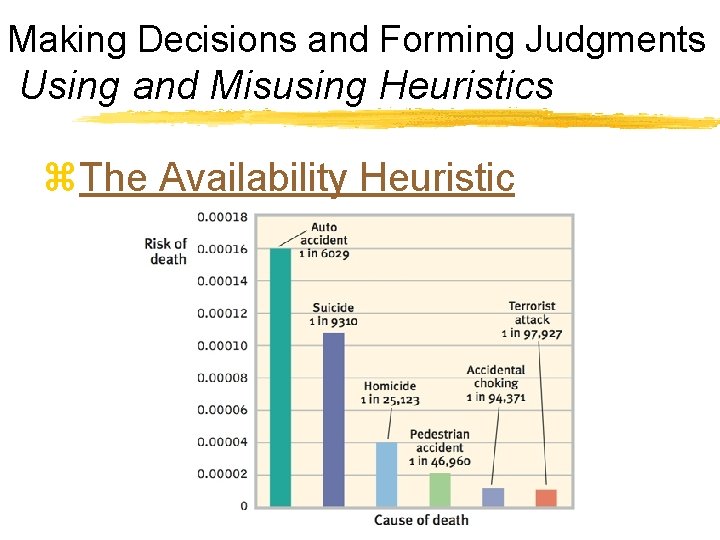
Making Decisions and Forming Judgments Using and Misusing Heuristics z. The Availability Heuristic
Thinking § Framing – read pgs 311 -312 § the way an issue is posed § how an issue is framed can significantly affect decisions and judgments § Example: What is the best way to market ground beef--as 25% fat or 75% lean? § Preferred Portion Size – Restaurants use words such as small, regular, supersize for their portions. § Opt In vs Opt Out § Those who understand the power of framing can use it to influence our decisions…
Thinking z“When you know a thing, to hold that you know it; and when you do not know a thing, to allow that you do not know it; THIS is KNOWLEDGE!” – Confucius z. Work on Group Problems to Solve Worksheet.
Language § our spoken, written, or gestured words and the way we combine them to communicate meaning § Phoneme § in a spoken language, the smallest distinctive sound unit. The sound of a letter as used in a word. § For example the letter A – sounds different in Ate and Cat.
Language § Morpheme § in a language, the smallest unit that carries meaning § may be a word or a part of a word (such as a prefix) ex. Uni, Bi, Tri (+ Cycle) § Grammar § a system of rules in a language that enables us to communicate with and understand others
Language § Semantics § the set of rules by which we derive meaning from morphemes, words, and sentences in a given language § also, the study of meaning § Syntax § the rules for combining words into grammatically sensible sentences in a given language
Language § Babbling Stage § beginning at 3 to 4 months § the stage of speech development in which the infant spontaneously utters various sounds at first unrelated to the household language § One-Word Stage § from about age 1 to 2 § the stage in speech development during which a child speaks mostly in single words
Language § Two-Word Stage § beginning about age 2 § the stage in speech development during which a child speaks in mostly two-word statements § Telegraphic Speech § early speech stage in which the child speaks like a telegram-–“go car”--using mostly nouns and verbs and omitting “auxiliary” words
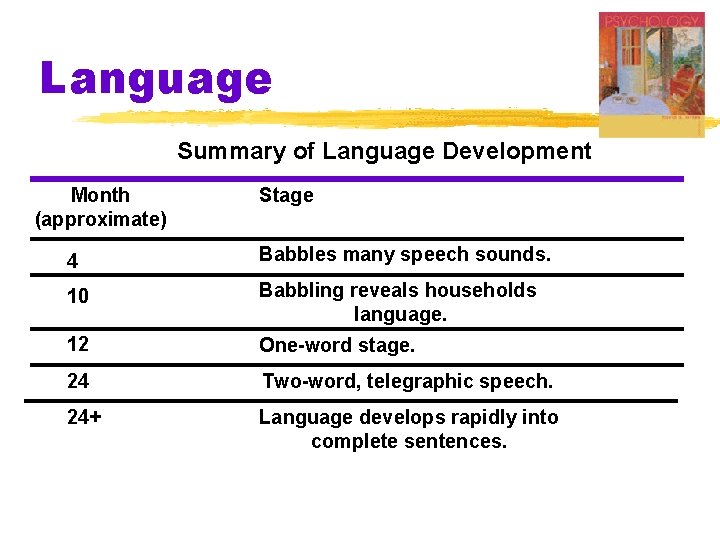
Language Summary of Language Development Month (approximate) Stage 4 Babbles many speech sounds. 10 Babbling reveals households language. 12 One-word stage. 24 Two-word, telegraphic speech. 24+ Language develops rapidly into complete sentences.
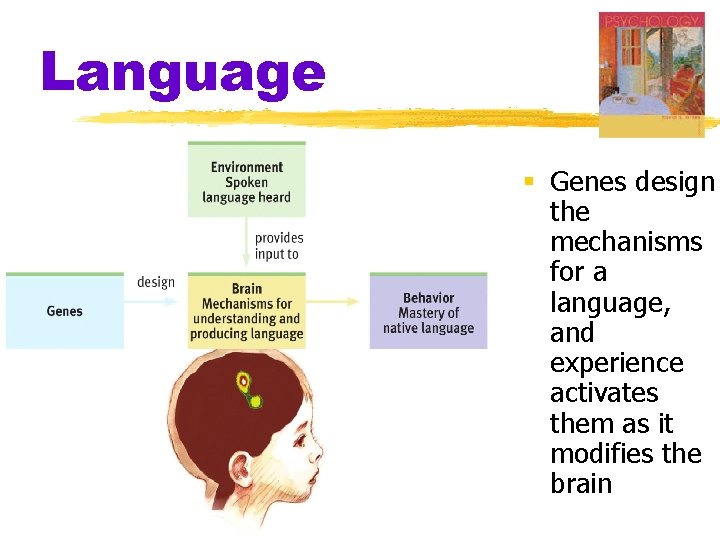
Language § Genes design the mechanisms for a language, and experience activates them as it modifies the brain
How do we Learn Language: Read pgs 316 -317 Skinner: Operant Learning z Association : sights of things with the sounds of words z Imitation : of the words and syntax modeled by others z Reinforcement : With smiles and hugs when a child speaks. z Linda Chomsky: Inborn Universal Grammer z Language Acquisition Device: we are genetically prewired to acquire language. As we hear language, the switches get set for the language we are to learn. z Universal Grammar: All human grammars have the same building blocks, such as nouns and verbs, subjects and objects. Regardless of language, kids start speaking in nouns rather than verbs or adjectives.
Language § Linguistic Determinism § Whorf”s hypothesis that language determines the way we think § Different languages impose different concepts of reality. § Ex. Spanglish, Pig Latin, Slang, words with different meanings by location.
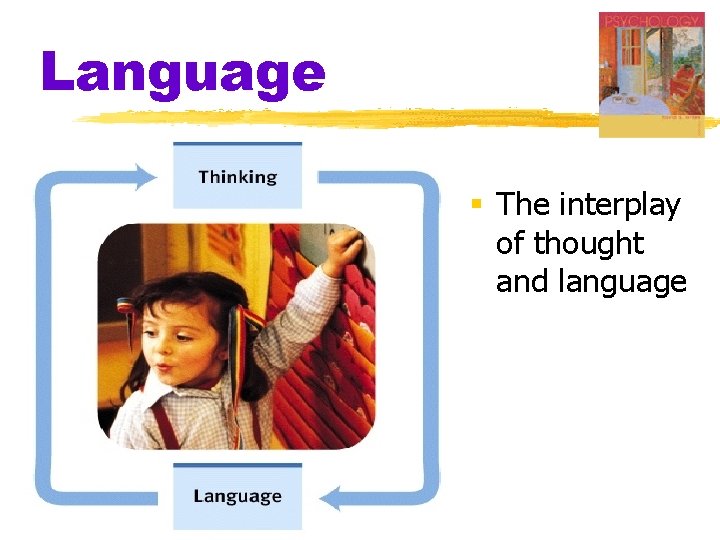
Language § The interplay of thought and language
Language Review z 1. What are the structural components of Language? z 2. What are the stages of Language Development? z 3. What is the relationship between language and thinking?
z For Next Class z. Study for Test – Unit 6, 7 A and 7 B Combined. z For the rest of class, go over Unit Review for both sections.
- Slides: 38