
Myers PSYCHOLOGY 6 th Ed Chapter 11 Intelligence
- Slides: 31
Myers’ PSYCHOLOGY (6 th Ed) Chapter 11 Intelligence James A. Mc. Cubbin, Ph. D Clemson University Worth Publishers
Origins of Intelligence z. Intelligence Test ya method of assessing an individual’s mental aptitudes and comparing them to those of others, using numerical scores
Origins of Intelligence z. Mental Age ya measure of intelligence test performance devised by Binet ychronological age that most typically corresponds to a given level of performance ychild who does as well as the average 8 -year-old is said to have a mental age of 8
Origins of Intelligence z. Stanford-Binet ythe widely used American revision of Binet’s original intelligence test xrevised by Terman at Stanford University
Origins of Intelligence z. Intelligence Quotient (IQ) ydefined originally the ratio of mental age (ma) to chronological age (ca) multiplied by 100 x. IQ = ma/ca x 100) yon contemporary tests it is the average performance for a given age is assigned a score of 100
What is Intelligence? z. Intelligence ycapacity for goal-directed and adaptive behavior yinvolves certain abilities xprofit from experience xsolve problems xreason effectively
What is Intelligence? z. IQ is a score on a test yit is not something you have z. Is intelligence singular or multiple abilities? z. Does it relate to speed of brain processing?
Intelligence z. Is intelligence culturally defined? z. Are intelligence tests culture free?
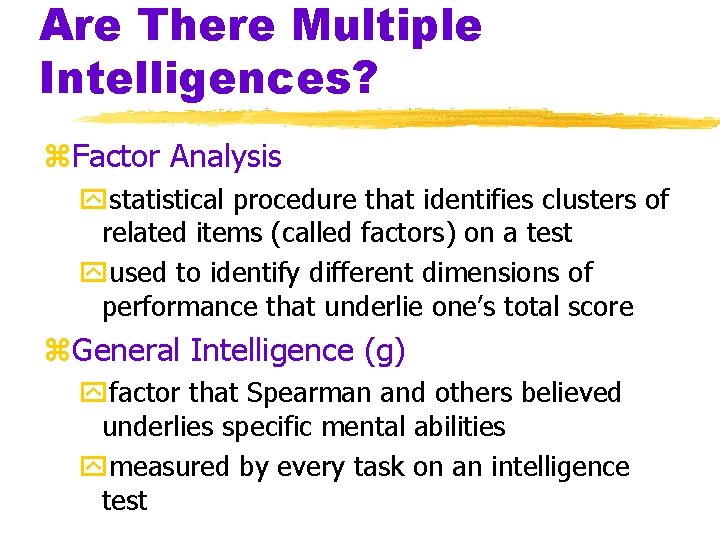
Are There Multiple Intelligences? z. Factor Analysis ystatistical procedure that identifies clusters of related items (called factors) on a test yused to identify different dimensions of performance that underlie one’s total score z. General Intelligence (g) yfactor that Spearman and others believed underlies specific mental abilities ymeasured by every task on an intelligence test
Are There Multiple Intelligences? z. Savant Syndrome ycondition in which a person otherwise limited in mental ability has an amazing specific skill xcomputation xdrawing
Are There Multiple Intelligences? z. Social Intelligence ythe know-how involved in comprehending social situations and managing oneself successfully z. Emotional Intelligence zability to perceive, express, understand, and regulate emotions zcritical part of social intelligence
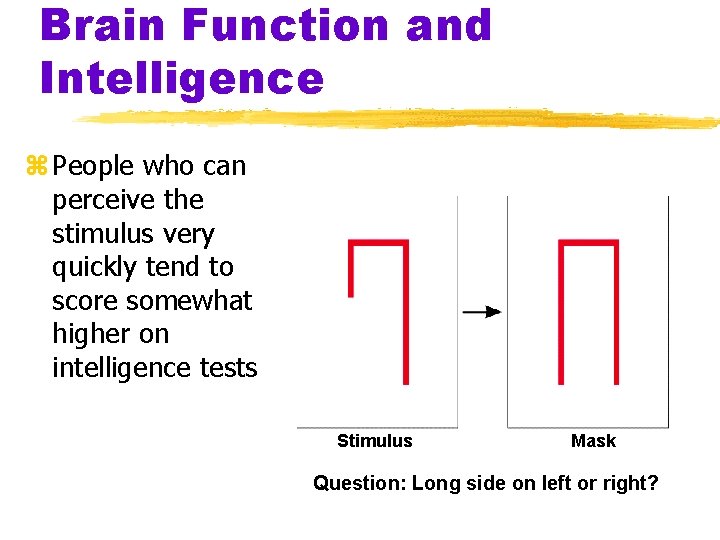
Brain Function and Intelligence z People who can perceive the stimulus very quickly tend to score somewhat higher on intelligence tests Stimulus Mask Question: Long side on left or right?
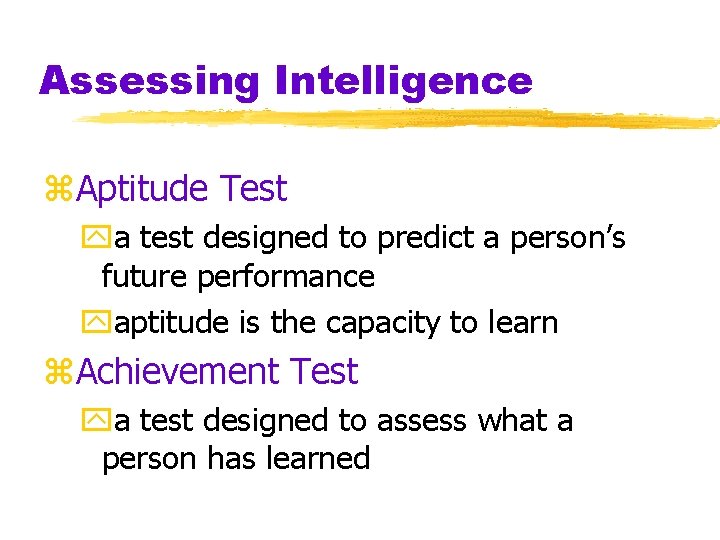
Assessing Intelligence z. Aptitude Test ya test designed to predict a person’s future performance yaptitude is the capacity to learn z. Achievement Test ya test designed to assess what a person has learned
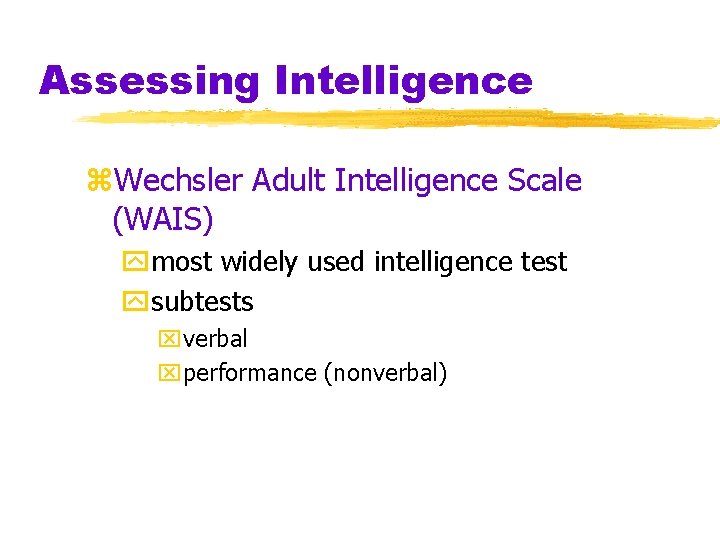
Assessing Intelligence z. Wechsler Adult Intelligence Scale (WAIS) ymost widely used intelligence test ysubtests xverbal xperformance (nonverbal)
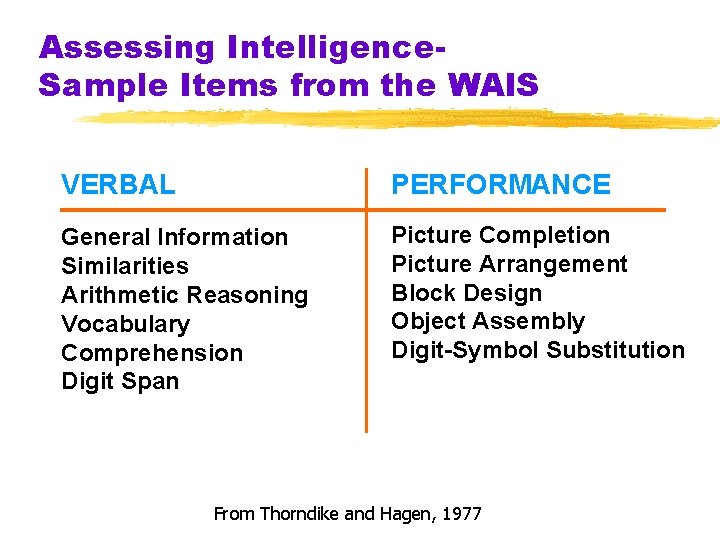
Assessing Intelligence. Sample Items from the WAIS VERBAL PERFORMANCE General Information Similarities Arithmetic Reasoning Vocabulary Comprehension Digit Span Picture Completion Picture Arrangement Block Design Object Assembly Digit-Symbol Substitution From Thorndike and Hagen, 1977
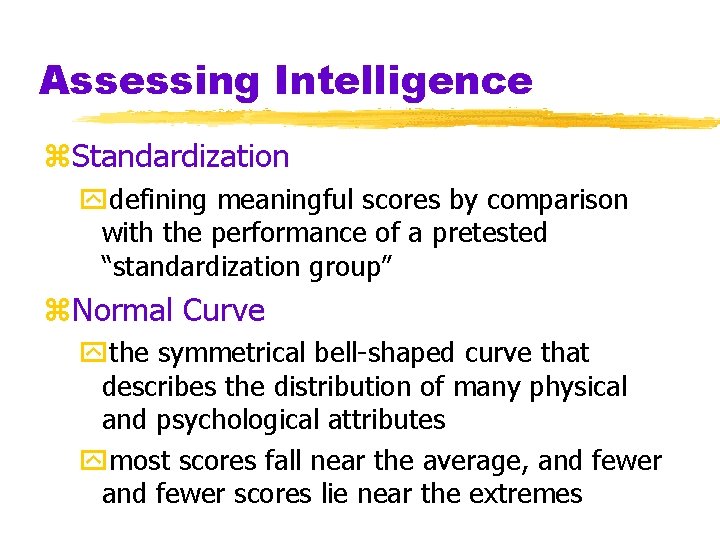
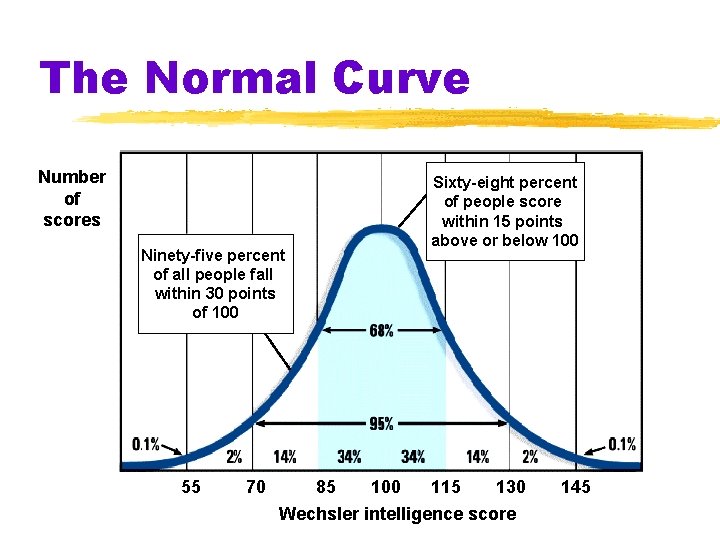
Assessing Intelligence z. Standardization ydefining meaningful scores by comparison with the performance of a pretested “standardization group” z. Normal Curve ythe symmetrical bell-shaped curve that describes the distribution of many physical and psychological attributes ymost scores fall near the average, and fewer scores lie near the extremes
The Normal Curve Number of scores Sixty-eight percent of people score within 15 points above or below 100 Ninety-five percent of all people fall within 30 points of 100 55 70 85 100 115 130 Wechsler intelligence score 145
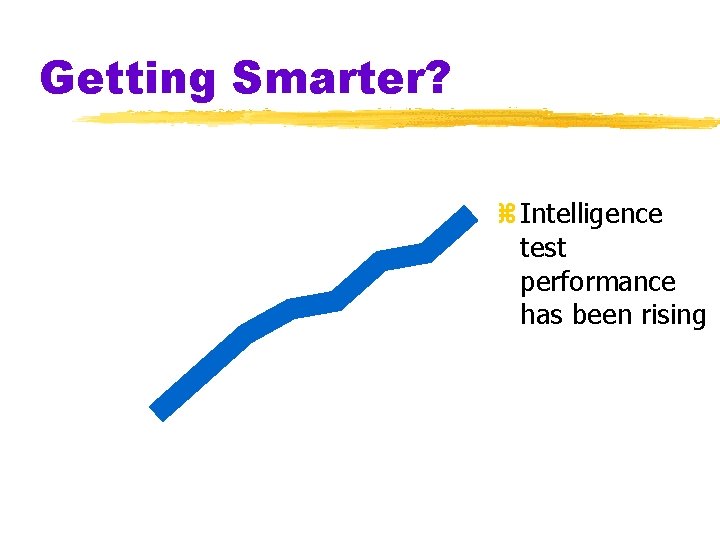
Getting Smarter? z Intelligence test performance has been rising
Assessing Intelligence z. Reliability ythe extent to which a test yields consistent results yassessed by consistency of scores on: xtwo halves of the test xalternate forms of the test xretesting the same individual z. Validity ythe extent to which a test measures or predicts what it is suppose to
Assessing Intelligence z. Content Validity ythe extent to which a test samples the behavior that is of interest xdriving test that samples driving tasks z. Criterion ybehavior (such as college grades) that a test (such as the SAT) is designed to predict ythe measure used in defining whether the test has predictive validity
Assessing Intelligence z. Predictive Validity ysuccess with which a test predicts the behavior it is designed to predict yassessed by computing the correlation between test scores and the criterion behavior yalso called criterion-related validity
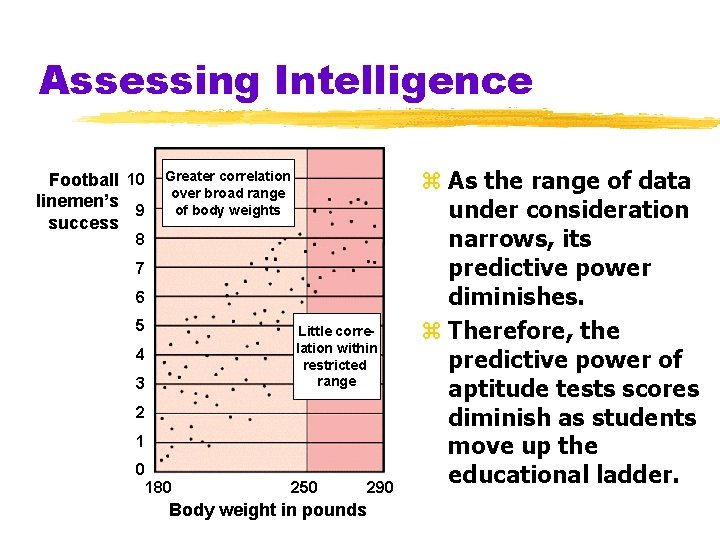
Assessing Intelligence Football 10 linemen’s 9 success Greater correlation over broad range of body weights 8 7 6 5 Little correlation within restricted range 4 3 2 1 0 180 250 Body weight in pounds 290 z As the range of data under consideration narrows, its predictive power diminishes. z Therefore, the predictive power of aptitude tests scores diminish as students move up the educational ladder.
The Dynamics of Intelligence z. Mental Retardation ya condition of limited mental ability yindicated by intelligence scores below 70 yproduces difficulty in adapting to the demands of life yvaries from mild to profound z. Down Syndrome yretardation and associated physical disorders caused by an extra chromosome in genetic make-up
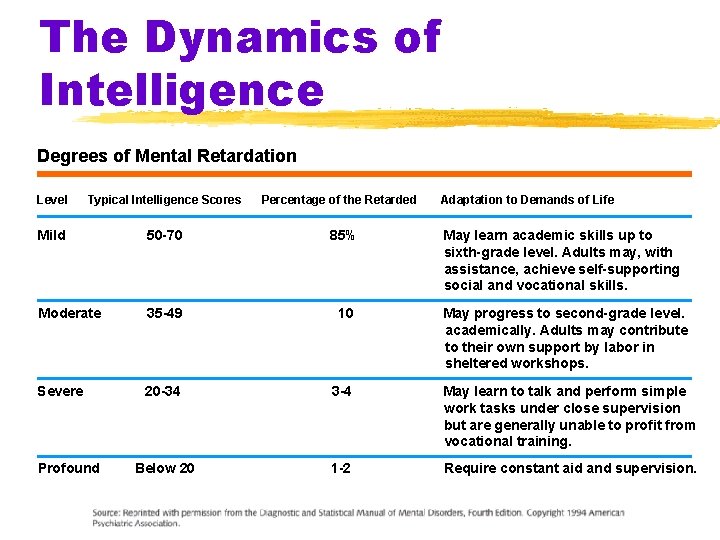
The Dynamics of Intelligence Degrees of Mental Retardation Level Typical Intelligence Scores Mild 50 -70 85% May learn academic skills up to sixth-grade level. Adults may, with assistance, achieve self-supporting social and vocational skills. Moderate 35 -49 10 May progress to second-grade level. academically. Adults may contribute to their own support by labor in sheltered workshops. Severe 20 -34 3 -4 May learn to talk and perform simple work tasks under close supervision but are generally unable to profit from vocational training. Below 20 1 -2 Require constant aid and supervision. Profound Percentage of the Retarded Adaptation to Demands of Life
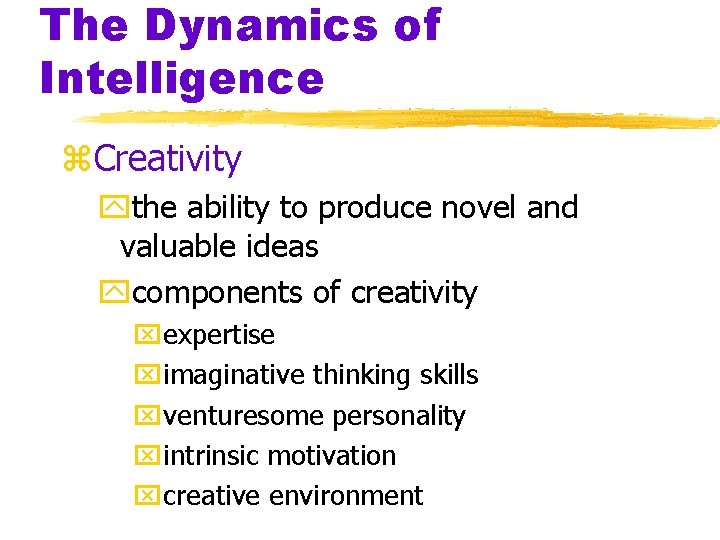
The Dynamics of Intelligence z. Creativity ythe ability to produce novel and valuable ideas ycomponents of creativity xexpertise ximaginative thinking skills xventuresome personality xintrinsic motivation xcreative environment
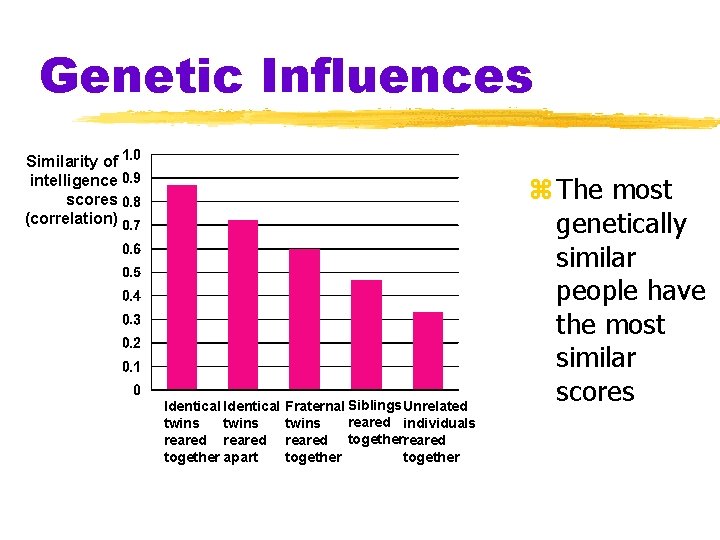
Genetic Influences Similarity of intelligence scores (correlation) Identical twins reared together apart Fraternal Siblings Unrelated reared individuals twins reared together z The most genetically similar people have the most similar scores
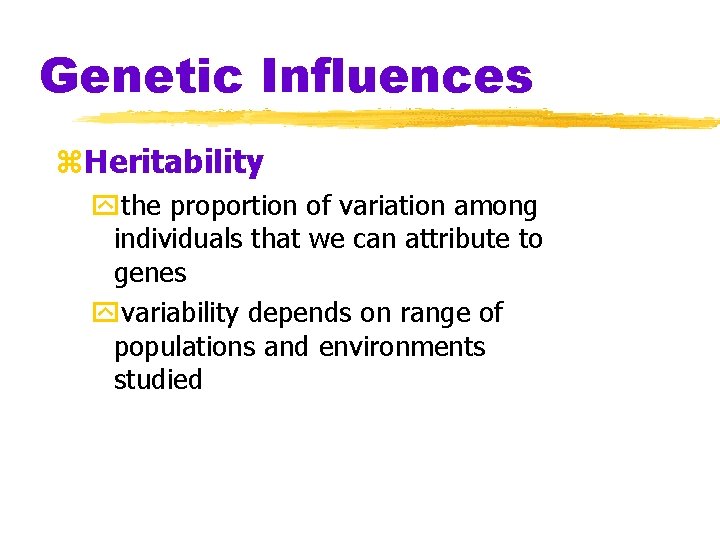
Genetic Influences z. Heritability ythe proportion of variation among individuals that we can attribute to genes yvariability depends on range of populations and environments studied
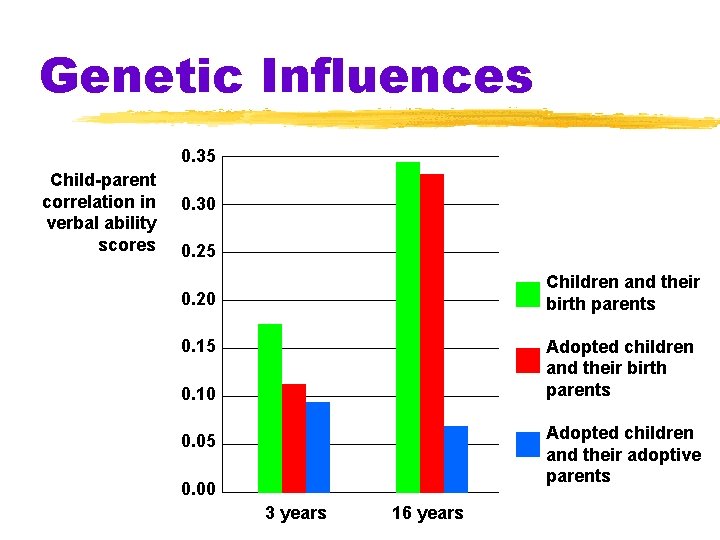
Genetic Influences 0. 35 Child-parent correlation in verbal ability scores 0. 30 0. 25 Children and their birth parents 0. 20 0. 15 Adopted children and their birth parents 0. 10 Adopted children and their adoptive parents 0. 05 0. 00 3 years 16 years
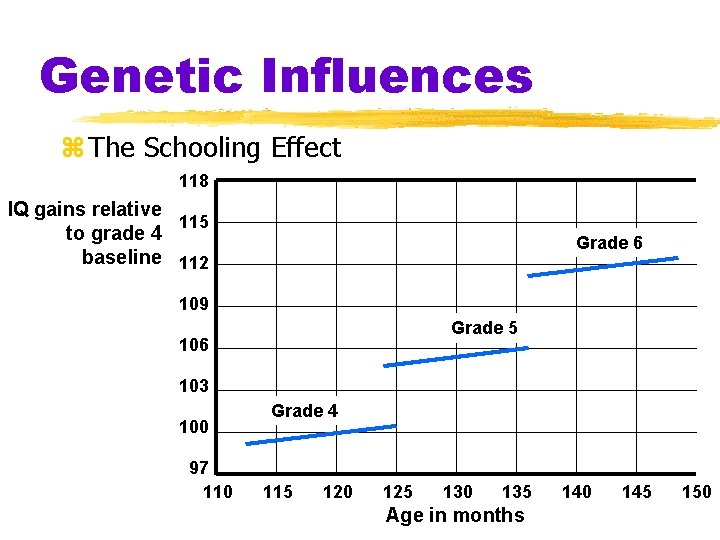
Genetic Influences z The Schooling Effect 118 IQ gains relative 115 to grade 4 baseline 112 Grade 6 109 Grade 5 106 103 100 97 110 Grade 4 115 120 125 130 135 Age in months 140 145 150
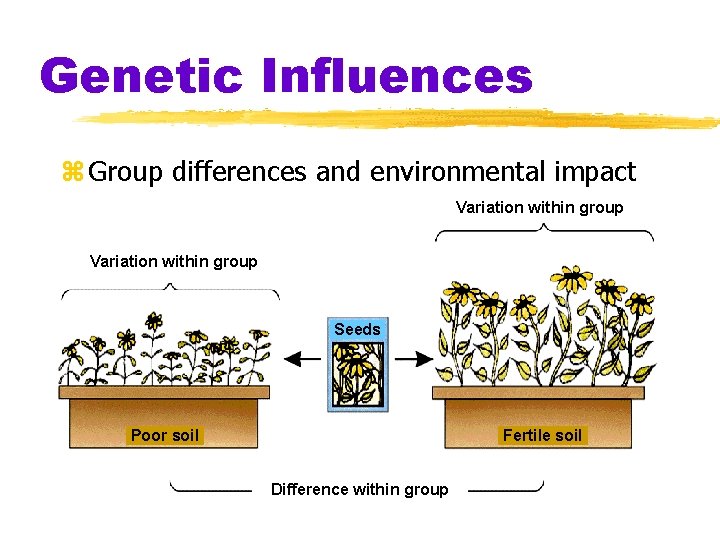
Genetic Influences z Group differences and environmental impact Variation within group Seeds Poor soil Fertile soil Difference within group
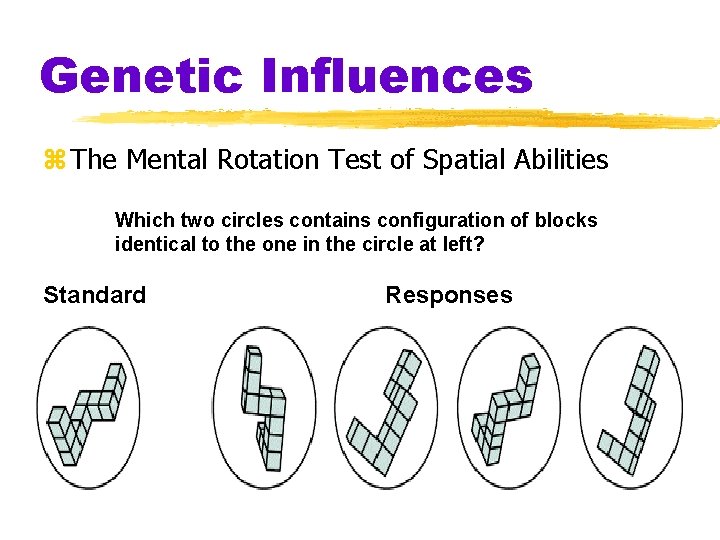
Genetic Influences z The Mental Rotation Test of Spatial Abilities Which two circles contains configuration of blocks identical to the one in the circle at left? Standard Responses