
Myers EXPLORING PSYCHOLOGY 6 th Edition in Modules
- Slides: 28
Myers EXPLORING PSYCHOLOGY (6 th Edition in Modules) Module 21 Information Processing James A. Mc. Cubbin, Ph. D Clemson University Worth Publishers
Memory § persistence of learning over time through the storage and retrieval of information § Flashbulb Memory § a clear memory of an emotionally significant moment or event
Memory § Memory as Information Processing § similar to a computer § write to file § save to disk § read from disk § Encoding § the processing of information into the memory system § i. e. , extracting meaning
Memory § Storage § the retention of encoded information over time § Retrieval § process of getting information out of memory
Memory § Sensory Memory § the immediate, initial recording of sensory information in the memory system § Working Memory § focuses more on the processing of briefly stored information
Memory § Short-Term Memory § activated memory that holds a few items briefly § look up a phone number, then quickly dial before the information is forgotten § Long-Term Memory § the relatively permanent and limitless storehouse of the memory system
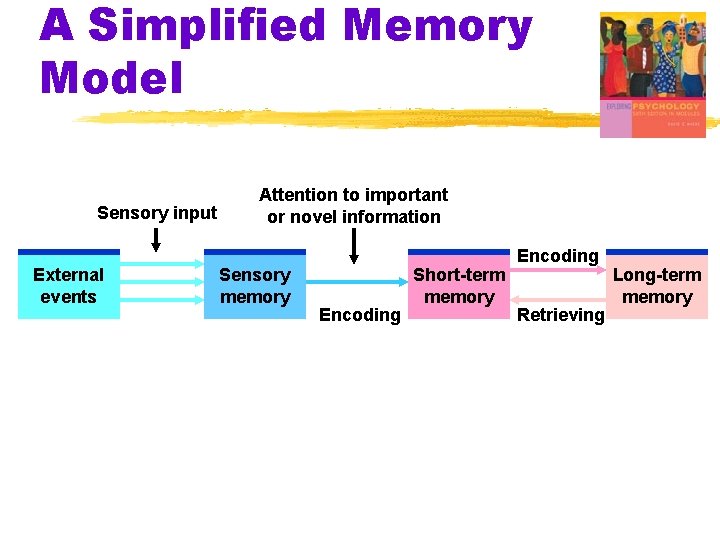
A Simplified Memory Model Sensory input External events Attention to important or novel information Sensory memory Encoding Short-term memory Encoding Retrieving Long-term memory
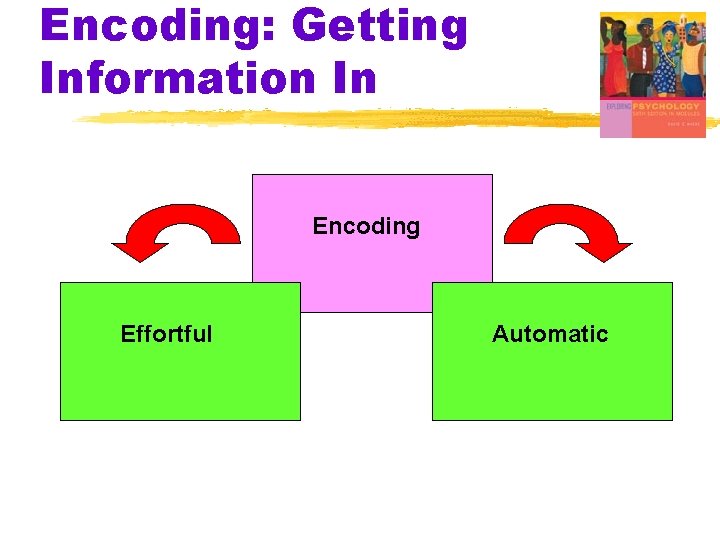
Encoding: Getting Information In Encoding Effortful Automatic
Encoding § Automatic Processing § unconscious encoding of incidental information § space § time § frequency § well-learned information § word meanings § we can learn automatic processing § reading backwards
Encoding § Effortful Processing § requires attention and conscious effort § Rehearsal § conscious repetition of information § to maintain it in consciousness § to encode it for storage
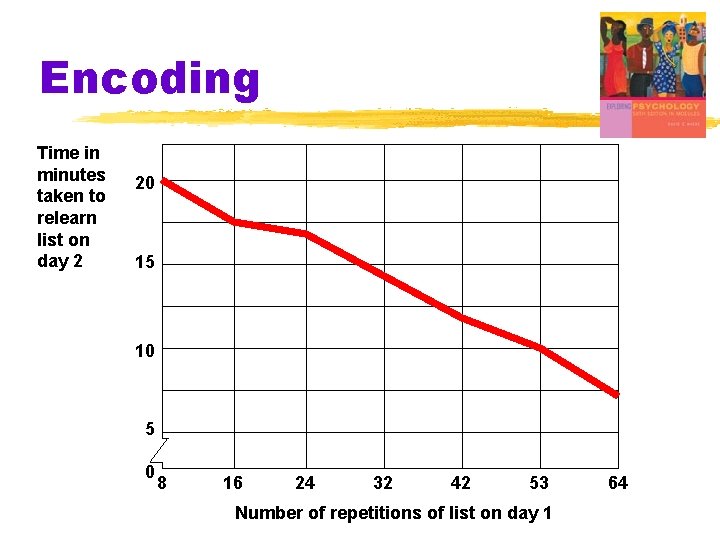
Encoding § Ebbinghaus used nonsense syllables § TUV ZOF GEK WAV § the more times practiced on Day 1, the fewer repetitions to relearn on Day 2 § Spacing Effect § distributed practice yields better longterm retention than massed practice
Encoding Time in minutes taken to relearn list on day 2 20 15 10 5 0 8 16 24 32 42 53 Number of repetitions of list on day 1 64
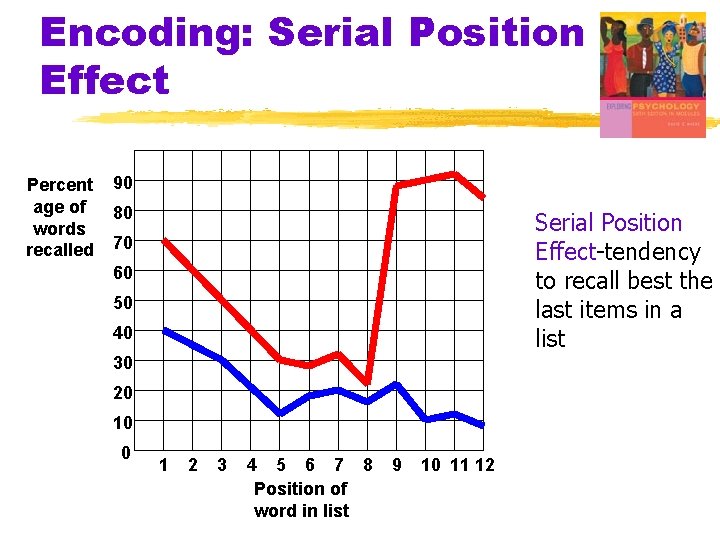
Encoding: Serial Position Effect Percent age of words recalled 90 80 Serial Position Effect-tendency to recall best the last items in a list 70 60 50 40 30 20 10 0 1 2 3 4 5 6 7 8 Position of word in list 9 10 11 12
Encoding § Imagery § mental pictures § a powerful aid to effortful processing, especially when combined with semantic encoding § Mnemonics § memory aids § especially those techniques that use vivid imagery and organizational devices
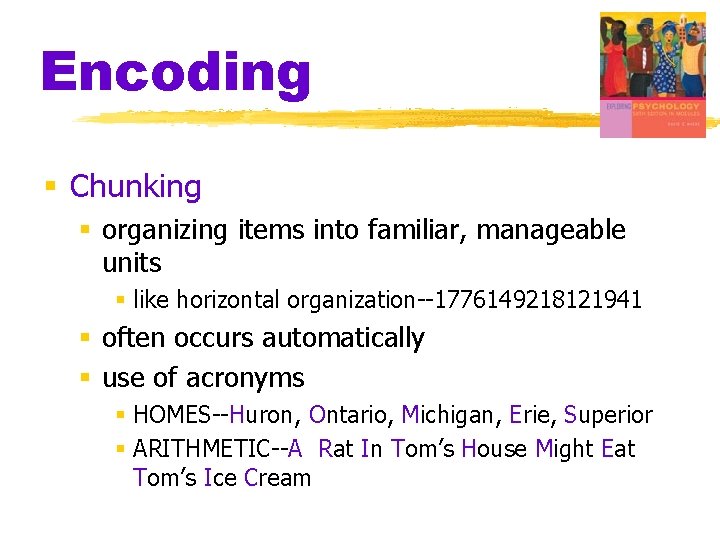
Encoding § Chunking § organizing items into familiar, manageable units § like horizontal organization--1776149218121941 § often occurs automatically § use of acronyms § HOMES--Huron, Ontario, Michigan, Erie, Superior § ARITHMETIC--A Rat In Tom’s House Might Eat Tom’s Ice Cream
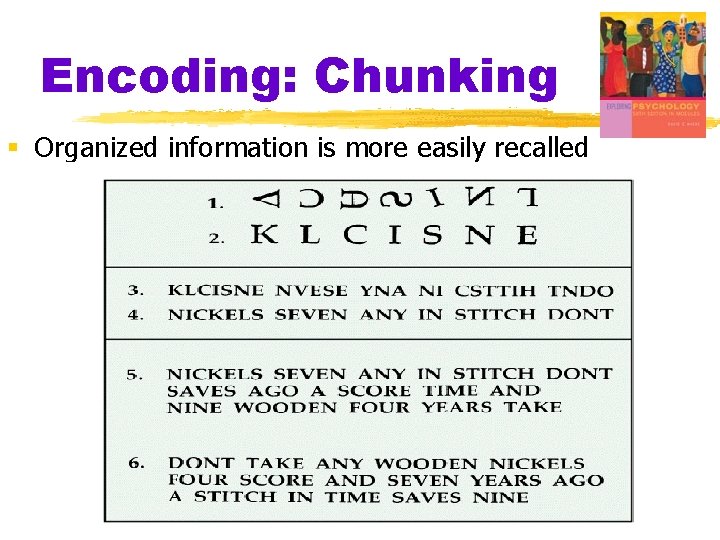
Encoding: Chunking § Organized information is more easily recalled
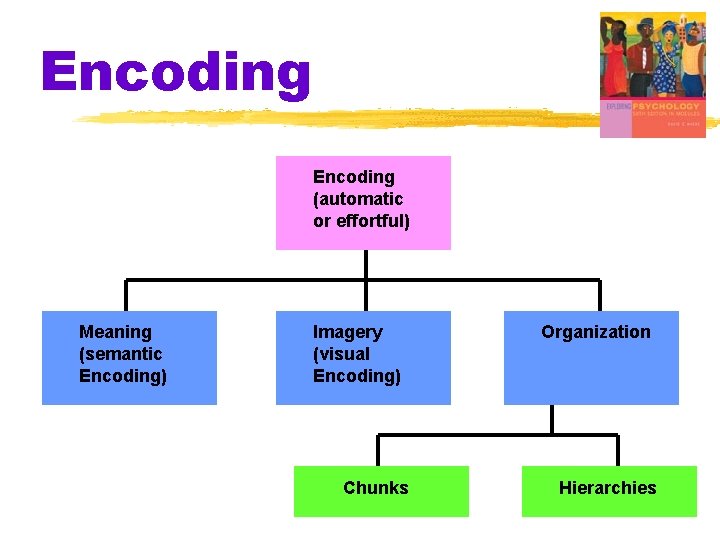
Encoding (automatic or effortful) Meaning (semantic Encoding) Imagery (visual Encoding) Chunks Organization Hierarchies
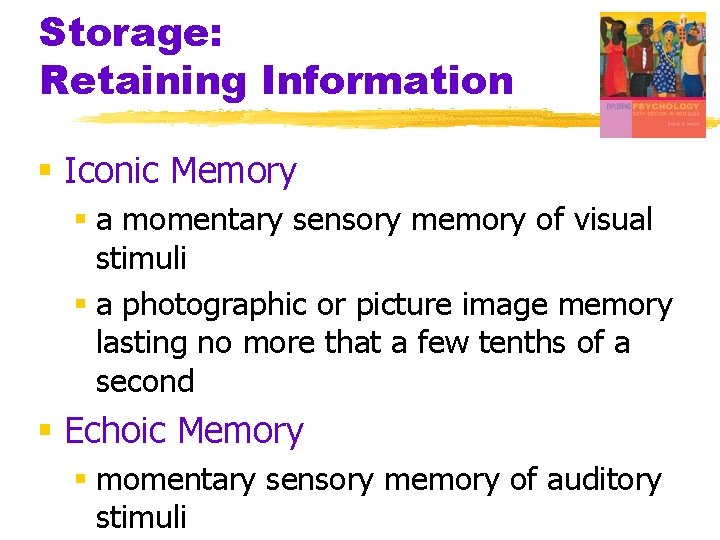
Storage: Retaining Information § Iconic Memory § a momentary sensory memory of visual stimuli § a photographic or picture image memory lasting no more that a few tenths of a second § Echoic Memory § momentary sensory memory of auditory stimuli
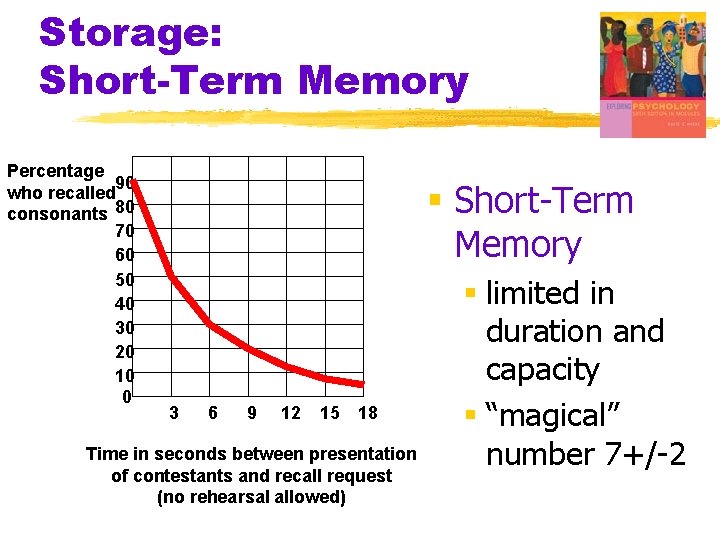
Storage: Short-Term Memory Percentage 90 who recalled consonants 80 70 60 50 40 30 20 10 0 § Short-Term Memory 3 6 9 12 15 18 Time in seconds between presentation of contestants and recall request (no rehearsal allowed) § limited in duration and capacity § “magical” number 7+/-2
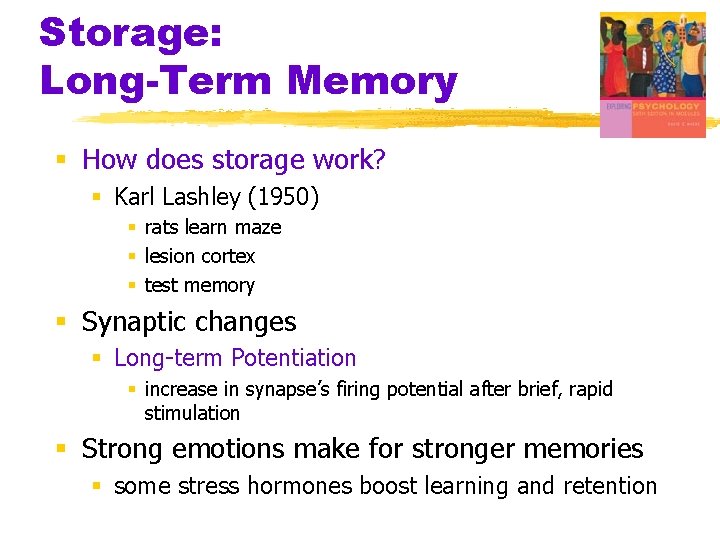
Storage: Long-Term Memory § How does storage work? § Karl Lashley (1950) § rats learn maze § lesion cortex § test memory § Synaptic changes § Long-term Potentiation § increase in synapse’s firing potential after brief, rapid stimulation § Strong emotions make for stronger memories § some stress hormones boost learning and retention
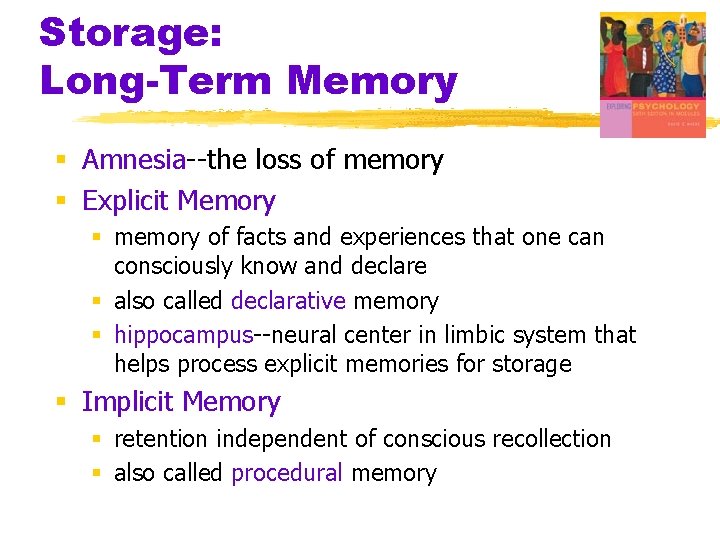
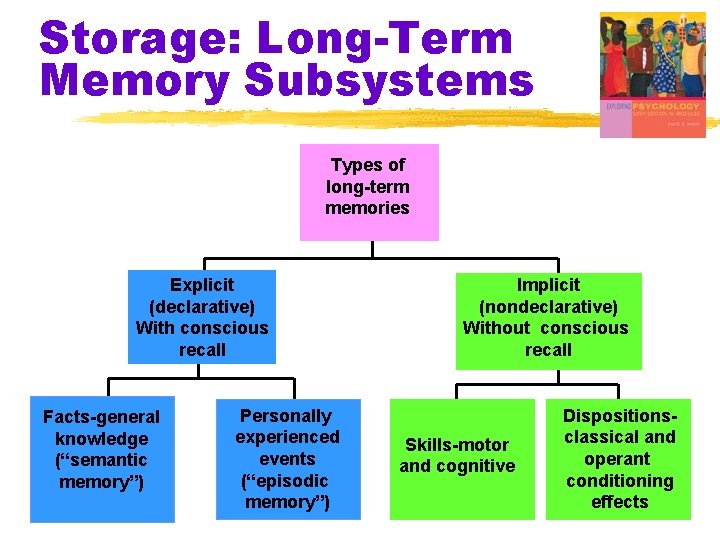
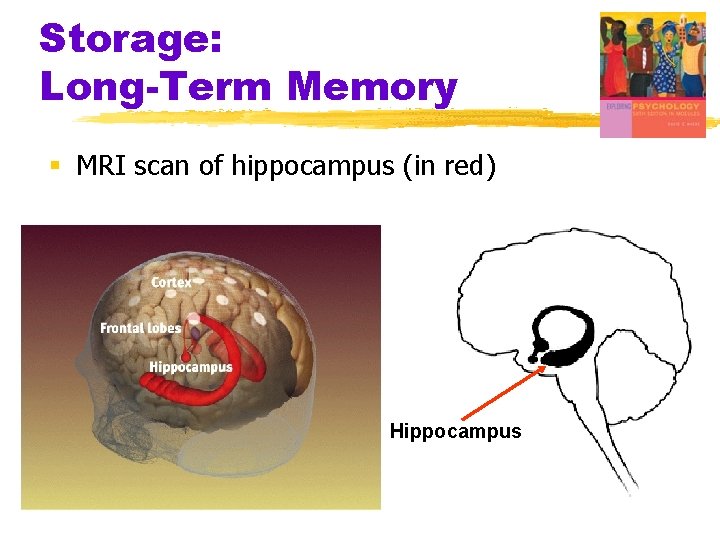
Storage: Long-Term Memory § Amnesia--the loss of memory § Explicit Memory § memory of facts and experiences that one can consciously know and declare § also called declarative memory § hippocampus--neural center in limbic system that helps process explicit memories for storage § Implicit Memory § retention independent of conscious recollection § also called procedural memory
Storage: Long-Term Memory Subsystems Types of long-term memories Explicit (declarative) With conscious recall Facts-general knowledge (“semantic memory”) Personally experienced events (“episodic memory”) Implicit (nondeclarative) Without conscious recall Skills-motor and cognitive Dispositionsclassical and operant conditioning effects
Storage: Long-Term Memory § MRI scan of hippocampus (in red) Hippocampus
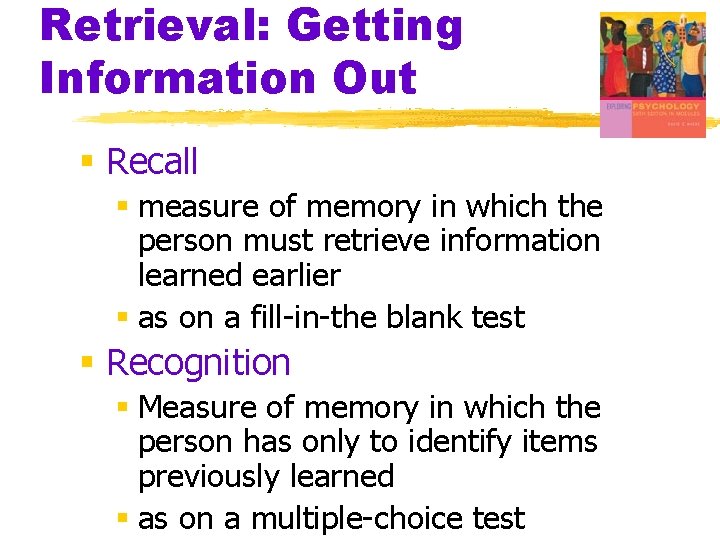
Retrieval: Getting Information Out § Recall § measure of memory in which the person must retrieve information learned earlier § as on a fill-in-the blank test § Recognition § Measure of memory in which the person has only to identify items previously learned § as on a multiple-choice test
Retrieval § Relearning § memory measure that assesses the amount of time saved when learning material a second time § Priming § activation, often unconsciously, of particular associations in memory
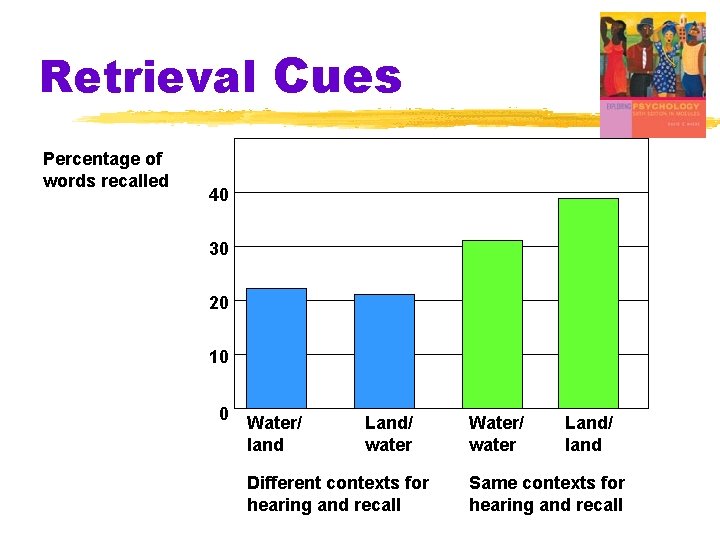
Retrieval Cues Percentage of words recalled 40 30 20 10 0 Water/ land Land/ water Different contexts for hearing and recall Water/ water Land/ land Same contexts for hearing and recall
Retrieval Cues § Deja Vu (French)--already seen § cues from the current situation may subconsciously trigger retrieval of an earlier similar experience § "I've experienced this before. "
Retrieval Cues § Mood-congruent Memory § tendency to recall experiences that are consistent with one’s current mood § memory, emotions, or moods serve as retrieval cues