
Myers EXPLORING PSYCHOLOGY 6 th Edition in Modules
- Slides: 25
Myers EXPLORING PSYCHOLOGY (6 th Edition in Modules) Module 33 Historic Perspectives on Personality: Psychoanalytic and Humanistic James A. Mc. Cubbin, Ph. D Clemson University Worth Publishers
What is Personality? § Personality § an individual’s characteristic pattern of thinking, feeling, and acting § basic perspectives § Psychoanalytic § Humanistic
The Psychoanalytic Perspective § Freud’s theory proposed that childhood sexuality and unconscious motivations influence personality
The Psychoanalytic Perspective § Free Association § in psychoanalysis, a method of exploring the unconscious § person relaxes and says whatever comes to mind, no matter how trivial or embarrassing
The Psychoanalytic Perspective § Psychoanalysis § Freud’s theory of personality that attributes our thoughts and actions to unconscious motives and conflicts § techniques used in treating psychological disorders by seeking to expose and interpret unconscious tensions
The Psychoanalytic Perspective § Unconscious § according to Freud, a reservoir of mostly unacceptable thoughts, wishes, feelings and memories § contemporary viewpoint- information processing of which we are unaware
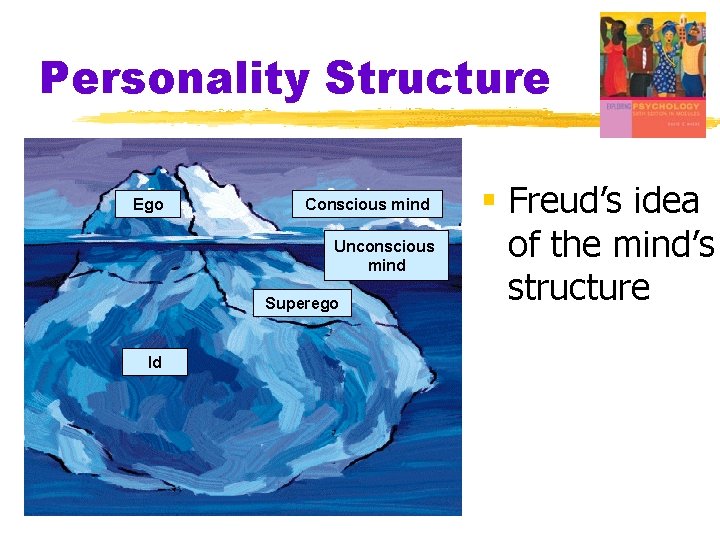
Personality Structure § Id § contains a reservoir of unconscious psychic energy § strives to satisfy basic sexual and aggressive drives § operates on the pleasure principle, demanding immediate gratification
Personality Structure § Superego § the part of personality that presents internalized ideals § provides standards for judgement (the conscience) and for future aspirations
Personality Structure § Ego § the largely conscious, “executive” part of personality § mediates among the demands of the id, superego, and reality § operates on the reality principle, satisfying the id’s desires in ways that will realistically bring pleasure rather than pain
Personality Structure Ego Conscious mind Unconscious mind Superego Id § Freud’s idea of the mind’s structure
Personality Development § Psychosexual Stages § the childhood stages of development during which the id’s pleasure-seeking energies focus on distinct erogenous zones § Oedipus Complex § a boy’s sexual desires toward his mother and feelings of jealousy and hatred for the rival father
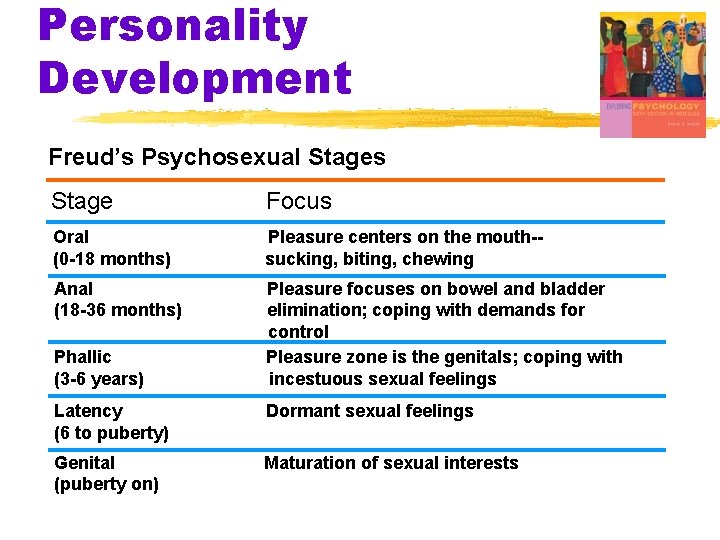
Personality Development Freud’s Psychosexual Stages Stage Focus Oral (0 -18 months) Pleasure centers on the mouth-sucking, biting, chewing Anal (18 -36 months) Pleasure focuses on bowel and bladder elimination; coping with demands for control Pleasure zone is the genitals; coping with incestuous sexual feelings Phallic (3 -6 years) Latency (6 to puberty) Dormant sexual feelings Genital (puberty on) Maturation of sexual interests
Personality Development § Identification § the process by which children incorporate their parents’ values into their developing superegos § Fixation § a lingering focus of pleasure-seeking energies at an earlier psychosexual stage, where conflicts were unresolved
Defense Mechanisms § the ego’s protective methods of reducing anxiety by unconsciously distorting reality § Repression § the basic defense mechanism that banishes anxiety-arousing thoughts, feelings, and memories from consciousness
Defense Mechanisms § Regression § defense mechanism in which an individual faced with anxiety retreats to a more infantile psychosexual stage, where some psychic energy remains fixated
Defense Mechanisms § Reaction Formation § defense mechanism by which the ego unconsciously switches unacceptable impulses into their opposites § people may express feelings that are the opposite of their anxiety-arousing unconscious feelings
Defense Mechanisms § Projection § defense mechanism by which people disguise their own threatening impulses by attributing them to others § Rationalization § defense mechanism that offers selfjustifying explanations in place of the real, more threatening, unconscious reasons for one’s actions
Defense Mechanisms § Displacement § defense mechanism that shifts sexual or aggressive impulses toward a more acceptable or less threatening object or person § as when redirecting anger toward a safer outlet
Assessing the Unconscious § Projective Test § a personality test, such as the Rorschach or TAT, that provides ambiguous stimuli designed to trigger projection of one’s inner dynamics
Assessing the Unconscious § Rorschach Inkblot Test § the most widely used projective test § a set of 10 inkblots designed by Hermann Rorschach § seeks to identify people’s inner feelings by analyzing their interpretations of the blots
Neo-Freudians § Alfred Adler § importance of childhood social tension § Karen Horney § sought to balance Freud’s masculine biases § Carl Jung § emphasized the collective unconscious § concept of a shared, inherited reservoir of memory traces from our species’ history
Humanistic Perspective § Abraham Maslow (1908 -1970) § studied self-actualization processes of productive and healthy people (e. g. , Lincoln)
Humanistic Perspective § Self-Actualization § the ultimate psychological need that arises after basic physical and psychological needs are met and selfesteem is achieved § the motivation to fulfill one’s potential
Humanistic Perspective § Carl Rogers (1902 -1987) § focused on growth and fulfillment of individuals § genuineness § acceptance § empathy
Humanistic Perspective § Unconditional Positive Regard § an attitude of total acceptance toward another person § Self-Concept § all our thoughts and feelings about ourselves, in an answer to the question, “Who am I? ”