
MYERS BRIGGS TYPE INDICATOR MBTI Introduction to Your
MYERS BRIGGS TYPE INDICATOR (MBTI) Introduction to Your Personality Type and How It Influences Your Career Choices
Agenda… ¡ Discuss MBTI types ¡ Relate types to careers ¡ Relate types to learning styles ¡ Relate types to teams/projects
Career Decision Making Aptitudes ¡ Skills ¡ Interests ¡ Values ¡ Personality Type ¡
Assumptions Underlying Type Theory Preferences are Inborn ¡ Environment Enhances or Impedes Expression of Type ¡ Type is Dynamic, Not Static ¡ All of the Types are Equally Valuable ¡
Things to Remember About Type ¡ There is no right or wrong type, and there are no better or worse combinations of types ¡ The purpose of learning your type is to help you understand yourself better
More Things to Remember… ¡ Everyone uses each of the preferences to some degree ¡ You are the final judge of your best-fit type ¡ Type should not keep you from considering any career, activity, or relationship.

What are Preferences? ¡ Preferred Hand l l Feels Natural Didn’t think about it Effortless, easy Writing looks neat, legible, adult ¡ Non-preferred Hand Feels unnatural l Had to concentrate while doing it l Awkward and clumsy l Writing looks childlike l
Why Do We Want To Use Our Preferences? When we use our preferred methods, we are generally at our BEST ¡ Feel most competent ¡ Natural ¡ Efficient ¡ Energetic and Successful ¡

Here we go…. .

The E-I Scale: Extraversion vs. Introversion Where do you prefer to focus your attention?

Extraversion(E) ¡ Focuses on the outer world of people and external events ¡ Directs energy and attention outward ¡ Receives energy from external events, experiences, and interactions
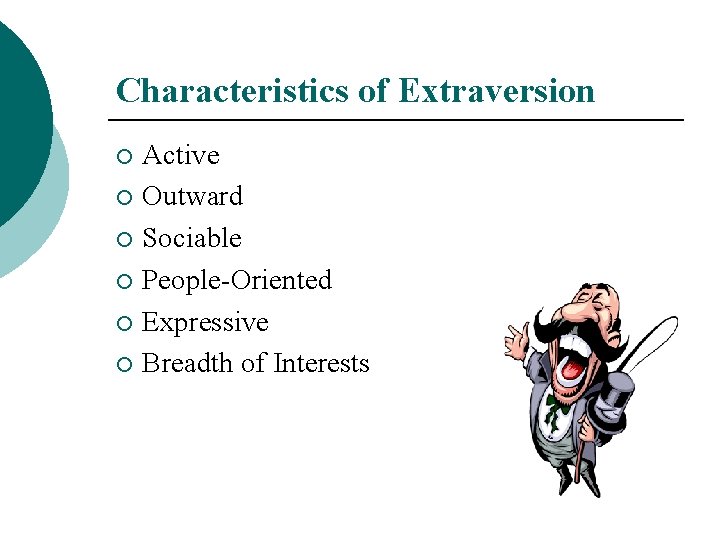
Characteristics of Extraversion Active ¡ Outward ¡ Sociable ¡ People-Oriented ¡ Expressive ¡ Breadth of Interests ¡
Introversion(I) ¡ Focuses on their own inner world of ideas and experiences ¡ Directs energy and attention inward ¡ Receives energy from their internal thoughts, feelings, and reflections
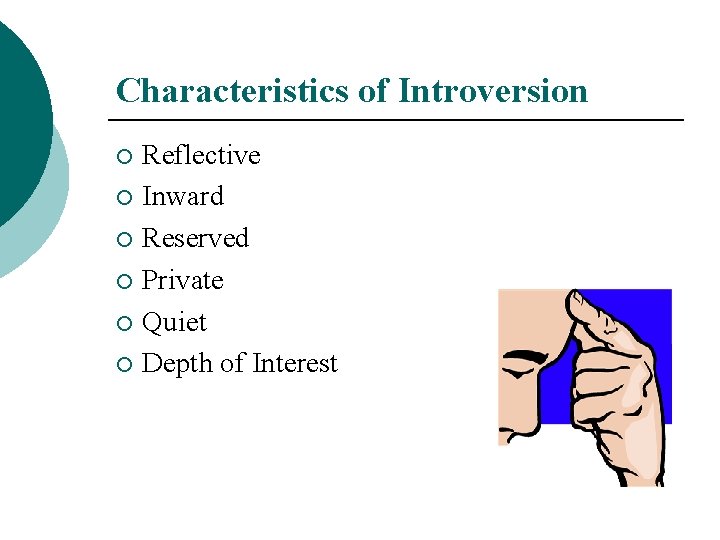
Characteristics of Introversion Reflective ¡ Inward ¡ Reserved ¡ Private ¡ Quiet ¡ Depth of Interest ¡
The S-N Scale: Sensing (S) vs. Intuition (N) How do you take in information?

Sensing(S) ¡ Like to take in information through their eyes, ears, and other senses ¡ Observant of what is going on around them ¡ Able to recognize the practical realities of a situation
Characteristics of Sensing Detailed ¡ Present-Oriented ¡ Practical ¡ Factual ¡ Sequential ¡ Reality-Based ¡ Trusts Experience ¡
Intuition(N) ¡ Like to take in information by seeing the big picture ¡ Want to grasp patterns, relationships and connections between facts ¡ Especially good at seeing new possibilities and different ways of doing things
Characteristics of Intuition Insightful ¡ Future-Oriented ¡ Imaginative ¡ Innovative ¡ Theoretical ¡ Looks for Possibilities ¡ Trusts Inspiration ¡
The T-F Scale: Thinking vs. Feeling How Do You Make Decisions?
Thinking(T) ¡ Thinkers look at logical consequences in decision making ¡ Remove themselves mentally to examine a situation objectively ¡ Seek universal truth and the application of principals
Characteristics of Thinking Objective ¡ Logical Problem Solvers ¡ Non-Personal ¡ Reasonable ¡ Analytical ¡ Precise ¡ Fair ¡ Strive for the Objective Truth ¡
Feeling(F) ¡ Consider what is important to them and others when making decisions ¡ Utilize person-centered values in decision making ¡ Seek harmony and recognition of individuals
Characteristics of Feeling Subjective ¡ Sympathetic ¡ Caring ¡ Guided by Personal Values ¡ Appear Tender-Hearted ¡ Appreciative ¡ Compassionate ¡ Accepting ¡

The J-P Scale: Judgment vs. Perception How do you deal with the outer world?
Judgment (J) (or Structure) ¡ Tend to live in a planned, orderly way, wanting to regulate and control life ¡ They make decisions, come to closure, and move on ¡ Seek structure and organization, and like to have things settled
Characteristics of Judgment ¡ ¡ ¡ ¡ Organized Structured Decisive Deliberate Likes Closure Planned Deadline Oriented Productive
Perception (P) (or Spontaneous) ¡ Prefer to live in a flexible, spontaneous way ¡ Seeks to experience and understand life rather than control it ¡ Plans and decisions feel confining. Prefer to stay open to experience and last-minute options
Characteristics of Perception Flexible ¡ Curious ¡ Spontaneous ¡ Open to Change ¡ Casual ¡ Adaptable ¡ Receptive ¡
What Type Are You?
How Does This Relate to Careers?

SF Types ¡ Tend to pay attention to detail, and approach things with warmth and value ¡ Seek a highly personal work environment ¡ Enjoy providing practical help and services for people

Typical Occupations for SF’s ¡ ¡ ¡ ¡ Elementary Teachers Child Care Workers Nursing Bank Employees Community Service Workers Receptionists Secretaries Health Professionals ¡ ¡ ¡ ¡ ¡ Dental Assistants Salespeople Clergy Customer Relations Speech Pathologists Social Workers Medicine Pharmacists Library Assistants
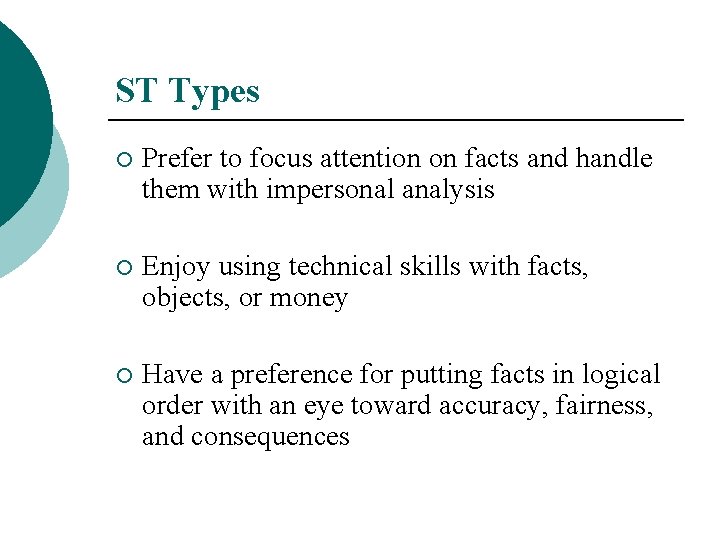
ST Types ¡ Prefer to focus attention on facts and handle them with impersonal analysis ¡ Enjoy using technical skills with facts, objects, or money ¡ Have a preference for putting facts in logical order with an eye toward accuracy, fairness, and consequences

Typical Occupations for ST’s ¡ ¡ ¡ Retail Store and Small Business Managers Mechanical Engineers Bookkeepers Police Officers Purchasing Agents Accountants ¡ ¡ ¡ Computer Programmers Voc-Tech Teachers Lawyers Bankers Medicine: Surgery, Dentistry, Medical Technology

NF Types ¡ Prefer to focus on possibilities for people ¡ Enjoy understanding and communicating with people ¡ Seek meaning, authenticity and social significance in work
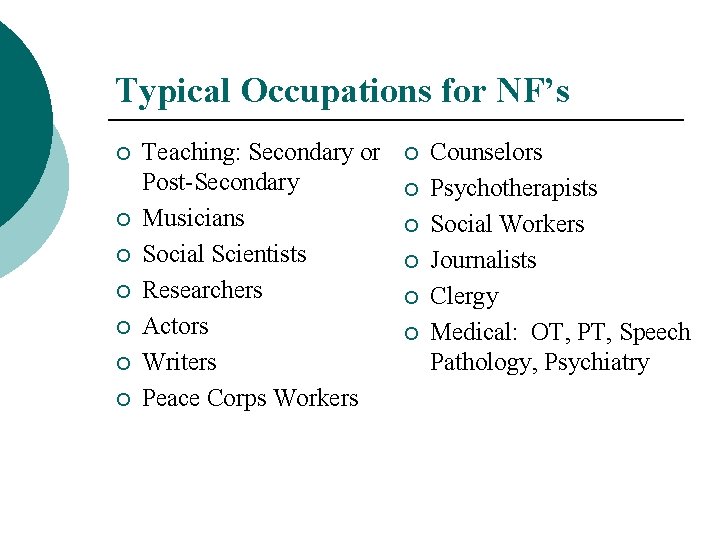
Typical Occupations for NF’s ¡ ¡ ¡ ¡ Teaching: Secondary or Post-Secondary Musicians Social Scientists Researchers Actors Writers Peace Corps Workers ¡ ¡ ¡ Counselors Psychotherapists Social Workers Journalists Clergy Medical: OT, PT, Speech Pathology, Psychiatry

NT Types ¡ Prefer to focus attention on the possibilities and handle them with impersonal analysis ¡ Enjoy theoretical and/or technical developments and work that requires reorganizing, designing, or project planning ¡ Enjoy working on series of projects/activities that don’t require detailed follow-through
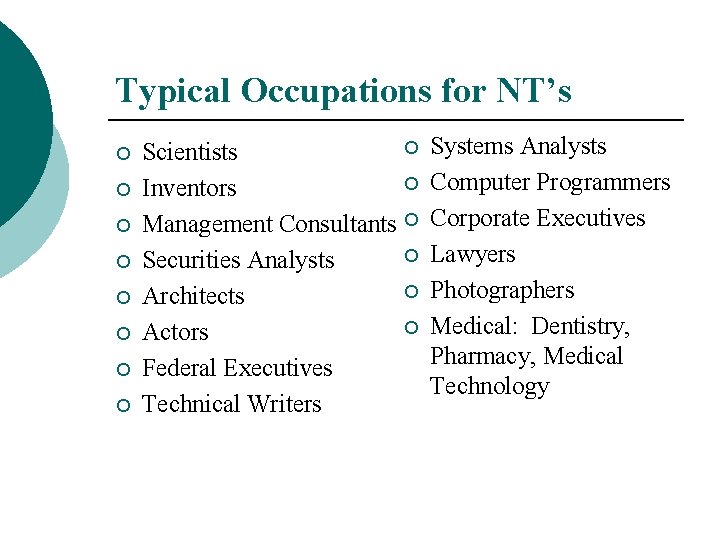
Typical Occupations for NT’s ¡ ¡ ¡ ¡ ¡ Scientists ¡ Inventors Management Consultants ¡ ¡ Securities Analysts ¡ Architects ¡ Actors Federal Executives Technical Writers Systems Analysts Computer Programmers Corporate Executives Lawyers Photographers Medical: Dentistry, Pharmacy, Medical Technology
How Does This Relate to College?
Learning Styles ¡ Learning styles classify different ways people learn and how they approach information. ¡ Learning style assessments provide you an opportunity to learn how you are likely to respond under different circumstances and how to approach information in a way that best addresses your own particular needs.
MBTI and Group Projects
- Slides: 42