
MYERS AND STAUFFER LC PRESENT OBRAPDPM MDS ITEMS

MYERS AND STAUFFER LC PRESENT OBRA/PDPM MDS ITEMS EFFECTIVE 10/1/2020 1
BACKGROUND • CMS has updated the Minimum Data Set Version 3. 0 (MDS 3. 0) item sets (version 1. 17. 2) and related technical data specifications. • The changes will support the calculation of Patient Driven Payment Model (PDPM) payment codes on Omnibus Budget Reconciliation Act (OBRA) assessments when not combined with a 5 -day Prospective Payment System (PPS) assessment. • This change will allow State Medicaid Agencies (SMA) to collect PDPM payment codes and compare to Resource Utilization Group (RUG) III/IV and, thereby, inform their future payment model. 2
MOVING FORWARD • Beginning October 1, 2020, States will have the option to require the completion and submission of specific MDS item set fields associated with PDPM on all OBRA nursing home comprehensive (NC) and quarterly (NQ) MDS assessment submissions. • These additional fields are located in Sections GG, I and J. • This is a necessary step for States to begin evaluating the PDPM classification system and its viability as an alternative for the Resource Utilization Group-III/IV classification system that is used today as the basis for the case mix reimbursement system. • Additionally, this data will assist in future UPL calculations. 3
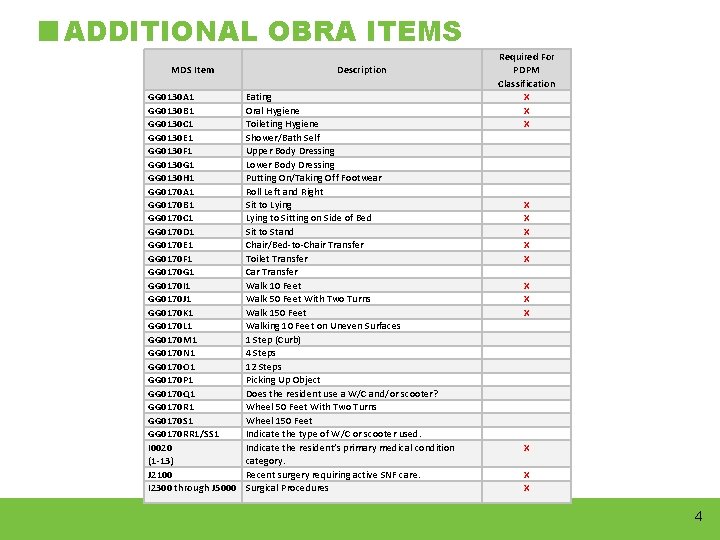
ADDITIONAL OBRA ITEMS MDS Item GG 0130 A 1 GG 0130 B 1 GG 0130 C 1 GG 0130 E 1 GG 0130 F 1 GG 0130 G 1 GG 0130 H 1 GG 0170 A 1 GG 0170 B 1 GG 0170 C 1 GG 0170 D 1 GG 0170 E 1 GG 0170 F 1 GG 0170 G 1 GG 0170 I 1 GG 0170 J 1 GG 0170 K 1 GG 0170 L 1 GG 0170 M 1 GG 0170 N 1 GG 0170 O 1 GG 0170 P 1 GG 0170 Q 1 GG 0170 R 1 GG 0170 S 1 GG 0170 RR 1/SS 1 I 0020 (1 -13) J 2100 I 2300 through J 5000 Description Eating Oral Hygiene Toileting Hygiene Shower/Bath Self Upper Body Dressing Lower Body Dressing Putting On/Taking Off Footwear Roll Left and Right Sit to Lying to Sitting on Side of Bed Sit to Stand Chair/Bed-to-Chair Transfer Toilet Transfer Car Transfer Walk 10 Feet Walk 50 Feet With Two Turns Walk 150 Feet Walking 10 Feet on Uneven Surfaces 1 Step (Curb) 4 Steps 12 Steps Picking Up Object Does the resident use a W/C and/or scooter? Wheel 50 Feet With Two Turns Wheel 150 Feet Indicate the type of W/C or scooter used. Indicate the resident’s primary medical condition category. Recent surgery requiring active SNF care. Surgical Procedures Required For PDPM Classification X X X X 4
SECTION GG: FUNCTIONAL ABILITIES
SELF-CARE AND MOBILITY(3 -DAY ASSESSMENT PERIOD) (GG 0130 AND GG 0170) ü If the State requires completion with an OBRA assessment, the assessment period is the ARD plus 2 previous days; complete only column 1. ü No goals need to be established on the standalone OBRA assessments. ü Section GG is not required on the stand-alone OBRA discharge assessment. 6
SELF-CARE AND MOBILITY(3 -DAY ASSESSMENT PERIOD) (GG 0130 AND GG 0170) CONT. Performance Coding using 6 -point scale: • When coding the resident’s usual performance and discharge goal(s), use the six-point scale, or use one of the four (activity was not attempted” codes to specify the reason why an activity was not attempted). 7
SELF-CARE AND MOBILITY (3 -DAY ASSESSMENT PERIOD) (GG 0130 AND GG 0170) CONT. Steps for Assessment: ü Assess the resident’s mobility performance during the three-day assessment period. ü Residents should be allowed to perform activities as independently as possible. ü A “helper” is defined as facility staff who are direct employees and facility-contracted employees. ü A “helper” does not include individuals hired, compensated or not, by individuals outside the facility’s management and administration. ü Activities may be completed with or without assistive device(s). 8
SELF-CARE AND MOBILITY(3 -DAY ASSESSMENT PERIOD) (GG 0130 AND GG 0170) CONT. Coding Tips: ü Do not record the resident’s best performance and do not record the resident’s worst performance, but rather record the resident’s usual performance during the assessment period. ü Do not record the staff’s assessment of the resident’s potential capability to perform the activity. ü If two or more helpers are required to assist the resident to complete the activity, code as 01, Dependent. 9
SELF-CARE AND MOBILITY(3 -DAY ASSESSMENT PERIOD) (GG 0130 AND GG 0170) CONT. Coding Tips: ü If the resident does not attempt the activity and a helper does not complete the activity for the resident during the entire assessment period, code the reason the activity was not attempted. ü To clarify your own understanding of the resident’s performance of an activity, ask probing questions to staff about the resident, beginning with the general and proceeding to the more specific. 10
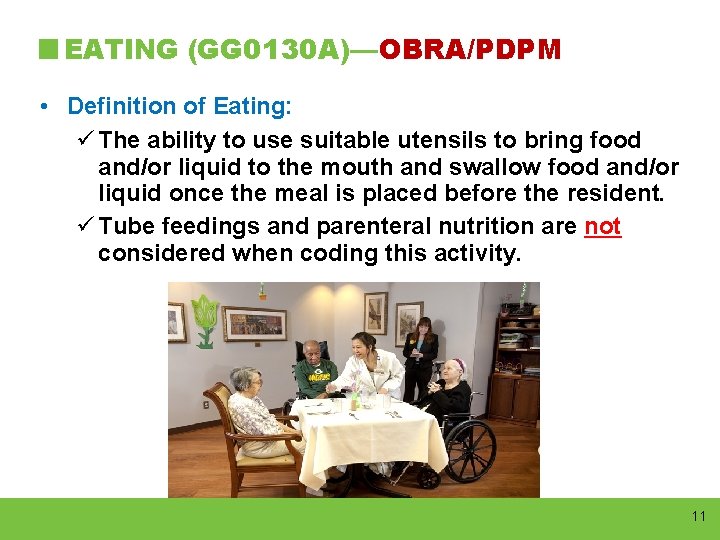
EATING (GG 0130 A)—OBRA/PDPM • Definition of Eating: ü The ability to use suitable utensils to bring food and/or liquid to the mouth and swallow food and/or liquid once the meal is placed before the resident. ü Tube feedings and parenteral nutrition are not considered when coding this activity. 11
ORAL HYGIENE (GG 0130 B)—OBRA/PDPM • Definition of Oral hygiene: ü The ability to use suitable items to clean teeth. § Dentures (if applicable): The ability to insert and remove dentures into and from the mouth, and manage denture soaking and rinsing with use of equipment. ▀ TOILETING HYGIENE (GG 0130 C)— OBRA/PDPM • Definition of Toileting Hygiene: ü The ability to maintain perineal hygiene, adjust clothes before and after voiding or having a bowel movement. If managing an ostomy, include wiping the opening but not managing equipment. 12
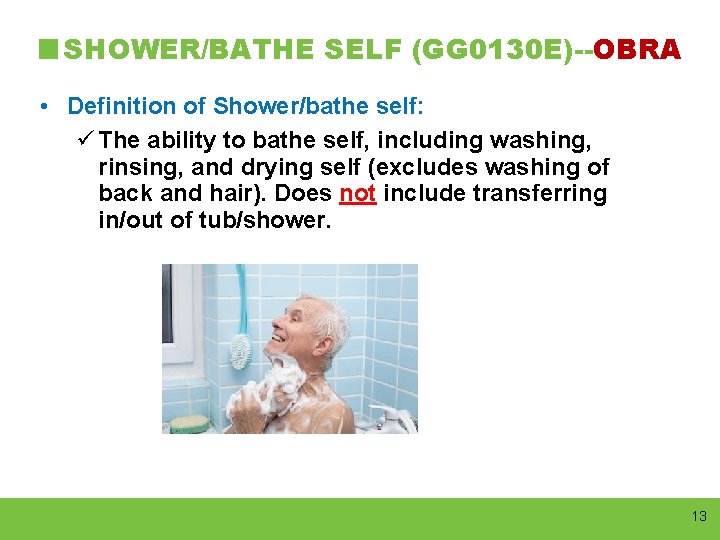
SHOWER/BATHE SELF (GG 0130 E)--OBRA • Definition of Shower/bathe self: ü The ability to bathe self, including washing, rinsing, and drying self (excludes washing of back and hair). Does not include transferring in/out of tub/shower. 13
UPPER BODY DRESSING (GG 0130 F)--OBRA • Definition of Upper body dressing: ü The ability to dress and undress above the waist; including fasteners, if applicable: ▀ LOWER BODY DRESSING (GG 0130 G)— OBRA • Definition of Lower body dressing: ü The ability to dress and undress below the waist; including fasteners, does not include footwear: 14
PUTTING ON/TAKING OFF FOOTWEAR (GG 0130 H)--OBRA • Definition of Putting on/taking off footwear: § The ability to put on and take off socks and shoes or other footwear that is appropriate for safe mobility; including fasteners, if applicable. 15
ROLL LEFT AND RIGHT (GG 0170 A)—OBRA • Definition of Roll left and right: § The ability to roll from lying on back to left and right side, and return to lying on back on the bed. ▀ SIT TO LYING (GG 0170 B)—OBRA/PDPM • Definition of Sit to lying: § The ability to move from sitting on side of bed to lying flat on the bed. 16
LYING TO SITTING ON SIDE OF BED (GG 0170 C)—OBRA/PDPM • Definition of lying to sitting on side of bed: § The ability to move from lying on the back to sitting on the side of the bed with feet flat on the floor, and with no back support. ▀ SIT TO STAND (GG 0170 D)—OBRA/PDPM • Definition of Sit to stand: ü The ability to come to a standing position from sitting in a chair, wheelchair, or on the side of the bed: ü If a mechanical lift is used and two helpers are needed, then code 01, Dependent. 17
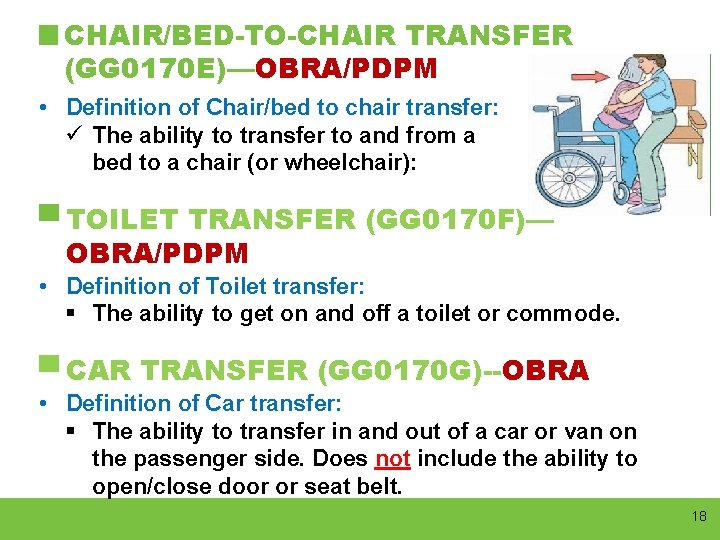
CHAIR/BED-TO-CHAIR TRANSFER (GG 0170 E)—OBRA/PDPM • Definition of Chair/bed to chair transfer: ü The ability to transfer to and from a bed to a chair (or wheelchair): ▀ TOILET TRANSFER (GG 0170 F)— OBRA/PDPM • Definition of Toilet transfer: § The ability to get on and off a toilet or commode. ▀ CAR TRANSFER (GG 0170 G)--OBRA • Definition of Car transfer: § The ability to transfer in and out of a car or van on the passenger side. Does not include the ability to open/close door or seat belt. 18
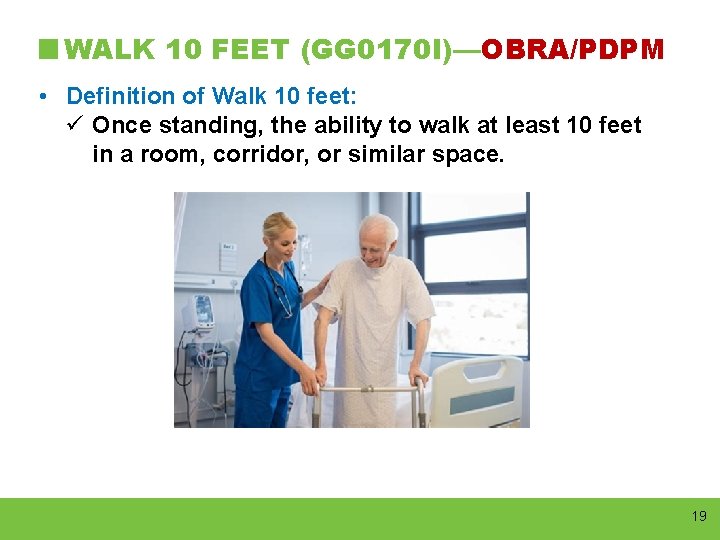
WALK 10 FEET (GG 0170 I)—OBRA/PDPM • Definition of Walk 10 feet: ü Once standing, the ability to walk at least 10 feet in a room, corridor, or similar space. 19
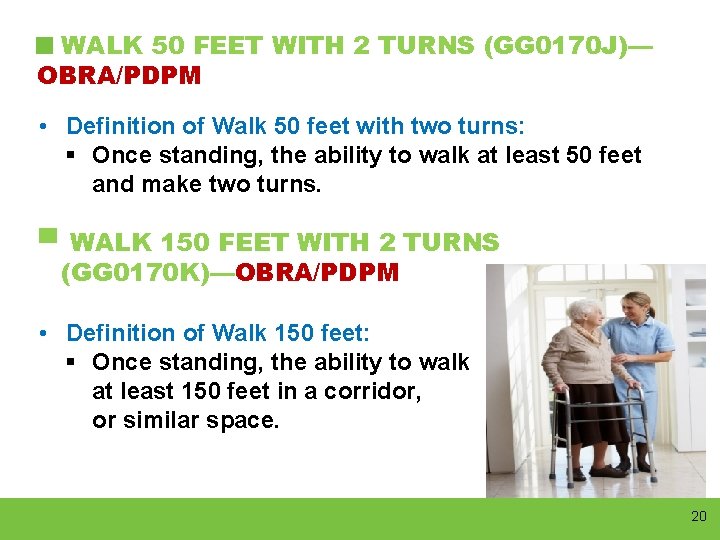
WALK 50 FEET WITH 2 TURNS (GG 0170 J)— OBRA/PDPM • Definition of Walk 50 feet with two turns: § Once standing, the ability to walk at least 50 feet and make two turns. ▀ WALK 150 FEET WITH 2 TURNS (GG 0170 K)—OBRA/PDPM • Definition of Walk 150 feet: § Once standing, the ability to walk at least 150 feet in a corridor, or similar space. 20
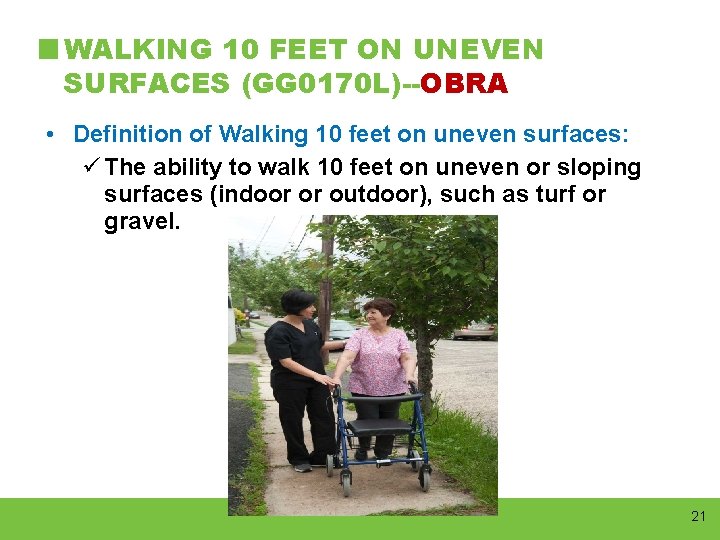
WALKING 10 FEET ON UNEVEN SURFACES (GG 0170 L)--OBRA • Definition of Walking 10 feet on uneven surfaces: ü The ability to walk 10 feet on uneven or sloping surfaces (indoor or outdoor), such as turf or gravel. 21
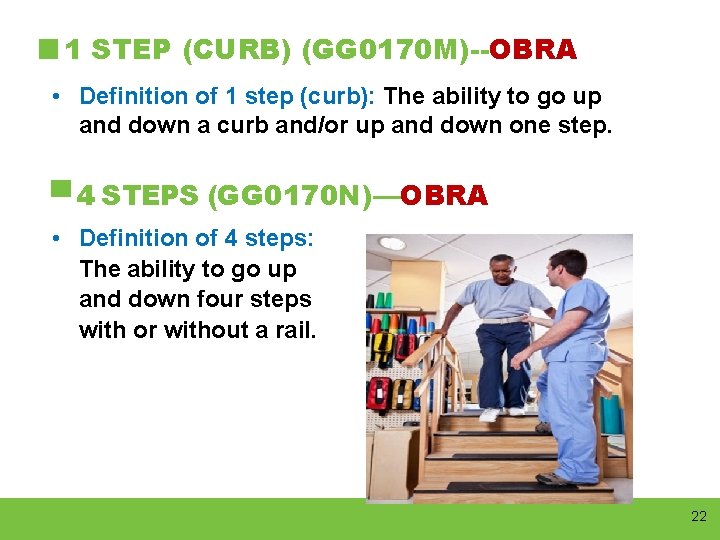
1 STEP (CURB) (GG 0170 M)--OBRA • Definition of 1 step (curb): The ability to go up and down a curb and/or up and down one step. ▀ 4 STEPS (GG 0170 N)—OBRA • Definition of 4 steps: The ability to go up and down four steps with or without a rail. 22
§ 12 STEPS (GG 0170 O)--OBRA • Definition of 12 steps: The ability to go up and down 12 steps with or without a rail. § PICKING UP OBJECT (GG 0170 P)--OBRA • Definition of Picking up object: The ability to bend/stoop from a standing position to pick up a small object, such as a spoon, from the floor. 23
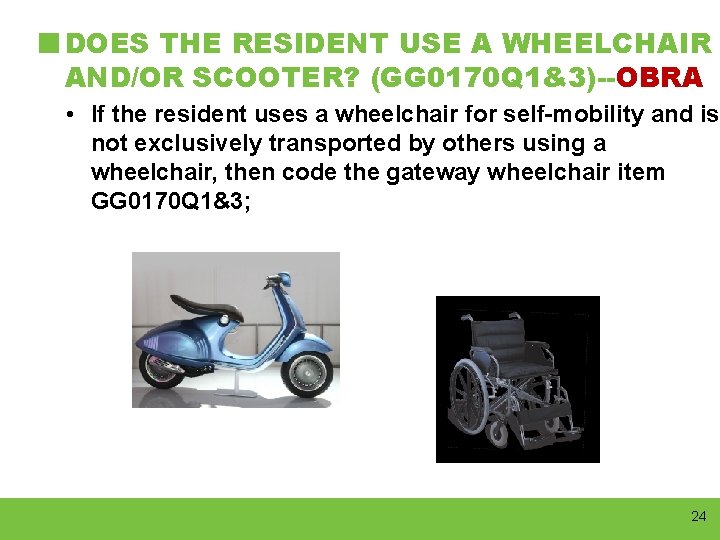
DOES THE RESIDENT USE A WHEELCHAIR AND/OR SCOOTER? (GG 0170 Q 1&3)--OBRA • If the resident uses a wheelchair for self-mobility and is not exclusively transported by others using a wheelchair, then code the gateway wheelchair item GG 0170 Q 1&3; 24
WHEEL 50 FEET WITH TWO TURNS (GG 0170 R)--OBRA • Definition of Wheel 50 feet with two turns: ü Once seated in wheelchair/scooter, the ability to wheel at least 50 feet and make two turns. • WHEEL 150 FEET (GG 0170 S)—OBRA Definition of Wheel 150 feet: ü Once seated in wheelchair/scooter, the ability to wheel at least 150 feet in corridor or similar space. 25
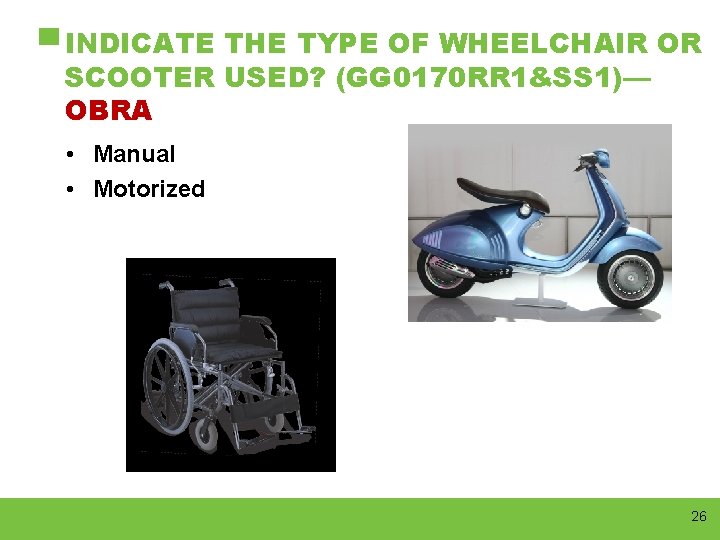
▀ INDICATE THE TYPE OF WHEELCHAIR OR SCOOTER USED? (GG 0170 RR 1&SS 1)— OBRA • Manual • Motorized 26
SECTION I: ACTIVE DIAGNOSIS 27
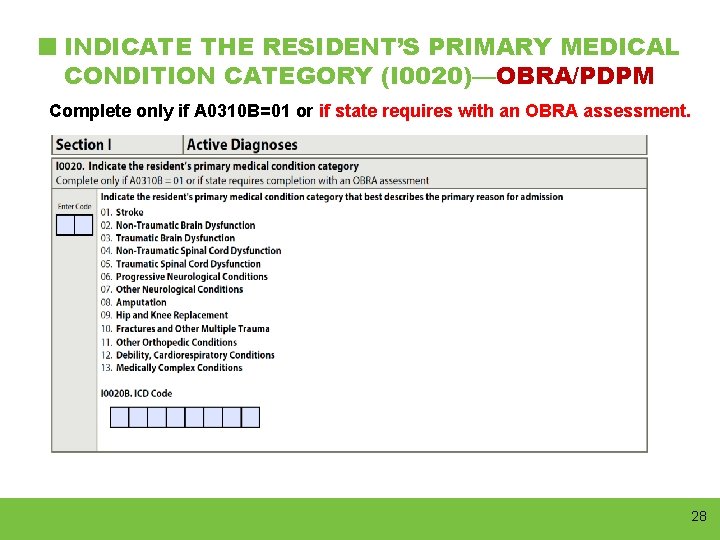
INDICATE THE RESIDENT’S PRIMARY MEDICAL CONDITION CATEGORY (I 0020)—OBRA/PDPM Complete only if A 0310 B=01 or if state requires with an OBRA assessment. 28
INDICATE THE RESIDENT'S PRIMARY MEDICAL CONDITION CATEGORY (I 0020) • Indicate the resident's primary medical condition category that best describes the primary reason for the stay. • Complete only if PPS 5 -day, IPA assessment or if state requires completion with an OBRA assessment. ü Code the resident’s primary medical condition. ü This will be the most current medical condition and diagnosis and may not be the same as the reason for admission. ü The primary diagnosis referenced should be the primary diagnosis at the time the assessment is being conducted. ü Providers should base coding of item I 0020 on the residents clinical condition during observation period. 29
INDICATE THE RESIDENT'S PRIMARY MEDICAL CONDITION CATEGORY (I 0020) CONT. Then proceed to I 0020 B and enter the ICD code for that condition, including the decimal. ü SNFs should not use acute diagnosis in I 0020 B. ü Sequelae and other such codes should be used instead. ü Include the primary medical condition coded in this item in Section I: Active Diagnosis in the last 7 days. 30
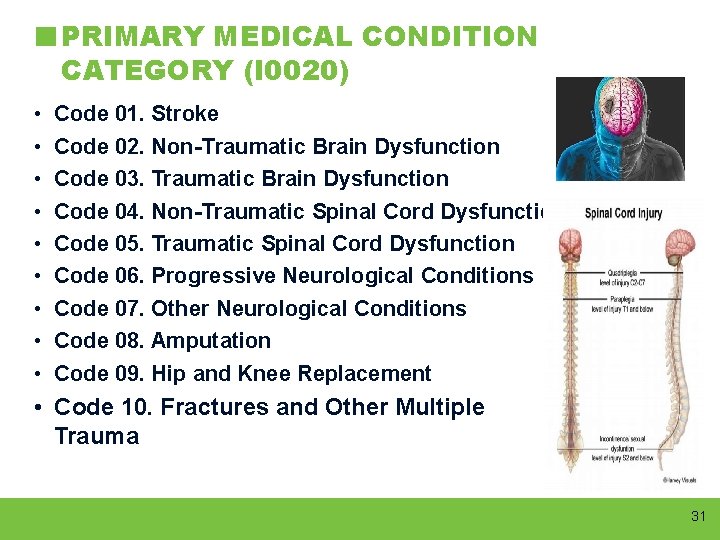
PRIMARY MEDICAL CONDITION CATEGORY (I 0020) • • • Code 01. Stroke Code 02. Non-Traumatic Brain Dysfunction Code 03. Traumatic Brain Dysfunction Code 04. Non-Traumatic Spinal Cord Dysfunction Code 05. Traumatic Spinal Cord Dysfunction Code 06. Progressive Neurological Conditions Code 07. Other Neurological Conditions Code 08. Amputation Code 09. Hip and Knee Replacement • Code 10. Fractures and Other Multiple Trauma 31
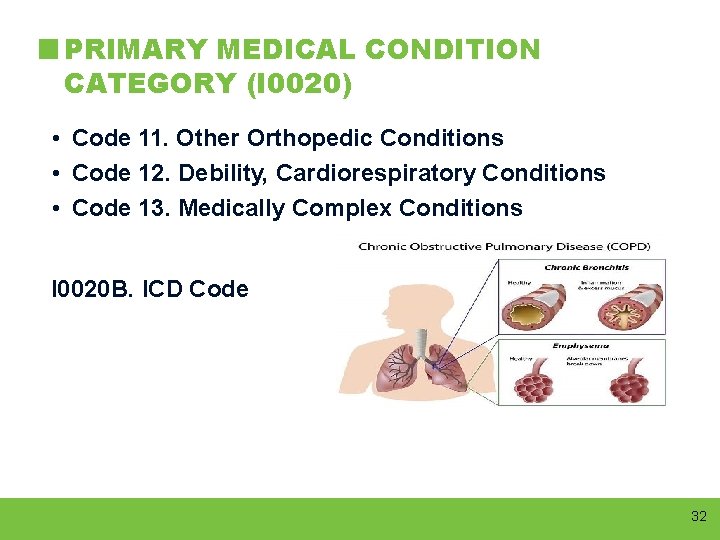
PRIMARY MEDICAL CONDITION CATEGORY (I 0020) • Code 11. Other Orthopedic Conditions • Code 12. Debility, Cardiorespiratory Conditions • Code 13. Medically Complex Conditions I 0020 B. ICD Code 32
ICD-10 CODE MAPPING ü In the case of the OBRA assessments where the state has elected to calculate the PDPM, a valid ICD-10 code is expected in I 0020 B. CMS will provide a list of valid ICD 10 codes that may be appropriate for a non-skilled long stay resident (OBRA NC and NQ assessments) that are not in the original list for Medicare Part A stay residents that will be included in a secondary mapping table. ü As of 10/1/2020, these additional ICD-10 codes (“Return to Provider”) will be accepted in I 0020 B for the OBRA assessments when the state elects to calculate the PDPM on the OBRA NC and NQ. These Return to Provider codes will be mapped to a category of Medical Management. 33

SECTION J: HEALTH CONDITIONS 34
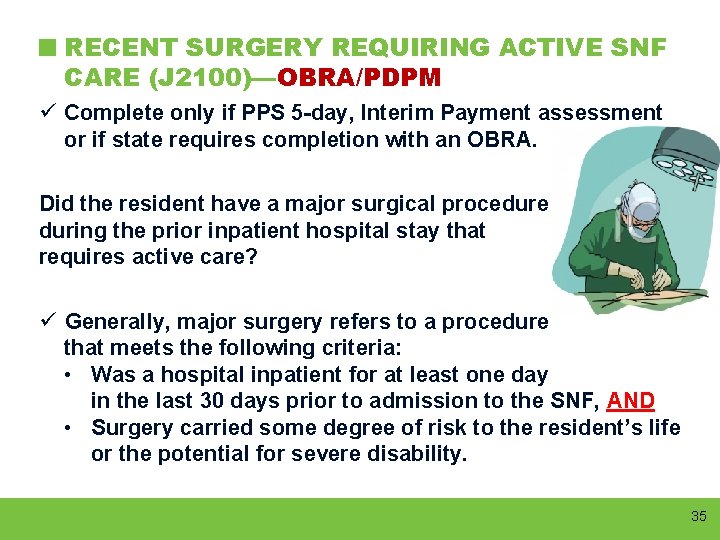
RECENT SURGERY REQUIRING ACTIVE SNF CARE (J 2100)—OBRA/PDPM ü Complete only if PPS 5 -day, Interim Payment assessment or if state requires completion with an OBRA. Did the resident have a major surgical procedure during the prior inpatient hospital stay that requires active care? ü Generally, major surgery refers to a procedure that meets the following criteria: • Was a hospital inpatient for at least one day in the last 30 days prior to admission to the SNF, AND • Surgery carried some degree of risk to the resident’s life or the potential for severe disability. 35
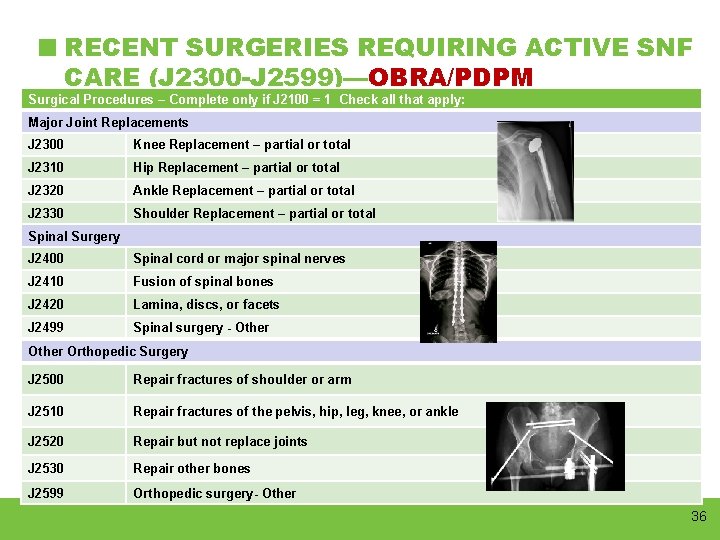
RECENT SURGERIES REQUIRING ACTIVE SNF CARE (J 2300 -J 2599)—OBRA/PDPM Surgical Procedures – Complete only if J 2100 = 1 Check all that apply: Major Joint Replacements J 2300 Knee Replacement – partial or total J 2310 Hip Replacement – partial or total J 2320 Ankle Replacement – partial or total J 2330 Shoulder Replacement – partial or total Spinal Surgery J 2400 Spinal cord or major spinal nerves J 2410 Fusion of spinal bones J 2420 Lamina, discs, or facets J 2499 Spinal surgery - Other Orthopedic Surgery J 2500 Repair fractures of shoulder or arm J 2510 Repair fractures of the pelvis, hip, leg, knee, or ankle J 2520 Repair but not replace joints J 2530 Repair other bones J 2599 Orthopedic surgery- Other 36
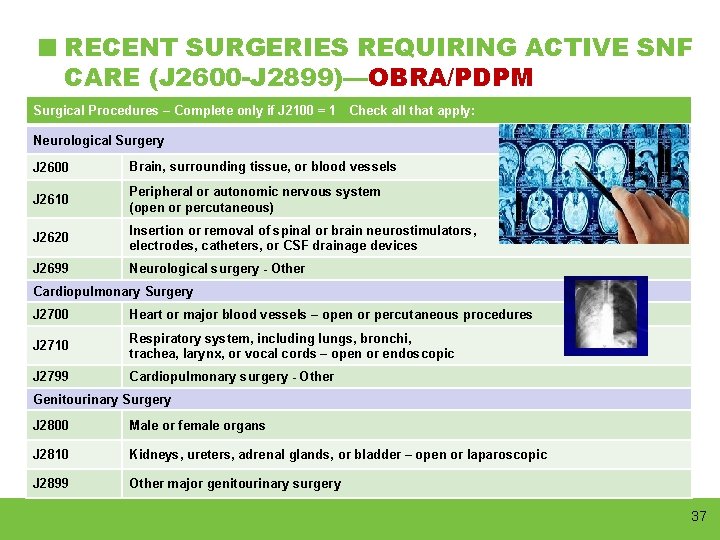
RECENT SURGERIES REQUIRING ACTIVE SNF CARE (J 2600 -J 2899)—OBRA/PDPM Surgical Procedures – Complete only if J 2100 = 1 Check all that apply: Neurological Surgery J 2600 Brain, surrounding tissue, or blood vessels J 2610 Peripheral or autonomic nervous system (open or percutaneous) J 2620 Insertion or removal of spinal or brain neurostimulators, electrodes, catheters, or CSF drainage devices J 2699 Neurological surgery - Other Cardiopulmonary Surgery J 2700 Heart or major blood vessels – open or percutaneous procedures J 2710 Respiratory system, including lungs, bronchi, trachea, larynx, or vocal cords – open or endoscopic J 2799 Cardiopulmonary surgery - Other Genitourinary Surgery J 2800 Male or female organs J 2810 Kidneys, ureters, adrenal glands, or bladder – open or laparoscopic J 2899 Other major genitourinary surgery 37
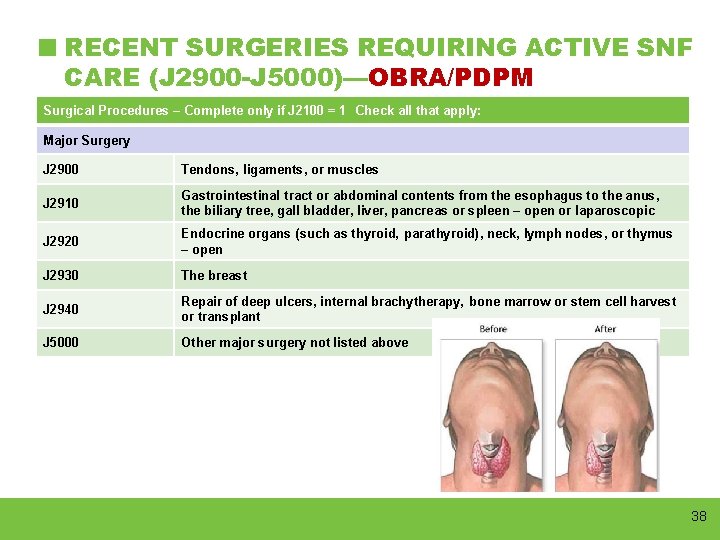
RECENT SURGERIES REQUIRING ACTIVE SNF CARE (J 2900 -J 5000)—OBRA/PDPM Surgical Procedures – Complete only if J 2100 = 1 Check all that apply: Major Surgery J 2900 Tendons, ligaments, or muscles J 2910 Gastrointestinal tract or abdominal contents from the esophagus to the anus, the biliary tree, gall bladder, liver, pancreas or spleen – open or laparoscopic J 2920 Endocrine organs (such as thyroid, parathyroid), neck, lymph nodes, or thymus – open J 2930 The breast J 2940 Repair of deep ulcers, internal brachytherapy, bone marrow or stem cell harvest or transplant J 5000 Other major surgery not listed above 38
HIPPS CODE ü The OBRA PDPM HIPPS is only 4 characters. ü The modifier/assessment indicator (the 5 th character) will not be added to the stand-alone OBRA assessments. ü There will be no default code for Z 0100. If a PDPM classification cannot be calculated it will be blank. 39
MDS - DASHES ü A dash (-) indicates “No information. ” CMS expects dash use to be a rare occurrence. HOWEVER ü When necessary, use of dashes on the stand-alone OBRA assessments will have no effect on the SNFQRP Quality Measures and/or Annual Payment Update (APU). 40
MDS ACCURACY ü It is a must that healthcare professionals performing an MDS assessment use their clinical judgement and consider all sources of information to ensure the assessment accurately reflects the state of the resident. ü Accurate coding for all items is crucial to maintain the integrity of the MDS. 41
THANK YOU !
- Slides: 42