
Mycorrhizae Influence Plant Community Structure and Diversity in





- Slides: 22
Mycorrhizae Influence Plant Community Structure and Diversity in Tallgrass Prairie Ashley Popovich Jenn Mc. Quade Alyssa Novarro Molly Stetz
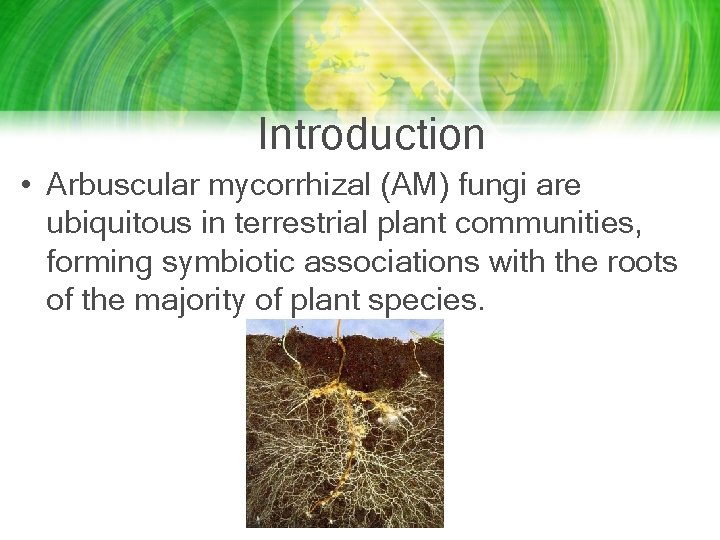
Introduction • Arbuscular mycorrhizal (AM) fungi are ubiquitous in terrestrial plant communities, forming symbiotic associations with the roots of the majority of plant species.
Mutualism • biological interaction that is beneficial to both parties. Benefits—fungus o gains carbon source Benefits—host o enhanced uptake and transport of poorly mobile soil nutrients. o improved water relations. o reduced pathogenic infections.
Previous Studies • Involved growing plants individually in pots in the glasshouse or laboratory. OR • In monospecific stands • Field data relating plant performance to mycorrhizal symbiosis are inconsistent with these techniques.
Objective of Study
METHODS
Experimental Site • Conducted at the Konza Prairie Research Natural Area (KPRNA) • Vegetation dominated by perennial, warm season matrix grasses o Big Bluestem (Andropogen gerardii Vit. ) o Little Bluestem (Andropogon scoparius Michx) o Indian grass (Sarghastrum nutans [L. ] Nash) o Switchgrass (Panicum virgatum L. ) • High diverse mixture of less abundant plant species of warm and cool season grasses, composites, legumes, other forbs, and woody species • Vascular flora of KPRNA includes over 500 species representing over 90 families
Experimental site (continued) • Temperatures range from -2. 7°C to 26. 6°C • Total annual precipitation of 835 mm, 75% of which is during the growing season o Mean annual rainfall of 858 mm during the study • Soils consist of Chase silt loams and silty clay loams • Spores of 13 species of mycorrhizal fungi were identified in the area • Dominant fungi were: o Glomus aggregatum o G. Constictum o G. Macrocarpun
Experiment Organization • KPRNA is divided into 60 watersheds units. 55 km 2 • Units are specifically prescribed unique burning regimes and grazing treatments • For this study, six ungrazed units are used o o Two annually burned upland units Two infrequently burned upland units One annually burned lowland unit One infrequently burned lowland unit • Within each unit: o 20 replicate permanent 2 x 2 m plots were created 2 m apart from each other o 10 plots are control plots, other 10 are experimental plots
Experimental plots • Plot area is treated to suppress AM fungi • Treated with applications of fungicide benomyl o 7. 5 L of benomyl per plot o Applied every two weeks during the growing season as a soil drench • Benomyl has the fewest drawbacks out of all potential methods for suppressing AM fungi, and is most effective with no direct effects on a wide range of plants o KPRNA also evaluated the effectiveness of benomyl themselves • Control plots were given 7. 5 L of water every two weeks during the growing season
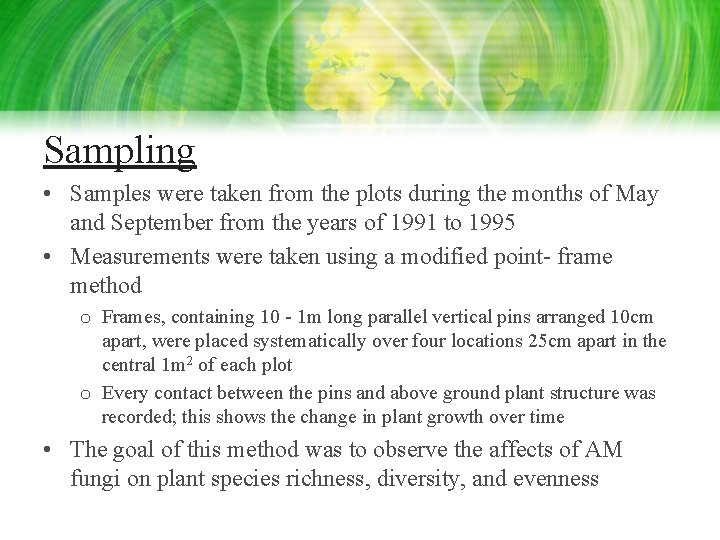
Sampling • Samples were taken from the plots during the months of May and September from the years of 1991 to 1995 • Measurements were taken using a modified point- frame method o Frames, containing 10 - 1 m long parallel vertical pins arranged 10 cm apart, were placed systematically over four locations 25 cm apart in the central 1 m 2 of each plot o Every contact between the pins and above ground plant structure was recorded; this shows the change in plant growth over time • The goal of this method was to observe the affects of AM fungi on plant species richness, diversity, and evenness
RESULTS
• Significant decrease in abundance of dominant warm-season grass species with benomyl application. – EXCEPTION: Switchgrass (Panicum virgatum) • Warm-season and cool-season grasses increased significantly in percent cover with AM fungal suppression • Fungal suppression = ↑ in relative abundances of several tallgrass prairie forbs and ↑diversity.
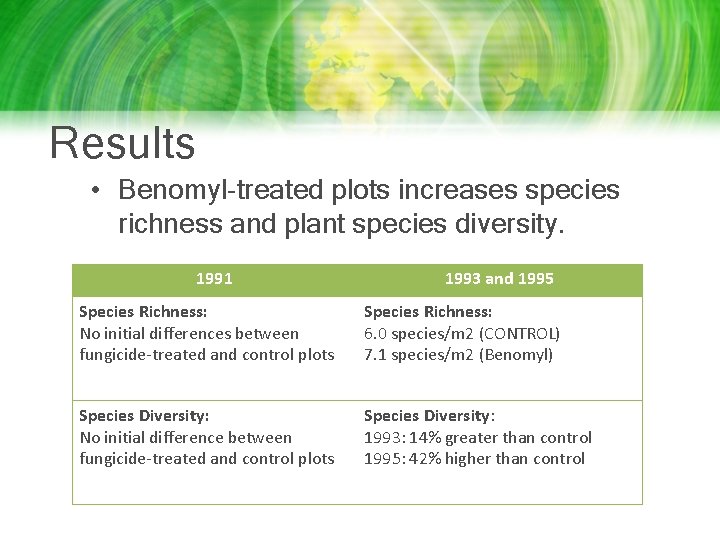
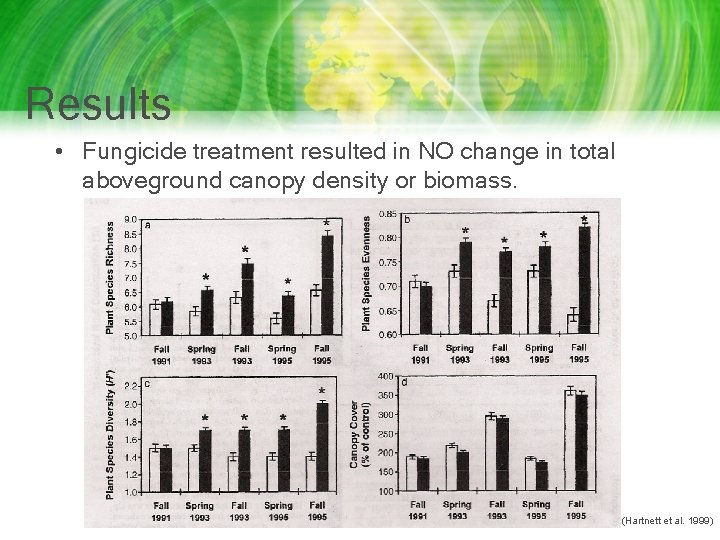
Results • Benomyl-treated plots increases species richness and plant species diversity. 1991 1993 and 1995 Species Richness: No initial differences between fungicide-treated and control plots Species Richness: 6. 0 species/m 2 (CONTROL) 7. 1 species/m 2 (Benomyl) Species Diversity: No initial difference between fungicide-treated and control plots Species Diversity: 1993: 14% greater than control 1995: 42% higher than control
Results • Fungicide treatment resulted in NO change in total aboveground canopy density or biomass. (Hartnett et al. 1999)
DISCUSSION
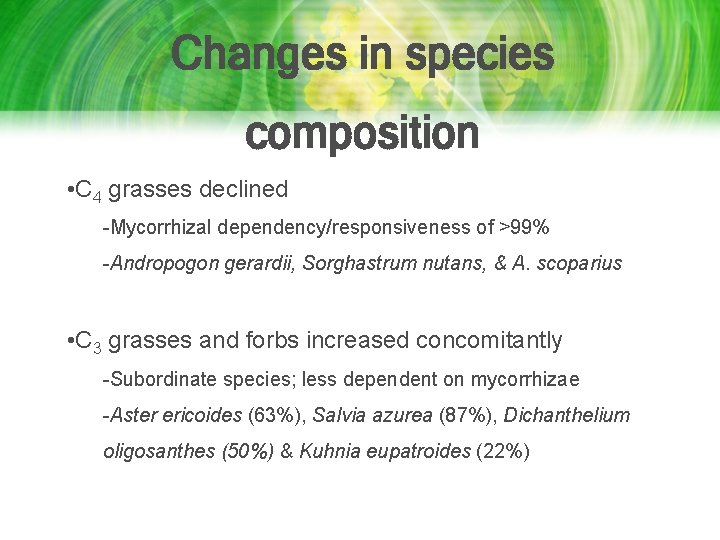
Changes in species composition • C 4 grasses declined -Mycorrhizal dependency/responsiveness of >99% -Andropogon gerardii, Sorghastrum nutans, & A. scoparius • C 3 grasses and forbs increased concomitantly -Subordinate species; less dependent on mycorrhizae -Aster ericoides (63%), Salvia azurea (87%), Dichanthelium oligosanthes (50%) & Kuhnia eupatroides (22%)
No effect on total aboveground biomass • Estimated by total number of pin-contacts per plot • Strong suppression of competitively dominant grasses • Equal increase in the subordinate species • Subordinate competitors experienced competitive release when mycorrhizae were suppressed
Mycorrhizae decreases floristic diversity in tallgrass prairies • “Different host plants species responses to colonization by mycorrhizal fungi result in changes in species diversity if the dominant competitors are significantly more strongly or more weakly mycotrophic than their neighbors” -The dominant C 4 grasses were more strongly mycotrophic than their neighbors -Fungal suppression reduces their dominance, leading to an increase in species diversity
CONCLUSION • Mycorrhizal symbiosis has a large impact at the community level -Key factor in explaining the dominance of C 4 grasses and limiting plant species evenness and diversity • Alterations in belowground fungi and rhizosphere processes have large effects on aboveground floristic composition and diversity at Konza Prairie
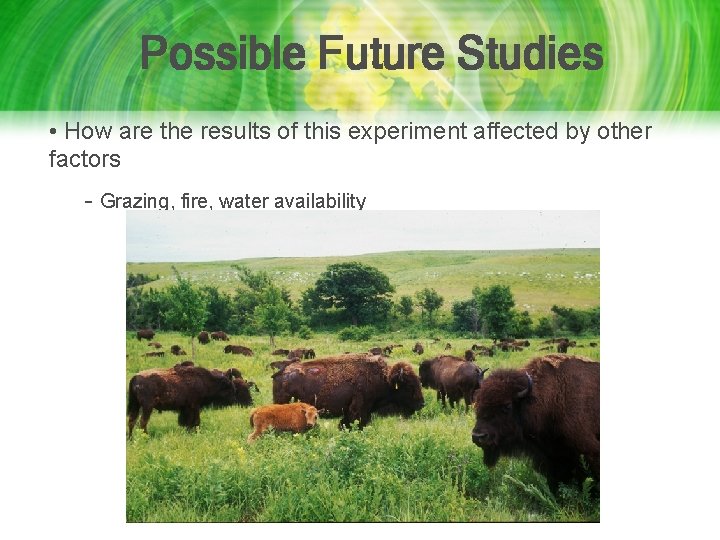
Possible Future Studies • How are the results of this experiment affected by other factors - Grazing, fire, water availability
Bibliography Hartnett, David C. , Gail W. T. Wilson. Mycorrhize Influence Plant Community Structure And Diversity In Tallgrass Prairie. Ecology 80, no, 4 (1999): 1187 -1195.