
Mycetoma and other Subcutaneous Mycoses Dr Ahmed AlBarrag
Mycetoma and other Subcutaneous Mycoses Dr. Ahmed Al-Barrag Asst. Professor of Medical Mycology School of Medicine and the University Hospitals King Saud University
Subcutaneous Mycoses Ø Fungal infections involving the dermis, subcutaneous tissues, muscle and may extend to bone. Ø They are initiated by trauma to the skin. Ø Are difficult to treat and surgical intervention is frequently employed. Ø Diseases in healthy host, however, more severe disease in immunocompromised host.

Subcutaneous Mycoses Ø Mycetoma Ø Subcutaneous zygomycosis Ø Sporotrichosis Ø Chromoblastomycosis Ø Pheohyphomycosis Ø Rhinosporidiosis Ø Lobomycosis

Mycetoma ØMycetoma is a chronic, granulomatous disease of the skin and subcutaneous tissue, which sometimes involves muscle, and bones. ØIt is characterized by Swelling , abscess formation, and multiple draining sinuses that exude characteristic grains of clumped organisms. ØTypically affects the lower extremities, but also other areas of the body e. g. hand, back and neck. ØThe disease was first described in the Madura district of India in 1842, (Madura foot). Ø Classified as : Ø Eumycetoma: Ø Actinomycetoma: those caused by fungi those caused by aerobic filamentous bacteria (Actinomycetes) Clinical findings are similar for both. Eumycetoma are usually more localized than actinomycetoma
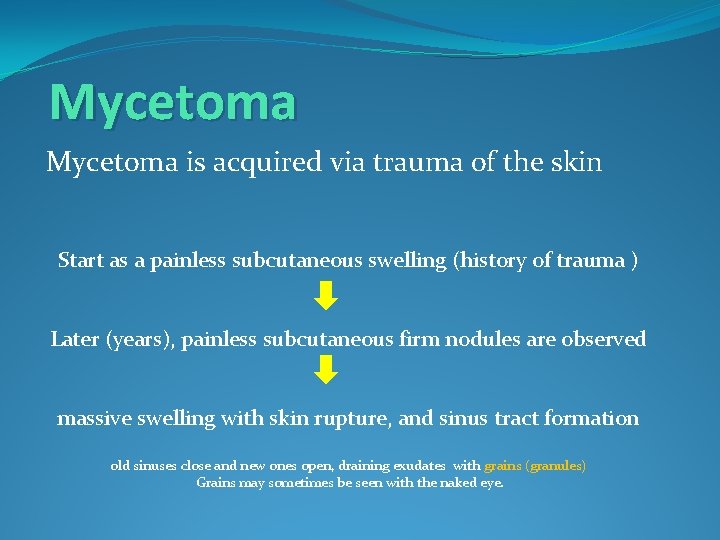
Mycetoma is acquired via trauma of the skin Start as a painless subcutaneous swelling (history of trauma ) Later (years), painless subcutaneous firm nodules are observed massive swelling with skin rupture, and sinus tract formation old sinuses close and new ones open, draining exudates with grains (granules) Grains may sometimes be seen with the naked eye.

Mycetoma is endemic in tropical, subtropical, and temperate regions. Sudan, Senegal, Somalia, India, Pakistan, Mexico, Venezuela Is more common in men than in women (ratio is 3: 1). Commonly in people who work in rural areas, framers
Mycetoma Etiology Eumycetomas Caused by a several mould fungi The most common are Madurella mycetomatis, Madurella grisea, and Pseudallescheria boydii The color of grains is black or white Actinomycetomas Caused by aerobic filamentous bacteria , gram positive Actinomadurae Streptomyces somaliensis Nocardia brasiliensis Color of grains yellow, white, yellowish-brown, pinkish – red. Actinomycosis (anaerobic Actinomycetes)

Mycetoma Diagnosis: Clinical samples: Biopsy tissue (Superficial samples of the draining sinuses are inadequate) Pus Blood (for serology only) 1. Direct microscopic examination Microscopic examination of tissue or exudate from the draining sinuses Histological sections: Hematoxylin-Eosin, Smears: Stain with Giemsa , Gomori methenamine silver , or periodic acid-Schiff stain (Fungi) Stain by: Gram, ZN (Actinomycetes) Grains (Observing the size of the filaments , the color of the grain) e. g. White-to-yellow grains indicate P. boydii, Nocardia species, or A. madurae infection. Black grains indicate, Madurella species infection. Red-to-pink grains indicate A. pelletieri infection.
Mycetoma Diagnosis 2. Culture Media such as Sabouraud dextrose agar (SDA) to isolate fungi Blood agar to isolate bacteria. Fungi are identified based on the macroscopic and microscopic features. For Actinomycetes biochemical and other tests are used for identification 3. Serology: Detect the antibodies using culture filtrate or cytoplasmic antigens of mycetoma agents Antibodies can be determined by immunodiffusion, , enzyme-linked immunosorbent assay Helpful in some cases for diagnosis and follow-up

Mycetoma Treatment Eumycetoma Ketoconazole Itraconazole Also Voriconazole and Amphotericin B Actinomycetoma Trimethoprim-sulfamethoxazole Dapsone Streptomycin Combination of 2 drugs is used ØTherapy is suggested for several months or years (1 -2 years or more) ØActinomycetoma generally respond better to treatment than eumycetoma ØRadiologic tests (bone radiographs) if bone involvement is suspected (Multiple lytic lesions or cavities, Osteoporosis) Surgical Care In eumycetoma, surgical treatment (debridement or amputation) in patient not responding to medical treatment alone and if bone is involved.
Subcutaneous zygomycosis • Chronic localized firm Subcutaneous masses • facial area or other like hand, arm, leg, thigh. • Firm swelling of site with intact skin-Distortion. Direct spread to adjacent bone and tissue. • Acquired via traumatic implantation of spores needle-stick, tattooing, contaminated surgical dressings, burn wound Etiology: Mould fungi of the Zygomycetes, Entomophthorales Conidiobolus coronatus, Basidiobolus ranarun, and few mucorales.
Subcutaneous zygomycosis Laboratory Diagnosis: Specimen: Biopsy tissue Direct microscopy: stained sections or smears: broad non-septate hyphae Culture on SDA Treatment: Oral Potassium iodide (KI) Amphotericin B Posaconazole
Phaeohyphomycosis Is a group of fungal infections caused by dematiaceous (darkly pigmented) fungi widely distributed in the environment Subcutaneous or brain Abscess Presents as nodules or erythematous plaques with no systemic involvement Affected site: Thigh, legs, feet, arms Etiology Dematiaceous mold fungi. common: Cladosporium, Exophiala, Wangiella, Cladophialophora, Bipolaris Diagnosis Specimens: Pus, biopsy tissue Direct Microscopy: KOH & smears will show brown septate fungal hyphae Culture: On SDA Treatment The treatment of choice is Surgical excision of the lesion Antifungal ( Itraconazole, Posaconazole)
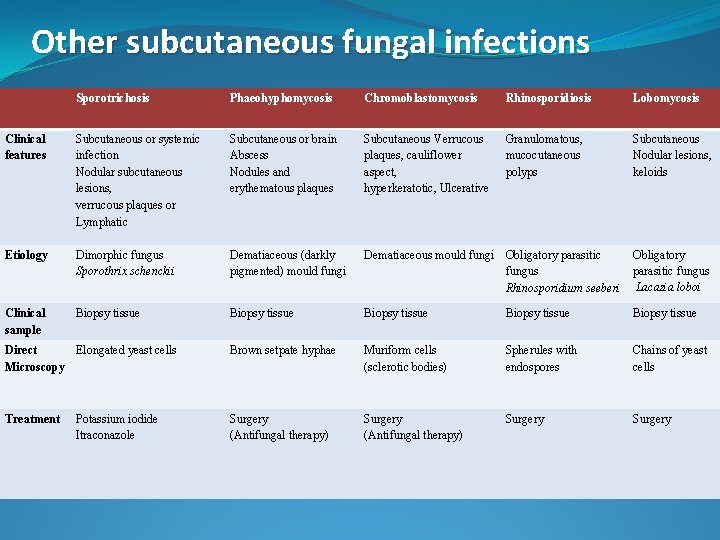
Other subcutaneous fungal infections Sporotrichosis Phaeohyphomycosis Chromoblastomycosis Rhinosporidiosis Lobomycosis Clinical features Subcutaneous or systemic infection Nodular subcutaneous lesions, verrucous plaques or Lymphatic Subcutaneous or brain Abscess Nodules and erythematous plaques Subcutaneous Verrucous plaques, cauliflower aspect, hyperkeratotic, Ulcerative Granulomatous, mucocutaneous polyps Subcutaneous Nodular lesions, keloids Etiology Dimorphic fungus Sporothrix schenckii Dematiaceous (darkly pigmented) mould fungi Dematiaceous mould fungi Obligatory parasitic fungus Rhinosporidium seeberi Obligatory parasitic fungus Lacazia loboi Clinical sample Biopsy tissue Biopsy tissue Direct Elongated yeast cells Microscopy Brown setpate hyphae Muriform cells (sclerotic bodies) Spherules with endospores Chains of yeast cells Treatment Surgery (Antifungal therapy) Surgery Potassium iodide Itraconazole
Bone and joint infections They are uncommon Not as isolated clinical problem Result from: Hematogenous dissemination Presence of foreign body Direct inoculation of organism (trauma, surgery , etc) Spared as a result of direct extension of infection to the bone e. g. Rhinocerebral zygomycosis, Aspergillosis, mycetoma Osteomyelitis Joint infections

Thank you
- Slides: 16