
Myanmar 2008 Cyclone Nargis Index 1 Background 2
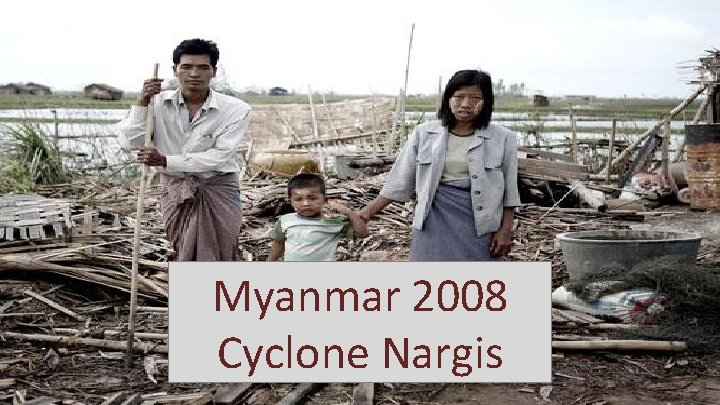
Myanmar 2008 Cyclone Nargis
Index 1. Background 2. Historical Information 3. International reaction to Nargis 4. Criticisms of the International Community 5. 6 Criteria 6. Myanmar Today 7. References
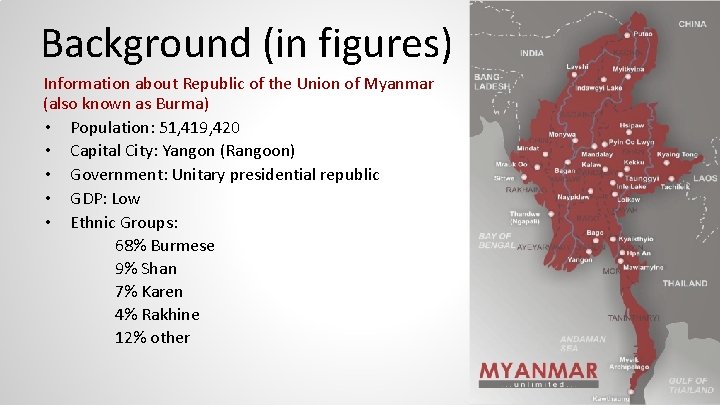
Background (in figures) Information about Republic of the Union of Myanmar (also known as Burma) • Population: 51, 419, 420 • Capital City: Yangon (Rangoon) • Government: Unitary presidential republic • GDP: Low • Ethnic Groups: 68% Burmese 9% Shan 7% Karen 4% Rakhine 12% other
Historical Information Before the British occupation, the nation was called Myanmar and had a rich culture, and valued equality. They shared a culture with the Khmer (now Cambodia). • British colonial rule began in the 19 th century, gradually annexing the whole country to its empire and named the country Burma. Empire lasted 75 years. • During WW 2, due to Japanese occupation and British colonization, Myanmar nationals Burma Independence Army and the Anti-Fascist People's Freedom League (AFPFL) were formed, with the AFPFL gaining power after 1945. • After independence in 1948, new Burmese government faced many problems due to political divide across the nation. • 1962, army seized power. •
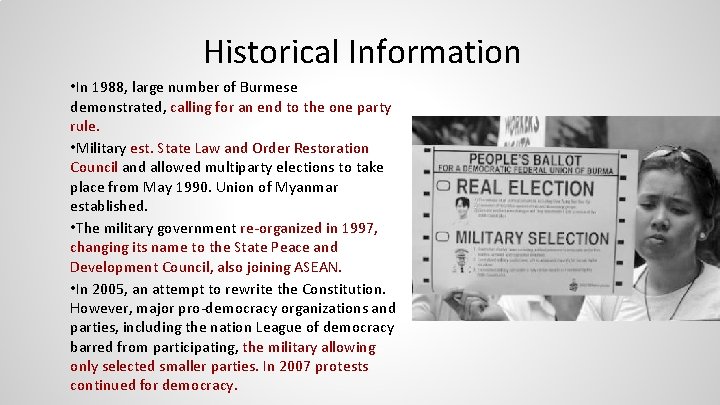
Historical Information • In 1988, large number of Burmese demonstrated, calling for an end to the one party rule. • Military est. State Law and Order Restoration Council and allowed multiparty elections to take place from May 1990. Union of Myanmar established. • The military government re-organized in 1997, changing its name to the State Peace and Development Council, also joining ASEAN. • In 2005, an attempt to rewrite the Constitution. However, major pro-democracy organizations and parties, including the nation League of democracy barred from participating, the military allowing only selected smaller parties. In 2007 protests continued for democracy.
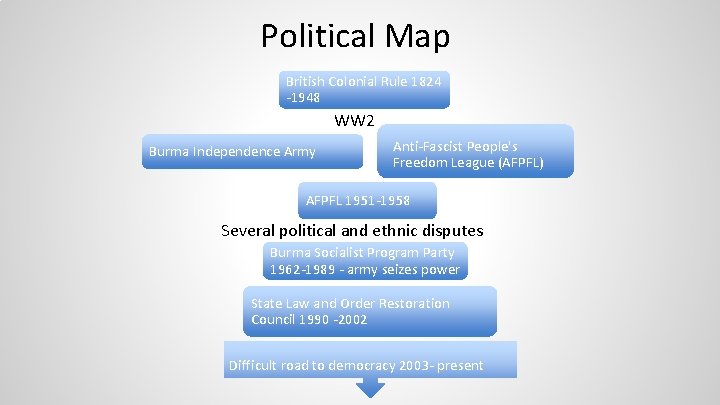
Political Map British Colonial Rule 1824 -1948 WW 2 Burma Independence Army Anti-Fascist People's Freedom League (AFPFL) AFPFL 1951 -1958 Several political and ethnic disputes Burma Socialist Program Party 1962 -1989 - army seizes power State Law and Order Restoration Council 1990 -2002 Difficult road to democracy 2003 - present
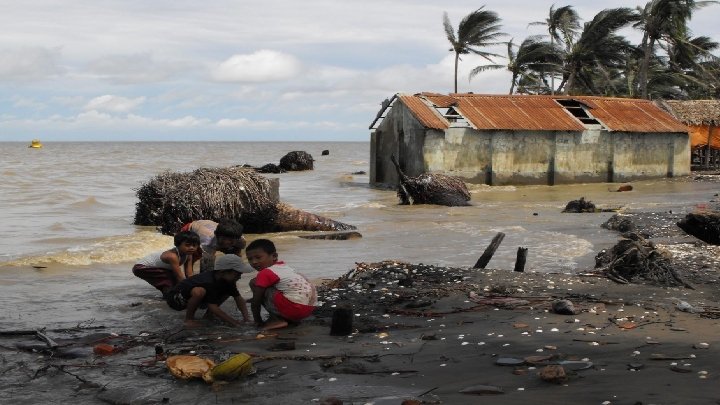
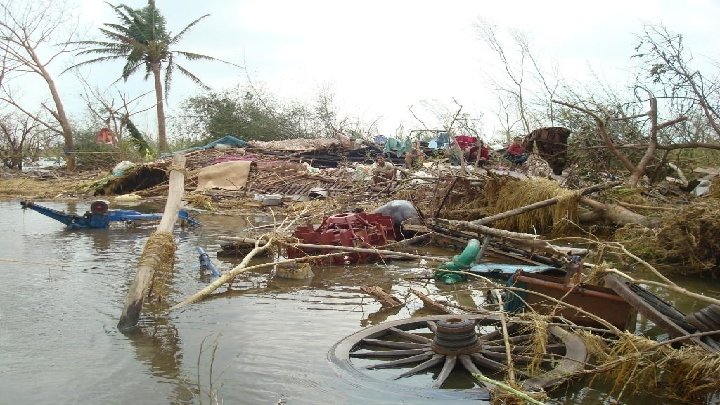
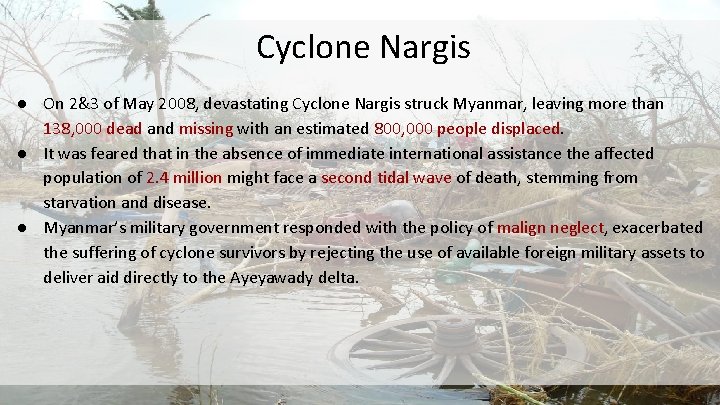
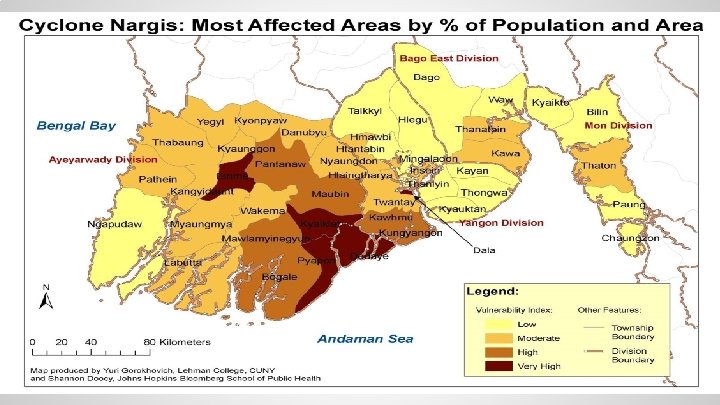
Cyclone Nargis ● On 2&3 of May 2008, devastating Cyclone Nargis struck Myanmar, leaving more than 138, 000 dead and missing with an estimated 800, 000 people displaced. ● It was feared that in the absence of immediate international assistance the affected population of 2. 4 million might face a second tidal wave of death, stemming from starvation and disease. ● Myanmar’s military government responded with the policy of malign neglect, exacerbated the suffering of cyclone survivors by rejecting the use of available foreign military assets to deliver aid directly to the Ayeyawady delta.
International Reactions to Nargis ● On 7 May, French Foreign Minister Bernard Kouchner suggested that it was time for the UN to assist the cyclone survivors under the responsibility to protect principle, coercively if necessary. ● US Permanent Representative Zalmay Khalizad reiterated that U. S. Navy ships in the Gulf of Thailand were ready to provide support to relief efforts, commenting that ‘a government has responsibility to protect its own people, to provide for its people. And since it’s not able to, you would expect the government to welcome assistance from others’. ● On 13 May, Prime Minister Gordon Brown argued that the UK government was ‘determined to make sure that even with the lack of cooperation of the Burmese authorities, they are pressured now into the unfettered access that should be available for all humanitarian operations’.
International Reactions to Nargis ● Gareth Evans, current Chief Executive of the International Crisis Group (ICG), argued that the R 2 P might indeed be applied, commenting ‘when a government default is as grave as the course on which the Burmese generals now seem to be set, there is at least a prima facie case to answer for their intransigence being a crime against humanity-of a kind which would attract the responsibility to protect principle’. ● Sir John Holmes, the UN’s Humanitarian Relief Coordinator, also urged Myanmar’s authorities to ‘respond to the outpouring of international support and solidarity by facilitating the arrival of aid workers, and the clearance of relief supplies in every way possible’.
· ICISS Report 4. 20 It is important to make clear both what these two conditions include and what they exclude. In the Commission’s view, these conditions would typically include the following types of conscience -shocking situation: …overwhelming natural or environmental catastrophes, where the state concerned is either unwilling or unable to cope, or call for assistance, and significant loss of life is occurring or threatened.
2005 World Summit Outcome 138. Each individual State has the responsibility to protect its populations from genocide, war crimes, ethnic cleansing and crimes against humanity. This responsibility entails the prevention of such crimes, including their incitement, through appropriate and necessary means… 139. The international community, through the United Nations, also has the responsibility to use appropriate diplomatic, humanitarian and other peaceful means, in accordance with Chapters VI and VIII of the Charter, to help to protect populations from genocide, war crimes, ethnic cleansing and crimes against humanity. In this context, we are prepared to take collective action…should peaceful means be inadequate and national authorities are manifestly failing to protect their populations from genocide, war crimes, ethnic cleansing and crimes against humanity…
Rome Statute of the International Criminal Court Article 7 Crimes against humanity 1. For the purpose of this Statute, ‘crime against humanity’ means any of the following… (a) Murder; (b) Extermination; (c) Enslavement; (d) Deportation or forcible transfer of population; (e) Imprisonment or other severe deprivation of physical liberty in violation of fundamental rules of international law; (f) Torture; (g) Rape, sexual slavery, enforced prostitution, forced pregnancy, enforced sterilization, or any other form of sexual violence of comparable gravity; (h) Persecution against any identifiable group or collectivity on political, racial, national, ethnic, cultural, religious, gender as defined in paragraph 3, or other grounds that are universally recognized as impermissible under international law, in connection with any act referred to in this paragraph or any crime within the jurisdiction of the Court; (i) Enforced disappearance of persons; (j) The crime of apartheid; (k) Other inhumane acts of a similar character intentionally causing great suffering, or serious injury to body or to mental or physical health.
Actions taken by International Society 9 -18 May ASEAN deployed Emergency Rapid Assessment Team(ERAT) in coordination with the Government of Myanmar to assess damage level and assist aid provision. 12 May The first C-130 carrying U. S. relief supplies went into Myanmar accompanied with Henrietta Fore, Administrator of the US Agency for International Development(USAID) and high ranking officials. 12 May Representatives of the ASEAN Secretariat, the World Bank and UN Office for the Coordination of Humanitarian Affairs(OCHA) met to discuss the relief effort and medium/long-term measures for the victims of Cyclone Nargis.
Actions taken by International Society 19 May The Special Meeting of ASEAN Foreign Ministers at Singapore led Naypyidaw to accept ASEAN’s assistance, facilitating the deployment of medical teams and the establishment of a humanitarian task force to work closely with the UN. 25 May Yangon-based Tripartite Core Group comprising representatives from the government of Myanmar, ASEAN and the UN as a working mechanism for coordinating and monitoring the flow of international assistance into Myanmar was created.
Criticisms of the International Community regarding Cyclone Nargis and its Consequences
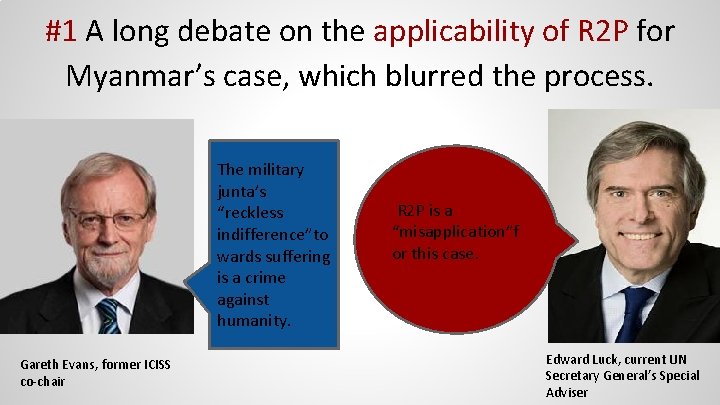
#1 A long debate on the applicability of R 2 P for Myanmar’s case, which blurred the process. The military junta’s “reckless indifference”to wards suffering is a crime against humanity. Gareth Evans, former ICISS co-chair R 2 P is a “misapplication”f or this case. Edward Luck, current UN Secretary General’s Special Adviser
• Not every human security concerns are associated with R 2 P. • Main intention of R 2 P: avoid circumstances in which states used force unilaterally. • We don’t want R 2 P to become an excuse for states to intervene in the domestic affairs of others. • Counter-productive: a. it would increase the paranoia of the junta. b. it could diminish the doctrine in the future. c. intervention in the forms of air drops would be ineffective. • Simply does not apply to natural disaster.
However, its invocation clearly impacted and pressured the military junta and ASEAN to accept humanitarian aid. It played a role in a whole range of decisions taken by the military leadership.
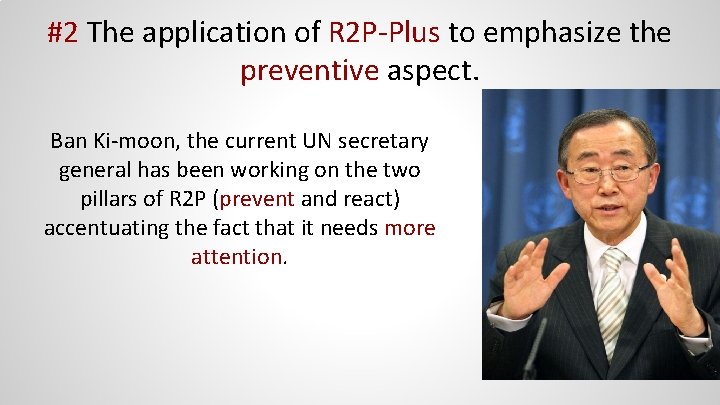
#2 The application of R 2 P-Plus to emphasize the preventive aspect. Ban Ki-moon, the current UN secretary general has been working on the two pillars of R 2 P (prevent and react) accentuating the fact that it needs more attention.
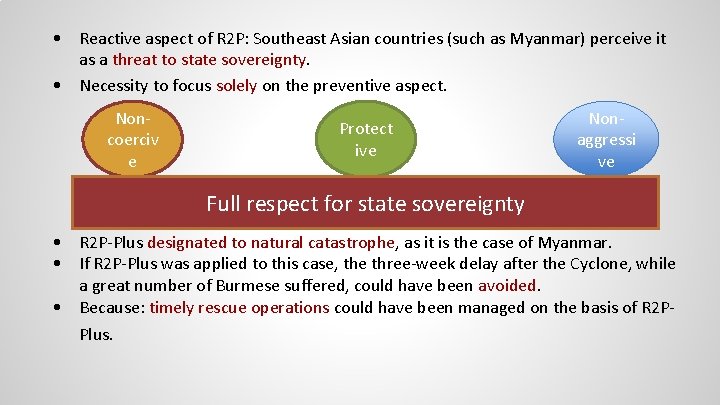
• Reactive aspect of R 2 P: Southeast Asian countries (such as Myanmar) perceive it as a threat to state sovereignty. • Necessity to focus solely on the preventive aspect. Noncoerciv e Protect ive Nonaggressi ve Full respect for state sovereignty • R 2 P-Plus designated to natural catastrophe, as it is the case of Myanmar. • If R 2 P-Plus was applied to this case, the three-week delay after the Cyclone, while a great number of Burmese suffered, could have been avoided. • Because: timely rescue operations could have been managed on the basis of R 2 PPlus.
#3 Myanmar’s case demonstrate ASEAN’s inability to reign in a recalcitrant member • YES ASEAN served as a facilitator between the West and Myanmar during the post-Cyclone situation. • BUT ASEAN contains several flaws that deter the respect of its stated purposes. • For instance, the attempt to strengthen democracy in Myanmar which is impeded by the absence of sanctions in the ASEAN Charter. • The lack of networks between ASEAN and NGO’s which, if existent, could have facilitated the promotion and protection of human rights commissions and bodies in Myanmar and others. • Instead of debating the junta’s response to the cyclone, the three-week lapse could have been avoided if ASEAN had been prepared.
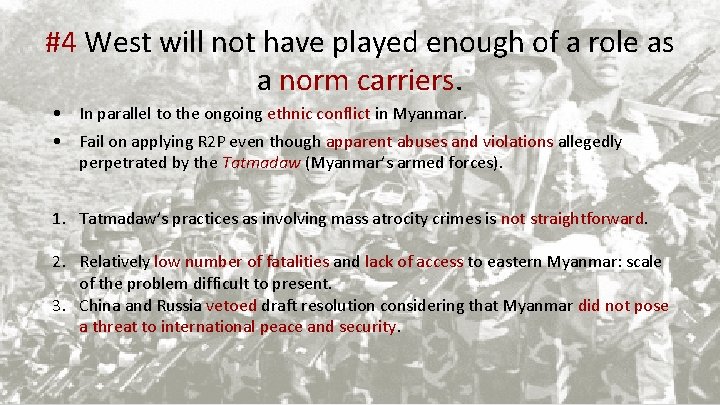
#4 West will not have played enough of a role as a norm carriers. • In parallel to the ongoing ethnic conflict in Myanmar. • Fail on applying R 2 P even though apparent abuses and violations allegedly perpetrated by the Tatmadaw (Myanmar’s armed forces). 1. Tatmadaw’s practices as involving mass atrocity crimes is not straightforward. 2. Relatively low number of fatalities and lack of access to eastern Myanmar: scale of the problem difficult to present. 3. China and Russia vetoed draft resolution considering that Myanmar did not pose a threat to international peace and security.
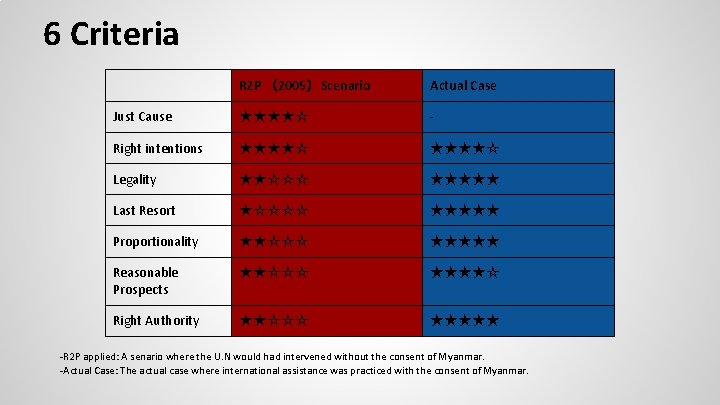
6 Criteria R 2 P (2005)Scenario Actual Case Just Cause ★★★★☆ - Right intentions ★★★★☆ Legality ★★☆☆☆ ★★★★★ Last Resort ★☆☆☆☆ ★★★★★ Proportionality ★★☆☆☆ ★★★★★ Reasonable Prospects ★★☆☆☆ ★★★★☆ Right Authority ★★☆☆☆ ★★★★★ -R 2 P applied: A senario where the U. N would had intervened without the consent of Myanmar. -Actual Case: The actual case where international assistance was practiced with the consent of Myanmar.
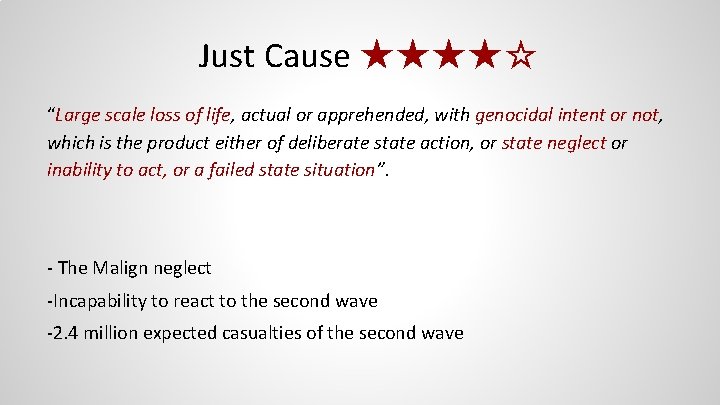
Just Cause ★★★★☆ “Large scale loss of life, actual or apprehended, with genocidal intent or not, which is the product either of deliberate state action, or state neglect or inability to act, or a failed state situation”. - The Malign neglect -Incapability to react to the second wave -2. 4 million expected casualties of the second wave
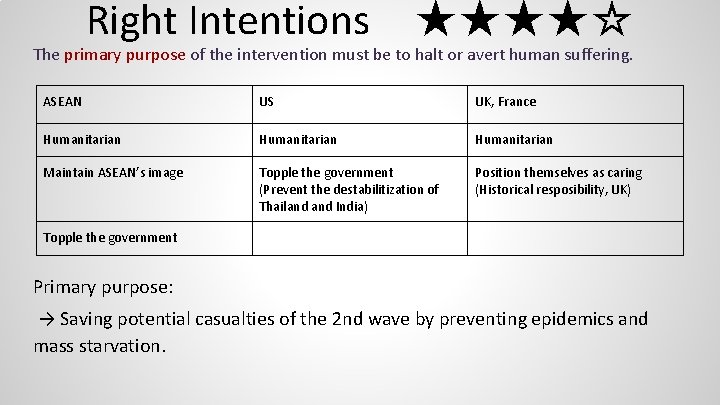
Right Intentions ★★★★☆ The primary purpose of the intervention must be to halt or avert human suffering. ASEAN US UK, France Humanitarian Maintain ASEAN’s image Topple the government (Prevent the destabilitization of Thailand India) Position themselves as caring (Historical resposibility, UK) Topple the government Primary purpose: → Saving potential casualties of the 2 nd wave by preventing epidemics and mass starvation.
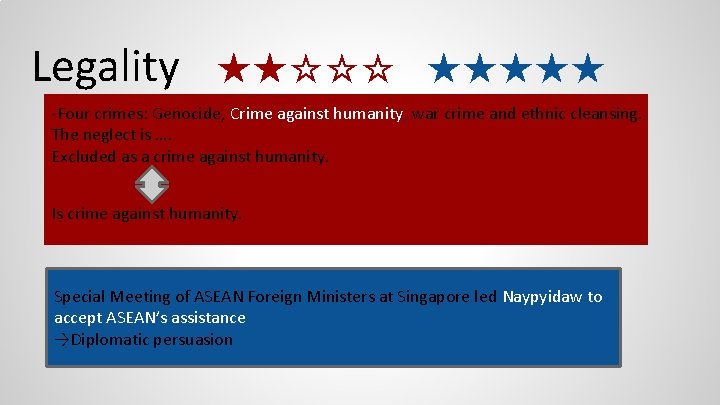
Legality ★★☆☆☆ ★★★★★ -Four crimes: Genocide, Crime against humanity, war crime and ethnic cleansing. The neglect is …. Excluded as a crime against humanity. Is crime against humanity. Special Meeting of ASEAN Foreign Ministers at Singapore led Naypyidaw to accept ASEAN’s assistance →Diplomatic persuasion
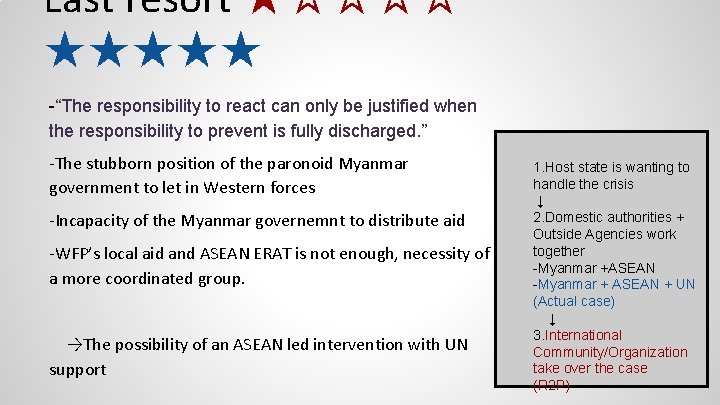
Last resort ★☆☆☆☆ ★★★★★ -“The responsibility to react can only be justified when the responsibility to prevent is fully discharged. ” -The stubborn position of the paronoid Myanmar government to let in Western forces -Incapacity of the Myanmar governemnt to distribute aid -WFP’s local aid and ASEAN ERAT is not enough, necessity of a more coordinated group. →The possibility of an ASEAN led intervention with UN support 1. Host state is wanting to handle the crisis ↓ 2. Domestic authorities + Outside Agencies work together -Myanmar +ASEAN -Myanmar + ASEAN + UN (Actual case) ↓ 3. International Community/Organization take over the case (R 2 P)
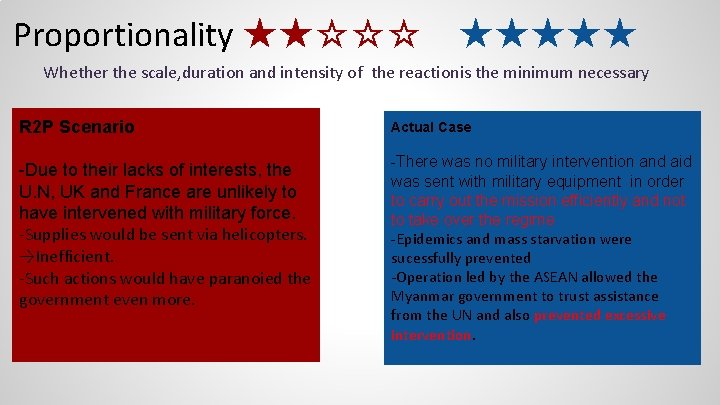
Proportionality ★★☆☆☆ ★★★★★ Whether the scale, duration and intensity of the reactionis the minimum necessary R 2 P Scenario Actual Case -Due to their lacks of interests, the U. N, UK and France are unlikely to have intervened with military force. -Supplies would be sent via helicopters. →Inefficient. -Such actions would have paranoied the government even more. -There was no military intervention and aid was sent with military equipment in order to carry out the mission efficiently and not to take over the regime -Epidemics and mass starvation were sucessfully prevented -Operation led by the ASEAN allowed the Myanmar government to trust assistance from the UN and also prevented excessive intervention.
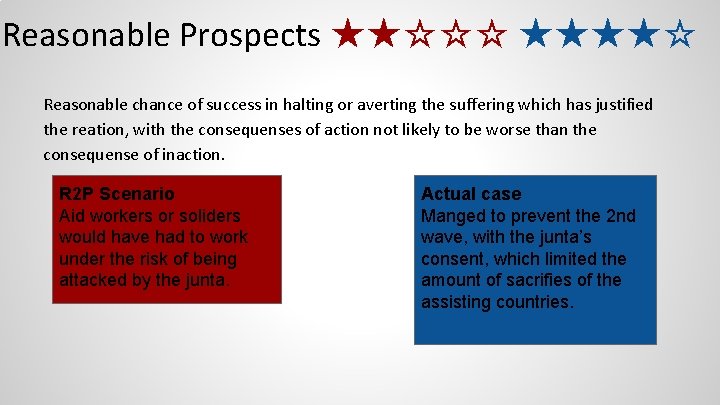
Reasonable Prospects ★★☆☆☆ ★★★★☆ Reasonable chance of success in halting or averting the suffering which has justified the reation, with the consequenses of action not likely to be worse than the consequense of inaction. R 2 P Scenario Aid workers or soliders would have had to work under the risk of being attacked by the junta. Actual case Manged to prevent the 2 nd wave, with the junta’s consent, which limited the amount of sacrifies of the assisting countries.
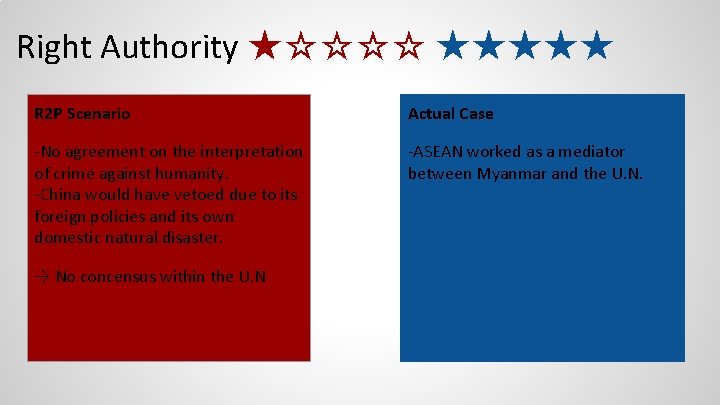
Right Authority ★☆☆☆☆ ★★★★★ R 2 P Scenario Actual Case -No agreement on the interpretation of crime against humanity. -China would have vetoed due to its foreign policies and its own domestic natural disaster. -ASEAN worked as a mediator between Myanmar and the U. N. → No concensus within the U. N
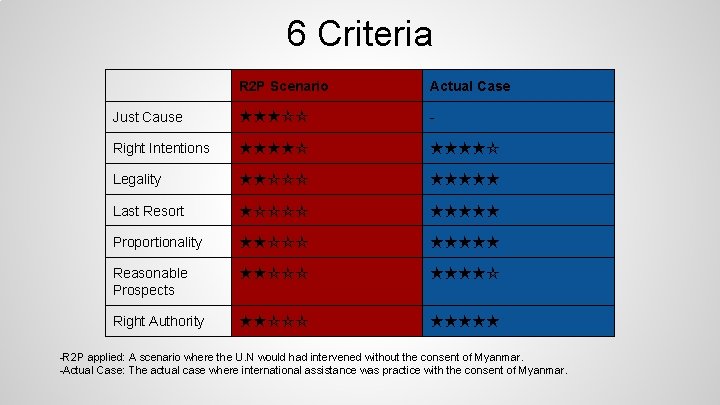
6 Criteria R 2 P Scenario Actual Case Just Cause ★★★☆☆ - Right Intentions ★★★★☆ Legality ★★☆☆☆ ★★★★★ Last Resort ★☆☆☆☆ ★★★★★ Proportionality ★★☆☆☆ ★★★★★ Reasonable Prospects ★★☆☆☆ ★★★★☆ Right Authority ★★☆☆☆ ★★★★★ -R 2 P applied: A scenario where the U. N would had intervened without the consent of Myanmar. -Actual Case: The actual case where international assistance was practice with the consent of Myanmar.
Myanmar Today (2010 -Present) • Despite international response to the cyclone, natural disasters still does not apply to the Rto. P doctrine. • Activists who independently provided aid to rebel against the government continued to be imprisoned till 2010. • 2010– 2014 Burmese democratic tranformations have been an ongoing series of political, economic and administrative reforms in Myanmar undertaken by the military-backed up government. • Improvement over the last 2 years, more prisioners have been freed, media restriction relaxed. • As a consequence of the reforms, ASEAN has approved Burma's bid for the chairmanship in 2014 to encourage further progress.
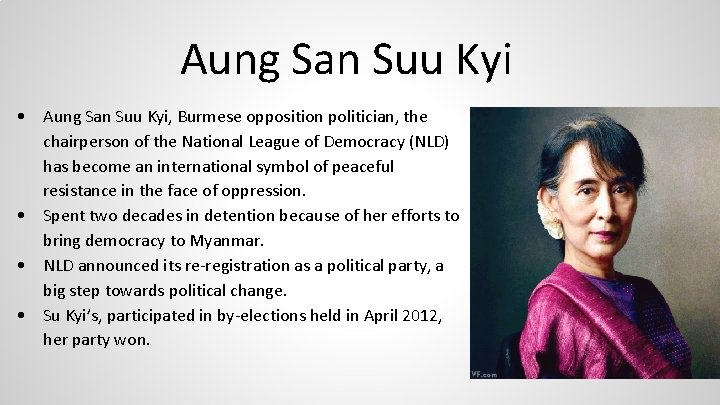
Aung San Suu Kyi • Aung San Suu Kyi, Burmese opposition politician, the chairperson of the National League of Democracy (NLD) has become an international symbol of peaceful resistance in the face of oppression. • Spent two decades in detention because of her efforts to bring democracy to Myanmar. • NLD announced its re-registration as a political party, a big step towards political change. • Su Kyi’s, participated in by-elections held in April 2012, her party won.
References Tzu Chi Website http: //www. tzuchi. org/en/index. php? option=com_content&view=article&id=569%3 Afoundation-builds-schools-helps-farmersand-sick-in-cyclone-hit-myanmar&catid=94%3 Amyanmar-after-cyclone-nargis-&Itemid=297&lang=en Jurgen Haacke. Myanmar, the Responsability to Protect and the Need for Prcatical Assistance. http: //paulbacon. files. wordpress. com/2011/09/waseda-teaching-ph 303 -fall-2011 -myanmar-haacke. pdf Mely Caballero-Anthony and Belinda Chng. Cyclones and Humanitarian Crises: Pushing the Limits of R 2 P in Southeast Asia. http: //paulbacon. files. wordpress. com/2011/09/waseda-teaching-ph 303 -fall-2011 -myanmar-caballero-and-chang. pdf Noel M. Morada. The ASEAN Charter and the Promotion of R 2 P in Southeast Asia: Challenges and Constraints. http: //paulbacon. files. wordpress. com/2011/09/waseda-teaching-ph 303 -fall-2011 -myanmar-morada. pdf
- Slides: 37