
My Support Plan Training September 2017 Todays Agenda
My Support Plan Training September 2017
Today’s Agenda • • 9. 00 – Context of MSP 10. 00 –MSP and the Graduated response 10. 30 - Funded MSPs 10. 45 – Break 11. 00 – Evidence to support an MSP 11. 30 – Producing a MSP 11. 50 – Questions and Further support
Our Vision • ‘Our vision for children with SEND is the same as for all children and young people, that they achieve well in their early years, at school and in college and lead happy and fulfilled lives. ’ • Foreword to the SEND Code of Practice 2014
My Support Plan • My Support Plan is a strategy used nationally when a young person has complex needs; • It provides a more coordinated, family centred and personalised planning approach • It demonstrates a graduated response to SEN • It demonstrates accountability for notional SEN funding; • In some cases, it may allow access to additional MSP funding.
What we are aiming for… • The majority of children and young people in educational settings will have their SEN effectively met within that setting using the setting’s own approach to planning and recording eg. Provision map / IEP • This does not mean that they will be doing exactly the same as all of the other children • There should be a graduated response.
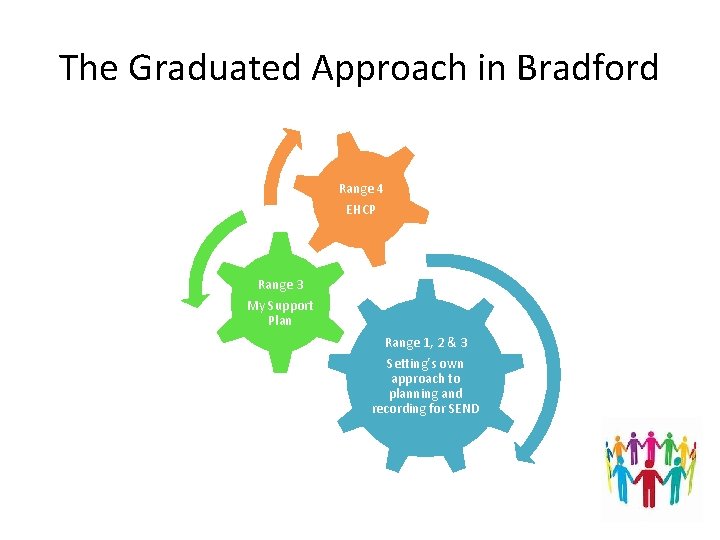
The Graduated Approach in Bradford Range 4 EHCP Range 3 My Support Plan Range 1, 2 & 3 Setting’s own approach to planning and recording for SEND
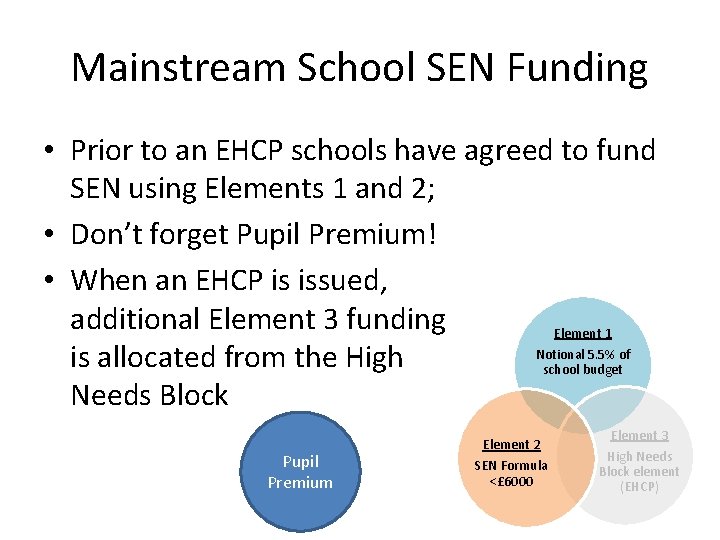
Mainstream School SEN Funding • Prior to an EHCP schools have agreed to fund SEN using Elements 1 and 2; • Don’t forget Pupil Premium! • When an EHCP is issued, additional Element 3 funding Element 1 Notional 5. 5% of is allocated from the High school budget Needs Block Pupil Premium Element 2 SEN Formula <£ 6000 Element 3 High Needs Block element (EHCP)
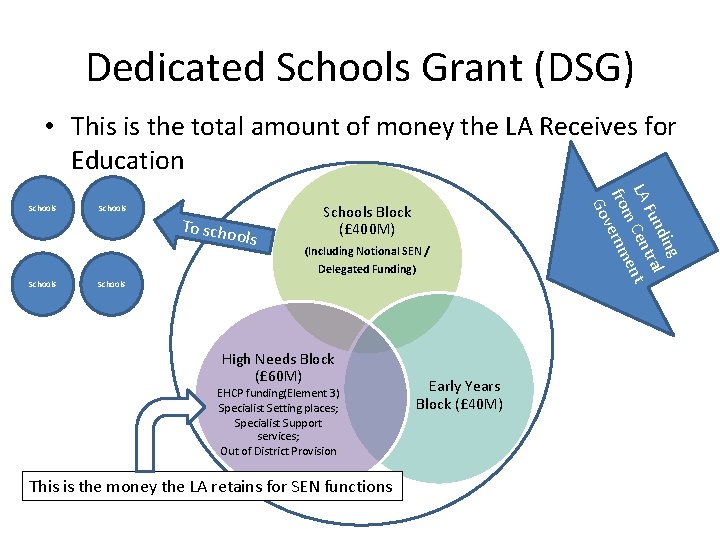
Dedicated Schools Grant (DSG) • This is the total amount of money the LA Receives for Education Schools To scho ols Schools Block (£ 400 M) (Including Notional SEN / Delegated Funding) Schools High Needs Block (£ 60 M) EHCP funding(Element 3) Specialist Setting places; Specialist Support services; Out of District Provision This is the money the LA retains for SEN functions Early Years Block (£ 40 M) g din l Fun tra LA Cen nt e m fro ernm v Go Schools
High Need Block under pressure • Currently over 7 m overspent • Requests for EHCPs have doubled since 2014; • Requests for specialist placements are increasing; • This is not sustainable; • Schools and LA need to work together to ensure best use of available funds.
So why do an MSP • It is part of the ‘graduated response’ outlined in the COP; • It provides a joined up way of meeting complex SEND needs; • It provides an accountability for the Element 1 and 2 funding; • EHCPs will only be issued if you can demonstrate that you require more than Element 1 and 2 funding to meet identified needs.
Who should have a MSP? Children at School Support who fall into high R 3 / borderline R 4 and who mainly : • Have complex needs • Are making poor progress based on the School Progress grid • Have external agencies involved • Require significant individual input to meet their needs • Are very vulnerable on transition.
Who doesn’t need a MSP • Children at R 1 – 2 • Children at R 3 whose needs are clear and who are making good progress with Element 1 & 2 funding; • NB: An EHCP may be more appropriate for c/yp who have significant and long term needs at R 4.
Difference between MSP and EHCP • MSP is non statutory – it does not legally bind you to deliver what is in the plan; • It applies to children who are high R 3 / borderline R 4 • MSP is owned by the school, not the LA; • MSP is reviewed 2 x per year; • Maximum funding available is £ 3000 p/a.
From MSP to EHCP • Children and young people may remain on MSP for some time if they continue to make progress (Funding only available for 2 cycles); • Following review it may be decided that MSP is no longer necessary; • Occasionally when children do not make the expected amount of progress, it may be appropriate to request an EHC assessment; • This will normally be agreed with those involved when the MSP is reviewed.
EHC Assessment • Agreeing to assess does not mean that a EHC plan will be issued; • The possible outcomes are: – Assessment indicates needs can be met from existing school resources – (unfunded) My Support Plan issued – Assessment indicates needs R 4 and additional resource (over and above Elements 1 & 2) required –EHCP issued.
Funded MSPs • MSPs can be implemented by school for any student; • Funding of up to £ 3000 can be requested from the LA (£ 1500 x 2); • This is pro rata for nursery; • In order to access funding, requests will need to demonstrate that: – the c/yp is at high R 3 /4; – The setting is using Elements 1 and 2 of the Notional SEN funding; – Advice has been sought from relevant professionals.
Funding process • MSP collated with family and submitted to LA; • MSP assessed at weekly panel and funding agreed / declined; • Decision communicated to school and funds allocated for 6 months; • Formative feedback on submission to guide any future submissions.
Break
Before Initiating a MSP • Check that the c/yp is R 3 / 4 on the ‘School Age Progress’ grid; • Calculate the support currently being given to the c/yp using the ‘SEN Support Grid’; • Discuss MSP with parents and gain consent; • Identify who needs to be invited / what evidence needs to be collated.
Who to invite • • • Senco Class teacher / support Parents Young person Advice from / actual attendance from other involved professionals.
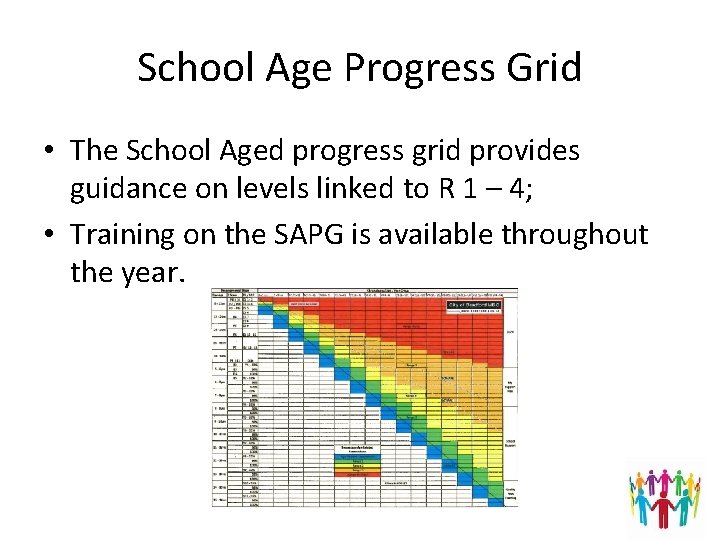
School Age Progress Grid • The School Aged progress grid provides guidance on levels linked to R 1 – 4; • Training on the SAPG is available throughout the year.
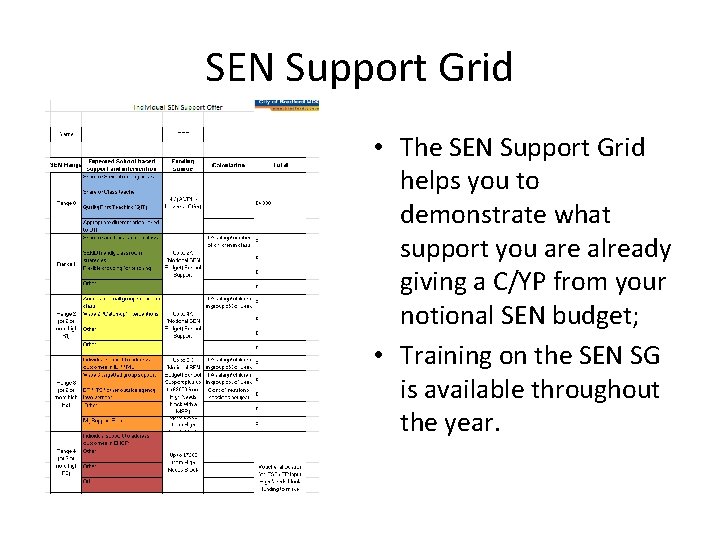
SEN Support Grid • The SEN Support Grid helps you to demonstrate what support you are already giving a C/YP from your notional SEN budget; • Training on the SEN SG is available throughout the year.
Before the MSP Meeting • ‘This Is Me’ completed with child / young person / family; • Up to date accurate information about the child’s needs collected from teachers / others; • ‘Personal Details’ and ‘Needs’ section completed.
At The MSP Meeting • Agree ‘Needs’ section; • Discuss outcomes - these will be short term – no longer than 6 months; • Discuss what provision will need to be put in place – be as precise as possible; • Discuss who will implement this and how to evaluate; • Incorporate advice from external professionals; • Discuss parent’s role
Requesting a Funded MSP • In addition, you must clearly identify what additional funding is required (up to £ 3 K); • Forward form to SEN Assessment team at MMT.
After MSP • Circulate MSP to all involved; • Ensure review date booked in (at end of next term); • Submit requests for funded MSP to LA
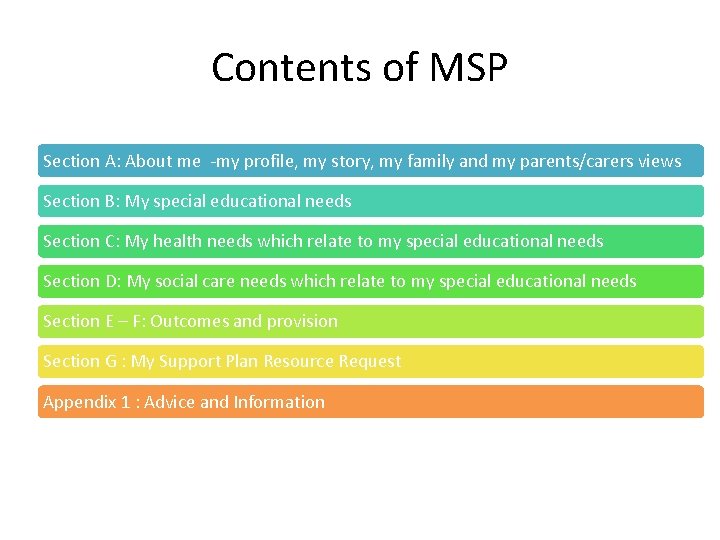
Contents of MSP Section A: About me -my profile, my story, my family and my parents/carers views Section B: My special educational needs Section C: My health needs which relate to my special educational needs Section D: My social care needs which relate to my special educational needs Section E – F: Outcomes and provision Section G : My Support Plan Resource Request Appendix 1 : Advice and Information
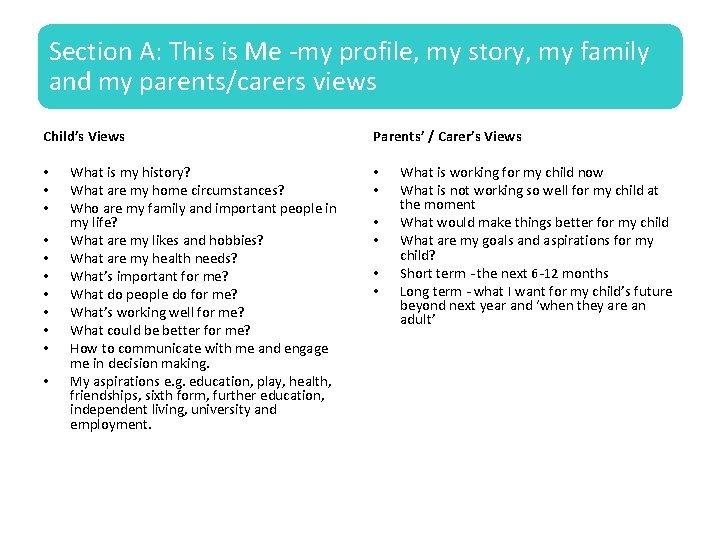
Section A: This is Me -my profile, my story, my family and my parents/carers views Child’s Views • • • What is my history? What are my home circumstances? Who are my family and important people in my life? What are my likes and hobbies? What are my health needs? What’s important for me? What do people do for me? What’s working well for me? What could be better for me? How to communicate with me and engage me in decision making. My aspirations e. g. education, play, health, friendships, sixth form, further education, independent living, university and employment. Parents’ / Carer’s Views • • • What is working for my child now What is not working so well for my child at the moment What would make things better for my child What are my goals and aspirations for my child? Short term - the next 6 -12 months Long term - what I want for my child’s future beyond next year and ‘when they are an adult’
Section B: My special educational needs • NEEDS should be presented under the 4 EHCP headings, as clear, succinct summaries of what the child needs to develop/improve/enhance/learn and so on – bearing in mind what the child’s difficulties are and what their rate of progress is likely to be. • Provide a very short summary statement at the beginning of this section that gives an overview of the child/young person’s strengths and needs in learning. • Describe the child’s strengths (what they can do) • Include the level of learning difficulty and/or the impact of their other needs in relation to their access to learning. State how delayed their learning is in relation to the School Age Progress Grid / EY progress grid; • Summarise what the child/young person needs to be able to do next to make progress eg develop expressive language skills
Section C: My health needs which relate to my special educational needs • Only complete this section if there is direct involvement from a health professional. If there is no involvement from a health professional please state ‘there are no health needs’ or if a referral has been made for involvement of a health professional please state ‘ a referral has been made to……………for………………. . ’ • Specify any health needs which relate the child/young person’s SEN, where the related health needs are having a direct impact on the child/young person’s education or training. Any known formal medical condition/diagnoses can be noted in this section, but should be accompanied by information about the impact that condition/diagnoses has on the child/young person. • Within these descriptions include what impact the child/young person’s health/medical needs have on them/their environment and what the child/young person needs to be able to do next to make progress; – Eg: X has Epilepsy. He has made excellent progress in his development since his epilepsy surgery and has been seizure free for 1 year. X needs to develop an awareness of how his epilepsy affects him and ultimately what actions he can take to reduce this impact;
Section D: My social care needs which relate to my special educational needs • Only complete this section if there is direct involvement from a social care professional. If there is no involvement from a social care professional please state ‘there are no social care needs’ or if a referral for social care involvement/assessment has been made please state ‘ a referral has been made to………………. . for……………. . ’ • Specify any social care needs which relate the child/young person’s SEN or disability, where the related social care needs are having a direct impact on the child/young person’s education or training. • Describe the child/young person’s strengths (what they can do) and needs (what they – X’s is a Child in Need as a disabled child as defined by the Children’s Act 1989. The majority of her social care needs arise from her physical disabilities which restrict her independence. X is very sociable but her physical disabilities restrict her opportunities to mix with her peers in the community. X needs to be able to take part in fun and enjoyable social experiences; and develop her independent living skills.
Section E & F: Outcomes • Co. P defines Outcomes as “…the benefit or difference made to an individual as a result of an intervention. ” • What observable change there will be in the child’s functioning by the next review, i. e. what the child will be demonstrating/showing/be able to do. • Should be positively phrased and • Regular progress monitoring should always be considered in the light of the steps, outcomes and aspirations.
Section E & F: Provision • PROVISION should outline exactly what is in place (or needs to be put in place) to help the child begin to achieve each of the Outcomes. • It should refer to what intervention/support should be provided, who should provide this support and how it will be provided, as well as what facilities /resources /equipment / staffing arrangements etc are needed. • It should be specific and quantified eg 2 x 20 minutes per day.
Section 6: My Support Plan Resource Request • What funding is already in place for the c/yp? • How much additional funding are you requesting? • What exactly will this be used for (not just ‘ 1: 1 support’)?
Appendix 1: Advice and Information Documents that inform My Support Plan • Evidence of advice or support from Education professionals eg EP; previous My Support Plan(s), s, behaviour log/diary etc • Evidence of advice or support from Health eg. Therapy advice, Paediatricians report • Evidence of advice or support from Social Care eg. Child in Need Plan, PEP, Care Plan) • Other evidence from other people or agencies
Questions
Further Advice and Support • Example MSPs on BSOL; • MSP Review document on BSOL; • Monthly MSP drop-in / advice sessions (BSOL)
- Slides: 37