
My own inquiry planner template Instructions How to



- Slides: 9
My own inquiry planner template Instructions: How to work with this template Teachers and/or parents/guardians: • Create a copy of this template. • Support the child/student in working through the planner as independently as possible. • Check in regularly and be curious about what and how the child/student is learning. Try to keep conversations going to encourage exploration and reflection. Keep the discussion conversational rather than interrogative. Show interest in what and how they have learned so far. • Ask questions so that the child/ student has opportunities to explore ideas, wonderings, problems and solutions. Try to give time for independent discoveries and hold back from giving too many suggestions. Ask what is challenging in their learning, or what they feel they need help with. Make time for talking through their ideas, wonderings and problems to enable them to come up with their own solutions. • Have regular check-ins to support active engagement and interest. • Consider pairing students up or setting up small groups (virtually via Skype, Zoom, Google etc. by phone or within family groups etc. ) so that students can share their learning, suggestions and feedback throughout the inquiry process. • Focus on the learning process rather than the product. Personal inquiries are an opportunity for students to develop critical thinking skills, learn how to research and investigate, learn to ask questions that deepen their learning and inspire further questions. 1
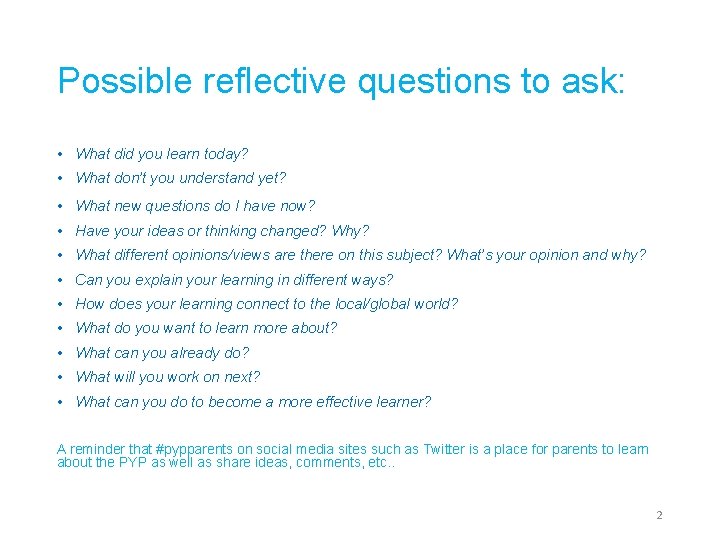
Possible reflective questions to ask: • What did you learn today? • What don’t you understand yet? • What new questions do I have now? • Have your ideas or thinking changed? Why? • What different opinions/views are there on this subject? What’s your opinion and why? • Can you explain your learning in different ways? • How does your learning connect to the local/global world? • What do you want to learn more about? • What can you already do? • What will you work on next? • What can you do to become a more effective learner? A reminder that #pypparents on social media sites such as Twitter is a place for parents to learn about the PYP as well as share ideas, comments, etc. . 2
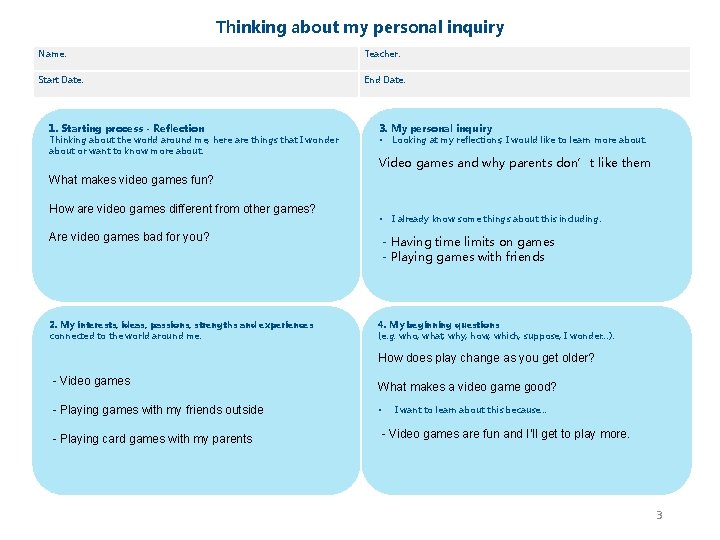
Thinking about my personal inquiry Name: Teacher: Start Date: End Date: 1. Starting process - Reflection Thinking about the world around me, here are things that I wonder about or want to know more about: 3. My personal inquiry • Looking at my reflections, I would like to learn more about: Video games and why parents don’t like them What makes video games fun? How are video games different from other games? Are video games bad for you? • 2. My interests, ideas, passions, strengths and experiences connected to the world around me: 4. My beginning questions (e. g. who, what, why, how, which, suppose, I wonder. . . ): How does play change as you get older? What makes a video game good? - Video games - Playing games with my friends outside - Playing card games with my parents I already know some things about this including: - Having time limits on games - Playing games with friends • I want to learn about this because. . . - Video games are fun and I’ll get to play more. 3
Planning my personal inquiry Transdisciplinary theme: I have decided upon the transdisciplinary theme that my inquiry is in: Who we are Where we are in time and place How we express ourselves How the world works Sharing the planet My Questions: What new questions do I have? Can I refine and add to my beginning questions? Central idea: I have developed my central idea from my questions. I have checked this with my teacher/parent/guardian/peer/mentor etc. Play invites opportunities for communication and creative expression Key concepts 1 or 2 key Who do I play video games with? What kinds of games do I play? What makes something fun or not fun? Why do people play video games? My timeline (plan and check): I have began to develop my timeline with support. concepts that will help my frame how I look at my personal inquiry Form q Function q Causation q Change q Connection Perspective Responsibility Lines of inquiry (I have developed my lines of inquiry from my central idea and questions) Discoveries made through types of play Communication in play Our responsibilities in play Approaches to learning (skills that I will further develop and demonstrate). Thinking skills Action (actions that I may take because of my learning. It may be participation, advocacy, social justice, social entrepreneurship, or a change in my lifestyle choices). Create a new game to play with different people to improve communication between different family members and friends. How we organize Learning goals Where am I going in my learning? What do I want to learn? I can. . . formulate a specific question to investigate. I can. . . generate and organise ideas and information to write for an intended purpose and audience (e. g. instructions to a game) I can. . . collect, organise and display data Research skills Social skills Self-management skills Communication skills Learner profile (learner profile attributes that I want to further develop and demonstrate). Inquirer Openminded Knowledgeable Caring Thinker Risk taker Communicator Balanced Principled Reflective Subjects What opportunities are there for me to use my knowledge and skills in other subjects? (Mathematics, Language, Science etc. ) Language: reading, writing and presenting for a variety of purposes and audiences Social studies: surveying Science: looking at forces and movement through play Mathematics: data management and probability 4
Inquiring Collaboration: Who am I going to collaborate with during my personal inquiry? (teacher, peers, parent/guardian, family, members of the learning community and beyond) My teachers, my older brother, my grandad, and a friend from my class. How am I going to collaborate? (When? , How? , For what? ) Are there different people I need to collaborate for different things? How can I organise this? I need to collaborate with my teacher every week and with my friend. I will also check-in with my brother to ask questions and decide on my next steps. Resources: (time, people, places, technologies, learning spaces, physical materials) My new questions: (evolving questions and theories) • What new questions do I have? • What resources do I need? Digital resources, interview adults, video game makers if possible. • Where will I document my questions and new learning? (e. g. a journal, poster, notepad, digital adn non-digital media etc. ) In my notebook and possibly Power. Point – each page will be a different question. Action (action that I might already have in mind in reponse to my inquiries). Approaches to learning (What skills do I notice I’m using the most right now? Which do I need to work on more). Self assessment How am I doing and how do I know? q Thinking skills: Research skills: • How do my questions help me further my understanding of the central idea? q Social skills: q Self-management skills: What have I learned already and what do I need to learn more about? Learner profile What learner profile attribute do I notice I’m using the most right now? Who am I talking to and sharing my learning with? Who is giving me feedback and how am I using it? My timeline (check-in): I have checked my goals and next steps based on my timeline. Which might I want to work on more to help me with my personal inquiry? 5
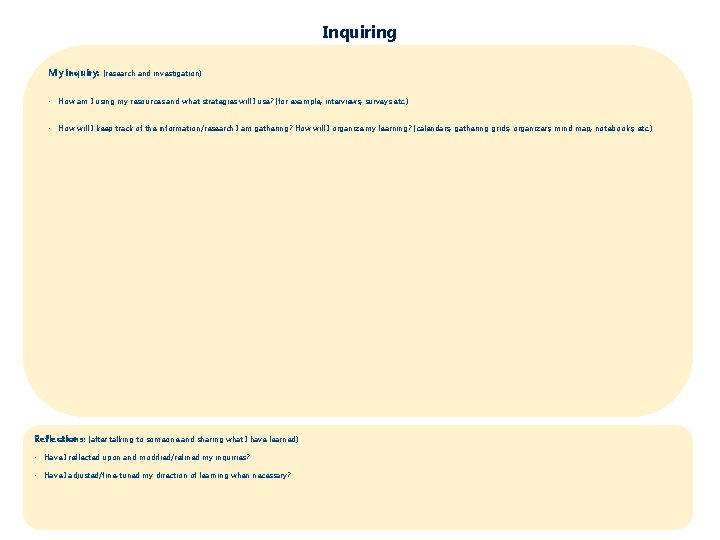
Inquiring My inquiry: (research and investigation) • How am I using my resources and what strategies will I use? (for example, interviews, surveys etc. ) • How will I keep track of the information/research I am gathering? How will I organize my learning? (calendars, gathering grids, organizers, mind map, notebooks, etc. ) Reflections: (after talking to someone and sharing what I have learned) • Have I reflected upon and modified/refined my inquiries? • Have I adjusted/fine-tuned my direction of learning when necessary? 6
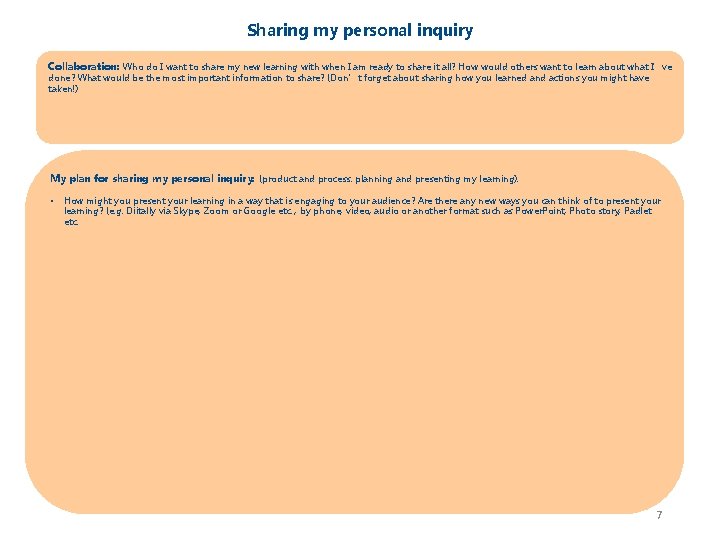
Sharing my personal inquiry Collaboration: Who do I want to share my new learning with when I am ready to share it all? How would others want to learn about what I’ve done? What would be the most important information to share? (Don’t forget about sharing how you learned and actions you might have taken!) My plan for sharing my personal inquiry: (product and process: planning and presenting my learning). • How might you present your learning in a way that is engaging to your audience? Are there any new ways you can think of to present your learning? (e. g. Diitally via Skype, Zoom or Google etc. , by phone, video, audio or another format such as Power. Point, Photo story, Padlet etc. 7
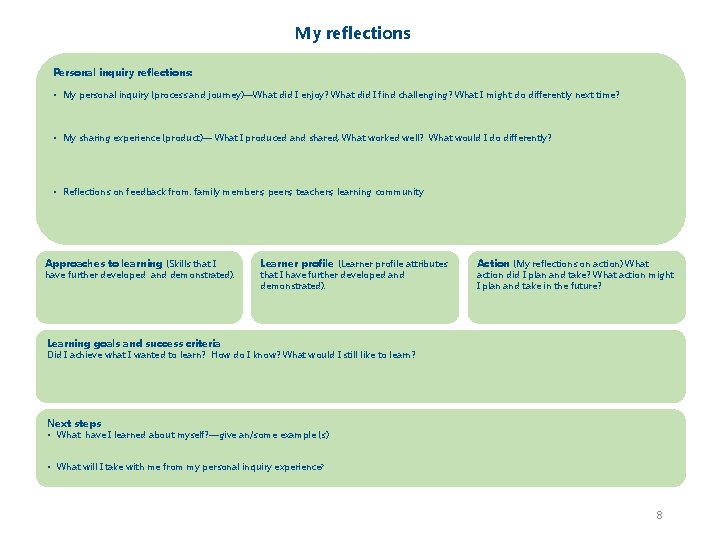
My reflections Personal inquiry reflections: • My personal inquiry (process and journey)—What did I enjoy? What did I find challenging? What I might do differently next time? • My sharing experience (product)— What I produced and shared; What worked well? What would I do differently? • Reflections on feedback from: family members, peers, teachers, learning community Approaches to learning (Skills that I have further developed and demonstrated). Learner profile (Learner profile attributes that I have further developed and demonstrated). Action (My reflections on action) What action did I plan and take? What action might I plan and take in the future? Learning goals and success criteria Did I achieve what I wanted to learn? How do I know? What would I still like to learn? Next steps • What have I learned about myself? —give an/some example (s) • What will I take with me from my personal inquiry experience? 8
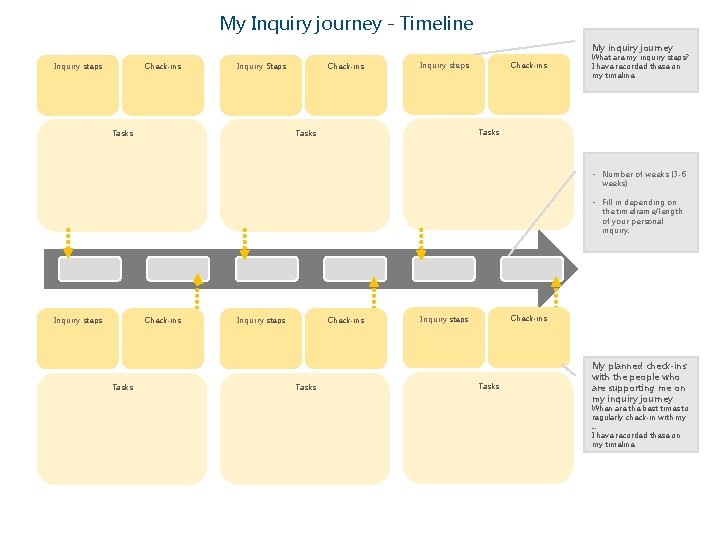
My Inquiry journey - Timeline My inquiry journey Inquiry steps Check-ins Inquiry Steps Check-ins Inquiry steps What are my inquiry steps? I have recorded these on my timeline Check-ins . Tasks • Number of weeks (3 -6 weeks) • Fill in depending on the timeframe/length of your personal inquiry. Inquiry steps Check-ins Tasks My planned check-ins with the people who are supporting me on my inquiry journey When are the best times to regularly check-in with my . . . I have recorded these on my timeline.